The Secret to Sales Success: It’s All About Relationships with Jon Ferrara
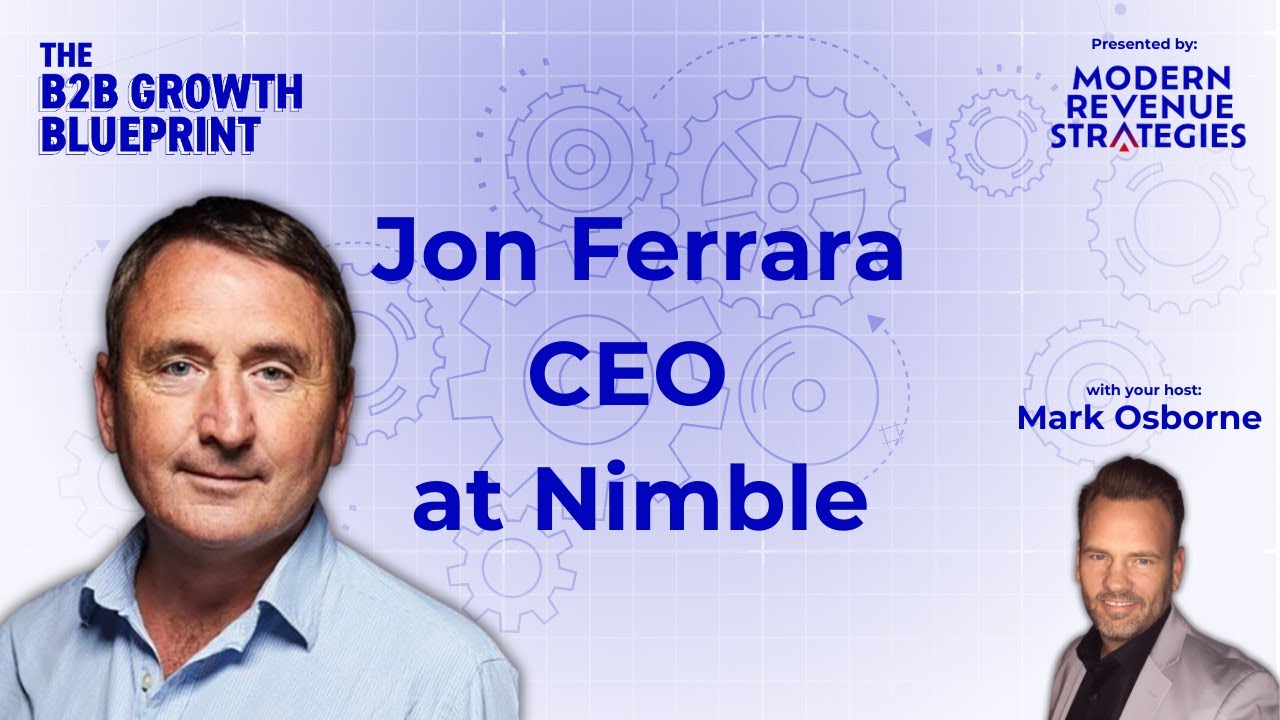
Jon Ferrara built GoldMine in the 1990s as the first integrated email and contact tool before Outlook existed, growing it to Fortune 500 customers through partnerships with Novell and Microsoft. He now runs Nimble, a cloud CRM that unifies contacts across Google, Microsoft 365, LinkedIn, and other networks, arguing that most CRMs are reporting tools, not relationship managers.
Chapters
Welcome to the B2B Growth Blueprint podcast, where we talk with entrepreneurs, founders, and leaders at B2B services, tech, and SaaS companies to learn the systems and processes they've used to create success for their business. We'll also learn from marketing and sales experts to provide insights to help you grow your business. I'm your host, Mark Osborne, and the podcast is brought to you by Modern Revenue strategies and their 10x ROI B2B growth guarantee. Schedule a free diagnostic call to learn the fastest path to double your B2B revenues in just 90 days. The Blueprint Podcast. I'm your host, Mark Osborne, and today I'm very excited to welcome my guest, John Ferrara. Now I'm gonna read John's bio to make sure I get it right. He's got an illustrious background and career. John is the founder and CEO of Nimble, Nimble is an award-winning CRM for both teams as well as individuals. Farrara is the best known as the co-founder of Goldmine Software Corporation, which was one of the early pioneers in Salesforce automation and customer relationship management software categories for small to medium-sized businesses. You might be familiar with them. Farrara has been recognized for pioneering innovation with honors such as the 1997 Ernst Young Entrepreneur of the Year. And his former company, Goldmine Software, ranked number 154 on the '97 Inc. 500, a national Fast 500 company, and swept the computer industry awards, including some highlights of being awarded back to back to back to back PC Magazine's Editor's Choice from '93 through 1997. So John was recognized by Forbes as one of the top 10 social CEOs. top 10 social salespeople in the world, and top 100 marketing influencers. He's also a graduate of Cal State Northridge. So, John, I'm super excited to welcome you to the show. Thanks so much for joining me.
Mark, I'm really excited to be here with you today. I, I, um, you know, listening to all that, it's, uh, it's, it's interesting to hear some of that. You know, the thing is, is that Nimble is current, but that Goldmine stuff you're talking about, it's like decades old, and I've been doing this relationship management thing for some time. And I think I'm doing it because I dig helping other people. And I, I think that's how we all grow on this planet is by helping other people grow. And so, thank you for inviting me for a conversation. Hopefully, we give people some really great takeaways where they could accelerate, uh, their life and blow some wind in their sails.
Yeah, for sure. Well, and just from our previous conversations, I know we've got some really interesting stuff to share. Before we dive in on some of those topics though, like, just kind of give us a little flavor of your story. Like, obviously you've, you've done a lot of things and, and seen a lot. Like you say, you've, you've got decades of experience. Tell us a little bit about what that, uh, path and progression looks like.
Well, if you could put yourself into a place to where there was no Outlook, there was no Salesforce, there was no term CRM or marketing automation. Um, we essentially had an email inbox app called Outlook Express and it just did email. And you manage your contacts and your to-dos and things on a thing called a Daytimer. It was a leather-based thing that you put in your pocket, paper management. And really, the world kind of ran on spreadsheets, and that was sophisticated because spreadsheets were new. And, uh, I was a computer science graduate from, as you said, Cal State Northridge. I worked my way through my degree in a Computerland store where I learned all the software programs on the market and how resellers sell technology to large corporations. And I knew that wasn't a program that integrated email, contact, and calendar and sales and marketing automation. I was working at a startup and they were basically telling me to go sell, and I was managing my contacts and stuff on paper, right?
Sure.
And, uh, and so I said, there's got to be a better way. I looked around and couldn't find it, and I quit my job and started Goldmine. Goldmine was the first program that integrated email, contact, calendar, and sales and marketing automation. It was Outlook before Outlook existed. In fact, We grew from that apartment to tens of millions of customers before Outlook ever existed. So, we were Outlook before it existed. And then, when Outlook kind of emulated what we were doing to become the contact manager for businesses, we evolved into the sales and marketing system for corporations. So, we essentially had 50 of the Fortune 500 companies using Goldmine as their CRM. And, um, and it was really fun. And the cool thing about it is we grew it without spending a dime on, on, on marketing. And so back then, we accessed our prospects through their trusted advisor, which was the Novell reseller. And we got the Novell reseller to use GoldMine, and then they started recommending and reselling it. And that's what got us to our first million dollars in sales. And then Microsoft wanted to enter the, um, the network operating system business and the server business. And we basically integrated to their first-party solution— NT Server, SQL Server, and Exchange Server— by integrating GoldMine. And when you help a large corporation sell their first-party solution, they'll push your third-party solution night and day.
Right.
And that's how we got to hundreds of millions of dollars in revenue. So, by using influencer marketing, the Novell reseller, and, uh, business, biz dev, Microsoft, We essentially, uh, pioneered contact management, um, CRM, and email marketing because back then we built the first, uh, automated processes that allowed you to put a name in the, in the database and automatically put 'em on a track and do nurture and drips.
Yeah.
And it was, it was a load of fun. I, I, I think the thing I learned most about that was the power of your team, right? That no entrepreneur does it by themselves. It's really, a testimony to the team around them. And my team wasn't just the employees, and I hate that term, the team at Goldmine, but it was the constituency around it. So, it was a relationship bidirectional with the resellers, the distributors, and even the press and the analysts and the influencers because it's more powerful when somebody else talks about you than when you talk about you. And we built pay-it-forward relationships with the press because they didn't know what CRM was and we helped them define it and to teach others about the category. In fact, John Tachik, who was the editor at PC Computing, is now head of strategy at Salesforce and has been so since the beginning of their time. And so we really helped create a whole industry through those pay-it-forward bidirectional relationships. And, um, and it really was a gold mine.
Yeah, I, I was actually an early customer, uh, at one point. Uh, I, I can still remember sort of the logo, uh, on the, on the software and, and using it and thinking like, what a powerful way to create sort of one-to-one relationships At scale and sort of to have that capability to have all that visibility. And so, so you had a lot of success with Goldmine. What prompted you to kind of get back into the game with Nimble?
Well, there's one thing I'm remiss in emphasizing. At the heart of Goldmine was contact management.
Okay.
What is contact management? Contact management is effectively you managing your contacts for you to achieve your purpose. Really. And, and that's who we built for, was that customer-facing business team member, whether they were individual sales rep or all the people on the front line. Not just the salespeople, but everyone in the company, because Goldmine was the contact system, the relationship manager for the whole company, not just the salespeople. And that root and foundation was why people loved it. You had to rip it out of people's dying hands, if you will.
Yeah.
So management wanted command and control, so they basically built Siebel as the enterprise CRM to kind of take over all these more workgroup and departmental ones. But they lost their way in CRM. CRM stands for customer relationship management. Outlook became the contact manager, the relationship manager for corporations. So CRMs became more of a reporting repository tool for management.
Yeah.
So sales reps today have to go out and buy all these tools like ZoomInfo, LinkedIn Sales Navigator, uh, Outreach or Salesloft, the SFA contact tools that they need to engage and then go feed the beast, the CRM, so they don't get in trouble with management. And so I sold Goldmine in '99 and, um, I spent 10 years being a present father, raising 3 babies and getting them into school. And, uh, it taught me more about the value of relationships and the power of a of a soft heart and expansive soul. Um, and it was amazing, but it also gave me time to swim in the social river as Twitter, Facebook, LinkedIn, Pinterest, Instagram, Foursquare, Google+, Crunchbase all started to emerge. And I saw the power of, uh, social, and I knew it was going to change the way we work, play, buy, and sell. And I looked for a solution that would enable me to integrate the contacts I was in, the relationships I was building in Twitter and LinkedIn, etc. And so, these platforms enabled you to outreach and connect to existing or prospective relationships. And I was building my brand and my network, but they were all disparate contacts in these platforms and all the conversations were out there. And I knew from my experience that I needed a centralized contact tool for myself. And so, I looked for something that would unify my Google Contacts because that was a cloud productivity system at the time. Microsoft did not have a cloud-based productivity system. and all these social contacts and networks. I couldn't find it. Then I started looking at contact management and saw it was broken because Google Contacts is a separate contact database for every team member. So, there's no single contact database for the company. And then CRM systems aren't about relationships, they're about command and control. The reason they call it Salesforce, you have to force salespeople to use it. And, um, and so, I knew there was an opportunity to reimagine a cloud-based CRM that would automagically build itself from the tool, the data you already have.
Wow.
So, every business has an email productivity system, Microsoft or Google, and I would basically build a system that would unify all those contacts, synchronize every email and calendar that every team member has ever had. So, there's a single source of record of relationships, and then unify in the Twitter, Facebook, LinkedIn contacts, and synchronize all the signals and history and all that. I got LinkedIn to give me the public and private APIs. Nobody's ever gotten that done. And so, I basically pioneered social selling and social CRM. Was Nimble and, um, and used influencers to scale the brand. So what I did is I identified the thought leaders of the, the promise of my product and services, thought leaders in social sales and marketing, and I built pay-it-forward relationships to, um, to, um, to facilitate a connection with that thought leader, get them to give me feedback on the journey I was building with Nimble try it where they then became owners of it. They basically had an investment in its future and they started using it. And people sell what they know and they know what they use. So, they started recommending it to all of their constituency. And that's how we got to 100,000 uniques per month in eyeballs without spending a dime on advertising. And then, the rug got pulled out from me. So, LinkedIn, wanted to sell you Sales Navigator. Facebook wanted you to go to Facebook in order to use it. And all the APIs that I built to pioneer social CRM and selling disappeared. So, I had to reimagine what was our promise and our purpose. About that time, Microsoft came in and they said that we want to basically launch cloud-based Microsoft 365. So, I knew that they would eat Google in the same way that Microsoft ate Novell. Because Microsoft doesn't innovate, they iterate. They wait for somebody else to build the market, then they come in with something good enough. They build something good enough, and then they use their muscle— billions of users and hundreds of thousands of hours— to eat the market. So, I basically built integrations with Microsoft 365, built relationships with the people, which gave me access to all their programs. And Microsoft then built a cloud-based distribution system where they became Nimble's reseller. So, Nimble— Microsoft pushes Nimble through all their distributors and resellers as the layer on top of Microsoft 365 that turns it into a simple CRM for those small businesses. Because Microsoft, even though they have Dynamics, only suits enterprises. It doesn't suit that space between Microsoft 365/Outlook and Dynamics. So, we're the bridge that enables Microsoft resellers to start selling business solutions on top of Microsoft 365. And grow the customers to where they might be able to start consuming Azure and Dynamics. We're doing the exact same thing that we did in GoldMine and building it by identifying the influencers. Back then it was Novell, today it's thought leaders in social sales and marketing, and then using biz dev to scale by going after the emerging gorilla in the marketplace, Microsoft, and helping them to sell their first-party solutions, Azure and Dynamics, by growing the Microsoft resellers who traditionally don't sell business solutions. They just sell infrastructure, plumbing, the highway, Microsoft 365, and backup and security. And so, that's kind of getting us close to where we are today. But one thing that's missing is one of the great things about Goldmine was the fact that we had automated marketing. And a lot of individual people send emails via their email service provider, and a lot of systems have templates and tracking that'll enable them to send them. And we had that with Nimble, but our customers, many of them want to send tens of thousands of newsletters or webinar invites or whatever. They want email marketing. And today, most of them go buy a separate system like Mailchimp or HubSpot or whatever. And then, there you have all these disparate systems. So, we're in the process of rolling out email marketing that enables you to have a unified system of sales and marketing and that core contact relationship system for your whole company and, um, do it in a way where it's not costly and complex— costly and complex. Because I don't know if you ever priced an email marketing system, but if you put 10,000 names in HubSpot, ActiveCampaign, or even Mailchimp, you're going to start spending anywhere from $2,000 to $10,000 a month In email marketing, and it shouldn't be that expensive. And so, with Nimble, a business gets a relationship-focused CRM for the whole company, plus the core sales and marketing features that you need to grow your business, but also the workflows and other things that the non-salespeople who want to engage at scale can use to manage the people, business processes, and you're not running on spreadsheets. I'll leave you with the fact.
Right.
There's 225 million global businesses, less than 1% use any CRM. That's amazing, isn't it?
Yeah.
Why? CRM is about for salespeople to pound prospects. They're not designed for the rest of the company to manage relationships. And the whole— your whole company has to manage relationships for it to achieve its dreams. Most salespeople represent about 5% of the company. So, the rest of the company, biz dev, HR, accounting, all those people are touching the constituents around your business and they're managing their processes with spreadsheets. With Nimble, the rest of them have the tools they need to scale and grow the business.
So, first off, thanks for sharing that story. And you just sort of casually dropped so much knowledge that it's obvious why you've been so successful because that was a masterclass in real sort of understanding the, you know, sort of forces that are driving a particular marketplace of looking at not only what your company's, you know, sort of capability is, which is kind of where many people stop, but then thinking about the context in which the company is operating in and recognizing that there's an opportunity to partner with large behemoth players like Microsoft to help grow a particular product. So that kind of partnership ecosystem is something that people so often overlook, but so valuable in B2B. And then thinking about sort of your comparative, you know, sort of benefits versus the other solutions that are out there. So it's definitely worth sort of calling out how insightful it is to take the time to think about that before you just kind of start go buy ads for whatever B2B SaaS or software solution you've got that you're working on. So I wanna call that out for our listeners and it's, it's so interesting to see the way you thought through that and, and brought that to market. I want to switch gears a little bit though, because you and I have chatted about this, and I think it's really important for our audience to think about as they think about the context in which, you know, we're all operating today. And there's a lot of research, and I consume a lot of research that shows that the volatility index, so essentially like how topsy-turvy things are in the world, whether it's, you know, from rapidly changing interest rates to you know, wars that exist within the, the, within the landscape to sort of brittle international infrastructure for sourcing, whether it's components or talent or whatever it might be. There's a lot of volatility out there. And that volatility actually sort of creates a bit of an environment of fear and trepidation. And one, and we as humans, the way that we get over that is through real human connection. And which is something that relationship management, you know, is, is really sort of designed to facilitate. And then the other trend that I see that you and I have chatted about is, you know, as generative AI makes it easy for solopreneurs to generate as much content as, you know, large marketing teams did, you know, 5 years ago, that's creating this sort of flood of kind of anonymous generic stuff that's out there. And so with the whole world being in a space of we want more human connection and there being this rising tide of just more and more generic stuff, real human connection and interaction becomes even more valuable and sort of stands out and cuts through the clutter even more. I think it's so interesting that the way that you've built Nimble Is to operate the way that humans operate when they build relationships. They—the goal isn't you know disjointed systems that well this one knows that you owe me money and this one knows what you care about and this one knows what our last email was. That's not the way humans build relationships. Human build relationships by knowing hey he owes me five bucks but he's always been good for it and let me let me text him see what he's up to this weekend if we can hang out. And so I love the. sort of mindset that you have with Nimble of bringing it all together?
Well, it's really about a singular system or record of relationships for your whole company, for the constituency around it. And if you, you know, my wife brought me out to her garden the other day and she showed me this monarch butterfly caterpillar. And I said, what is a monarch butterfly caterpillar doing in our yard? And she said, well, I plant milk thistle. to attract the monarch butterfly caterpillar, which eats the aphids, which makes it so I don't have to spray. And then I plant all these other flowers and other things that attract all these other plants and animals that create this self-sustaining garden around our home.
Uh-huh.
And I said to myself, what a great analogy. Isn't this what every business is trying to create is a self-sustaining ecosystem that enables them to sustain themselves and grow, right? And so, so many businesses just think about pounding customers till they buy or die. And, um, and, uh, they forget that sales is the beginning of a relationship.
Yeah.
It's not the end. And that sales, um, really happens as a result of an entire relationship environment between the constituency around you and the people in your business, but they have all these disparate systems in their business. So, every business has an email service provider, which means you have Microsoft or Google email, contact, and calendar. Every team member in your business has a separate contact database in Microsoft or Google, whichever you pick.
Mm-hmm.
And so, then they have an email marketing program that they use to capture leads and pound them. And they might throw that lead over the wall to the sales rep in the CRM, but the sales rep has no visibility into the marketing system. They don't have any idea of the journey that the customer has been on, so they have no real visibility. So they get this lead, they have to start all over, and they Google them.
Yeah.
And then they have to basically— they put— they write on the piece of paper about that person, and then they They might, uh, connect with them, and eventually, after they might have qualified with them, they put their, their info in the CRM. So the data goes in the CRM the night before the reports are run because it's not part of their daily process. It's basically the, the beast that they feed. And, um, and then the name's thrown over to the accounting program and you invoice them and you forget about them.
That's right.
Hello. So, I believe that there should be a single system of record relationships in your business that, uh, every constituent is in there because some people might be a prospect, a customer, an influencer, or a vendor, or, or an editor, writer, or all of the above.
Right.
And so, you want to have that consistency of the relationship That includes who did it, what happened, who did it, what's gonna happen, who's gonna do it. So that when you pick up the phone, you're like American Express, right? They, they know who you are. They know what happened. Nobody wants to repeat themselves.
That's right.
And, and so by having that singular system of record of relationship that ideally potentially has an integrated sales and marketing solution, including the marketing automation stuff that the marketing people want, But also the sales enablement stuff that the salespeople need. And I'm gonna give you a brief example. Let's say that you do a blast out to your— to an audience, right? And the whole idea of a blast is to get them to engage, right? But to blast, uh, 10,000 people or 1,000 people or even 500, you're gonna need a marketing email marketing system. So, or a marketing system that has email and text and chat and whatever, but a marketing system. So you blast them, but the whole point of blasting is to get people to respond. Okay, so then they respond, and in an email marketing system, you throw the lead over to the sales rep, and then there's just this blank lead where you have no history and stuff. With a system like Nimble, where that— what you do is you blast with the marketing system, and then when they respond, you put them in a workflow where the sales rep is notified and they can engage using their personal email.
Right.
And then they're engaging, and they can even put them on a personal sequence where they're engaging with that person to drive the phone call and the conversation. And then after the sale, when you invoice them, there's a webhook that goes back to Nimble that sends an email that says, hey, thank you so much, Mark, for your order. Tell us about your journey. How can we improve? And if our services were beneficial for you, please click this link and do a review for us. And if you have any friends, here's a coupon of 25% off their first order if you want to spread the gospel for us. Thank you very much. Right? And so, what you got is a single system of record that makes it easy for you to see the complete view and tie into your other systems that may be there because we're never going to do the back office, the accounting. But so, I think that the world has changed. We've become more inhuman, more digital. It's so easy to just blast people. But I think the more digital we get, the more human we need to be.
Yeah.
And I did these experiments when I was, when I was a young marketer, and I've tried sending out perfect, uh, emails that are printed on a laser printer. And I've also printed out like ones that look like they're written on a typewriter with yellow highlight. Guess which pulls better?
Of course, the one that feels more authentic.
Right, right. And so I believe in the power of relationships. And I believe in, in that contact management is the center of every single business. And I think we've forgotten about that. And I think that, um, businesses need to rethink how they're treating their constituency. They first need a holistic approach to their entire audience around them, and they need to stop talking about themselves and their products. Nobody cares.
That's right.
Nobody wants to hear how great you are. They wanna hear how great they are. They can become. So, I tell people, teach people how they could be great and they'll see you as a trusted advisor and they'll pick up the phone and call you and drag their friends with them. And so, I think that we just need to shift our mindsets a little bit. And I think that it's required in today's over-digitized world. What do you think?
Yeah, for sure. Well, and what you Set up this really interesting sort of juxtapositioning of, you know, Salesforce. You have to force the salespeople to use it, which really, as you say, exists as a reporting infrastructure. It doesn't actually facilitate developing a relationship.
Yeah.
It's just capturing data that can be used for reports versus a relationship management system that allows you to deepen your understanding of who that customer is. From a real sort of holistic context so that you can know, well, you know, they've attended a few of our webinars in the past, and we actually have had some conversations with them, but they were never ready to, you know, purchase our thing because they were waiting on this funding event or whatever it might be. That type of knowledge is so much more valuable and actually facilitates a relationship Rather than just, well, we captured their name and email address within Salesforce so that we, you know, we can say we had one more lead that attended the webinar. And that's really the objective versus actually building relationship. And it really just comes down to what's your goal. And so many organizations, their real goal is to build relationships, but they use software that's designed for reporting and not that's designed for building those relationships.
And, and the thing is, is that, um, the biggest cause of failure of CRMs is lack of use. Yeah, that's right. And the second is bad data, because even if you beat people to type data in, the data decays like fish. And so why don't people use a CRM if it's the number one cause of failure? It's because it's not designed for them and relationships and engaging. It's designed for recording and management and reporting. So, we all resort back to spreadsheets. And so, I think what we need to do is we need to think about those customer-facing business team members and not just the salespeople.
Yeah.
Because it's not just salespeople that sell or support or deliver or hire new people or do the biz dev or the PR or the investor relationships or the, you know, all the different things that you do in your business. I think that by having a focus on the entire constituency around them, I think that that will change how people look at their contact database. And, um, and I think that the, the whole idea of it just being a, a sales database for prospects and for salespeople to pound them, um, and then it's not even good enough for the salespeople. So the salespeople have to go out and buy LinkedIn Sales Navigator, $150 a month, ZoomInfo to enrich leads, $100 a month, and LinkedIn and, um, and, and outreach with templated email tracking, $150, $200 a month. And then these systems don't talk to each other, let alone the marketing system. And so you have to hire a sales administrator to actually run this stuff. And so I believe That there should be something out there that's affordable as a system-wide contact tool for the whole company, not something that you blink your eye and you got to go from $29 to $79 because we want to add security for contact records. So, oh, we're going to bump everybody to that, where the reality is, yeah, for salespeople, I'll spend $100 a month maybe on a combined set of tools, but for the admin and support and all these people that need to be part of the conversation, That's a lot of freaking money. And then you add on top of that the cost of, of, of an email marketing system and all the other tools. So I think there should be a singular system with a singular seat price that makes it really easy to do the basic sales and marketing stuff that every business needs to do, but also facilitates the non-sales things. Because if I'm in HR and I'm hiring people, I want a process around that. If I'm in biz dev and I'm outreaching, I want a process around that. If I am PR and I'm outreaching, Right. Or investor, I'm getting people to invest in us. That's all spreadsheet process stuff, and it doesn't work in a CRM because CRMs are all about dollars and deals.
Right.
But guess what? Most relationships aren't about dollars and deals. It's about agreeing to some commitment of some business thing and then doing that business thing, which isn't really a direct dollar. So, I just think that today's CRMs are built for sales. So, if you Google CRM, you're gonna see Pipedrive sales CRM, Salesforce the sales CRM. Guess what? Business isn't about sales, it's about service.
Yeah, and relationships. As you say, it's designed to be that relationship manager. So you paint a really compelling picture of, you know, differentiating Nimble, which is sort of this infrastructure for relationships versus other sort of CRMs, which are essentially sales tools, and very compelling. For our audience that's listening and they're like, yeah, that's really what I'm trying to achieve is to build relationships with my customers, not just to sell them one thing and then, you know, have all that knowledge disappear. So for folks that this is resonating for, how do they get in touch? How should they engage with you and Nimble?
Well, Google me, Google Nimble. In fact, Google yourself because most people don't show up on the first page, let alone the third.
Sure.
And you should do something about that because people are going to Google you when they go to meet with you. And so, I'll give you a tip. Build a Wikipedia page for yourself and your company. It'll show up on a Google search right there and you can control the information. Just follow the rules, cite all your stuff, or else the little bots of Wikipedia will eat you or eat your text. So, if you want to get a hold of me, My email's john@nimble.com. I'm easy, but Google me and find the channel that's most effective for you to connect and communicate. I want to hear from you about what are the challenges you're facing to achieve your dreams. And, um, I'd love to help you, uh, by figuring out a way I could blow wind in your sails. As far as Nimble, it's nimble.com. We have a free 2-week trial. You can go sign up and, and check it out. Um, if you dig what we're doing and want to sign up, I'll give you 25% off your first 3 months. That's John25 is the code that you put in. But think about this. Whoever's listening to this today, you're not going to work where you work the rest of your life, probably not longer than the next 3 years or 1. Everybody should have their own golden Rolodex. If you don't know what a Rolodex is, Google it. The thing we used to put business cards in.
Yeah.
Everybody should have their own personal CRM. Every connection you make on a regular basis that you feel might be valuable in your future, put it in your personal CRM. Nimble makes it easy. You could just grab the data that's on the screen through our Prospector, uh, plugin in your browser and, um, and maintain that because you're going to be hired on your next job based off your brand and your network. Your network is your net worth, and you should be maintaining that.
Yeah.
I'll give you a challenge. Let's say you're going to have an event that you want to invite certain friends to, Christmas card list, whatever it is. It's hard, isn't it? Because you don't have a contact database.
Right.
Oh, I know because I've sold tens of millions of these things to people. So, if you listen to this today and this is resonating with you, go check out Nimble, go watch our videos, connect with me personally. Let me know how we can help you achieve your dreams in life. Because as the great Zig Ziglar said, the more people you help grow, the more you'll, you'll grow. And what I've synthesized out of that is my purpose in life is to grow my soul in the brief period of time that I'm here. And the best way I'm determined to grow my soul is by helping other people grow theirs. And if that resonates with you, Come join the Nimble Way.
Awesome, John. That's such an inspiring vision and such a great place to leave off. Thank you so much for joining us today. You've shared so much wisdom about your business strategy as well as a really inspiring vision for, you know, what companies can achieve through building relationships instead of just building contact databases. So, thank you so much for joining us.
You bet, Marc. It was a real pleasure. I hope there was some good takeaways. I know that I dumped a lot of stuff. fast. And a lot of it is very strategic business processes around scaling without advertising. And, um, and I, uh, I encourage you to go back and listen to that slowly because there's a lot of meat in them bones.
Absolutely, absolutely. Thank you so much, John.
Thank you, Mark.
Thank you for joining this episode of the B2B Growth Blueprint podcast. We hope you've gained insights to grow your business. If you enjoyed this discussion, please rate, comment, like on your favorite platform, and share to others who will find it useful. Do you know a CEO, founder, or leader at an early-stage B2B services, tech, or SaaS company who would like to be a guest and share their story? Send us a note. Let's schedule a conversation. Thank you, Mark.
More from Mark

How Can You Maximize Your Business Value Before Selling? with Randy Katz Video







