Transformative Salesforce Projects, Marketing Cloud Success, with Marty and MJ Davis of Digital Mass
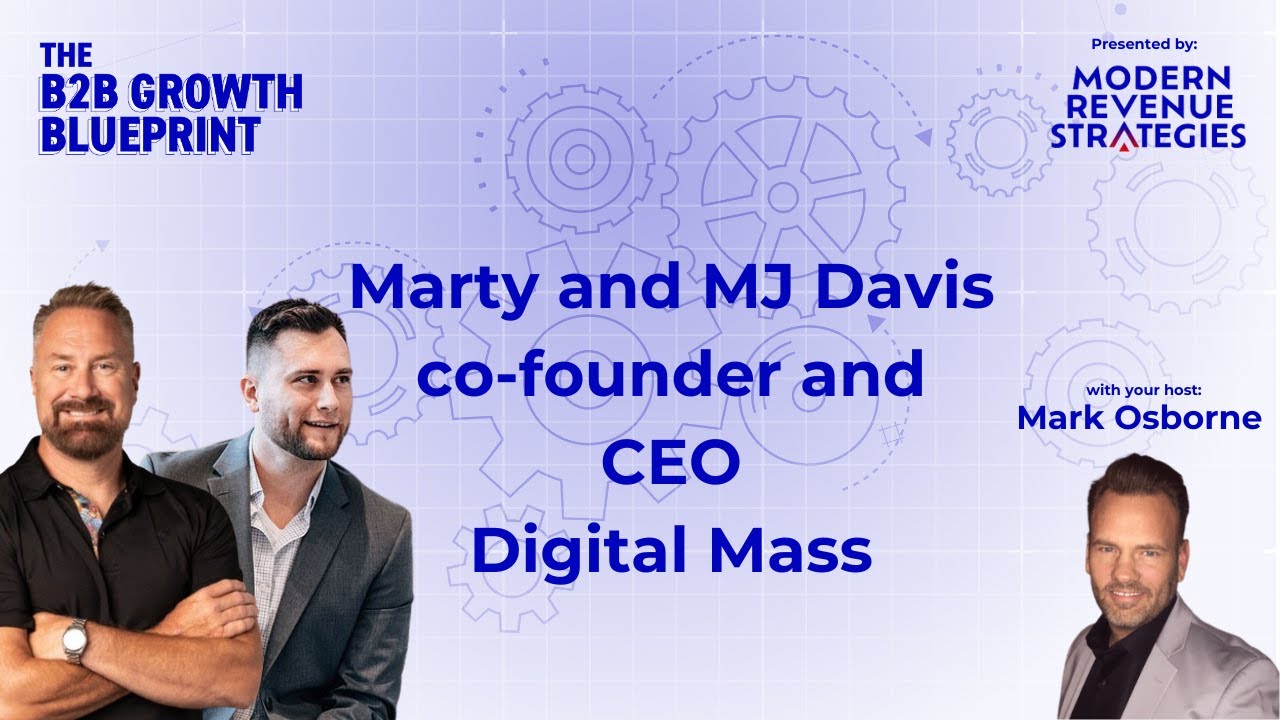
Marty and MJ Davis run DigitalMass, a Salesforce consulting firm in Minneapolis that grew revenue 81% in two years, mostly organic. They embed teams with clients on long-term projects and just launched Lead Calculus, a tool that turns web engagement data into a single lead-scoring metric.
Chapters
Welcome to the B2B Growth Blueprint podcast, where we talk with entrepreneurs, founders, and leaders at B2B services, tech, and SaaS companies to learn the systems and processes they've used to create success for their business. We'll also learn from marketing and sales experts to provide insights to help you grow your business. I'm your host, Mark Osborne, and the podcast is brought to you by Modern Revenue strategies and their 10x ROI B2B growth guarantee. Schedule a free diagnostic call to learn the fastest path to double your B2B revenues in just 90 days. Hello and welcome to another episode of the B2B Growth Blueprint Podcast. I'm your host, Mark Osborne, and today is a first for me. Uh, it's a first in a couple different ways. For, uh, for starters, I have two guests on at the same time, and then secondarily, they both have the same name. So we've we've we've come up with some code words to to keep things clear. I'm I'm blessed to be welcoming both Martin Davis the fourth and Martin Davis the fifth. But Marty goes by Marty, and MJ goes by MJ. They are with Digital Mass. Now I'm going to read their bio so I can get this. Straight. Digital Mass is a Minneapolis-based Salesforce consulting firm. They were named one of the best places to work in the Twin Cities in 2022, and the company has experienced 81% growth over the last 2 years. So we're definitely going to get in, uh, and talk to them about how they've, uh, achieved that success. So Marty, co-founder and CEO, he's been named as a high achiever and leader by the Minneapolis-St. Paul Business Journal's 40 Under 40. Received a Financial Commerce Progress Award. In early 2004, he recognized the crucial role of technology in delivering user experience through design. So he built Ratchet, which was a technical agency for other agencies. Ratchet was named one of Inc. magazine's fastest-growing companies in 2008, and he successfully sold that in 2013. MJ, at just 30 years old, is co-founder and chief technical officer of, at DigitalMass. And there he leads large-scale digital transformation projects with enterprise businesses, IT teams at Minnesota's largest and most recognized companies in financial services, healthcare, consumer goods, construction sectors. He leads their expansion into new service offerings, including the company's Marketing Cloud consulting team that was founded in 2020, and it's the fastest-growing department. We're going to talk about some of the new things they have coming out. As their clients really seen a lot of tremendous value in working with those teams. So Marty, MJ, welcome to the show.
Thanks for having us.
Thank you.
Yeah, I'm excited to unpack some of these things, and we had a great little conversation prior to this. But tell our audience, what does DigitalMaaS really do?
Yeah, so I mean, we're Salesforce partners, right? So we plug in. And implement Salesforce for clients. And then a lot of times we're doing improvements over time. So, you know, a couple different models, project-based, well as embedded teams. So we'll put in our folks and sit in chairs alongside full-time employees.
And so that makes us really sticky. And in terms of the different kinds of clouds or things that we're active in, is we kind of have things organized in terms of our core and in terms of our Marketing Cloud kind of practice teams. That means, means for us Sales Cloud, Service Cloud, Experience Cloud, MuleSoft, and the marketing side of the house, that'll be Marketing Cloud proper, Pardot or Marketing Cloud Account Engagement, right, Personalization and Marketing Cloud Intelligence. That's kind of our footprint and what we do, where we're active with our customers.
Good stuff. So I read this earlier on the, on the bio, and it's sort of an eye-popping stat. 81% growth over the last 2 years. What do you attribute that to? How do you, how did you sort of accomplish that? What's that? What's your secret to success there?
Yeah, the secret is kind of no secret, right? It's delivering quality work. You can't build that growth without having sustainable long-term clients that keep coming back. You know, that's a big part of it. And then it's, you know, it's our marketing efforts and it's a great account executive team, you know, reaching out, spreading the word. It's— for whatever reason, our story resonates the way we— once if we get that lead in, we get a meeting with a client and we tell them how we do work, why we do work. And what we can do for them, it's usually a win, you know, more than, you know, probably 60-70%. And then the trick is doing great work and staying plugged in.
Oh, I'm sorry.
Just, I guess, one other thing that, you know, we do really well is we really get to know their business. It's important You know, there's senior team members that come in and really dissect, you know, what they need and why it's a good fit. And that's one of our core values. We call it fiduciary responsibility, even though we're not fiduciaries, we treat it that way.
I mean, to underscore that, and what I really want to say is when you're saying like there is no secret, it's just, it's things that are known, but it's about the discipline and maybe there's parts of us, like, we are applying modern technologies in our modern development practices, but the way that we approach problems and the way that we approach our teams and the way that we approach business, I think, is remarkably old school. And in some ways that are kind of interesting, right? Like, throughout the pandemic, I mean, something that was really important to us while we were growing during a critical time, and we were an agency as a consulting group that grew in a very difficult business environment, And one of the things that really made a difference is while respecting appropriate safety protocols when people were exposed, is that we're in the office. We're just better being able to collaborate together, to crunch hard problems, to break out a whiteboard, write things down. And so I think it's been that in addition to Marty's expertise and his mindset and understanding there's been some specific milestones, particularly when he had created Ratchet and successfully sold it. But we understood that there's a couple of key inflection points that we needed to change socially to continue to drive and stay sticky, stay connected and provide value for our customers.
Interesting. So we do work with, you know, companies like yourself helping them achieve growth. And when we sort of tackle it, we typically sort of look at 3 different areas. Oftentimes growth comes from either attracting more of the right prospects Or doing a better job of accelerating those best opportunities through the sales pipeline so they don't fall out. Or then the final piece is we call activation systems, like activating your existing clients for faster renewals, larger upsells, more referrals. I'm curious, within that 81% growth, how much of that came from, you know, growing organic growth with your existing clients or getting referrals from those clients because you're doing good work? And how much of it came from doing a good job of being out in the market and attracting more of the right prospects?
I'd say it's about 70% organic growth.
Yeah.
You know, it's getting that footprint, it's expanding and really seeing, knowing their business.
Yeah.
Really able to see how we could impact their business. So we're in there and we're making recommendations for you know, the next phase. It might be things they haven't even thought about, and some of these are pretty long tail, right?
Right.
So you're going through a corporate cycle, budget cycle, you need to be talking about them, about these projects in June, July, so that they can start their CapEx and start to get their justifications, the ROIs, and that's for 2025. So that's a lot of what I do, you know, plugged in with with certain clients. And then it's, yeah, it's really targeting that other 30% is really going after the accounts that we've identified as, you know, ripe for opportunity.
Yeah.
It's in our, you know, our industry's vertical and, you know, we might have connections. So we really do that account-based targeted, hey, who do we know? Oh, let's start to have a conversation. And, and it, you know, all of these things take a long time to come in. So it's like this giant flywheel that's, you know, you just keep rolling, keep feeding, keep going. And it's just steadily steady growth.
And sometimes it only takes like a small win like that, that really long kind of long-term sales cycle. If it's over a year and a half or 6 months, I mean, 6 months is like a shorter sales cycle. And sometimes I think that starts with a small win. Hey, can you right-size this particular element of data? Hey, can you implement this one particular module inside of one of those technologies? It starts as a small project that's scoped and bounded, and then we're allowed to demonstrate value, bring our business acumen, and then kind of plant flags around, hey, now that this capability is in place, have you thought about this? Have you thought about that? And to really underscore and really talk about, or not to really just continue to use the word underscore in order to go off of your— I mean, the important, the real big important about it is like our group of our customers tend to be skewed mid-sized enterprises.
Uh-huh.
And they tend to be focused inside of financial services or health and life sciences. It just happens to be. And once we kind of really brought our discipline and kind of our chops and our rating that we have the ability to handle sensitive data, that we have the practices, we have the procedures, we know how to configure these tools to do that. That really has been the license to become increasingly active inside of those sectors.
That's right.
What is crazy important about that is that type of account manager engagement. When Marty was talking about that, he, he's, he's telling us about what he's really sitting alongside the customer and understanding that they have their own objectives. And he's trying to work within their process, where if they need to go and ask and get budget allocated to make a digital transformation, to make a push in order to do something, 6, 7, 8 months ahead of time, he's working with them in order to build that business use, that, that business case, right? What's going to be there from a software architecture in order to unlock additional capabilities? So it's boots on the ground in delivery and then it's boots on the ground in terms of account management.
And, and you'll never guess what platform we use to drive account management.
Is it Salesforce? It is.
We eat our own dog food. I mean, you know, that's a big part of it. And we have our systems are built in. So we're making sure our other account executives are doing those checkpoints, you know, our monthly one-on-ones. So it's, you know, one thing to You know, I'm still working in the business, but it's, you know, it's our working on the business, providing those systems for our employees. That's how we scale. That's how we expand. Because, I mean, we're going to top out, you know, probably would have topped out at, you know, 25 people if it was all just, you know, on us and us doing it. So that's a big part of it.
Yeah, it's so funny and so refreshing to hear you say that, talking about systems. We have a phrase around here that, you know, Systems set you free. And it's really the companies that kind of struggle to either implement a system or then to follow the system that they've implemented, which a lot of them, they'll write it down on paper, but they don't stick to it. And it's really clear that you guys believe in and actually, you know, sort of follow the systemic approach because you don't get that 70% organic growth Unless you have a system for asking for renewals and upsells and referrals and all those things. And also, you know, Marty or MJ, you were talking about how you'll come in and do sort of one discrete project as a way of sort of, you know, getting your foot in the door and then building the business to, you know, sort of grow up the size of the account. I've seen many businesses in your space. They don't do that effectively. And so 2 things happen. One, they wind up doing free projects for people that are, you know, underwater and unprofitable. And so they can never sort of get ahead of the sort of economics of it. Or 2, they don't have a system for turning that small project into a larger project that's going to be a 7-year engagement. And so when you have both of those things together, it creates You know, it, there, what's the role? There's, there's no small parts, just small actors. It's sort of like, you know, these aren't small projects because they're door openers. They lead to really big things, but you're obviously doing them in really smart ways that is allowing you to, you know, not do free work for folks, but instead to do work that's gonna lead to more work. And so that's really smart.
Yeah, we, and we have a, we have a role You know, our solution manager role is really, you know, there's, there's, they kind of wear a few hats, but a big one is, you know, account management. You know, they're plugged in, they're the ones like really understanding the business, but we also want them billable and active. So they're, they're our project managers as well using agile, right? So we're all agile, we're all time and materials. That's a, that's a key thing for for those free, you know, free project scenarios.
Right.
You know, you have to do a good job of estimating, but then it's also the journey through agile to get there with an eye on the prize of the budget, but also the eye on the prize of the features. And it's that constant communication with the client and understanding scope. And one of the tricks we use for that is we invite them in. So they're, they're the clients, the product owner. They're in our Jira board. They're seeing the work. They're seeing what's getting done. They're seeing the estimates. They're seeing things produced every 2 weeks. And so it's, it's understated and maybe not as well understood, but that's really the key to winning the clients over is letting them see how it's getting made. You know, they see what's getting produced. So they understand when it's like, oh, you walked in and we're connecting with this third-party system and it's way hairier than any of us knew, right? Like, it's the, okay, well, hey, are we going— are we gonna scale down MVP? Are we gonna add budget? I mean, it's, uh, everybody sees the cards on the table so that it's not as challenging of a conversation.
Yeah, that transparency really breeds that sort of sensation of partnership so that you feel like you're building it together with your clients instead of it being this sort of adversarial of they make demands on you and then you jump and say, you ask how high. And instead, it's you're sort of co-creating and really creating a much more collaborative environment, which is obviously really working.
For sure.
And there's an element like there's a certain amount of risk and there's a serious amount of trepidation in feeling that we must put our best foot forward.
Mm-hmm.
Solutions and all of the designs. And as we understood, the specification of an external system is one way, and then suddenly it's different. There's the, there's the emotional valence that you feel like you're about to get a lot of egg on your face. That is a serious opportunity to show wisdom and experience and transparency. In providing a thoughtful response to that. Like, nobody knew it was like that. And to provide that in a collaborative way builds a lot more trust. And it's not this, this, this slapstick comedy moment where you're running into a wall. It's just, no, it is different. And this is what we're doing about it. There's a lot that turns something that could be such a terrible and negative and fraught and emotional conversation to No, it's just different.
That's right.
Do about it. There are options A, B, and C with these different trade-offs. They have different budget, they have different feature, and they have different timeline considerations. Our recommendation is 2, based off of what we understood. Is that what you'd still like to do? Yes? Okay, we'll do it. No, it's 1? Great, let's fit it into the project, let's estimate it, and this is how the project timeline is going to change.
Yeah, there's an old phrase that I think about all the time, which is clients will like you for how you win, but they'll love you for how you lose. And so, like, when everything's going great, it's pretty easy to have a happy client and things to go well. But when, you know, you find out that something's a lot hairier than you expected it to be, or it's a lot more complex than anyone thought, Lots of different ways you can respond to that. And if you do it in the right way, like you described, where you keep your composure, you lay out what happened, and that it's no one's fault, it just is the way that it is. And you have enough sort of insight to make a recommendation on how to overcome it and then to chart a path for the client and sort of empathize with them. We wish it was simpler, but it's not. And so here's a good way to solve it. Like, that really builds that rapport and trust that the clients are looking for so they can collaborate with you and so they can partner with you for the long term.
For sure. For sure.
I mean, sometimes it can be from different internal alignments or there's a concurrent initiative that just changes the game, right? There's not— it's the Japanese style, right? Like, just the pot is broken. It's not so-and-so broke the the pot. These are just the conditions, and these are the things that we have to do. And really, just to state that it's about the way that you approach that situation and providing a constructive path forward really demonstrates a lot of value and turns those small projects that we were talking about before into something that's bigger. And it is still a balance. I mean, it's still things that we have to think about when we're engaging with our customers, right? I mean, there's, there's a number of different analogies to think about it. You can be Captain Ahab and go after your white whale. The real sin is, is that if you don't land that big deal, you spent all that time on it.
That's right.
Problem is if you're plinking squirrels and you're chasing after small engagements, I mean, you're, you're gonna get a death by a thousand different cuts, right? You have to figure out how you wanna scope these things in order to do that. What you wanna be is you wanna be a deer hunter. You wanna understand what your customers are. You wanna focus on that. And I don't know if your audience, I don't know if I'm gonna go like way too Midwest in that. The whitetail or— But the, but the other part that Marty really talked about that's important, where when we're looking at those smaller engagements in our kind of land and expand strategy, that the construction of the deal that we have is really important. We are agile and we are time and materials, which allows us to accept changes, but then also have the framework to say, now we can do something different. And it's not this Always a fraught conversation about change orders, and we have to go revisit scope, right? Adaptable for customer needs and having the coverage in the framework in our agreements in order to accommodate that change reasonably.
Yeah, you have to be agile to work with agencies.
Yes.
Yeah, absolutely.
Because I mean, they deal with so much sort of ambiguity and change that they have— you have to by definition. And it's also really interesting you talked about You know, not hunting for squirrels and not chasing the white whale. Clearly, you guys have done a good job of really thinking through like, what does our ideal customer look like? And then one of the things that we see so often with companies is when you don't really have that robust ideal customer profile, you don't really understand who the buyers are and the personas of different influencers, the technical influencers and the actual decision maker and All those things, then it's hard for you to recognize: Is this a good deal or not? Because you don't have a standard against which to hold it. And so then you wind up doing projects that never turn into anything else because you didn't know that that was the type of company that could turn into something else, or it wasn't the type of company that could turn into something else. So you did the project just because you wanted the work, but you wind up doing all these little projects that don't. don't graduate because you haven't thought through, is this really the type of company that we need to be working with? Does this really align with our ideal customer profile? So again, that it's sort of the, these foundational principles that are really paying off in your business. So that's great to see.
It is. And in our approach and the way that we got into it, it's not like we drew on a whiteboard that we knew that a company has to have this amount of headcount and have these different kinds of things. Like we didn't draft it and take it from the ether and so it is. And now we have a checklist every single time we deal with a, you know, we approach a new deal. We did walk backwards into this and we did walk into it organically.
Yeah.
And really like in the beginning, some of the things that were critical to us is what products are we active in? What is our expertise? Because that allows us to sort, hey, we have a couple of different deals. There's people that we know, there's a some different referrals? Where do we want to be active? Where are we good? And where do we want to go? Because some of the things that we are very good at in what my team and what my role is, is breaking open new doors and new product offerings that we can get skilled up in and offer. So that's a big part of my job is kind of what's the next frontier of the different things that we're working on. There's a couple of different times where we've taken deals that we were comfortable, but we knew it was a reach. And that's exactly the sweet spot that you want to be at, where it sounds achievable, you're high confidence that you can do it, but you know it's going to push you outside of your comfort zone. If it's something that you've heard of about, it's okay to leave it, and it's okay to sometimes say no and to come back to it. And when we work on these different deals and we're looking at something that might look squirrel-ish and we're not sure if it has antlers yet, To have the framework to say, it's okay, we know we can take this deal because we know how this is— we are very happy and our customer is going to be happy when we have accomplished the mission.
Right.
That they have what they need. And then this is a good project for us. And a big part of that was kind of our implementation of our resource planning software. That was something that was really important to us to understand our pipeline. changing over from a spreadsheet from the Ratchet days, from the old 2013 color-coded spreadsheet to turn into something that's modern and is connected to Salesforce was huge for us to plan that. But like, we meticulously groomed that spreadsheet in order to keep track of where our associates, where we're going to be active, and then make calls in that to, to meet with our account managers, to meet with our solution managers to say, well, does this have antlers?
Right.
And if it doesn't, that's actually okay. We just know it's going to end. We want to put a bow on it. We can come back and revisit maybe when there's budget, when there's another initiative next year. If it's a smaller company, that's okay. They have those different kinds of constraints. Let's stay engaged. Let's keep things friendly. Let's continue to provide value. But if we don't have budget, that's all right. Let's look at the next deal that we need to look at, how we're going to sort people and bring in things from the pipeline. So it's also a comfortability in looking at something that's squirrelish because we know what we need to do to not get stuck there.
Right. That's right.
The, yeah, a good example is we, we had an opportunity come from an agency and it was writing an AI engine for an old like Oregon Trail type, type game, right?
Okay.
Really high profile. We want to get into the AI. but it's not in Salesforce.
Right.
And it made us question like, oh, do we want to do, you know, but we turned it down. Like, you have to focus, right? And then one more point on that targeted customer. Like, it's a size thing, but also a key ingredient is somebody, it's usually a director level, somebody that owns some initiative and they want to drive change, like need to have a motivated client, you know, to come in and like they want to make a splash. Maybe they're the new CMO, maybe they're, you know, just got, you know, put in charge of the Salesforce org. That's when my eyes light up, is somebody who really wants to do something is a key client and a great partner, and that's key to a long relationship.
So smart of you to have that sort of qualitative layer to your identification of like who a real ideal customer is because so few or so few companies just kind of miss that piece of it. They're like, well, it's this size and it's in this industry and that's who we work with. But they don't have that sort of qualitative piece of and they want this change to come out of it. They want to you know, sort of make a name for themselves. You being able to identify that your best clients look like that is really smart of you. So I know that you talked about some of the new innovation that you have been working on, and I think you've got some stuff coming out. So talk to us about some of the stuff that's on the horizon for you.
On the horizon for us, I mean, some of the things that we're personally excited about, there's really 2 big milestones that's coming up. We're changing over into a bigger space here in August. We're moving over We're excited about that to really grow our actual physical footprint. And then in addition to changing our physical footprint is changing our offering footprint.
Okay.
So it's a very interesting balance as we are launching really one of the first installations of our product inside of Salesforce, which is called Lead Calculus. And Lead Calculus in terms is to augment that type of qualitative analysis that quant— the qualitative analysis that we were kind of talking about, and then to bring in the quantitative analysis that you can get from digital marketing properties.
Interesting.
Package that has a footprint in both Marketing Cloud and in core Sales Cloud that can connect to a large number of different web properties. think of a marketing site or think of On24 for different webinars, or think of different landing pages or microsites, Unbounce, in order to federate those different kinds of digital engagement into one single metric. Wow. So we're super excited about it. Um, we did a, we did a little bit of an unveiling and a little bit of a demo jam at the local conference here. Um, and we likely will be talking a little bit more about it, um, in, in a couple of weeks here at Midwest Dreamin'. to show some hands-on, but it's been something that's been really interesting that we're excited to offer to our customers is this new way to keep track of digital engagement for organizations that have many, many, many different web properties in order to consolidate that into a single quantitative metric.
And we've made, you know, we've implemented things like this, it's expensive. You know, there's a lot of hooks and, you know, things that need to wire in. So, you know, Lead Calculus is really that engine that we can drop in that gets them 80% of the way there. And it's, you know, that's how we sell it is it's really a price point and like, hey, you want this closed loop, you want to be able to track your lead scoring from all these third-party apps and you all want to flow into the sales process, however that's, you know, set up in Sales Cloud. And this just gets them most of the way there. It's pretty slick.
That's exciting. Very cool. Well, you guys have shared a lot with our audience today. We could probably talk all day, but I don't— I want to be sort of mindful of your time. You've shared a lot about sort of your own entrepreneurial and business journey and the the things that have led to success for DigitalMass. But some of our audience might actually be in the market for Salesforce consulting. Why don't you give us a pitch? Tell us why they should work with DigitalMass.
Yeah, I mean, I think if you listen through to here, you kind of heard our secret, right? Like, we plug in. We get to know your business or your nonprofit. We work with a lot of nonprofits as well and really can build you out a roadmap sized to your budget. And hey, we can get there in 1 year, we can get there in 3 years, we can get that, you know, make some quick moves in 3 months. But we're gonna be doing it and be transparent about it, give you the pros and cons of each approach and do good work. I mean, it's, It's, it's, it's as, as easy as that.
Well, easier said than done. Obviously, lots of other businesses struggle to, to achieve what you guys have. So certainly congratulations are in order. How do people get in touch with you?
Yeah, it's, you know, our website, digitalmass.com. Otherwise, you know, our phone number, 612-386-6332. And hello@digitalmass.com for, you know, picking up any inbound leads. Be happy to talk to anyone about their company and their projects and how Salesforce can help.
Awesome. Well, Marty, MJ, thank you so much for being on the show with us today. I really enjoyed our conversation. I know our audience got a lot out of it. Thank you for joining this episode of the B2B Growth Blueprint podcast. We hope you've gained insights to grow your business. If you enjoyed this discussion, please rate, comment, like on your favorite platform, and share to others who will find it useful. Do you know a CEO, founder, or leader at an early-stage B2B services, tech, or SaaS company who would like to be a guest and share their story? Send us a note. Let's schedule a conversation.
More from Mark

How Can You Maximize Your Business Value Before Selling? with Randy Katz Video







