Turn Business Curveballs Into Growth Opportunities with Joelle Kaufman
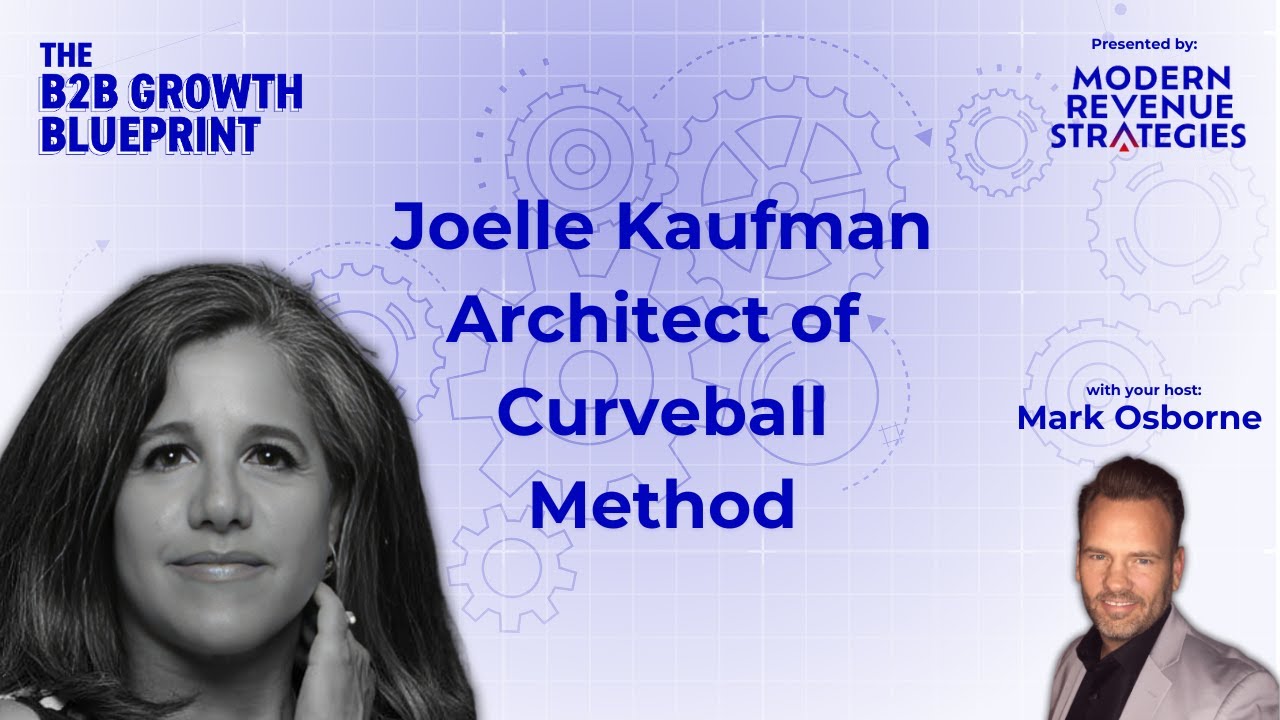
In this B2B Growth Blueprint podcast episode, host Mark Osborne interviews Joelle Kaufman, creator of the Curveball Method, a leadership framework that helps executives recognize, anticipate, and respond to unexpected business challenges. Joelle shares how personal experiences with cancer shaped the method, outlines a step‑by‑step approach (breath, focus, strengths, mindset, resources, choice, communication, swing) and explains why premature action is a common mistake. The conversation then moves to practical growth challenges faced by SaaS founders – balancing design‑partner custom work versus a true MVP, identifying urgency triggers, qualifying customers, and avoiding “customizer” clients that can derail a product vision. They discuss scaling risks such as the Rule‑of‑40, champion turnover, and the importance of building multiple champions. Joelle introduces the five leadership levers – focus/alignment, clarity, ambition, purpose/why, and mindset – and shows how they tie into the Curveball Method. The episode ends with a look at the looming generative‑AI curveball and how leaders can integrate AI without losing their strategic edge. Listeners are directed to Joelle’s landing page for a free copy of the 5 levers and a 20‑minute consultation.
Chapters
Welcome to the B2B Growth Blueprint podcast, where we talk with entrepreneurs, founders, and leaders at B2B services, tech, and SaaS companies to learn the systems and processes they've used to create success for their business. We'll also learn from marketing and sales experts to provide insights to help you grow your business. I'm your host, Mark Osborne, and the podcast is brought to you by Modern Revenue Strategies and their 10x ROI B2B Growth Guarantee. Schedule a free diagnostic call to learn the fastest path to double your B2B revenues in just 90 days.
Hello and welcome to another episode of the B2B Growth Blueprint Podcast. I'm your host, Mark Osborne, And today I'm very excited to welcome my guest, Joelle Kaufman. Now I'm gonna read Joelle's bio to make sure I get this right. Joelle is the architect of the Curveball Method, which we're gonna talk quite a bit about today. She developed this method through 25 years of navigating high-stakes business challenges. And this approach, born from personal adversity with cancer and honed in the tech industry's fast-paced environment, equips leaders to transform unexpected challenges into opportunities. The Curveball Method integrates neuroscience insights, leadership frameworks, and practical tools. It's now implemented by leading tech companies, impacting over 150,000 professionals across various industries. She has a background that includes Harvard Business School training in transformational coaching and experience as a public speaker. She brings a really unique perspective to leadership development and organizational change. So I'm very excited to welcome you today. Thanks, Joelle.
Thanks. And since we're on the B2B Growth Blueprint, the 25 years I led growth, I led sales and marketing at a bunch of tech companies people might know, like BloomReach or Addefy, going back with AI with Firefly. So for your audience, the curveballs I wanna talk about have to do with growth curveballs, revenue curveballs, Efficiency curveballs.
Awesome. All right. So I can't wait to get into this. So first, though, why don't you give us a little background of sort of how you developed this and sort of the arc of your career and really what the Curveball Method is?
Sure. So look, what I realized, because the first time cancer came as a curveball to my family, I was 13. Now we're 10 episodes past, including my own. And the lesson you learn, because it came at 13, at 15, my sister was 29, I was 32. Like, it— this particular curveball's a pitch my family sees. The thing is, the first time you see a curveball of any type, it's really disorienting. It throws you off balance. If you ask a baseball player, if you watch people trying to figure out how to hit actual curveballs, they're literally lunging, or they're not— balanced to their base.
Yeah.
Because the dang thing's moving around. But when you've started when you're 13 or 15, it changes your perspective because she's like, okay, curveballs aren't actually a surprise. They're actually normal. They can happen. The more you aspire to leadership, whether that is as an entrepreneur or as an executive, and the longer you live on this earth, the more curveballs you're gonna see because most of life is curveballs. So out of that, and as I came into, you know, my first startup back in 1996, and it's constant curveballs. What is our product? How are we going to sell it? It, we were selling something hosted, which was really different in 1996.
Yeah.
How do we even talk about that? When we're talking to people, they're like, well, how do I install this on my servers? Well, you don't. Well, then how does it work? Well, do you have high-speed bandwidth? I mean, these are curveballs.
Sure.
Right? But if you look at curveballs with, if not anticipation, with expectation. So when my doctor called me, I was diagnosed the day before my prophylactic mastectomy. So my doctor called me and said, hey, our scans turned out it's malignant. Yeah, the oxygen left the room, but I quickly harnessed— I have an approach for this. I know what to do next. There's people I'm going to need to tell. There's help I'm going to need. And I can actually anticipate what my life is going to look like for the next few months. And beyond that, that I'm gonna be okay. So let's talk about that in business.
Yeah.
The Curveball Method is about having an approach so that you are able to recognize the curveball, actually be curious about its motion and its speed. And, you know, truly know it's always moving slower than it appears.
Hmm.
Right? We're in B2B growth. We're not cardiovascular trauma surgeons. Like, the curveball's moving slow. And the biggest mistake we make, just like a baseball batter, is we swing too soon. I gotta go. I gotta move. I gotta do. No, I need an approach. So what are the elements of the approach? Number 1, take a breath. Everybody on the podcast, whatever Curveball you are seeing right now, and I'm sure there's one. Breathe. Give yourself 10, 20, 60 seconds of just okay. It's just a curveball. Okay. Now, what's my approach? Focus. What's important? Two strengths. The strengths I already have. When you're facing the curveball is not the time we invest in our strengths. To build new ones, we harness the ones we've got. They also show us this is one of the gifts of curveballs where we might have a strength deficit and we want to invest going forward. Three mindset: if your reaction to the curveball is oh no, I I can't, I don't know. That's all a giant energy sucking vacuum. If your response is at a minimum. Okay, it's a curveball. You're going to be better if your response— and granted, there are certain curveballs like cancer that you can't respond this way. But if it's cool, I've got a curveball, that's going to be fun. Doesn't apply to the medical and the divorce and the other personal curveballs. But in business, we can look at a lot of them and say, Well, that's gonna be fun. What are my— 4th step. What are the resources at my disposal? These are different from strengths, right? Strengths are things I'm good at. We're really good at messaging. We have an awesome sales team, and they're dynamic. Your resources are what money, what time, what brand, what customers. These are resources. So now I have an approach that I've gone through those. And I've slowed down enough to say, all right, given my strengths, given my focus, given my mindset, and given my resources, what are my choices? I might have that conversation with my team. What are our choices? Let's improve on them. Let's iterate. All right, having made a choice, I now need to commit and communicate. That's leadership. I communicate what's happening, why we're going to respond the way we're going to respond. And let's go. And then we swing. Now here's the catch, and any baseball player or softball player or any athlete will tell you, sometimes you take your best swing and you whiff. The good news is you get to swing again. So there's very little we do that if we try something and it doesn't work and say, um, Let's make an adjustment and let's swing again. So you never get to choose the pitch, but you always get to choose the swing. And the Curveball Method is how you choose and communicate the swing.
That's so, so interesting and so insightful. So many things I want to sort of unpack there. The first is, you know, you talk about that first element of, you know, sort of focusing on what's important. And so oftentimes in business, there's this, you know, that quadrant of it's urgent but not important. And, and I, like, I could just sort of feel within myself as you're talking about these curveballs and, and what you talk about of they feel like they're moving faster than they are. They feel like they demand faster response than maybe they do. Maybe a lot of these things that feel urgent aren't even that urgent, much less that important. But when you sort of use that filter to sort of focus on what really matters in your business, then maybe you can let some of those curveballs that are actually gonna be balls and outside of the strike zone. Just float on by without without having to challenge them. And I also love this idea, you know, of at the end of you know sort of making a mindful choice on the action. It gives you this sort of opportunity to make a choice on what you want to do, and and even to sort of think and come up with a quantity of items that you could choices that you could make again. If you're taking that time to think through it, you're not having this knee jerk. You know, from quantity comes quality. You can take the time to. Think through multiple different responses instead of just having that knee-jerk one, uh, and then leveraging those strengths, those resources to, you know, really sort of bring it to bear so that you can, you know, make this, uh, this best response. So I, I love this framework.
Thank you. Me too. It's worked for me.
So I'm curious. So a lot of our listeners are folks that are in, you know, sort of a certain stage of growth. And, you know, oftentimes someone will have an idea for a better mousetrap. They've worked in an industry for 5 to 10 years. They had an idea for a better mousetrap. They go found a company to make this mousetrap and then they know what's wrong with their competitors because they used to work there and they know the customers because they, you know, have served them for, you know, some time. They know what's right about their product because they just built it. So that gets them to a certain sort of stage of growth. And then, and then they need to sort of break through and find that next stage of growth. I'm curious, do you see that when companies are at sort of this inflection point that there are common curveballs that come at them? And tell us a little bit about, you know, what you've seen for companies at that stage and the curveballs that they face.
So first, speaking to those founders, You are doing something really hard and it is stressful and it's anxiety driving— driven. Uh, so I wanna give you a moment of grace to say it is hard and everybody hits— sees the curveballs I'm gonna name. So the first curveball that I see a lot in that $1 to $5 million revenue rate.
Yeah.
Um, I sold something to a design partner and they told me things they wanted, and those things were so specific to them. And now I've invested a bunch in that, but it may not actually be what was most important for my product. And so I need to balance these very valuable design partners and what I've built for them, which might effectively be a custom solution.
Yeah.
Versus what my real MVP is. So there's a really good framework, not mine, called the Traction Gap. And what they talk about is actually seeing multiple different milestones. And your first milestone is actually, do you have a viable category? So what I'd say to people who are in that stage, if you have people that are paying you money for something, what are the 3 things in common across your design partners? And are they things that you could improve 10x better than another alternative? And if they're not, go to number 4 that's in common, right? We— this is a very disciplined approach to finding, going from your design partner to your initial viable product, which your minimum viable product in your initial category. Fall in love with the problem you solve Better than any other option. And I mean way better because the resistance to trying something new is very high. It's actually a career risk.
Yeah.
And there's tons of research. People are way more apt to take risk personally than they are with their careers.
Right.
So your really great mousetrap does— needs to be profoundly great for an ideal customer who has the specific problem that you solve. So the mistake is you start saying we're horizontal, we're, we're going to be good for a lot of people. And that might be true. Who are you going to be great for first?
Yeah.
So we go from this horizontal to a tip of a spear. And what's important is what— again, strengths— what can we be 10x better at? Focus for who? Now, the other thing that people need to do, and they don't only have to do it in the 1 to 5, but they desperately need it there, is when you have those great design partners or those initial customers and you're so excited and you're so relieved they said yes and they went live, I'm so happy, you actually need to go ask them why they did that crazy thing. And when they tell you it's all about how great your product is, that's not the answer. It's one that's gonna feel good, but it's not the answer you can use. The question is, why now? Why did you need to do this now? Because what you're trying to get with is, why did you take this risk?
Right.
And it's something that has to do with either their career, their team, their leadership, their company, It's something internal that took your thing from being an interesting problem to, I need to solve this now. The reason you want to know is you want to understand the shape of that urgency trigger because you can hunt it.
That's right.
Who else has it? And you also can use it as a qualification because what you have in a finite quantity. The only finite resource is time.
Yeah.
So you want to spend your time on those customers you can serve 10x better than any other option who have an urgent need. That's your curveball.
You raised 2 great things there that, that we, we talk about so often. Uh, and, and the first is around you know, those design partners that are really partnering with you. And we talk about, you know, clients that can kill your business. And one of the, and in fact, recently, it's around Halloween time here while we're recording this. And so I was recently doing a talk and I used sort of like classic, you know, Halloween movie examples. And one of them that I used was, you know, Jigsaw from the Saw movies. I call him the customizer. This is the kind of client that can kill your business if they don't believe in your sort of product vision, the long-term thing that you're building for the marketplace that, you know, can be 10x better than what everyone else provides. But they want you to build what they want, which might not be aligned with your product vision, might not actually serve the rest of the marketplace. And if you put all of your resources into building something just for them, they might be pulling you behind your competitors. So it's really important to have that, that real you know, long-term product vision so that you can then convey that to the customer so they buy into that rather than demanding that you, you know, customize something just for them, which may not be what the rest of the market wants.
Well, and they may not have even been the right design partner, right? You need to be, you know, we're so eager to get that first sale and I get it because revenue is oxygen and we need oxygen. And if we suck on that wrong oxygen pipe, we're going to end up with, you know, oxygen, uh, death from the wrong kind of air.
That's right.
So, um, my analogy kind of fell down there, but whatever. Um, the thought here is if you're falling in love with a problem, what you're really looking for is people who have the problem. And in doing that, you can refine what that problem really is, right? If you came out of the space and you were the user, great. You may have a lot of sense of the problem as you experienced it. Now you want to add some skepticism.
Yeah.
How are other people experiencing it? Is this a top 5 problem for these other people?
Right.
Great. If you didn't come out of the industry, and a lot of founders don't, Now you're saying, well, we're going to disrupt the industry. Okay, great. What's your understanding of their top problems and why they're the top problems? And again, everyone's got a list of 100 problems, 100 urgent things. They're gonna solve 3.
That's right, because they only have the bandwidth and resources to tackle 3 in a year, or—
Right. And yeah, it is really even hard to move Onto the list or up the list. It's way— now, if you're— if it's the number 1, they've probably already started figuring out how they're gonna solve it. But number 2, number 3, number 4, those could be good places to play.
That's right. I also love your idea of not just understanding the problem that matters to them and the one that you can be 10x better at delivering, but also this idea of the context that they, that they're operating in that's this trigger. And so oftentimes we'll work with companies to develop, you know, an ideal customer profile or, you know, like buyer personas of decision makers and champions and companies are like, oh, we have that. And then they give it to us and it's very static.
Mm-hmm.
You know, everything on that ICP or ideal customer profile, it's all firmographic, maybe a little technographic, but they're not ever thinking through the context of What's the trigger that made this a problem that just raised it from priority number 20 to priority number 2, and they gotta solve it now. And so that has them out in the marketplace. And even, you know, as you describe those decision makers, those buyer personas, they are taking a big risk. What was it that, you know, made it worth tackling this risk and sort of sticking their neck out to have this sort of solution? And oftentimes, there's a context that they're operating in. There's a trigger. And those triggers can be things that you can then identify and go out to the marketplace and find people that have that trigger that they're experiencing. And so oftentimes, you know, and to take a really easy example, you know, a SaaS company can, you know, make a product that makes things run more efficiently. Well, is that because they service people who are in a shrinking context and they have to do more with less because they just have less? Or is it people that are in a growing context and they're trying to just maximize the outcomes? The same solution can operate in both areas, but chances are your version of the solution does better for one or the other. And if you focus on that, you can really sort of create that 10x capability.
I agree completely. And, you know, there are— I use the word trigger very deliberately. There are moments when teams and organizations are more amenable to change.
Yeah.
And moments when they aren't. I'll give you an example. When I, my very first deal I ever did in my life, right? It's 1996. This little company called Amazon is kind of annoying to the bookseller market. But, you know, Borders, Barnes Noble, they're the big players. And I happen to have this idea that what would make books sell more was recommendations. If you like this book, you might like those. Believe it or not, in 1996, that didn't exist.
Wow.
And I made a bunch of calls. I did a bunch of networking. That part of the story is not all that interesting. But what became clear is Barnes Noble was feeling behind because Amazon existed. And even though it was a small little pissant, to the credit of Steve and Len Riggio, They both were like, "I don't think that's gonna stay a pissant. I think this thing is happening, and frankly, we're not in, and we need to protect our brand and our you know, and you know they were right; they needed to. So they said, "But we can't just do what they're doing." So their trigger was they had a new competitor playing by different rules. You should have heard them talk about sales tax. I didn't have a solution for sales tax, but I had an idea that hadn't been done before. And they could launch Barnes Noble with book recommendations informed by the Barnes Noble history of book sales and learning from each user on barnesandnoble.com. So their trigger was they already had decided we're launching a website that's gonna sell books. To compete with Amazon. Okay. I didn't have to sell that idea. We're doing it relatively quickly. Also didn't need to sell that idea. What's going to make our site better than the one in Seattle?
Right.
And the answer, they mean, we have our brand and our— yes, yes, yes. They wanted something, an experience that would be unique. And then I showed up. Right now, was that replicable? Not sure, for a whole host of reasons. But the urgency trigger was clear, which is why that deal went fast.
Yeah.
And Barnes Noble did launch barnesandnoble.com with book recommendations powered by my company. Hey, because they had an urgency trigger.
Yeah.
Right. And Amazon was interested, but, you know, they were up, they were building customers. They were like, yeah, that would be good. Maybe we'll build it ourselves. I don't know if we need to use you guys.
Well, and that creates a whole segment of the market though, because in that, in that time, in that context, once you have a successful deployment of this, you can then say, okay, what other legacy players have the opportunity to bring reviews, testimonials to bear against their, their submarket disruptors that are, you know, online natives. So that creates a whole market that easily sort of helps you, uh, sort of bifurcate and find those big opportunities to go after.
Exactly. And you have a success story, right? Which brings me to another curveball. So let's say you got through the $1 to $5 million and, you know, you're getting— maybe you got $20 million. Right. But you know the rule of 40. So if you're not profitable, you got to be growing at least 40% a year and not because either you've hit some sort of a plateau or you're growing great, but you're hemorrhaging out the back.
Yeah.
So that's a big curveball, that one. And it is moving slower, but that one can kill you.
Yeah.
Right. It takes a while. People should know, like, companies take a long time to die unless they spend like drunken sailors. So don't spend like a drunken sailor. But what— there's a few things that come up there that you see as, let's dig into the curveball, let's be curious. Are people not adopting my product? Or what's the difference between the companies, the clients that are and the companies that aren't. They're not all the same.
Yeah.
So I need to guide my marketing, get more like these, less like those. My customer success, double down on these and less on those. I might need to size my company differently because I'm gonna have to transition out the ones who aren't using it. It just didn't solve a problem. It didn't get traction. Now, the other thing that happens when you don't get traction is if you're single-threaded, you have a champion, and that champion has driven the purchase and the acquisition, and then they do what happens a lot. They leave.
They get promoted.
Yeah.
Right?
They get recruited. Promoted's often okay. Recruited's the hard part. They get recruited out. Now, if you haven't built the champion successor, Your deal's at risk. Now, that curveball has an opportunity. You're that— you're the play for the new company that the person went to. But you gotta work both sides of this curveball.
Yeah.
And this is one that you can anticipate. Anticipate your champion's gonna change jobs because they do.
Right.
So how are you not single-threaded? You know who your other champions are. And you're elevating the careers of the people who adopt your solution, not just the buyer who's famous and great, but the other people. You're elevating them. So Marketo did this really well years ago.
Yeah.
They, you know, great. I was one of the first 50 buyers of Eloqua. I then bought Marketo later and great. I'm a CMO. Yay, Joelle. Applause, applause. Thank you. Send me nice gifts. But they came up with the Marketo Champions, which wasn't for me. It was for the people who were using the product and spreading it into the whole way that the go-to-market motion worked. And these people were good at it. They were making careers out of it. And Marketo recognized them by being, you are a Marketo Champion for the year. It's a small select group. They get special meetings, they get special access, they get to put it on their LinkedIn, and now they're elevating the next person. So if I leave, what do you think the odds are that the Marketo champion is going to rip out Marketo?
Right.
Zero, right? You need to cultivate champions at multiple levels and be elevating their careers. So putting customers and people who are your customers at the center of your go-to-market strategy. They have urgency. There's a trigger. You're critical to them. You're critical to them being successful. You're helping them get visibility for how great they are. You've become more than a piece of SaaS software.
That's right. That's right. Oh, so many great insights here. And you've obviously got so much, you know, rich experience and background. We could talk all day, but I got to be mindful of your time. But before I let you go, like, tell us a little bit something that's on the horizon for you that you're excited about, either with the Curveball Method or something else.
So I think that Actually, the whole industry is facing a massive— I'll call it a barrage of curveballs.
Okay.
And that barrage is from the unleashing of generative AI.
Yeah.
Right? If you're not looking at and incorporating generative AI into how you do your work, maybe everyone's thinking about how I put it into my product, but it also is about how you do your work. And if you're not aware of the limitations, if you're not comfortable, you as a leader are going to be surpassed. On the other hand, I do not think GenAI is going to do the job of leaders, right? But your people are scared that it's going to do their jobs. And we are in a moment— and I remember this, you know, this was the moment like in the late '90s when I was talking to Barnes Noble. Where you're looking and saying, I think the world is changing and this internet thing is gonna be pervasive.
Mm-hmm.
So we're here again. The world is changing and this GenAI thing is gonna be pervasive. And how you see this curveball and how you invest in strengths on your team and for yourself Is really important. I do not think everyone needs to know how to program a custom GPT. I will tell you, it's not that hard.
Yeah, that's right.
So, you know, you could play with it, but everyone's going to need to think about how do I use AI to be more informed, more efficient, more able to— more predictive. of the future? And what do I need to be skeptical about when I get an answer from GenAI?
Yeah.
That's just on how you're using it. How you incorporate it into your product is as diverse and creative as all of the people listening to your podcast. So when I'm thinking about the 5 levers that leaders need to pull, we do need to be investing as leaders in our own growth, right? What are we uncomfortable with and how do we learn something about it? That doesn't mean become an SDR, right? It's good to be an SDR when you're starting your career, but understanding how could GenAI help my SDRs be more focused, more successful, more efficient, that's an executive level question.
That's right. So super interesting. So tell us about those 5 levers. What are those 5 levers that exceptional leaders pull every day?
Yeah. So the first lever is the lever of focus, which we've talked about, but particularly alignment. So one of the things that great leaders do is they recognize that their job is alignment. They're always aligning. It's like driving your venture is like a car running on a dirt road with lots of potholes and logs and Every time you drive, which is every day, something's getting out of alignment. And your job is to figure out what it is and get it back into alignment. That may mean changing the alignment. That may mean bringing things back. But that's the job. Okay? So focus and alignment is a lever that great leaders pull constantly. And a trick, by the way, is if you've identified what the top 3 objectives are for your organization for the year, a half year, that is not, we're going to generate X amount of revenue. That's a measure of having done something right. So what's your objective? We're going to launch a product that customers absolutely adore. How are we going to measure it? Our pipeline's going to move faster. Our customers are going to have this kind of adoption, but it's the product they're going to adore. That is the objective. Okay, well, what— let's flesh that out. But that's number one. I put that on everyone's desktop, everyone's laptop. What are the 3? Because 80% of leadership teams can't tell you the same top 3 priorities for their group, right? That's startup all the way to big company. So if you're not pulling that lever and making sure we all know what are the top 3, You're working at odds internally. That's like, you know, someone forgot to tighten the lug nuts. The tires can fall off.
That's right.
Okay, 2, clarity. We have to communicate with clarity. Um, we have to be clear on that top 3. We have to be reiterating it. And every time we communicate, we have to be clear. If there's room for interpretation and you're talking to Another human being, let alone multiple ones, guarantee there's interpretation. So one of the things Jeff Bezos implemented at Amazon was for any big strategic decision, he made people put it in writing.
Yeah.
It's called the 6-page memo. You can adopt, morph it, what have you. I don't mean sending a quick Slack. I mean a thoughtful, whether it's in Notion, Coda, a document, I don't care.
Yeah.
Have you thought through, this is the curveball, these are why it's important, these are our pro-cons. You want to really light my fire, these are the financial ramifications, right? Like, we're running a business here, it's not a club. And so, and we share that in writing. And when we make a decision, we put that in writing. Why? Because it's way easier to identify Disconnects when people read it. Only 10% of people in the world learn by hearing. So just because you said it, assume like they didn't hear it. They didn't hear it the way you meant it. But you say it, you write it, and you confirm that they heard it. Now we've got clarity.
That's right.
Okay, number 3, we gotta be ambitious. But within reach, it can be a stretch. But I can't tell you the number of people that come to me and say, I don't know what I'm gonna do. They handed me a number and there's absolutely no way to do it. Like, oh, what, why do you think that? And what have you. And it turns out, well, because they want 3x growth and we're not investing in marketing and I have no extra sellers. And I, I don't know, like, is this gonna come from my installed base? Because they don't have money.
Yeah.
Right? So, you know, wishful forecasting and wishful planning leads to spending money like a drunken sailor, which we've already said, don't do that. So number 3, ambition that's a stretch but within reach. Number 4, great leaders are clear on the why. It's not just the focus and the alignment, but like, why does it matter that we succeed? Why? Not because you're going to get rich. Nobody— that's not a why. Yeah.
Why?
Why does it really matter? How are we going to make the world a better, more equitable, safer— I don't know what the answer is. But if you can't say, this is our why, when things get hard, people wonder if it's worth it. You want to make sure the answer is, hell yes. And finally, really great leaders They're really good at managing their mindset. They're good at what we call emotional regulation. I don't care how they do it, right? Some of them do it through exercise or meditation. Some of them do it through self-talk. I work with leaders on how to do it. Well, I actually work with them on all 5 of the levers. But mindset, how you think about the thing in front of you, is actually where we started with the Curveball Method. Yeah.
Right?
Like, I got diagnosed with cancer. That sucks. My mindset became, how can I minimize the impact of this on my life and get through it with as much strength and success as possible? And that sounded like kind of an interesting puzzle. Yeah. Now, maybe I'm sick and crazy, but It was an interesting puzzle. It's actually— by the time this podcast comes out, my book, Crushing the Cancer Curveball, will be available on Amazon if you're curious about how do you apply the curveball method to one of the mothers of all curveballs, right?
Yeah.
And it turned into, and I kid you not, one of the happiest years of my life. So I still wouldn't recommend cancer. I'd like to say we could get there without that. But given that I didn't have a choice, that was the pitch. My swing became about strength and hope and humor and community.
Awesome. Well, such an inspiring story. Joelle, thank you so much for joining us today. For those that are listening and want to learn more about, you know, the Curveball Leadership Transformation Program or how to get in touch with you, What's the best way for them to connect?
Sure. So first off, you can go to www.gtmgo2marketflow.com. There's plenty of ways to contact me through that. But for your listeners, I'm creating a custom landing page. So they go to GTM— Oh, thank you. Yeah, sure. GTM Flow B2B Growth Blueprint. And if they go there, they'll get a free gift of the 5 Levers. So they don't have to take notes from your podcast. They can have the 5 levers, and I'll offer your listeners a free 20 minutes with me so we can talk about the curveball they're seeing. And, you know, if they don't— if they get everything they need from the 20, perfect. There's no obligation.
Fantastic. The Curveball Crusher Leadership Transformation Program. Thank you so much for, uh, that offer to our listeners and I know a lot of folks will take advantage of that. You've given us so much to think about today and so much to use in the way that we approach those curveballs that we face in business. So Joelle, thanks so much for joining us.
Thank you for having me. It's a pleasure. And everybody doing the hard thing, keep going.
Awesome. Thanks so much. We'll talk to you soon.
You bet.
Thank you for joining this episode of the B2B Growth Blueprint podcast. We hope you've gained Insights to grow your business. If you enjoyed this discussion, please rate, comment, like on your favorite platform, and share to others who will find it useful. Do you know a CEO, founder, or leader at an early-stage B2B services, tech, or SaaS company who would like to be a guest and share their story? Send us a note. Let's schedule a conversation.
More from Mark

How Can You Maximize Your Business Value Before Selling? with Randy Katz Video







