Visionary vs. Integrator: The Key to Scaling Your Business with John Glover
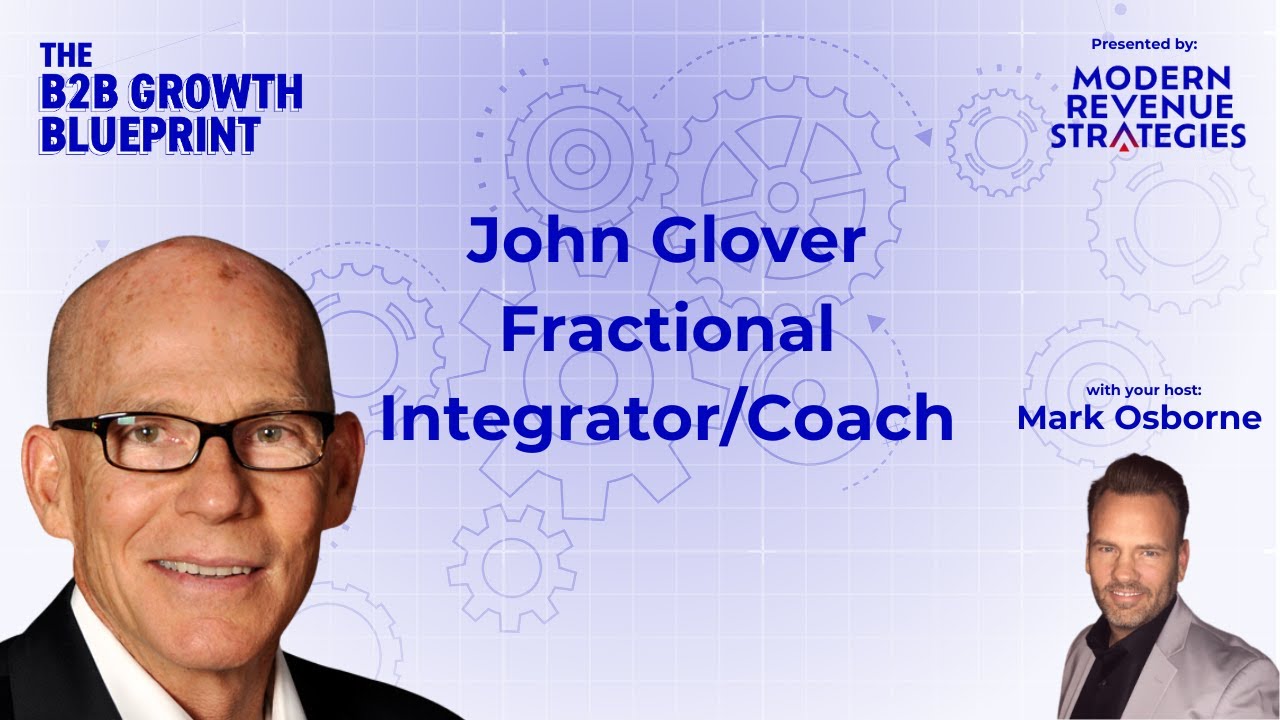
John Glover, a fractional EOS integrator, explains why scaling requires two roles: Visionaries who generate ideas and take risks, and Integrators who execute and build processes. He walks through hiring steps, team alignment, and how a fractional integrator working one day a week can accelerate growth without the bureaucracy many founders resist.
Chapters
Welcome to the B2B Growth Blueprint podcast, where we talk with entrepreneurs, founders, and leaders at B2B services, tech, and SaaS companies to learn the systems and processes they've used to create success for their business. We'll also learn from marketing and sales experts to provide insights to help you grow your business. I'm your host, Mark Osborne, and the podcast is brought to you by Modern Revenue Strategies and their 10x ROI B2B Growth Guarantee. Schedule a free diagnostic call to learn the fastest path to double your B2B revenues in just 90 days. Hello and welcome to another episode of the B2B Growth Blueprint Podcast. I'm your host, Mark Osborne, and today I'm very excited to welcome my guest, John Glover. Now, I'm going to read John's bio to make sure I get this right. He's a 40-year veteran of entrepreneurship with the first 18 years of balancing all the different aspects of both leading and managing an organization. We're going to talk about what those two aspects are, the difference between being a visionary and an integrator and what it's like to try to carry both. And he realized that actually through having the unique opportunity of seeing Gino Wickman, who's the founder of the Entrepreneurial Operating System, or EOS and author of the bestselling book Traction that describes the EOS process. He had the benefit of working directly with Gino in implementing this system within a business where he was operating. He's actually been working as a fractional integrator with EOS for the last 5 years and has a lot of insights to share with us. So, John, welcome to the show.
Well, thanks, Mark. It's great to be here. I appreciate it.
Yeah. So, tell us your story. So, you Have a 40-year experience. Tell us some of the businesses you were in and sort of what your experience was like and how you came to discover EOS and evolve your thinking.
Sure. Yeah. So, I started out in a family business. My father had started a small business and had built it up and it was a one-man band as a lot of small businesses are. And when he passed away unexpectedly when I was in college, my sister and I took it over. And I knew nothing about business. I was a business major but had no practical experience at running a business. But I dove in and I made a lot of mistakes along the way. And we had good growth for about 18 years.
Wow.
And then, like a lot of companies, we hit that, you know, the growth started to slow down and I started looking for answers. And in those answers, I found Strategic Coach, which is a great coaching program by Dan Sullivan. that I joined. And it was a tremendous learning experience for me to go through that. And I did that for a number of years. And from there, I ended up picking up a partner in business and decided to turn my family business into a real business from the standpoint that this partner was what we call in EOS terms a classic visionary because he had a lot of big relationships to bring to the table. So, we created essentially a whole new company and it was great for about 2 weeks. A lot of dysfunction and communication problems, not because we weren't trying to grow a business, because we were 2 different people. He was what we would call a classic visionary owner who's got a million ideas and he's a big relationship-type person who loves to go out and sell. And I was more of that operational type. management guy that wanted to cross all the T's and dot all the I's and put processes in place. And so, that's that natural healthy tension that a leader has sometimes with a manager.
Right.
So, we struggled. And then, one of my clients suggested I read a book called Traction by Gino Wickman, which I did and quickly was able to secure an appointment with Gino. We're local Michiganders and that's where he founded the business. So, we jumped on a quick appointment calendar and got in front of Gino. Within 90 minutes, my partner was singing his praises, ready to take the leap into EOS. So, we did that. And that's when I first heard the term, you know, what's an integrator, what's a visionary owner. And it was very apparent to both of us from that first meeting with Gino that it takes 2 people at the top of a company to really have a successful, thriving business because you need that complementary set of skills in order to really reach your full potential. And if you think about all the great companies that we've all heard of, from, you know, Disney to Ford Motor, all the tech companies, every single charismatic founder has a person next to them that is running the day-to-day. that you typically don't see in front of the camera. They don't want that limelight. They are the managers of the business that get great joy from executing upon the game plan that the visionary has. And so, for the next 18 years, I grew the business along with my partner and successfully sold that business in late 2018 and then decided that I wanted to kind of utilize A little bit of knowledge that I've acquired along the way of 40 years of making a few mistakes and learning and share that with other entrepreneurs. So, I had a conversation with Gino and my question to him was, well, do you think I should be an implementer that teaches EOS to business owners or should I be an integrator, which is more one of those people that come in on a short-term basis to help supercharge those EOS tools and really teach that leadership team how to use them in a way that just fuels that growth at a faster rate. And so, that's the decision I embarked upon being the classic integrator that I am. And I've been doing this for about 5 years now.
That's fantastic. Well, and one of the things that I always love, and you really laid this sort of inflection point out really well, is that so commonly in sort of in the American sort of picture of an entrepreneur, you know, when Gerber talked about this in The E-Myth, like there's this idea of like, you know, it's a superhuman that does everything. They have the vision and they have the execution and they bring it all together themselves. But it's just really not true, at least not sort of on a statistically relevant sample size. Once you get outside of maybe one anecdotal observation or one, you know, sort of survivorship bias storyline. Really, the successful companies are the ones that realize there are 2 different things that need to be done. And people have different sort of zones of genius, for lack of a better phrase. And so, if you can help people focus within where they're strongest and then bring in someone to supplement where they may not be as strong, you get much better outcomes than one person trying to do it all.
Yeah, absolutely. You know, and I would disagree with what you said only from the context that a lot of small businesses that are started by visionary owners are successful and they're the only person at the top of the organization and they do very well. However, most of those people aren't able to scale because in order to scale, you need that different perspective from the top.
Right.
And so, let's talk about what a classic entrepreneur looks like. And you can read a lot of books and they all say the same thing basically. But it is that individual that's inspired by passion. They lead with their heart. They're not about logic. They're not about meticulous planning. They have a passion for something and they follow that and they have the guts to follow it. Whereas most of us would say, I'm going to weigh the pros and the cons and decide not to do it because it's too big of a risk.
Right.
But visionaries are very good at dealing with risk. So, they have a higher risk tolerance than most people. And so, what makes the qualities out of a great visionary are also some of their blind spots. They are great at building relationships. They're passionate about what they believe in, and they're great at inspiring people to follow them. What many times they're not good at and they don't love to do is manage people. So, many times they end up with an organization that we call a genius at the top with 1,000 helpers because everybody's a yes man, right? Whatever the boss wants, the boss gets. And you can have a successful company leading that way. But as you and I both know, Marc, it really is that balance of being able to put people in the right position so they can utilize their own talents, their own unique abilities. And now, you've got this team of people operating all in their unique zone where the visionary can step back. Allow that integrator, that second-in-command, COO, whatever title you want to give that second-in-command person, let them run the business, keep the teams healthy, and the visionary gets to choose what role they want to play in their own business. And that should be the path according to Michael Gerber in The E-Myth that he lays out is that if you're working in your business, then it's not really a business. You're an employee.
Yeah.
Right? And so, what Dan Sullivan talks a lot about is what we call a self-managing business. And that is freedom of time and freedom of money. And if as an entrepreneur, you've built a great team around you, then you have both. You have freedom of time. So, you're not tied to that business. You can go on a vacation for an extended period of time. And you have freedom of money because the company's producing profits every single year. And the team gets to decide where to allocate those resources to fuel that growth.
Yeah. Well, and you talked about, although there are a lot of small businesses that do have that person at the top that experience success, but they struggle to scale. I've also had the experience, I'm sure you have too, of although they might be successful as a company, the person oftentimes is going crazy in their mind because they don't have that freedom. And And they sort of see opportunities because they are those visionaries, but they can't capitalize on those opportunities because they're so overwhelmed with running the business because they've resisted bringing in an integrator who can build the processes or doing the processes themselves because that's just not in their sort of wheelhouse of sort of their natural strengths and skill sets. So, I think it's such an interesting dynamic that You know, you don't define success as one person needing to do it all, but instead success is defined by creating a team where you can have multiple people playing multiple roles, but leads to much greater success overall. It's really much more than additive. It's really multiplicative because you make each other better. And then in that type of environment, and I know you do a lot of work with your clients on sort of building healthy leadership teams. I'd be curious to sort of hear, like, you know, how do you do that? What does that really mean to have a healthy leadership team?
Yeah, that's a great question. And I think it's been talked about a lot in business. You know, Patrick Lencioni has kind of led the way with that term in all of his books. And I think when I engage clients in the initial call, the one thing that always comes up is the question I ask them, tell me about your people. And invariably, what comes out of that conversation is their number one frustration about being an owner is dealing with people, which is kind of ironic because that's also your biggest competitive advantage.
Right.
And so, what the visionary owner is telling me basically is, I don't want to be that manager of people. I have the vision for where my company's going and how to get there and the strategic moves behind it. But I just don't like that management day to day. And so that's when I ask them, well, tell me about your leadership team. And their answer always tells me whether or not they are executing upon EOS as we teach it, because most of my clients are operating on the EOS platform. I don't have any clients today that aren't running on EOS because it is such an easy platform to implement throughout an organization. And so, when you talk about a healthy leadership team, most owners have trouble doing what? Letting go because they're the ones that built the business. And it's always faster for them to do it than it is to delegate and train somebody. And so, many times those leadership teams have a false sense of health. So, they all come to the meeting, everybody agrees with one another, especially the boss, and they all leave nodding their heads. And then, When they get into their departments, they're not backing up some of the agreements that they came to. They're offering up opinions that might differ from the vision. And so, when we talk about health, we really talk about people buying into the vision first and foremost. The owner has the vision and they get to build that vision, and that's what their unique ability is. So, if you're working for an owner that has a tremendous vision, Do you feel passionate about it? Have you bought into it? Because if you don't, tells me you're the wrong person. Not the wrong person that disagrees with this owner's vision, but you just need to go to a different company and find somebody that inspires you so you can buy into that vision. And that's where we get to the right person, right seat, which has been a very common term starting with Jim Collins' book, Good to Great.
Right.
Come back and look at a healthy leadership team. I think that it starts with the core values. Every single person on that leadership team has to have and exhibit the core values that have already been identified as these are the type of people that will be successful in this environment. And you can't fake core values. Either you have them or you don't. And if you don't, it again doesn't mean you're a bad person. It just means you're not a great fit for this company.
Right.
So, core value alignment is critical. And then second, Obviously, what seat are they sitting in? And are they the rock star person that you need leading that department? Whether it's HR, finance, sales, or marketing doesn't matter. But as a visionary owner, a healthy leadership team has rock star people in every seat who are— who have the emotional ability, the EQ we call it, to understand people and their behaviors and their motivations and have a great way of communicating because all All leaders must have a high IQ and have a great ability to communicate beyond their intellectual capacity and their skill set.
Right.
And so, that's how I define a healthy leadership team. Right people, right seats, but a high IQ or high EQ and certainly high skill sets. And the last thing I'd probably add is healthy egos are great. But we all have seen the abuse of healthy egos. And, and, and as humans, we get defensive. As humans, we don't like criticism. And when you have a healthy leadership team, you're able to put your ego off to the side, accept and even ask for feedback from your peer group, and then be able to do that in kind. So everyone is giving each other feedback in a way that's making everyone better because at the end of the day, we do everything for what the company needs to grow.
Yeah.
And so, if we're following that vision and we're making decisions that are best for the company and we're putting our egos aside, then we don't have any collateral damage. We don't have any talking behind people's backs, none of that resentment that goes on typically with many leadership teams. And Having said all that, Marc, it's not an easy thing to get to. Getting a healthy leadership team is hard and one person can throw it off. So, many times when I come into an engagement, there's typically one, maybe 2 people that are a question mark on that team. The owner wants me to dive into and ask some questions around and figure out, do we have the right person and do we have the right seat? for that person. And many times when we do identify there's a wrong person issue, we do it in a way that's kind. We do it in a way that gets them to recognize that, you know what, I'm not real happy in this seat. Here's why. And I'd probably be happier somewhere else or in a different seat.
Yeah.
And so, that transition is what a good integrator brings to the table to help that leadership team Gracefully manage their right seat, right people issues because you can only grow as fast as a healthy leadership team will take you.
Yeah. So, love all these concepts. And one of the things like to kind of put some very tangible sort of stories around it, one of the things that I've seen in companies that when they have that strategic vision, part of that vision includes sort of Who is your customer and what is it that you do for them? What's the core of the solution that you offer? And also, when you talk about sort of values, that tends to include things like— and I'll put up a little bit of a false choice, but one company might say, we value efficiency and technology over all else. We want to always be creating efficiency through the use of technology wherever possible. And another company that could be serving a similar, you know, customer in a similar marketplace might say, we value innovation and ingenuity. And in fact, maybe that makes us inefficient at times, but because we're creating bespoke solutions for our clients, those are 2 different sets of values. But both of which are valuable and can fit well within a company. But if you value one versus the other, that maybe you're not the right fit for a role within a company as you're making decisions on how to deliver a particular solution. And one of the things that I love about this framework from a sort of marketing and sales perspective is it does 2 things. One is it creates focus because very often these visionary leaders, or really lots of people at companies, can get distracted by, hey, what if we offered this new product or service or this other thing. And you can go back to, well, does it serve that same customer that we've strategically agreed to? And does it help them accomplish the thing that we've decided we're going to help them accomplish? And does it fit in with our values of the way that we appreciate, you know, sort of delivering value to that customer? Because if it doesn't, then that helps you start to say, well, then we— let's not get distracted by that. That's not our core mission. That doesn't align with our strategic approach or our values. And creates a good objective measuring stick instead of just, well, no one ever likes my ideas. And instead, it's, well, it's, was the idea aligned with the strategic vision, our overall mission, and really the values that we've agreed to as a company?
Yeah, that happens. I see that all the time in even healthy leadership teams where I had an incident the other day where one of the CFO Was, was not happy because he, he wasn't being heard from his perspective. He had given a lot of opinions in various meetings on solving certain issues. In some cases, the company didn't take his opinion. They listened to others, made a decision. It went badly. And this happened 2 or 3 times. And so, The CFO is now questioning why his voice isn't being heard as loud.
Yeah.
And as a fractional integrator who meets with each leadership team member on a weekly basis to check in and do some leadership coaching, in hearing that, my question to him was, well, have you told the visionary owner about your feelings? And he said he hadn't. And when I asked him why, it was a lot of excuses and a lot of reasons why the past was going to dictate the future. And I reminded him that last time I checked, nobody really can predict the future. So, why don't we put our assumptions off to the side and have that difficult conversation? And from that, he's going to then understand your perspective. And hopefully, you'll understand his perspective and you meet somewhere in the middle to move forward. And that is the essence of a healthy leadership team is communication. Nothing is off the table, right? It's how we present it is what matters. It's the messaging behind the intent is what matters. And if you have the right person on your team who is respectful and kind and not abrasive in their messaging, then I would hope that 2 people who are both of that mindset would be able to then truly listen to one another and arrive at that best decision going forward in order to make the best decision for the company.
Yeah, such a great story. So I am going to switch gears here a little bit. So as the integrator within, you know, these companies that you're working with, you're bringing in oftentimes process and systems to help them accomplish things. And a common, you know, sort of fear for either visionaries or just companies that, you know, they haven't had as much formalized processes Oh no, we're going to be weighed down with bureaucracy and I'm going to spend all my time getting chastised for being wrong, not following the SOP. How do you sort of approach that kind of mindset? What would your response be to someone who sort of has that concern as you come in helping to bring some of that system and process?
Yeah, well, what you pointed out, Marc, is I'm smiling because most visionary owners can't stand processes. That's the last thing they want to spend time doing, right? They want to get out in front of that big customer And sell the deal. And so, processes are something that when you look at coming into an organization as a fractional integrator, I always ask them this question about processes. Tell me about how you manage your people. Not what your HR process is, but tell me about how you attract the right people into your organization. How you talk to them, how you hold them accountable, and sometimes how you fire them. And I have yet to have anybody send me a one-page outline on how that's done, right? Because HR might own it and it might be 45 pages long, or there might not be anything. There's just a bunch of people that decide to interview along the way and they, you know, do the best they can. So, I believe that in order to get a visionary to sit up and pay attention to processes, you have to ask them about his or her people. And so, what we teach is breaking down processes into a very simplified format of give me a one-page outline. How many steps in your people process?
Yeah.
Right? Could be 5 to 10. The first step is how do I attract the right kind of people that have my core values, that have the skill set I'm looking for? Where do I look for them? Do I have a good recruiter on staff that I can turn to when I'm really looking for that high-powered person that I can't find through posting And then, you go through, well, what's your interview process? And most people say, well, we just talk to them. And once in a while, we give them an assessment and we use our gut. And so, I walk them through what a lot of my successful clients do. They do use assessments to understand what that profile of that job description looks like. What characteristics and traits do I want that person to have to be successful in this position? And then, once I built that profile, I can go out and start interviewing. Then, how do I interview? Well, most people interview, I think, backwards. They look at a resume and they ask questions all around the resume. Well, instead, how about uncovering their life story first? How about uncovering their core values to see if they have the same core values that you do through a conversation, not a series of questions that they're expecting you to ask for which they have canned answers? So, that's just one small example of if I can come into an organization and create a one-page outline of their HR process from how they attract people to how they interview to how they onboard people, which by the way is another huge weak spot in most small companies is onboarding.
Yeah.
And that's the candidate's first impression of the company. Their onboarding. And so, from there, you go to reviewing. Do you have reviews with people on a regular basis or is it the typical, yeah, once a year and then we give them a raise?
Right.
Well, people need more advice and feedback along the way than just waiting for that annual review. And so, at the end of the day, you've got a 5 to 10-step process on how to attract people, how to manage people, how to reward people, And yes, how to fire people because not everybody is going to fit in your organization and you have to have a process for exiting people like that in a nice way, in a kind way that allows them to go out and find a better job, which helps their life. So, that little example of a process is what most owners sit up and pay attention to because they know if we start hiring better people, Better people are going to make my company better. And I've lived through making bad hires and bad hires cost a lot of money and lost time to get back that growth that you've lost from a few bad hires.
What a prime example of the importance of having systems to ensure that you're doing your best. But look, we've had some great conversations and we could talk about this all day. We're both clearly pretty passionate about it, but I got to be mindful of your time. But before I let you go, for folks that have been listening and you know, really loving what they're hearing and could see the value of having an integrator in their business, what's the best way for them to get in touch with you? What's the sort of why should they work with John?
Well, thank you for that, Mark. I think as a fractional integrator who's been around EOS since 2012, EOS is just a platform and there's a lot of other platforms out there that teach small business how to run their businesses more effectively. But because of my experience in running EOS for so long, I only work with companies that are running on EOS currently. And ideally, you have an implementer already in place or you're thinking about hiring an implementer. My most successful engagements have been when an implementer brings me in on the front end of that engagement when they start their process of teaching the company and the leadership team about EOS. And they don't have that second in command already on the team. So many times that visionary owner doesn't have that second in command identified, and sometimes they do, but they might sit in another seat. They're in operations or they're in finance. And so by bringing me in on the front end of that engagement with the implementer, I'm able to really take everything the implementer is teaching them quarter to quarter. And applying it on a daily or a weekly basis. And so, like most fractionals, I work one day a week I dedicate to a client and I run their leadership teams and occasionally department meetings. I have same-page meetings with the owner and also meet with the leadership team members as well every single week. And so, I'm embedded into a company in a way that allows me to really identify what's working, what's not working, and apply some of those EOS tools to the team and the company in a way that causes faster growth. And be careful what you ask for because EOS will absolutely deliver it. And most clients find that out very early on in the engagement. But again, it's all about getting those right people and getting that leadership team healthy so the owner can start to see what a self-managing business looks like.
Thank you for joining this episode of the B2B Growth Blueprint podcast. We hope you've gained insights to grow your business. If you enjoyed this discussion, please rate, comment, like on your favorite platform, and share to others who will find it useful. Do you know a CEO, founder, or leader at an early-stage B2B services, tech, or SaaS company who would like to be a guest and share their story? Send us a note. Let's schedule a conversation.
More from Mark

How Can You Maximize Your Business Value Before Selling? with Randy Katz Video







