What Drives Success in Niche Market Ownership with Vince Barbarie
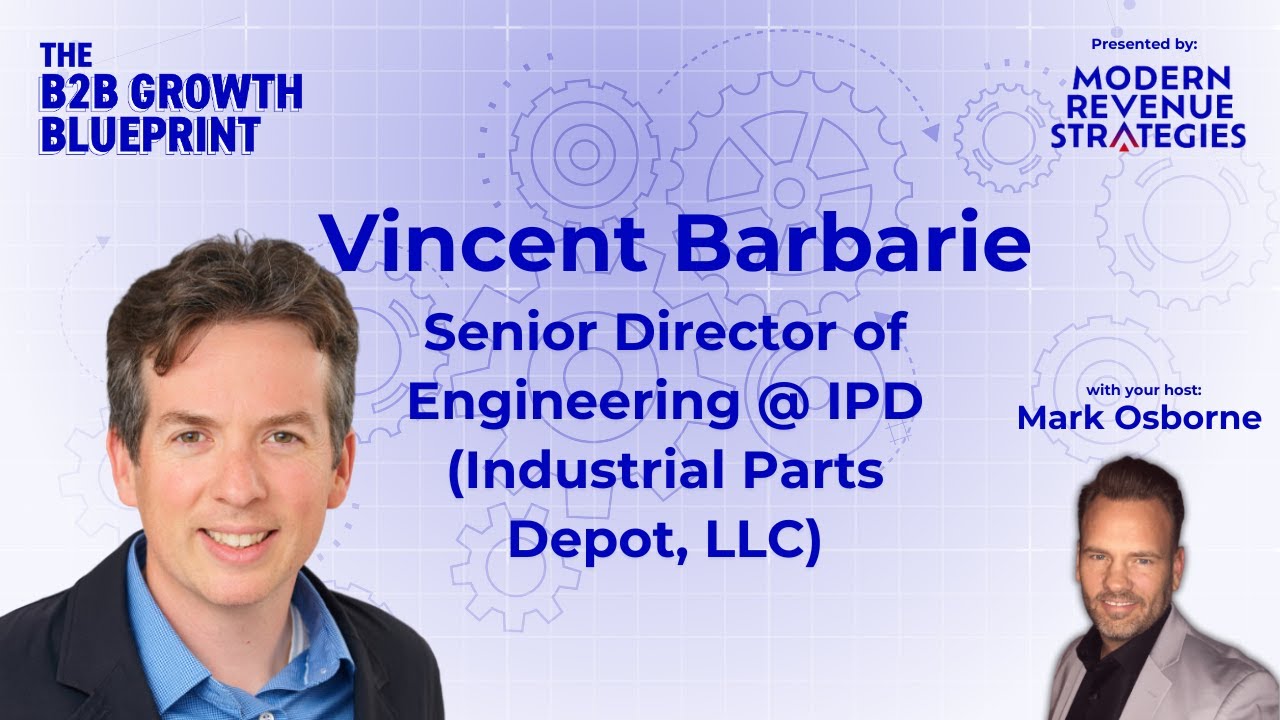
Vince Barbieri, CTO at Industrial Parts Depot, went from founding a car-culture media brand to leading engineering at Honeywell and now overseeing an IoT venture. He explains how legacy B2B companies survive by owning a niche and using bold marketing, like blowing up diesel cylinder liners with a Navy SEAL-trained shooter to sell industrial parts.
Chapters
Welcome to the B2B Growth Blueprint podcast, where we talk with entrepreneurs, founders, and leaders at B2B services, tech, and SaaS companies to learn the systems and processes they've used to create success for their business. We'll also learn from marketing and sales experts to provide insights to help you grow your business. I'm your host, Mark Osborne, and the podcast is brought to you by Modern Revenue Strategies and their 10x ROI B2B Growth Guarantee. Schedule a free diagnostic call to learn the fastest path to double your B2B revenues in just 90 days. Hello and welcome to another episode of the B2B Growth Blueprint Podcast. I'm your host, Mark Osborne, And today I'm very excited to welcome my guest. My guest today is T. Vincent Barbieri, or Vince as he goes by. He's the Senior Director of Engineering at IPD, which is Industrial Parts Depot. He leads engineering, product development, technical support, and warranty functions for heavy-duty engine components. Over nearly a decade at IPD, Vincent has been instrumental in scaling the company's aftermarket product offerings and technical capabilities across diesel and natural gas platforms. He also serves as Chief Technology Officer for IPD's tech venture, Industrial Digital Solutions, where he built and launched the MachineRx platform, an industrial IoT or Internet of Things solution enabling remote diagnostics and data-driven insights for commercial vehicle fleets. With over 2 decades of experience in R&D and product leadership roles at companies like Honeywell Garrett, turbochargers, and clean air power, Vincent's background blends engineering depth with cross-functional business acumen. He's an expert in turbocharger design, internal combustion engines, remote diagnostics, and systems engineering, with many patents and published technical papers to his name. He holds a mechanical engineering degree from UC Berkeley and an MBA from Pepperdine's Presidents and Key Executives program. He also founded Daily Turismo, which is a successful automotive media brand and podcast. Now, whether leading global engineering teams or launching new ventures within legacy businesses, Vincent brings deep insight into how technical innovation, customer understanding, and organizational alignment drive sustainable growth, particularly in complex B2B markets. So Vince, welcome to the show.
Well, hey, Mark, thank you. I appreciate being on, and I'm just excited to spend some time talking about this Travis Kelce-Taylor Swift engagement because that's what you wanted to talk to me about, right? That's the topic for today.
That's right, that's right. Uh, I spend most of my time, uh, discussing either football players or pop stars, so this is—
hey, it's one or the other.
So on a side note, before we get to that, let's talk a little bit about, you know, sort of your background. You've obviously done, you know, a lot of interesting things and some kind of diverse ones from, you know, a media component as well as, you know, sort of heavy engineering and, you know, sort of technical expertise. Why don't you give our audience a little bit of background on sort of your journey and sort of what you've done and what brought you to where you are today?
Sure, sure. It's, um, I've had some of the strangest titles. And in fact, for a while, I was, uh, I was Director of Engineering and Marketing.
Okay.
Okay, which is probably, you know, that was probably one of the strangest roles you'll ever hear of someone, you know, leading those, those 2 functions in a business. Um, but, you know, at heart, uh, I, you know, if someone asked me what I do, I'm still gonna kind of try to say I'm an engineer. Okay, and that's because that's what I, you know, as a, you know, a kid, all I did is take things apart and maybe they went back together, maybe they didn't.
Mm-hmm.
You know, Berkeley engineering, I mean, it's hard to ever say I'm not an engineer or not want to do engineering or want to get my hands dirty in something. And the weekends I'm tearing apart old cars and, you know, whether building race cars or fixing classics, at heart I love engines and mechanical things. And, um, uh, but, but I also have a sort of creative side, right? And so, you know, uh, Daily Turismo, a media company I founded, uh, what, 15 years ago now, um, just as an outlet to, to talk about cars and, and, um, uh, car culture. Uh, and then, you know, I finished, what, a year ago now almost, I finished an MBA at Pepperdine, um, to sort of bring some of the skills that I've learned about managing people. And look, I've been a manager for close to 20 years now, the various teams, to try to put a feather in my hat and say, okay, I can do this. I've done it. And bring that combination of engineering, combination of some of the softer people skills, managing teams, and turn that into something that can provide value to businesses. And that's, you know, from a career perspective, that's where my career arc has gone. And, you know, I'm always excited to see what the next part is. And sometimes I don't know, you know, it's just, you know, you talk to people and you— the strangest coincidences about, you know, who you know and what they know. It's It's fun. Yeah.
Well, and because you've done some really unique and unusual things and had some, you know, kind of different kind of experiences, you bring a lot of kind of interesting expertise. And one of the things that I know that, you know, our audience will find interesting is, you know, as you know, in the heavy engineering and technical space, It's sometimes hard for those companies to stay relevant because they tend to be kind of conservative environments, conservative cultures. Talk to us a little bit about, you know, how you've worked with legacy, you know, sort of businesses and sort of slow-moving B2B spaces and help them stay modern even in, you know, sort of despite them being in kind of a commodity category.
Sure, sure. You know, I've worked at a number of businesses that were sort of founder-driven, some of them while I was there, some of them before I got there. But it's always interesting when you come to a company where the founder is a person who does everything from just define the specs on a product to authorize you buying a pencil so you can do your work. And I actually did work at a company where I showed up and I had one monitor on my desk. I'm like, I need a second monitor. You know what? You know what? What is this? And the the owner of the company, and this was you know what? Eighty million dollar year company. The owner of the company had to approve that for me to get a second monitor because he controlled everything that tightly. And you know, look, those guys, they they they know what they know. They've learned a bunch. But when they go to to to certain phases of business, as you hit the thirty million dollars, the hundred million dollars, you hit these different. Level, suddenly you can't control everything. You have to have a team of people. You have to hire guys like me. You have to hire people that I've worked with over the years who manage specific disciplines within your business, whether it's engineering, whether it's marketing, whether it's sales. And you have to trust those guys. And those sort of— they're not your soldiers, they're your generals. Right, in the war, right? They have to be good, and they have to be— they have to work well with each other. They have to be able to coordinate things. Um, and, you know, in these, particularly in these, I'll say, low-margin commodity kind of product, you can easily get a company that, that makes money and can survive, maybe will survive for years, but it doesn't thrive.
Yeah.
And so to make it thrive, you have to get People who want to bring some creativity, people who want to say, okay, let's come up with a new product that will just blow the socks off the market. We just finished filming a video at IPD. And by the way, all the things I'm going to say today are my opinion. Okay? So it's not— I work for a company, IPD, great company, fantastic boss. I love my job. But everything I say today on the podcast is my opinion.
Sure.
It's not a statement for the company.
Not an official spokesperson.
Exactly. Yeah. But we had so much fun. We, we blew up— we shot and blew up diesel engine cylinder liners. Okay.
Okay.
For a marketing video. Okay. And we were proving that our, that our product is tougher than the standard product that's in the market.
Okay.
It's cast iron versus steel. All right. And it was so much fun to actually blow up engine parts. And I had a guy who I met at my MBA class who spent 20 years in the Navy SEALs. And so I got him to set up these piston parts on a firing range and shoot them with high-powered, high-caliber rifles. So, you know, it's the— we could have gone on selling a standard product, right? We— IPD could have sold the same product for years, but instead we said, no, no, we're gonna put something special in the market, and we're going to explain why this is special. And even though this is not going to be a— that single product isn't gonna be, you know, sell enough to, to, um, to make, you know, millionaires out of everyone, it's the halo product. That's right. And it brings, you know, all the other product— the IPD does look a little bit better because you've got this, this product that you've done something fun with, and you've, and you've, um, you've taken some of the the kind of boring aspect of some of these industries and you made them a little more exciting. And you can do it with any industry. And we had that in a company that I worked for that made vision equipment for food and bev.
Mm-hmm.
And part of a big thing we did was a huge rebranding of these— there were these stainless steel machines that take pictures of Coke bottles as they move down assembly line, okay? And, you know, yeah, they didn't look very sexy at all 'cause they were industrial equipment. Why would it look sexy? But we hired a marketing company, we worked with the whole thing to reskin, and we, with this blue and these swooshes, and, you know, add some flair to this piece of industrial equipment. Because even the people who are buying industrial equipment, they're gonna, it's, you know, it's like, are they gonna buy the Toyota or the Ferrari? Right. And if the prices are similar, if you don't have to put a whole bunch of money into your product to make it look kind of cool, that's just— it's right. Yeah, it's fun.
That's right. Well, it's funny, you know, as you're talking, the thing that I see so often in B2B that people forget is although it is, you know, a business making a decision to work with another business and it's not my money that I'm spending, it's the company's money. It's fundamentally people that make these choices, and people are emotional. And people don't only buy based on the logic of this product is objectively better than this other, especially when, and oftentimes in commodity markets, they're hard to distinguish between the two. And in fact, taking that time to do a little bit of extra effort and and build some of those emotional components, that brand around a product can be that differentiator in seemingly undifferentiated, you know, commodity marketplaces. So talk to us a little bit about how, you know, how'd you come up with the idea of, you know, shooting it with a, you know, high-powered rifle or blowing up parts? Like, you know, you sort of made the choice. To take, you know, a seemingly boring or non-sexy product, you know, in 2 of these examples, one, you know, one, you shoot it with guns, the other, you just give it a little bit of style, some swooshes and some things like that. How do you identify the things that are the right thing to do that will help the product stand out?
Yeah, from a, from a You know, from a tactical perspective, you know, yeah, you got people and you figure out how to do it. But from a strategy, it has to come from a, hey, I want to own this niche.
Yeah.
Okay, I want to own, you know, if you look at from a classic marketing perspective, right? When someone says, hey, are you gonna buy my thing? Okay, what's the next best alternative, right? People always talk about, okay, what is that next best alternative? Is it to not buy a product? Is to buy the one that's ugly. And so from a, how do you how do you say okay I'm gonna do something that's a little bit wild? You have to say okay I want to own this niche. I have to own this niche. I have to own this. In this case it was these cylinder liners for for Cummins engine and and I want to be the one that people say yeah that's the one to get. All right and even if even if I'm a Small percentage of the market, I want everyone to talk about it.
Yeah.
And so, you know, when I say that's my niche, all right, I'm gonna— how am I gonna own it? I'm gonna own it with creative stuff. I'm gonna own it by not letting my competition own the space.
Yeah.
And so really, it's— you have to commit to it and you have to get your team on board. You have to get the right people. I mean, it's people to, you know, if you're doing a filming a video for something like, again, industrial engine parts, it doesn't sound like something you would have a fun time filming video. But, you know, we absolutely had a fun time filming video at it. And we got people who are like, yes, let's go. I got my sales guy to be in the video with me. I had— we filmed in Australia, we filmed all around the world, and got people to be excited about filming a video and then put together. So it's— but it has to start with that desire. I think a lot of people in B2B businesses, they get up in the morning and they make their coffee and then if they don't spill it on themselves, they get to it. They drink it and they do the same thing. But you have to have some time to say, okay, I need some creative time.
Yeah.
And me personally, I love to be able to do some of that deep work. At times. And, you know, when you're managing a team and you've got, you know, you know, what do I have, 7 or 8 direct reports right now? It's, it's sometimes you're so busy doing the day-to-day work that you don't take the time out to, to say, okay, I need to do some brainstorming.
Yeah.
Or I need to go to— I need to go lunch with this sales guy because he's interesting and he has cool ideas.
Yeah.
Or, you know, I need to go dinner with the, the one of my engineers and talk about these ideas.
Yeah.
Or even this, it's funny, some of the craziest and best ideas come from when we go to like a conference together, right? Even like a, you know, you can take the most boring trade show on the planet, you know, but you know, you're gonna get on a plane, you're gonna fly there, you're gonna talk to your colleagues, you're gonna talk to the cross-functional, whether it's a guy from quality department or, you know, like I said, sales guys are always, they have always, They have some of the best personalities usually, so they're always fun to hang out with. But getting all those people together, either at a booth at a trade show or, you know, at a bar afterwards, man, you get so much, so many interesting ideas. And then you— okay, how do you execute those? All right, that's a different story. Yeah, that requires the discipline.
That's right. Well, so it's so interesting that you talked about this sort of commitment To owning your category and owning your niche. And it reminded me of, have you ever read the Seth Godin book, The Dip?
The Dip?
No, I've not. So it's a really short read. It's a very interesting book. In it, he talks about, you know, sort of the kind of startup idea that you got to push through the dip and sort of go through. And that part of the book is interesting. But actually, the piece that's most interesting to me, and there are other books that talk about this as well, Is that we really live in sort of a winner-take-all kind of environment. So, if you look at the difference between number 1 in a category and number 2 in a category, oftentimes, it's 50% or more market share. Like, it's a huge difference between number 1 and number 2. And then, between number 2 and number 10 is like everything. And then, there's really sort of nothing left after you get to number 5. Some categories are even more consolidated than that. And so, this idea that you really have to strive for that market leadership position because those market leaders, those category kings, as they talk about in the book Play Bigger, which is about category creation, they take all of the economic benefit out of the marketplace. And so, as you say, what are you doing if you're not striving for that number one position? And using the, you know, sort of creative tools at your disposal to get people talking about you so that you can really dominate and create that position for yourself.
Yeah. And, you know, you don't want to put your sales guys into the mode of just selling on price.
That's right.
And it's, you know, look, price is sort of something that's easy to sell on, right? You know, all right, mine's a dollar cheaper. You know, you should buy mine, sir. But it's just, it's, you know, it's simple. You just start running math and you realize, oh, I'm not making money anymore.
That's right.
And really selling on whether there's technology or a competitive advantage, it's just, it's not that just better for the business in terms of, you know, financial health, in terms of earnings and all the, you know, all the financial aspect. It's, I find it to be more fun, more interesting.
That's right.
When you're selling on technology or selling on a key feature. And then the ability to communicate those features is another part of that. And it's always cross-functional, right? Because your engineering team has to be able to communicate to your marketing team and your operations team has to be able to communicate to sales. Okay, this is our advantage and this is why you want to buy our product. Our delivery is better, our quality is better, You know, the fit and form and function of our products better than the competition. And you have to be able to communicate that in an effective way because— and I worked at companies where sometimes the sales guys didn't know that, right? You sit down and you talk to it, you're talking to a customer and explaining something to this customer and the sales guy's like, wait, I didn't know our product was better. And it's like, well, what do you even— what have you been telling people this whole time? Right.
That's right.
So it's, yeah, you know, you've mentioned that the dip on the, you know, pushing a new product into a marketplace, right? You know, you always, your new product launches are always gonna encounter some resistance and something's different. Someone has to, you know, change the number on a purchase order. And, you know, in the B2B world, sometimes we forget that Um, I, I'm not selling to a consumer, right? My products don't go to consumer. In fact, there's about 4 people in this chain, or maybe 5 in this chain, and I'm just trying to contribute my part to help. Now, there's an end user who— oh, there's always someone, whatever the business is, there's always someone at the end who's, who's gonna take money earned doing something else and put it into my industry.
That's right.
All right, and the attractor part, it's, it's the guy who says I need landscaping done at my house, right? And he's gonna pay someone to do the landscaping. That landscaper is gonna pay someone to maintain his, his tractor, right? And that tractor guy, the person who's maintaining his tractor, is gonna pay likely distributor of the company I work for for an engine part, right? So I, I'm so removed from it, from an end user. So I don't, I don't want to— I don't need to market to an end user because oftentimes his— and this is B2B— oftentimes his The end user is not making the decision. He's just paying someone to do some work.
That's right.
The decision maker is actually oftentimes my distributor or my distributor's customer. That's right.
Well, and very different, you know, sort of mindset and motivation for those different folks. But by understanding the whole ecosystem gives you a lot better visibility and insight into how to impact each of those decision makers at those different sort of stages of the value chain. And yeah, and you talked about earlier and something that I want to come back to because I think it's really interesting. So, you know, a lot of our audience are, you know, sort of founders, entrepreneurs that are, you know, building their business. And as they're trying to grow, they experience these sort of growing pains that you alluded to of, you know, this transition from just the founder to the founder having a team. And since you've been through that sort of experience and seen it both successful and probably you've seen some skinned knees and bruised elbows as people have attempted to do that, I'd love to hear your insight on how you've seen that go well or not so well and maybe some advice you might have for folks as they try to make those transitions.
Yeah, so you know from a from the perspective of you know first off you know in my career I was a young engineer working at a company down down San Diego and they got to the point where the founders couldn't couldn't support the business anymore and they you know they they sold it to a private equity company that then you know brought in a new CEO and and, you know, tried to figure out what to do with this company. It didn't work out so well because the new CEO came in with a philosophy of, okay, I gotta spend all this money to make this happen, but didn't have the depth of commitment from his investors.
Okay.
So he lasted, I don't know, you know, 2 years, something like that, a year, if he was lucky. And the company didn't make it. That you know that if you went down to where it was, it's gone. I think there's some little entity of its remaining somewhere in the UK or something like that. But from from you know that that was certainly an example where the company was making money. Okay, it wasn't thriving. I would not describe it as a company that was you know gonna gonna grow you know anything more than with inflation five percent a year. And it was making it had to make some valves or had contract with the the government to. And that's, um, what the— the— so I remember the CEO always talked about this hockey stick curve. He's like, it's a hockey stick, it's a hockey stick, we're just on this flat part of the hockey stick. And, and I— and he always talked about how it's gonna, you know, the stick's on the ground, we're just gonna zoom up all of a sudden. But I think the problem was the hockey stick was on its side, okay? So it was too long. He didn't— he, he put the hockey stick in the wrong angle. But, um, you know what What my advice would be is, and I think what his mistake was, is he didn't find the right core guys to run the different departments at his organization. He found yes-men. Okay? He found it was buddies from his previous job and smart guy, but the people that were working with him didn't want to tell him no.
Interesting.
They didn't ever want to tell him, hey, that's the wrong idea. And it was, look, it was personality, right? I've been fortunate enough to work with other leaders who, when you come to them and you say, hey, this is not a good idea, instead of them telling you, stay in your lane, they say, okay, tell me why. Explain it to me. What's your perspective? Why do you think that's— okay, all right. And then figure out— and look, I'm not always right, okay? I've been wrong many times, most of the time probably. Ask my wife, she'll tell you. And it— but, but it's your, your employees who are in that, you know, first-level manager, director kind of level at a small company. They're going to come with insight that you as a president or founder or the main guy, you're not going to have that same insight because people are going to try to— when you're around, they're going to have their backs up and they're going to be, all right, we're going to work great, sir. Um, but the next level, they're the people that They have to be honest, they have to be transparent, and they can't be yes-men.
Yeah. So that reminds me of 2 things. So there's this, I don't know if it's a cartoon or if I've just always heard it sort of told as a story, which is, you know, when you're, everyone's climbing up the ladder and when you're at the top and you look down, all you see is smiling faces looking up at you. But when you're in the bottom looking up, all you see is a bunch of assholes.
Yeah.
But it reminds me of, you know, it's hard sometimes to get that, you know, honest feedback from those folks down the ladder. But the other thing that, you know, there's this phrase that people, you know, recite all the time, which is, you know, culture eats strategy for breakfast. And I think it, you know, came from Drucker, you know, Harvard Business School. And oftentimes people wonder, well, how How can that be?
You know what I mean?
Like, if you don't have a good strategy for your business, how is the culture going to overtake it? And I think you hit on something right there that really captures it, which is if you build this culture of, you know, sort of collaboration and open communication, then you've got your, you know, all of the people in the organization bring their best ideas and a CEO that can actually ingest synthesize, find the good pieces from it, turn that dross into gold and really guide the strategy. But without that culture, they'll never get that impact that they need or that insight that they need in order to really run the business and grow. And there's another phrase that I've heard recently, but I really like it, which is You know, the fish rots from the head, and it's it's sort of you know it's a very visual and you know experiential sort of quote. But it always reminds me that like if there's a culture problem, it's usually because the folks at the top aren't exemplifying what it is they're trying to get folks to do. And so by you know really having that focus on leaders that can find you know. team leaders that will be honest with them, that will challenge them, that will give them the insight they need. That's really how companies grow. And when they create this culture of yes-men, they wind up with the result that you saw and experienced.
Yeah, yeah. And even if those guys are— it's the old hungry, humble, smart, right? That's what you're looking for in an employee, right? But you know, you still need that. That you know, maybe maybe it's culture, right? You still need that aspect of like the culture has to be good. It has to it has to work. And look, every business every business is different, right? And every person's different within that within that business. You know, and and whenever I like well one of the hard things for me is when I'm when I'm hiring. someone, uh, particularly like replace an employee who's been there a long time, it's okay. Um, I'm not trying to find the person who has the same skills as that person that's retiring or something like that. I'm trying to find the next generation.
That's right.
Um, I'm trying to find someone, you know, who is, who is, who is better. No disrespect for the people that are retiring or the people that, you know, the guy did that job for years and then left to another company. Um, But you know, you're it's easy to fall into the mode of okay, I just need a guy to do these. He needs to do this every day. He needs to come and press this button, right? You know, and that's what he needs to do. But no, I want someone. I want someone who's gonna automate that button pressing. Go do something else for me. I want someone who's gonna gonna gonna blow the world up and you know come up with something something creative that that'll help. And because in in in small businesses, um, you know, you often have sort of homegrown heroes who only know what they've done. Uh, and, you know, I had, I had really good advice early. My first job out of college, I worked at a small company in San Diego. Um, and one of the guys who was— I think he was the, the— he was like the chief financial officer— told me, Craig, he told me, Vince, go work— you know, those are small companies— go work for a big company. Okay, work there for a number of years, learn how these big companies that have been around for 100 years operate, and then go work for small companies and apply some of what they do to the small companies to look like a rock star.
That's right.
And so after that, I went and worked at Honeywell. Garrett, you know, 100,000 people in the US, or how many people at that company these days? And then since then, I've worked at small companies, and I've loved working for small companies. I love talking to founders and owners and, you know, the people who who've been scrappy and started these small businesses and then helping them to say, okay, generation 2, generation 3 of your business should look like this, and here's why it should look like this, and here's why you need a better upgrade to your financial accounting system, right? Here's the reason why. Here's the reason why you need a new engineering system. And I'm going to explain to you your product lifecycle management. Here's what this should look like. And, you know, take them from that, you know, the mindset of, okay, I'm gonna control everything, to the mindset of, okay, I'm gonna have people who are smart that are gonna control everything for me.
Yeah. Well, Vince, you're obviously an expert in a lot of really interesting topics, and we could spend all day, but I gotta be mindful of your time. But before I let you go, like, what's something on the horizon that You're sort of excited about or looking forward to?
I mean, other than Taylor Swift and Travis Scott.
Other than the nuptials for Taylor and Travis.
I'm curious what his suit is gonna look like. It's how many changes anyway? What's, you know, look, it's from a business perspective, you know, the company I work for, Great place. I enjoy working there. My boss is fantastic. He should be on your podcast. He can, he can, he can. He's got a far better business mindset than I do. But, but really, you know, to me, continue to grow this business, to do more fun, you know, video shoots on, you know, blowing up cylinder liners. I, it's You know, it's just— I don't want to say business as usual, but it's sort of business as usual. It's doing the same things to make the company that I work for more interesting, more profitable for the owners, you know, shareholders, employees. You know, we all have to work together, um, and that— and that's the fun— that's the fun part.
Awesome.
Um, and really it's getting past these tariffs, which is currently a bit of a threat to our industry. So, uh, you know, it's—
yeah. Yeah, that'll be interesting to see how all that plays out. Well, for folks that have been listening and want to, you know, sort of engage with you or, you know, learn a little more about some of your perspective, what's the best way to get in touch?
Have them reach out to me on LinkedIn. Okay, LinkedIn, find me. There's only one Vince Barbieri on LinkedIn.
Okay, that's not— that's a nice position to be in.
Yeah.
Only is better than best, right?
Yeah, there you go. Well, I see it's I'm the best and the worst. So, you know, I think—
Well, Vince, thank you so much for taking the time to join us today. I really enjoyed our conversation.
Likewise, Mark. I appreciate being on the podcast and keep up the good work.
Thank you for joining this episode of the B2B Growth Blueprint podcast. We hope you've gained insights to grow your business. If you enjoyed this discussion, please rate, comment, like, On your favorite platform and share to others who will find it useful. Do you know a CEO, founder, or leader at an early-stage B2B services, tech, or SaaS company who would like to be a guest and share their story? Send us a note. Let's schedule a conversation.
More from Mark

How Can You Maximize Your Business Value Before Selling? with Randy Katz Video







