What Makes Exit Strategies More Successful with Gerri DeRubeis
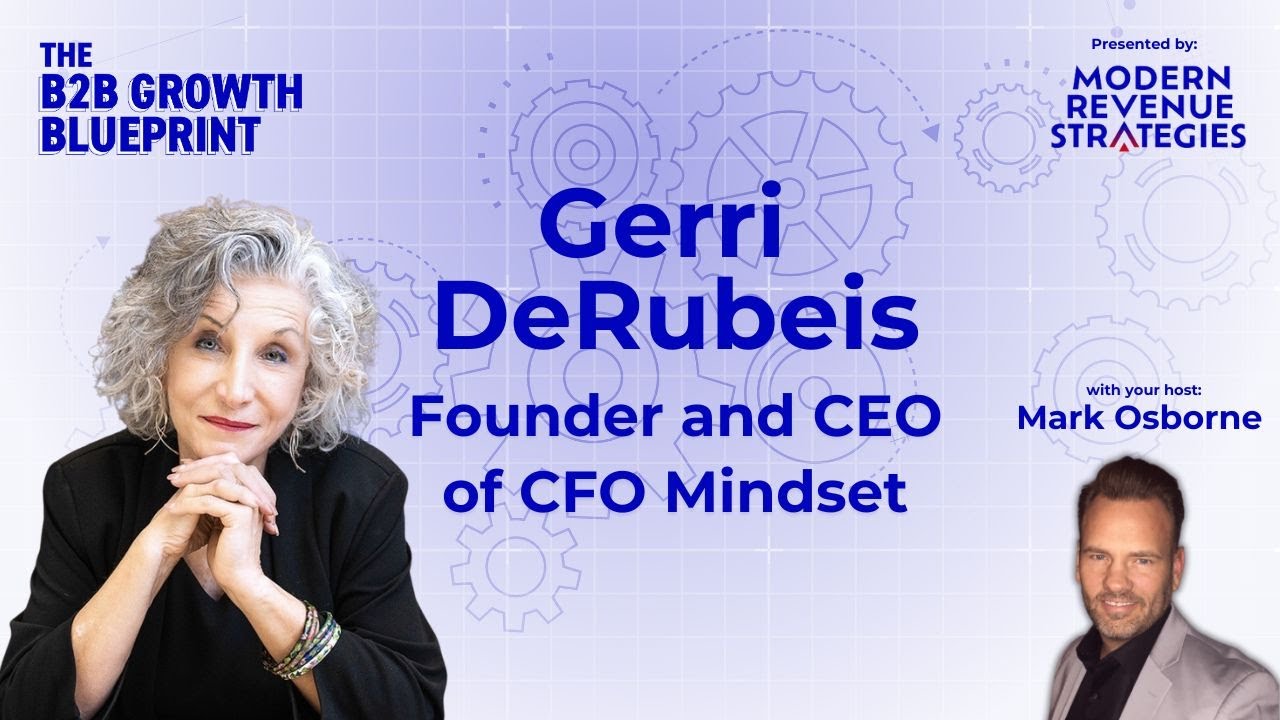
Gerri DeRubeis, a CMA and exit planning advisor, discusses how business owners can prepare for a successful exit through value acceleration, systematization, and financial discipline. She covers owner dependency, building accountability with EOS tools, and translating vision into a 3-year financial plan with 90-day execution sprints.
Chapters
Welcome to the B2B Growth Blueprint podcast, where we talk with entrepreneurs, founders, and leaders at B2B services, tech, and SaaS companies to learn the systems and processes they've used to create success for their business. We'll also learn from marketing and sales experts to provide insights to help you grow your business. I'm your host, Mark Osborne, and the podcast is brought to you by Modern Revenue Strategies and their 10X ROI B2B Growth Guarantee. Schedule a free diagnostic call to learn the fastest path to double your B2B revenues in just 90 days. Hello and welcome to another episode of the B2B Growth Blueprint Podcast. I'm your host, Mark Osborne. And today, I'm very excited to welcome my guest, Geri DeRubis. Now, Geri is a Certified Management Accountant and Exit Planning Advisor with 20+ years of financial leadership. As a founder and CEO of CFO Mindset, she helps small and medium-sized businesses accelerate value, drive profitability, and protect their legacy. Having grown up in a family business and led several businesses of her own, Geri brings firsthand insight into the challenges of privately held companies. She specializes in guiding owners of $2 to $20 million enterprises to make smarter financial decisions, reduce risk, and unlock long-term growth. Through her company, CFO Mindset, she delivers CFO-level expertise without the full-time cost, equipping business leaders with the tools to scale, Safeguard wealth and prepare for successful ownership transitions. So, Jerri, welcome to the show.
Well, thank you, Mark. Pleasure to be here.
Absolutely. So, we've got some fun topics lined up to talk about, but before we dive into some of those specifically, why don't you give our audience a little bit of a picture of sort of your background and the different things that you've done that sort of led you to where you are today?
Of course, Mark. Well, I'm a third-generation immigrants. And so that means my grandfather was born and my grandmother in Poland.
Okay.
And so I didn't really know how, how that might play out in my life. But I do know that they gave me the very strong work ethic that I have and desire to build. And so my mom and my dad owned a business. We worked in it. It was a restaurant and we learned hard work. I married into a restaurant family and then we got into selling products and cameras at that time when it was really big before the internet started to be very big because that really turned upside down that business model of selling cameras and photo finishing.
Yeah. What, so I have to ask what kind of restaurant, what kind of food?
Yeah, it was, uh, uh, one of them was like a restaurant bar and one of them was a coffee shop. And we had 2 businesses the family had. One was on 8th Avenue in New York and one was on, uh, 7th Avenue. When I went back to New York, um, in the last few years, a coffee shop, Starbucks, was on that corner. So that was a great corner and we did make good money then. Yeah.
Well, and they're still serving coffee there, so.
They sure are.
You were on to something.
No donuts.
No donuts. Well, so it's interesting. You and I met through Exit Planning Institute, and both of us are Certified Exit Planning Advisors, right? And a lot of folks, when they hear that, they think, oh, well, I'm not planning to exit. I'm new in my business. I'm planning to grow. But you and I have chatted about the fact that The things that make a business attractive to an outside buyer are also the things that make a business really prepared to scale and grow. And I know you spend a lot of time helping companies to really sort of scale and grow by getting their foundations right. Talk to us a little bit about some of those elements of foundations that, you know, although they align with making a company more attractive to an external investor, are also really important just for early-stage companies as they're trying to grow.
I would challenge everybody when they just think that they shouldn't be thinking about exit because exit is not just the endgame. Exit is a strategy on how you run your business. In the CEPA world, we talk about value enhancement or value acceleration. And so accelerating the value of your business so that every 90 days you have the opportunity to make a decision. Should I continue to grow or should I look to sell? And so definitely it's not just to sell.
That's right. Well, and also there's a lot of things that, you know, happen beyond your control. Like we live in a very unstable world and a lot of volatility.
Absolutely.
Not only with sort of market conditions, but, you know, they oftentimes say, you know, sort of the 5 Ds of things that could happen to you. You could, you know, you could get ill or, you know, have some disease or disability and needs.
Absolutely, absolutely. And it's very easy to plan for the death. You can have life insurance, right?
That's right.
It's much less easy to plan and execute for the life after the, the owner might stop working full-time in that business. I'm working with a couple of businesses right now. One particularly comes to mind that the owner is transferring ownership to his children, and it's the first time that he stepped back. And indeed, you know, this business that he's gifting to them most likely is a very different business than he grew. And so you never know what's going to happen, whether the economy— economic issues change, whether you get dropped by a key customer, or you have union issues. You never know what's going to happen. And so you have to be preparing from the beginning of your business to say, what is going to be there at the end? Because there's 2 kinds of business owners, right? A lifestyle business owner, they're just working to provide for their family and have a good life. And most million-dollar businesses, they really are profitable. And the reason why is because the owner's doing most of the work.
Right.
And that's great. If you do 5 jobs, you can make hundreds of thousands of dollars. But People burn out and/or want more. And so the legacy for a million-dollar business is very— not very often that it's able to be continued and go to the children or be bought by someone else if indeed there's an issue with health or a marriage breaking up or a partnership breaking up.
That's right. Well, and the thing that people don't think about a lot too is what if that unsolicited offer comes along? You know, even if you're in a business that's growing fast and you're building lots of stuff and you're thinking, I'm going to run this until it achieves $100 million or whatever it might be.
Absolutely.
But then someone comes in and makes an offer. If you've sort of thought through some of those components of, you know, is this something that is transferable that I could sell? Or, you know, what do I want to get out of it if I do sell? What do I need to get out of it if I do sell? If you've got those things in place, then you're ready for that unexpected consequence that may come along.
Good point. Good point. And indeed, people make offers of interest all the time. I have clients telling me, oh, I have lots of people calling me up, they're interested. They're not really interested, they're hunting. And so what would make them really interested when they come and do due diligence on your business? And not only do they look at the numbers, but they look at how does the business survive without you. And very often they're going to only make an offer contingent upon the owner staying at least for a few years to make sure it succeeds. And that's a very different dynamic usually than that owner has had, where he makes all the decisions and he doesn't— He doesn't get anybody talking to him about if he spends too much money on entertainment to be thinking and be successful at being an employee of someone else. And then the offer is contingent upon that. So that's a challenge. If your systems aren't in place and you aren't running the business already like that, it's a very hard transition to make.
So, you hit on something that's really key that I think is worth exploring a little more, which is this idea of sort of owner dependency. And it's one of the key factors that makes a business sort of not transferable. It's also one of the key factors that makes running a business really unpleasant. If it's entirely dependent on you as the owner, then you can't take vacation, you can't, you know, Go to the baseball games or the school plays or whatever it might be. What are some of the ways that you have seen be successful in helping businesses grow and evolve from kind of this 100% dependency on the owner where they're doing 5 jobs that has them working 80 hours a week and maybe they make some good money from it, but they don't have the time to enjoy that?
Right.
How do they make that transition? What are some strategies you've seen that to help?
And I think it's all in the education.
Okay.
Interestingly enough, a client I've had for 10 years that we've gone through this process, and I never ever gave him any kind of information on what are some of the challenges that founders have. And it shocked me that he recognized himself in that. And that's probably something I should have brought up years and years and years before. And you think everybody knows it and they don't.
Right.
But the issues that people have are common, right? Every business owner I've ever met thinks their business is special.
That's right.
And no one else has a business like mine. And if that's true, that's never gonna go anywhere because that's always gonna be dependent on you. If you can't systematize some things, if you can't train other people to do the thing that you do well, that's going to be a challenge. But yeah, that was a really interesting experience.
Well, and it's that systemizing that really sort of creates that opportunity for scale and growth too, because if it's all dependent on you as the founder or the owner, you can't bring in other folks to help you do it because it's really dependent on you.
And a lot of business owners, when they're even at, you know, $4 or $5, $10 million, they're still the ones making all the key decisions.
That's right.
They're still the one that nobody else can make decisions. And that is unfortunate because that bottleneck in essence is the owner himself. Or herself.
Yeah, we oftentimes help people start to understand kind of where they are on the continuum by saying, you know, these key processes, whether it's sales or marketing or, you know, sort of fulfillment and delivery or finance, whatever, sort of the key things within the business, you know, on a scale of it runs completely without me To, well, I do everything related to it. Where are you? And oftentimes people sort of overly estimate how much they've delegated or how much it exists. And then you ask that question of, okay, so can that person make a decision on it or do you have to make the decision on it?
Absolutely.
And very often they're like, well, I'm still making the decisions.
Right.
And we're like, well, then that means you're, you know, way past that middle point. In terms of how distributed it is. If you're—
And it is interesting because they think they've given up that authority.
That's right.
And they nod their heads every time you come up with the ideas that would change that dynamic. And they say, yes, yes. But the proof is in the action. You can say yes, yes, all you want, but if it doesn't happen, That's right.
Well, and it is that sort of removing of bottlenecks that creates businesses that can really grow and thrive because the way to remove those bottlenecks is to create systems for evaluating and making decisions and then empowering other folks to do it. I was having a conversation with someone actually earlier today and they were saying not only does that empowerment of your team You know, remove some of the burden on the owner. But it also ensures sort of better longevity with those people because those people don't like sort of being micromanaged where they don't have any sort of autonomy. And so, you're likely to lose these good people that you really depend on if you don't give them that autonomy and give them that opportunity to make an impact.
Within the bounds, right? And that's the challenge within the bounds of accountability.
Yeah.
And so, you know, sometimes running a business is sort of like raising children, you feel like. And, you know, if you weren't such a good parent in that accountability area, you might not be such a good owner. And so you need to get educated and to exercise those skills or that muscle. And that can be trained, accountability and holding people accountable. That's a muscle that has to be exercised and exercised and exercised. So if you weren't so hot with managing the accountability for your kids, don't worry. That is something that we can help you form that habit and muscle.
So let's talk about that a little bit. Are there some sort of tips or tricks you have that when you're working with someone to help them Kind of start to let go and kind of start to build some accountability from other folks? What are, what are some ways that you've seen be successful with that?
So I go back to EOS, which I think is a great operating system for small to medium-sized businesses. And it, it has, you know, key tools that they use and I use in my practice too, which is an accountability chart.
Yeah.
So just defining what is that person responsible for and who's responsible for, because a lot of smaller businesses, they're not going to be able to answer who's responsible for it. And most likely that's because it's really the owner that's responsible for it, right? And so starting to educate them on there are different roles and responsibilities, and to grow larger, you have to give up some power But you have to maintain the accountability for meeting the goals and/or if something's not going well, to be able to pull up and say, let's change our game. And that's where I look at the numbers. If you give me your income statement and balance sheet over the last 3 years, I can tell you what happened in your business.
Yeah.
And it is your story. And if you don't know your story, which is how to read your income statement and balance sheet, and what all the actions are that impact that income statement and balance sheet, you don't know how and if the decisions you're making are improving your business or not.
Yeah.
And so that is a disconnect I find. Even in EOS, they talk about key metrics, and I love that. Key metrics are important, But what are key metrics connected to meeting some kind of goal in sales volume, which is usually growth, but not always is growth more money or growth more profit, right?
Yeah.
But having that plan, that vision put into numbers so that you can say, see, is this reasonable and feasible? I want to grow 20%. Well, is that possible? in this industry, in this geography, in the way you're doing business? And if not, what changes do you need to make? And so all the accountability comes back to impacting something on that income statement and balance sheet. And that's the basis that people who are buying businesses want to have going so that they don't have to come in and change everything or come in and put a new management team.
Right.
And so that's why that infrastructure of having more than one person make decisions, more than one person give input on better ways to do things, is an integral part of what improves your multiple, which is what we're wanting to do— improve the multiple, whatever multiple it is in your industry, in your geography, for your size. Improving that multiple is not just growth. Improving the multiple is being able to have those systems and people and systems people. What is it? It's human capital, structural capital, financial capital, and in place in order to improve your multiple.
That's right.
It connects, right?
You make such a good point there. And it's really worth underlining and scoring, which is, you know, what's the the business outcome that this particular activity is tied to? And so oftentimes I see companies where they're like, well, we do this because it gives us better insight or visibility, or we have a, you know, we have a better understanding of what's happening. I'm like, well, what do you do with that understanding?
Right.
And then how does what you do with that understanding impact, you know, Bottom line revenues, or the efficiency, or your cost of goods sold, or the cost to deliver, like the you know sort of churn that you experience with customers, like these actual business outcomes that you care about. And and you talked about the metrics being so important. You know fundamentally there's sort of very few business metrics at the end of the day. Like it's you know how much money do you generate and how much Does it cost you to generate that money? And then, but you can have sort of these leading indicators.
Leading metrics, yes.
But if you don't know the relationship between them and that business outcome, we see people sort of build really complex processes that aren't really doing much for the business. Whereas if you have that clear line of sight of we do this because it impacts this leading indicator, and we know that if we impact this leading indicator, This business outcome changes.
Great, great point. That's definitely— and it's for new business owners especially. And I'm going to say that most new business owners, in my experience, are the operators, right?
That's right.
If you have 3 kind of like areas of the business— get the business, do the business, keep score. Most people who start businesses are either in the operator side or they're the rainmaker, right? They can get sales. I've never— I've only once in the hundreds and thousands of businesses I've been to have seen somebody that was in the finance.
Right.
And so that area of the business, it's very rarely that you have somebody already in the business that's strong in that. And so that, that doesn't mean they can't be educated, and that doesn't mean we can't help them to be the CFO of their business. Or if the wife is the partner and keeping the books, that they can't be the CFO of the business, but somebody has to be the CFO of the business, especially as it becomes more complex and the volume goes up and the money's coming in and out are more, more volume. It just, it's ripe for fraud, theft, and just having a disaster when you least expect it if you don't try to get educated in that area. So.
Yeah, well, you raise a great point. And I've seen this happen to many businesses where the founder or founders, you know, are more passionate about either creating the solutions, innovation, Or they're more passionate about working with clients and delivering it. Maybe it's from the sales side, maybe it's from just actual project side, but they don't really have a passion for those back-of-office things like the finances. And so, they will sort of abdicate that to someone else.
Mm-hmm.
Maybe it's someone external, or maybe it's someone in the organization who may or may not be super qualified to handle that. But The, those founders, owners are just happy to have it off their plate, right? What they don't realize is that by sort of abdicating that responsibility, they could be setting themselves up to sell deals that aren't profitable, uh, to create innovations that they can't support or deliver.
Nobody wants, maybe.
That's right. Or yeah, or to lose money on every client. And so growth is actually, you know, you're growing broke. As they say. And so, we always encourage the folks that we work with to have enough knowledge about their financial picture to where they can at least kind of provide some oversight for whoever's managing it on a day-to-day.
Absolutely.
And say, yeah, we are growing in the right direction. We're not growing broke. And oftentimes, at fast-moving companies especially, they're like, Let's just worry about getting money in the door. We'll worry about how we, uh, how we spend it later. But, uh, that can oftentimes, uh, be a slippery slope.
And interestingly enough, when I ask people who has that understanding, it's usually they say their CPA, right? And maybe there are CPAs who are financial managers of smaller companies, but I haven't met very many of them. Um, a CPA by training and, um, licenses is an expert in taxes.
Right.
And some of them can be experts on the transition of the corporation and the recalibration of your cash, but the actual— what are you supposed to be looking at to make sure that what's happening, what you think and want to happen, is actually happening, is very rarely the CPA that puts that together. And so CPA is very important. You don't want to go sideways with the government, but the government does not help you run your business. The government wants the money whether you have it or not.
So you, you tease up something that I'd love your insight on, which is I've heard it said that, you know, your CPA is your historian. They help you document what happened, uh, and, and maybe a little bit of why, but mostly they're just documenting what happened so that you can then pay taxes against that, so that you have a reporting. Your finance function is the person that's helping you see what's gonna happen, or what do you need to change in order to achieve future outcomes that you are looking for. Would you say that's a pretty good—
I think that's really a good way to look at it. Also, if you're wanting to forecast the future, you do need to have some understanding of the past. One of the first things that I do with a client is look at their 3-year history against each other. And then I look at the key metrics in their income statement and balance sheet against what their industry benchmark is.
Right.
And very, very rarely are industries sharing those benchmarks very freely with the smaller businesses. The construction industry is really great in this because Construction Finance Association, they compile statistics up the kazooey, and if you're a member, you get those statistics every year, right?
Interesting.
But it's very rarely that the smaller businesses even understand that there's benchmarks. Again, you go back to my business is And definitely every entrepreneur has a little bit different spin on how they make money.
Sure.
Absolutely. But when everything is said and done, nothing new has been invented under the sun. You need to get the sales, you need to do the sales, and you need to keep score so you are able to make changes as you need to and fast. You need to be flexible. And you need to be fast. And so if I'm looking at an income statement to a budget that's 2 months old, it's useless.
Right.
You need to be looking at those key leading indicators and then those lagging indicators as soon as possible. And your books should be kept— I just had a discussion with a client on this— the books have to be kept not after the fact, but as you're going. Your books should tell you So that by the time you get to the end of the month, very little would change when you reconcile your bank accounts.
Yeah.
Very little. Maybe you'd miss something, but it would be not material. You should be able to know really very quickly how did you do. And if it's good, yay! If it's not good, you need to make changes.
That's right.
Owners are The ones that need to— managers and owners are the ones that need to make the changes when things aren't going to the place that you're wanting it to go.
That's right. That's right. Well, and if you don't have that timely information, you can't tell if you're on your way there or not.
And I will say one more thing, that taxes are paid on a cash basis.
Uh-huh.
Until you're about $10 million in sales, right? But if I'm $2, $3, $4 million in sales and I have a business where I have accounts receivable and accounts payable, cash accounting doesn't do anything for you. It doesn't help you understand if you're making money because it only tells you I collected the money, and you could be collecting the money at a time when you didn't have any business, or you had too much cost and things were going awry. And so this accrual is a mystery to people, and I just talk about it. I have to see up against each other. Did I make money when I billed that invoice and I had the cost for that invoice? Is there any money left over? I don't care about the cash in that respect. Although the cash is important too, right? But if I could be a big business, I just had a big business go down in sales from, oh, 50, 30, 20, 10, 7. They had lots of cash. So much so that maybe the pressure wasn't on them to make changes fast enough.
Interesting.
So having cash does not also always guarantee that you're making money.
Yeah, that, that whole concept of growing broke, uh, that, uh, I've seen businesses that they don't think about the cost to deliver. They're just like, just get it in the front door. We'll worry, we'll worry about it later.
Right. The opposite happens too. You don't worry about the cash because we're never gonna have cash if we grow. Well, that's absolutely true that the cash doesn't appear from anywhere. You either have to have saved it from your profits to use, or you have to finance it, or you have to get investors.
Yeah. So, Gerri, you're obviously an expert in a lot of really interesting topics that we could talk all day about, but I got to be mindful of your time.
But, and thank you.
Yeah. But before I, before I let you go, you know, give us the pitch a little bit. Like, who do you work with in your practice, and, and what do you really help them achieve?
I, I see myself as an educator, and I'm, I'm passionate about empowering business owners with the tools and the education that they need to grow smartly, maximize their profit, and grow confidently. And so, you know, I, I work on their businesses in many areas. I do Assessments to see where you are financially and what systems, uh, you have or need to have in order to be seeing your numbers in a timely manner and doing something about it. I work with owners to turn their vision into a financial plan. There are lots of financial planners for people, but there's not a lot of financial planners for business.
Mm-hmm.
And so if you have a vision, we have to translate it together to a 3-year plan, and then we have to see if that's going to be realistic and doable or not. And then we need to see every month, which is the roadmap. We have to see if we are meeting our roadmap. Did I make the profit I expected? If I didn't, was it because I didn't sell enough, or was it because my operations didn't perform at the rate that they were supposed to, or was it because I spent too much money in overhead? Um, this plan is not just for the bank so that they'll loan you money or have a line of credit. This plan should be for you so that you can have your report card every month to see, are we on track? Are we going off track? And if we're not, on track, what are we going to do to change to be on track? For me, if you don't have that in your business, you are not— you're flying blind. Flying blind.
Right.
So, and so that leads us to then growth. You asked me what I do, and that's what brought me to become a CEPA® like you, is because there's a lot of things to do with growth. It's not just Sales. It's operationally, are you good? Can this business survive without you? Do you— have you de-risked your business? Have you the insurance you need? In project management, do you have the holes, you know, closed up where you could leak profit or have high risk? And then, then you Make the decision every month, and it's your decision. Every 3 months, the 90-day sprints we call them in the CEPA world, you can make the decision. Do you want to grow or do you want to sell? And you could be then confident that your business is worth something instead of just hoping. Hope is not a strategy. We talked about that before.
That's right. That's right. So for folks listening in the audience that would love to get more from you and learn more about how they can really capture and take more control and not just be hoping that they're growing, but actually knowing that they're growing, what's the best way for them to get in touch?
Right. On LinkedIn, I have all my contact information. I also have a link to my calendar. You can make a half-hour, you know, meeting with me and we can talk.
Fantastic.
We can see if there's something that I could do to help you. I'm happy to help people. Of course, I would love it to lead to business, but I'm passionate about helping entrepreneurs. I actually am a mentor and have been for several years with the Latino Action Business Network.
Okay.
And so I'm doing it again this year, and I'm happy to give advice. The thing is, People often need more than advice. They need help to execute. And so that's, that's where I am. So I want to educate, help, and then help you execute your growth plan.
Well, Gerri, thank you so much for taking the time to join us today.
Thank you.
I enjoyed our conversation.
It was so interesting. I enjoyed it too. Thank you.
All right. Talk to you soon.
All right.
Thank you for joining this episode of the B2B Growth Blueprint podcast. We hope you've gained insights to grow your business. If you enjoyed this discussion, please rate, comment, like on your favorite platform, and share to others who will find it useful. Do you know a CEO, founder, or leader at an early-stage B2B services, tech, or SaaS company who would like to be a guest and share their story? Send us a note. Let's schedule a conversation.
More from Mark

How Can You Maximize Your Business Value Before Selling? with Randy Katz Video







