Why Most Founders Can't Scale Their Business | Brianna Hendley
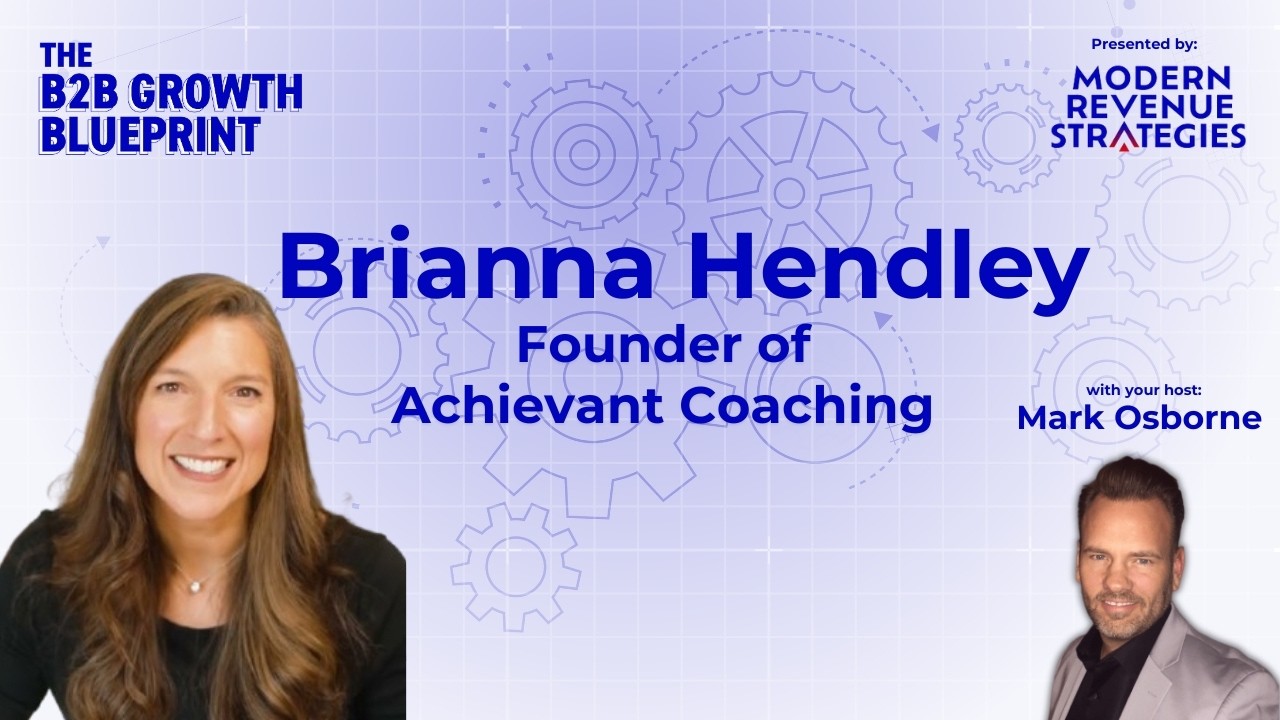
This content was created by Mark Osborne, MBA, CEPA®. This content was uploaded by Mark Osborne, MBA, CEPA®. This is a YouTube-hosted podcast episode titled "Why Most Founders Can't Scale Their Business | Brianna Hendley" (published June 7, 2026) from the B2B Growth Blueprint show. It is an interview-style conversation in English between host Mark Osborne, MBA, CEPA® and guest Brianna Henley (founder of Achievement Coaching). The discussion covers challenges founders face as they scale (when to add management layers, operational breakdowns), leadership development, time management, hiring and delegation strategies, and the eliminate–delegate–automate framework for freeing founders to focus on growth. The episode targets small‑ to medium‑sized business owners, founders, and leaders in B2B services, tech, and SaaS.
Chapters
Welcome to the B2B Growth Blueprint podcast, where we talk with entrepreneurs, founders, and leaders at B2B services, tech, and SaaS companies to learn the systems and processes they've used to create success for their business. We'll also learn from marketing and sales experts to provide insights to help you grow your business. I'm your host, Mark Osborne, and the podcast is brought to you by Modern Revenue strategies and their 10x ROI B2B growth guarantee. Schedule a free diagnostic call to learn the fastest path to double your B2B revenues in just 90 days. Hello and welcome to another episode of the B2B Growth Blueprint podcast. I'm your host, Mark Osborne, and today I'm very excited to welcome my guest, Brianna Henley. Now, Brianna is the founder of Achievement Coaching and a business and leadership coach with more than 20 years of experience helping small and mid-sized companies scale sustainably. She works with business owners and executive teams to strengthen time management, team development, operational systems, and leadership effectiveness, especially during rapid growth phases or succession planning. Brianna focuses on helping founder-led and service-based businesses evolve from specialist-driven operations into structured team-led organizations with clear expectations and accountable management. Today she joins us to talk about things that break during growth and what it takes to build leaders who can carry it forward. So Brianna, welcome to the show.
Thank you for having me, Mark. That was a fantastic introduction. Oh, it was excellent. I love it. Thank you.
So I've been looking forward to our conversation, and before we jump in on some of the topics we've been chatting about, why don't you give our audience a little bit of sort of your background? Tell us the story of the twists and turns that brought us to where you are today.
Absolutely. So I feel like I'm probably one of many that in their 40s decided, hey, this isn't what I feel like I should be doing after having all these years of experience. I'm going to open up my own company. So I started out in the administrative side of the house, thought I wanted to go back and get my master's in teaching, and then decided, nope, there They're not happy either, so let's just stay in the corporate world where I feel like I love the business side of things. And I ended up getting recruited to be a recruiter, so started out in the temp-to-perm world, and that was so exciting. I got to work with a lot of different clients and a number of applicants and really help them move to their next step. So for me, it was almost as if I didn't really know what I wanted to do, but I was able to help other people live their dream and get their foot in the door, keep them moving forward in their career. So to me, that was cool. And from there, I just dove right in, kept on going, moved up into management, ended up working with a government contracting company. And government contracting was a whole new world. Worked with a nonprofit, moved up within that company, and by the time I left, I was a manager managing over 500 people all over the world. So we would place them into military laboratories. So I was dealing with the client military folks. I was dealing with recent grads, bachelor's, master's, PhDs, scientists, visiting scientists, senior folks, and then having to deal with the team back at home, making sure we dotted all the i's, crossed all the t's. So long story short, after, after going through the government contracting side, One of the things that I really noticed specifically with small businesses is that both my parents were small business owners. They both own their own separate businesses. And back before the dot-com, before, you know, www.theinterwebs, there really wasn't much. I mean, there might have been Tony Robbins, but how are you going to hear about him unless you're in that personal space? My parents didn't have time to read books. About personal development or anything like that, so they would just talk to family members who either had businesses or recently graduated college. Like hey, what do what do your teachers say that you should do? What is what is a survey say you should do about sales, about marketing, about all those things? And we're in an age right now to where I mean literally you've got a podcast, I've got a podcast. Someone can go. on Spotify and Apple and say, hey, I wanna learn about business. And it's so easy to get that information.
Right.
Back then it wasn't. And so I, I kind of felt like I was in this, this cool place of being able to help my parents answer some questions that they had. I saw their businesses grow. And as I was out in the workforce working with small business owners, I, I kind of saw some things that happened that they would talk to their employees about things that they had no business talking to their employees about. such as decisions of, hey, we might need to do some downsizing. You know, what do you think about that? Well, when you're an employee, what do I think about that? It better not be me. You wanna get Joe over there because Joe isn't pulling his weight. So the questions were being asked of people who cared about the direction of the organization, not just cared, but they had a, There, it was a part of them, part of their identity in one way, shape, or form. Or talking to their spouse like, hey, what do you think? And they're just thinking, I don't want you to make that risky decision because then that puts our family at risk. And, and we can't— what if it goes well? Okay, well, what if it doesn't? And that's what I care about. So having those conversations, the sounding boards that they had weren't people who could help the business owner think objectively. They were people who were focused on what's in it for them and not really what is in the health and wellness of the company, of the business, of the business owner, understanding what's going on with the market. So one of my areas of genius, I would say, is I know how to deal with people. So I, I've worked in operations, hiring, firing, and when you are a professional, your focus Is how do I get the most work done in the short amount of time? How do I become as efficient and effective as possible? How can I utilize my contacts, my people around me to help them do their job more efficiently, be able to get the information I need and get it off to where they need to go? So there's a lot of time management in there. It's a lot of setting expectations, SOPs, processes and procedures, and then being able to take that and What does that look like as far as money is concerned? What's the return on investment if I do my job well? How much more money are we saving? Or how much more can— more time do we have to go out and build business? Or how much more work can we take on because we're so efficient and we're walking out of this at the end of the day feeling good about ourselves, the people we're helping, the product that we're getting out there, and the people we're serving? So So when I kind of took a step back and I'm like, I kind of like this coaching thing because I have an opportunity to be a sounding board to those business owners, help them really think about what are they doing with their time, help them build a little structure, engage their employees, set expectations, hire the right people, fire the right people within reason, and then really start paying attention to their money. And certain metrics that I'm not your accountant, I'm not your CPA, I'm not your bookkeeper. And there are a couple of things that you need to be paying attention to if and when you can, you want to grow or as you continue to grow. So being able to work alongside those vendors and those subject matter experts to be able to do that. So that's kind of where this coaching thing came from. And from that, there's been opportunities to do consulting, bring in other subject matter experts such as ISO 9001, folks who help with certification, recruiters to help the companies that I'm working with, with recruiting, bring in people who do all kinds of like assessments for benchmarking to bring in the right people to the company. So it's really allowed me an opportunity to work with a number of different specialists. I know we're talking about specialists specifically, but working with specialists to be able to bring a comprehensive plan to my clients so they know they've got a plan in place. Well, now we know how to execute it and the direction to go and ensure that we're doing everything the right way and as efficiently and effectively as possible.
That's great. Well, and it's such a sort of a comprehensive approach, uh, to, you know, guiding your clients. And, uh, I think it's sort of worth, uh, calling out— there's a little bit of a, a curveball for you, but tell us a little bit about the name Achievement coaching? Because I know that comes from sort of a special place.
It does. So one, one thing about me, I love, I love a goal. I love having something to work toward, to strive for. And, um, I, I feel like me as a person, so a little bit about me, um, I, I do bodybuilding. So I, I have a coach, I do bodybuilding. That's kind of my extreme Quote unquote, if you guys are listening and you're not seeing, quote unquote extreme sport. So for me, it's just hitting a goal, creating and providing structure for me. And I know that if I have that for me and I have somebody to be accountable, then I'm going to be successful. I'm going to achieve my goals. So when I'm working with my clients, I have that same mindset of this is the structure For you to become successful. If you follow that, even if you only follow it like 70% of it, you're gonna get so much closer to your goal. And I'm gonna do everything in my power to help you get there. You gotta do the work, but I'm gonna do what I can. I'm gonna provide as many resources. I'm gonna, I'm gonna kind of customize things to you because I wanna see you succeed. I wanna be a servant to your achievement. And that's where Achievent Coaching came from.
Yeah.
So that is my goal. I want to be a servant to your achievement. And my other tagline is, by providing the GPS to your business success. So great.
I love the rhyme. It's hard to not love a rhyme, right?
I mean, seriously, that's how we remember anything.
I love that, servant to your achievement. Uh, and it's such a great, uh, such a great approach. So speaking of that, Yep. Uh, you know, one of the, I know you, you work a lot with founders that oftentimes, you know, are, you know, sort of technical experts. And, and one of the things that I see a lot working with founders is, you know, someone, they work in an industry for a while.
Mm-hmm.
They have an idea for a better mousetrap, so they go found a company to create that mousetrap and they know what's right about it 'cause they just built it. What's wrong about the competition 'cause they used to work there and they've got enough big enough Rolodex. That they can get some clients. So they start to grow. And, and then, you know, maybe the business sort of outgrows their capability or their strength. And on the marketing and sales side, you know, oftentimes they hit some revenue roadblocks. And we have some, some interesting ways that we approach that. But I'm sure they see the same thing sort of operationally and from their leadership ability and their ability to sort of project manage and sort of recruit, hire, and train. Tell us a little bit about some of the challenges you see leaders go through when they bring all this deep domain expertise into founding a company, and then that company grows. What are some of the signals that you see that are sort of signaling like it's time to build some management layers? And then where are some of the places that it starts to break down? What are some of the roadblocks that you see Uh, companies run into as they, as they grow and scale.
Absolutely. So, uh, one of the clients that I've been working with most recently, uh, he's got a— he's— it's him and his, um, father. So they have their own business and it was the father's business before and he took over. So it was kind of a small business that was going and running and he took it over and he is a sales and marketing Dude, like, that is his jam. He lives in— he doesn't even need to try. Just, it's just who he is. And he's been able to blow this business up in a fantastic way. And at the same time, he is the main person in the business.
Right.
So his father's the specialist, he's out there doing the sales, and he's picking up all the extra slack. They have a couple people that work for him. For them as a whole, and he's finding he can't do it all. He's working every weekend. He's not showing up the way he wants to for his family. His wife is pushing back and saying, hey, you're coming home so frustrated and so irritated. And so they even had something happen with his kid and had to bring his teacher in like, hey, what's going on in the household? But you got a lot, you got a lot going on because this kid's stressed out. And it's like, all I'm trying to do is make this business go so it can help the family, so it can, you know, put food on the table, pay for mortgages, to, you know, do all these things that we said that we wanted to do with our life. You know, I'm living the entrepreneurial dream. I've got, you know, I'm— You're doing great. I've got my golf club membership and I've got, you know, I've got like a boat and I've got a beach house and I've got all these things. And it's like, I don't have time to enjoy any of it. And my family's stressed out and I'm stressed out and I know I need to hire somebody. Who is this person that I need to hire? I need them to have— I want to be able to unload everything. So you and I both know that You're the business owner. You're, you're, you got your hand in a lot of different things, and there are certain things that you want to focus on because that's what you're good at. That's your area of genius. And there's other things that you want to let go. So being able to work with that business owner, number one, to understand what's really important to you. Is it your time that you can spend with your family? Are there certain boundaries? Are there certain things that you want to make sure that you can show up for, like Saturdays and Sundays? Make sure, hey, I don't want I don't wanna have to work on those days. Or in the evenings, I wanna make sure I can turn everything off by 7 o'clock so I can put my kids to bed, so I can eat dinner with them, so I can show up and coach with them. And a lot of business coaches don't attack the personal side. And that's one of the things that I do because you are not just a business owner, just a specialist. That's not who you are. You are a—
Human being.
A son, a daughter, a wife, a husband, your brother, sister, father, mother. There's so many other things that— a friend. There's so many other things that make up who you are. And typically when you go into business for yourself, it's because you want that freedom. That's what I hear all the time. I don't want to have this boss that doesn't have our best interests in mind, that is just making decisions, not taking into account, cutting our bonus structure, commissions.
Right.
You know, they're, they're not not doing things the, the right way, whatever the right way looks like. You know, everybody has their own thing, and they create this business, and when it goes well and they're having some frustrations and troubles, we really have to dig down. Okay, well, let's figure out, first of all, what do you really want as a business owner? Number one, what do you want to be doing? What should you be doing? What, what gets you excited? What lights you up inside? And then let's figure out who else you need to bring on board. What makes most sense for where you are as far as, are you sitting at $5 million, $10 million, $15, $20 million? Which direction are you going? How are you growing? Are you doing more corporate things like commercial business? Are you doing more residential if it's a type of business that does B2C?
Right.
So really figuring out Okay, who are you as a person? What are your expectations here? Where are you going? What do you wanna do? How do you plan on growing? And then let's figure out the things that you should be doing and the things that somebody else should be doing that makes most sense for the business. And that sounds easy for you and me to sit here in a conversation like, oh yeah, that's easy.
Right.
Let's, this is, this is like a 30, 30-minute conversation. We can solve all the world's problems over a beer or some coffee, right? We can, we can do that. But it's a process and it, it takes a little bit of time. So in, in working with business owners, I feel like that's probably the most fun is doing for me, because I really see where they might have been closed or fearful, scared, shame, anxiety. There's all this stuff that's rolling around their head because they've got this little voice that Talking BS, that's saying all kinds of stuff that's holding them back or stopping them or or just putting them in a little bit of a loopy anxiety spiral. And we don't have time for that. We don't. We there's there's too much stuff to do. Let's you got your your families to lead. You've got your business to lead. We got your clients that are depending on you. So we need to get out of that. And what I always tell my clients is instead of going down the rabbit hole. We need to start working up and thinking in possibilities. Because when you go down the rabbit hole, that anxiety, that energy is nervous and not good and extremely negative. And that's not— depends on the type of person you are, that's not the energy you wanna attract.
That's right.
And it doesn't light you up. It doesn't get you excited. But if you're able to do that flip of, okay, this bad thing happened, this client just left me, I don't know what I'm going to do. And then you start saying, then I won't be able to pay my mortgage. I won't be able to pay my team. I'm going to get in a thing. If you're thinking in a different way and you're thinking in, okay, this client left me, but then that opens up time. It opens up opportunity. Maybe that's not the right client. Where should I be focused on now? And what if I focus on this? Maybe they're going to pay me more.
Right.
Maybe it's a whole different area or arena or, or place that I've never been before that's going to provide excellent, amazing opportunities, connections. And then when you start thinking in that way, you start getting excited. And that's a different kind of energy that you're bringing in. And don't we want to be in that energy?
Yeah.
Instead of the negative. No, yeah, we want to be in the happy energy because then you're seeing things different. Your perspective is different. And I find this with all, all, all, every single one of the business owners that I work with. even if they have a happy disposition, there's always those moments, there's always those little loops that kind of bring them back in.
Of course.
So that's the other beauty of being a coach and doing what I do. Same with leaders. It's like, hey, it doesn't matter. That doesn't matter. Let's start thinking in what could happen, what amazing thing could happen, not negative, what amazing thing could happen? So being able to push people in that way, and usually that helps them break through to be able to take that next step Oh, okay. Yeah, we could have an operations director come in and, oh yeah, I could pay them $180,000 because they get to take all this stuff from me that I don't have to deal with anymore. And they can—
Right.
We can put systems in place. We've got these processes. Nobody follows them.
Right.
So they can, they can now start following processes and have somebody to answer to. Have a team meeting rhythm every day so everybody knows what's going on at all times. So again, being able to help business owners kind of get out of their own way, but usually that's when they know they have a problem is when they're stuck. So that's usually what opens up that door.
So your passion is obvious and I, I love it. And I also love how you take a really sort of holistic approach to not only sort of the person as a business owner, you know, leader within the organization, but also as a person that has a space outside of that and then an identity outside of that. And really this idea of, you know, kind of starting with, you know, where are you and where do you want to go? Having that end in mind because, you know, so often companies kind of operate today not thinking about the future and, and then wind up making choices today that sort of limit their potential. So I love all that approach. We see so often that companies don't want to take the time to have that holistic sort of thinking. And they're like just hoping, well, there's a magic bullet out there. All I gotta do is hire a salesperson and he'll be exactly like me and we'll double our revenues, but without building the process for that salesperson to thrive within. They're never gonna have that success. Or, you know, and on the marketing side, well, we'll just hire an agency and so they'll buy some ads and then it'll, it'll bring in all the leads we need. Well, without creating the strategy around what you say and, and, and how you're unique in, in the marketplace, no amount of ads is gonna sort of COVID that. So I love this sort of really holistic approach that you bring. And you talked about something in there that I, I think is really worth bringing in. And I know you've got this sort of really great phrase around sort of eliminate, delegate, and automate. And we've talked about this before, but, um, you know, as companies are growing and scaling and, uh, you know, trying to balance all of these different, uh, you know, sort of opportunities, uh, as well as just sort of challenges, talk to us a little bit about this idea of eliminate, delegate, automate. Are there things that should never be automated? Are there things that where automation can create fragility within the market? Or how do you, how do you sort of approach that?
Well, I love that you asked that question about should everything be automated? Because in this world of AI, Mark, everything should be automated.
Right. Certainly lots of people will say that.
You should be able to open up your laptop and everything should be done.
It just runs. Why do we need you? Just open your laptop.
It's like, it's just magic. So, so, so with that being said, I, any entrepreneur, I don't care how big or how small you are, I feel like the bigger entrepreneurs, I'm gonna throw this out there, Steve Jobs, fantastic with eliminating, delegating, automating, and streamlining. I mean, granted, he wore the same outfit. He didn't deviate. He took away decision fatigue. And right now, with all the things that we have going on, I mean, you just sit at your email inbox and you're gonna get decision fatigue.
It's true.
I mean, you can't— you're not even looking at social media. You're not even looking here. You're just looking at your inbox. So when You're first starting out, and you're having those conversations with just a solopreneur, and the conversation comes down to, "Hey, I don't have enough time." Okay, you don't have enough time. I want you to take a look at the things around you and think about what are the things that you love to do, and what are the things that you don't love to do? And I'm just gonna. Take where again we're going to go in that holistic approach because I feel like with solopreneurs and and founders who are just starting out maybe have a couple people on their team they feel like they need to do it all because they are holding on so tight to the money they're they're holding on tight because every dollar matters everywhere where they put that dollar is important and the more that I can do the 24 23 and a half hours that I can work that I'm not paying to somebody else or something else is going to be well worth. My time, and I'm going to say that that's not true. So, so when we're talking about eliminate, delegate, and automate, the piece that is so important is you look at the things that you're currently doing and you say, "What is it that I can take away that I can literally not do?" You don't have to do everything. So what are some things that if I don't touch it? Nothing's actually going to happen to it. It's going to be okay. I can pick it up later. One. Number 2, what can I eliminate and give to somebody else? So what is something that I can delegate to somebody else? And just in this example alone, when we're talking about delegate, let's think about cleaning your house. Most, most women And men, they think about, well, it's easy enough. I can just take 10 minutes here and 10 minutes there. But that's a stressor that they're looking at. Well, who's going to clean the bathroom? Who's going to clean the floors? Who's— you're already doing the laundry. That's another thing. You're already washing the dishes. You're already cooking meals. That's another thing you can give away, right?
Right.
There's, there's other things that you can give away in your home life that will help free you up because Most people work from home these days, especially if you're a smaller business, you're working from home and all you're doing is you're looking around and seeing all the things that need to be fixed, all the things that need to be done. So if you're giving that to somebody else, you're allowing somebody else to do that. It's in their area of genius. This is what they're good at. They could probably do it better than you, quicker than you. And again, did I say better than you? Better than you.
Yeah.
Than, than you can, cuz you're worried about Getting everything done, they can do it, and you can pay them to do it. Now think about how much you make an hour. This is an easy way. I feel like it's kind of easier for those who are more on a salary that they can figure out. Okay, you know this is the amount of money. A great way to do this, and I see you smiling, is you can take what you made last year, divide it by 2080, two zero eighty. That's the number of hours in a year, and you figure out how much you make an hour. And And then you think about, well, it might take me 4 hours to clean my house. Well, if I make $100 an hour, let's just say, if I make $100 an hour and it takes me 4 hours to clean my house, that's $400. Don't you think you could pay somebody probably less than $400 and they could do it better and more efficient than you? And if it's not something that you enjoy doing, Right. It's one less thing you have to do. It frees you up to think creatively and to go out and do more business development stuff. Now, the trick to that is taking that time that you would normally spend and actually applying it to your business. So, right, you gotta apply it. It can't just be, I'm just gonna let it go and I'm gonna go get a massage. I mean, you could, but that kind of defeats the purpose of that delegating and really taking that time to where you're building your business, you're doing things for your business. And then, so we have eliminate, you get rid of it, you delegate it to somebody else. And if it's something that can be automated, then do it. Just like you might automate your mortgage payment.
Right.
If it's something that can be automated, automate it. And I feel like even outfits, like I'm going to go back to the Steve Jobs thing. If you can have a uniform that you wear all the time, maybe it's not just the same color, but maybe it's the type of outfit or like the type of shirt you wear and pants that you wear, buy them in every color that you want, and then you don't have to think. It's taking away that decision fatigue because that's typically what slows us down. So it's taking away— the goal is take away things that you don't have to do and take away decisions that you don't have to make so you can spend more time thinking, focusing on the business and not on other things that really Yeah, that's so true.
So true. And so many of those things we could kind of unpack and talk about all day. Each thing.
Each thing. Yeah, I know.
Each of them. But I got to be mindful of your time. But before I let you go, like, give us the pitch. Like, sort of who do you work with and how do you help them? Who are, who should reach out? Yeah.
So I work with medium business owners. I say small, small to medium business owners. I really help them with their time. engaging their team and paying attention to their money and the things that actually drive and move their business forward. So I, I have a coach. Not only do I have a business coach, I also have a personal fitness nutrition coach. And one of the things that I find is, as an entrepreneur, it's just so easy to let things slide.
Mm-hmm.
And when we have big hopes and we have big dreams and we have amazing things that we wanna accomplish, Why not bring somebody in who can hold you accountable, can help you think differently in a positive way, help you work step by step to actually achieve your goals and not just have it be a hope? Because a hope is not a plan.
Right.
But it's not just having a plan, it's having a plan that you execute. So being able to execute on that plan and get to that place of where you wanna be. So Again, not everybody wants to do that. Some people feel as though they want to do it on their own. I'm looking for business owners who want that extra help, who want somebody that they can have as a sounding board, who truly has their best interests in mind, that my focus is on you and moving you to that next step and just being able to be a partner in that and, and helping you grow and get there and being able to coordinate and connect with people like yourself, Mark, who when they're ready to rock and roll and get out of their business, that we're connected to the right people to get them where they want to go. And that piece is super important to me too. I love connecting people and getting them in, in front of the right vendors and people that can take care of them.
And, and what's the best way to get in touch with you?
So for me, you can go to Achievent. coaching.com. That's A-C-H-I-E, V as in Victor, A-N-T, coaching.com. And all of the information is there, including my podcast, the GPS to Success podcast, and the Been There, Sold That podcast that I also have with Phil Whitebloom, a sales coach. So all the information is there.
Well, Brianna, thank you so much for joining us today. I appreciate your time, and I learned so much. I'm sure our audience did too.
I hope so. Thank you so much for having me, Mark. I appreciate it.
Talk to you soon.
Take care.
Thank you for joining this episode of the B2B Growth Blueprint podcast. We hope you've gained insights to grow your business. If you enjoyed this discussion, please rate, comment, like on your favorite platform, and share to others who will find it useful. Do you know a CEO, founder, or leader at an early-stage B2B services, tech, or SaaS company who would like to be a guest and share their story, send us a note. Let's schedule a conversation.
More from Mark

How Can You Maximize Your Business Value Before Selling? with Randy Katz Video







