Your SaaS Isn’t Failing Because of Product—It’s Failing Because of This One Mistake
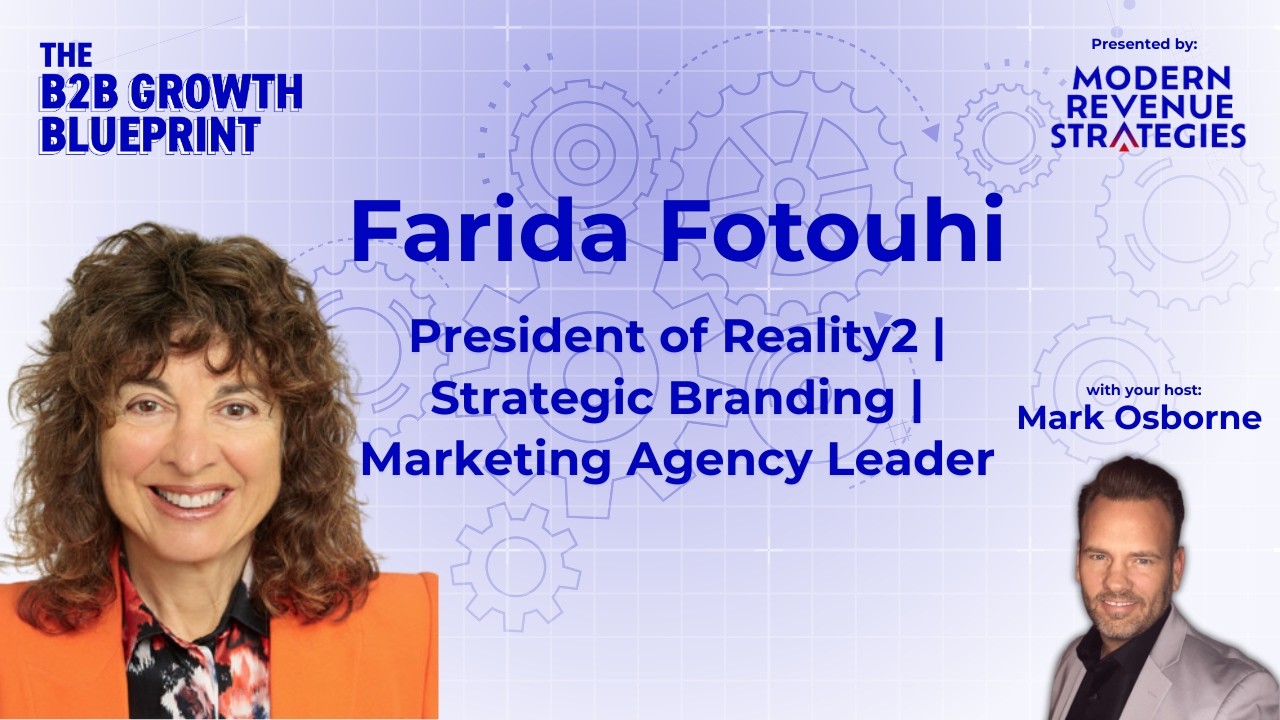
In this episode of the B2B Growth Blueprint podcast, host Mark Osborne interviews Farida Fatui, president of the strategic branding firm Reality 2. Farida frames her role as a “translator” who bridges the gap between technically‑focused founders and the language, culture, and concerns of target buyers, investors, and partners. She explains why many SaaS and technology companies stumble not because of their product but because they fail to communicate value in a way that resonates. Key points include: the need to “dumb‑down” technical concepts for a six‑year‑old audience; crafting a clear, benefit‑focused value proposition that avoids technical specs on the homepage; staging a company like a house when preparing for an exit or fundraising; using a multi‑panel website narrative that tells a story and leaves room for a call‑to‑action; aligning messaging across sales, marketing, and R&D through workshops and a strategic framework; and delivering the story through various assets such as websites, trade‑show backdrops, pitch decks, and other collateral. Farida also shares practical tips—run a “value‑proposition vs. competition” exercise, focus on differentiation, and ensure the website stimulates conversation rather than answering every question. The conversation ends with contact details and an invitation for listeners to engage with Reality 2 for branding, messaging, and go‑to‑market support.
Chapters
Welcome to the B2B Growth Blueprint podcast, where we talk with entrepreneurs, founders, and leaders at B2B services, tech, and SaaS companies to learn the systems and processes they've used to create success for their business. We'll also learn from marketing and sales experts to provide insights to help you grow your business. I'm your host, Mark Osborne, and the podcast is brought to you by Modern Revenue Strategies and their 10x ROI B2B Growth Guarantee. Schedule a free diagnostic call to learn the fastest path to double your B2B revenues in just 90 days. Hello and welcome to another episode of the B2B Growth Blueprint Podcast. I'm your host, Mark Osborne, and today I'm very excited to welcome my guest, Farida Fatui. Now, Farida is the president of Reality 2. That's Reality numeral 2. They're a strategic branding and marketing firm that helps companies turn what they do into a story the market and buyers can actually understand and value. She spent more than 30 years working across B2B and consumer markets, including co-founding and leading one of LA's top mid-sized advertising advertising agencies for over 2 decades. Today, she's best known for helping companies clarify their positioning, articulate their true value, and in many cases, directly influence successful exits and acquisitions by shaping the narrative that business buyers and investors can really believe in. What makes her perspective unique is that she doesn't just think like a marketer, she thinks like a translator. Bridging the gap between technical founders, business strategy, and what customers and investors actually care about. So, Faridah, welcome to the show.
Hi, thank you. It's great to be here.
Absolutely.
From my translator.
Well, I've been looking forward to this conversation, and, you know, you and I have had some interesting conversations already about your background. Why don't you give our audience a snapshot of some of the interesting twists and turns that brought you to where you are today?
Well, first of all, I've been a translator since I was 6 years old. And my father became the first American diplomat in Hiroshima after the atomic bomb, 7 years after World War II, when Japan and America finally became friends again, shall we say.
Correct.
And so he said to me, okay, it's going to be your job to make friends with the kids, and mom and I are supposed to make friends with the parents. So we land in Japan, and of course, I was a kid, and they had the courage to send me to an all-Japanese school. I was the only American kid in this whole Japanese school.
Wow.
And I learned Japanese in 3 months because when you're 6, that's what you do.
Right.
Right. And so I was a translator across languages and cultures for my parents because when we went to the market or whatever, I was the one that knew how to translate what the price of eggs were. So, so I've always been a translator. And again, it's not just languages, it's cultures. And today in business, we have companies that are brilliant technology founders who have created this company and they focus on the engineering aspects, but they don't really speak the of the end user, the CEO, the CMO, the individuals that are going to make the decision to buy the software or buy the product. And so what we do is we act as a bridge builder between not only the tech language but the tech culture. We really understand and learn about the culture of the target audience. And with SaaS particularly, there's many niches of that you're targeting, right? Like one of our clients, it's trucking software, okay, for trucking companies. Another is healthcare software. It's all different kinds of software. So we need to understand what the culture is of the folks we're talking to and learn their language and make sure that our clients speak in that language to their concerns to what matters to them.
So that's such a great example. And I love sort of the visual of you translating for your parents in the grocery store in Japan. And even today, you translating for your clients as they're trying to sort of speak to their marketplace. And you use that example of— I think it was a scheduling software for trucking companies.
Yeah.
And it's so— You know, becomes very clear, and I can, you know, see it very clearly. A group of Stanford technologists with engineering degrees who have spent the last 20 years in Silicon Valley building things in the technology space versus a more rural blue-collar trucking company who's trying to understand what is this software really going to do for me and why would it be worth it. There's a real disconnect there without someone like you to make that translation. And so talk to us a little bit about how you help those engineers, those companies that are creating the product, how you help them translate it for the marketplace that they're in.
Well, it's really funny because one of the first things I tell them when I'm talking to these brilliant founders and engineers is, okay, Dumb it down for me. Pretend I'm a 6-year-old. Pretend I'm your 6-year-old kid. I'm gonna go, why? What does that do? What does that mean? And you've got to define it in simple terms that I, the 6-year-old, will understand. We actually do this exercise. They have a lot of fun with it too, because we laugh a lot. One of the things about working with Reality 2 is you do get to laugh a lot. And so, so I speak to these engineers, but they really appreciate it. And you know what? Every single one of them is actually able to do this. They can do it. And founders and tech companies in general do not realize that this is something they really need, that this translation thing is something they need. They think their website, for example, is fine. I mean, and it even looks nice because they've used a platform that makes it look nice. So it looks nice, but it's usually not about the right things. Usually they put too much complicated description of the technology up front, or they try to be clever and do something really generic that doesn't show why they're different. It's just kind of a broad thing. So it runs the gamut from overly technical to overly generic. And we really focus in on, okay, come on, let's talk about why you're different. What is the unmet need that you're satisfying better than anyone else does? That's the key question.
Yeah. So one of the, you know, what are, if someone's listening and they're like, man, I hope my website isn't making some of those mistakes or maybe my sales deck or whatever, are there some sort of common watchouts or tips, tricks that you could give people to help them come out of that really technical where they're maybe a little too focused on the trees instead of the forest as they're trying to sell the story? What are some of the ways that they can do that?
Well, we actually— I kid around that don't try this at home.
Okay.
Because you really do need a professional branding and marketing and messaging strategy firm to work with you very closely to develop your messaging strategy. It's much more of an in-depth process than it might appear to be. And so like if I were to say, well, here's some tips and tricks, sure, I can say some things like the value proposition, for example, should be—
Yeah.
We do, we create this value. Our value proposition for this company is X, unlike, hmm, and say, unlike your competition, unlike the current solution, we do it this way, which is the differentiator.
Wow.
And to just create that little exercise for yourself is certainly one way to identify your key differentiator that you need to express. Simply and clearly on your website.
Yeah, that point of view where you can talk about why you're different than other folks, not just claiming that you are, but actually showing why. Oftentimes it comes back to even like a point of view or a belief about what's wrong in the world and why your way of solving it is a better way of solving it than the status quo. That's super interesting.
Yeah, very true.
So, we tend to work with companies at a similar inflection point, which is as a company is preparing for maybe it's a founder exit or an investment round or something else where they're really going to get a lot of scrutiny. So, investors need to really understand what they do, or maybe rapid scaling where buyers need to really understand what they do, or You know, some of these different instances. And, and so in those times, it's almost like a pressure cooker, pressure cooker, because there's a lot of, you know, sort of attention on the business and it needs to really be sort of, you know, firing on all, on all systems. And one of the things that we do is try to help them get their marketing and sales systems ready for that stress. One of the things we have to do is make sure they've got that story. ready to tell to the marketplace. As you see, you know, companies getting ready to, you know, kind of tell that story to the marketplace, you know, what do they get wrong sometimes as they're thinking about going to market for an investment round or an IPO or, you know, pitching investors? Are there some just sort of misconceptions that they have about what's important at that stage as it pertains to really sort of telling that story?
Well, one thing that you always need to think about if you're planning an exit, for example, is planning an exit is very much like in the real estate market selling a house.
Yeah.
You need to stage your company just like you stage your house. So like, like your firm, Marc, will make sure that they have the business aspects and the business mechanisms right and the business processes right, the objectives right, the go-to-market strategy going forward right, whatever it is. But if they're trying to sell their company in 2 years, let's say, or in a year, or whatever it is, then they really need to make sure that they are staging their company so that it's seen in the best light. And one aspect of that is that your homepage when people— where people land when they come to your company, right? Needs to express the core value proposition of your company and the story in multiple panels. You need to be able to scroll down about 5 or 6 panels with headline, copy, picture, headline, copy, picture. And at the end of that, get the full story. that is the value proposition, the uniqueness, the differentiator of that company in simple terms, not technical specs. You don't want any technical specs. You want value, you want benefit, not functions, right? You want benefits. So that's really very, very key. And a lot of folks make the mistake of having, as I said, too much technical detail on their homepage. You don't want any technical stuff on your homepage. You want to tell your story. You want to express what the business drivers and the value drivers of your company are and then have links to interior pages that satisfy the concerns of the more technically oriented folks.
Interesting. And I've also heard it said that, you know, on a website you don't want to satisfy all of their curiosity. So you don't want the website to answer every question they have. You want it to stimulate a conversation so they'll actually reach out and say, well, I'm interested in the story you've told. Now I want to dig into the technical specs, but don't give them the ability necessarily to do that on the website. Have that be the next stage of the conversation that happens live.
Yeah, whatever you want your call to action to be, Who do you want them to talk to? What do you want them to do? Is this to contact a salesperson to discuss a consultative sell to buy the product, or do you want to talk to the CEO about perhaps investing in the company? It depends on your objective, but whatever that call to action is, yes, you, you don't want to Tell them everything. You want to leave something for the call to action to satisfy.
That's right. You keep it, keep a little bit hidden up your, hidden up your sleeve. Otherwise, they'll never call you, right? Because they feel like it's, it's all sort of answered there. So, as you know, folks might be thinking about, well, maybe I could use some of this. Kind of give us the pitch a little bit. Who, what, what kind of companies do you work with and what exactly do you help them do?
Well, if any kind of technology company, whether it be SaaS software or hard tech, like a big box that does something amazing, you can't just show a picture of the box. You have to show what it does.
Right.
When a technology company wants to get to the next level, whatever that next level is, We want to sell the company. We want to increase sales. We need to get some new investors. We want to get some new partners. We want to license our technology. Or we're moving— earlier stage— we're moving from the R&D mode. We've got some SBIR money that we've used to do some R&D. We have some TABA funding, which is— you can use it for commercialization, to use to commercialize our product, and the US government wants to get an ROI on their investment in SBIR, that's Small Business Innovation Research. They want a commercialization path. So, are you looking to commercialize now? Whichever these objectives are. That's what working with us will support, because it is so key to have really engaging messaging on your website and on your trade show booths. You know, you go to a conference, you need a summary of what's great about you on the backdrop behind your little table there where you're talking to people. So we do all of those deliverables that enable you to achieve whatever your objectives are, that support your objectives.
That's right. Well, and I'm sure part of it is coming up with that story and then deciding what deliverables you want to put it on, whether it's a website or a backdrop at a conference or a pitch deck or a t-shirt or whatever it might be. It's having that story first that makes it all tie together and makes it really valuable.
Yeah. And, you know, it's not about having clever lines, you know, like a cute little statement. It's not about your logo. No one cares about your logo. It's not about colors. And there are all these design firms out there that go, okay, we will develop your color scheme. Use any colors you want. That's not the point. What's important is, is the value proposition going to resonate with your target audience? Does it demonstrate that you're different? It's about content. It's not about all these other things. Obviously, We're a professional marketing and design company and what we do looks great, right? It'll look great. But, you know, it's not about your logo or whether you use this blue or that blue. No one cares about that.
That's right. That's right. So for folks that are listening and are liking what they hear and they want to connect, what's the best way to engage with you?
Well, just email me. My email is Farida, F as in Frank, A-R-I-D as in David, afarida@reality2.com. That's reality and the number 2 dot com. And just say, hey, let's talk about— we're looking to get to the next level and let's talk and we'll just do an exploratory conversation with you. We'll talk about your objectives first. We do a lot of listening, so I'll ask you a lot of questions. What are your goals? What is different about you? What's great? And it's amazing because founders know these things. And when you ask them the questions straight and simple, they will answer them. But then you look at the website and you go, uh-oh, they're not saying that on their website.
Right.
So, we'll do a consult like that and then we will recommend a process. We have what's called our reality-based process, which is number one, we listen. We will have a couple workshops with you and your team, your sales team, your technology team, really understand because one of the ways that we help is that we are not only bridgers between you and your customer, we can often be bridgers internally. Get the R&D people talking to the salespeople, talking to the marketing people. Let's really integrate our messaging and our objectives and figure out what's great about us and, you know, argue out a few things. And so we'll do a work— a branding marketing workshop with the company. We will create a strategic framework document that will be the basis not only for the new website we develop but for what things their salespeople can say. Here's your value proposition and here are the support points. That's really helpful when the salespeople are going out and selling as well. So it's strategic framework first and then the creative. So again, we like to say that we do strategically creative websites because the strategy is as important. The messaging strategy is as important as the output.
Yeah, well, and it all comes back to that translation. You're translating the visual from the strategy, translating between marketing and sales and research and development. Yeah, and bringing all those things together.
Absolutely.
Well, Farida, thank you so much for taking the time to join us today. I really enjoyed our conversation. I'm sure our audience got a lot out of it.
Well, thank you. It was great to be here.
All right, talk to you soon.
Thanks. Take care.
Thank you for joining this episode of the B2B Growth Blueprint podcast. We hope you've gained insights to grow your business. If you enjoyed this discussion, Please rate, comment, like on your favorite platform, and share to others who will find it useful. Do you know a CEO, founder, or leader at an early-stage B2B services, tech, or SaaS company who would like to be a guest and share their story? Send us a note. Let's schedule a conversation.
More from Mark

How Can You Maximize Your Business Value Before Selling? with Randy Katz Video







