Brainstorm Tech 2018: How This Startup Passed the Scale Test I Fortune
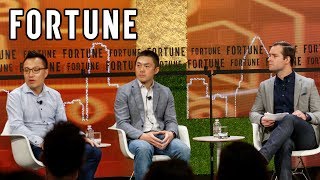
Tony Xu and Sequoia's Alfred Lin discuss how DoorDash scaled from a personal problem Xu experienced to 1,200+ cities. The company raised $535 million from SoftBank at a $1.4 billion valuation and is expanding beyond food delivery into grocery and other services. Xu spent a year delivering orders himself to understand the business before hiring.
Chapters
Good morning.
Good morning to the troopers.
I know, right?
The brave.
Thanks for waking up early.
Yes. Caffeinated.
Good.
Yes. All right, so we're gonna have a nice conversation about the delivery and logistics category. We're gonna talk a bit about startups and valuations and all of that. But, Tony, I want to start off first just by asking, how was your company started? It was 2013, right?
It was. It started almost five years ago, June of 2013. We started DoorDash because we wanted to help local businesses. I actually grew up working as a dishwasher for my mom's restaurant in Illinois for all of my childhood. And I didn't exactly think that was going to make its way back so quickly back into my life. But when I was in grad school, thinking about what to do next, I was talking to a group of small businesses, some of which were restaurants, others were retailers, and they would tell me about deliveries they would refuse, which is pretty un American to turn down all these credit cards, I thought. But to figure out why this was happening over and again, I became a delivery driver for about a month, driving for services like FedEx as well as Domino's Pizza, and figured out why delivery does not exist in America. And after figuring that out, that's when my co founders and I decided to start DoorDash.
Yeah. And, Alfred, tell me a little bit about why you decided to invest, because I read this great statement you had. I can't remember where you gave it, but you said the best startups and founders are those that rectify something the world got wrong. Which I thought was a really nice way of putting it.
Yeah.
At Sequoia, we like to invest in founders that are trying to solve their personal pain. And Tony had a personal. He found a personal pain and he went and tried to solve it himself, trying to learn as much as he could. Very thoughtful about his approach. And we're always inspired by people who do that. So at Sequoia, we try to invest from seed to IPO and beyond, or from idea to IPO and beyond. We didn't get that quite right in the first round, but we invested in the Series A. I had the misfortune of having to tell Tony that we're going to pass in the seed, and thankfully, he let us correct the mistake and invest in the Series A.
There's a bit of a story there. Tony, could you go into more detail?
It was a difficult start to the relationship. I was actually a groomsman at a wedding when I received Alfred's rejection call. And I was a Groomsman at a wedding. And this was summer of 2013. We had just graduated from Y Combinator. We were certainly not the cool kids. You know, everyone was raising their seed rounds in a week, maybe eight days at most. We were taking 10 weeks, and still there was no money. We had $20,000 in the bank. I was personally broke, so I was a groomsman, you know, trying to, you know, keep happy for the photos and obviously to keep, you know, the bride and groom happy while thinking about what we were going to do, especially given that I had my own wedding that I could not afford in two weeks upcoming.
Yeah, I felt really bad giving. I did not know at the time that I was calling Tony during a wedding. I would have said, I just asked him, do you have some time? He said yes. And then I found out later he was on the beach being a groomsman. So one of the things that we did was we continued to develop our relationship. A few months later, after he came back from these two weddings, we were at a networking lunch or dinner. I think it was at a restaurant that you had signed up Chef choose, but it was for a different event. And I sat next to Tony. He talked about his experience as a dasher. He knew all the metrics, all the things he needed to improve, and he was just very, very thoughtful about the approach. We had been concerned at the beginning that this was a service for just the wealthy or the people on Stanford's campus, because you were just on Stanford's campus at the time. And more and more that we thought about it, we reconsidered that decision, and we begged our way back into investing in the Series A and every single round after that. I think the key point investing is you go very, very high level on that thesis. We have a saying at Sequoia that great consumer businesses address one of the seven deadly sins. He actually sort of addresses two of them, Sloth and gluttony. So we should have invested right there.
I mean, it's true. So you now have how many employees?
There are 700 employees at DoorDash.
Okay, so it's been an incredible couple of years for you. Tell me a little bit about. Take me there. About the hard choices that you've made over the years to scale. Because that's an enormous amount of scale in a very short time.
It certainly is. And we've been fortunate along the way. But I think it goes back to, you know, one of these early notions that we've been chatting about on stage, which is to run your own race and to not focus on the media frenzy or the competitive dynamics, but to really stay your course and to prove out things that make the most sense for the business. You know, for example, you know, one of the things Alfred brought up was you, is this just a service for certain types of neighborhoods? And in fact, before even fundraising, one of the early decisions we made was actually not to launch in San Francisco, which was a bit contrary to what a lot of the companies at the time were doing. We actually decided to launch in East San Jose. We made that decision based on our own independent thinking to figure out could this actually be a mainstream service. And we answered many questions like that before we actually decided to scale the company. So focusing on what matters to the business and then believing in the convictions against the noise and against what other people are doing has been one of the best things that has allowed us to do what we've done. Yeah.
So strategic focus. How about the team? How did you look at that? Is the team that is helping you grow beyond today, the same team that got you from that first truck on out?
You know, it's amazing that I think sometimes as operators, we can forget that the things that got us to where we are, they are actually more scalable than we may otherwise believe. For example, early on, everyone in the company, especially the founders, did every single delivery for the entire first year. And while that sounds incredibly, you know, not scalable, given that DoorDash today serves over 1200 cities across the US and Canada, it's now scaled into something we call we dash, where every month, every employee does a delivery or does customer service or goes and works inside of a restaurant or other parts of the business to continue to become experts as such. You know, people scale in that way, too. And, you know, from day one, what we wanted to do was to build something unique to our company that not only scales our ability to learn the business, but our ability to grow the people. And so many of the positions today are run by extremely ambitious and talented people who have always put DoorDash first, their own team second, and themselves last in a way that maximizes the outcomes for the customers, dashers and merchants, and also for their own personal growth.
So now your company is worth A reported $1.4 billion. You just raised a bunch of money. What was it? I wrote it down. $535 million from SoftBank, among others, earlier this year, talking about scale. That's a lot of money. And Sequoia, of course.
Sequoia, SoftBank, GA. Sorry, Alfred.
That's a huge chunk of change. How are you going to make sure that you stay focused? And how do you make sure that you don't overly expand or just lose sight of the goal?
Well, first, it's a massive opportunity, and the investors we brought in, as well as the size of the investment, was really commensurate to achieving that opportunity faster. If you think about it, only 5% of restaurant sales today are online. 95% of the time, you are still walking inside of a store to pick up your order or you're calling it in before doing that. 4% of pizza sales in 1980 were delivered. Today, that number has gone to 45%. If you look where we are today outside of pizza, it's less than 10% of sales are being delivered. So we have a long ways ahead in terms of serving the millions of restaurants out there. But with regards to making sure that we run the business with the same amount of discipline, it's always been about goaling as much about the outcomes as the inputs and making sure that we care, not just achieving certain targets, but caring just as much, maybe more about how we get there. This is one of the reasons why DoorDash actually did not expand that much early on. It was about making sure that we had a playbook and in which we understood exactly how we grew and also the pacing so that the economics would never get ahead of ourselves. And that's why actually, only after becoming contribution margin as a positive as a company, did we raise the series D and the size of investment that you discussed. And now we're in a position to go a lot faster, but also to do it in the ways that have gotten us here.
You've described your company as disciplined at execution in the past. What are you going to use that money for? Are you looking at further market expansion or are you looking at beyond food?
Yes, to both. But first, there are a lot of markets, America and our business. It's almost meaningless to talk about the aggregate. We could be delivering 30 minutes inside of a city, but certain streets might be doing better than others, for example. So, first of all, we have to get to every street in America. Today, we're in about. We're serving over 1,000 cities, but we still have five or six hundred cities that we want to get to just this year. And by the end of next year, we'd love to be able to deliver to every door, not ship to every door, but actually be the only service maybe outside of the postal service that will actually be able to reach every single household. Second, we want to be able to continue building on the merchant services that have allowed DoorDash to reach partnerships with 90% of the top 100 restaurants. That's more than all of our peers combined. And it's one of the reasons why we've been the fastest growing service in the space for the last 12 consecutive months. And then finally, as you mentioned, certainly if you can deliver ice cream in 10 minutes or a burrito in 20 minutes, you can deliver other types of products in more time. And so in April, for instance, we announced a partnership with Walmart where we're fulfilling their grocery deliveries. And you can imagine that there might be other extensions of that.
Yeah. I'd like both of you to answer this question. You know, we've had a lot of logistics companies, broadly speaking, on the stage here at Brainstorm Tech, and we haven't done too much talking about employee rights and how we're thinking about independent contractors versus not, you know, benefits versus not how are we thinking about that? Because that's very material to your business. And of course, it started out of your mom's restaurant.
Right.
So you know this very well.
Absolutely. One of the things that's really important to us at DoorDash is to make sure that we can keep the following sentence true, that 60% of the jobs that have been produced in any decade since 1950, when the census Bureau started measuring this has come from the businesses on the streets. This is even true in Silicon Valley. And I think it's very easy sometimes to overlook that, especially when we're at a conference talking about the future of technology, automation, artificial intelligence, et cetera. And for this to be true, we have to help these businesses enter the technology world. We have to not only help them with logistics, we also help them get online. We have to help them think about the future designs of their stores. These stores will have both showrooms as well as convenience solutions. And we want to be their business partner to do that with regards to workers rights. This is when I think about the 400,000 plus Dashers on the DoorDash platform. I think about how do we offer them the most flexibility and how do we also make sure that as we enter a new age of work, that they not only have the security, but also the skills to learn other types of work? As technologies evolve, as the DoorDash platform evolves and serves not only restaurants, but other types of businesses.
I think the question is very complicated. I think tech creates jobs, tech destroys jobs, and there's a constant movement. And to Tony's point, I do think we need to make sure that the people whose jobs have been lost get jobs elsewhere. I think the on demand economy has actually helped people who have had traditional retail jobs shift to a more tech centric job. I think there are a bunch of things that I think we should think about and government can help, but the companies in the on demand space can gather together and form alliance around how do we take traditional benefits and make it flexible so you can take it from company to company or from how much you spend at one on demand company to another on demand company so that the group can pool and chip in to your benefits. I think that would be very beneficial to everybody involved because despite, you know, the growth has just created lots of demand for these kind of jobs. People are filling these jobs. It's giving them plenty of flexibility and they want to do it on time and some of them do it part time, some do it full time. There's a wide range of people and hopefully we solve the problem for all of them.
Yeah, I'm going to come to the audience in a second for questions, so please prepare one last one for you. So there have been reports of a potential merger with you and postmates. Do you need to merge with another company or acquire one to scale?
We've had the ambition from day one to build the independent multi generational business from day one. And especially given our current course in speed, being the fastest service, being the number one service and two thirds of the nation, we're on a fantastic trajectory in accomplishing that objective. And again, we're just getting started at doordash. Food is a fantastic category. At the same time, when I think about the businesses on the streets, the 20 million plus just in the United States alone, they cover many, many categories. We have a lot of work to do.
So is that a yes or a no?
We have a lot of work to do and we're staying the course of being an independent business.
Fair enough. All right, we have a question way back here.
Yes, sorry, Dan Primak from Axis. This is kind of follows up on what you just asked Andrew. So Tony, I'll go to Alfred on this. Can you talk how you see the future of kind of consolidation in the general, call it delivery space, not just food. I mean, for example, you know, you guys, Tony, you guys have somebody on your board now who's also sort of on the board of Uber, Uber Eats. Alfred, you guys have money in Instacart. When Tony talks about delivering to Walmart, delivering Walmart groceries, which Instacart is probably not thrilled, you guys got that deal. So can you talk about how you see long term. Is this going to be a consolidating industry?
I hate to speculate on the future.
But.
Let'S put it this way. I think the best companies win. And some of the companies that do not win either go out of business or they get consolidated. So there's a lot of money going into this space and frankly, I think the capital is occurring to the winners and you have to figure out how to become number one and number two.
All right.
Yes, right here in the front.
Marcelo Lima from Heller House.
Tony, I was curious. You mentioned in the beginning when you.
Started this, you drove for FedEx and.
Domino's and you saw you learned why delivery didn't work. What did you learn and how did you go about solving those problems? And how is your company specifically different from your competitors from a strategic and competitive standpoint?
Okay, so two parts. First part, what did I learn? Well, a couple things. Number one, it's virtually impossible for a single store to do their own deliveries. So at a pizza store, there are almost always too many drivers or too few. If there's an event in the city like a football game, forget about it. You know, wait times are going to skyrocket. But most nights if you're driving, you're probably folding pizza boxes with your fellow drivers on the other side. When I think about FedEx and when I think about a lot of these businesses that, that have gotten us to where we are today, or logistics, the industry to where it is today, it makes the assumption that you have time to plan a bunch of routes and we go door to door to door and we drive these same routes every day. When you think about how consumers are purchasing today, consumption is becoming more last minute. When's the last time you thought about what you're going to eat today? Or when are you going to buy your next pair of shoes? I think people just make these decisions now. You, you know, very, very last minute. As a result, you know, in order to bring those goods to us, we require a much more, just in time, flexible system. The second part around differentiation. DoorDash has always been a merchant first business. Where we started this business to help local businesses. And as a result, we build a lot of products that are invisible to the customer that make the operations perfect. So, for example, there's a Cheesecake Factory store in San Francisco that is located on the sixth floor of a mall. To make that one delivery happen from that one store out of 242 locations of cheesecake Factory, we have to figure out where the Dasher is going to park. We have to figure out how to get access to an elevator that only mall employees get access to. We have to collate items from three different stations, dessert, food and drinks. We have to think about how to talk to each one of the systems so that we can close the books and make any reconciliations. That differentiation is what has allowed DoorDash to offer the most selection in this space.
And to add to Tony's point, the one thing that is amazing about how hard this business is is the little things you have to get right. And so the differentiation is getting all these little things added together and that sort of little. These little things add up to becoming a real moat around the business.
U.S. execution, as you said. Yes, in the back.
Hey, Mark Tinnerman from Bank of Montreal, have you given any thought to delivering cannabis as it becomes more legalized on a medical and recreational use?
We are in Colorado, after all.
That's our general counsel's favorite question. No, but in more seriousness, we've certainly considered delivery of all products. The short answer is that's not what we're doing today and not what we plan on doing. There are a lot of complications back to the point around complexity and delivery. There are a lot of complications with payment when it comes to something that has certain types of regulation. For example, DoorDash delivers alcohol. To make alcohol delivery happen in the US and in Canada, we have to actually get different regulatory checks by county, by different types of liquor and with different tax codes, things like this.
Zhensky has a question and I was just going to say I feel like there's a big opportunity for pot and pizza with DoorDash. Go ahead.
Pot and pizza.
Hi, Jasper Weir, Task us. I'm curious, in the past few years, with the growth we've been in a bull market and so I'm curious, how do you think about your business being somewhat expensive to the average consumer to get their lunch delivered and delivery fees and Dasher fees, How do you think about that in a downturn?
We've always thought about the business actually in a way that's independent of the environment because we're always driving prices down. So in a bull market, we're driving prices down. In a bear market, we're going to drive prices down. However, one of the benefits of food is that people do eat 20 to 25 times a week. And maybe irrespective of the technologies, that's not going to change for a long period of time. Maybe in 300 years that will change, but for a long period of time. And so for us, it's focusing on how do we keep getting the service more and more affordable, how do we cut out every single inefficient cost in the system so that we can do that again irrespective of market environments?
You both gave rather flowery answers to.
Andrew's question about workers rights.
So, Tony, how exactly are Dashers paid? Do they get benefits? And how does that compare with your competition? And Alfred, are you and Sequoia actively working on this coalition to band together on demand workers to get them benefits?
So Dashers are paid per delivery? DoorDash, actually, since year two of the company's life, so four years ago, has been working actively with governments across different states, New York, Colorado, for instance, in figuring out how to create portable benefit solutions. DoorDash currently today is actually starting the alliance with a lot of different companies and actually captaining a lot of these conversations and making sure that again, I mentioned how do we create flexibility, how do we create security? So this hits the security point. And how do we also think about the skills? And that's kind of the next phase, in addition to creating a framework in a public private partnership with city governments, state governments, and ultimately the federal government to make this a reality.
And Alfred, if you could briefly.
Yeah, so, like, Tony's already part of this alliance that he talked about. And I think that that alliance has been working effectively to some degree, but they're also competitors. So there's got to be some form of overarching sort of group that sort of takes leadership. And I think DoorDash is taking some of that leadership. We've met with Mark Warner, who is very passionate about this, Senator Mark Warner, about this sort of issue, and given him some of these ideas that may be he can drive from the legislative side.
If we could please, a round of applause for our gentleman here. Thank you.
More from Alfred
Sequoia’s Alfred Lin explains why your startup should focus on being different rather than “better”


Alfred Lin from Sequoia Capital | Advice for founders, future of consumer social, and more