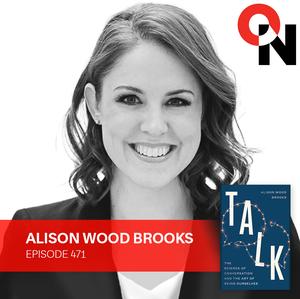
TALK: The Science of Conversation – Alison Wood Brooks
10 Mar 2025 · 36 min
In this Retire Wisdom Podcast episode, host Joe Casey interviews Alison Wood Brooks, O'Brien Associate Professor at Harvard Business School and author of Talk: The Science of Conversation and the Art of Being Ourselves. Brooks shares the personal origins of her fascination with conversation—growing up as an identical twin—and introduces her TALK framework (Topics, Asking, Levity, Kindness) as a practical tool for navigating everyday dialogue. She explains why levity and kindness matter beyond mere information exchange, describes the topic‑pyramid model that helps people steer micro‑topics, and warns against “boomer asking,” a self‑centered question‑asking pattern that undermines conversational balance. Brooks highlights follow‑up questions and callbacks as conversational super‑powers, discusses the prevalence of mind‑wandering while listening and offers simple repair strategies. She introduces an identity‑map exercise that surfaces observable and unobservable facets of self, showing how disclosure deepens connection. The conversation moves to the anatomy of effective apologies, outlining seven components and emphasizing the promise to change. Finally, Brooks presents a layered “earth” model of moments of difficulty—from surface words to core identity—offering strategies for handling disagreements. Throughout, she references research findings, real‑world examples, and a workbook/appendix of exercises for listeners to practice.
Chapters
Think about how much time you spend each day in conversation. There's a range of them. Some are short, some are long, some are more important than others. But what if you were able to bring your best to those conversations, particularly those with people who are most important to you in your life? And perhaps especially those difficult, challenging ones. I'm Joe Casey, and you're listening to the Retire Wisdom Podcast. And our special guest today is Alison Wood Brooks. She's the author of the new book, Talk: The Science of Conversation and the Art of Being Ourselves. Alison is the O'Brien Associate Professor of Business Administration and Hellman Faculty Fellow at the Harvard Business School. Her research on the science of conversation has been published in prestigious academic journals, including the Proceedings of the National Academy of Sciences, The Journal of Personality and Social Psychology, and Psychological Science, as well as in popular media outlets such as The Wall Street Journal, Forbes, The New York Times, Scientific American, and Harvard Business Review. Professor Brooks holds a PhD in decision processes from the Wharton School at the University of Pennsylvania and bachelor's degree in psychology and finance from Princeton University.
Alison, it's great to meet you.
It's so nice to meet you, Joe. Thanks for having me.
And loved your book and just excited about having the opportunity to talk it through with you and share some of the wisdom from it.
Should we have some fun?
Absolutely. Well, of course. So I wanna start very way back in the beginning. How did growing up as an identical twin help you develop an appreciation of communication?
Oh my gosh. I, this is a question that I love unpacking with my therapist. It almost didn't occur to me that I ended up in my adulthood sort of obsessed with human-to-human conversation and Probably because I'm an identical twin. So I have a twin sister named Sarah, and we were unexpected. My parents did not know they were having twins until I was born. I was out and they said, oh my God, there's another one. And from that moment on, I had a sort of weird copy of myself shoulder to shoulder with me through my whole childhood. And it's a really interesting existence. I don't know anything other than being a twin. But getting to watch— every human has multiple versions of themselves that we're constantly curating and showing to the world. But having an identical twin is like having one of the versions of yourself outside your body and getting to watch a version of you sort of navigate the world and the social world. And so at every moment, I could watch this sort of weird version of me having successes, making people laugh, being blazingly competent, doing really well, and these— and flops too, you know, like— telling jokes that didn't work or saying things that hurt people. And it's this extra source of feedback of like, oh, well, I could do the good things and avoid the bad things. And of course, it's all the same as all siblings, which is it just means that you have this conversation partner right next to you all the time, giving you very direct feedback about what's going well and not well. And so I think it's no coincidence that I— she and I are very close still. We always were. And we have this really— Lovely, very tight shared reality. And you know, the, the old saying that twins can read each other's minds, I think is true to some extent in the sense that like you have so many shared experiences and shared reality and your brains work in such a similar way that you can very often through pattern recognition and familiarity predict what your twin is going to think or do. And so I kind of spent the rest of my career trying to help other people find that tight-knit shared reality and sense of closeness with the people in their lives.
So could you give us a brief overview of your TALK acronym and its guiding principles?
Of course. Can I just say it starting out, for anyone who is skeptical about acronyms, I'm right there with you. I actually don't love acronyms in general, but the setting of conversation is so wildly complex, like remarkably, shockingly complex, that I I do think we need a simplifying mechanism to help us remember what we need, what we mean to do, what we need to do once we're in the chaos of a conversation, and that's where this TALK acronym came from to help simplify the noise. T stands for topics, A stands for asking questions, L is for levity, humor and warmth, and K is for kindness.
And the last 2— all 4 are important, but the last 2 stand out to me— levity and kindness. Tell me a little bit about how they matter, why they matter.
Yeah, I think they stand out to me as well. I think there have been decades of thinking and work about how to be an effective communicator, or how to be an effective negotiator, or how to have difficult conversations. So much of work in scholarship and in practice, I think, has focused on goals that very squarely are focused on accurate information exchange, to be efficient, to be relevant, to be honest, to be clear. And so I think topics and asking are— live in that world. It's sort of thinking about what's the content of what we're saying to each other, what information are we exchanging. But as we proceed in life, and as scholarship sort of opens the aperture of what's possible to study, and we think more broadly about what does it actually mean to live a good life and be a good person, You very quickly, at least as a psychologist, start to realize, oh, information exchange is only a very tiny piece of this puzzle. Humans hold a lot of sincere desires and goals in conversation, and many of them have nothing to do with information exchange. In fact, actively don't want to exchange information. We want to keep secrets or maintain privacy and just feel safe and allowed to do that. We wanna have fun, we wanna feel connected, we don't wanna feel awkward. Sometimes we just wanna fill time. We wanna stay engaged with each other, and at the same time, we don't wanna get angry and feel threatened. And so levity and kindness together very much focus on those more relational and emotional purposes and motives that people hold in their conversations.
So the 3 levels of the topic pyramid stood out to me. It all starts with topics.
Yes.
Like your acronym? How can people use it to guide their conversations?
Topics has been a revelation for me too, as a person and as a scientist. I think for a long time we've had a tendency to think of conversations at the conversation level. You'll hear people say, oh, this is a difficult conversation, or this is an easy conversation. And over time, when you look at hundreds of thousands of transcripts, you realize That's not quite right. It's not that a whole conversation is going to be difficult. It's that maybe one pasture, one moment in a conversation could be a little bit challenging, but everything else around it doesn't have to be so fraught and difficult. And actually, when you start to look at transcripts, you realize that they are an unfolding pattern of sort of these chunks of topics over time. When we think of topics naturally, it's sort of like, oh yeah, well, we talked about your mom, and then we talked about sailing, and then we talked about— Music. What that looks like in a conversation though is that it's like a chunk of turn-taking. You say something about music and I respond, and then I see something else about music and we talk about that for a little while, then we switch to a new thing and all of a sudden we're talking about reality TV. And so you can map these, how topics drift and shift over time during a conversation, which is very helpful in retrospect, like our brains are very good at doing that chunking in our memories, but it is also helpful during the conversation. You realize, oh, I'm making these micro decisions. We're all making these micro decisions to steer topics that I'm choosing to stay on this because I think it's still interesting, or I'm choosing to actively switch to something else when I feel like the conversation is starting to lag. And that felt really empowering as a scientist in studying, well, how can we help people do that better? How can we help people steer topics more effectively? And just as a person, it makes you feel more empowered when things start to lag. Now I know, oh, I can just change to something else. And that's very empowering.
So tell us about boomer asking. I thought it, as a baby boomer, it had something to do with my demographic, but it doesn't necessarily.
It's not about you, Joe. I love boomers, and this is a phenomenon, a conversational phenomenon that applies equally across generations, and it is very relevant to topics as well as asking. So asking questions has tons of benefits. When we're thinking about the goals people hold, asking questions helps us exchange more information. I ask you a question, you're gonna answer it, and I'm gonna learn from you. So that's already amazing. But also, when I ask questions, it shows that I'm interested in learning from you, which feels really good. And so it's good for those relational outcomes as well. So asking questions is magical. It's why there's a whole part of the acronym is about asking. But boomer asking, which is named after the outgoing and incoming returning arc of a boomerang, is sort of a boundary condition on the power of question asking. Because it's like this, it would be like I say to you, Joe, Have you ever been to Nepal? And you say no. And I'm like, let me tell you about the time I went to Nepal. It's almost like you're thinly veiling your egocentrism and sort of self-centeredness, your desire to disclose about yourself. You're kind of masking it with this insincere question. And you hear it all the time. And what we find in our research is that When I say, have you ever been to Nepal? First of all, that question's so specific, you're already on high alert. You're like, oh God, here comes a story about Nepal. But even if I were to ask you like, how was your weekend? And then I let you answer, and even if you were excited to answer that, and then I bring it right back to myself immediately without following up on your answer, it makes you feel like I wasn't interested to begin with. And that's a really bad feeling. In the end, conversation needs to be sort of ping-pongy back and forth. Where both people are sharing about themselves, but also feeling affirmed and validated and listened to as we're playing this ping pong game. And so if you bring it right back to yourself in boomer ask, it undermines the healthy ping ponginess of a conversation.
And to your point on the give and take, why are follow-ups and callbacks so valuable?
Follow-ups and callbacks do exactly the opposite. So whereas boomer asks are a villain and you're doing, you're bringing it too much back to yourself, which people do all the time, Follow-up questions keep the focus on the other person. So anytime someone gives you this great gift of a disclosure, you share anything about your weekend, or if I say, you, have you been to Nepal? And you say, no, but I've been to Tibet, or whatever. If they're giving you any sort of sharing, some disclosure, some information about their perspective, that is such an amazing gift. That is the greatest gift that humans can really give to each other. And so a follow-up question shows, hey, I value the gift you just gave me. I want to hear about your time in Tibet. I want to hear about your weekend. I actually care about your perspective and I want to learn from you. So follow-up questions are superheroes, so much so that when we studied question asking on— we studied it in, in many different domains, but dating is one of them. And people who ask more questions do better in dating, both men and women on heterosexual dates. But people, that's almost entirely driven by follow-up questions, because it shows that you're listening to the other person's answers and that you're interested enough to know more, you want to learn more. It's just a, it's a direct expression of listening and responsiveness and care. The same is true for callbacks. So callbacks, it's not a question. Instead, you're referencing back to something that you discussed earlier in the conversation. If follow-up questions are a superhero, then callbacks are sort of like the advanced superhero. It's like you have to hold information in your head longer in order to call back to it later in the conversation. Knowing about callbacks has changed the way that I listen to people because now I'm like latching on. I latch on to things that they say. Before we came on and we were recording, Joe, you told me that you live across the street from T-Sweets in Princeton. You told me that you like basketball. You told me all of these little details that now. I feel so powerful sitting here knowing that about you, knowing that I can call back to it anytime the conversation calls for it. And those callbacks are magical.
There's a lot going on in these conversations. And you mentioned listening. So what gets in the way of listening?
Oh, so many things. The idea of listening seems so simple on its surface. It's sort of deceptively simple. The human mind, unfortunately and fortunately, was not built to focus on one person and one idea at a time. Our brains are amazing, and so they were more built to wander, right? We're constantly drawing connections between adjacent and unrelated ideas. We're thinking so much. Even while I'm talking to you, I might for a fleeting moment remember, oh, I got to pick up my kid in like an hour and a half, right? That's not Bad per se, doesn't mean that I'm a bad listener, but it is bad if I'm pretending to listen to you and I'm actually thinking about something else, and it means that we aren't actually exchanging the information that we believe we are exchanging. If we're constantly pretending to listen to each other and we're not actually hearing each other, that will become a problem. If you disclose something important about yourself to me and I don't hear it, but I pretend to hear it, That's not gonna go well. So we studied this tendency by having hundreds of people come together and have conversations, and we interrupted them every 5 minutes and we said, okay, were you just listening to your partner? 24% of the time, people self-reported that they were not listening to their partner, that their mind was wandering elsewhere. And we suspect that is a pretty massive underestimate because we all know that it's embarrassing to admit that, that you weren't listening. There's this very high social expectation that you listen attentively. So we suspect that our minds are wandering even more frequently than that, and that's already a very high number. This isn't a bad thing. It's not a criticism about the human mind, but what I— it can be helpful about it is realizing, oh, my mind is wandering a lot of the time. Your mind is wandering a lot of the time. What can we do to make sure that we actually are hearing each other, that we're actually exchanging the information we think we are? That we're making each other not only feel heard, but making sure that we actually are heard. Like, I want to allow your mind to wander and also have a successful conversation. And so I think that's a very helpful thought experiment of like, what can we do? First of all, we can give people more grace when they don't hear something. Like, it's not because they're not interested all the time. Often it's because they're doing— they're so interested that they're probably elaborating on Something you already said earlier, and being a little bit more direct and overt about admitting when we haven't heard someone, right? Like, oh, I missed that thing. Did you mean this or this? Can you repeat that? These little repair strategies can be very, very helpful.
The only time my mind has wandered is when you brought up basketball. I was thinking about yesterday's Celtics-Nuggets game in different, different plays, but now I'm back on, I'm back on track.
My little son Grady went to the game with a friend, so I'm, I know we, we won. Go Celtics.
Yes.
Yes, I was there the Sunday before with my oldest daughter and her husband when they played the Knicks. And it's always great and always a great experience. Now, when people retire, there's a big issue with identity because all of a sudden your identity tied to work goes away. And I noticed that in your appendix, by the way, the appendix to this book has a lot of great resources in there and we'll talk about it a little bit later as well. But you talk about this idea of a tool of an identity map. And so you model it and list, if I counted right, 17 descriptors of your identity, and one was basketball player. So that jumped out to me, of course. So talk a little bit about identity and, and fill us in on that part of your identity, because all I know is mid-range jumper.
Exactly.
And it's evolved over time, right? I still feel like a basketball player, but if you take a look at my life now, I'm, I'm more of a basketball coach of my own kids, right? I'm not Sometimes I play in adult lady leagues, which are pretty great around Boston, but I spend much more of my time coaching my kids now and playing driveway basketball with them. Isn't it crazy that you could do an identity map and have 17 things that you list about yourself? And I don't think I'm unique in that way. And in fact, I don't even think I tried that hard to come up with those 17 things. Our identities are incredibly complex. And ever-evolving, right? One who— those who were athletes as kids and teenagers and in their 20s, it slowly changes to be maybe coach or adult player, ex-athlete over time, and then maybe at some point just healthy person who likes exercise. And that's true for so many things, except for the things that we can't control and are born with, like, like race. But all of these things are dynamic and change over time. Gender, religion, sexuality, your areas of interest and expertise, the relationships you have in your life become part of your identity as well. And so what I find interesting about this, of course, our identity, our identities are tied to our work. What is so interesting about conversation is that many of our identities are not observable to others. So I do this exercise with some of my students where I have them list out all of these identities. Basketball player, raised Catholic, mother of 3, I don't know, wife, scholar, teacher, all of these things. And then you plot them on a spectrum from observable to unobservable, and you realize, wow, so much of who I am that is deeply felt in my own mind and in my own heart is not actually observable to other people unless I talk about it with them, unless I share those things. With other people in conversation. And that's why disclosure, when someone shares something with you, even if it doesn't feel that significant, even if it's just like one moment where they say, oh, I did go on a trip to Tibet, or I did go on this trip to Nepal, it's why it's so important to sort of give them the respect and listen and follow up on it because they're sort of saying, hey, I'm pulling from something from this unobservable part of my identity map. And I'm sharing it with you, and that can make me feel very vulnerable. And I'm looking for you to say, hey, I hear you, and that's cool. Like, I like affirm who I am. Not only affirm who we are, but also help us make sense of who we are, right? Like, that's part of what makes conversation so marvelous is it's the vehicle by which we are making sense of who we are a lot of the time. It's sort of Seeing how people react to us when we do share, oh yeah, I was a high school basketball player. I was a mid-range jump shooter. But most of all, actually, Joe, I was like a rabid raccoon on defense. I was a mostly defensive player. I played with my twin sister. You do not want to get caught in a Wood girl trap on the press with our long gangly arms. And so mostly I identify as like a defensive, crazy defensive player. We went to the New York State High School Championship 3 times, lost every time. My kids, my little boys never stop making fun of me for that one. But yeah, you, it's like you would never know that unless I make myself vulnerable and share details. And that's true in every conversation with every person. And so when people do, it's so important to actually honor it during the conversation.
Very helpful people retiring because we're much more than our job title and of course multidimensional. And it helps. The identity map could be very useful for people to really see that, see that in print.
Yes.
So what's the recipe for a good apology?
Oh my gosh. Well, there's a whole chapter in the book about apologies. This is something that I, I had done some research on apologies and I have always been fascinated by them, but Through my research, realized how— what a powerful force they are. I think possibly one of the most powerful tools that we have in our conversational toolkit as human beings. Saying you're sorry is almost more powerful than saying I love you, because it is the action of love, not just saying it. You're showing someone, I care so much about you that I'm going to do this vulnerable thing. I'm going to make myself vulnerable to you and Apologize, and you can do with that what you're— whatever you're going to do with it, because I want to be in a relationship with you, because I want to have a future with you, because I care about you. And so it is sort of like the action, the action of love. Scholars talk about 7 different components of apology. I'll see if I can remember them off the top of my head. The first is just stating apology, so saying, I'm sorry. Expressing remorse, I wish I had not done that. Self-castigation. So saying, I'm an idiot, I'm the worst for doing that. Let's see, asking for forgiveness. So please forgive me. Making a promise to change. So say, I'm going to be different in the future. An explanation for the transgression. So I did this because I was angry, I was drunk, I was whatever. And I'm going to forget the 7th one. Boy, the limits of human memory start to strike us even at age 40, Joe. But there are, so there are these many possible components of apology. Not every apology includes all of them, of course. It's sort of like a menu of options that you can choose, that we all choose from when we're apologizing. Our research suggests that some of them are much more effective than others. The statement of apology is important. So literally saying the words, I'm sorry, is important. Is it important just to signal, hey, I'm apologizing now? One that— the most powerful element of all is the promise to change, and the more concrete it can be, the better. Explanations for a transgression that happened in the past tend to just remind you of the harm and the pain that happened and sounds like excuse-making. So you're sort of making it about yourself rather than focusing on the other person and focusing on the past rather than on the future. So I'm sorry. Taking accountability can be really good too, right? Like, I realize that I played a part in this harm, and I'm so sorry. Here's what I'm going to do in the future to make sure this doesn't happen again. I'm going to go to AA meetings. I'm going to whatever, whatever it is. I'm never going to pile up dishes in the sink. I'm not going to— whatever you're apologizing for, the promise to change in the future is really important. And then, so you do the apology, great job. Next step, actually following through on the promise is like— The dream scenario. I talked to an amazing person about apologies. She's a therapist named Orna Guralnick. She's on this amazing show on Showtime called Couples Therapy, and I talked to her about apologies. She said really what apologies are doing are 2 things. They're showing people that you understand their pain and their struggle. You understand their perspective and that they— that something bad happened to them. So it's sort of this expression of empathy. And understanding. The second piece is taking accountability for it and saying, I was at fault for that, or I at least played a role in the situation that led to you being harmed. If you can achieve those 2 things, showing that you understand someone else's perspective and take some accountability, you shouldn't even really need to apologize, right? Like, you've done the work. It's just that we often don't do that. We fail to show that we understand someone's perspective. We fail to ask questions to try and understand someone's harm and struggle and suffering. And we often very much aren't willing to take accountability for things. So that's why apologies are the best shortcut we have for getting back on, getting back on track.
So you have a great section in the book about disagreements, and you mentioned that you used to be seen as conflict-averse. How has your research and teaching helped you handle disagreements?
Not just seen as conflict-averse, but also truly conflict-averse. I think I am a— and I know this, like, some people like confrontation or are very comfortable with it, other people very avoidant. I lean in the avoidant direction for sure. I don't know if it's my Irish Catholic heritage. So my teaching and research on conversation has been incredibly empowering for me and for anyone who is Afraid, nervous, or conflict-averse. Because it made me realize that, first of all, as we said, we were talking about earlier, whole conversations aren't hard and bad and scary and hostile. It's just like little moments. And that's what we talk about in the book. It's called— it's not like difficult conversations, it's moments of difficulty. And moments of difficulty can crop up even in conversations that are supposed to be fun, right? Like you think about gathering with your family at Thanksgiving.
Mm-hmm.
Or going out on a date or having a gathering with friends, you never know when a little rift is going to happen, a little moment of difficulty crops up that was unexpected. And even more sort of troublingly, I worry that we often sort of poke barbs into each other in ways that we never even know that that moment of difficulty has come and gone, that someone that you're talking to might ruminate about later and you didn't even know that you said something. Hurtful. Well, let's set that aside. In the moments when you do know that things have gotten difficult, these moments of difficulty can occur for any number of reasons. And in the book, we talk about a model like layers of the earth. And above the surface, these are the words and gestures that you can see during the conversation. We might simply be using the same word to mean different things, or we might use different words to mean the same thing, or we're just sort of talking past each other and we misunderstand each other. Those sorts of coordination problems can cause all kinds of moments of difficulty during a conversation. Just below that, at the sort of surface of the earth, are our emotions. So let's say you're feeling really calm, but I'm stressed out, and I need you to be there for me more intensely, that can cause conflict. Or I'm really excited and want to have a good time, and you're feeling sort of sleepy and want to be peaceful, we're going to have a bit of a Emotional clash there. Beneath that are our beliefs. So I believe the truth about something. I believe some data about vaccines. You believe different data about vaccines. We disagree. And are we going to confront that and discuss it? Are we going to avoid it? It's up to us. Beneath that, we have differences in motives. Let's say you want to give me advice, but I don't want to hear your advice, or You want to talk about the wedding I just went to, but I don't want to talk about it because it was kind of upsetting and sad because the groom never showed up, right? All of our differences in goals, what we want out of our conversations can cause all kinds of conflicts. And then at the very core of the Earth, this sort of hot magma is where we have differences in identity. And just like we were talking about earlier, our identities are so complicated and sort of changing over time, But anytime a conversation sort of threatens someone's identity in any way, that's where things can feel very personal and we get defensive and things can easily get overheated. And so there's all of these possibilities of moments of difficulty cropping up. And so in the book, we talk about what can you do when that happens? How can you make sure that things don't get overheated and derailed?
So one last question. You stress in the book that like basketball, the key is practice. And as I mentioned before, you've got really a great appendix that has a lot of tools and reminders, but it also has lists, plural, of different questions. And I'd like to ask one of you.
Love that.
Has someone made you laugh recently? What happened?
Oh, Joe, you're singing my heart song. Before I answer, I, I wanna add, I Since writing the book and even launching the book, I created a workbook and I'll send it to you and you're welcome to share it with your listeners that has all of the topics that are in the appendix of the book and many more, and many of the exercises that I use in my course at Harvard that are very, very fun to do with family members and friends or like at a book club meeting or at your workplace, wherever. They're really fun to try. So I'll send you the workbook. That you can share freely. Okay, who made me laugh recently? Oh man, you made me laugh. I mean, during this conversation, but even before we were recording, I think it's quite helpful. You came prepared with a number of commonalities. Like, you really very quickly made it feel like we had a very sturdy common ground. We had a lot in common. And I think anybody can do that. You look at somebody's resume or look them up online, you're always going to find things that you have in common because humans have a lot in common. Even people we vehemently disagree about— with, we have so much more in common that we agree about. And so just highlighting those things makes people feel comfortable and at ease and safe and ready to play and laugh. Aside from showering you with compliments, though, my— I have a 6-year-old daughter. Actually, she's turning 6 on Thursday. And she makes me laugh every day, Joe. Every day. And I have 2 older sons, so I don't want to not give them credit, but my daughter is just so very, very funny right now, and she just makes me giggle all the time. She's— this morning she was wearing— she insisted on wearing this hot pink cardigan, and she was like strutting around being like, look at me, I look terrific. And it was just like so, so cute and really made me laugh pretty hard.
And you have a great story opening the book.
Exactly. I think it's no coincidence that the book opens with a story about talking with her.
We have one granddaughter who lives in Boston and is turning 3 in 2 weeks. Oh, and every— we always have great things with her. As a coach, I ask a lot of questions. So I was with her this summer and asking her, and she put her arm gently on mine and said, No more questions. Okay, G.
They are fabulous truth tellers, aren't they, Joe?
They really are. Alison, congratulations on the book, and thank you so much for taking the time to share your insights with us today. It's just a great topic, and that book is a wonderful resource.
It's a delight to connect with you, Joe, and I think you're the best question asker, so don't stop asking questions.
Thanks, Alison. Thanks again.
Bye-bye.
Time for takeaways, some actionable ideas you can use following today's conversation with Alison Wood Brooks. Number 1, which of the 4 areas of talk do you want to master first? They all sound important, and I'm sure they are, but there's always something we feel confident about and areas that we know can really raise our game. So what is it for you? Is it the topics, preparing for conversations, coming up with Some possible interesting ideas of things to start the conversation and move up that hierarchy of the 3 levels.
Or is it in the asking area?
Asking good, open-ended, genuine questions that demonstrate that you care while avoiding some of the traps like we talked about with her concept of boomer asking. But she also talks about in the book gotcha questions and repeated questions. Perhaps it's switching topics to keep things interesting and moving forward. Or maybe it's levity. Maybe you're too serious. And I've gotten that feedback actually from some people who know me who said, boy, I feel like you left your sense of humor at home when you do the podcast sometimes. But levity really is important.
And I think she makes a great point in her book.
It's not about being funny. She tells her students, I can't teach you to be funny, but it's about finding the fun and setting the tone. Or perhaps it's kindness. She writes that it takes work and it's really about speaking respectfully, making sure that you're intending for people to feel seen and heard. And as we talked about a lot in this conversation, listening, putting in the effort. But she makes some great points in the book about we often focus on the nonverbal cues in listening, but she really emphasizes the verbal cues as well, those callbacks, the follow-ups. To really demonstrate, show people that you are indeed listening and care about what they're saying. So which one is it for you? What area do you want to zero in on to raise your conversation game? Number 2, mind wandering is okay. I thought this was a very interesting point that Alison made, that we need to accept and expect mind wandering on our part, as well as on those who are on the other side of our conversation that we're engaged with. And to, when it's happening with the other person, to give them some grace. If they appear like they're not listening, their mind may have wandered and that's okay. Bring it back. If your mind wanders, same thing, bring it back, but demonstrate that you really are interested. And I liked her authentic move of saying, look, I've— I got distracted. Could, you know, let's revisit that. I want to hear what you have to say. So just know that your mind and others will wander. That's what they do. Number 3, find common ground. Make them down some preparation, but by exploring, find common ground more quickly than you expect. And I find that usually almost without fail, you can find something in common that will set a different tone for your conversation and your interaction. You'll find a link to the workbook that Alison Wood Brooks mentioned, so you'll be able to get that. And you can find more information on her and her book, Talk: The Science of Conversation and the Art of Being Ourselves in the show notes. Thanks for listening to the Retirement Wisdom Podcast. You can browse all of our episodes at our website, retirementwisdom.com. We hope that you'll subscribe to the podcast. You'll find the link in the show notes. And if you like this episode and the podcast in general, always appreciate a review.