4 Keys to Scaling ANY Digital Product, Course, Membership or Coaching Program
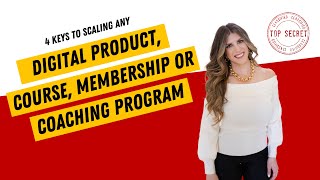
This is a YouTube video titled "4 Keys to Scaling ANY Digital Product, Course, Membership or Coaching Program" created on October 22, 2021. The content likely focuses on strategies for scaling digital products and related offerings, but no conversational dialogue or speakers are identified in the excerpt.
All right. Excited to be here. I'm excited you're here, too. Boom. Yep. Affirmative. Perfect. You guys are amazing. Okay, so tonight we are talking about the four keys to scaling any digital product, course, membership, or coaching offer. So if you're existing in any way in the digital business realm, you know, that's pretty much just about everything. So we're going to be talking about how to scale whatever it is that you've created. We're going to talk about the systems, we're going to talk. We're going to get a little technical and talk about the numbers. But I'm going to intro that in just a second. So we're going to jump right in. I want to make sure that everyone is in the right place. Of course. I want to show you exactly how I have sold $3.6 million of my own digital products. And by that I mean my templates, my courses, my coaching, and my mastermind. I want to show you the exact funnels. I used to do it. In the past, I've said funnel, like one funnel, but we're going to go through more than one funnel tonight. And even as a mother of three from northern Minnesota, if you haven't picked up on my accent yet, that's where it's from. I know, it's cute. Maybe, maybe not. But I'm sharing this because I want you to know that even with everything that's going on today, the crazy climate of the world and the chaos that I feel like we've had in our brains for the last year, this is still working. It's still possible. Even with the Facebook, iOS updates, even with algorithm shifts, all of those things, it's still happening. It's still possible. So I'm really excited to bring you the most up to date version of the training and we can jump right in with that. So how do you know if you're in the right place? I roll my eyes too when I hear this. When I hear presenters be like, all right, I want you to get out a piece of paper and a pen to take notes, and then they spend like two hours giving you nothing that's tangible. No specific actions to take. This isn't that kind of webinar. So while I am saying, like, please pay attention to me, it's not because I'm just going to bore you for two hours. We are going to move fast. I have way more than 45 slides, so even if I talk for one minute on each slide, we'd still have to go fast. So take notes, try to focus, put Your funnel vision on. We're going to talk about that later and we're going to get down to business. So I want you to commit to showing up ready to act on any and all good ideas you come up with while you're watching this webinar. Don't show up to just learn. Show up to make money. Because plain and simple, your success is my success. If you've ever been on a training with me before, you know they're packed with a lot of tangible, not fluff, information. And I've had people tell me I've attended this webinar seven or eight times, which seems crazy, but I mean, maybe we just. They like hanging out with me or maybe they learn a lot. Every single time. I don't know what it is, but there's going to be a lot. So if you have distractions, maybe put the AirPods in, try to sneak in a different room, hide in your closet, hide in your car. I've totally done all of those things because we're going to jump right in. So this webinar is going to most benefit you. If you already have an offer that you're selling and if you're ready for more from that offer, that's where it's going to be the most valuable. If you are looking to validate your business concept or get clarity on what you should sell, there's a chance the information might be slightly overwhelming. And I don't want that for you. If you're in that spot, I want you to know that you're in the exact place that you should be on your own journey. But just so you know, if I'm talking about roas and if I'm talking about profit and loss statements and some of those things that you think about a little bit more when you're slightly more established, I don't want you to get overwhelmed and feel discouraged because that's not my jam. So I have a lot of other trainings that would benefit you, but this one is more specifically about scaling what you already have proof is working inside your business. So before we jump into the framework, I want to show you what's possible with it. This was possible for Tasha because she became a client of ours and allowed us to implement the strategies that I'm about to teach you. You can see on the left. That was right away when she had launched the tiny offer that we're going to be talking about later. She was excited about having made $2,000 from this offer in her business. A few months later, she sent me a message and she said my GROSS Sales were $109,000 this month. And then a few months after that she sent me this story that said yes, that actually just happened. I now run a million dollar business. So you can see the potential of how fast this can shift your business when you start implementing these systems. But knowing that in full transparency, at the end of this 48 minute training, if you have gotten value, you will be invited to learn more about working together. And I'll give you a link where you can book a call to talk to my team. So just so you know that's coming, there's no surprises at the end or anything. There's going to be a whole bunch of fun stuff in the middle, but that's what's coming at the end. So now who am I? I know most frameworks about webinars say if you talk about yourself for like the first 15 to 25 minutes in the beginning, you only need a little bit of content and then you can get to pitching. I don't want to do that. I have the social medias, I have Instagram, I have Facebook. If you want to learn more about who I am, about my story, I have a pretty long bio on my website. You can go check all of that out. Odds are if you're here, you may already know a lot of that already. So throughout my career, I have spent roughly $1.5 million on Facebook ads of my own money and another $1 million hiring and paying my team. So you can see you're learning from someone who is teaching from experience, not just theory. You're also learning from someone who's ready to pump a little bit of estrogen in the digital marketing pool because there's not a lot of options when it comes from learning from strong leading females. So I'm here to do that. And more than vanity, I've been able to leverage my business to create a life for my family. We've bought investment properties, I've gotten to travel to meet entrepreneurs that are in my groups while while really thinking about the future and the legacy that I want to leave behind. So I'm super driven. Truly believe I'm just getting started in this whole crazy world of Internet marketing. So let me know if you can relate to that in the comments. If you're driven, if you're excited, if you are ready to jump in, let me know. Mim says she's excited about profitable scaling, 50 to 70% profitability. Profitability is my goal. That is an awesome goal. We're definitely going to Cover that, what to look at if that's your goal, where you can streamline and what you can trim and what can do, we're going to go through all of that. So another level of transparency that I want to make sure that I tell you about. A lot of the people who are mentioned as case studies or testimonials in this presentation had an existing business. So a lot of the stuff we're going to talk about is, isn't necessarily going to work for someone who doesn't know who they're talking to, doesn't know their messaging. It's not really meant for a business that's just dabbling and experimenting. It's much more focused on scaling people who are ready to take what they already know is working and pour some gasoline on the fire and really, really make it, make it hum. So if you don't have clarity on your messaging, your niche or who you serve, it's probably not going to work for you. I just want to put that out there. And if you're here and you're like, but I thought you were going to teach me how to start a business. I just want to save you the next 45 minutes of feeling frustrated. So another thing that I want to talk about is that the principles I'm going to teach you on this webinar work in any niche and suit any and all goals that you have. So if 50 to 70% profitability is your goal, heck yes, you can totally do that. Kelsey, who you see on your screen right now, her goal was to be able to be financially independent so that she could homeschool her kids and remain a stay at home mom despite the fact that she was getting a divorce. I didn't add that part in her testimonial and I messaged her today with a screenshot and I was like, hey, just want to confirm that this is fine. And she's like, you didn't say the part about how I left my marriage after 10 years and that this system was what allowed me to do that, so I had to add it in. But I think it's really interesting to know that side and know that this can provide that level of security and predictability in your business if you don't already have that. But I also want to tell you that it can be a heartbreaking amount of work at this time. I have erased all of my copy that said anything about me having the easy button because I've found that that doesn't exist. It's always going to be work. There's no way around it. Just got to go through it. And the people in the case studies that I'm going to be talking about were willing to invest in their businesses through doing the work. They've signed up for softwares, they invested in advertising, and they also took a ton of action to get it done. So what I'm about to teach is not for beginners. And I just want to like, put that whole thing out there right at the beginning. If you are listening or you're like, I signed up and I wanted to learn and now she's telling me I'm not going to learn anything. I invite you to open up a new tab and email support, Le Bjork and talk to Michelle, because we have lots and lots of trainings that might be better suited for, you know, starting your business or just jumping it. So I've been able to sell about $1 million of a $27 offer funnel, a million dollars of a course and a million dollars of a group coaching and mastermind program. So these principles and key shifts work together on all sorts of different levels. I've also helped my clients sell millions of dollars in online courses, memberships, coaching and mastermind groups. The like Amanda, you'll see on the screen said that her tiny offer made her $16,000 in the first week. And the additional upsells that she had from her evergreen webinar brought in another $30,000 on top of that. So. So those kind of results are my bread and butter and just totally light me up. This is Christy Barker from Girl Hustle Fitness. She is in another a different industry because I know there's also preconceived notions from people or ideas that you have to be in the sell sell how to make money to make money on the Internet business. Like only business development can make money from info products. And that's not true. So Christie sells fitness. She sent me this message back in July, like a year ago July, not just a month ago. And she had just launched her tiny offer and she was showing me how much her sales have increased since launching. You can see that big spike, just FYI, she says then just two days ago, she sent me this message and said, I'm about to hit a million dollars in sales because of this tiny offer. So just that, I mean, it's probably about 13 months. Tasha's was probably about 12 months to 13 months. So you can see how quickly that can happen, that spike. I mean, if you look at her thing here before she hit this 20k, I mean, she was probably at like 1500 dollars a month and then implemented ads in the system. And it changed everything. Diana is also in a different niche than the sell how to make money niche. And she's, she helps moms learn how to declutter, how to be less overwhelmed, how to be happier parents. And she has totally mastered a niche that can be kind of challenging to get into. Honestly, like, moms have a really hard time investing in ourselves. For whatever reason, we'd much rather buy stuff for our kids or, you know, for the family. We feel guilty when we invest in ourselves. And she launched a product that she's now averaging $1,000 a day in, teaching moms how to declutter and how to meal plan and all sorts of really cool products. So it, it is applicable for all sorts of different industries. Okay, cool. So these are the four keys that we're going to go through. We are going to be talking about the three key benchmarks that you must hit in order to start scale your offers. We're going to look at the easy hack to increase conversions and connection to increase that customer lifetime value, because that's super important. And what we did to our lead generation strategy that canceled out all of our ad spend entirely and why we stopped doing 90% of other strategies to do that. And then the single strategy that we use to tie everything together, make it work, earn more profits and, and work less at the same time. So key number one, the benchmarks. This is probably one of the most frequently asked questions that I get. Like, how do I know when I can scale? What numbers do I need to hit? When can I hire an agency? How can I make this all work? So it seems really simple on paper, right? Like you have to know how much it acquires or how much it costs to acquire a customer and how much your customer lifetime value is. Because then you know how much you can afford to invest on the front end and still run a profitable business. But then there's also the side of it that you have to know how much it costs to service that customer and how much it costs to keep your programs running. So if you've invested in a coach that's helping you strategize a really certain, like a specific tactic, you could include that because you're learning it to keep servicing your clients. Or if there's a software or even ad. Not ad fees, but yes, ad fees on the other side, like stripe fees, PayPal fees. What does it cost to run your business and calculate that into your programs? Because a lot of people, they look at just the front, just that top front end funnel that I talk about so much, that tiny offer funnel, that's just the casting, the wide net with the Impulse purchase at 27 to $47, that funnel, people are like, oh, now it's costing. Because ads have gotten more expensive. They're like, oh, it's costing me like $25. It used to cost $12 to get a customer. But when you look at it and you think about what is that customer doing once they're inside of your business? Are they buying another course, like a $2,000 course, or joining a group program, or are they ascending a value ladder? Do you have a value ladder really making sure that you look at all of those different pieces and if you're someone who you want that 50% profitability, making sure that you're scaling people quickly and getting them into the programs that would cancel out the ad spend and running super lean. There's a lot of ways that you can invest in automations and tools instead of people. I like having people, so I've invested in a team. I like having my, my rah rah. My whole team's on here probably. But like, getting to have that community as someone who works at home and is an extrovert is super important to me. But you get to decide that. You get to choose what your business looks like. So I speak in gif. Hopefully you all can relate to that. But you have to. There's like this teeter totter, the fulcrum thing, right? Like, you have to be able to keep it balanced and you have to know how much does it cost for you to currently get a new client in your business? If you're not running ads that might be super hard to answer. You might say like, oh, I spent 10 hours on clubhouse and I got one client. Or I spent all this time, you know, posting, creating one Instagram reel and it got a client, so. And offer what they need next. So I've had coaches that I paid a lot of money to work with and that was their advice. Like, oh, you want to make more money, raise your prices, Cool. What else? But it can be that easy. Now I was thinking of saying like, all right, webinar is over. You just got your advice. That's all you need to do to scale is just raise your prices. You can PayPal me some money for the advice, but that's. We know it's more than that, right? Like, we know it takes a lot more than just putting a different price thing on it because it has to be in Alignment. There has to be messaging. You have to be coming in with the mindset that selling is serving. And you can't just put something, a new price tag. You can't 10x your prices without believing in yourself and without having that confidence and having the energy behind it that your customers can feel. If you're not excited about what you're selling, your customers can feel that they can totally tell. So I know there's a whole web of lies in our brains that that lives around money mindset and it's pulling us back. And there's even guilt about showing up and selling. And I told this story earlier today when I did this presentation in the Summit. But I had a really hard time showing up live, and that's why I haven't done it for a year. I had a really hard time during coronavirus, like showing up and having my headspace in the right place where I didn't feel guilty watching the news and looking at how many people were losing their jobs. I wasn't overwhelmed trying to homeschool my kids for the first time ever. It was a very overwhelming year. So I completely understand and relate to the mindset, like how much that can affect everything that we're doing inside of our businesses. So you have to just pull yourself out of that and know that serving is selling. And I know that people who I didn't sell to for the last year that I wasn't helping with High Ticket, I can guarantee you that they were still looking for someone and they probably hired someone else that isn't as confident in what they can teach or isn't as caring about all of the people that are signing up for their program. So you just have to remember, if you're not showing up, you're doing a disservice to your ideal clients who are there just waiting to to purchase what it is that you have to sell. So when you think about your gym membership and you think about why selling High Ticket is of higher service, if you have a gym membership and you're spending like 50 to 100 bucks per month, depending on your gym, you might use it or you might not. You might go in and walk around and, you know, take a drink or your protein shake and leave because you don't really feel like working out that day. But if you have a fitness coach or you have a personal trainer who you're paying 700 to $1,500 a month, you're going to show up, you're going to make sure that you don't miss your training. Sessions, you're going to make sure that you're there on time, that you're putting in the work, that you're walking away sweating like crazy because you've committed and you're paying a higher ticket. So you're involved, you're committed. So if you can attract someone with that impulse purchase of something that is designed to get their attention, if they're cold, you know, cold traffic to you, or you know, they're not familiar with you, they're a complete stranger, you can still get their attention by giving them a really valuable product for $27 and making sure that everything on the back end is set up to ascend them in the amount of time that they're ready to be ascended. There's a really big misconception about funnels that they take a long time to go through, that you join at one spot and you're not going to see another offer until like three months later. But you can design it in certain ways that you can show them what else you have almost immediately. So automating the low ticket sale is also of service to your ideal buyer. When you think about it that way, because you have all of this time cleared up. You're not on Clubhouse, you're not on TikTok, you're not doing, you don't have to be doing all of the things and feeling frustrated in this state of fear of like I always have to create content, you can just go make the best program on the market. You can become the market leader in what it is that you're teaching because you only have to focus on becoming the best on, on being the best. You're not trying to constantly get the next person in the door so that you can keep paying for your software, paying for your coach or paying for your team. So just for, I guess, illustration of why I think this is so important, we're going to do a little exercise on imagining your dream home and how shifting how you see things slightly can make a really big difference. So say your dream home is a million dollars. This picture right here is my dream home. I creepily took this picture off the Internet because the house is not for sale. But I'm going to own it someday. So generally speaking, if I were to buy a million dollar house, the bank would want to see about a 2, $250,000 a year income to approve me for a mortgage for a million dollar house. If I'm going to, if I'm not going to buy the house with cash, they're also looking for 20% down so just for easy math, imagine that you need to make 250k a year and have an extra $200,000 down to sign up for this house. Think about how many actual humans you would need to serve to make that happen. So whether it's maybe it's a Tesla, maybe you want a fancy watch. I mean maybe it's not a house, maybe it's a vacation. How many people equal the dream coming true? If every customer ends up spending roughly $2,000 with you, that's only 100 people to get that, get that down payment ready. If you want your take home pay to be $250,000, that's only 125 people a year. So total for 225 people per year and I guarantee you there are that many people out there looking for exactly what you do. That's it's simple. It's, it feels so much easier than feeling overwhelmed by like infinity money. Like my business needs to generate infinity money. It's just not very, you know, it's not as motivating to look at your. I even have it plotted out on my wall of like this is how many more humans I need to connect with. I need to, you know, reach to make this dream come true. So you can improve what you can't measure. If you're ignoring your numbers, if you're not looking at how many people are coming in monthly, they're going to get away from you. Because what we don't pay attention to tends to fall apart. You know, where we focus, those are the things that really expand and really grow. So I'm focused on growing my business and my personal net worth at the same time, not just being an employee of my business. So I don't know if anyone has ever felt like that. Like I am obsessed with my business. I ruminate on it constantly. It's overwhelming. I can't turn it off. Like I sometimes, and this is true for me too sometimes I miss being an employee and I could like clock out and go home and watch Netflix at night because now I like my brain just doesn't stop because I love what I do so much. So this is what a million dollar business can look like when you have, just for the sake of simplicity, say you have three different funnels in your business. That's all you would need to build a million dollar business. You have your tiny offer funnel bringing people in, we'll say just to $27 straight. We won't talk about upsells, cross sells any, any part of that. Just for the left side of these columns, high ticket program, that's going to be your bread and butter. That's the easiest thing to scale and that could be 60 to 80% of your revenue. If you sell your tiny offer to 7,400 people, only 2% of those people would need to be like, oh my gosh, I love this tiny offer. What else do you have available? Only 120 people to hit that goal. So then when it comes to one on one work, say you're, you know, say you're a service provider or you have VIP days or you have a mastermind or any of those, you know, like higher, higher ticket, something that you could sell for $20,000. You would only need 10 people at $20,000 and that's 0.13 conversion. So not, what is that, like an eighth of a percent? Almost like that's not a very big percentage of people. When you get the massive visibility that you can get by having a tiny offer. This is Jerry. She was a student who is now, now a coach on my team. And she said that she had tried almost everything. She had joined every program and the tiny offer was really like her last chance. And I hate to even say that out loud because I don't, I don't like it when it's people's last chance, but sometimes that's the scenario. So she now says she's making an average profit of $150 to $300 per day. And she's enrolled three people into her higher ticket program, which is more than she's had in that two weeks since launching. That's more than she had the previous three months. And that was spending way more time marketing. So you can see how, how quickly this can work, how awesome it is and just what it looks like to have these different tiers in your business. So key number three, I think you've probably imagined this already or you probably have predicted what I'm going to say. Key number three is what we did to cancel out our, our lead generation cost entirely. So cancel out because it has to be in alignment. There has to be messaging. You have to be coming in with the mindset that selling is serving. And you can't just put something, a new price tag. You can't 10x your prices without believing in yourself and without having that confidence and having the energy behind it that your customers can feel. If you're not excited about what you're selling, your customers can feel that they can totally tell. So I know there's a whole web of lies in our brains that lives around money mindset, and it's pulling us back. And there's even guilt about showing up and selling and. And I told this story earlier today when I did this presentation in the Summit. But I had a really hard time showing up live, and that's why I haven't done it for a year. I had a really hard time during coronavirus, like showing up and having my headspace in the right place where I didn't feel guilty watching the news and looking at how many people were losing their jobs. I wasn't overwhelmed trying to homeschool my kids for the first time ever. It was a very overwhelming year. So I completely understand and relate to that mindset, like how much that can affect everything that we're doing inside of our businesses. So you have to just pull yourself out of that and know that serving is selling. And I know that people who I didn't sell to for the last year that I wasn't helping with High Ticket, I can guarantee you that they were still looking for someone and they probably hired someone else that isn't as confident in what they can teach or isn't as caring about all of the people that are signing up for their program. So you just have to remember, if you're not showing up, you're doing a disservice to your ideal clients who are there just waiting to purchase what it is that you have to sell. So when you think about your gym membership and you think about why selling High Ticket is of higher service, if you have a gym membership and you're spending like 50 to 100 bucks per month depending on your gym, you might use it or you might not. You might go in and walk around and, you know, take a drink or your protein shake and leave because you don't really feel like working out that day. But if you have a fitness coach or you have a personal trainer who you're paying 700 to $1,500 a month, you're going to show up, you're going to make sure that you don't miss your training sessions, you're going to make sure that you're there on time, that you're putting in the work, that you're walking away sweating like crazy because you've committed and you're paying a higher ticket. So you're involved, you're committed. So if you can attract someone with that impulse purchase of something that is designed to get their attention, if they're a cold, you know, cold traffic to you, or, you know, they're not familiar with you, they're a complete stranger. You can still get their attention by giving them a really valuable product for $27 and making sure that everything on the back end is set up to ascend them in, in the amount of time that they're ready to be ascended. There's a really big misconception about funnels that they take a long time to go through that you join at one spot and you're not going to see another offer until like three months later. But you can design it in certain ways that you can, you can show them what else you have almost immediately. So automating the low ticket sale is also of service to your ideal buyer when you think about it that way because you have all of this time cleared up. You're not on Clubhouse, you're not on TikTok, you're not doing, you don't have to be doing all of the things and feeling frustrated in like the state of fear of like I always have to create content. You can just go make the best program on the market. You can become the market leader in what it is that you're teaching because you only have to focus on becoming the best, on being the best. You're not trying to constantly get the next person in the door so that you can keep paying for your software, paying for your coach or paying for your team. So just for, I guess, illustration of why I think this is so important, we're going to do a little exercise on imagining your dream home and like how shifting how you see things slightly can make a really big difference. So say your dream home is a million dollars. This picture right here is my dream home. I creepily took this picture off the Internet because the house is not for sale, but I'm going to own it someday. So generally speaking, if I were to buy a million dollar house, the bank would want to see about a 2,250,000 a year income to approve me for a mortgage for a million dollar house. If I'm going to, if I'm not going to buy the house with cash, they're also looking for 20% down. So just for easy math, imagine that you need to make 250k a year and have an extra $200,000 down to sign up for this house. Think about how many actual humans you would need to serve to make that happen. So whether it's maybe it's a Tesla, maybe you want a fancy watch. I mean maybe it's not a house, maybe it's a vacation. How many people equal the dream coming true? If every customer ends up spending roughly $2,000 with you, that's only 100 people to get that, get that down payment ready. If you want your take home pay to be $250,000, that's only 125 people a year. So total for 225 people per year and I guarantee you there are that many people out there looking for exactly what you do. That's it's simple. It's, it feels so much easier than feeling overwhelmed by like infinity money. Like my business needs to generate infinity money. It's just not very, you know, it's not as motivating to look at your. I even have it plotted out on my wall of like this is how many more humans I need to connect with. I need to you know, reach to make this dream come true. So you can improve what you can't measure if you're ignoring your numbers, if you're not looking at how many people are coming in monthly, they're going to get away from you. Because what we don't pay attention to tends to fall apart. You know, where we focus, those are the things that really expand and really grow. So I'm focused on growing my business and my personal net worth at the same time, not just being an employee of my business. So I don't know if anyone has ever felt like that. Like I am obsessed with my business. I ruminate on it constantly. It's overwhelming. I can't turn it off. Like I sometimes, and this is true for me too sometimes I miss being an employee and I could like clock out and go home and watch Netflix at night because now I like my brain just doesn't stop because I love what I do so much. So this is what a million dollar business can look like when you have, just for the sake of simplicity, say you have three different funnels in your business. That's all you would need to build a million dollar business. You have your tiny offer funnel, you bringing people in. We'll say just to $27 straight. We won't talk about upsells, cross sells any, any part of that. Just for the left side of these columns, high ticket program, that's going to be your bread and butter. That's the easiest thing to scale and that could be 60 to 80% of your revenue. If you sell your tiny offer to 7,400 people, only 2% of those people would need to be like oh my gosh, I love this tiny offer. What else do you have available? Only 120 people to hit that goal. So then when it comes to one on one work, say you're, you know, say you're a service provider or you have VIP days or you have a mastermind or any of those, you know, like higher, higher ticket, something that you could sell for $20,000. You would only need 10 people at $20,000. And that's 0.13 conversion. So not, what is that, like an eighth of a percent? Almost like that's not a very big percentage of people when you get the massive visibility that you can get by having a tiny offer. This is Jerry. She was a student who is now, now a coach on my team. And she said that she had tried almost everything. She had joined every program and the tiny offer was really like her last chance. And I hate to even say that out loud because I don't, I don't like it when it's people's last chance, but sometimes that's the scenario. So she now says she's making an average profit of $150 to $300 per day. And she's enrolled three people into her higher ticket program, which is more than she's had in that, you know, two weeks since launching. That's more than she had the previous three months. And that was spending way more time marketing. So you can see how, how quickly this can work, how awesome it is, and just what it looks like to have these different tiers in your business. So key number three, I think you've probably imagined this already or you probably have predicted what I'm going to say. Key number three is what we did to cancel out our, our lead generation cost entirely. So cancel out our ad spend. Liquidate our ad spend. And of course I have to tell you about what a traditional launch method looks like first because, you know, in the info commercials they have to like, or the infomercials, they have to be really dramatic and like spill things and it's black and white and there's like music. I wish I had that capability on Gotowebinar and I would like make it really dramatic. But this is what a lot of traditional, my slides just freaked out. Traditional launch methods look like. Can you guys see that? Like with the loop de loops and dramatic effects, all the things. Oftentimes when you're launching it takes like six weeks sometimes. So you get people to opt in, you send them emails, you deliver their free lead magnet. I have to say that carefully because people make fun of how I say magnet. That's like the most Minnesotan. Then you bring them to an offer page and then at some point you send them a lot more messages and hopefully they end up signing up for something, hopefully they buy something. But there's a lot of places that people can drop off and it's a really long process. When you're doing like a full launch. I don't know if you've ever watched people who do like the annual launches, maybe twice a year launches, you don't really see them a lot. And then for like six weeks they're in your face. Everyone has an ad, everyone's affiliate, like it's a huge thing. But if you're new, if you're just getting started, or if you're just scaling for the first time, you don't have that much Runway. You don't have. I mean if something goes wrong, that's a lot to lose. That's a lot to bank on to. Just put all of your, all of your profits and launching's exhausting. Like, let's be honest, it's a lot of work. This is what it looks like to have a funnel that has a free PDF sign up, which is what a lot of people were doing prior to this Tiny Offer strategy being, you know, more of a well known strategy. If you have people signing up for a PDF just for easy math, let's say 1000 people sign up, they register, they get on your email list. 20% of people are going to open your emails because those are just benchmark numbers. So that's 200 people. Then if 3% of those openers click, that's six people. 30% register for a call with you. Maybe somebody doesn't show up and you're like waiting on zoom and it's awkward and you just don't come. And then the other person comes on the next call and they buy. You might have one sale for the thousand people that signed up for your free lead magnet funnel. And if you're running ads to that, what's even worse is if you're running ads and you're paying save and $5 per lead, you could be breaking even. If you're selling something that's $5,000. You can see just like the math doesn't make sense anymore for how much ads are costing in today's market. So this is the Tiny Offer Blueprint. If you haven't seen this is also called like a self liquidating offer funnel. Tiny Offer blueprint gives you different traffic options, but essentially you bring them to a sales page that has an order form either on the page or on the next page. That order form lets Them put in their information and then there's a box on it that's called an order bump where they can check something and add on to their order. In the next step there's a downsell or an upsell. You can get as crazy and fancy with these funnels as you want, but when I launched my first one, it had three steps. It had the main offer, the order bump and the upsell. So if we're going to simplify it and just look at what I'm doing now, it is the sales page order bump on the order form the oto, which is the one time offer upsell page. And then I also have on my current funnel I have a one time offer or an OTO 2. So like a second upsell. And that's for my monthly membership and that I think we sold three of those today. So we're averaging lots of new people joining our membership as well because we have this system telling them that it exists. So a lot of people feel like this when they look at ads. If your face is glazing over and you're like, but I don't want to start money on fire. Like, I don't like ads. I've never run them before. I've never had success with them. This strategy lets you scale your ads in a way that you know right away if it's working. So this looks super complicated. So I'm going to try to break it down because it's really not as bad as it looks conceptually. So this is called the waterfall ads scaling strategy. And this is how I was able to scale my first tiny offer as fast as I did. I think I scaled it to like $90,000 in the first two months and how much it was generating. But that's because I knew ads. I was coming from being an ad strategist, being a funnel strategist. So I was able to use that experience and put it to work and do this really quickly. Essentially what this is saying is that if you, if the red is the amount of money that you have available to test ads and they start working on day one, by day four, you're going to have money dropped into your account from the sales that you made two days prior, maybe that's three days prior. So you can see those arrows. Like it just keeps depositing more and more money. So as you're spending more on your ads, you're making more profit. And as you keep going, by day 10, you could have 27x the amount of sales that you were making on day one. Just because you're scaling that, if that makes sense. This is assuming a 3 return on ad spend, which I would say is less common now. But today on my own funnel, I had three return on ad spend. And I'll about talk, talk about that in a second if you're not familiar with those terms. But, but it is still possible, is still working. You can still get results like that from your tiny offer funnel even with the iOS 14 update. So in this instance, this is what it looks like to run ads to a live webinar. You essentially would need to spread your ad spend out over seven days, and you wouldn't know until day 10 if those ads had even worked. So if you have a set budget for how much you can afford to spend and it's going to be smaller, you're not, you're going to have to spend less per day because you have a longer time span to spread it out. And if you're doing an evergreen webinar, you might not know. Like, when we have our evergreen webinar up and running, we don't know sometimes two until two or three weeks down the road if it's even working. Because people have to watch the webinar. They have to, you know, get in the reminder sequence. They have to. There's just like a much longer waiting period to know if that funnel is functional or not. So when I talk about return on ad spend, by definition it is how much money you're getting back from your ads. So if you would spend $1 on ads and get 3 back, that's return on ad spend. That would be a 3x return on ad spend or 3 ROAS. So this is a form that we created for our students to be able to track inside of our program what their offers are doing and knowing where to improve things, where to look at them. The beauty of a tiny offer funnel compared to some of the, you know, more elaborate webinar funnels or evergreen webinar funnels, even challenge funnels, is that it's harder to know how to optimize it because you have a lot more time in between, you know, like launches and evergreen. Tiny offer funnel is just functioning every single day. So you can look at it week by week and you can say, okay, my order bump conversion rate looks a little bit lower than what Ali says her benchmark is, or my OTL looks like it's lower. If I could get that up, or maybe if I could add another course on the back end, I could get my average cart value from, we'll say 100 to 250. And then what would that look like for how profitable my ads are? So you can start playing with the numbers. And I'm going to say this probably more than once in this webinar, but business is just about numbers. It's a numbers game. I'm reading a book right now called the Great Game of Business, and he says that all the time of like, you can't get too emotionally caught up in it. It's just numbers. So knowing funnels are just numbers. If it's not connecting, it's just messaging, it's just positioning. It could be your audience. It's like a science experiment where you have to detach from it a little bit and not take it personally. If it's not working, it's not you. It's not because you have a bad business. You just need to make sure everything is in alignment for the person that you're trying to sell to. So this is today. If you look at the date, I just pulled the screenshots, August 11, 2021. And this is how. This is how much we made in sales, which doesn't seem like a lot. We're actively scaling this funnel. But what it shows you is that 15 people bought the toolkit, three people bought my $197 offer. I don't know if that says that on there. This one right here is $197. And this membership offer is $47 a month. So if you're trying to grow your membership, a lot of people, you know, they're either like team courses or team membership. Like, those are the passive income options they've been presented. So they do all this work to create a membership, and then there's like four people in it, and they're like, this is not worth all of the effort. And I don't know how to get new people in it. This is a good way to get people into your membership. If you have a higher ticket course that you've built and no one's buying it, or you don't know how to get it in front of people, this is also a good way to get people into that course. So no matter what, what business model you currently have, you can add this on the top and bring people into your existing offers. So these are the ads from today. You can see average cost per result, getting $11 purchases. I don't know why today is working out so well. I guess it was trying to get me excited for this webinar. In the past, we've been seeing more like 15 to 25. Even that $30 purchase has been pretty normal for us in the last couple weeks. But you can see when my average cart value is $105, it makes it a lot easier to scale. That's still like a 3 return on ad spend. So what a lot of people are doing is everything. Like they're doing blogs, podcasts, Facebook groups, Instagram, dancing on TikTok, like all the things. But they're not running Facebook ads. And Facebook ads are. Yes, it's the scare, maybe the scariest quote, unquote, because you're putting money into it. But how much is your time costing you for all of these other things that you're doing? That was a huge shift for me when I thought about just made so much more sense because I value my time so much. I have such a limited amount of time with having three little kids and wanting to be really intentional and focused about how I get to hang out with them, that this was kind of my only option. So if you look at my social media, I'm not on there a lot. Except for Instagram. I like to hang out on Instagram. But if you're sitting there and you're like, cool story, Ali. Like, what am I supposed to do? I've never run ads. I don't, I don't have any proof that it's going to work for me. This seems scary. You have to dial in your back end. Again with the gifts. So I was a horrible waitress in college. Like probably one of the worst waitresses that Red Lobster has ever seen. True story. I didn't know the difference between a New York strip and like a T bone. It was. I don't know why, but anyway, I was a super bad waitress. But when people talk about this top of the funnel and back end of the funnel, you can think of it like a restaurant. So if I were waitressing still and I was trying to cook all the food and I was trying to run it out to the tables and I was trying to clear the tables and I was trying to seat people and like walk around like managers do and they're like, how's your meal? If I was trying to do all of those things, it would never work. So you. When you can get automations in place and you can have emails checking in on people and you can, you know, enroll people through, through automations into your programs and deliver the contracts automatically and deliver access to everything automatically, it saves you so much more time to stick with doing the thing that you're really good at. Backend also means the other offers that you have. So waiting a week before you're emailing them, you almost like stack your email sequences. Thank you for buying the tiny offer. That's awesome. I'm so glad you're here. Here's a little bit about me. Here's the testimonials that I have. Like, here's all the cool things that I've done. And also this might be of interest to you if you are interested in X, Y, Z. So you can just add it right on. You can invite them to a one to many sales experience, which is so meta because here you guys are on a webinar and I'm talking about how to get people on a webinar. You can just look at the emails that I sent and what, what made you want to show up tonight? Like, what were you interested in? And how do you create that same experience for your people? Terrible waitress. This is Lindsay. Lindsay was one of our students. She posted in our group and she said, I've made about three, $3.5K. I don't know why I always say it that way instead of 3500. Like the 3.5K always throws me off. So she sold $3500 of her tiny offer and immediately on the back end sold her powerhouse program, which is, I think between the two that she sold was 15, an additional $15,000. So between her tiny offer and the two places she sold in her higher ticket thing, she brought in about $19,000 right away from launching her tiny offer. Because you're just showing people that you exist. Like, it's not, it's not that crazy of a system. But oftentimes, like, we forget that ads have such a blanket availability. And when you can write copy and when you can design graphics that get their attention, people are just waiting. And this is related kind of. But funny story I set up. My husband is a den master for our Cub Scouts locally. And he, like, is having the hardest time getting kids to join. And I was like, let me set up an ad. Let's build a funnel. Let's get some little kiddos into Cub Scouts. And I turned it on yesterday. He's gotten two new people signed up into his Cub Scouts pack by, you know, just within a couple days. So it works. These principles work whether you're selling, you know, digital products or trying to enroll people in your, in your Cub Scout den. I don't know. All right, this is Melissa. Melissa was another student of ours. She did it her own way too. And that's the biggest takeaway that I want everyone to know is that this is not. It is a one size fits all, but the way you implement it isn't. So Melissa had a tiny offer. Her Facebook group was her bread and butter. That's where she hung out the most. That's where. That's where she pitched her free challenge that she did. I think she did it like monthly. And then she sold her program on the back end of that challenge. So from bringing people in with this tiny offer, she. Her next step for them was, hey, thanks so much for joining this or buying this tiny offer. Join my group. Like, that's where I teach. That's where I do live streams. That's where the community is. Come on in. So she had this pool of people that she could nurture that wouldn't have been there just from stumbling across it or maybe seeing her organically, she was able to reach such a wider audience because she was running ads. So the secret single strategy might surprise you because it's not really a secret. It's kind of a secret because a lot of people don't realize this or don't give themselves this much credit, but the secret is that no one but you has the answer. So the secret is, is learning to trust your gut and taking action faster, generally, meaning being able to fail faster and recover from failure faster. That's the only secret. That's the. That's the strategy. That's what we were able to do to tie everything together, increase profits, earn more, and work less, is to stop listening to all of the other ideas and stop trying to be good at everything and really like losing our focus on what. What was our bread and butter, what made the most sales for us. And it's always been tiny offer funnels into webinar funnels. Whether it was evergreen or live. That's what's always worked for us. So I've talked to thousands of entrepreneurs by this point in their businesses, and I know that most of the stories that keep people stuck in their businesses, there's like only five of them, only five stories. So the stories that we hear over and over again are I don't have enough money to invest in a system to get this up and running. I don't have time to make it work. I'm afraid that I'm going to put all this time into it and it's not going to work. I don't know if I'm. I don't have the ability. Like, I'm not sure I'm tech savvy enough, and I'm confused. Like, I don't even know what you're talking about. I don't know what I would create. I don't even know where I am, any of those. So when you're thinking about your own audiences, know that those are their fears too. Like, that's just human nature. That's buying psychology. If I go to Target and I'm like, going to buy a new shampoo or something, of course I had to use a Target example. I might, I might have some of those objections too, or some of those issues about buying an expensive shampoo or, you know, like, is this really going to make my hair shinier? Is this thing. So it's, it's a universal principle. So if you've invested in other programs that didn't yield results or you didn't finish them, I just want you to, like, acknowledge that that was not your fault, because maybe it was designed without having the thing that tied it all together. We talked about memberships, we talked about courses. So the one thing that is holding you back from success is just what we talked about in key number one, which is knowing your numbers. It's knowing, do you have enough people at the top of the funnel to go into your other stuff to make that stuff. Stuff successful? So the other, other thing that I run into a lot is believing your own thoughts are true. You don't. I tell my kids this all the time. Like, you don't actually have to believe the things your brain is telling you. Like, our thoughts are conditioned responses designed to keep us safe. And normally that's the number one issue people face when it comes to implementing something new in their business. So beyond that, I mean, you could be successful with just about any strategy. So if you have launched a membership program and not enough people have enrolled, or if you've created a course and not enough people have enrolled, you just have to reverse engineer. Know how many humans that equals how many actual people need to come into your stuff and know what benchmark conversion rates are. Because as much as our businesses are unique, the benchmarks typically aren't. I mean, funnels convert at almost the same rates no matter what. So being able to look at those benchmarks and optimize your funnel based on what's typical. I mean, I think if you, if you even go into Google, don't do it right now, because we talked about committing and focus. But if you sometime you go onto Google and you look up like, what are the benchmark email rates for my industry? It'll tell you. It'll say like, you know, corporate companies are this when they send out email, retail and E Comm are this marketing info products. Is this like you can break it down because it is so similar. So it's just knowing those numbers and not taking it personally if it's not working and looking at it like a science project of like how do we fix this one piece or how do we make this thing over here work? Because there are just little spots in the funnel where they can break down and throw the whole thing off base. So as long as you know like what your average click through rate on your ads is and it's at the benchmark, as long as you know how many people should be buying from that page or if it's a webinar, like how many people should be signing up, how many people should be opening your emails, it just becomes a numbers game and then an optimization game to get your ad costs down to maybe even move beyond ads and make sure you you are using that as a call to action. If you have a podcast or if you have a YouTube video like you want to always have one net to cast so that it makes it really easy to track where people are coming from. So if you're in that spot, let me know if that's happening. What is the tiny offer strategy? 45 minutes. Thanks Sherry for keeping me on point with the time. Tiny offer strategy is what I explained earlier. It's a three step funnel, that blueprint, that's the tiny offer strategy. So if this is not working for you, just acknowledge for yourself if your business is growing, it's all coming together, it's all in process. Just stay in gratitude for how far you've come and give yourself a minute to sit with that, own your own voice and look at what alignment looks like for you. What does that next step look like for you? So knowing that you could be successful with anything, if you just believe that you're going to be successful with anything, and if making an impact on the Internet by selling your digital products and programs is what success looks like to you, then everything that we've talked about so far tonight is going to increase tenfold. So Derek I think is on this call, but this is something that he said inside of one of our groups of like this blew my mind thinking about who I want to work with for the next three to five years. You don't have to just create a product that's not going to serve your ideal audience. I have another private client who she's focusing on one thing because it's been how she started her business, it's how she's been making money. But she's really interested in shifting and actually serving a new audience. You don't have to keep serving the same audience if you feel like you've outgrown them. The sooner that you can launch something new and start getting data and start getting information about if that's sellable, the better. So as humans, we way overestimate what we can accomplish in a single day. Like we can have crazy long checklists, but when we look at how much we could accomplish in a year or two years and five years, we underestimate what we are capable of and what that can look like. And we end up being frustrated and discouraged as a result of that never ending cycle. So I don't have the easy button for you, but that is what it looks like for a lot of us. A product suite, when we're talking about, yes, I did say key for Brenda, that one was what ties it all together. And that's essentially alignment and knowing that it's just about putting your funnel vision on and going all in with whatever strategy it is that you want to make work. When we try to dabble and we try to do too many different things, try to be on all of the social media without mastering one source, it gets really overwhelming. So one source of leads, one offer. When you can dial that in and get that working, that's when you can start expanding and growing. So a product suite. This is a picture from my favorite store. Guess what? It solves all of the problems that your client might have. So when you're thinking about who that ideal person is, you can look at all their different pain points and put them all in one place for that person. And that's what's going to help people to ascend your value ladder and to want to keep investing with you. Because you've already, you've agitated a new problem after solving their new one. Like, cool, my ads are working and now I have so many people coming in, now I need to hire a team. Well, then you could create a product about how to hire that team. See what I mean? So you can like keep, keep increasing people's need for your next product. So the real secret is to trust your gut more and to take action faster. That's it. So by definition, wealth is the ability to remove your time from how you make money. So when you stop needing to clock in and get paid hourly, when you don't have a salary, when your money starts making money for you, basically that's when real wealth is created. So by my definition, when you have a business that can generate wealth for you, so you're waking up to sales, it's making money for you while you're sleeping. That's when you have time to really build that wealth for you, your family. Focus on profits, focus on optimizing, and that's what scaling should be all about. So there's plenty of people out there who are successful just because they made that choice to show up in the decision to sell. So these are all things that I hope you agree with after seeing the last four shifts that there are thousands of different directions you could go. Focus is going to help you accomplish all of those things. And you can make lots of money in your business through imperfect action. As long as you are, you're focused and you're getting the help that you need and you can get it done relatively quickly. As we saw in the examples of these people who grew million dollar businesses in a year, in a whole year, you know, like 12 months. They started with some established foundation, but then they were able to scale it really quickly. So when you're ruminating on the stories that you have about not being able to finish things or being afraid to start something new, those are the things that are truly keeping you stuck. This is Catherine. Catherine came in, she had been afraid to sell previously. She wasn't really showing up to sell her hire ticket. She ended up launching a tiny offer and making $15,000 on the front end. And then she messaged me and said I've made €110,000 because she's German euro since we last spoke. So it's really just so rewarding to see this work in all sorts of different businesses. This is the system that I implemented to be able to go from took me about six years to hit six figures and then once we cracked this code, I went from six figures to a million dollars in about 10 months. So if you're wondering if you're like what is the tiny offer strategy? This is what it is. This, it's a four step sales funnel that you can build in lots of different tools. You could do it in click funnels, you could do it in ThriveCart, WordPress, Kajabi even. There's lots of different ways that you can build this type of funnel, but it's just the automated process of continuing to introduce the other products that you have available for people. So just offering it and not being afraid to sell, not being afraid to step into that sales role of like, look at this other thing I have for you, just putting it out there. And the beauty of it is that you see around that red circle when you're running ads, you know, on step one, if it's going to be profitable or not, you know, usually by like 48 to 72 hours of starting your ads, if it's working or not. The other thing that we've talked about is the high ticket blueprint or the high ticket funnel. And what a high ticket funnel looks like is bringing your existing tiny offer buyers into an opportunity like this one. Like an evergreen or a live one to many sales experience. You can also run Facebook or YouTube ads or use the social, so Facebook, Instagram, any of the things and drive them to your high ticket webinar. So here's a couple more experiences that people had. There's so many testimonials that I could just pop them all on the screen and you can read through them. I could, I could have slides upon slides of screenshots like this. Like my whole phone is full of these screenshots. I have one, well, two more for you actually. This is Catherine. She sold $100,000 offer on the back end of the tiny offer. And I remember her being like, how are we going to do this? This is, as far as, you know, in between a $27 offer to a high ticket offer of $100,000. You can't get much more widespread than that in your offer, right? And it worked for her. She brought people in by selling them something that was $27 in her case. It was a case study because when you have something that people have such a preconceived idea about, like there is no way I could sell something that is that expensive when you can prove it to them. And you're like, look at all of these clients that have created $100,000 offers. That was worth paying $27 to get this case study and get the blueprint from her. And then she was able to sell her $25,000 offer like her mid tier at $25,000 right off of the back end of that and had to turn off her ads because her sales team was overbooked. So it can work for all different levels of tiny offers. This is Katharina. She is from Denmark and she was sending me these messages and sent me the screenshot saying I was making sales while I was messaging you. So she launched, had 700 students join and made $34,000 right off of the back end. She said she's so grateful that she joined this program. So those are the four shifts to scaling your digital product business. Hopefully that was helpful for everybody. And I just want to check in with all of you. Like, do you feel more comfortable knowing what it'll take, knowing what you need to study, knowing what you need to pay attention to inside of your business? So do you realize the advantage that you would have in being able to scale if you have the numbers, if you have things coming into your business that help you make sense? Randy asks, how far ahead do you need to be in your upsell when you launch your tiny offer? That's a great question. I can't talk. Great question, Randy. Um, you could pre sell it. I meant to say that earlier, but I don't. I don't really create a whole lot of anything before I try to sell it. I like to get that proof that it's gonna work. Because in a previous life before, before things started working, I would create whole courses and then I'd sell it and maybe like send out one email to my list of 400 people and nobody would buy it. Cause it was like a course nobody wanted about SEO, which is a true story. And it was done. I had spent months, months and months building this course and I was finally going to launch it. And then nobody bought it. And I was crushed. And I was like, I'm never going to do this again. I'm never going to create a course again. But it's because I did it in the wrong order. Had I tried to pre sell it and then like live built it with people, it would have, I would have seen. Oh, no one is actually interested in this. This is not an attractive, irresistible offer. Maybe I shouldn't spend months building this. So you could totally pre sell it. You could, you could make it like a live experience to go through it. You could still sell it and put it on the OTO page and say, you know, if you're interested, we're starting this program live. You can book your spot in now, save your spot, blah, blah, blah. That's a really good way to do it too. So I see some comments coming in. Ooh, Jeff has a good question. I'm going to save these questions for the very end because I have more to say. You guys tell. I just took my shoes off. I just got like an inch and a half shorter. I noticed now my screen is at a different angle. But the next thing that I want to make sure that I share with you is that I have spent hundreds, spent and lost hundreds and hundreds of thousands of dollars trying to get to this point. I Mean, even if it. If it's just time, like I told you the story about the course that was never sold, but I failed. And I've come back and I've failed again and I've tested some more. Told you right at the beginning that I'd invested, like, $1 million of my own money into apps and testing ads and finding out what works. So I've seen entrepreneurs do this, too, alongside, like, where they're trying to model or they're trying to figure it out and they're failing and they're spending money and they're losing money, and they get to the point where they're like, I don't know if this is worth it. I'm ready to give up on my dreams. They become so discouraged that they just think that it's not for them anymore. So I just want to mentally prepare you that if that's your journey, if you are ready to go off on your own, that might be what you're going to face. So you could totally take what we've talked about tonight and go test and go tweak. But obviously, I'm presenting a better option for you. What? You know I'm biased, but what I believe to be a better option for you, there is a link that I popped on the bottom. So knowing that you can model what other people are doing, but getting in behind the scenes and getting access to their tools and getting access to their resources is so much easier, and growth is going to happen in a much more natural way. So we're going to pop into questions in just a second, but how are you guys? How are you guys doing? Is this sitting well? All right, so if you want to optimize, if you want to get your business functional. I know I said this earlier, but business truly is just a game of numbers. So if you're not profitable, you. You're not where you want to be. If you have a lot of questions, if you just want someone to look at what you're creating and you want to know part of a community, like, if it's working well, then I want to offer this call to you that I put the link on the bottom because that's exactly what you can have by being part of any of my programs, is getting that feedback, getting the information of what's actually working. Like, what are those benchmark numbers? Ali, what should my page be doing? What should my headlines say? All of those different things. So the link here will bring you to a booking page where you can talk to my team and see if it would make sense for us to work together. They'll sit down with you, take a look at your business, and figure out what exactly is holding you back from growing that business. Your business is unique. And I think after that whole key number four, I hope all of you know that, that your business is completely unique to you. It's based on your perceptions of the world and what you have already created in the past. When I've done these webinars, I had a whole elaborate stack at the end, and I had bonuses that had values on them, and I encouraged people to buy right off of the webinar. But I realized that that's not necessarily doing you the best. It's not like serving you to your highest good. Because maybe the thing that I'm selling isn't actually the thing that you need. Maybe there's something else that would be a better fit. Maybe I have a different program or a course or a mastermind or something that would really suit your business. So I'm at the point in my business where it's not the bonuses that are going to bring in the right people into my program. It's knowing that you've seen yourself in the examples that I've shared, you've seen yourself in my story, and you're ready to get help. So the exact tactics and structures that have worked for me might not be the exact things that work for you. And I'm a strategist at my core. So getting to look at other people's businesses and tear them apart and build them back up and make them work the way they should, to get to your profitability goals, to hit your dream number of humans in your programs, that's. That's the biggest thing that's important to me. So on these calls, we have an opportunity to look directly at entrepreneurs, businesses, hear their struggles, be able to tell them exactly what to change and what to do in their specific business, how that would happen. And the reason that we can come up with what needs to change or what would help is because we've seen it a lot. I've had thousands of students by this point go through Tiny Offer Lab, Tiny Offer Accelerator, my Impact Lab mastermind. And I've seen all of the different issues that people face, and they're usually very similar. So odds are we've probably already seen it, and it's not going to be a hard fix for us to give you the suggestion to go and implement. So we have numbers and data, all sorts of different businesses, because we've done it so many times, not Only have I built a multi seven figure business. But as you saw earlier in the presentation, there were three women clients which for women run businesses, I think less than 3% of the time they actually hit a million dollars in revenue. So in addition to that group of women, which I'm super proud of and they're very driven and I cannot take credit for their success entirely because they went and did the work. But a lot of other people inside of the program have gone on to hit 100k months, 50k months, even 10 and 20k months. So helping people become financially independent, like looking at all of those wins, even putting this presentation together, I was sitting in so much gratitude that people chose me to work with. There's a lot of options and I'm well aware of that. They chose to partner with me because they trusted me, because they saw themselves in my story and, and I can sit here with complete confidence looking in the camera and asking you to book a call. Even in my Minnesota niceness, helping people become financially independent, like looking at all of those wins, even putting this presentation together, I was sitting in so much gratitude that people chose me to work with. There's and my, you know, ex people pleasing tendencies because I believe in this program so much and I just have so much gratitude for the clients that chose me and trusted me and you can see how well that paid off in their business. So that's why I'm offering this free call. We can sit down and take a look at your business, find out what's wrong with it and see if we can help. If it seems like a good fit and you want to move forward and become a client, we'll help you with all helping with your tiny offer, helping write that webinar, figure out, you know, what would even be included in your high ticket rock your customer service. You're hiring, you're firing every aspect of that digital marketing business or digital product business. Because my team, I'm so proud of my team, they're unlike any other team I've seen in the digital realm. So no matter what it is, we can support it. And if you click the link right now, we'll take you to a page where you can tell us a little bit more about your business and where things are at, what you think you need help with, what you're excited about, why you think this strategy would really work right now in your business, and then book a time in with my team to speak to us. So I want to be very clear that this is not a coaching call. It's not like a clarity session to figure out what your ad should say or to write your copy on the call. It's clearly, it's just a call to connect and evaluate, evaluate your business. So if we see any problems that we can fix and we can tell you what it would be like to work together so that we can come in and fix it. So if you're coming to the call expecting coaching, I just want to be clear that that's not the purpose of this call. Purpose is to see if we're a good fit to work together so that we can move forward and do all of the amazing things that we mapped out on this webinar. So as far as what kind of support you'd see inside of any of my programs on my team, I have a copywriter who does strategy calls weekly. She'll look at your headlines, she'll look at all of the stuff that you have on your page, give you feedback, help you optimize it. We have a sales coach who is absolutely amazing. She helps you know how to show up, how to sell. Because selling is really one of the biggest issues that I've seen a lot of people struggle with. We can't just hide behind our funnels, right? Like, we have to get out and connect with people, especially in this current climate where we're all starving for connection. We want to reach out to people, we want to talk to people. So being able to sell in a really natural way is something that we focus on inside the program too. What do you do once you get the lead in, Once you have that tiny offer funnel in place, what's next? We also have mindset and accountability coaches that host calls just about every single day of the week. There are coworking sessions where you can pop on and get support to hold yourself accountable and to show up. I'm going to stop showing my screen. Well, there's my face. All right, so think about, oh, the other thing that's included. How could I forget this? So I host a strategy call every single week. Can you guys still see my face? Just out of curiosity? It says I'm not showing anything. I think you can. Yes. Okay, awesome. So getting on Zoom with me every single week and getting feedback, being able to share your ad account, being able to share your stats and be like, what audiences should I test or what should I do next? Those are all things that you can get access to inside of different programs that we have available. And if you're like, this is all very open ended. I'm curious, like, what am I looking at if I book a call, all of our offers are between $47 up to $36,000. And we will help you if any of those are a good fit. Being that I love humans and I'm an empath, I would never want to oversell someone who didn't want to be there. I would never have sleazy sales strategies into a program where I'm seeing them every week, because that would be really awkward. That would not be fun if someone didn't want to be there and they hated the fact that they had joined. So for that purpose, the call is completely from a place of service. It's not like if you don't join this, bad things are going to happen. I mean, that would never happen, but you know what I mean, it's not going to be a scary call to get clarity. So if all of your sales funnels started working, what would that do for your business? What would doubling your revenue do for your business? Or even tripling your profit? What would. What would any of those things do for your business? And what is your, your biggest goal for the next six months? For the next 12 months? Booking this call could be the most profitable thing that you do all year because it can change the trajectory of everything once you get those systems in place. So how much better would things get for you? Would it be worth getting on a call to talk to my team just to see what it's all about? Obviously, I think the answer is yes to that. I was just on a podcast interview this week, and before the podcast interview even started, she said, thank you so much for creating this program. It has literally changed my life. So when I heard her say that and when I knew I hadn't been doing live webinars, I. I knew that I need to tell people about this because I believe in it so strongly and I'm so proud of it. So the disclaimer is that it's not a get rich quick scheme. I always just want to make sure that we're on the same page with that. It is work, it is funnel building, it is copywriting, it is tech. If you're not comfortable with those things, you can hire people to help you build those in your business. But we are not an agency. We don't build those things for you. We just help with the strategy side. So everyone, I believe everyone needs to get support and coaching. I wouldn't be anywhere that I am. I mean, with my mindset, with my ability to show up with even the tech, knowing the tech behind doing the things. If I hadn't gotten coaching, I wouldn't be able to do any of this stuff. So if you're still here, you're still listening. There's still a handful of you here listening. You must be open to the idea of what would it be like to run Facebook ads for traffic so I didn't have to be on social media? What would it be like to run YouTube ads, believing that that's possible for you and knowing that you're not too scared to try something new? So we know exactly what works and what doesn't work and we know that your business is unique. And that's why I didn't want to just offer one thing at the end because I know we can help on so many different levels. And I just, I really wanted to be here to support people no matter where they're at in business. So I know my story isn't your exact story. My unique experience and skillset isn't the same as yours. And while these principles have worked, I implemented them in one specific way. I only had a tiny offer funnel for a little while and then I only had a tiny offer and a group program and then a course. You might have a membership. I didn't have a membership right away. So knowing that you can implement this strategy however you want in your business, but we can look at it and give you ideas of where you can add it in and how it could work for you. So knowing all of that, that's when I decided it wouldn't be fair to just give you the buy button. That's why we have a book button. This is totally different than I've ever done before. So book that call. The link has been shared. It's just alibi.com book and I really look forward to working with you guys. I hope that that's a good option for some of you. That's all I have for you today as far as the presentation. So I'm going to hang around for a little while for the Q and A. But just putting it out there that it's hard for me to coach very specific items in question and answer. So I'll do the best that I can. But if you're asking me like should I choose this niche or this niche, it's just really hard to do over chat. So this is more about strategy and tactics versus coaching what you should do next or what that looks like for your current business. We also have an Amazon gift card to give away. So let me figure out who is winning that Amazon gift card. We'll see. Oh, my team's typing on Slack. You might have to hang tight on that. I'm going to look at some of the questions while I wait for that answer. Oh, Olivia Goguen. Is that how you say your last name? You are the winner of our Amazon gift card. So send us an email supportybjork and we can get you hooked up with that call or that card. So the link is alibj.combook if you want to book a call if you have any questions. You want to talk to our team, see what it looks like to work together. Mim says, I love ads despite the current challenges with them. I totally agree. Randy says, still developing tiny offer. Not quite ready for business advice. Nice. I would say the sooner the better because sometimes you can build the whole thing and launch it and it doesn't, it doesn't work. So if you do want advice, if you want feedback, we are available for you. Mim says she wants to work together at some point. Awesome. Miriam says, do you help people who are just starting out? Yes. I have a membership that's $47 a month. And that's, that's where it's like the idea, the idea planting area where you can get the ideas and you can go through different trainings and just try different things on for size. When it comes to what kind of business model to have, what kind of marketing you want to do, all of those different things are available inside of the membership. Emma says, I'm in tiny offer lab and the membership you are good for now. You're amazing. Emma's gonna book the call. Awesome. I can't wait to learn more about your business. And what's the link to the membership? Michelle, do you have that handy? I could dig but then I'd be like typing in my computer would probably bounce and like make you guys all sick. So she will pop that in the chat. And Kat says huge respects for your approach. Just getting started and we'll be in touch when I have my benchmarks confirmed. Awesome. Siobhan says, ready to jump in. Amazing. You guys are so such such a great group to hang out with. I'm glad to be here. Any other questions you guys want to post? What is the best thing to start working on? I would say probably getting. Getting clarity. That was one thing I was going to say earlier. Darn it. I was going to say a lot of people debate like start with high ticket and then go to low ticket or start with low ticket and then go to high ticket. But it's really up to you. I think if you're just getting started, it can be based on your comfort level. Like, if you know what you're selling and you really believe in it and you've gotten results and you feel confident in selling it for a high ticket price. I had a student who's in my mastermind right now. She joined when it was called Tiny Offer Lab. Joined Tiny Offer Lab, decided she didn't want, for whatever reason. It was a long story, but she felt uncomfortable running ads. Like, didn't know she wanted to be seen. Some mindset stuff. She was like, you know what? I'm just going to turn this into a 10k offer. And she ended up adding coaching to it and, like, creating her course. Her $27 course. Sold it for 10k, but then came back and she was like, okay, now I have this 10k program. Now I need to get more people into the program. So it was kind of funny to. To see her, like, go on both sides. Like, started thinking tiny offer, then went high ticket and then came back for the tiny offer. So if you're just getting started getting that clarity on who you. Who you serve, I think listening is way underrated. I listen all the time. Like, I was. This is a funny story, a long story, A little irreverent, but that's me. So we're going to go there. I was in a Facebook ad, or not a Facebook ad, Facebook group. And someone. It was someone else's group. They posted a picture of my ad and it was like this whole thread of people, like, making fun of it because I looked tiny in the ad. First of all, I'm 5:1, so yes, I'm tiny. But also it was like this caddy catty threat. And so I commented on it and I was like, yep, that's me. Got your attention, didn't it? Or I said something like that. And they're like, oh, my gosh, I didn't know that you were in this group. Like, huh. Because I sit quietly in all these groups and I just listen and I learn what people are struggling with and what questions they have and what's keeping them stuck. So if you can figure out where your people are hanging out and you can just kind of lurk, you can start doing a ton of research and see what do people actually looking for, what do they want help with, where can you jump in and fill that need for what people want in the market or what's new in the market? Yeah, I think that's where I would start. Let's see. Thanks. For pouring your heart out today. You're welcome. Thanks for being here. It's fun. Like, I missed. I missed doing this. Thank you, Leanne. I like my ads too, but you know, it's. Anytime someone says something mean about your ads, it says more about them than it does about you. And I try to take that to heart of like, this isn't a me thing. This is a them thing. And it's just people who aren't running ads that want to throw rocks at people who are. Do I still have solid profit margins? With your large ad spend and decent sized team, that was something. I mean, full transparency. I have a blog post and a podcast about this. That was something that I really struggled with back in 2019 and the beginning of 2020 because I way over hired. I hired consultants on retainers. Consultants are expensive people, right? So I had like four, almost $40,000 in team expenses on three people. It was rough and it was, it was my own stuff. Like, it was my own doubts. It was my. My own thinking that I needed all of the support and I didn't need it. So that was. That was the hardest part. And I can show you. I had this prepared and then I forgot to show you guys this too. This is what happens when I haven't done a webinar in a while. I forget things. I'm going to share. If I can share this screen 2. We're going to drag this over. Can you guys see? Nope, you can't yet. We'll see if this works. Okay, so this is my stripe account. So if you look at roughly around September, August is when I said I stopped doing live webinars. Right? So then in September, I went to only selling the $2,000 product. I had a ton of guilt about selling High Ticket, which again, my stuff. And you can see what happened to my revenue. Like, I. I went from having a $360,000 month and actually in this month, I had a $200,000 day, which was the craziest thing ever. But then I stopped advertising my live webinars. I stopped running live webinars and my profit. I was still staffed to have a business that was making this amount of money. And I stopped. I just stopped cold turkey. So profit margins are my biggest focus right now. I have way. Can you still see me? Stop. Okay, Stop showing screen. I. I know that buying that house and investing in my future, like that's my priority overall. So I know that profit has to be the focus. So it's looked like letting go of those consultants, which Was really difficult. Like I loved them but if you're going to work with someone who is super expensive, maybe just book like a one hour intensive. I almost spilled my water. A one hour intensive with them and just get the advice that you need and then find someone on like fiverr or upwork to go implement the things. Because a lot of consultants, that's what they're doing anyway, charging you the high ticket and then paying someone else to do the work. So that was like the biggest aha moment I had is just bringing people in for one single call at a time if I needed some advice or if I needed some feedback or I wanted to learn something really specific instead of being like, I have to have them on my team all the time and Pay, you know, $15,000 a month. It was a silly choice, but I learned from it. And now I have a core team of two, like two right hand women, Rachel and Michelle. They're absolutely amazing. I have coaches on the inside of my programs there. I think there are four coaches now and they're absolutely amazing. But I have a very tight knit, a tight knit group and I go through my expenses every single month. Like I look at all my software, I go through every, every ad and I think my ad spend, my ad spend is about 44% of my overall revenue. But now my team costs are way down and my software costs are way down. So that there is a of lot, a lot more profit now than there was last year, if that makes sense. It's such like a, like a weird thing to talk about because nobody talks about it. Right? Like it's, they just show the guru math of like I made a million dollars on a webinar even though it's like a 30 month payment plan. Like people just don't say those things. Okay. Emma says priorities, paying off my debt. So I need those profit margins to be on fleek. Yeah, absolutely. I think again, learn from my mistakes. Don't, don't over hire. Run as lean as you can and you'll be there in no time. Goddess says, I love your energy. The caddy comments about your ad. They see something in you they want. Yes, a hundred percent. That's what I try to remind myself when I'm crying on my phone. No, I'm just kidding. What made you keep going when you actually didn't make much profit with so much work to do? I still have had a paycheck. Like I'm, I'm an employee of my business. I have, I'm set up as an, an llc that files as an S corp. So I'm an employee, so I get a paycheck. And I also adore my team. And I knew better things were coming. So my biggest priority when, when everything shut down In March of 2020, I had a banging savings account. Like, it was amazing. And I had probably 300 people enrolled in. And we started offering crisis calls because so many of our students were losing jobs, their spouses were losing jobs. Like, they were in a really tough place where if I would have been like, oh, we have a contract. Sorry, you have to keep paying me. Like, that would have been a crappy thing to do. So we ended up having these crisis plans. And to me, it was more important to keep serving the people in my group and make sure they were being able or learning this stuff and able to implement this stuff so that they did have other options. And also, like, I never wanted to not pay my team. Like, I had to keep showing up. I had to keep doing it for them. Even though, I mean, profit margins, it's all relative because I still, you know, got my bi weekly paycheck from my business. But I was reinvesting so much back in the efforts, or not the effort, but like, with the vision of how much impact I wanted to make. So I've had this conversation with a lot of people of like, sometimes we can romanticize what it looked like before we were scaling. Like, we can romanticize when it was just us. And I talked to Michelle, my customer success specialist or whatever her amazing title is now, and I'm like, remember when it was just us and like we just sold these tiny offers and we made bank. And then I. I wanted to help more people. I had a bigger vision. Like, I want to speak and I want to write and I want to do all these things that I needed to build the business to support that, to be able to get on bigger stages. And that's always been my vision. That's the longer, longer answer. Emma says, did I start with organic traffic or did I go right to ads? I went right to ads with this offer inside of the program. I typically recommend getting that. Getting like your first 100 sales, which seems like maybe overkill, but like, getting that social proof organically can really help solidify that there is a demand for your product and even give you a clearer idea of who your audience is. Plus, if you have your Facebook pixel installed, I hope all of you do. They're watching that data. That's like, I think one of the things they can still track as long as you've identified the purchase, they can see who the buyers are. So eventually, like, once you get beyond a hundred plus purchases, you can create lookalike audiences, which helps do other things. Man, I think they turn the air conditioning off in my office when it's past like 8 o'. Clock. All right. Facebook ads to online quiz email list. Tiny offer. Good strategy. Yes, but I would test it. That's like, I know the marketing cop out answer because I had a student who did ads to a quiz and then sold her tiny offer on the back end. And I was like, what would happen if we just went straight to the tiny offer and she ended up shutting down the quiz funnel because her tiny offer funnel was so much more profitable because more people were buying right off the bat. So with any, any case, you know, it depends, but I test it for sure. But you can totally, you know, if there's some kind of segmenting that you want to do. Like if you wanted to have different tiny offers for different people, that's like maybe a phase two version of the quiz. But that could be a good way where the, like, the thank you page shows, jumps right into that tiny offer. It's a sales page instead of a confirmation page. So then there's not even like the email holding space. It just goes straight to that offer. Christy says, do you always recommend an OTO on the back end of the tiny offer funnel? I do, because that's where a lot of the profit comes from. And even, even more than one. You know, if you can get your, your average cart value up to like $250, then you can scale a lot easier because for whatever reason, when you give Facebook more money, your ads cost more. Like, it never fails that when you scale an ad set, your ads get more expensive. So you have to be able to have like a more of a gap between how much the ad is costing and how much the funnel is bringing in to be able to scale safely and not go into the negative. But yes, you can always pre sell things or like, tell them that, you know, a course is launching on a certain date. It's also a really good way to like, hold yourself accountable. I've also done challenges as tiny offers. So I sold a challenge for $47 and it had an order bump with like an extra workbook, and then it had an upsell of $97. That was like VIP access where they got to hop on zoom with me for an hour after the challenge day was over. So for five days, man, that wiped me out. That was like a whole different level of energy. Doing a challenge that was an hour of teaching, an hour of coaching afterwards, and then pitching at the end. It was madness. I was knocked out for like a month after that. I didn't want to do anything, but that is another way to do it. If you want to run a challenge monthly, you can make that like your big pitch or your big, your big thing that you're promoting and do. Just rinse and repeat. Do it all the time. What price range for Otos? I used to have mine for 77. Now I do it for 97 and they convert at the same rate. And then I have a. Well now actually I have a 197 and the conversion rate is a little bit lower, but. But it's still selling. Like, I have it pulled up right now. So my 19% of people that buy my tiny offer go on to buy my $197 one time offer. And then 25% of those people go on at least today. 25% of those people went on to join my membership after that. So it can range. I've talked to. Thanks, Emma. That was a fun. Was a fun boot camp. But man, I don't know. I'm not an introvert, but that like wiped my energy out for a long time. So the price range for the first offer, I would say 97 to. Or not the first offer. The first one time offer, all of these acronyms, 19797 to 1 97. But you can add on like a 297 to 497 course on the back end of that. Because even if like say one person out of a hundred buys it, that's still like $497. That was just money on the table. If you didn't even casually like mention like, hey, I have this thing. I also added as I'm bringing this enrollment team on and you know, like moving more into this booking that you guys saw. As I'm moving more into that strategy, I've added application buttons and book buttons onto all of my funnels because you never know. Like, somebody might go through all of my stuff and be like, this is cool. And I like these templates, but I really just, I want to know like how far I can get into everything else. Like, I want her clear attention on all the things that I have. Okay, Sim says I'm about to launch a brand new SLO funnel. Is it a good idea to spend $50 per ad set? I have been having a lot better luck with smaller ad sets. So like $25 a day, $30 a day and just keeping them small. Like for some reason, the micro ad sets are working really well for us. So even sometimes we'll test new audiences just to see how click through rates look and all those things. We'll start them like $1 a day or $5 a day just to see. And then we move them, bump them up. People seem like they're clicking. So you can start, start tiny and then grow from there. So the second part of your question, if it doesn't hit the benchmarks, what would you recommend starting a new campaign with less money? I would. Well, that's where it's like the teeter totter thing. Like is it the offer or is it the ads? Because if it's not working, could be the landing page, could be the sales page. Um, I was talking to one of my friends today who didn't look at his funnel for like six weeks. He was traveling. He had changed the headline, like just the headline on his page before he left and didn't look at it for six weeks. And his page went from converting at like 30% to converting at 1%. And he, he was traveling and like didn't pay attention to it at all. So when you can tweak little things like the color of the headline or what the headline says, sometimes that's the thing that can make the offer start working. So benchmarks that I would look at is like, what's the click through rate? If it's not 1% or higher, then it's probably the ads. Or if your cost per impressions are crazy, like if they're 80 or $90, cost per impression means like how much it costs to show it to a thousand people. If it's that, then it's probably the audience side or the ad side. But if people are clicking through and then they're not buying, then I would look at that page and just look at the design of it. Is it clear? Can you tell in like two seconds what it is that you're selling? Otherwise that's, you know, it could be the offer. So that's, that's a really great question because a lot of people always think it's the ad, but they go, you know, very much hand in hand. Okay, Emma says, how do you go about pre selling a larger course? I know you said pre sell tiny offers, making it in 72 hours. You teach it live. That's the, the easiest way that, I mean, the first time I launched my group program, none of it was created like it was all just in my brain. And I said all right, for eight weeks, you're. We're going to show up and I would teach it. I would create it, like the week, the module, the week that we were teaching it, and I would teach it live on Zoom. Then I'd take the recording and I put it into the course. So just week after week, we completely built it together. I didn't call it a beta just because I don't, I don't like calling things betas. I feel like that, like, changes the. The pre persuasion of people joining it. It just feels different. So I just said, like, we're going to build this together. You're my, you're my first students going through this class, so it's going to be totally catered to your experience. You're going to get a completely customized, lots of attention, lots of, you know, making sure this is the best possible, getting all your questions answered and position it that way instead of being like, oh, this is a beta course. And then people think, like they have that preconceived idea that it's not going to be great. So. Yeah, exactly. It sounds unfinished. All right, I think I got all of the, all of the questions. If you think of anything else, feel free to reach out with. Out to me. I'm Allie Bjork. That's the benefit of having a weird last name on all of the social media channels. So you can find me on Instagram, send me a message. And we do have calls available as soon as tomorrow afternoon and then this. I should tell you guys this as well. For the next five days, they're called five business days. There's an opening for you guys to book in, so if you have any interest in discovering what this could look like for you, what the options are, definitely book that appointment. They're super nice humans on the other sides of the calls, and I think you'll get a lot out of that. So. Awesome. Well, thank you for being here, everybody. I hope you had a fun, informative time and I will see you all on the interwebs so soon.
More from Allie
Your Price Point Is a Business Model: How to Price the Offer You Actually Want to Run

Evergreen Webinars & Rolling Enrollment BTS Training from my Tiny Offer® HQ Community
The Great Trust Recession of 2025 (How to Overcome & Dominate In Your Niche This Year As a Creator)