The Weird 'Problem' With Rolling Enrollment Group Coaching Programs
A coach explains why rolling enrollment group programs create friction: new clients join at different times, making it hard to keep everyone on the same page. He shares what happens when you change the program mid-way and how to write contracts that protect you from angry clients.
What's up everybody? In this episode I want to talk about one of the biggest downfalls of having a group program that uses my favorite type of launching, which is hybrid live launch, close cart, the behind the scenes rolling enrollment, where your program's always open. If people come in through the right doors, through the right type of funnel, there's always an opportunity in a back door for people to find their way in. But to your list into your social media following, it's going to appear like the program is closed. So that's like this hybrid style where you can still open cart, close cart when you want a cash injection, but you also have people who are coming in behind the scenes all the time through other funnels like a tiny offer funnel or an application funnel. You can always present this program as an option for them. So that's my favorite type of group program. But there is a really big downfall to running your program is in this manner. And it's something that I've come across a couple times throughout having the same program running for about three years now. And that is what happens when you need to change something that is included in the program. What do you do for the existing clients who already signed up and are maybe three months in of a six month contract or they've been in the program for some amount of time, but you know you need to make a change. I'm a huge fan of really knowing your numbers. I look at my numbers every single day. I do a deeper dive on Friday mornings where I'm looking at profit and loss statements. And then at the very end of the month, after everything's been reconciled, I dig in super deep and I look at how much things are costing inside of programs for delivery, how much team is costing to help run the program, and if numbers are not where I want them to be at the end of the month, then I know I need to make changes somewhere. And it's usually going to come in the form of either changing how much I'm spending on ads, how much it's costing to run my business, expense lives with team, team members, software, et cetera. And like what is my current profit goal and if I have a big project or I have an investment that I want to make, I do a lot of property investing. Sometimes I want to have a more profit heavy month. So I look at what changes need to be made in order to hit those goals. But if you have a program that's been running some amount of time and you're looking at the numbers and things just aren't adding up. Like there's. If there's a piece of the program that you think is not really making it more sellable for people, or you think it's not well attended, or you think, you know, some. Some part of the program needs to go, you have to make changes in order to keep your business working. It's not because all you care about is money. It's because you're a business owner. And why would you want to keep continuing to do something that is making your business lose money, right? If you think about any big corporation, they have entire departments of people, their finance department, right? Like they're looking through all the numbers. What can we cut? What can we trim? What should we change? What should we add? When you're a solopreneur, you're a coach, you're an expert, you. You don't have a whole department. So it's on you to make some of these decisions. And looking at, you know, what is the critical number in your business that's helping you deliver and helping you, you know, hit your goals and have client satisfaction. Sometimes there are things that need to change within a program. So I ran into this recently when I had coaching sessions included for accountability and mindset coaching that were included inside of one of my programs. They were super low attended. Like we had of all of the people, you know, we had 50 to 100 people in the program at any given time. Only a handful of people, I'm talking like three, maybe three to four people in all of the enrollments were actually coming to these calls. So I have a coach on my team who's being paid to host the calls. She doesn't want to be there if there's only a couple of people there. Doesn't feel like a great use of her time. So when you think about it, I knew inside of my program for months that this was something that needed to change. And I sat on it and I stood and I ran the numbers in one direction, I ran them in another direction, and I thought about the people who were attending the calls, and ultimately I made the decision that we had to end the calls. Now enter the backlash, right? So for the people who were using these calls, they were something that they were entitled to because of how they joined the program. So it's super disheartening for that client to be like, what the heck? Like, I was attending these, now they're gone. So I made a really big mistake. This is like full transparency, very authentic and vulnerable. I just ended the calls, I said, you know what? Moving forward or at the end of the month, we're not going to have these accountability calls anymore. The mindset calls are going to be going away. Sorry. In hindsight, it was what needed to be done. But I handled it very, in a very not attractive way for those four or five people. So with that, there were people on one end of the spectrum who were disappointed by the change and they came to me and they're like, hey Allie, I feel like these calls were instrumental to my success and I'm really bummed that they're gone. Like, what else can we do? Is there anything else that you can add in that would give me the same result? It's being able to attend these calls. And for those people we were like absolutely 100%. We'll work with you. We'll make sure you get the support that you need. Maybe you can get access to calls from another program as well. Just make sure that you're fully supported. So there's that side of the spectrum and then there are always going to be people who are on the other side of the spectrum who come and verbally attack you or say really mean things about you. And as a coach and an expert and a provider, you 100% do not deserve to be attacked verbally. Even if you make changes in your program. Let me just say that number one, there's always an adult way to handle things. And sending someone a mean email is, is never going to get you the result that you're after. There's that, that quote I kept thinking after I got this email and I was reading it over and over again. I kept thinking about the book how to Win Friends and Influence People by Dale Carnegie from like 1920. And you never come at someone with an attack you if you actually want them to do what you are asking them to do, right? Like you get more bees with honey than vinegar. So that's just bad practice from like a human perspective and a persuasion perspective. Now that person is facing letters from my lawyer and asking to be removed from the program. So that's just like a total side note. And also another thing to think about adding in your own contracts. If you have a rolling enrollment type program, what are you allowed to do as the creator of the program? Do you have a clause in there that states that you're able to make amendments to the contract in writing moving forward at any time? Do you have a non disparagement clause in your contract that allows you to remove people who are verbally attacking you? These are just some things like if you Have a contract. It's a really great idea, especially if you bought it as a template or something, to have a lawyer review it and ask him or her about extra protection for you as a creator. If you're doing this type of rolling enrollment program, because things do happen in a different way versus just opening cart and then if you don't like the program, waiting for the time to run out and then relaunching it in a different way the next time when it's this rolling enrollment there can be hard. It's hard to figure out what that hard stop would be in between programs. Right. So after talking to some friends and just asking like, how can I do this better in the future? Sometimes things have to change. Sometimes I look at the numbers and I realize, you know what, if my business is going to keep surviving, this has to look different. Every business should be doing that all the time. So how do you do it in a way that feels good for you as a creator and also feels good so you don't get angry emails, so you don't disappoint clients? Because that's absolutely something we never, ever want to do as a coach or a creator or an expert. We don't ever want to let our clients down. We don't ever want them to have a negative experience with their business. So. So how do you fix that? Right. So I was talking to some friends who have similar style programs and I was like, what do you do if you need to make a change? How do you move forward without completely shutting the program down and letting anyone who had the extra piece that you want to change, letting it run its course and then reopening the doors. And the feedback that I got from a friend named Stacy Tuchel was saying that you start offering it as like a limited time, extra feature of the program. So if this, you know, the mindset and accountability calls, if it was an extra piece that I'm presenting as like, hey, this is something we're doing for a little while and it's going to go away in the future, then they don't feel so let down, then it's like an extra bonus. So it's already different in their brains and how they're. They're thinking about you and thinking about the program is that it's not an entitlement thing anymore. It's not like, oh, well, I deserve this because it was on the sales page when I bought it. It's like, oh, cool. Like, I'm really excited that I get this extra piece that's even More in. In addition to everything else, I'm already getting inside of the program. So it's just like a really subtle tweak that will allow you to not disappoint people in the future and actually excite them and make it feel like they're getting even more from the beginning. So that's like, the thing I'm going to do different in the future if I feel like there's a piece of a program that needs to change or a call schedule that needs to be adjusted instead of just me stewing on it without telling anybody for months and then dropping the hammer and being like, okay, from the end of the month on, this is no longer part of the program. That sucks. And I'm sorry that I did it that way. But hopefully anybody who went through the program and felt a certain kind of way about the calls going away, hopefully that's my side of the story. Because I never, ever want to disappoint people. I never want them to think I'm being selfish or like I don't care, because I do care so, so much. So that's a big lesson that I learned. If you are doing this type of ongoing enrollment, like, take note right now that you can change the program. It's your business, right? You are the CEO. You are 100% within your right to make adjustments, to make changes, to make tweaks, especially as you see it affecting profit and loss or low attendance or, you know, like team changes. That's the whole point of having your own business, is being able to have that freedom and be able to change things when they're not lining you up anymore, but doing it in a way where you're slowly weaning off of the thing instead of just ripping the band aid off, knowing that as a coach and as an entrepreneur and an expert, people respect you a lot, and they put a lot of weight on the actions that you're taking. And that's not to be overlooked either, right? So we want to make sure that we can keep ourselves happy, keep ourselves lit up and motivated and not burned out. Because if you burn out, there's no business left. There's no coaching calls at all, because you're just going to shut everything down and go hide under a rock for the rest of your life, right? So we want to make sure, maybe not the rest of your life, but for some amount of time. So we want to make sure that you are getting what you need from your business and from your programs, and you're getting the space that you need and you're allowed to change and pivot and adjust things as you grow, but also make sure that the people that you are looking out for, the people that you're nurturing, the people that you are, you know, you're the matriarch for and you, you are caring for these people. You want to make sure that they feel that as well. So just that's something I learned super hard way. A big mistake that I made. I'm always going to be straight up with you guys when I do things wrong. Obviously, that's how we learn. If I would just brush this under the rug and be like, whatever, you know, I never make mistakes, that's going to make me a lot less trustworthy in the future, I think. So hopefully this is helpful. Let me know if you've ever run into any of these issues. I mean, leave me a comment or send me a DM if you've ever wondered this or you've ever been stuck in this position of wanting to change something but not being able to. Hopefully being able to phase it out or being able to offer it as a limited time pop up addition to your program will help you be able to make the changes that you need to be truly happy in your coaching programs in the future. Thanks so much for watching. I hope you have a great day.
More from Allie
Your Price Point Is a Business Model: How to Price the Offer You Actually Want to Run

Evergreen Webinars & Rolling Enrollment BTS Training from my Tiny Offer® HQ Community
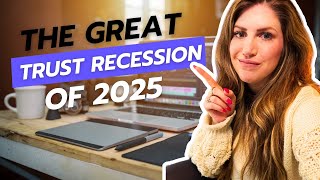
The Great Trust Recession of 2025 (How to Overcome & Dominate In Your Niche This Year As a Creator)