Andrei Zinkevich - How to identify your ICP in an ABM Campaign
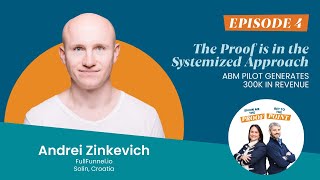
A podcast interview with Andrei Zinkevich about account-based marketing (ABM) and how to identify an Ideal Customer Profile (ICP). Andrei argues for “less leads, more revenue” by prioritizing product–market fit, in-depth customer interviews, tailored messaging to buying-committee roles, careful account selection and disqualification criteria, and human-led warming/activation (content hubs, personalized gifts, events) rather than buying expensive ABM stacks. He presents a pilot ABM case study (30 target accounts) and shares practical tools and processes for running low-tech, high-touch ABM campaigns.
Questions this video answers
Approximately $300,000 (six pilot projects at about $50,000 each).
30 accounts.
About 37% reply rate (12 replies from 30 accounts).
Six pilot projects closed.
Paperflight (replacing DocSend).
Chapters
Welcome to Show Me the Proof, get to the point, the B2B marketing podcast where we show you the proof in the form of case studies and success stories. And we get straight to the point with your hosts and founders of proofpoint Marketing, Mike and Gabby Grinberg.
And today we are very glad to have Andrey Zinkovic with us all the way from Croatia. Andre is has so many accolades to his name so I'm going to try to get through all of them. Andre, let me know if I miss anything. Andre is the co founder of Full Funnel IO and he's also the co founder of ROI Plan, which is a marketing SaaS platform that helps marketing teams align with sales and business schools. He's also the author of LinkedIn B2B Marketing Inbound Book awarded as the best B2B 2B marketing ebook. And he's also the founder of B2B Marketers and Founders community. So Andre, welcome to the show.
Thanks a lot for having me.
And one of the things that really stood out to me on your website, and it's really right and front and center for everybody and you have a very bold claim is less leads, more revenue. And in the world of marketing and sales, that's a very bold claim because people, people usually want more leads and more revenue. But you're saying less leads and more revenue. So I know that today we're going to talk about a fascinating case study around an ABM campaign that you put together, which is a hot word out there. Everyone's talking about abm, so we want to hear about that. But tell us first quickly, what does less leads and more revenue mean for you?
Yes, thanks a lot first of all for this great intro. So let's dive deeply into that positioning. So how I came up with that idea of less leads, more revenue, you know, lots of B2B companies, they have a growth obsession. It means they tend to think, okay, I need to scale marketing, I need to scale lead generation, I need to scale my sales processes, et cetera. And when they have this growth obsession, they tend to skip the most important, the most fundamental marketing things like setting up, go to market strategy, you know, defining your ideal customer profile, defining your position in that unique value proposition, and tailor this unique value proposition to a target market. Next, analyzing the buying process, analyzing the decision making process at your target accounts, analyzing their research process. And in most cases, if we are talking about B2B companies with complex and long sales cycles, this is the vertical in general we are serving. These companies in most cases operate with unformed demand, which means that their customers are not actively buying this product and they need to generate, they need to create this demand first of all. And in this particular case they need to work the full funnel way. They need to create, they need to generate this demand, they need to generate the awareness, they need to build a credibility and trust, they need to educate and nurture their buyers. That's why they need to have some sort of sales enablement programs. Then they need to have activation playbooks. Basically how they are going to turn this, let's say conversations or potential, let's say warm prospects into sales opportunities. And then they have, let's say most companies stop at the sales process so the deal was won and now they're passing the lead stores product and maybe client success team which has a very passive approach. Basically they're just answering the support, the tickets or maybe live chat and that's it. But the real truth that this is another funnel. So now you have an existing client and you need to run this in depth interviews where you exactly can learn more about the buying process as well the strategic initiatives of this company, why they bought your product and you need to track the satisfaction so you can find the truth is that if client is not satisfied, they are not eager to recommend your company or your product. And if they are satisfied, then you have an opportunity to expand the business, to upsell new licenses or upsell to new branches, et cetera. And this is the whole thing, this is how the marketing or B2B marketing in general looks like. When it comes to these B2B organizations, they tend to skip all of these things and jump to let's say lead generation and sales processes because they tend to think it's scalable. You know, you need just to buy some fancy software like sales cadence automation software or marketing automation software, scrape the data, put as much accounts as possible into it and basically spam them all. Let's be honest, it looks like a spam. And they play the game of numbers because it's transactional. You can just calculate, okay, I sent 1,000 emails, I booked one call. Let's say this is a conversion rate. I need to improve it and scale it. And when it comes to let's say generating demand, it's not something, it's not like purely transactional. You can't see the exact attribution. And that's the biggest pain point. So in my case, what I'm presenting, I'm saying, guys, look, you don't needs, you don't want to have more leads. Your goal is to generate more Revenue. This is basically what is important to the organization at the end of the day. And in this particular case you need to focus on the companies that have the highest revenue potential. And you need to tell, you need to find actually a match between your product or your service and their needs or strategic initiatives. And in this particular case, if you are focusing on Tier 1 or Tier 2 accounts, basically the companies with the highest revenue potential or the medium revenue potential, it can scale your revenue and let's say help your sales team to overcome overachieve the target sales quota in a more, let's say it will be more effective, more productive to them than just blaming everybody. That's why I mean in some cases you can close two deals and generate more revenue than you know, prospecting the entire market with this automated cadences with purely outbound mindset. This is how less leads or more revenue came into the game.
Let's start with the beginning. How do you, how do you identify the right, the right targets? And because I know like you kind of mentioned Yola, for a lot of companies it's ABM really just means okay, it's an ABM platform. Let's buy some expensive technology. Let's look, let's, you know, let's get some intent data this, that and the other. Next thing you know they're spending, you know, 10 grand a year or more on, on just their ABM tech stack. But that's not what you're like, what you're talking about is different. So I'd love to hear your take on how do you, not just how do you do ABM on the cheap necessarily, although that's interesting as well, but sort of how do you, how do you tackle it without necessarily focusing just on the technology aspect?
That's a very good question. And basically, you know, the process will be different for let's say startups, the companies that are looking towards product market fit and let's say for mature or established businesses. So let's talk about the second group for established companies. So the way how I'm doing this, first of all I'm analyzing their use cases, the best case studies. I'm not looking into revenue numbers because they might have like a fantastic customer that you know, generated lots of money but basically this customer didn't adopt the product or didn't have a really good use case and maybe they are not satisfied and thinking about churning from that company. So I'm analyzing use cases. That's why I highlighted client success role in this process. So I want to see where the Best product adoption when it comes to tech companies or when in what area, in what vertical. We have the best case studies when it comes to selling professional services. And I try to figure out the common features between these companies. And based on this I'm mapping out the ideal customer profile. Next step, I insist that we are going to interview.
I'm going to interrupt you because I want to before we get away from the icp, what are the like give us some more details on what kinds of things are you looking at when you're building a building the icp, what types of factors are you looking at? How are you defining what makes that that tight group of the Right.
So the first factor was as I mentioned, the use case. Basically the company had result by using that product or service. That's the number one factor. Next one is that I insist on in depth customer interviews. Basically we have a list of questions and we have five group of questions. The first group belongs to questions that are related to let's say research process. We ask them questions like how did you search for product like this, you know what sources you are looking for. Next one. Next group of questions belong to let's say decision making process. Like what influenced your decision making process? Did you compare us to any other vendors? Why you decide to choose our company or our product? Like if you had in house meeting, who was involved? This is how we can identify the buying committee. And next group of question questions belongs to value. So ask what is the value you got from the product so far? You know, if you are recommending it to anybody, how you describe our product and basically we are listening to our customers because then we can extract this knowledge and use it in our let's say marketing message. This is how we tailor our positioning and unique value proposition. So the in depth interviews, the second point here and next one.
Andre, let me ask a quick question. Yeah, of course, I like that you're really adamant about client interviews because I think that it's so important to get the voice of the customer. And oftentimes as marketers and even on the sales side, we may have a distorted view or not a full picture view of the customer's, you know, feedback. Let me ask you a question. What happens when you're working with a client and they're resistant or hesitant to want to give you access to their clients in terms of getting these types of customer data? You know, we have a lot of B2B marketers listening out there and this is often one of the challenges is getting your client to agree to do the interview, tell us what some strategies or some tips that you have for that.
That's a really interesting question. And I will share my approach basically when I share the benefits of running in depth customer interview. Because we clearly understand why we are doing this and I'm describing it to clients the same way and they tell me, okay, you know, we don't want to bother our clients or maybe they don't have time for this calls. What's the value for our customer to share this information with us? You know, for me it's a warning sign that they don't have a really good relationship with clients. For me it's like honestly, it's a warning sign. So then I just book a private call with the executive or let's say with team lead, chief marketing officer or head of sales. Doesn't matter, it depends on the organization. So I share privately with him my observations. I say, look, if you have these problems, it means that you in future you'll definitely have a churn issue. Just believe me, from my experience, I share some practical examples, examples that I don't want, I mean, I don't want to provide some real time examples of this, but you got the idea. So I share some private examples and say, look, this is what is going to happen with your company. So the decision is like the first thing, are we going to replace this process and start building that relationship with clients or you want to keep the things as they are at the moment? If they say, okay, yeah, that makes sense. What are the strategies, how we are going to book these calls, what I recommend to do my personal opinion. Basically I always ask CEO or let's say somebody from executive side to record a personalized video where we explain why we are doing this stuff. And basically that said, I say, let's pretend I'm SEO. I will say, hey Gabby, thanks a lot for being my partner. Not just generic one, it's like personalized video for each of the clients. Let's say thanks a lot for being a fantastic customer for the last five years. It means a lot to me. So basically we helped your company with this and that stuff and now it's like time for us to change the way how we are going to build relationship with our clients. It will mean a lot to me if you dedicate 30 minutes and we'll be able to chat with let's say John Doe from my client success team about these questions. We want to extract this value. It will help us to present our services, our product in a more meaningful way to our Target vertical and that's it. And then we are sharing this message because if the first person of the company shows his or her face and make an ask then it becomes an irresistible ask for the prospects. Otherwise if you'll be sending just generic email, hey, would you like to have a 30 minutes call with me about this and that? Of course you never chatted with the clients what the deal, why they should devote time. Of course they won't do it. So this is the way how I suggest to proceed.
Yes, thank you so much for sharing that. I absolutely love that approach. I've actually never encountered anyone that has had a really strong answer to that question. Maybe because I didn't ask the question before. But in general I love this approach. I love that you are going direct to the source and saying look, this is why we need to do this and providing them really valuable case points as to why it's important. And I love the idea of getting the CEO involved or whoever the top executive leader might be to record a very special and personalized video to the client directly. And I'm sure that that helps a lot with adoption and getting the clients on board. So I'm going to say malediets, which is, which is, which is for those that are Russian speaking and that are listening, that means awesome job, way to go because that's a wonderful example. Andre. I do have a follow up question though. What happens if you have a client that after talking to the leader and saying look here's why we should do this, we really feel it's important to talk to your clients and there's still resistance and there's still pushback. What do you do then?
I simply cancel the project. So I'm not going with that client and I will tell you why. Because at least the way how I treat B2B marketing, I feel that it's not about creative, I don't know, creative motto, if you will or some sort of put in some creative ideas. This is how actually many B2B companies tend to think about value proposition, positioning and marketing message in general. I always want to hear from my customers what are their challenges and what are the values they are getting from the product. What is like if they are going to share this product with anybody or recommended basically how they will describe this product, how they will describe this value and this is what you should use in your copy. Doesn't matter if you're running ads, if you are sending cold emails, if you are writing inbound articles and you want to present your company, you need to Use your customer language. And the second reason, if you don't understand the way how your customers will buy, just believe me, you'll be wasting time and pouring money into Liquid Bucket. You know you'll be paying for AdWords basically just, you know the other way you can just simply ask Google to make an invoice for you and just pay this invoice without wasting time. You know that would be, you don't need to spend that much time to understand that you are just sending money to Google without getting any results.
Like let's go to the outcome. What did it generate? How many revenue SQLs, whatever metric that you want to measure it on.
Yeah, of course. So basically the case study we are going to chat about, so this campaign generated 300k in revenue and basically just to give you a more precise data about that campaign. So we had 30 accounts in our account list and we had 37 reply rate for that campaign. So basically 12 from Soto accounts replied and we were able to close six deals and the average deal size for that moment because that's like they're usually selling pilot projects and the pilot project value is 50k and then they are selling. So I don't know the exact data and the exact number of revenue. But let's say as for the pilot projects, we were able to sell six pilot projects. So in total it means it equals 300,000 in revenue. So that's let's say prerequisites of that campaign. So coming back to your question about the steps, so we have ICP and that the next step is what I mentioned. So after this in depth customer interviews, we need to analyze these interviews and basically next create our market message to this specific vertical and to the buying committee members. Because the truth is that you can't reach out, let's say your internal champion and CEO the same way with the same message. But most companies are doing it. They're sending generic messages to all of them. Another mistake. Lots of them are ignoring the buying committee. They want to reach out to the decision makers. The chances that you'll be able to close that deal successfully are much higher if the buying committee members are aware about you, your company and your product. Because people buy from people they know, like and trust. That should be the key mantra of B2B marketing in general. So that's why we need to adapt our message to the buying committee roles and next step is prospecting and account selection. So I mentioned the icp. One more thing that we need to add to this process is disqualification criteria. So let Me share a practical example in this particular case for that campaign, disqualification criteria. So keep in mind, client is software development company, and you know, software development companies, 99% of these companies are operating in one size fits all mode, which means they're reaching out and saying, hey, Gaby, do you need any web application or mobile app or website or whatever? We can do whatever you want. Just tell me. Just share me your needs. And your question is, okay, guys, I'm getting like thousands of these emails and LinkedIn messages every day. What makes you different? Why should I bother? Watch. Why should I reply? That's the huge problem. So in this case, that's why it was extremely critical to narrow down the position into one particular industry. So the next step was adding this disqualification criteria. And basically what I was doing at that point, I was analyzing CRM, I was listening to the sales calls to the email threads, and I was analyzing the deals that were lost. And I was trying to figure out the common patterns, the common features between these accounts. And in most cases, what I have identified, basically there were two reasons, like let's say two very clear disqualification criteria. One of them was if anybody from the buying committee originated from, let's say, ex Soviet Union countries. And the reason why, the only reason why, because usually they have a network in these countries and they can find a cheaper vendor, they can find somebody.
To do it for 15 an hour with whatever 25 markup and off you go.
You got them, basically.
And they're very hard to. They have a very good poker face. I will say also, right, Andre?
Yeah.
And I'm poking fun at Mike, who's, who's originally from the former Soviet Union.
So.
And I do have a network over there. So if I needed some development there, that's exactly what I would do.
Yes. And you never know if they're KGB also. That's also a very good thing to keep in mind. Right, Exactly.
But you know, that's the funny fact. So basically they tending to think I, I, you know, I always kidding when I'm writing some, some webinars or workshops for this vertical, I'm always sharing because they have this mindset, they want to set up an LLC in United States and they tend to think about this market as, let's say I call it like California Golden Rush. You know, they're coming to United States. Okay, guys, so like we have developers for $15 in our country and now we are going to sell it for $100 here in United States. And they think if they came, everybody will buy. Now because that's the key I need to be presented on this market. But the truth is I'm living on Adriatic Seaside and Crash and I have lots of clients from United States but I have never been ever the United States. That's the truth about the remote work. But coming back to that stuff. So that was the first disqualification criteria. The second one is if these companies, I have noticed, if they had an open position, if they were actively hiring people, like I don't want just to go dive deep into this specific technology stack, but if they were hiring people with this, let's say specific like frameworks and technologies background, then we needed to disqualify these people because it means that the major part of the project will be done in house, they are not going to outsource it. So this is really important to analyze. And now you can see basically on the surface client, a potential company looks like a potential client. But when you'll deep, when you'll dive deep, you'll say okay, this is a disqualification criteria, this is a disqualification criteria. And you simply don't waste time on this. So that's, that's the next step. And once we build this account list then we can start work on the warming up programs and the activation place.
Really what you're saying is to set up, to appropriately set up an ABM campaign, it really is a manual effort. It, it requires a person, a real person who's doing the work, who's identifying the key criteria. Dr. Real people. Right, Identifying the key criteria, et cetera. A lot of, I mean and you touched on this a little bit, a lot of People Today on LinkedIn and just out there in the world are just what I call the spray and pray, right? They put the information into a bot or into some sort of, you know, what's the word I'm looking for? Automation tool. And just sort of put it out there and get it out there. But what I like what you're saying is no, you really need to take a human approach. So can you talk to us a little bit about what are the actual tools that you're using to set yourself up for this campaign? I'm assuming it's probably a combination of spreadsheets and documents, but do you have a certain tool stack that you use for this or that you would recommend?
So I will be honest with you. At one point I was considering any kind of marketing software to launch and at least orchestrate these campaigns. I reached out to all the well known ABM vendors. When I have heard about the price I was like, oh my gosh, fortunately I don't have hair. Otherwise I was like, what's going on? So the biggest problem here is that Martech vendors, they're let's say the biggest content players. Let's say major part of ABM content is produced by them. And the key goal of that content is not to educate the market, but basically to sell this software. And that's why lots of B2B marketers are thinking that okay, to launch an ABM program, I need to run this programmatic ads, buying this fancy software, etc. And they simply forget about this, let's say human processes that you need to do a country search, you need to do, let's say the groundwork, you need to do all the things that we shared previously and next when it comes to activation Playbooks or warming up programs, I have done like I will be honest with you, I launched Programmatic ads just once. When I saw the poor results from these ads, I did it just out of curiosity. And when I saw how awful were the results, I told, okay, I don't want to waste time and money on this stuff because I can launch LinkedIn demand generation campaign. I can involve clients into market research. I can, you know, I can add some sort of, let's say private events or workshops dedicated to these clients. I can host like panel discussion, I can hire a soft leader, you know, if I have some budget, I can hire a well known sort leader that serves this vertical and invite key executives. And that's a fantastic opportunity to have lots of, let's say inbound opportunities to do this stuff. And this is how I prefer to do the warming up programs. Next we have activation Playbooks, depending on the account engagement and again by default they used to say, I mean Martech vendors used to say, okay, once they click your ad then you need to transfer that lead to sales team and they're reaching. Or if they downloaded any gated content, then you need to send it to sales and they need to reach out. But the question is like why are you thinking that person who is downloading the ebook or subscribing to the webinar if it's not like product oriented webinar, what makes you think they're interesting or ready to buy? So that's the key question here. So in my case I prefer to check the real account engagement. It means I track the IP data like if they have visited my service page, if they read my key case studies. Next step, I prefer to control the sales process. So I create dedicated content hubs I put something that is highly relevant to these people. Again, if you want, I can share you the example of this content hub. So I create the content that is highly relevant to this person and then I say, this is how. For example, I might, I will give you a more precise example. So I might say, okay, Gabby, you know, you're launching this podcast and basically you have like a great speaker lineup and I have some ideas I want to share with you how basically to grow this podcast or whatever, how to monetize this podcast or how to bring people like, let's say, I don't know, like Seth Gordon to your podcast. Just, just a quick idea. And then I created to you, I share this content hub and I can ask like, does it make sense? What Would you like to check it out? In most cases this is like step in, make a first step and open the doors and then I can see if you consume that content. I can reach out and say like, hey, do you have any questions regarding this process? Would you like to have a quick chat? I can describe you now how you can implement it for your B2B marketing podcast. That's just like a first idea, but basically you got the idea. So content hubs help you to control the content consumption and you can see if this content hub was shared internally, if they share it with executive Steam, with sales team and you can add more, let's say marketing content marketing assets that is dedicated to this, different roles.
That's exactly what we do because we use, I mean we use a tool called sales reach and it's pretty much, you know, it pretty much is like a dedicated content hub to the specific person we're speaking to.
Yeah, right.
It's here's the relevant case studies, here's the relevant testimonials, here's relevant content we've developed, etc. Etc. And then we can track, like you said, did they share it, when did they look at it, that kind of stuff. And that allows us to sort of understand are they interested, are they not?
Andre, are you using a specific tool for this content hub or is it just a landing page? How do you do it? How do you create it?
So for many years I was an active user of Docsend and right now I switched to Paper Flight. Very nice product with like, like there's a better, let's say feature set and like way better UX ue. So I highly recommend to check this product. And one more idea, you know, regarding this, let's say warming up programs and coming back to the case Study we are discussing. So this 300k case study. So for this particular company I skipped the warm up program which was bad because I always insist on doing this. But in this case we were very straightforward. They asked me, you know, to bring new revenue as fast. So I worked heavily like on this, let's say strategical part. So I had pretty good insights on what kind of accounts we should add to this program. And next I was analyzing the AP data and I was selecting, that's why I mentioned there were only 30 accounts for that pilot program. And I was selecting the companies that were already visiting the website. So they checked the product, sorry, service pages because it was about the services, the service pages, they checked some case studies. So in this case I knew that at least they were aware about the company and they might have a potential need. Otherwise they will never visit like a website of a software development company that has a broad positioning. So that was the key here. And next I was sitting down and I created like personalized. So we did an in depth account research. So we were analyzing the press releases, the executive interviews, the posts they were sharing on social media, etc. Something that's where we could collect the information about their potential needs. We were analyzing their tech stack as well. And based on this we created proposals that were dedicated to four target job roles. We had CTO as usually this is like a decision maker in this enterprise companies, CEO as well because this person approves the budget. Next we were reaching out to product managers because they are influencers. They are people who don't have, let's say a decision power but they will be collaborating with the software development company. And as I mentioned, it's better, you know, to make these people aware about you and share how you can help them because these people by default they expect, okay, a new vendor is coming in. So my company is going to outsource some processes. So maybe I can lose, you know, I can lose my job so they can treat it as a danger. So that's why you need to share that you're actually not going to replace them but basically helping them to accelerate the product, let's say development. And finally that was like a job role. I had a huge resistance from the executive team. I wanted to reach out to hrs. And the reason why, because in most organizations HR is the most, let's say undervalued position. So I mean in this specific area.
Procurement is a little bit.
Yeah, yeah. So in this case I was thinking, you know, how it works in IT or in tech companies. Like if IT team, let's say company got an investment and now they have money to work on new product features, et cetera. And they need to ramp up their team, they need to find some talents. So they say, okay, like I need to find a new developer just in two weeks. Here is the skill set, here is the background. Now it's your job, you know, and they are always on fire. And I played with this, so I was like describing this situation and that's why I told you about the account analysis. So I was searching for this, let's say signals and if it was true, I was saying this is like, I know you are on fire. I was personalizing and playing by this and basically this is what we can do. You don't need to do the interviews. Basically you just provide us the skill set and the background and the tech stack you need and basically we'll provide you a list of vetted developers with this skill set. And now you just do the final round. They passed all the, let's say tests or whatever, they can jump and jump into a project and ramp up your team literally tomorrow.
Andre, you mentioned something, I want to go back to it. You said that during, and I apologize if I'm saying this incorrectly, but the ramp. Is it the ramp up phase or the research phase where you're really digging into the research? Research phase. Okay, so you're digging into the client to each account, that is. And you're looking at press study, press releases, videos, probably listening to podcasts, looking at LinkedIn. You're collecting a lot of data. Two questions for you. What is the typical timeline for running an ABM campaign? And what is. Can you also elaborate on how much time do you dedicate per each account in terms of the research? And also, how many people does it take to run an ABM campaign? And I assume it probably will expand or contract depending on the number of accounts that you're targeting. But we want to have some ideas on timeline and bandwidth around this kind of stuff.
Just to give you an idea, first of all, the campaign can be launched by two people, one marketer and one salesperson. That's the minimal, let's say the minimum, the minimal team probably for launch and.
ABM campaigns, the minimum requirement is one marketer, one salesperson. Okay. Okay.
So marketor is in charge of all these processes like account selection, like account list building, like research, etc. And warm up programs, while sales is in charge of activation. So the latest parts of this campaign.
And so this is very good information that you're giving us because I think a lot of the misconception around ABM especially obviously if somebody's never run an ABM campaign then they, then they don't have an idea about it. But I think there is a misconception that you need a lot of personnel, you need a lot of tools and that you can do it right away. And actually what you're telling us is you don't need a lot of people but you, but the more the better. Obviously you don't need a lot of tools but you do need a lot of research and a lot of personal dedication. You know, a human dedicating the time and the effort and the analysis to gathering this information. And then depending on the number of accounts it could be some, you know, could could be two to three months to get it up and running or it could be as long as five to six months to execute it. Do you have one other follow up question? Is there a ideal number of accounts that you should have when running an ABM campaign or is there like an average that you think is very, very good? Okay, what?
So my suggestion is for the pilot campaign not to add more than 30 accounts for the pilot campaign. So that's my rule of thumb. It depends on the industry because as I mentioned for example for LG it was like we launched it on a smaller in a small region. So it was Estonia, Lithuania and Latvia. So the northern part of Europe. These are small countries but they're like tech oriented and advanced. So in this case the scope is smaller. Let's say if you are going to launch it in the United States and Canada, of course you have like let's say a bigger market and you can add more accounts with let's say with this appropriate account research. But again for the pilot campaign it makes no sense to add more than 30 accounts. The reason why, because the only key reason for this because you will never able to run let's say a perfect campaign just from the beginning, from the scratch. So you need to think about this campaign as an opportunity to learn more about your target accounts because at one point you'll be reaching out. You'll never have 100% positive reply rate, positive reply rate. But you'll have calls with this prospects, let's say and now let's say they will say hey Andre, we are not interested in this. Or maybe this is not right point. And this is the key part in let's say when it comes to the final stages of the ABM campaigns. Your key goal here is to say okay Gabby, I completely understand that maybe it's not the right moment or whatever. So switching from sales perspective to human perspective. Can you please share with me what are the reasons? Because I did like in depth account research, I analyzed all these interviews and basically I saw the feed, I noticed that there is definitely a match between my service and your need. So can you please just give me more context so I won't be targeting the companies like yours in future? This is critical. Just believe me. Major part of the company is never doing this. They say, okay, yeah, I will never bother you. Thanks a lot. Sorry for this.
Right, right. I like that point. But I have to say that sometimes, at least maybe personally speaking, is that when a salesperson reaches out to me and I tell them very politely, hey, you know what, I'm sorry, I'm not interested. And then they come back and say, can you tell me why you're not interested? I genuinely don't take the time to give them that feedback. And maybe that's shame on me. Maybe that's, that's a bad, a bad example that I'm setting in the marketplace. But I'd love to know, you know, what is, what is the, what is the success rate when you do ask for this feedback? How many times do you get the feedback? And is there a difference between somebody running an ABM campaign and then asking for the feedback versus somebody that's just like I said, pray and spray setting things out there and hoping something. Is there a difference in the response that you get from the client?
I will tell you why it's happening with you because in most cases, I believe, correct me if I'm wrong, in most cases people are just sending you cold emails or LinkedIn messages and they are coming back to you and say like, hey, can you please tell me why you are not interested in the way, how I am arranging this ABM campaigns? If you want, I can quickly share with you. Maybe in this case it, it will make sense to share screen. So just to give you a precise example of my company's campaigns.
That would be great if you can share the screen. We'd love to do that. And then if we have any technical difficulties, perhaps you can send it to us in an email and we can include it in the show notes.
Can you see my screen now?
Unfortunately, no. Mike, do we have to do something on our end?
No, no, I see. I didn't click the. Can you see it now?
We're getting there. We're getting something. Okay, go ahead. Yep.
Yeah. So look how my proposals look like so just to give you an idea.
So you are.
You're sending physical mail. You're not talking.
Yeah. And you can see a link and QR code that leads you to the content hub, where you can learn more.
Now, I do have a. I think this is phenomenal and I love the tactile feel of this campaign because I think that oftentimes we lose that feeling of having something physical being in a very virtual digital online world. So I really love that you did this. But in this world of COVID how did you manage to get addresses and get this in the hands of the right people? I'm sure that there was some problems because of COVID Right.
So indeed, we are sending physical parcels that include printed proposals. And inside, you probably have noticed, there is a link that leads to the content hub as well, where we create a content hub, highly personalized to this company. And in this content hub, we add some bottom of the funnel content. Like, what's the difference of working this full funnel IO versus marketing agency? What are the benefits let's say executive team, marketing team and sales team will get by working with us, Case studies, et cetera. You got the idea. So the next one, this is like highly personalized, as you have seen. It's like what let's say cycling and growing B2B tech company have in common. And then I'm just. Because I know, let's say in this case, our target prospect is a huge fan of cycling. I saw on Facebook that before COVID this person went to the mountains in Belgium and France, and I was even putting the names of the hills. This person took pictures, you know, that was like 100% personalized. And as a small gift, I bought a book called like 30 Best Cycling Destinations in Europe. And that's the idea how you're going. It's not about, you know, very expensive products, sorry, gifts, but it's about making it 100% personalized. Now, coming back to a second question.
I think this is another moment where I have to say Malediac, because I love this example and I'm a big fan of gifting. Gifting is a big part of my personal language. Mike knows that. And it's also a big part of my language. Professionally. I think it's very meaningful to when you can to provide a very personalized experience for a client or prospects.
The main question I want to know is how do you find people's addresses right now?
Yeah.
Oh, yeah, yeah.
That's a good question. So several ways I mentioned that we have like warm up Programs and when it comes to warm up programs, I love to invite people to join, let's say, my podcast. If you'll open fullfinal IO podcast, you'll see that we have some series where I invite people like you who are well known B2B marketers, an audience and as well, I know that executives are listening to us as well. A natural way of, let's say, generating awareness. Something that we spoke in the beginning about. Next month we have CEO series and we are inviting executives of our target accounts. And this is like we say, Kate, you are fantastic guests. Of course, just a way of natural interest. Our guests asking like, guys, you are doing fantastic stuff. Usually before they join in the show, they're checking out our website, our content. We try to keep it like very practical and I believe at least that the quality of the content is really high. So they see it, they see the value and they say, okay guys, you're doing fantastic stuff. Can you please provide more idea on what you are doing? And basically then we discuss some Danish initiatives, etc and we say like, I would like, I would love to share with you, you know, I would love to send a small gift to you. The same like we are doing market researches. We say like, if we involve people, we involve people from revenue Genius, for example, we said like, I don't say that. In case of podcast, of course, people say, yeah, of course, here is my address, please send it to me or whatever. In case of market research, not everybody is going to give it to you. They say, okay, like I don't need it, I just wanted to contribute and that's it. But let's say like how we present it. We say I want to like, I want to send this like gift for as, let's say a thank you for contributing to this market research. People are sharing it and that's totally fine. The same if we are hosting like private events, panel discussions, we're inviting these people and we deliver value upfront. In my case, yeah, it's more easier because I have the audience and it's more easier to you know, together the people and have and hosting a really good virtual event. But in case of other company, you know what I mentioned if I was, let's say a CMO of tech company, what I'd be doing, I'd be, let's say I know that you are hosting a fantastic podcast. I'd ask you guys like, may I hire you, you know, for let's say to run a dedicated like private event for my target audience, more or less like this and I'd rather pay you. And it would be, I will have, just, believe me, I will have much higher ROI from that campaign just then, just putting, you know, this money into Edward's machine and waiting passively for leads that should be coming, but not actually.
Well, now I, now I know why your company is called Full Funnel. Because you really are touching every part of the funnel, up and down, left and right. And I love that you're leveraging two very hot topics right now, podcasting, especially in the B2B space, and ABM campaigns. So, Andre, you have shared, showed us the proof and you've gotten to the point. You've shared so many really valuable and interesting and unique ideas on how our listeners today can execute an ABM campaign. Not without having to spend tons of money on tools, without necessarily having to have a very large sales or marketing department. And with really focusing on the two very important things that we always talk about in business, especially bringing the human side and appealing to somebody's, you know, appealing to their interests, appealing to their likes through this idea of gifting and adding value, valuable content, adding them on the podcast. Wow. I learned a ton. We've loved having you on the show. But before we go, before we go, we want to talk and do a quick lightning round.
First thing comes up to mind. What's the main KPI you use to evaluate marketing success?
Sales, qualified opportunities?
What's a new marketing strategy or tactic that you're looking forward to testing? This year?
I'm going to double down on lead nurturing.
What's a tool or platform you use in your work that you couldn't live with?
Out active campaign?
What is your least favorite business word or phrase?
Growth and scalability. Yeah, I'm muted.
Those are your least favorite.
Yeah. And the reason why I will tell you, because they're always intertwined with growth and scalability. Obsession.
Okay.
Always used in that context.
Makes sense. What is your favorite podcast?
My favorite podcast is the State of Demand right now, which is Chris Walker is running.
Oh, okay.
Yes. Very practical. Very good.
Very good. Yes, that is a good one.
What is your favorite business or marketing book?
8020 in sales and Marketing by Perry Marshall.
Very nice. And who's a B2B marketing expert that you admire on LinkedIn?
Yeah, Chris Walker. And the reason why I mentioned him again, for the second time I mentioned him. And the reason why, because he's very straightforward. He is actually practicing what he's preaching. And lots of people, just to be honest, lots of people are talking about high level stuff but never executing this. Chris is exactly doing what his company RefineLabs is promising on their website and I love it.
Well, if you know Chris, tell him to join us on the podcast.
Yeah, he was on my podcast and he was on my summit last year. So I will definitely can make an intro on LinkedIn if you want.
Thank you. Thank you. All right, a couple of bonus questions. So, Andre, you mentioned before we started recording that your family is part Polish. You were born in the Ukraine, you live in Croatia, you speak, I'm assuming you speak Polish, Ukrainian, a little bit of Russian, Croatian. What is your favorite Soviet era cartoon?
That's a good question.
But basically, I bet you never got asked that question on a podcast before, have you?
Just. That's. That would be a funny answer. I don't know if you have heard about this cartoon called Carlson. This is actually, this comes from Sweden, but it was very popular in my childhood. And yeah, this, this is my favorite.
I had, my parents had the vinyl. I listen to the audio stories and whatnot, and there's books and all that stuff.
Yeah, yeah, I don't know that one. I am not from the area, but. But I think. But I've been introduced. I've been introduced to a lot of Soviet era cartoons and I think my favorite is Cheburashka.
Yeah.
All right. And you are currently living in the beautiful country of Croatia.
Yep.
Which a lot of people know nowadays for, you know, the beautiful panoramic views in Lord of. Not Lord of the Rings. In. What's the show? Hbo. Game of Thrones. Yeah.
Yes.
What is your favorite place to vacation?
This one where I live, Split. Basically. This is where the Game of Thrones was recorded.
So. So it's very beautiful.
Yep. I invite you come here when you'll have an opportunity.
We would love to. Absolutely. Hopefully very soon we can travel again safely to Europe and hopefully you'll have the opportunity to come to United States. You mentioned you've never been here before.
Yes, that's on my to do list.
All right, well, reach out to us when you plan to come to the U.S. we'll give you some ideas. Andre, it's been such a pleasure to have you on the show. Today I'm going to try to speak, say havaladam. Is that correct in Croatian?
Havala.
Havaladam. Right. To say thank you.
Ah, okay.
Okay. Sorry. I. I'm. I'm learning. Okay. Well, thank you anyways, Pasiba. Thank you for being on the show. You've been a wonderful guest. You've shared so many valuable takeaways. I know that our listeners today are going to be really excited to start executing their own ABM campaign. What is the best way for our listeners to connect with you?
LinkedIn Basically I'm quite active there so they can type. Andrej Zinkevich There are not so many guys. At least there are not so many bald guys with that.
Wonderful. Thank you so much. Andrej.
Thanks for tuning in to the Show Me the Proof. Get to the Point Proofpoint Podcast. Join us weekly for new episodes and seriously smart B2B marketing success stories. We'll show you the proof and get to the Point every time. Find additional resources on The Proofpoint website www.proofpoint.marketing including the full episode library with show notes, guides, templates and more. Great resources. If you like this episode, don't forget to subscribe and please leave us a review on itunes or wherever you listen to podcasts.
More from Andrei
ABM Isn’t Dead—You’re Just Doing It Wrong w/ Andrei Zinkevich on Real Pipeline Strategy (#17)
Andrei Zinkevich: Without marketing and sales alignment you're wasting your marketing budget
S02E04 | Andrei Zinkevich: ABM Isn’t Ads, It’s Relationships. Here’s How To Do It Right.
How FullFunnel.io helps B2B companies to boost their sales? | with Founder Andrei Zinkevich