S02E04 | Andrei Zinkevich: ABM Isn’t Ads, It’s Relationships. Here’s How To Do It Right.
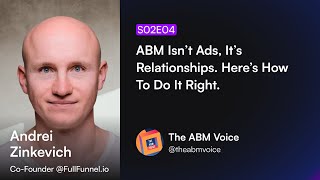
This is a transcript of a YouTube interview (S02E04) with Andrei Zinkevich, co-founder of Full Funnel IO, about account-based marketing (ABM), LinkedIn-driven demand generation, and positioning Full Funnel as a consulting firm that builds in-house ABM capability. Andrei emphasizes ABM as relationship-building (one-to-one and one-to-few) rather than programmatic advertising; the need for careful account selection, manual research, and sales-marketing collaboration; LinkedIn as a primary organic source of leads (majority of Full Funnel leads); content that answers buyer questions across the buying journey; and cautious, process-embedded use of generative AI. He argues programmatic ABM is often misused, causes poor ROI, and that effective ABM requires patience and blended demand-generation plus manual outreach.
Chapters
Foreign.
Welcome Andre. So glad to have you on the show. I've been looking forward to host you for quite some time. You know, I'm a big fan of the work that you do and specifically the approach that you take in terms of giving first and enabling the marketing community, ABM community, with your sort of thought leadership, sharing best practices, in some cases even your playbook.
Right.
So that's really wonderful and thank you for that. Right. For someone who's in. In the B. In the B2B marketing space and are active on LinkedIn, I'm sure they would have come across your post, interacted, learned. Right. But for others. Right. So I want you to just give a quick background about yourself. Right. What was life before Full Funnel? Right. And basically before it sort of became a force in the ABM space.
Yeah, absolutely. Thanks a lot for inviting me. So excited to chat with you as well today. And as you already mentioned, I'm co founder of company called Full Funnel IO where we help B2B tech companies with long end complex sales cycles to implement let's say blended account based and demand generation model to consistently drive revenue and pipeline with target accounts. So before Full Funnel IO I was running, I was working as a fractional CMO for five years and before this I had really good career in the enterprise space. And the one thing I I'm always being asked so how did I learn account based marketing? The truth is, so I started my career as a sales rep SDR and had quite successful career in sales for the first five years and then switched to marketing. And that was always a motivation for me to understand aside from sales tactics, how can we motivate our customers to buy more. Right. So that was my biggest motivation and that motivated me to switch from marketing. But the biggest advantage that I got from my sales career was that I knew the hurdles and the challenges that sales been facing every single day. Right. I didn't wear pinklasses. Assuming that marketing is really easy and we just need to run creative campaigns or doing some, you know, stuff that is not helping sales to win more deals and generating revenue. So knowing all of that was super helpful. And coming back to the question, how did I learn account based marketing? So basically early in my career I got after the first year in sales I was moved to the key accounts department. So and then the same when I ended up my, let's say corporate career I was VP of marketing to key accounts channel. Right. So spent almost all of my life selling and marketing to enterprises. So our market was limited to 50 plus accounts, right. 50, 52, 53. Don't remember the exact number, but generally speaking, these were the biggest retail chains in our region. Right. And the average contract value, and I mean the annual average contract value could vary from let's say $1 million to $50 million. Right. Depending on the chain size, et cetera. So we are the same like an account based market. And we had different tiers of accounts. We were differently budgeting the market and for this, these accounts. And basically when your market is limited to 50 to 53 companies, you have nothing to do then account based marketing. Right. So I learned that the hard way. So that's, that's the point. And this was way before HubSpot. HubSpot demand base 6 cents. And all well known ABM vendors appeared on the market. Right. So we did ABM always manually, without programmatic advertising. Hence this where our philosophy comes from. Right. So ABM is first of all the strategy and the right process to select the right accounts. Build the individual offers for these accounts. Right. Running one on one campaigns for tier one, running one to few for tier two. Right. So this sort of things and unfortunately the majority of modern marketers, they understand ABM slightly differently, thinking that it's all about uploading a bunch of accounts to an ABM software, running programmatic advertising and then sending everybody who clicks the ad. Right. Engages with the content of sales for automated outreach. I wish it was that easy.
Sure, yeah. I wanted to deep dive on abm. But before that I want to ask couple of questions. Right. So one, like which role do you prefer? Are you Andre as a marketer or Andre as a salesperson? Because you're bringing in a sales marketing view to customer acquisition process.
So when it comes to account based marketing, I believe in a shared experience. I don't, I don't believe that it's just because it says account based marketing. Right. That it's just solely market and playbook. It's a shared playbook. Both teams should be involved if you want. Some people call it account based experience. I don't know if that's the right definition, but let's call it like this. It's not possible to run successful ABM campaigns without sales.
Absolutely. I think that's one of the core constructs. Right, right. This is good. Want to stick to LinkedIn a little bit. And I think that's where we got connected, we interacted and that's where you do a lot of work. You once mentioned 85. Over 85. Percentage of your lead comes through LinkedIn. I suppose most of them is organic. Right. And I think it's easy to understand why. But I'm curious to know, when did you actually start recognizing the power of the platform? What actually motivated you to invest on a single platform and then basically use it for your business success?
Yeah. So let me share a little bit of the backstory. Probably I never shared before on any interview. So I was running a local agency, right. So we're working on our local market and we were quite well known. But at one point I was feeling that I reached the, you know, this is so I'm not growing anymore. And I wanted to grow on a global scale. But not just the ambitions to make more money. It was was the ambition to run global programs, connect with like minded people from, from the world, learn from them. Because our market was limited to the local knowledge. Right. And at that time I realized that it's just completely different from being, let's say among top players on your local market, but on a global scale. You are just no name brand. Right. Nobody knows. I was checking for our agency at that moment it was 20, let's say 2014, 2015. Right. One of the core platforms for let's say inbound growth was Facebook. I was checking Facebook for. I was related Facebook would be a good fit for let's say for growing my new consultant, well not consultant but basically my new gig as a fractional cmo. I didn't want to launch an agency. I just wanted to try if people would be willing, you know, to print me as a fractional cmo. So I was leveraging Facebook. I started my community, my first group which was called B2B marketers and founders. But I didn't see a lot of people who belong to our icp, the ICP that we are serving at full funnel IO. So there were lots of people who are working for SAS, for startups, for mass market SaaS products. I mean mass market like five dollar products. Right. Where approach is completely different. You don't need to run account based marketing campaigns to sell 5$CRM.
Right.
Or email software. So that led me to the point that I need to check LinkedIn. I had LinkedIn profile but I never used it. I probably had, I don't know, a handful of connections, 20, 30 connections with my ex colleagues and that's it. So at that day LinkedIn was like a resume.
You're talking when, what year is this?
So it was 2016, seven years ago. Yeah. So at that point I didn't see that lots of people, you know, posting content on LinkedIn it was like kind of CV platform and it was a platform for SDRs who love spamming everybody, you know. So I didn't, I didn't check my profile and then out of surprise I saw like a lot of you know, silent sunset. That's completely irrelevant to me, which was ridiculous. But the same point I just decided to make an experiment and I started to look through people, you know, and who, who my ex colleagues were connected to and I saw that they quite often they are connected because I was working for US companies. I saw that they are connected to a lot of companies that actually might be ideal customers for me. So what I decided to do, I just decided out of curiosity to post some content. I didn't get a lot of engagement in the beginning but I saw that some folks from Facebook also started to post on LinkedIn. That's motivated me just you know, to give more time and doing my experiments. So what I did and at that point I just, believe me, I had problems. I started to connect with this ICPS so slowly grow in my network. I had probably 200 connections maximum. But what I did, I posted, I wrote something that I was looking for B2B marketing communities for companies with high CV and long sales cycles and I didn't find any community. So I decided to start my own Facebook group. And if you are interested leave a comment, I will send you a link. Right. And that post generated probably 2,000 comments and around 200,000 views. So which was mind blowing considering the fact that I had probably 200 connections.
That was your first viral post?
Yes, yes. So that was, I was like wow, crazy how that's possible, right? So the post went viral and obviously it helped to fill in the community with target page people, etc. But they were not that much active on Facebook. So while I was thinking how to grow the, the community on Facebook, I saw that mostly on Facebook, the most active, let's say community members were consultants. You know, people like me, fractional CMOs etc, but not our, not our target ICP. They were, they were joining the community but they were never participated participating in the discussions etc. So I was reaching out to people and asking why? Because you wanted to apply, right, but. And they thought yeah, but I'm not using Facebook actively. So I'm just, you know, sometimes I'm opening it and I see the discussions but I don't, you know, just use Facebook for my fab to, to stay in touch with my family and my friends and that's it. That was the feedback from the majority of our ICP and I asked like and what about LinkedIn? And they say yeah, so I prefer LinkedIn. This way I hang out more regular. And I thought okay, so if that post works that well, maybe I should try just instead of Facebook, maybe I should try to post regularly on LinkedIn and see how it will go. So that was the beginning and this how the story started.
Wonderful. I think just on a question on full funnel, right? So you guys don't brand yourself as an agency, you call yourself as a consulting company. Is that a. That's behind it?
That's correct.
Is there a reason reason behind it? You don't like agencies or you're much.
More than an agency because we don't do an agency work. So we don't do anything instead of client. Right? So it's not done for you service where we do the work instead of client. And I honestly I don't believe that ABM can be fully outsourced. Right? It's in this case you need to have advanced sales people. The sales people should also get appropriate product knowledge and product training, right? And it takes time. And then you need to have all the knowledge about the market, the competition, target accounts, etc, regular communication with subject matter experts. And only in this case ABM could be fully outsourced. But now imagine, I mean what would be the price to pay that agency for let's say outsourcing it to really skilled sales reps and marketing reps, how long it will take to, to do this appropriate onboarding, right? And then the actual execution. So the price for that gig would be enormous. That's the first thing. Right. And most clients won't be willing to do it. So I really believe that account based market that should be in house motion. So hence our idea is what we are doing. We train and coach the in house team and help them to launch a pilot ABM program later, operationalize and scale it and develop this in house motion that they could run and maintain without external help. Right? So we do partially an agency work because we have office hours and we do all the, all the campaigns together, right? But ultimately the key goal is the knowledge transfer so the team can run and maintain process. And this goes against the agency model because for the agency the ideal case is the perpetual right retainer. With a client there is agency wants just to have an endless retainer, right? So for us all the projects have a clear timeline, right? So the clients more or less know when we'll be able to finish it. They can estimate the right budget and that's that's the point. So for companies that have good in house teams and that's they that want to build that motion, that's exactly the value that we deliver and that agents want deliver. Right?
Yeah, I'm, I'm completely with you. So agencies has a role to play, but not in terms of strategizing, but more acting as a supporting system. Right. It could be content production or anything of that sort where you exactly know what is required and then you get and use them as more around resourcing. Right. To identify, let's say creative generation, for example, or designing a certain piece of content, for example. They could do it if you give the brief. But to outsource the entire ABM program may not be the worst choice, especially during the pilot stage.
Yeah, absolutely. I believe if you ask my opinion about agencies, I believe that you can outsource parts of your marketing operations like design, like search engine optimization, maybe demand capturing or retargeting. Right. Because you do just for not the full, let's say paid motion, but just a part of it that's absolutely possible. Analytics software development. Right. These things could be outsourced, but not the processes that should be done on a regular basis by marketing and sales.
Sure, yeah. Just staying on with LinkedIn for another question. Right. What is that you do differently compared to others. Right. Who wants to sort of emulate you get the kind of engagement that you get. Right. But not doing things the way that it should be done. Right. So what are some things companies are doing incorrectly and then not able to achieve what they want according to you?
So we can break down it into two groups. Right. The first one, and this is what most people never consider this, this is the psychological problem. So the psychological problem is lack of patience. So everybody wants to get the immediate results they don't get. They don't give enough time to program to generate the results. So let's say, hey, so yeah, let's say full funnel is doing really great. Let's copy them, let's emulate them as you said. Right. Then let's post something. We post once, we post twice. Right. And we don't generate a lot of engagement. We don't get inbound requests like apparently target accounts are not reaching out and not saying hey, I want to purchase your product. So then the company says yeah, so it doesn't work. Yeah, let's, let's move to, let's try something different. Lack of patience. So the second one is the lack of understanding the full picture because if you open LinkedIn, you'll see a lot of advice from personal branding gurus. You know, it's all about show up, post valuable content and the leads will come. But there are several questions, right? What to post, right? And basically how to build the relationship with people. Because the truth is that lots of, lots of our opportunities, they are coming from one on one conversations with target accounts. Not only from, you know, that somebody reaches out occasionally and says hey, just saw your post, let's book a call. That happens as well. But the majority of it is when we have a proactive engagement and communication, we usually mention that there are a couple of pillars. So thought leadership is one of them. Then regular engagement with LinkedIn ecosystem that includes target accounts, that includes industry influencers whom our target audience is also following. Industry communities and media. So this helps to always be visible to our target audience, right. And always appear in the newsfeed. The then we track the engagement signals and there are multiple engagement signals like that you can track like engagement with your content, profile visits, website visits, sign ups to your events, et cetera, et cetera, et cetera, right. You can set up the right triggers for yourself. Could be also job, new job positions, rights, new job positions, they're hiring for money raised, whatever. So it depends on your business model, right? And based on this, we always leverage these insights to start timely communication. And I'm not saying pitching, right? Because most companies are doing exactly the opposite. They say hey Arun, I saw that you raised money, let me pitch you my services, right? But that's exactly the fact that I'm raised, that I have raised money doesn't mean that I'm going to buy anything, right? So that's the point. So we do it completely differently. And that's so most companies don't see that full picture. They assume it's just enough to post something and then everybody would engage with their content. But one of the things that everybody needs to understand that it's first of all about building relationship with, with this LinkedIn ecosystem. There is a process that works, right? So if you want that people will engage back with your content, you need to engage first, right? And not engage them by posting spot on fantastic content, I love it. But adding value to the conversation, asking questions, sharing your point of view, right? Tagging people who might engage, etc. So this brings the value to the conversation. And then you can always use these insights to move conversation from the comments to inbox. Usually people who engaged with you in the comments would be more likely to reply to your connection request and then continue a conversation with you absolutely right.
I think the other thing is around not having this sense of give first. Right. So how do I take first? So people, most people, I think they start with that kind of an intention. Right. So how do I, how can I sell something? And you talked about everybody wants results. There is no patience. And the patience is around like how can I contribute to this company or conversation or the community and then, then go for something what I want. Right. I think that sense is really lacking, staying with content. And I think that's one of the ways how you really build a relationship and then get this conversation going on and add value to this community. Right. So how do you like, what's your playbook in terms of how you've structured your LinkedIn content, for example?
Right.
So how do you. Is there a specific playbook that you adopt?
Right.
I've seen you, your partner Vlad.
Right.
Consistently posting. There are some overlaps, but I think there are like the way you approach.
Right.
The posts are like very different.
Yeah, that's true. So first of all, there is obviously overlap between our content, which is absolutely fine because what we are doing, I would cover it in a moment. What we are doing whenever we see that specific topic, got a spike in engagement. Right. So you can always see this in the analytics. Then we can do a specific, we can repurpose that content. So for example, my post, let's say about the buyer journey using a specific diagram workflow could be repurposed into slides or carousel post. And Vlad would structure it a little bit differently, maybe adding his thoughts, etc. And then we have a new. So the topic is the same, but it's presented in a new way. And with carousel you can add more images. Right. You can add more examples, etc. So, and this is where the overlap comes. So it doesn't mean that let's say somebody copy and paste the same post, but it just present on the same topic in a different way with different examples, etc. So the way how we structure our content and it also correlates to the mistake that I mentioned. Right. So lots of companies don't understand what is the value? Because some people think that the value is posting, you know, post on a blog post saying, hey, we published a new article, go and check our website. What's the value for me here? Right. I'm not here to see a new, just link. A lot of people don't understand. They think selfishly about that process. Right. If I'm just publishing a link, then all my ICPs would go to my website and check it, which never happens of course. So to have a success with your LinkedIn content strategy, not only LinkedIn but generally speaking with your demand generation strategy, you need to understand the buying journey and the stages that your buyers go from identifying the problem. Because on the top of the funnel, right, the beginning of the buyer's journey, two things might happen. One, there are business triggers. So something has happened in their business. So they start looking for specific solutions. Let's say the company didn't hit the revenue quota and investors expectations, right? They realized that the way they used to run sales and marketing process is not efficient, right? And they are looking for different solutions. That's the business trigger and the. Right. And but these are the accounts, right? And this is the minor part of your market that is ready to buy. They are looking for different solutions, right? The majority of your market is not actively buying and the only one way is first to. Is to attract the attention first, right? So you need to leverage the demand triggers, what can attract their attention, right? So what can I say that make your target buyer thinking hey, I didn't think about this, right? That sounds smart. Where can I learn more, right? And this is not the buying trigger, this is just attracting awareness, right? So they're willing to learn more. They check and maybe more of your content. They start attending your pot, your let's say events, webinars, whatever. They start listening to your podcast, they start reading your blog, sign up to you and newsletter, etc. Right? Depending on how your demand gen program looks like. So they start consuming more and more of your content. And the more comprehensive content, the more expertise you put in your content, right. The more demand will be created for your products. I believe that's the only one way to create demand for doesn't matter what you sell, product or service is showing that you know the solution, right? Proven that something works, right? Not just sharing some, I mean hype content, whatever. Like don't work for cmo who doesn't get marketing, right? And then you get lots of engagement. So not that sort of things. So you need to understand the buying journey and next you need to understand what are the questions that your buyers are asking during these different buying journey stages, right? And you need to write a comprehensive analysis. You can run customer interviews and collect this insights from your customers. You can analyze your CRM, right? And see what questions are being asked by your target buyers. You can attend sales calls and actually hearing what's buyers are asking, right? You can look, you can join the industry communities and see what people are asking, right? If there are no industry communities, you can find associations, you can find the conferences and events, seeing what are the topics being covered, what are the questions being discussed, etc, right? What people ask during the panel sessions, etc. So I can collect lots of insights, right? And basically next, the success of your LinkedIn strategy, content strategy, right? And also demand generation strategy lies in how comprehensive would be your answer to these questions. If you look at our content, right. In most cases these are how to guides, right? So this something that you can apply, this something that is always practical, right? We try to share actionable steps. We never say hey, and if you want, so this is the challenge and this is the solution. But if you want to know how to, then you need to reach us out. No way. So the key point is providing comprehensive answers. And when you have done this analysis, right, when you understand the buying journey, when you collect all of these questions, producing content becomes really easy because all you need to do is to provide a comprehensive answer. Wonderful.
I think most people when they talk about or think about content marketing, they just think about content production, right? I think they don't talk about or think about the distribution and I think that's where you guys have really scaled and then you made it as a like sort of a, an engine that consistently produces, right? And that's where you bring in the repurposing element of it and then you, you sort of customize to the different conversations, the different pose and other things, right? And I think it has to be a sort of a rounded effort to have anything valuable to be got out of your content production effort.
That's correct. That's good summoner, right?
Excellent. I was wondering whether to include it or not. But talking about content, right? So the charge GPT, the generative AI, right? Is this something that you're thinking, actively using or if so, how are you using? And with this last question conversation, I'm.
Not actively using it, to be honest. I believe there are SS about everything, right? We can talk about the good, the bad and the ugly. So unfortunately what I am seeing is that it's like a new toy every everybody becomes obsessed with, right? So if you remember years ago we had periscope and everybody was saying, hey, you need to get the periscope, this is just the number one channel, etc. Then people were saying, hey, you need to get to clubhouse if you remember all the hype, so you can get only by invites, etc, but then it just disappeared. So ChatGPT is really powerful tool that can accelerate a lot your Research, but it doesn't replace your research. It's so, it's. I would be very straightforward. I believe it's really stupid to assume that the ChatGPT replies is your ultimate research, right? If you just rely on AI knowledge without doing your manual research, you are doomed. It's what, what happens nowadays. Unfortunately, so many folks substitute their brains with Chat GPT replies. I. Quite often, when I post something on LinkedIn, I clearly see how people comment with ChatGPT answers, right? So. And obviously it's hilarious, right? I never engage back. Some people call out these people directly and they become offended because they think it's just I'm, I'm so smart, right? But it's, it's, it's, it's, it's really, it's really ridiculous and hilarious. The problem is that with like, with every software, right, you need to understand how to embed it in your processes, right? It can help a lot. It can. First of all, I believe this is a fantastic software to accelerate the research, right? So you can ask additional questions, materials, etc. And collect it. But that's it, right? That should be embedded into your process. And what folks, what lots of folks are doing right now, they start substituting processes with chargeability. Hey, create a content, right? Maybe I would be smart. Let me, Let me ask ChatGPT. So what are the challenges? Let's say VP of Marketing of B2B Tech Company with long and sales cycle, right? Has. And then you have a bunch of standard challenges. And what content should I write, right? Boom, boom, boom. And can you write this content for me? Boom, boom, boom, right? And I would pause, but my question is, so what if everybody would be doing this, right? So you become a commodity, you become you, you become. It's, it's just probably everybody understands that the era of mediocre content is over, right? So you can't generate demand with content that could be created by Chat GPT, right? Because if that's possible, then your buyer would simply open ChatGPT and ask the same question, right? So remember this, like this blog post that were popular five years ago, like 20 Ways to Like accelerate your pipeline and then they do do email outreach, run ads, etc. Like generic advice, right? Or whatever. Like why you need mobile app in 2023, right?
These are the feed clickbaity articles, right? I think if it started from B2C just like according to B2B and. Exactly writing listicles and no value. Absolutely not, right? It just maybe additional page on the website. Yeah.
What most people don't realize that you don't need more content, you need less content, but the content that will actually generate demand and opportunities for you, right? And if you want to get, if you want to get targeted traffic, if you want your target buyers to read it, that should be exceptional. That should be based on the real expertise also including the market insights. You can involve thought leaders, right? To collaborate with that piece of content, you can involve your target buyers to make it actionable. Right? And then, then, then you get an exceptional content that stands out, right? And all the mediocre content that will be created by ChatGPT. Just what marketers who, who are obsessed with ChatGPT, right? And who are using it for everything. What they don't realize is that they're basically, you know, digging the grave for themselves because they would be the first who will be replaced by charge PT, right? So if all the processes are based on ChatGPT, then a smart CEO or CFO will say, hey, but if, like why I need to pay you, you know, 10 times more, I would just hire a virtual assistant who will be maintaining the same. Right? So that's the point.
Awesome. Let's just do some ABM talks. So you've been involved in ABM doing and advising a lot of these companies, right? So what's the state of ABM according to you currently? Right? Where has it evolved from? Where do you see? What's the maturity? Right? So the reason for this question is there's a lot of awareness on ABM. So everybody, you're a B2B marketer, you wanted to do an ABM. Right? And then at the industry level, so we start, we called three, four years ago as an ABM rather than it was called as Account Based Experience. Right? Engagement, whatever. Right. The chronoms keeps changing, right. But what's your view? Where do you see this going? Where did it start? Where is it presently?
So I would share that obviously ABM gets traction and with every year this approach becomes more popular and popular. I would say it's quite trendy, right. And lots of companies are trying to do it. The problem is that most companies don't have the skills and in most cases, as I said in the beginning, they assume that ABM is all about, you know, purchasing ABM software, uploading a bunch of of companies to eat and then run, and programmatic advertising with automated outreach, which is very far from the real account based marketing. We did a webinar in early February about ABM strategy. We had around 300 attendees live and we ran a poll so we asked first of all Iranian ABM planning to run it or stop. Right. And then people who are running abm, that was the minor part. Most of them said that we are planning it but don't know how to do it properly. And then we asked another question for those who are running abm, how are you satisfied with your results? So can you guess how many people told they are frustrated with the results from the ABM program? What?
90%?
Yes, that's correct. So 95.
I did not attend the webinar.
Yeah. So 95% told they are frustrated with the results. And then we were asking to share in the chat why. And they then they were mentioning no engaging, no engagement with ads, miserable reply to outreach. Right. Spending money, don't see roi. So everybody is challenging lots of people. And that was really a fantastic conversation because lots of people came from our community. People were sharing, hey, we purchased this ABM software. As you know, all ABM software are really, really expensive. And then I don't want to drop the names, just not to, you know, just not make a bad. Because the problem is not in software. The problem is how it is. It's been used. Yeah. So and then people were saying, hey, I purchased, let's say this ABM software and now we are running this programmatic ads and outreach for the third months. No results. And I'm getting a heavy pressure from our CFO to justify the investment. That was, that was the reality. Right. So this is how it's going. Unfortunately too many and, and I can understand why it's happening because the same like you asked me about ABM on LinkedIn and I told lack of patience and also lack of a big picture understanding the how, how ABM works. And finally there is a third argument. The pressure on getting quick results. Right. And then everybody instead of, because instead of doing appropriate account selection, account research, manual warm up, right. All of this takes time. These companies exclude the most important steps in account based marketing and they say okay, so let's run the sets and let's do this outreach. Right. And the point is I'm always saying I'm not, I'm not against programmatic advertising. That's absolutely fine if you have budget, but this is an add on. So it just a supplement to your ABM processes, but not the processes itself. So it's nice to have if you have a good process, but this not process itself, right. Then you can do it. Because the question is, I'm always asking even if you'll make right now a programmatic banner Right. So adding my company's logo, full funnel and saying something, hey, full funnel, do you want to buy this product? I honestly, I never click display ads. I just simply don't see them because it's like it's a matter with a matter of time. You have this, you know, banner blindness and I, I made this poll once on LinkedIn and I just asked how often do you click display ads? And the majority people told never. Right. It's not the B2C world. And this what most companies don't understand, there is a real display ads blindness. That's the point. And that's why they are struggling. Unfortunately, still only a miserable amount of people understand that. So, so coming back and summarizing everything, ABM becomes trendy and more popular, but not that many companies are doing it properly.
Yeah, I agree. I think ABM is, is made to be a synonym of account based advertising or aba. I think most companies. And there is a lot more to an ABM than just advertising. Right. Hopefully that'll change, right. Over the course of maybe the next couple of years or so as ABM becomes more a matured sort of a process and you have more people understanding and leveraging the power of abm. I know we are running out of time. I have like two, couple of two important questions, right? So one is around. So you are a. You and Vlad are a major proponent of one to one and a one to few ABM and not too much on one too many abm. Right. And most people when they start, unless they are an enterprise, let's say targeting another enterprise, right. So their target account list does not stay in one, let's say 10 or even 50. Right. It goes beyond, it goes to 100. And I think there's a reason why there is a one too many that exist. And the programmatic type of abm. Right? So what is that you don't like about the programmatic ABM or one to many abm?
This what I just actually covered, right? With what companies believe that they can run just programmatic advertising and they assume this is how they create awareness. Right? And when somebody engages they will send all these accounts to sales and sales would be reaching out. The problem is as this what I'm saying, companies don't understand that companies are not buying from companies, but people buy from people they know like and trust. That's the reality, right? So you need to build a relationship with the buying committee and you need to create awareness inside the buying committee. And it's not possible to do only with programmatic Advertising. Now as I mentioned, the majority and this is the reality, right? This is not my just subjective opinion. The reality is that at any given B2B market, most buyers are not actively buying, right? Otherwise it was, it was super easy, right? And especially if you are selling high ticket software or services, let's say starting from 50k, right? The process is completely, the buying process completely different from selling five dollar CRM right there. You can play just impulsive, right? Nobody will ever, I don't know, blame, let's say CMO for purchasing five dollar tool to try, right? Nobody will ever blame. But if, if CMO will purchase 50k product, right? And won't use it, this person might get a lot of questions, right? If there is not a solid roi. And that's my point, right? So you need to have this manual processes. So the next point is that companies try to create awareness with display ads and what they are doing. They are driving traffic to semi personalized landing pages. Why? I mean semi personalized because they use the tools to replace the page with the company's name based on enrichment software like Clearbit. Demand based domain for doesn't matter, right? So and that's it. But there is no real personalization for that company. And again it's all about assuming that these companies are ready to buy. So they are pushing it. Some of them understand that companies are not ready to buy. So what they are doing, they are promoting gated content, right? EBooks, reports, etc. So come and download and then sales tax start following up. The reality is that the companies that are doing it are dealing with miserable conversion rate and they are struggling to generate pipeline and revenue. So my point is that there is no one to many abm. It's just a lazy excuse for not doing appropriate demand generation. Because the point is you need to. First of all, you need to run successful demand generation program to create awareness, right? The next point is looking at the accounts that demonstrate engagement. I'm not saying buy an intent, but engagement. First of all, buying intent is obvious, right? There's something that you need to pay attention, but the engagement intern companies that are actively engaging with your content, signing up for your events, etc. Right? Depending on what you are doing and these are companies that are already aware of you, right? They might be checking your website, right? Again, as I said, sign up for your events and this account should be, if they fit your icp, this account should be sourced to your one to one and one to few programs, right? The next step, depending on what playbooks you'll be using you can start manually marketing to these accounts, right? Why? Because you are likely to get the reply. This company is already aware of you, right? They know you and because of that that engagement proves that somehow they already trust. Right? There is no credibility problem. So you can expect that whenever somebody from your team will be reaching out to the buying committee members, you can get a reply. That's the point. But most companies never doing it.
Could we say the one to many type of an abm, right? Or call it programmatic. ABM is the problem of not utilizing it correctly. Correctly to let's say qualify accounts, right? The reason I say that one to one and one to few may not be applicable for all kinds of companies. Let's say I'm a SaaS company, I'm doing a couple of million in arrangement and go to the company and then say you do a one to few ABM you mentioned and you alluded to the fact that not all the companies that you're targeting are in market currently. So let's say if we wanted to continue my growth trajectory at a 2 million ARR and let's say my ACV is around like 30k 40k. So you need about 50 deals to close on a. Not counting the repeatability part of that thing, right? So I'm just talking about new logos that is getting added, right? So you need a sizable deal size to maintain your traction and also to grow, right? So those kind of companies, right? How do you think can basically afford to do something like a one to few abm?
Batya actually mentions one of the most important answers, right? So to do one, first of all to do ABM you need to have a good acv, right? So it's your ACV should be high, right? So all the campaigns that you are running, they should pay off, right? That's why I'm saying it just makes no sense if you're. Let's say ACV is like $5,000. It just makes no sense to do it. So coming back to your question, again the point and that's why I'm evangelizing one on one and one to one and one to few campaigns, right? The point that you don't need to have to generate more leads. The point is that you need to generate more qualified opportunities that are likely to be converted, right? So most companies are focusing on volume. Hey, we need 500 leads or we need 1,000 leads. And I'm saying like exactly like you mentioned, you need like 50 sales qualified opportunities, right? And for this specific point, if you Invest. So first of all my theory is that one good sales rep could maintain relationship with 100 accounts, right? So let's say that's, it's. I mean you can structure it differently but let's use it as an example, as a rule of thumb, right? So this, this, this is the capacity that you could look at. So generally speaking if we need to needs 50 sales qualified opportunities, the key point is, right that marketing is focusing in the beginning a lot on demand generation and supporting sales with this engagement insight. So sales start building relationship with highly engaged accounts where the reality that you can generate sales opportunity is way higher, right? And now in ABM we have the tier segmentation, tier 1, tier 2, tier 3 and ACV obviously varies, right? So let's say your ACV is 10k with tier 2 is 30k like you said and with tier 1 it's 50k or 60k, 70k whatever, right? And then you can calculate it completely differently. Then you say okay, so with tier 1 I need to generate potentially like 5, 5 new logos, right? With steer 2 I need to generate 15 logos etc and then it becomes way more real. So sales would be focusing on constantly engaging and creating personalized offers, right? Because now they don't have a pressure. I need to generate 500 leads to prove my efficiency, right? All they need, they are focusing on revenue and they know that these accounts are highly engaged. Why I'm saying that's why it's really important because you have a can, you can have a candid conversation. So just to give you an example, yesterday's chat, right. One of our community members, she was unfortunately she was part of a layer of program and so she was unemployed for some time and she joined the company that's our icp, right? And she had a birthday. I also sent her birthday wishes and also congratulated with joining a new company asking how does she enjoy a new environment? You know, the what is her role? Etc. We have quite good relationship and this is what we aim, right? Before this she was an active member in community engage and participated, right? No, by an intern because she didn't even work for a company, right? But that was high, high engagement int and this is what we are tracking. So I reached out because was, let's say if this is what I mean, the trigger, right? So she joined a new company and also she had the birthday double trigger to reach out, right? So we had, we had this conversation and then I even didn't ask anything, right? But then she mentioned and she said I'm joining ask like what's how do when the do you plan to launch and build ABM motion etc? So she gave me some insider information that she's working on the pilot motion and she said and I want to to involve you. I'm just waiting for budget when we potentially can do it, right. That's exactly what we are aiming for, right? And I could, what could I do, right? I could focus on like spamming a big let's say broad list of companies trying to achieve that. Or I could just thoroughly watching and tracking the engagement intern identifying companies that demonstrate already engagement and build the relationship with these people, right? So I know that the fact that the person joined the company doesn't mean that they immediately would involve us, right? But that might happen in the period of time and that's exactly what we are aiming for. And then the sales rep and I'm not saying again not even sales rep, but I just think the in terms of ABM team, right? What I would say, I would sit down, let's say if I was selling a specific product in this case, right. I would sit down with marketer and I would say let's chat with her and think how can we help, right? So maybe like in our case we have a guide. So what's our recommendations for the first 90 days of a new CMO? What exactly to focus on sharing the templates, etc. So providing value beforehand. And then we can assume based on the estimate of let's say our contact that the opportunity might be in Q3 for example, or Q4 doesn't really matter. So if we look at because ultimately we need to hit yearly annual quota, right? So we can start mapping out, okay, this opportunity might appear in Q4, right? So we can create this revenue dashboards and mapping it more or less so with how we can continue delivering value building the relationship, right? But in terms and we can assume that more or less this account belongs to the activation stage, right? But it should happen later, right? At the same time in terms of, of further conversation and warming up and activation I need to focus on some more accounts. And then when you build this relationship you have a good understanding of when the opportunity might occur, right? Or if there is no opportunity, these people want, you know, they would be honest with you, they would just say hey, so there is no opportunity, sorry. And that's a good feedback. You can maintain the relationship with the person, right? Because maybe later this person will join another company and there would be opportunity, right? But to stop actively marketing to them. That's the point. And this goes way beyond traditional, you know, mindset of creating cadence and spamming everybody you know, everywhere. Email, LinkedIn, phone follow up, etc, etc. Right? So that's the point. And this, what this where I'm going with it, it's not, it's, it's not really problematic, right? So then you can map out opportunities over time, etc. Etc. But the key point is that both teams should work together. You need to track the engagement and the buying intent and add this account to your abm to one on one and one to few programs.
I get the relationship part, the staggering and managing the pipeline and all of that, right. So I just wanted to just take a minute of your time to understand because math still doesn't work for me, right? The same example, right? So if I'm a SaaS company, I have to generate let's say 3 million million in revenue and if my GTM is around ABM and if I'm prevented from doing one too many type of an ABM and only stick to one to few, right. For me to generate 50 opportunities, right. I need so many more accounts, right? The moment you get into the hundreds, that's you're sort of getting into that one to many type of abm, isn't it?
So if you, I mean if you are measuring, right, the, the revenue growth. So first of all, that's why I mentioned this couple of times, you need to have a blended version. So it's not purely abm, but you have a blended version of demand generation and abm. So you'll be generating inbound options opportunities, right? And the more advanced, the more developed is your demand generation motion. Sorry, the more inbound opportunities you'll be getting, the more engagement intent you'll be creating for sale. So the more accounts will appear there. Right now the next step is how would you be structured? I'm not saying I don't know if it makes sense in your case to do one on one, right? Depends on also on acv. Maybe you will be doing one too many. And there are always, oh sorry, one to few campaigns. There is always opportunity to do so. For example, you reach out to this engaged account, you extract a specific challenge they have, right? And then you group accounts based on this challenge and start running individual workshops. Basically this is how we started our company. We partnered with accelerator in Belgium, right? And they have scale ups. So we introduced scale ups and we extracted companies that mentioned that they have good presence and crows on the local market, which is Benelux region in Europe. But they are struggling to grow outside. Right. So we created a program for them how to, how to grow outside of your market with. Without making any shifts in your organization and hiring more people. Right. So, and as a result, we suggested one on one debriefing sessions where we were answering their questions and also sharing some ideas they could implement. Right. The reality it 12 accounts signed up. 12 accounts, not. That's not a lot. Right. And 18 people in total because there were multiple people from some companies then we had around seven or eight debriefing calls and out of these calls we generated three clients. So just giving you an idea. Right. And this is a typical one to few campaign. I just shared one playbook. There are multiple ways how you could do it. Right. So that's that, that's, that's, that's the reality. And example out of these 12 accounts, let's say you could also validate with whom there is a still. Maybe there is an opportunity in the upcoming future, as I told you, so you could start mapping out the revenue. So with this company, the opportunity might happen in Q4, but maybe in Q3, we need again to somehow engage more actively, come up with new ideas, new offerings, whatever. Right. For them. So that's, that's the point. And if you'll be doing this, you'll have, you'll have enough accounts and enough intent.
Sure, I get that. I think that the key is to dovetail with an demand gen program where this is more around accelerating the pipeline and doing maybe some sort of a customer marketing as well.
Right.
So that's where one to one to few ABM types of ABM fits. Wonderful. Andre, this has been like a fantastic last hour or so, so thank you so much for your time. So before we wrap up, do you have any final thoughts? And for those who do not know you, how should they reach out to you?
Right.
So please go ahead and share your thoughts.
Yeah. The easiest way is to type an Andre Zinkevich on LinkedIn or on Twitter and connecting with me. Always happy to answer any questions about account based marketing and B2B marketing in general for companies with complex sales and high ACV products.
Awesome man. Thank you so much, Andre.
It's my pleasure. Thanks a lot for enlightening me. Thank you. Sa.
More from Andrei
ABM Isn’t Dead—You’re Just Doing It Wrong w/ Andrei Zinkevich on Real Pipeline Strategy (#17)
Andrei Zinkevich: Without marketing and sales alignment you're wasting your marketing budget
How FullFunnel.io helps B2B companies to boost their sales? | with Founder Andrei Zinkevich