60 min Yin Yoga for Self Love
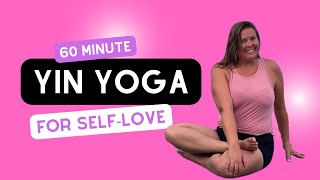
In this 60‑minute online Yin Yoga class, Angelica (known as Yogalebrity) guides participants through a gentle, spine‑focused practice designed to cultivate self‑love and inner stillness. She begins by introducing herself, her 17‑year teaching experience, and her one‑on‑one Yoga Alliance‑approved teacher‑training programs, inviting viewers to learn more via the video description. After a brief check‑in and intention‑setting, Angelica explains the three core tenets of Yin Yoga – finding the edge, settling into stillness, and holding for time – and repeatedly emphasizes breath awareness and non‑judgmental observation of sensations. The class proceeds through a sequence of long‑hold postures: supported bridge, Sphinx/Seal, Banana (side‑bend), Happy Baby, Butterfly forward fold, gentle twists, and a final Shavasana. Throughout, she offers prop alternatives (bolster, pillows, blocks, blankets, books), modification options, and encourages participants to honor their unique bodies rather than chase a perfect shape. Angelica frequently greets and names participants, shares a personal teaching anecdote, and weaves in reflections on self‑love, the beauty of individual variation, and the deeper purpose of yoga as meditation and connection to the divine. The session concludes with a gratitude closing, a reminder of her online teacher‑training offerings, and a warm farewell.
Chapters
Welcome everyone to Yin Yoga for the Spine. I'm so glad that you're here today. My name is Angelica. If you haven't met me before, I'm really grateful to have you in class. I've been teaching yoga for 17 years and practicing for 37 years. I teach an online yoga teacher training, 200-hour, 300-hour, and 500-hour Yoga Alliance approved online yoga teacher training. I teach the courses one-on-one, so I only teach people individually, and that way we can focus more on making your dreams happen and helping you to achieve all of your goals. If you'd like to find out more about how you can become a certified yoga teacher, check the description. And let's go ahead and get started with today's practice. We're going to be practicing Yin Yoga for the spine. It's a very gentle and chill kind of practice. You may want to have a couple of props, but if you don't have them, it's not a super big deal. I have a yoga mat. If you don't have a yoga mat, a blanket works just fine. This is not a hardcore practice. It's not like a vinyasa or an ashtanga where you're gonna really need the grip of the mat. You're not gonna need that, so you can just use a blanket if you want. I like to have a bolster You do not need to have a bolster. You can have a couple of pillows instead, but if you want to have a bolster, then grab a bolster. Oh, look, my friends Raw Food Romance and Nate— he used to be Nice Cream, now he's Raw Natty. Um, and I'm super excited that you guys are here. I know that y'all went on a hike today and now you're doing yoga, so I'm really glad that you're here. Okay, let's come back. So we, um, oh my goodness, Gigi, is that you? Oh, it's so nice to see you. Okay, so if you have a bolster, grab your bolster. If you don't have a bolster, not a big deal, a couple of big pillows will be great. If you have some blocks, I have what's called eggs, these are great because they're rounded, grab those. If you have a blanket, I have a blanket here, you can use the blanket for sitting on it or, um, you can use it for chilling out in shavasana and staying warm. Whichever way you're going to use your blanket, it doesn't matter. You can have any kind of blanket will work. All right, so we're going to start in an easy seated posture. And if I don't have any music playing because I don't want the video to get flagged on YouTube or Instagram or anything for copyright, so if you want to turn on some chillaxing music in the background, please feel free to do so. And I'm really excited that all of my favorites are here today, and we'll go ahead and get started. So just find your way into an easy seated pose, and we're going to— oh, there's a, there's a big, big spider here. Oh, buddy. Okay, that spider is not going to be part of our practice today. All right, just sit tall, maybe sitting on the edge of your blanket, lengthening through the spine, relaxing through the shoulders. Let's take a deep inhale through the nose. Maybe close the eyes as you exhale out the nose. Deep inhale through the nose and exhale out the nose. Just taking a moment now to notice the temperature of the air against your skin. To notice any sounds that might be around you, to notice the way your body feels right now. Not taking an inventory or judging, but just taking a moment to notice how it feels. How do your knees feel? How do you feel in your low back? How does your chest feel? How about your shoulders? How do they feel? How are you feeling in your cervical spine? How's your mind? Checking in with your thoughts. Are they slow and steady? Are they racing? Are we thinking about things other than being present for our class today? Not taking any kind of inventory, not judging, just noticing. We're just taking a notice. Breathing deep in and out through the nose. As our intention today is to target Just continuing to breathe in and out through the nose, deep inhales and deep exhales. Let's take a moment to select an intention for our practice today. [FOREIGN] And let's take a moment to bring our awareness into the spine. And as you inhale, let your awareness go down the back side of your body. And as you slowly exhale, draw the awareness back up the spine. Inhale, drawing the awareness down the spine. Exhale, drawing the awareness up the spine. Inhale, drawing the awareness down the spine. Exhale, drawing the awareness up the spine. Our yin yoga practice is a very gentle and quiet practice, so as you move through your practice today, draw your awareness into the breath and into the spine. Go ahead and just slowly open your eyes. Bring your hands behind you, lean back to release the legs. Let your legs come in front of you, maybe bringing your knees up and down, maybe rubbing the legs. So from here, we're going to start with a supported bridge. So go ahead and cross your ankles, roll over onto your knees. If you have blocks or a bolster or pillows, you might want to use those for your supported bridge. If you have a bolster, you can bring it underneath of you. I'm going to use a this block that I have. You could also use books if you don't have any of these things. You want to just slide this right underneath of your pelvis and then lean back onto the ground. And this is just a easy bridge pose. You'll bring your arms to your sides and let your palms face up, and you'll keep your knees bent. If you want to add a little bit more stress in this back movement, you can extend your legs out straight. But if you want to just keep the knees bent, like I like to do, that's totally fine as well. So in our Yin Yoga practice, we're finding multiple different states in our posture. So the first part is we're going to find this posture and find where it feels like we're getting a little bit of stress, where it feels like we're getting a little bit of sensation. And then if you want to, from here, again, like I said, you can make it juicy, or we can move into the next step, which is to find stillness. So we're just finding that quiet space in this posture, and we're going to hold it for time. So try to not wiggle, try to not move around a bunch, try to just find a spot where you can stay and maintain it for a moment. Just bringing your arms out to the side, palms facing up, and then just breathing in and out through the nose here. And we'll just stay here for a moment and let it marinate. If you find that you want to take this deeper, again, you can bring the arms over the head, or you can extend the legs straighter, or you could just stay right where you are, experiencing this moment as perfect exactly the way that it is. The hardest, most difficult part of the Yin Yoga practice is just finding the stillness and staying in the space, staying in the quiet, staying in the peace. We're gonna hold this posture for one more minute if that feels appropriate for you. If you haven't closed your eyes yet, close your eyes. Come into the posture and really just feel the different parts of the body, really connecting with your own divine inner space, connecting with you inside of you. We'll take 3 more breath here. If your legs are straight, bend your knees. If your arms are over your head, bring them back down to center. And moving very slowly, slightly lift your hips up to move your blocks or your bolster or your pillows or your blankets or your books Underneath and lift them out and just pause here for a moment and notice how the posture affected your body. Notice how it shifted your body. Just letting this settle for a moment in this space. Maybe take a moment to smile. I'm gonna go ahead and roll over onto your side. Push your knee way up. Coming over and lying onto your stomach. We're going to do what's called the Sphinx pose. Now you don't need a bolster here, but if you want one to get a deeper bend, you can certainly use one. I like to use one. I think I might use one today. You can just bring your hands to reach your elbows here. You can bring your hands forward You can bring your hands a little bit higher and come into, like, a seal pose. Or if you have a bolster or some nice pillows, you can just bring your elbows onto that bolster and you'll feel a nice easy backbend. There's a lot of different options. Use whatever works for you, whatever you like for yourself. We're going to find the 3 tenets of Yin Yoga. So the first is to find our spot and find our edge. Then the second is to come to a stillness. And then the third is to hold for time. If you have your green tea, you can have a sip. Just finding a space where the stress in the low spine is okay, where you feel a little bit of something, but maybe you don't feel too much. You just feel a safe amount of sensation that feels good to you. If you want a little more sensation, you can bend your knees, bring your feet up. You just want to find a space where you can stay and linger, and I just invite you to take a moment to bring your awareness inside, maybe close your eyes. [FOREIGN] So we're already halfway through this posture. If you want to make an adjustment to come deeper, maybe moving into the seal, you can certainly do that. If you're feeling really great where you are, please please stay exactly in the space that you're in. I'm gonna stay right where I am, but if you wanted to bring it deeper, you most certainly could. Again, breathing deep in and out through the nose. I can't see that far, but I think that Jason just joined us. Hi, Jason. Really breathing into the sensations. I'm gonna breathe here for another 4 breaths. And in your last breaths, how do you feel? What's happening in your spine? Taking some inventory on how you're feeling and connecting with your body. If you have any bolsters or blocks, you can move them out of the way, and you can go ahead and just bring your hands to the ground and let your head fall to one side. And whichever side you go to with the head, just let your knee bend towards that elbow and just fold here to have a nice counterpose lying on the ground. And now let's turn our head to the other side and slide that knee up alongside toward the opposite elbow. We have a natural tendency to allow our minds to wander. If you notice your mind is wandering, make no judgments. Just allow yourself to come back gently to your practice, knowing that we're not trying to empty our mind of thoughts, but we're just trying to not react. So our yoga practice is the non-reaction to our thoughts. We're gonna go ahead and come up slowly. And since we have some major banana lovers in our class today, we're going to go ahead and do the banana asana. So roll over onto your back and just lie onto your back. We're going to create a C shape with our body, so bringing the right leg over to the side Maybe bringing the left leg over, crossing at the ankle, and we're going to make sure that our hips stay nice and even. And then you're gonna bring your arms overhead. Creating the banana shape. So bringing your right arm to the side and then your left arm will reach over. You want to keep both hips on the ground so we're not rolling onto our side. We're staying on our back and creating a banana shape with our body. So we'll do the 3 tenets here. We'll find our, our spot. And then we'll get to a point where we're not fidgeting, and then we'll hold for time. So just breathing here in and out through the nose and maybe closing your eyes. Just taking some time here to notice where you're feeling it in the pose. I'm feeling it in my left hip, along the left side of my body, and in my left armpit. Maybe that's different for you. But just notice in your own body, how are you feeling? Where are you feeling? Notice where your breath is. Is it slow? Is it rhythmic? Are you breathing in and out through the nose? If you want to adjust to come deeper into the pose, you can. I'm gonna stay right where I'm at. This is one of my favorite poses. It just feels really great on the body. It's very rare that we get lateral flexion in our spine, so this is really good for the spine. You'll just spend one more minute in this pose. If you feel your mind has wandered for your last 3 breaths, let's just bring it back so that we can be present in these final 3 breaths in this pose. So we'll just really slowly bring that left arm back to center, and then we'll bring that left leg back to center, and then the right leg, and then the right arm. Maybe doing really slow windshield wipers in the middle. Maybe take one knee gently into the spine and the other knee gently in toward the spine. Alright, now we're gonna move on to the other side. So we'll let our left leg come out to the bottom half of our banana, and then we'll let the right leg cross over the left leg, creating that half banana on the bottom. Then you're gonna take your left arm over toward the left side to create the full banana shape, and then the right arm will come over. Just coming to your edge where you feel something and then staying there and holding for time, finding a spot where you don't feel like fidgeting. And remember, we want to keep our hips even. We're not rolling onto our side. We're staying on our back, noting that this banana might look different than the banana on the other side. Every banana we get is totally different. Whenever you go to the store and you grab a banana, they're all different sizes, different shapes, different lengths, different curves. We're just doing our side bend, Bananasana, and we'll just wait and let it soak in. And breathing deep in and out through the nose. We're not trying to find the most intense position, we're just trying to find a position where there's some stress and we feel it a little bit. If you want to come deeper, you can. If you want to back off, you can. The beautiful thing about our online practice is that we don't have anyone else looking at us. It's just you and your body, you and your mind. You get to decide where really feels good. See, the thing that people miss about the yoga practices is they think that they yoga practice is about achieving some certain posture. The yoga practice is about finding out what your body wants, what feels good in your body. It's about having a relationship with your body and your mind. Has nothing to do with how a pose looks or how you think it should look or what it is supposed to look like or how it looks like on a picture on Instagram or what somebody else looks like in it. It's just how you connect with your own body. We're all so varied and different. There's no way that a pose would look the same on you as it does on me. We're all gonna look different, and that's what makes us beautiful. So just sitting with that and breathing through it and accepting the beauty of how amazing you are exactly the way you are. Loving every little bit of yourself exactly the way that it is. All of our yoga practice is yoga of self-love, finding the quietness and the peace within your own body. Come to the most obvious sensation in your body right now, where you're feeling it and experiencing the most, and just breathing as you pay attention to that sensation. Sensation. What happens as you inhale to that sensation? What happens as you exhale to that sensation? Just noticing your breath in the sensation. We're coming up on the last 4 breaths in this pose. And we're going to slowly take that right arm, bring it back to center, and then we're going to slowly take that right leg and bring it back to center, bringing the left leg back into the center and bringing the left arm back into the center. And just coming into a mini shavasana— this isn't our final resting pose, but just a, a little bit of a resting pose here. Maybe shaking it out in the legs, maybe moving the hips back and forth. Maybe bending the knees if that feels good. I like to press the low back into the ground a little bit. Mm, then let's go ahead and draw both knees into the spine. Maybe make a circle. Maybe your knees are together, maybe your knees are apart. So we're gonna come into a really great pose here called the Happy Baby. You can grab underneath of your legs, right in— right next to your knees if you want, or you can grab onto your big toes and and grab onto them in a yogi toe lock. Piece fingers in between your big toe and your second toe, and then the thumb on top of the big toe. Or you can grab onto the outside of the feet, whichever feels— whatever feels good to you. I like to grab onto the toe, but we're all going to be different. And then just finding a good spot here in this pose. It's okay if your tailbone comes off the ground. It's okay if it doesn't. What we want to find here is what's best for our individual body. Just breathing deep here, in and out through the nose. You can stay here in the happy baby if you want, or if you want to come into the butterfly Bring your feet together, let your knees come wide, and then just bring them down to the ground, letting the heels come pretty far away from the rest of the body. If you want to, if you have blocks or eggs like I have, then you want to bring them underneath of your knees. You certainly can do that, but you don't have to. Just whatever feels good to you. Just breathing here in and out through the nose. You could also just stay in happy baby if that felt good. I'll never forget, I was teaching a yoga class in— at 24 Hour Fitness in Las Vegas at Tropicana and Decatur. They— it's the it's not even there anymore, that place. But I was teaching a class and I had everyone come into Happy Baby, and all of a sudden someone's phone went off and the phone ringer was her baby laughing. And it was just the per— it was one of those most perfect moments. I think that was about— oh goodness, that was been maybe 11 or 12 years ago. It's been a really long time. It's a really— one of those good yoga memories. And if you've moved away from your breath, you want to just come back to the breath. If your mind has wandered off, you want to just bring your mind back to the practice, back to this present moment, back to this time right now, back to the air on your skin. I'm going to go ahead and bring our knees back up to center and then just let the legs come Come out straight again. Maybe do some counter movements. Maybe bring the feet back and forth. Maybe bend the knees. Maybe let the knees go back and forth into a windshield wiper position. Maybe you just want to be still in your mini shavasana. Whatever you're feeling in your body is just Perfect. Just do that however you want to feel right now. It's great because no one is there judging you, no one's there looking at you. It's just you and your body getting to know each other, loving yourself. So we're going to go ahead and just roll over onto our right side and use our left hand to press our way up, coming back to the center. And if you have a cushion or a blanket, go ahead and just sit on top of that. If you got your green tea, maybe take a drink of that, or your water. And you're gonna just go ahead and— we're gonna come into the butterfly but in a forward fold. So bring your feet together and you want to have your heels pretty far away from you. In a regular yoga class, we just pull those really close in, but in a yin class, we want to create a nice big diamond shape. Now, if it feels good to you to stay like this, you can. If you have blocks or you have, uh, the eggs, you can stick them under your knees, but you don't have to have that. It's not really a big deal. If you have a bolster, you can use that too. Or some pillows or a bunch of folded blankets, whatever feels good. And we're just going to fold forward. So if you, if you don't have anything, you can just fold forward here. That's totally fine. You don't need to have anything for Yin Yoga. But if you want to, if you have a bolster, you can just hold on to the bolster And whatever level feels good to you, we'll just take an inhale and then we'll just relax into that in an exhale. We're gonna stay here for about 3 minutes. So we're just gonna breathe in and out through the nose. So the 3 tenets of Yin Yoga— again, we find our spot, we get to a point where we can not fidget, not move around, and then we hold for time. The Yin Yoga practice is really a more advanced practice in a lot of ways because it requires requires you to really be at one with yourself. It requires you to be able to find stillness and to really just stay in one space. There's not a lot of movement happening, but there's a lot happening in the body. We're actually finding a way to come deeper into these postures with our long holds. Yoga was first brought to the United States by a couple of different people, but one of the biggest people who was a real influencer in bringing yoga to the United States was B.K.S. Iyengar from Pune, India. And he met a man named Yuri Mendelin, and Yuri Mendelin was an Austrian violinist. He was very very famous, and he went and he studied yoga with B.K.S. Iyengar. And he said, the whole world has to see this, the whole world has to, to practice your yoga. So Iyengar went to Europe, and then he went to the United States, and he wrote a book called Light on Yoga that is used in almost every single yoga teacher training today. And Iyengar was really big into props. He was really big into long holds and holding postures for a really long time. So even though he didn't teach yin yoga, he taught what he called Iyengar yoga. He taught a long hold yoga, and so this is kind of a more traditional way of doing yoga than some of the quicker, faster movements. Although that is also— can be more traditional way, but we'll save that for another class. Just noticed that my earring got stuck in my hair, so we're just going to leave that. I'm going to have one earring for the rest of our practice today. No judgments. It's perfect and divine exactly the way the earring is meant to be. If it feels good to come a little bit deeper into this pose now, you can certainly do that. If it feels good to stay where you were, you can certainly stay where you were. So go ahead and slowly just make your way up and maybe bring your props over to the side, and we're going to find our way to lying on our backs. So Just let yourself come over to the side, let your legs extend out. We're going to come into some nice easy twists now. So find your way to lying onto your back, hugging your knees into your chest. We're gonna let your knees just fall over to the right as you extend your left arm over. I'm just breathing deep here, in and out through the nose. Now I like to bring my right hand onto my left knee. To just make it a deeper twist, but you most certainly do not have to do that. You can just bring your arms into like a saguaro cactus, whatever you'd like to do. This practice is entirely for you. This is not an Angelica practice. This is your practice. This is Lissa's practice. This is Nate's practice. This is Becca's practice. This is Jason's practice. You're each doing your own individual thing out there in the world. You could bring your arms over your head too and just notice how that changes the experience and how it feels slightly different. The pose is doing the work. We just linger and hold the space. We're just going to find stillness in this section, and I'm just going to be a little quiet as you find the interior reflection in our final parts of our poses. So we just have the twist on this side, twist on the other side, then we'll come into our final resting pose, Shavasana. So just juicy last bits of your practice today. Just let that breath hold you. And we're gonna hold this for another 2 minutes in this pose, so a nice deep hold. It's really slowly now bringing it back to the center and just releasing that. And I don't know what it looks like in your world right now. But in my world, I'm looking out from the yoga tent, hugging my knees to my chest here, one knee at a time, and I'm seeing the most incredible blue sky, the most incredible clouds, and it's all amazing here up in the mountains in Colorado, getting the Rocky Mountain high. Like I'm John Denver or something. Let's just hug both knees into the chest as you roll over onto your left side and let the right arm extend to the right. You're going to let your head turn to the right as well. I just— I'm trying to get into the microphone right now, but again, finding a stillness, maybe letting your eyes close as you just let the posture do the work and let the breath just hold you in that posture. Let the breath draw you deeper. Let the breath release the fascia. Let the breath soothe you and heal you. Let the breath help you to find connection with yourself. I'm gonna let you find quiet and stillness here as I turn my head to the right as well. We're still together, I'm still with you, I'm just letting you find your own breath and your own stillness. Really slowly, we're going to bring it back to center now. And if you have a blanket or a sweatshirt or something to keep you warm, maybe you want to cover up with that now as we come into our final resting pose. The final resting pose, Shavasana, is the most important pose. And the reason why we say that is because through the 8 limbs of yoga, the yoga asana is just used to find meditation. It's just used to find connection with the mind, with spirit, universe, God, of your each unique divine understanding. So we're moving into the final pose where We're going to find that unique connection, and when we skip that, we're skipping the whole point of the yoga practice. So just letting your feet come out to the side, letting your arms come to the sides, maybe palms facing up to receive, maybe facing down to keep your energy in. Maybe you bring your hands onto your stomach, whatever feels great to you. Just let your body relax down, maybe moving the breath into each part of the body, maybe moving the breath into the heels, maybe moving the breath into the toes, letting that relaxation move up the legs, maybe relaxing into your calves and your knees. And then feeling the breath relax all the way from your hips down to your toes. Feeling relaxation move into your stomach, into your chest, your back, opening the shoulders, letting it come broad across your shoulders, down the arms to the fingertips. Letting your tongue relax in your mouth, letting your eyes relax, letting your forehead and your ears and your cheeks and your nose and your chin relax, letting your neck relax and the crown of your head, letting all of your body relax and release into our final resting pose. We'll breathe here as we come deep and connected with ourselves and self-love. It's so beautiful that you chose to do this practice today. It's so beautiful that you chose to spend this time on yourself. So few people do that. Most people on a Saturday afternoon are drinking or watching TV. It's actually a Sunday, same same but different day. Doesn't matter, time is irrelevant. Just letting ourselves soak in the beauty of this moment. Very slowly beginning to wiggle your toes and your fingers, gently letting the awareness come back into your space. Maybe try to keep your eyes closed for as long as you can. Stretching your fingertips and your toe tips, stretching all along the body. Bending your knees and rolling over onto your right side. We'll just use our left hand to press our way up, coming back into a nice easy seated pose. Welcome back. In our last moments here, I want us to reflect on our body and come back to the space that we were in in the beginning of our practice. So, you know, just coming into this easy seated pose, closing the eyes, lengthen the spine, relax down the shoulders. What does the spine feel like now? What does the mind feel like now? What do the arms feel like? What do the legs feel like? How does the body feel? How does the breath feel? How has it changed since the beginning of our practice? Bringing your hands together at the heart center in Anjali Mudra, we'll seal our class with the final Om. Taking a deep inhale. Om. The light within me honors the divine and beautiful light within each and every one of you. I thank you so much for coming today. Namaste. Thank you, friends, you did great. I'm so glad to have practiced yoga with you today. I appreciate you so very much. This was a really relaxing, chill, great practice. I'm glad that you did it. If you are, uh, if you don't know who I am, again, my name is Angelica and I'm known as Yogalebrity on my podcast, on YouTube, on Instagram, on TikTok. And if you would like to get certified, become a yoga teacher, I teach online yoga teacher training. Thank you, Nate. Thank you, Lisa, for coming. Um, and I do teach online yoga teacher training one-on-one. So check out www.yogateachertraining.yoga for more information, or the link below. And I look forward to seeing you in the next class tomorrow. And yeah, thanks friends, y'all are awesome! That was really great. Thank you, love you, love you, thank you, I love you, thank you. Mwah! Mwah! Mwah! That's how I kiss my dog. Mwah! Mwah! Mwah! Mwah! Bye y'all, have a good day.







