60 Minute Yin Yoga Class for Body Awareness
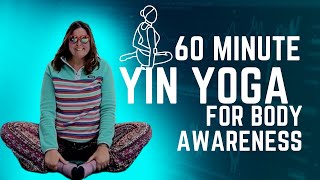
In this 60‑minute indoor yin yoga session, the instructor guides viewers through a complete practice designed to cultivate body awareness, gratitude, and relaxation. The class begins with a brief personal intro and a seated meditation in Virasana, inviting participants to set an intention and practice a three‑part Taoist breath combined with Child’s Pose variations. The sequence then moves through a series of long‑held yin postures: a wide‑legged butterfly (long‑legged butterfly), a forward‑fold called Caterpillar (Paschimottanasana), a supported bridge backbend using blocks, bolsters or blankets, a saddle pose with optional modifications, Sphinx pose, and a lateral stretch called Banana Asana performed on both sides. Throughout each pose, the instructor emphasizes deep, mindful breathing, sensory observation, use of props, and gentle modifications, encouraging participants to stay within a comfortable edge and notice sensations without judgment. The practice concludes with a Shavasana (final resting pose) for integration and relaxation. At the end, the instructor promotes a free online course, “Thriving Yoga Teacher,” offering guidance for aspiring or current yoga teachers on building a community and finding work opportunities, and provides a link in the video description. The overall tone is calm, supportive, and instructional, aiming to help practitioners develop a deeper connection with their bodies and minds.
Chapters
I'm not doing yoga outside today because it's super windy. It is like, it's insane windy, and it's very uncomfortable, and it hurt my ears when I was giving my dog a walk. So, um, I won't be doing yoga outside like normal. You are inside of my large abode. I like it because it has a big kitchen, and that's what's important. I also have some of my magic tea. I'm a big fan of tea, and, um, I'm gonna set it over here so it's easy for me to get. Everything we're gonna do today is on the floor for the most part, so let's get started. We're gonna start in Virasana, Hero's Pose, just like this. If this feels like a bit too much for your knees, you can always just come into an easy seated pose. Just like this. You can also sit on a blanket or a towel, anything that makes you feel comfortable. I actually really like sitting this way, it's pretty comfortable for me. So we're gonna do a meditation to get started, just sitting here. In and out through the nose. Good. Let the hands relax onto your lap. Chin slightly tucked, and either close your eyes or just let them gaze, becoming aware of the solidity beneath you, keeping yourself solid, beginning to go within. Sitting nice and tall like a proud mountain. And start to add an awareness to the space around you? What does your clothing feel like on your skin? What does the air feel like on your skin? How do you feel within the space immediately surrounding you? Allowing each breath to rise and fall. Just bringing a sense of happiness into your practice today. Grateful for this time that you're giving yourself to be here in this space now. We're just gonna take 3 more breaths here. Before you open your eyes, add an intention for your practice today. Just a reminder of why you're doing your practice today. What do you intend to cultivate? For me, it's a sense of gratitude and overall happiness with the beauty of my own life. For you, it may be something to do physical. It may be just gratitude for doing a practice. And go ahead and slowly open your eyes. Good. I'm gonna bring our hands to the side here. We're gonna do a 3-part Taoist breath. Inhale, raise your arms to the sky, bending the elbows. Bring your fingertips to the shoulders. Push the palms away, drop your chin to your chest as you exhale. Inhale, backbend, look up. Exhale, Child's Pose. Inhale out and up, bending at the elbows. On the exhale, hands out. Inhale, draw the energy inward. Exhale, rounding the spine. Inhale, reach up, look up. Exhale, bowing down, Child's Pose. Inhale. Exhale to the side. Inhale, drawing in. Exhale out. Inhale, rising. Exhale into your Child's Pose. Maybe close your eyes this time. Inhale, rising up. Exhale out to the side. Good. Inhale, pushing forward as you exhale. Inhale, reaching up, and exhale, coming into Child's Pose. I'm just finding a variation of the child's pose that works for you. As you're in your Child's Pose, notice the most obvious sensation that you're feeling and just breathe into your Child's Pose. We'll stay here for one more minute. Last 3 breaths here. And very, very slowly Start to roll up, seeing what it feels like to come up after a long hold. And when you're up, just pause here for a moment. Feel your spine. Feel your legs. Let's move over to one side. Let your legs come in front. We're just gonna shake the legs a little bit. We're gonna do the long-legged version of the butterfly next. So instead of having our feet in really close, we're going to have our feet out wide. If you want, you can sit on a blanket in this pose if that feels good to you. It helps to lift the hip and move the body towards the fold. You can have any blanket that you want. Typically I use a Mexican blanket, but I'm using this big fluffy yellow blanket today. and then just let your feet come together in front of you, nice and wide instead of close to you. We're going to feel a stress along the spine, maybe a little bit on the inner groin. You're going to inhale as you lengthen, and then exhale, just fold to a point you start to feel sensation. We don't have to go very deep here. We're going to hold this pose for a long time. That's the difference between yin yoga and a more yang or quicker asana. Like Ashtanga. This yoga is a nice long hold, and we're working with our connective tissue instead of with our muscular— sure. So just folding into the pose, we're going to hold this for a nice long time, many moments, many minutes, and just breathing and noticing any sensation, becoming aware of how you feel in your body, how you feel in your legs. How you feel in your low back. If it feels good to come deeper, or if it feels better to back off, do either one of those. But just try to find a space where you're not fidgeting, where you're just finding stillness. And then let's breathe together as we fold into this posture. If you have a bolster and you want to use that to fold into, you most certainly can use your bolster. If you don't have a bolster, don't worry about it. Try to just notice the sensations within your body without judgment. Typically we want to back away from anything where we feel intensity, but maybe just play with that intensity and see what it feels like to sit longer with it. We're gonna hold this pose for one more minute. We'll do this for 3 more breaths. Maybe just asking yourself, what is this sensation about? Am I feeling this in my mind or in my body? One last breath. And keep staying connected with your body as you Slowly roll up. What does it feel like to move out of the pose? If you have your bolster, you can just move it out of the way. And let's straighten the legs. Good. If it feels good to just do a nice easy backbend Just feeling the different parts of your body, any sensations that you feel. It might feel good to you here to come into a reverse tabletop, bending the knees. Can also feel good to do that same thing with the legs extended. Extended. And when you feel the time is right, we're going to come forward into a caterpillar pose. We call this Paschimottanasana in regular yoga. In yin, we call it caterpillar. Now if you have a bolster, you can use this again to fold forward into. If it feels more comfortable, you can bend your knees and bring your hands underneath of your legs and fold forward this way. You can also just fold forward, and we want to feel something on the spine and the back of the legs. So it doesn't matter how you do the pose, you just want to feel something. Yin is very forgiving and open to individuality, whereas Ashtanga is not. I love Ashtanga, but it is not open to individuality at all. Alright, inhale if you are underneath there, and just exhale folding into the pose. We're going to hold this for a few minutes. Noticing where you're feeling sensation and maybe just questioning, where is that? Asking yourself, where is the sensation that you're feeling? Not having any judgment on it, just noticing it, becoming more in tune with your own body. And how your own body feels. If you find an urge to move, try to just notice it and allow yourself to stay still in the posture. Just because we have an urge doesn't mean we have to act upon it. We're just gonna stay in this pose for one more minute. If you ever feel pain, definitely back off of that, but try to play with the edge of staying in the posture. Kind of a burning sensation is usually okay. A stabbing sensation is what we want to stay away from. We want to feel the sensation. We want to become more comfortable with our body. And maybe creating a little bit of stress in it. 3 more breaths here. Very slowly, staying in tune with your sensations, start to roll up. How does that feel on the spine? How does that feel in the legs? Move any props you have to the side. Just shake the legs out a little bit. Mmm. Maybe a backbend. Oh, it feels so incredible. Oh, oh, oh. I love that. Whatever kind of movements feel natural to you after doing a pose are usually the right ones. You can always do a nice windshield wiper. Now we're gonna come into what's called a supported bridge. So if you have blocks, you can use blocks for this. If you don't have blocks, you could use a bolster. If you don't have any of those things, you could just use blankets or books. You want to sit on the blocks or the bolster. This is going to give us a backbend. I actually have a little bit of a spasm that happens in my low back sometimes when I do this because I I was in an Anusara John Friend class one time, and I, I hurt my low back, and this was like 20 years ago, and I still sometimes feel a lot of intensity there. So I just breathe into it and just let the breath kind of move me in the pose so that I'm not feeling too stressed. But this supported bridge is a really nice posture for anybody wanting to get just a nice chill backbend without a whole lot of effort. So just breathing in and out through the nose here. And I just invite you to close your eyes if that feels comfortable. Just notice where you're feeling the sensation in this posture. Noticing where you're feeling sensation in the body with detached awareness, just letting yourself feel the sensation. For me now, it's moved from my low back to my glutes. And that could be because I just went on a nice long hike before we did this practice today. Just trying to find stillness in the posture. Just paying attention to your own body and how it feels in the pose, breathing in and out through the nose, just finding that relaxation. We're gonna take one more minute here. 3 more breath here. Keeping this inner focus as we slowly come out. Woo! Rolling over to one side. Just pausing here. Nice counterpose. And when it feels like a right time, just maybe hug the knees into the chest, rolling around a little bit to massage the lower back, maybe circling. Your knees in both directions. The next pose we're gonna do is Saddle Pose. Rolling over onto your side. Pushing your way up. Now the saddle pose can be challenging for some people, and you might find that you want to modify and maybe do one leg at a time. You might find that you want to use a bolster. I like to use a bolster. It feels good to me to use a bolster. Of course, everybody's a little bit different. You can sit on the bolster. You have a blanket, you can also add that. And then the next stage is to lean back. You can drop the head back if that feels comfortable for you. If it doesn't, you don't have to do that. If this pose is wildly uncomfortable for you, you can go into the Sphinx Pose on your stomach instead. We're just gonna be here for a while. You'll feel a lot of sensation in this pose, so maybe just try to breathe through it. Again, if it feels like too much, you can always just do one leg at a time. Finding some stillness in the pose, just breathing in and out through the nose. Slowly finding your way out of the pose, however most feels comfortable to you. Just moving your props aside, maybe finding a way to extend your legs out. Circles on the knees. Maybe we did a lot with the knees here, giving yourself a nice little massage in the knees. I'm just gonna take a moment here to just lie on our back. Maybe tighten the kneecaps and engage the quads and then relax. Tighten the kneecaps again, engage the quads, and then relax. Just breathing here, releasing down into the ground. So when you're ready, we're going to roll onto our stomach now. I'm gonna turn around so I can look at you while we roll over. So we're gonna start this sphinx pose By just propping ourselves up on our elbows, grabbing on to opposite elbows here. If you want, you can rest your head into your hands, just feeling a nice release in your back. If you'd like to increase the sensation, you can also take a bolster and bring your elbows on the bolster. Just relaxing here, feeling that stress into the low back, breathing in and out through the nose, getting really connected with your body. Just feeling sensation. Woo! Starting to feel sensation in my legs. If you want to have a little bit more sensation in the low back, you can just Bend the knees. I like to think of backbends as front body stretches. When I think of myself as stretching in the front body, it really helps to extend my backbend. Time is more important than intensity in a yin yoga practice, so we just want to hold the poses for longer versus trying to press ourself deeper into the pose. Just noticing the sensation, noticing the most obvious sensation in the body. Where is it? Is it concentrated or is it spread out? What part of the body? Is it throbbing? Is it tingly? Do you feel hot or cold? Just noticing with awareness the body. Does it feel like compressing? Does it feel open? How does the sensation change based on the cycle of your breath? How does it feel when you breathe in? How does it feel when you breathe out? 3 more breaths here. Noticing the sensation as you slowly come out, lowering down. And just turn your head to one side, and whichever way you turn your head, slide the knee up and let your head go to the side. And then turn your head to the other side and slide the knee up on the other side. And just straighten your legs, and we're gonna roll over onto our back again. We're gonna do one of my favorites, it's called Banana Asana. So we're gonna make our bodies like bananas. You're gonna lay on your back, and we're just gonna do a side bend. So let your leg come out to the side, and then the opposite leg will come over. Same arm comes out to the side. And then the opposite arm comes over. And try not to lift the hips up, just make a banana shape with your body. And just come to where you feel a nice tugging along the whole side of your body, creating this banana shape. It's called Bananasana. I love this. It's such a good pose. I love it. Just staying here with the breath and just keep coming back to the practice of noticing your sensations. We'll hold this posture for another minute, and in this last minute, just start to ask yourself, what is the sensation? What is the feeling that I'm feeling in this posture. What is happening in my body? Last 3 breaths here. And then slowly noticing the body as you come out of this pose. How does that whole side of your body that we just stretched out feel? Before we move to the other side, just take any movements that you feel you need or that feel natural to you. Whatever feels good to you. Maybe it's a nice happy baby. Oh yeah, that does actually feel— that feels amazing. If you're not doing a happy baby, maybe try it. And then when you're ready, we're gonna do the other side. So whichever side you didn't do, now you're gonna do the opposite side, bringing your top leg over your ankle and bringing your opposite arm over, creating your banana on the other side. Try to keep the hips even on the ground, just waiting for the body to open up, trying to not force it into the lateral stretch. I'm just breathing here in and out through the nose, letting the posture come just to where you feel some sensation. Whatever that appropriate edge is for you. Staying here and breathing in and out through the nose. And I just invite you to keep coming back to the sensation in the body and Having a detached awareness, but just asking yourself what the sensations are that you're feeling, what's coming from you and your body. Just breathing into those sensations with detached awareness. We're coming into our last 3 breaths here in this posture. Slowly releasing our banana. Just pausing, feeling the posture, feeling the quality of the pose and how it feels in our body. How our body feels here. Taking whatever movements feel appropriate for your body individually. And if you have a blanket or something that you want to cover yourself with for our final resting pose, Shavasana, please feel free to do so. My feet get— keep getting caught on the bottom of my mat. Just letting your legs extend out to the side. And your arms extend out to the sides, maybe your palms face up. Roll the shoulder blades out, letting the chest open. And then just commit to being still while we are in our final resting pose, Shavasana. Feeling your whole body just surrendering into the earth, releasing your focus and letting go. Relaxed and quiet. Connecting with the rise and the fall of each breath. Allowing your breath to get a little longer. Begin to wiggle your toes and your fingers. When you feel ready, hug your knees into your chest just to release the spine. Taking a deep inhale, exhale, just roll over onto your side. And just pressing your way up, we're gonna come into a nice easy seated pose here. Thank you everyone for joining me today in yoga. This is my personal practice that I'm just sharing with you, not a super cultivated class, just you joining me here in my home doing some yoga that I do myself. If you are an aspiring yoga teacher or you are already a yoga teacher, I do have a free course called Thriving Yoga Teacher. You can get it at bit.ly/thriveasayogateacher. The link is of course in my bio if you want to get that course and sign up. It tells you about how you can build your own community as a yoga teacher and how you can keep people coming to your classes and how you can get different ways to teach, like Where, where have I worked? Where can you find jobs? There's lots of places to work as a yoga teacher, um, and this will give you a lot of great ideas. The— I will let you know, the worst place to work is at a yoga studio unless it's your own. So that is not one of the options that I give. I give a lot of other options. So let's bring our hands to the heart center as we close out this class. Taking a deep inhale. Om. The light within me honors the divine and beautiful light in each and every one of you. I thank you so much for coming to class today. I absolutely appreciate you. Namaste. Thank you. Again, you can grab my free course for yoga teachers or those of you who want to become yoga teachers. The link is in my bio and, uh, or in the description of this video if that's where you're at. And, um, I will see you next class to do some more yoga. So again, thank you for coming, and I'll see you next time, friends. Mwah! Bye!







