60 Minute Yoga for Hips
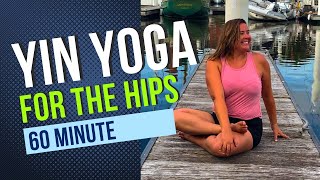
A 60-minute yin yoga class filmed from a camper, focusing on opening the hips through poses like Dragon, Shoelace, and Tadpole. The instructor uses whatever props you have at home, shares alignment cues for each pose, and connects hip tension to emotional release.
Chapters
But it's windy again today, so we're back inside of my camper. This is my whole— this is my whole house. Um, this and then the other side is my bed. So you are going to want to start— let's just get— let's just get it seated. Okay, you're going to want to start this yoga class with a couple of things. Not a lot of things, just a couple of things. You're going to want to have some kind of mat. If you don't have a yoga mat, that's totally fine. You can use a towel, you can use a blanket, you can use anything that makes you feel, um, comfortable. Doesn't have to be— doesn't have to be anything fancy. If you don't have a yoga mat and you want to get one, you can grab one at TJ Maxx for like $10. I have a really fancy expensive one that has lasted me a really long time. But you don't have to have that. This is not going to be that kind of practice today. We're doing something chill. I also have a bolster. I got this for $35 on Amazon, and these are the exact same bolsters that I used when I owned the yoga studio. They're great bolsters. They're really fabulous, and, um, if you want to pick one up, I think it's worth it. I think you're worth it. You're like Maybelline, you're worth it. Uh, if, if you don't have a bolster, don't worry, you could just use a big fluffy pillow or two. I also got these at TJ Maxx, 2 for $20. They're fabulous. Um, 2 is probably better than 1 just because they're, you know, this is like more harder. Um, if you have a blanket, at the end of our practice when we do shavasana, you might like to have a blanket. So grab that if that's something you want. Now I am challenging myself to do yoga for 75 days because I'm doing Andy Frisella's 75 Hard program. And also because I teach yoga, and I teach people how to be yoga teachers online. I have an online yoga teacher training. I have a Yoga Alliance certified 200-hour and 300-hour. That's what I've been doing for 17 years. I've been teaching yoga, and I've been online for about a year and a half, and I only work with students one-on-one. I don't do any, um, group sessions. Um, I do just individual sessions because I prefer to work with people one-on-one. So this helps me. This is my personal practice. This is not a super highly edited yoga class. This is just you and me chilling in my house together. Thank you for being here. I'm gonna grab my blanket really quick now so that I don't have to get it later. Okay, got it. It is also fluffy. I like fluffy. I like fluffy things. My dog is fluffy. I like fluffy stuff. You don't have to have fancy stuff to do yoga, first of all. That— I used to get caught in that trap, and I don't know if you used to do that in life, but, um, or if you still do, but I used to be like, I can't start doing this one thing. I can't— I can't run. I can't start a running program unless I have brand new running shoes, or I can't stop walking unless I have brand new walking shoes, or I need a new outfit before go to the yoga studio. No, you don't need any of that stuff. You don't. You can work with what you got at home, and if you like it, keep doing it and maybe treat yourself to something. But if you don't want to, you don't have the money, then just don't do it. Or just save the money. Man, I wish I saved all the money for all the things that I was like, I'm gonna do this forever, I need this new thing. I was counting up some of that money the other day and I was like, wow, so far this year that's been like a couple thousand dollars. But I, I spent like $300 on a tent to do yoga in, and I do really like that. We're just not doing it today because it's too windy and the sound would be awful. So we're going to go ahead and get started, um, on our yin yoga practice today. Yin is like a really chill style of yoga. We're working on the connective tissue, we're not working on the muscles. So we're going to be working on our connective tissue, and that's like our ligaments, our fascia, our joints. We're going to be putting a little bit of stress on our joints. So we're just going to take a moment to come into the space. So you can come into an easy seated pose like I'm in, or any kind of comfortable pose if it's with your legs straight out, or if you sit on your knees like this, whatever feels comfortable to you. Go ahead and just come into that pose, and we're gonna find some stillness. All right, so just begin to notice your breath, breathing in and out through your nose. And I got a few burgers in there. Breathing in and out. Thanks for being with me today. I'm so glad that you're here. Just simply breathing in and out through the nose. Maybe close your eyes if that feels comfortable. I forgot to say, I'm not going to play any music on this because I don't want to get tagged on YouTube or anything like that. It also isn't great sound-wise on live video, so if you want to turn on some chillaxing music that you love, please go ahead and do so. I like to just go to iTunes or Spotify and type in like chakra or Reiki or meditation or massage and then Just have like a chill music playing in the background. So just breathing in and out through the nose, trying to lengthen our inhale and our exhale to the same amount of time. You're doing great. You're beautiful and awesome. I'm so glad that you're here. Really coming chill into the space, noticing the calmness and stillness within your body, the calmness and stillness within your mind. Let's just add an intention for our practice today. Whatever that is for you. For me, I'm going to cultivate a sense of calm and peace. I've been feeling really erratic all day, so just cultivating that. Maybe you're going to cultivate some happiness. Maybe you're going to cultivate gratitude, whatever it is you're feeling. Good. So let's go ahead and inhale, reach up, and exhale, bring your hands behind the head. Good. Lift your heart. Exhale, pushing your hands forward. Good. Inhale, palms turn up and reaching to the sky. And then exhale, just coming forward towards the earth. Inhale, rising up. Exhale out to the side. Inhale, draw your fingertips in behind you. Exhale, pushing the fingertips forward. Nice. Inhale, palms turn up, reach up. Exhale, folding forward, surrendering to the earth. Inhale, reaching up. Exhale, pushing out. Inhale, fingertips behind. Exhale, pushing forward. Turn the palms to the sky as you inhale up. Exhale, turn the palms down, fold forward. One more time. Inhale, reaching up. Exhale out and to the side. Inhale, fingertips come behind your head. Exhale, reaching forward. Good. Turn your palms up, inhale to the sky. Turn the palms down, exhale, folding forward. Now from here, if you want to, you can just roll onto your knees. Sitting back into your Child's Pose. If it feels good in your Child's Pose, you can extend your arms. I like to bring my arms behind me. That feels really good for me, helps me to open and broaden my chest. Each of us is going to be different. Maybe your knees are wide, maybe your knees are together. Everyone's body is different. I think that's something we need to get away from in yoga, is this ideology that there's one way to do a pose. Sure, there's some really great proper alignment, but everyone has a different bone structure, so we're all gonna feel the body a little bit different. Yin practice, what we're feeling is our own individual body sensations. Where do you feel the most sensation right now? And just focus on that and breathe into it. And it's interesting because No one has the same body as you. No one's had the same experience as you in this life. No one has done the same things with their body that you have. Each of us is unique and individual, not just from a biological perspective, but also from an experience perspective. We're all different. We're just gonna honor that today through our practice, honoring how amazing and unique you are. Just bringing attention to where sensations are and putting breath into there. Sorry if I sound like a really heavy breather. We're at altitude, and also I'm in a crunchy pose right now. Thank God for microphones. You'll notice through your practice today that the body feels one of two things. We either feel tension or we feel compression. Tension is when muscles have stretched to their maximum point, and with more practice we can release those muscles a little bit more and maybe come deeper into the pose. Compression is the opposite of tension, and that's where our bones compress. So for instance, in a backbend, your spine— you're opening up your spine, and at some point your vertebrae are going to actually touch each other. So that's compression, and you're not going to be able to move fast past that because you can't move through your bone. And each of us is going to be very different in that. So let's try to bring an awareness today into our practice if we're in tension or we're in compression. That's just unique for each of us, and everyone's gonna look totally different. You're not gonna look like me, and I'm not gonna look like you. We're all gonna do a unique individual practice today. We're gonna take 3 more breaths in this pose. From here, we're just gonna bring our arms forward and come up onto our elbows. See if you can bring your knees wider apart, and then we're gonna sit back on our heels, and this is like a little frog. So on our forearms and sitting back into the heels. And it might feel comfortable to come a little bit wider with the knees and you start to feel that in the inner groin. If this feels a little bit much for you, you can always back off. What I want for you to find is what your individual space is, what your individual body wants in your pose. Because when you can find your own space in the pose, you can really get deep into it. If we're not focused on how we look alike, but instead we're focused on our own growth, think of how much further you're going to grow and how amazing it's going to be. Now if you want a little bit more, you can extend the arms out in front, bring your head to the ground. Woo! I really feel that. This posture is called Tadpole. Just start to notice if you're feeling tension or compression. Where do you have sensation come into that in your mind? Just feel that in your body and imagine, is that coming from the muscle tension or is it coming from the bone hitting the bone? Compression. Tension will be able to move deeper over time. Compression won't be able to change our bones. Just finding the stillness in the pose as we breathe deep in and out through the nose. You're doing great. You're awesome exactly the way you are. You can also rest your chest onto a bolster or pillow here. We just want to get to a point where we're feeling something. We're just gonna stay here for another 3 or 4 breaths. Just try to come deep into your own space, into your own self, into your own body. One last deep breath. So we're gonna come out of this really slow. So maybe walk a little bit more up on the elbows onto the hands. Maybe take one knee in and then the other. Making any movements that feel natural for you. Maybe your feet are a little bit asleep. Maybe come into a tabletop and move your feet back and forth. And let's just sit back into a hero's pose. Nice, you're doing great. So just really relax, really chill. The hardest part about yin is holding the poses for a really long time and being in the same spot. For a really long time. And it's more of a meditative practice than it is of this like really intense physical practice like Ashtanga. Let's go ahead and sit to the side, bring the legs in front of us. I'm gonna shake the legs out a little bit. Just to wake them up. We're going to start with one of my least favorite yin poses, shoelace. So we're going to take your right leg and bring it over the left leg, and you can keep it right here if this feels comfortable for you, or take the leg under and stack the legs on top of each other, trying to get the knees in line with each other. And now you may notice that my knees are not perfectly in line, and your knees might not perfectly be in line, and that is totally okay. For me, this is a really challenging posture, and it might be challenging for you, and it might not be as challenging. Everybody is going to be different. This is really demonstrating the differentness of our bodies. Finding that stillness again in your pose, breathing in and out through the nose. If it feels good, you can stay right here. If you'd like, you can begin to fold forward. If it feels comfortable, you can bring your hands onto your legs and rest your hands— your head in your hands, or you can just bring the hands down. All of us are going to be at a different point of Forward fold. So don't feel like you need to be where I'm at, or don't feel like you need to stay where I'm at if you want to go further in your body. I tend to have a very strong muscular body, and so for me flexibility is a little bit more difficult. For some people, they have very flexible bodies. And maybe doing arm balances and handstands are more difficult for them. So it just depends on where you're at in your body and what you are made up of. But just what I want you to feel so much today is just being yourself is perfect and divine. Just being who you are and being where you're at is so perfect. As long as you're feeling some sensation Mostly you're going to feel this in your hips. As long as you're feeling some sensation, you're right exactly where you need to be. And I'm so glad that you're here with me. Thank you for practicing yoga with me. All right, let's get to the business of breathing and focusing in on that posture. And let's go ahead and walk back up. You're going to keep the top leg where it is, and you're going to take your bottom leg and just straighten it out. And we're going to start to fold forward again, so we're going to feel that a little bit in the hamstrings now. So the back of the leg. Just try to find the stillness in the pose. Let's go ahead and slowly start to come back up. You're gonna lean back onto both hands and extend that top leg really nice and slow. And just maybe shake our legs a little bit. We can also do some windshield wipers here, which is a really nice yin pose, just coming, oh, side to side. Oh, I'm really feeling that in my back. This is just a really great practice, especially if you do like any kind of cardio in the day. Alright, let's go ahead and be still for a moment, bringing the legs straight in front of us. And now we're going to do the other side. So we're going to take the left leg and bring it over the right leg. And if you want, you can keep that leg extended, or if you had bent the leg on one side. We'll bend both legs on this side. Now notice I'm totally different here, right? This is— my knees are different here, not as in line as in the other side. So if you're different on one side than the other, it's kind of like boobs, right? Like one's a little bit different size than the other. Each of your sides are going to be different. So let's go ahead and just breathe here. And if it feels good, stay where you're at. And if you want to, you can bring it deeper by folding forward. If you want to rest your hands and your head in your hands, you can do that. Starting to notice where you're feeling it. I'm feeling it right here in my left side thigh. My side thigh is connected to my hip bone. Breathing deep in and out through the nose. Just noticing with detached awareness, really getting to know your own body. Where are you feeling it? Not where are you supposed to feel it, but where are you feeling it? Trying to find some stillness. Knowing that you're perfect and divine exactly the way you are. You don't have to be anything that your mind is telling you that you need to be. It's completely okay to be who you are right now. We miss out on living our entire lives because we spend so much of our lives focused on what we want to become, what we think we should be, what we're in a hurry to create, instead of just being in this stillness. We'll go ahead and slowly come up and come into the half shoelace. So bring that bottom leg straight out. Toe's gonna point back towards you, and then just fold forward. Whoo! Feeling that in the hamstring. My hamstring so needed that. Going on these long hikes with my dog every morning, it's the first thing we do. He knows when I put on my sunglasses, he's like ready. He's like, we're going on the walk. So this is great. It helps to release some of the lactic acids that are held up in your body. Yin yoga is also really good if you go on vacation, you do a bunch of walking. Just breathing here in and out through the nose. You're doing great. However you look right now is exactly the way you're meant to. You're perfect. You're absolutely perfect. Like TikTok, you're gorgeous. You're so gorgeous. You're doing great. Let's just find some stillness here in the breath. Let's just take another deep breath here. So really nice and slow. See if you can be the slowest one. The slowest one in the room, just to slowly roll up. Good. Just pause for a moment and take that top leg out, create a little bit of a backbend. Oh, shake the legs back and forth. Maybe we're going to do our windshield wipers here, bending the knees. Wiping back and forth. Yesterday it snowed here. So weird. Colorado's so weird, y'all. I'm from Las Vegas. I don't know how to feel about this. Coming up. Good. Let your head lean back. Coming down. Now extending the legs out again. Alright, we're gonna do some kind of challenging posture now. Go ahead and bring your legs around. We're going to do some dragons now. Dragons are very challenging for me, so if they're challenging for you, great, we're in this together. Go ahead and bring your right leg forward, and if you have some blocks, you can bring them to your sides. Mine are in the tent right now, so I don't have them with me. If your back kneecap is feeling too much intensity, you can put a pillow on there or a blanket if you have your blanket. And we're just going to move kind of forward deep into it. If you don't have any blocks, you can literally just grab anything that's around you. Like I have my dog's toys here. He got some squeezies. You can use those to hold yourself up. Whatever you got— water bottles, mugs. I just find this pose so challenging. I hate holding this one. Breathing deep in and out through the nose. Now if you want, you can also just walk the foot out and bring both hands inside. This actually feels a little bit more comfortable for me, but whatever feels comfortable for you is what you should be doing. Remember that we are honoring our own individual bodies today. That's the whole theme of the class, is just honoring your individual body. So you're gonna feel this in the hip, maybe you might feel this in the top of the back thigh. I feel a little compression in my inner thigh, my right leg. Tension, I feel tension, not compression. This is called Dragon Pose. Let's just breathe here together. Let's kind of try to find a space to breathe. So we're gonna walk our hands back up a little bit. We're gonna keep our foot there and keep our hands inside of the foot. Woo! I'm just having a little bit of a spasm there. And let your knee come out to the side. And this is called a Winged Dragon, so you're going to really feel this in your hips. It's kind of like an upward pigeon pose. Oh, that is some intensity. So what's really interesting is in our second chakras are in our hips, and the emotion of anger is actually held in our hips. So if we feel anger starting to come out, that's something that we're just holding in our hips. So don't be angry at me, okay? But it's interesting because I'm just sitting here and I'm thinking, I'm thinking about something from the past that really made me upset, and I was like, wow, that is my second chakra just coming out there. Let's just try to breathe and try to find some stillness in this pose. Alright, we're going to counterpose this by walking the feet a little bit forward— walking the hands a little bit forward, walking the foot back. You can be here in your tabletop if you want, or if you want to, you can come right into a nice downward facing dog. Downward Dog feels so incredible right now to me. Now normally I teach only in Sanskrit. This would be Adho Mukha Svanasana, but Yin Yoga, they renamed the poses because they want people the founder of Yin Yoga, Paul Greerly, wants people to think of these poses a little bit differently than our more yang practices of like Ashtanga and Vinyasa. Oh, maybe just pedaling a little bit. If you want, you can come into child's pose too. That's available as well. Now coming back to all fours, unfortunately we must do the left side. We'll be in this together. I also— I don't I don't hate any poses, but I really don't like this one. So let's just bring our left foot forward. The, the sooner we do it, the sooner we'll be done with it. All right, now you can bring your hands inside, or if it feels good, you can bring your hands on either side of your foot. I'm gonna do a hands inside. Don't forget, if you need something to pad your back knee, a blanket or a pillow is totally okay. You can even fold over your mat a few times. Let's try to just breathe in and out through our noses here and just kind of find some stillness in this pose. It's called Dragon Pose. So, being strong like a dragon. I like that. The bolster is nice. Forgot to put my phone on silent mode. I do not want to get a phone call while we're trying to do our dragon. When I used to own the yoga studio, my phone was always on silent all the time. I never got any calls. Mm, just thinking right now where you feel that and then breathing into that area. Where does that feel? How does it feel? What is it like in your body? I'm feeling it in my inner left leg, a little bit on my right quadricep, and some in my left hip. Slowly come up. We're gonna come into the Winged Dragon. So we're gonna let that front knee come out to the side. I'm actually gonna put something underneath of my right knee. There we go. That feels a lot better. And then just let your left knee come out to the side. Just breathing deep here, in and out through the nose, through the sensation. I'll be so glad when this pose is over. It is my least favorite. Gotta breathe, man. I must be holding a lot of tension in my second chakra. Alright, you ready to move out of that? You can come into a tabletop pose, maybe starting to make half moons with your body. If it feels good here, you can also come into a downward facing dog. Whatever feels good to you. When you feel like you're ready, you can also come into a child's pose. You can have your arms forward or you can have your arms back, whatever feels comfortable to you. So now here from the child's pose, we're just going to slide forward and then roll onto our back. So let's bring our feet as wide as the mat and bring our heels as close as we can to us so that we maybe can touch the heels. And then let's just move our knees side to side. Just let your knees fall to one side, and if you can, just grab on to the top leg with your hand. And you might really feel the intensity there. So I'm on my right side, my right leg is on the ground, left leg is on the top. So my— I'm grabbing onto my left ankle here with my knees bent, and I can really feel this in my left quadricep. It's really intense. So I invite you to just take a moment to close your eyes and fully come into the experience. If it feels too much in your knee, just back off. I can't be there with you, so you've got to take care of your own body. And do what works best for you. You cannot do everything that I say because I cannot know if it's good for your body because I cannot be there with you. So I'm depending on you to know your own body. So let's think about where we feel the tension in our body right now. And think about how we can just soften there. Imagine that you inhale breath and you just exhale and you send it out down to where you feel it. You're inhaling the breath into the area where you need it I'm just gonna hold this. For about 2 more minutes. So really take some time to breathe here. Really take some time to move into the breath. Really take some time to be with yourself. If any thoughts come into your mind, just try to acknowledge them, but allow them to release. The thing about having a meditative practice is that we're not trying to get rid of all of our thoughts. We're trying to not react to our thoughts. So if we're not reacting to the tensions in our body, if we're not reacting in our yoga practice to the thoughts that come up in our mind, then we can start to cultivate that in our everyday practice and our everyday lives. So we'll react less and move more with intention. And I don't know about you, but I've always wanted to be one of those calm, cool, collected people that thinks before they act. We're all going to be met with stressors in life. We're all going to be met with hardship. It's how we react to it that determines the quality of our life. About 3 more breaths here. I feel like I'm stuck here. I don't know if I'm gonna be able to get out of this pose. My man's gonna come home and be like, "How can I help you?" Let's come out really gently. Ah. And then let's just roll to the other side. Oh. And then back to center. Let's just straighten our legs for a second and pause here just to allow that sensation to kind of fade for a moment. Sledding that energy move out of the legs. I like to move my legs around a little bit, rotate my ankles, but you don't have to do that. Just do what feels good to you. Whatever feels best to you. Maybe it, maybe it feels good to hug your knees into your chest. Whatever feels good to you. Few windshield wipers here. All right, let's bring our knees in again. Bring our feet as wide as our mat. Try to be able to touch our edges of our feet here. Maybe you grab onto your right ankle as you go to the left. So intense, so much intensity. If you feel that you have pain in your knee, just— you could also just support it with your bolster, or you can back off of the pose. Whatever feels comfortable to you. We're gonna hold this pose for a, for a moment. We're gonna breathe here. Just getting really in touch with yourself and your own body. Let's just take some time to commit to stillness. Just being still in the pose, breathing through the discomfort, finding stillness and discomfort. Imagine if you could do that in the most crappiest parts of your life. If you could just be like, all right, I'm chill, it's fine. It's alright, the world's falling apart, everything's burning, it's fine. I'm good. Coming back to the breath and breathing in and out through the nose. I'm doing a nice long hold here. If you're hanging in here with me, you're doing great. I'm so glad that you're here. Just keep breathing. Doing the thing is half the battle. We're gonna stay here about 2 more minutes, so it's important that we just breathe. We've only got about 3 more breaths here. We're gonna move out of this pose so slowly with total awareness of our own individual body. Whoo, that is such an intense posture. Whatever movements feel natural to you right now to counterpose that. Let's really just touch in with our own bodies, you know, because we're all really different. We're all so individual. So many times we don't take into account our own individuality. Nice thing about being here together online is that you can do whatever you want. I don't have to see it. Whenever I would be in my yoga studio and people would be doing just all kinds of crazy stuff, like whatever they want, I'll be so irritated. I mean, there's a point, you know, like you can do your own thing in the yoga studio, but you gotta pretty much be doing what everybody's doing or else it's distracting. All right, maybe hug your knees to your chest, but bring your hands underneath of your knees. All right, folks, we're coming into our final relaxation pose. If you want to and you have a blankie, maybe got a nice fluffy one like I do, you can put that fluffy blanket on you to keep nice and warm for your final resting pose. Bring your feet as wide as your mat, arms out to your sides, palm facing up. Up to receive, down to keep the energy in. Take a deep inhale and an exhale out the mouth. Deep inhale into the nose, exhale out the mouth. Feeling yourself sinking into the earth, maybe rolling your shoulders under, letting your chest open. Begin to go ahead and wiggle your toes and your fingers. Maybe bend your knees. Ah. Maybe roll over onto your right side into a fetal position and use your left hand to press your way up, coming into a nice easy seated pose. Maybe you got shavasana hair. All right. You and me facing each other, friend. I'm so glad that we practiced together today. This has been really wonderful. I'm so grateful that you're here. I'm so happy that you took some time for yourself, for your own personal practice. I am so happy that I didn't have to do my practice alone, that we got to do it together. And I'm filled with gratitude. Let's go ahead and seal our class with one final Om, taking a deep inhale. Om. The light within me honors the divine and beautiful light within each and every one of you. I thank you so much. That was a great class. That was challenging but fun and wonderful. Namaste. Namaste. Thank you so much. That was such a great class. Thank you for being here. Yes. Um, for— I'm trying to like that. Trying to like that, trying to like it. There we go, I liked it. Um, just so that everyone remembers, I do teach one-on-one online yoga teacher training. You can go to www.yogateachertaining.yoga to find out more about that course. I have a 200-hour and a 300-hour and a 500-hour online yoga teacher training, and I work with people one-on-one. If you have any special requests or there's anything that you want to learn about more, let me know, and I'll see you in the next class. Thank you so much for coming. And, um, yeah, check out everything that I got. I got all kinds of things. Go to the link in my bio. There's all kinds of things. I wrote books, I got courses, I got all kinds of stuff. Lots of shit for you. I'm just— I don't think I'm supposed to cuss on this, but whatever, you know what I'm saying. Have a good night and I'll see you next time. Mwah!







