From Corporate to Calm: A Yoga Teacher's Journey with Crystal Cerrato
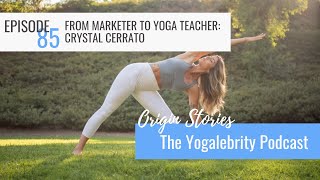
In this Yoga Liberty podcast episode, host Speaker A interviews yoga teacher Crystal Cerrato about her transition from a corporate digital‑marketing career at Scorpion to full‑time yoga instruction. Crystal recounts her 200‑hour YogaWorks training, a 300‑hour Booty Yoga program, and the development of her own teaching format, Primal Flow, which blends dynamic asana, static shakes, and spiral core work. She describes early teaching struggles—building a client base, teaching in gyms versus studios, and her first class that attracted only family members—highlighting the importance of teaching multilevel classes and adapting to diverse student needs. Crystal shares how she secured a spot at the Yoga Expo, the logistics of teaching large in‑person events, and her upcoming 200‑hour teacher‑training program at Thermal Horizons in Santa Clarita, detailing its weekend‑alternating format, focus on anatomy, physiology, yoga philosophy (primarily the Yoga Sutras), and creative sequencing. The conversation also covers balancing motherhood with a 6 am teaching schedule, business strategies for yoga teachers (marketing, client acquisition, online vs. in‑person training, Yoga Alliance standards), and philosophical insights about self‑healing, the mind’s modifications (chitta‑vrittis), and the core wisdom that each practitioner is their own guru. The episode blends personal narrative, practical teaching advice, and reflections on yoga’s deeper purpose.
Chapters
Welcome everyone to the Yoga Liberty podcast. I'm so excited about Crystal Serrato coming today to visit with us in the podcast room. And if you want to, you can listen to this on iTunes, Spotify, Amazon Music, Google Play, anywhere that podcasts are at. My podcast is there. Or you can watch this on the YouTube version and see what we actually look like. But either way, We're really glad that you're here. I'm super excited about my guest. We met at the Yoga Expo in Los Angeles, and I'm so excited that she's here to tell us her origin story, how she became a yoga teacher, and the why behind what she did, her struggles, her triumphs, and what she's doing now. So welcome to the podcast, Krystal. I'm so glad that you're here.
Thank you so much. I'm super excited to be here. Thank you for having me.
Tell us a little bit about what life was like before you became a yoga teacher. What were you doing? And, you know, what was kind of a catalyst that made you want to become a yoga teacher?
Oh, gosh, feels like many lifetimes ago. Before I was a yoga teacher, I had a lot of different kinds of jobs. Um, primarily I was in digital marketing, so I work in the 9 to 5, which actually turns out to be more like 8 to 6 plus a commute time, right? Um, doing the grind, really doing the grind, which, you know, at the end of the day I'm super grateful for because that's such an important skill to have, um, in today's world, in today's society, even as a yoga teacher. But, um, the catalyst was just feeling like I was being called to do something else. And at that time, I knew I loved yoga and I had a consistent practice, and so I took the yoga teacher training.
Awesome. And who did you train from?
I went to YogaWorks.
Okay. Oh, YogaWorks. All right. Yeah, I, um, did a lot of like over the past 20 years, I've followed Shawn Corn around the world and like took a lot of classes from her. And I know that she taught at YogaWorks for a long time. So yeah, I'm very familiar. That was— YogaWorks was like a big time thing in LA there for a while.
Yeah, yeah. I loved, loved my training with YogaWorks. I studied with Beth Pranditi and Haley Zachary in Tarzana. So that was my 200, and then I actually did my 300 was with booty yoga. So I studied—
oh, interesting. Okay.
And Jenny Lee Toner, incredible, phenomenal teachers, um, which just was so totally different from yoga work. So the blend of the two, a little bit more traditional, a little bit more energetic, was like such a fun combination that is culminating into how I teach.
Totally, totally different. Very traditional, very new modern style of yoga. They're really, really different. So, uh, when you did digital marketing, did you work for a particular company or did you work for like a digital marketing firm? Like, you weren't working for Ryan Dice, were you?
Oh no, no, I was working for a company called Scorpion.
Oh, okay.
It's a big Google partner, um, really incredible company, really, really great to their people.
Yeah. Awesome. Awesome. But you were just like, this isn't, this isn't it.
Yeah. Well, so I have two sons and my older son who's now 10 years old, this was 5, 6 years ago now. Um, he was just spending most of his time in daycare and he said he made some comment that he would rather go stay with his dad, who I'm separated from. And at that point, I was like, lightbulb, like, I need to be home with my son. And now I'm a mother of two. And the flexibility of being a yoga teacher, literally and figuratively, allows me to do all the things that I want to do. And, and that's really important to me is to be a mother, you know.
How long ago did you get your 200-hour?
This was 2017. Okay. 5, 6 years ago. Yeah.
Okay. How long did it take you to transition from doing the digital marketing, like corporate job to just teaching yoga full-time?
Well, I was halfway through my 200-hour and had that epiphany moment that I needed to make a change in my life. And so I actually started teaching before I graduated my 200.
Wow.
Still no idea of what I was doing or what yoga was about or what teaching yoga was about. So I right away built myself a website because that's what I knew how to do. Yeah.
Yeah.
I put together an event and I printed out flyers. I passed out all the flyers all around. The neighborhood and went to go teach my first event that was yoga in the park, and my stepmom and my now husband were the only attendees. That was humbling. I was like, okay, so, so they don't just come, don't just show up.
Yeah, right. Yeah, yeah, because people think like, oh I'm going to take yoga teacher training and then just like everybody's going to come to my class.
Yeah.
And it's not really like that. So that was a real struggle. So what were some of the things that you did to get people to start coming to your classes?
Well, I found as many studios and as many classes that I could put on my schedule. And like a lot of new yoga teachers do, I was teaching like 20-something, 26 classes a week. And thought that that was like really the way to success. And in some ways, obviously, it helped me to meet a lot of different people and to learn a lot about myself as a teacher and what works and what doesn't. Um, just so many things came from that that were really important. But, um, yeah, I, I only teach like one class per week at this point because that's the pace A lot of, a lot of experience though.
But I remember those days early on, like driving all over the city to like all these different gyms, different studios, different spaces to teach. And I think the main thing I learned from that was that if you want to make money as a yoga teacher, you have to do your own thing. You have to set up your own clientele. And set up your own space and find a place where you can teach, that you can bring your own clients. But also, like you, I found that it was a great experience because I learned different bodies. I learned how to teach different styles of people. I mean, I can literally walk into any room, not know anything about the people, and now just teach a class to any level at any time because of all that experience working with just like So many different kinds of people, right?
Especially teaching in public gyms.
Yeah. Yeah.
You know, and that, and that was like half of my classes when I started too, because a lot of people are taking the class because it's at the right time of day.
Yeah.
They just, maybe they thought it was kickboxing and they walked in and I'm teaching yoga and they just stayed to be nice. But yeah, it really does teach you a lot about like different things that you need to modify for and different body types. And people come in with all different things.
I always tell people to teach at the gym because it's such great experience because the people in the gym— you go to a yoga studio and for the most part, and I don't think it should be this way, but for the most part, people coming into a yoga studio have already had experience with yoga. Because yoga studios can be really intimidating for people. So they already have like a preconceived notion. They kind of understand what the different types are, maybe not all the way, but they have like more of an understanding. Whereas in the gym, people come with a vision of what they think yoga is, and it's widely different. Like, I would have a 24-year-old that wanted to do handstands and a 65-year-old with a pillow in the front row right in front of me.
Right. I had exactly that.
Yes.
I'm trying to please all of these people right now.
Right. And there's really no way to please everyone. But you do get really adept at teaching multilevel. Yeah. Yeah. It's the best experience. It can be really— and the other thing is that gyms aren't like yoga studios. Because at the gym they'll complain, you know, like they'll go to the front desk and they'll, they'll talk about your class if they weren't happy with it. Whereas at the yoga studio, it just, that almost never happens. It's pretty rare as a studio owner. It was like really rare to get a complaint about any of my teachers. I do think that, you know, one, the caliber of teachers at studios tends to be a little bit higher. But to also, again, we come back to this, like people know already at a studio what yoga is about for the most part. So you don't have that like huge gap between like what people think yoga is and what the class you're actually going to teach. And I know for me at 24 Hour Fitness, I would be like, can you tell them that it's vinyasa intermediate? And they'd be like, no, it's just yoga.
Yeah, right, it's just yoga, you know.
I'd be like, can you tell them it's yin yoga? And they'd be like, no, it's just yoga.
That's the thing.
That's— and now, like, I, I get asked to teach in different, like, private event venues, and they want a yoga teacher, and I said, well, but what exactly? Who are your clientele? Because yoga means so many different things. Are we shaking it out and pounding the mat and hitting the earth and jumping around? Or are we going to really hone in and learn about the breath and be still and, and get into some flexibility? So many different things.
Yeah. And what's your age group? And what's their ability level? And how many times have they done yoga? It's just a lot of questions that you need to ask, which is— I think that's really helpful for people to hear if you're ever doing an event to ask a lot of questions like that before you start doing any kind of events. What, like, really hone down on what it is that people want so that you can meet expectations and keep getting more events.
Right.
So where do you primarily teach now?
So I'm in Santa Clarita, California.
And that's where the vampires are, right? From that show.
Yes.
The diet. Is this the one you're talking about?
Yeah. With Drew Barrymore, the Santa Clarita Diet.
Everyone, everyone is a realtor. It's true. Which is great because there's a lot of houses being built. So planning a market for that. But there's a new studio that I'm teaching at and I just teach at 6:00 AM on Monday mornings for now. Studio called Thermal Horizons. And I'm only teaching at 6 AM because I have a 3-month-old baby, and that seems to be his golden hour where I can feed him, leave, come back, everything's good. As the day progresses, it's more challenging for me to leave.
So 6 AM, that's, that's intense. I never had children just because I can't be making these kind of sacrifices.
I just—
sacrifices.
Yes, it is. So you actually teach like your own style that you've developed, right? Or—
No, I— well, sort of. I'm teaching based off of another format that was created through the booty yoga platform. So I teach a format called Primal Flow. And so when I'm not teaching Primal Flow, I am teaching a style of vinyasa that's similar. The difference between a traditional vinyasa and the Primal Flow is that we're using dynamic asana. We do a static shake, which is great for lymphatic flush and just moving the body in a multi-directional way so you can rehydrate tight fascia. We also do a spiral structure, which starts to activate all of the layers of the core. And it's also a nice connection of feminine and masculine energy. So that's primarily what the Primal Flow format is all about that I teach.
So you kind of fused another style of yoga with your own, like, knowledge base and made this Primal Flow.
I didn't create Primal Flow. I do lead the trainings. I'm not going to take credit for that.
Okay. Okay. Okay.
So how did you get to teach at the Yoga Expo? Like, how did that happen?
Oh gosh, just, just by luck, I guess. I don't know. Um, I got the email. I had attended the Yoga Expo just once before, years ago, and I got the email that said that they were looking for teachers and to apply. So I submitted my information. Um, Ari loved the idea, the concept of Primal Flow, and I ended up there.
What a cool— awesome. It was a really cool experience. There were a lot of people. There were like 100 people in my class, and I was like, wow. I mean, I've taught to that many people before, but I wasn't like— it'd been a hot minute, you know, like since everything closed down, I really haven't taught in person very much. I only teach online now, so Um, to be with like that many people and that much energy was just like really pretty intense. Also, I was able to fix your microphone, so that was really— that was sort of—
we almost had a bad problem. I was like really prepared to project as loud as I can, but I was like, how loud are these speakers gonna be and how many people? There was like, yeah, 100 people in that room.
There was a lot of people in the room, so it was a huge event. It was a huge event. So, um, yeah, but it was really fun and I got to meet so many wonderful people. So you're going to be doing your first 200-hour yoga teacher training in Santa Clarita in October, right?
Yes.
So tell me a little bit about what is going to be in the curriculum. What's it going to be like? What can people expect? Where are you having it?
The details are still all unfolding, but it will be located at Thermal Horizons in Santa Clarita. We're looking at, um, a weekend format, so it'll be every other weekend, which I believe comes out to 16 weekends. We'll be focusing on anatomy and physiology, heavy on the philosophy and history of yoga, and then also very heavy on creative and empowering sequences. A lot of times we can get real creative with our sequencing, but it doesn't anatomically make sense. So that's where I want to bridge the gap that makes your students— helps them to feel empowered when they're in your classes by way of your creative sequencing.
Nice. Yeah, that sounds really fascinating. I feel like there's a lot of trainings out there today that are not doing enough of the philosophy and the history and not teaching enough of what yoga really is. But since you have that background with YogaWorks, which is very traditional and has like really long-standing relationship with really well-known— who was the founder of YogaWorks again?
Mati Esrati.
Yeah, that's right. And yeah, she's like really Really old school yoga.
Yeah. Yeah.
I took her class at Yoga Journal Conference, like, oh, that's so cool.
That's so cool.
Like 15 years ago, 17 years ago, a really long time ago. Yeah. And like just really hardcore old school yoga that I think like people just aren't doing anymore. That kind of makes me sad. You know, we've just like gone so far away from what yoga really is.
Right, and that was why I was inspired to create the 200, because I absolutely loved my experience. It was like more transformational than any self-improvement seminar that's offered, and I've been to a few, right? I, you know, and I wanted to pull all of these things that I really feel like should be in a yoga teacher training. If we're teaching yoga, we have to understand the lineage and the roots and heritage of it. So I'm definitely pulling a lot of that in, and then I'm also putting in a lot of the modern things that we've evolved, you know, we've evolved as a species. And I think that it is important that our yoga practice evolves as well. As long as we stay rooted and grounded, we can also then rise up and expand.
Yeah, yeah, I like that. It sounds like a really, really interesting yoga teacher training. How long are you going to do it? How many weeks? And do you have any of that worked out yet?
It'll be 16 weekends, and it will be—
okay, wow.
We're gonna do— I haven't worked out the details and the exact dates yet, but I believe we're meeting just on Saturday and Sunday.
It'll be okay. Okay.
Full day, 2 days every other weekend.
That'll be real. Oh, every other weekend. Okay. So now I see why it's 16. I'm like, that's a long time.
That's how mine was too. And I really like that we can really dive in for a solid weekend all day, morning to night, and then have a little bit of a break because it is so much information.
It's so much information.
And I just, I'm so excited about it. I'm just so excited because it really changed my life. And that's, yeah, that's my intention for teaching. It's like just to help people bring themselves back to themselves and to help other people then ripple out and do the same for others.
Yeah. Yeah. I love that too. I've hosted, I wanna, I think it's, uh, 28, I think 28 yoga teacher trainings in person in 3 different countries in Costa Rica, Thailand, the United States. And now I do one-on-one private online yoga teacher training. And I really thought that online could not match the feeling you get after hosting an in-person training and just like watching people transform. And at first it really didn't because I was doing like everybody else does where work at your own pace and, you know, like just watch the videos and turn in the assignments, but people got lost in that. That, and there was no connection. And you need someone. Yoga teacher training is hard. It is personal transformation work if you're doing it right. And so people need someone to hold them accountable, but also to say you're on the right track, you're doing okay, what you're doing is right. You are right. I'm glad that you're here. Um, so now that's why I switched to doing one-on-one private training instead, because they get the videos and they get the reading and stuff, but it's structured. It's like 10 weeks or 15 weeks depending on if they're doing 200 or 300, and then they have to complete certain assignments within a certain time frame. Um, just, just like in person. But the cool thing is, is that my online people, because it's private one-on-one, they're like crushing it. They're doing so well because we just focus on what— yeah, what they need. You're not, you know, like one of the things about in-person yoga teacher training, which I mean, I'm doing one in Las Vegas in the spring. I'm not like never doing in-person again. But one of the things is that there's so much wasted time, like going to the bathroom and, you know, like taking lunch breaks. And, you know, Susan had a meltdown and we all have to hug her, you know.
The meltdowns are real.
Meltdowns are real.
Gotta crack through some of those layers, you know.
Yeah, yeah, that's really cool. That's really cool. So when you talk about the philosophy of yoga, are you going to be covering Um, just the Yoga Sutras or anything else? Like, what, what are the— what's the philosophies of yoga that you're just really drawn to?
Primarily the sutras. Yeah.
Okay, cool.
Um, and I'm still working out— there's going to be a couple of other textbooks that I'm going to be requiring. I haven't decided if we're going to read the Bhagavad Gita perhaps, or Hatha Yoga Pradipika.
Right. Those are good ones.
Those are good ones.
Training down the road. I don't know.
Yeah. Those are 300 for me.
Those. Yeah.
Let's just, we'll just focus on the sutras and that's a, that's quite a bit to swallow.
It's a lot. It's a lot. I think I had to read the sutras 25 times before it started to get in there.
Yeah.
You, you and I just had an Instagram exchange about Yoga Chitta Vritti Nirodha. Right? Like all the time. The chitta vrittis.
Yeah.
Modifications of the mind are constantly in there eating at us. Honestly, the— so that for those uninitiated in the sutras, the chitta vrittis are the modifications of the mind that stop us from reaching any kind of level of enlightenment or connection with yoga or the self. And I think like the Yoga Sutras, like, that's, that's all of life. Like, anything you want to do, it's always the stuff in your mind that's actually stopping you from doing what it is that you want to do. You know, it's these put-downs that we say to ourselves. Like, I was working with a client this morning, and she was struggling a little bit with the computer stuff. And before I could, like, teach her how to do it, she would just be laughing at herself or upset with herself or irritated. I'm like, take out the emotion. Just drop the emotion entirely because we're going to do this. You know, like we are going to get past this point and we can get past it faster if we stop, if we stop with the put-downs. You know, I think that's like the thing we don't, we're always getting in our own way and we think it's other people, but really it's just us. Getting in our own way all of the time.
Yeah, it's like we project it out, and what, what's irritating us, if we are going to blame someone else, is just a reflection of our own internal conditions. So you're right, if we could just still those modifications of the mind— this is yoga, and yoga is now. The first sutra, yoga is now, and it is now, and it is now, and it's now, right? Right? And so in any part of life, it is us that stands in the way. It's our own self-sabotage and perceived limitations that don't actually exist.
They don't actually exist. They are perceived limitations. Absolutely. You know, like, you changed your whole life. You went from having the square peg, square hole life that we've all been told we have to have. I The same for me. I was in a corporate job as well, and one day you were just like, this isn't for me, and the universe opened up to you. Have you read The Alchemist by Paulo Coelho?
No.
Oh, you have to read that book. Um, he talks about when you put an intention out into the world, the universe conspires to make it happen. And so, um, the story is the story of a young man who is trying to find his purpose and his reason for living on this planet. It's an incredible book. I highly suggest it. It changed my life, like literally changed my life just thinking about it. But when we, you know, but we also have to keep in mind that there will be bumps along the road. Like you were saying, your first class was your now husband and your mom, you know, like it's not on everything.
And it's like, it's not like it's—
that's the only time either. Like so many times challenges come up and you just— you also have to practice non-attachment and let it go and just keep moving forward.
Right. And I think we, you know, even like on this podcast where we're, we're trying to like talk a little bit more about some of the struggles, we even like gloss over some of the harder times where it still happens. You know, like at the beginning of December, I, no one was calling. I wasn't getting anybody signed up for my training and I'm all just like, is, should I even be bothering doing it? Should I just get a job? You know, after 20 years, I'm still sometimes like, filled with self-doubt. It doesn't— it's like something we have to be constantly aware of and always be focusing on. How can we energetically put out the energy of creation? So instead of saying, like, why isn't anybody signing up for my training? Saying, like, okay, well, what can I do to attract people to my training today? Well, I can go live on TikTok. I can send out an email to my followers. I can send out some DMs. I can post in my Instagram stories about my training. I can put up a question sticker and answer questions about the training. And if no one asks questions, I can type questions into that question sticker and then answer them as if I am someone asking the questions.
I believe that we are co-creating. We are co-creating our reality. And so it is that element of putting in the effort, putting in the work, doing the work, and also trusting and surrendering that you're supported, right? And it's like we change our own personal frequency to match the desires that we want, or to just match whatever it is that we're calling in. And it's that surrender piece that that I think a lot of people struggle with, especially when you're brand new at teaching yoga. How do you— yeah, you're supported when you're leading this class, then it comes in time.
One thing I think is really common too, to like kind of play off that, is that people take yoga teacher training and then they just assume they're going to come out and make a ton of money and be really great at this. And everything is perfect. And I remember I had that same assumption about college. Like, I was like, I'm gonna graduate college and I'm immediately gonna make $50,000 a year, and I'll be able to pay off these student loans in no time, and everything will be great. And that is not what happened at all. I graduated college, I got paid $8.75 an hour to work overnights at a battered women's shelter. Like, it was not—
it was rough. But people—
that's what people think too. Like, I'm gonna go to this cheap yoga teacher training that I paid a couple thousand dollars for, and somehow that 200 hours is gonna teach me the breadth of experience of a thousands, thousands, thousands of year old practice that I'm gonna be able to just attract this humongous following because everybody wants to come to my class because I'm a yoga teacher. Teacher. And that's like really not— I mean, it took me like 3 years of teaching really consistently before I think I was even a decent teacher.
Oh yeah, easily, easily. Because you, you know, when you start out, I feel like for me, as I went through my 200-hour training, the information didn't actually apply or actually make sense until I lived that experience. And then things came up and I was like, okay, so this is where that piece of information fits. And so it's really like a full experience. You almost have to go through 200 hours and then go through 200 more of teaching.
Yeah, totally. I've always felt like 200 hours really isn't enough. Like, honestly, like, I mean, you know, I do the same, like, Yoga Alliance registered schools, and I, I have like kind of a hate-hate relationship with Yoga Alliance. They're not really my favorite. I think we all are kind of like, but at the same time, like, you know, Ari, who's the founder of Yoga Expo, her and I actually considered making our own kind of Yoga Alliance at one time, and we talked it out. And we were like, how would we, how would we even begin to make sure that everything was happening or that people were doing the standards or hold people accountable? Like, how can you even really do that? It would just be so impossible. So I feel for them, you know, not being able to really maintain those standards with people after they get the little seal. But now, and especially after the shutdowns and that, I think that you really have to do a lot more research on your teacher and find out where did they come from, how were they trained, how long have they been teaching, what are their ethics, do you really vibe with them, are they going to be teaching— like, it's really a buyer beware kind of thing. In a way that it didn't used to be. Um, you really have— well, maybe it did always used to be that way. I don't know, but it's worse now. I think that there's a lot of fly-by-night trainings that were able to get approved during all of the shutdowns that, that are not giving people the level of instruction that they truly deserve and need to be teaching a practice that is so transformational.
Right, right. Well, and with integrity. Yeah, which is why it's so important for me to include these sutras, because at the very least, this is— it's just the threads. These are just the threads of like life. And if we can then embody that, or try to do our best in embodying these threads, then we can inspire others. But if we did a online training that no one checked in on that didn't meet any of the standards. My training is going through Yoga Alliance, and I also share that same relationship with Yoga Alliance, but I'm grateful for it because it's, it's requiring all of these things that I think are so valuable.
Well, and they do that ahead of time, but then once you're approved, no one ever checks up. There's— and a lot of people will just go through what they need to do to get approved, and then they never, like, they never follow up on the things that are, you know, that are on there that are supposed— that you're supposed to do. It is really difficult to get certified now. Um, not difficult in actually getting the certification, but like, they require so many revisions.
Yeah, I thought there's elevated standards now.
Yeah, I— my school is elevated standards. So when I owned the yoga studio, I had a school, but then when I sold the studio, I sold that school with the studio. Um, and so I had to reapply when I did my new school, and I just went ahead and did elevated standards because Why? Everybody's gonna have to do it anyway. But, um, it took a solid like 9 months for them to get my approval back. It took a really long time. And my first school was like 2 months. Wow. Wow. Yeah. So, um, I think everybody's experience is probably gonna be different, but it, you know, and then I had some tech problems with them along the way. And I just had to send him an email.
I was like, this is how I make my full-time living.
I've been doing this for 20 years.
I know what I'm doing.
And then you see these ads for this $99 online yoga teacher training and you're like, I just know that's going to be so bad. And the lack mentality that people have I see people sign up for these really inexpensive, these like $379 on Labor Day weekend trainings and these like $99. And I'm not gonna call out the names. We know what they are, you know? And then they come to my 300-hour and they're lost. They can't even do a sequence. They can't, they can't say anything in Sanskrit. You know? Yeah. So it's like, it's really nice to see somebody teaching a 200-hour at the level of integrity that you're teaching it and the amount of work and effort that you're putting. It sounds like it's gonna be really cool. There was like a moment there inside of me that I was like, can I drive to Santa Clarita every weekend, every other weekend for 6 and take another one? Because like, I mean, I could use the continuing education. Like, I know I'm all like, that's a totally different style of yoga than I teach.
Like, this could be really fun.
Let's, let's talk about that.
Yeah, I just, it's important to me.
I, I also have friends and students who've taken other trainings and things online. Oh over the shutdown period, and some really great things have come from that and some really good, like, functional movement and things. But there's, like, just a key element. If you don't tap into the philosophy and you don't tap into the Sanskrit or, um, really truly understand how to sequence a class, um, yeah, yeah, yeah, you know.
That was actually, um, that was actually my class at the Expo, was, um, Mastering Sequencing. I taught like a class about how to sequence classes because that's like the number one thing that people don't know how to do is how to sequence. It's a real struggle. It's like the students always like— and transitioning, like how do you get from one pose to the next pose instead of just saying like, stand up, sit down, you know, like, how do you get somebody from standing to seated without saying sit down, you know? And that's, I think, the thing that people really get hung up on. And so a good teacher training is going to teach you how to eloquently transition people from pose to pose, right?
Well, it's the cueing, and it's just practicing. And that was a big challenge for me as a beginning yoga teacher, that it's something I get complimented on a ton now. It's just over years of practice and explaining and seeing different body styles and different people and teaching different practices and styles of classes. And to be able to verbalize and cue it up is really important. So that'll definitely be a focus in our training as Yeah, that's really exciting.
I'm really happy for you. I'm really excited for you, and I'm excited for you with your new baby and, um, all your vampire work that you do in Santa Clarita.
It would like—
people would be like listening to this like, what are they talking about? There's a show with Drew Barrymore, I think it's on Netflix, right? And she's like a vampire and yeah, and she eats people. And she lives in Santa Clarita. So, well, if you could leave everyone with one, like, one piece of wisdom, if it was like the piece of wisdom that you wanted to leave your legacy and let everyone know about being a yoga teacher, what would it— what would you like everybody to know?
I would just say that you are your own healer, you are your own guru. You are your own teacher. The movement is the medicine, and we all share a divine light within.
That's that.
That is really, really, I think, insightful and important. You are your own guru. Nobody's gonna— nobody's coming. You have to solve your own things on the inside. Well, thank you so much for joining us. I really appreciate it. Um, Crystal, you can find her at Crystal Serrato Yoga on Instagram. Are you just on Instagram, or is there anywhere else that you post content?
So I do have a YouTube channel that has like 4 videos on there. I don't actually share that, but since it's there, you can search it. You can just search my name, Crystal Serrato, on YouTube, and that focus is actually on prenatal stuff, which is a whole Oh, cool, cool.
Well, YouTube could really use more prenatal, that's for sure. That I know that that is a needed area. Okay, all right, thank you so much. I appreciate you. And, um, everybody, if you are listening out there in the world, make sure to subscribe. Uh, if you're on YouTube, hit the like button and share, and definitely share this podcast with everyone that you know who needs a little bit of inspiration, who is thinking about becoming a yoga teacher, or they already teach yoga. And all of this year I'm dedicating to origin stories. Where did people become yoga teachers? Why did they become teachers? And what are they offering to the world? Thank you again so much for joining us, Krystal, and we'll see everyone in the next episode. Thank you.







