How to Teach Wheelchair Yoga | Adaptive Yoga with Rodrigo Souza
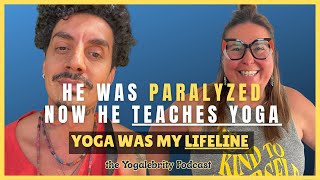
In this Yoga Liberty Podcast episode, host Angelica Govert interviews Brazilian‑born, wheelchair‑using yoga teacher Rodrigo Souza about his path from a T3 spinal cord injury to becoming a pioneer of adaptive yoga. After a fall that left him paralyzed from the chest down, Rodrigo discovered adaptive yoga through a DVD from Matthew Sanford’s nonprofit and incorporated it into his rehabilitation, finding it essential for managing spasticity, pain, PTSD, and depression. He recounts his first informal class at a Swedish rehab camp, the emotional impact of teaching peers, and his realization that mainstream yoga excludes disabled bodies. Rodrigo critiques the medical‑pharmaceutical model for neglecting breath, movement, and holistic care, emphasizing mindfulness and breathwork as low‑cost tools that the medical system overlooks. To address the lack of accessible instruction, he created a 10‑hour continuing‑education program through the Accessible Yoga School, teaching teachers how to adapt asanas, pranayama, language, and to confront ableism. He also runs a mentorship/ambassador program to support teachers bringing yoga into community settings such as rehab centers, prisons, and elder‑care. The episode ends with Rodrigo sharing his Instagram handle (@allyhopayoga) and website, inviting listeners to join his training and mentorship, while Angelica encourages sharing the podcast to spread the message.
Chapters
Welcome to the Yoga Liberty Podcast. My name is Angelica Govert, and I am so excited for today's guest. I think that, um, what he has to offer is very different than any other kind of yoga that we're seeing out there. And also it's going to revolutionize the lives for many people. I'm joined today by Rodrigo Sousa, who is an incredible yoga teacher teaching accessible and adaptive yoga. And And today we're going to deep dive into his story and how you can get trained with him to reach more people with the power of yoga. If you love our podcast, I would love for you to share it with the world. So definitely share it with your friends, let them know, and make sure to subscribe. Welcome to the podcast, Rodrigo. I'm so excited to have you here.
Hello. Hello. I'm very excited to be here as well, Angelica. Thanks for having me and for inviting me for the show.
We actually did try to record this before and we had some internet issues, so we're excited to get back together, um, and actually record this episode for all of you. Um, so I think probably the best place to start would be if you could tell us really your story about, um, how you came to teach the style of yoga that you do.
Right. My name is Rodrigo Souza. I go with the pronouns he and him, and I'm joining you from Southeast Brazil. I was born and raised in Brazil, but I moved to England, to London, when I was 22. And I was introduced to yoga when I was about 25. I used to do Bikram yoga, you know, those 26 poses done twice in a hot room. Very physical practice. I loved it. And I did that for for a few years. And fast forward time, I moved to Sweden. I fell in love with a Swedish woman. And when I was 33 years old, I fell from an embankment, a small cliff, and I broke my back. So I sustained what they call in medical terms a T3 complete spinal cord injury, which means that I broke the third vertebrae of my you know, spine on the thoracic level. And I became paralyzed from the chest down. I was 33 at the time. It was a very difficult moment for me in my life. And, but I had the grace and the privilege to incorporate adaptive yoga into my rehabilitation process. I was in my rehabilitation center I think like a few weeks after my accident. And I was complaining to my physiotherapist that I had a lot of spasticity, muscle spasticity and pain. And her name was Anna, is Anna. And Anna showed me a stretch that I could do in bed that, you know, it would decrease my muscle spasticity. And she showed me, uh, that pose. I think it's pose number 14 or 13 in Bikram yoga. The one that you're lying down and then you pull your knees towards your chest. And when she showed me that, I joked with her and then I say, Anna, this is yoga. I used to do that back in the days. And then she laughed and then she left the room and then said, I don't know if it's yoga, Rodrigo, but that's going to help you. And when she left, I remember that I took my computer and I put it in my lap and then I Googled yoga for paraplegics. And I came in touch with Matthew Sanford. You know, he runs a nonprofit called Mind Body Solutions in Minneapolis. And they, they sent me a DVD and I started practicing adaptive yoga in a disabled body, like right after my accident. And I incorporated it into my rehabilitation process and it was one of the best things I've done in my life because even though the trauma that I endured was really, let's say, like really challenging at that time, you know, I had the strength to, you know, to come out of it like, let's say, very quick. I come back to life really fast.
Yeah, that's really incredible. I actually was lucky enough to meet Matthew Sanford one time at a Yoga Journal conference in Fort Lauderdale. I, gosh, I think it was been like almost 20 years ago, a really, like, forever. But I was really impressed with him. He was a very approachable person. And that's really amazing that they just sent you a DVD like that. Like, they were like, here, do this. And at what point did you decide, like, okay, I really want to share this with other people, I want other people to get the benefit of doing yoga as well, I want to teach this? What made you decide that?
Right. I come back to life really fast. I used to say that, you know, after 6 months with a broken back in a wheelchair, pain, depression, PTSD, you name it. I start living by myself. Me and the beautiful woman from Sweden that I mentioned, we broke up, and I rent an apartment. I, you know, relearn myself. I, you know, relearn how to drive a car using my hands. I bought myself a new car, and I got myself a job. And my rehab instructor at that time told me, Rodrigo, you come back to life really fast. I haven't seen someone with this emotional stability for a long time, I think you might be able to help a lot of people because in Sweden around 170 and 180 people have, you know, spinal cord injuries every year. Generally, they, you know, they, they dive into shallow waters and break their necks or, you know, they have motorcycle accidents. Anyway, and then he told me that a lot of people, they They even kill themselves. They take a long time to recover. Some of them never recover. And then he invited me to be a rehab instructor. And I was, I am still very open to the possibilities that the universe throws my way. I was like, why not? And then I start working as a role model, as a rehab instructor in the biggest nonprofit in Scandinavia, a place called Adgeaktiv Rehabilitating, where we work organizing camps for newly injured folks, you know, folks that has gone through traumas, abilities. They come to us after 6 months, let's say, and we organize these camps by the sea and we teach them how to swim. We talk about sexuality, bowel program, bladder, how to come back to work, you know, how to live the lives The better they can. And my job at this, you know, rehabilitation center was to get them in a better condition. Most of them has been just in and out of hospitals, rehabilitation center, you know, really depressed. And my work was to, you know, to make themselves feel like it's slightly with more energy in their body. So I start working a lot with cardio. And one of the activities that I had was to take them around, you know, a stroll around the forest in their wheelchairs. And I used to teach them like wheelchair techniques as well. And one of these situations, you know, one of these strolls, like up here, a friend of mine complained about being tired. And then I asked him, Matias, why are you so tired? It's just breakfast, brother. And then he was like, I am tired because of a medication that I've been taking called Baclofen. And Baclofen is a muscle relaxant that spinal cord injury folks take to relax the muscles of the legs. But the problem is it relaxes the whole muscle, so you become really tired, really fatigued. At this time, I asked Matthijs to go back home and lie down, to go back to the hotel where we were and lie down. And then I told him that I have learned some, you know, adaptive yoga with Matthew Sanford. And I would teach him some stretch that he could do and he could try to decrease his baclofen intake. You know, because like adaptive yoga is really good for spasticity because you, you know, stretch your muscles all the time. Anyway, he went back. Lunchtime, he spread the love. He told everyone that Rodrigo was, you know, showing him some stretch in the afternoon. And then in the afternoon, I had about 15 people coming to me and say, we want to learn this stretch that you've been talking about. And I'm like, wow, okay, let's do this. And I call, I call like, I think was 4 or 5 physiotherapy students that were at the camp with us at the time. And then I asked them to lay some futons on the floor, you know, those thick mattress, the Japanese mattress. And we took like 5 or 6 like quadriplegics, you know, which is like folks with cervical injuries paralyzed from the neck down. And we put them in front of me. And then I closed the circle with a few paraplegics, folks who are paralyzed from the, the, the, uh, the, you know, the, the chest down, or, you know, even the, you know, lower, lower spinal cord injury. And, you know, with manual, um, wheelchairs. And then we had the circle and then I taught my first ever yoga class. I never in my life, Angelica, thought about being a yoga teacher, but the opportunity was there and I was not even certified. I was not a yoga teacher. I was just like, my intention was to show them my embodied experience, what I have learned, what I have incorporated in my daily life. And then I did. I taught like a 45-minute class, I did a meditation, and it was one of the most profound experiences I had in my life. Because I remember that as soon as we turned down the volume of distractions, I felt that tremendous amount of collective grief. You know, pouring in the air. And we had folks from different backgrounds in that room, like young, old, like rich, all, all different backgrounds, but everyone was grieving. Everyone was collectively going through a really hard time, you know, because spinal cord injury is a huge trauma. And I found myself there. I, I moved with them consciously. I stayed with them consciously. And, you know, we put them back in the chairs. And in the end of the practice, you know, some of them came to me and, you know, they gave me really, really, really beautiful feedback. I never forget, I had a woman that came to me. Her name is Biban. She fell from a horse and she had a broken her neck. And she, she looked at me and then she said that, Rodrigo, I haven't been safe in my body since my accident. And this was the first time that I revisited myself. Right. And when she said that to me, I, I want to cry. I, but I was a little bit, you know, with, with shame. Of crying in front of everyone. And I remember that I went to this toilet right beside this room, and then I cried, crying, because until that point, Angelica never had helped anyone, right? Never. My background is in arts. I used to do theater. I used to work as a bartender. I never had the grace to, you know, help someone be present in their bodies. And you know, I realized that I come back really fast to life was not because I was doing like all these different adaptive yoga asanas or poses, but the fact that I was revisiting my body every day, you know, I healed, not completely healed, but I embrace my trauma as it was, you know. Because one thing that happens, it's when you go through spinal cord injury, your body is not something that is welcoming anymore. You tend to dissociate yourself from it because your body reminds of things that you can no longer do. So it's not a familiar place. And the practice of yoga brings yourself back to your body every day. You stay there and you heal trauma going through it, not bypassing it. So I realized you know, how privileged I was that I had access to the tools of mindfulness, of adaptive yoga, and incorporated that in my life, in my rehabilitation process. And when I realized that, I had a tremendous amount of responsibilities because I knew that my peers didn't have access to these tools. No one, no one has access to these tools if they have a disability. Yoga, especially the Westernized version of it, are only designed for one type of body only. If you have a disability, if you live in a non-normative body, you are excluded of the practice. There is no yoga studio that serves this population. There is no yoga teachers that teach yoga to disabled folks. And there is no representative out there neither. Like, you know, I can count in both hands how many yoga teachers that use the wheelchair to get around. You know, so it's like there's so much work to do. And on the other hand, you know, my peers, you know, the people who are experiencing trauma right now, you know, they are relying on the medical model, you know, that are filling us with antidepressants, opioids, you know, all the medication, all the pharmaceuticals you can think about. And they are treating the symptoms. They are not looking at us holistically. You know, I used to say that the medical model, they treat a human body like a mechanic treats a car. So, there is so much work that needs to be done, you know, to incorporate yoga into this process, you know, is to make a yoga integrative practice, you know, into someone's habilitation, to work with a physiotherapist, you know, to learn these people how to breathe, how to move consciously, and most importantly of all, Angelica, how to return to your body. Because yoga makes you fall in love with the condition you have and can be anything. You know, there is something inside of us You can have a neurological death or not, but there is something inside of us that, you know, a flame that never stops burning, you know. And in that place, if you have access to that, you know, you have access to a better quality of life because you realize that there is nothing missing. So my work lies on that, you know. I become yoga teacher because of it. It was like a gift that was given to me, basically.
That's really incredible. Honestly, I think that a couple of things come to mind there. First of all, I think it feels very Iyengar-esque, like Iyengar's story of being sick and using yoga to heal and then sharing it with other people and having that. So it's almost like you're walking down that similar path of really creating a type of yoga that can heal and can help others. Another thing that really struck me was, um, how you said that, you know, people are really— the pharmaceutical industry, the focus is on the medicines and the pharmaceuticals and really like out-of-body experience. Yes, right. So when you're on a lot of medications, a couple of different things will happen. One is that you're, you're on all those downers, so you're going to get depressed easier. And two, it really disembodies the person. So I think that the work that you're doing is so essential because you're bringing people back to their body, like the woman, the equestrian. You're bringing people back to the connection that they have with their body, even though it's a different looking body than what it was before.
Yes, yes, yes. And, uh, uh, you know, they, the medical model, you know, you talk about depression and pharmaceuticals. I, I stayed trying out antidepressants. I, I was diagnosed with PTSD as well, post-traumatic stress disorder. I was, I was trying medications for about 5 years, you know, and I also have like a condition that it calls neuropathic pain. You know, about 40% of folks who— 70%, sorry— of folks who experience spinal cord injury, they also experience neuropathic pain. And I remember in around 2019, the last medication I was on was antidepressants that, that's called Cymbalta. And, and my neurologist at the time She even told me like, Rodrigo, I think I found the right medication for you because, you know, you will heal your PTSD, your depression, and your pain at the same time. And then I'm like, wow, let's try it out. But I was on it for 6 months and Angelica, I was literally feeling like a zombie. You know, I was apathetic. I had no emotions inside of me or anything. I remember that I watched Forrest Gump and I couldn't cry. And then I came to her and I said, I'm very sorry, but I want to cry. I want to feel it. I need to feel it. And then she was like, oh yeah, but if you're going to feel it, you're going to feel pain. And I was like, I got to feel my pain. I cannot just avoid it. It's like, yes, I need to feel my pain. I need to feel my anxiety. I need to come back of feeling human again. So, I drop all the medications and I jump really heavily into mindfulness. I start studying with another teacher called Vijjamala Burch and I dive deep into adaptive yoga as well. And I use those two tools to manage anything that I had to manage. And today I learned how to deal with my anxiety and my PTSD with my breath. You know, I deal my rapid heart rate, you know, my everything, my dysregulated nervous system, I deal with it only breathing, Angelic, only with my breath. You know, I'm driving my car, I feel, you know, the anxiety coming. I do like long exhales driving. It's gone. It's over. No one in the medical model, like, you know, neurologist that has been to school for 9 years, you know, has been like working with this population for about 30 years. No one told me, Rodrigo, use your breath.
That's ridiculous.
That's ridiculous.
Breath doesn't make them money, so they don't. They're not going to have you use breath because why would they do that? That doesn't make any money.
Yeah, they play by the books. No one told me, Rodrigo, if you purse your lips together, have deep inhales through your nose and long exhales through your mouth, you will downregulate your nervous system, you downregulate your heart rate, and you know, you will feel less anxious. No one told me that, right? No one told me that if I sleep well, if I eat well, if I socialize, if I get sunshine on my skin, you know, if I treat myself holistically, if I move, especially move consciously in your body, you will treat depression. No one ever told me if I wake up early and do a cobra, you know, in bed and, and do like a butterfly in bed or stretches in bed before I jump from my wheelchair, I will have less spasticity. No one ever told me that, you know, and, you know, I am a living proof that it works. So like, I have this huge responsibility because I need to make disabled folks that know that, you know, there is, there is like tools over there that, you know, you can, you can use and, you know, you can, you can have a better quality of life. Not necessary that you're going to ditch all the pharmaceuticals, far from it. I rely on the medical model. I have UTIs, I do take antibiotics, you know, I do take like painkillers sometimes, but it's like we don't rely on it only, you know, there are other tools out there that can, you know, can do the same work and it is less invasive, let's say.
Yeah. Let's talk a little bit about that, like sharing with the world what it is that you do, because you've created a training that people can take from anywhere in the world. right? And, and get this information so that they can help people in their community and spread the knowledge of, of your mission. Can you talk a little bit about what it is that you've created and how people can learn more about what you're doing?
Beautiful. My work lies in two fronts, Angelica. In one front, I teach disabled folks yoga. You know, I, I teach from, for, uh, several nonprofits. And I work with my representativity as well, making yoga accessible to them, making sure they know that yoga is for them, because it can be very intimidating to practice yoga in a disabled body where all the media imagery, you know, shows a different kind of body, let's say. So that's, that's a part of my work. And another part of my work, it's educating yoga teachers to do the same thing. Because the problem today, Angelica, is like, let's say that you want to be a yoga teacher, right? You do take a 200-hour YTT, Yoga Teacher Training, or a 300-hour YTT. And you come out of it with a very rigid mentality of how an asana should feel and look like, especially aesthetically. So like we need to break down so many narratives. And, you know, so I created like, let's say, a continuing education training where I give these yoga teachers the right tools they need to go and serve someone in a wheelchair, for example, someone with a disability. So I created a training where I teach folks like asana variations, how to break down asanas for someone in a wheelchair, for someone in beds, you know, how to work with the subtle body. Pranayamas and meditations for folks with disabilities. We talk about right language, you know, how to use invitational language, agency. We talk about ableism, which is a very important topic as well, because if you ever, you know, start to work with this population, you need to be free of bias. You know, you cannot feel sorry for your students, otherwise the power dynamic, you know, Works against the student, you know, you need to see the student through the diagnosis. You need to, you know, you need to, to see, you know, past, like, you know, all the conditions that the person have and always meet them where they are. So I created the training that teaches exactly this. It's a 10-hour training and you can find it on the Accessible Yoga School. It's on demand, and I will have another cohort starting in June. Yeah, in June.
So, um, you sent us all that information, so everything that, um, you need to get involved in what Rodrigo is doing and to get that continuing education will be in the description below. Um, you could just click through, but also you have an Instagram, right? That's how we found you. That's actually my assistant found you and sent your profile to me. She's like, you got to have this person on the podcast. I was like, I do, I do. Let me message them. So what is your Instagram handle?
My Instagram handle is @allyhopayoga. It's a— a-l-l-y-h-o-p-a, which means everyone in Swedish. Allyhoppa is my favorite Swedish word. It means everyone. You can find me there, you know, and my website is www.alehopayoga.com.
That's fantastic. I'm so glad that we were able to make this work and that you could come and be on the podcast. And I'm really honored to share your story and your message with the world. And thank you so much for, for coming today, because I think this is really Amazing. And I've had people in my classes before in wheelchairs. And luckily, like, I was very— it was very young in my career of teaching yoga, and I really did not know what to do. But they were all really wonderful and really easy to work with, and I just treated them like everybody else in class, and it worked out really great. And one of those students I still talk to, we follow each other on Instagram, but Yeah, I think this is amazing what you're doing. And if anyone has any desire to become a part of that movement, please do go to the link below and follow on Instagram and take that training and get to, get to help other people and broaden your perspective. Or maybe you've been called to do this yourself if you're in a wheelchair and you're listening to this right now. So thank you so much. Is there anything else that you'd like to leave us with or anything that you want us to know before we go?
Yeah, Angelica, I would like to let folks know as well that I run a mentorship program from, for Accessible Yoga School where we have like Accessible Yoga ambassadors and then we meet twice a month where we guide them, we mentor them through the process of serving, you know, the communities. You know, we are working on taking yoga out of the studios and, you know, bringing to the communities. You know, there are a lot of accessible yoga teachers out there that, you know, are serving this population in associations, community centers, elderly care homes, you know, prisons, like rehabilitation centers, hospitals. There are so many people doing wonderful work there and using yoga as a tool. And, you know, we have a lovely group. If you'd like to join, you know, our mentorship ambassador sessions as well, I will leave like a free monthly trial, you know, on the show notes and then you can click there and then, you know, come and join us that we will discuss anything and everything accessible/adaptive yoga and, you know, help you, you know, guide you through the process of serving your community, you know, through yoga.
That's very generous. Thank you so much. We actually just had somebody from the Prison Yoga Project on the podcast too.
Yeah.
So yeah, it's been a great month. It's been a great month. Yeah, thank you so much for coming again. And, uh, thank you everybody for listening. Make sure that you subscribe to the podcast and share it with your friends. We could also use a 5-star review. It helps us to get out to more people. So even if you can't afford to do any of the things that we talk about on the podcast or join any of the trainings, when you share the podcast, you never know who's going to get the information that they need, that they can take action on it. So anything that any of you do— liking, subscribing, giving a 5-star review— all of that stuff really does help. So thank you so much. Thank you again for being our guest today. I really appreciate you, and we'll see all of you on the next podcast.
Thank you so much, Angelica, and I wish you a lovely rest of the week.







