Is It Yoga? Episode 103
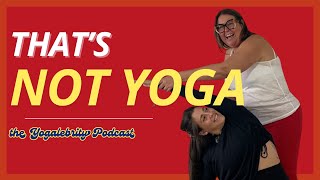
In this episode of the Yoga Liberty podcast, hosts Angelica Govert (Yoga Liberty) and Justine Kennedy explore what truly constitutes yoga by revisiting the classical eight‑limb framework (yamas, niyamas, asana, pranayama, pratyahara, dharana, dhyana, samadhi). They critique the dilution of yoga in contemporary culture— from loud breathing, “sexy” yoga, and yoga‑adjacent trends like puppy/goat yoga, yin‑style classes, Pilates, and somatic movement— arguing that many of these practices miss the essential philosophical and ethical foundations. Angelica emphasizes the importance of ahimsa (non‑violence) and vegetarianism, linking personal health, karmic concepts, and societal violence. The conversation also covers cultural appropriation, the role of yoga therapy, the impact of social media on yoga’s image, and the rise of online teaching platforms. Throughout, they stress personal responsibility, the need for teachers to honor the eight limbs, and encourage listeners to define their own practice while staying true to yoga’s roots.
Chapters
Welcome everyone to the Yoga Liberty podcast. I am joined today by my co-host Justine Kennedy. My name is Angelica Govert and I am also known as Yoga Liberty on social media. You can catch me on Instagram, TikTok, YouTube, and of course here on this podcast. Every week we endeavor to bring you topics that are important to the yoga community, specifically for yoga teachers. Today we'll be talking about, is that yoga? We're going to talk about what yoga really is and what yoga has become and what's not yoga very clearly. So with that, uh, let's go ahead and just jump in.
Fantastic. Well, I think before we define what yoga is not it would be helpful for our listeners to know what yoga is because I think that a lot of yoga teacher trainings don't always go as in-depth to the philosophy as they could be.
Yeah, I totally agree. And I've noticed in— I do a lot of continuing education and I've noticed in rooms I'll have conversations with people and they don't even know what the 8 limbs of yoga are. Like they're not aware of them at all, um, or I can speak eloquently about them, or you can even recite them. The 8 limbs of yoga basically are like the Ten Commandments. Like, you have to know them. They are our tools for living. They are the Yoga Sutras. And I think that there's been this movement into accepting everything and being inclusive to everything but not recognizing and realizing that like yoga is not everything. You know, for example, pranayamas are very specific breathing exercises. And I recently had a video that went a little bit viral, and people were getting really mad because I was saying your loud breathing is disruptive in class. And I specifically said not ujjayi. But when people are in class and they're doing, you know, they got their feet up, they're all in their happy baby pose, and they're like, you know, like the sexy sounds. That's not pranayama. That's actually not yogic breathing. So, uh, we'll go a little bit more into that as we get in later. But that post really is what inspired today's conversation for me because I felt like, oh, most of the people were like, yeah, this is a funny video, whatever, and moved on, right? Because that's what it was. Uh, that's what it was intended to be. I'm not— not everything I post is educational. Not everything I post is about being, you know, the friend to everyone. It— like, some stuff is just joking around. I'm old, I like to laugh. Um, and I think there were a few people— not, not a ton of people, but there were enough people to, to give it credence— who were really upset and were angry and felt like I wasn't being inclusive, that I was being a mean girl, that, uh, it wasn't right that I would not disclude people, and everyone should be allowed in class even if they're loud breathers. And you know, the thing is, like, actually, you're not doing your job as a yoga teacher if you allow that shit into your room. Like, there's a reason why yogic breathing is in and out through the nose. It's to lower the fight-or-flight response, right? When we breathe out through the mouth, it creates that in and out through the mouth, it creates that same system of like wanting— that's what you breathe when you're running. You want to get as much air in as possible, right? But we're actually trying to control our senses, right? And so when we're not teaching real pranayamas and we're just teaching people to do whatever they want and breathe however they want, and it, it's— that would just be like teaching Virabhadrasana 1 and saying, well, it's fine if you're actually doing, you know, um, Zumba, because that's, that's your interpretation of Virabhadrasana, so it's fine. But it's not fine, right? Because that's not what it is. And then that's where people have an argument like, well, what you're doing is cultural appropriation, because at that point it is, because you're not— you're not doing yoga and you're calling it yoga. And I know there was a time where people were very judgy with people and they were like, that's not yoga, and there was just a lot of back and forth on that. And so the pushback was that everything is now yoga, but that really isn't the answer. I think we've gone a little bit too far into like what is yoga and what isn't yoga, right? So let's just talk about what is yoga, right? So yoga is an 8-limbed system. It's the 8 limbs of Ashtanga yoga. And some of us know Ashtanga as also the system of yoga that Pattabhi Jois created. But, um, Ashtanga means 8. So ashta means 8, anga means limb. So So outside of Pattabhi Joynath and what he created, many years, thousands of years before he was born, were the Yoga Sutras of Patanjali. And it's thought that the Yoga Sutras of Patanjali were spoken word that was written down by Patanjali's students. Also, it could have been one man or it could have been many people. All right, but this is universally what we call the kind of yoga that we're practicing here in Western world. Now there's also the yoga, the Bhagavad Gita, which is a totally different kind of yoga. But when we're talking asana yoga, that's not mentioned in the Bhagavad Gita at all, and that's not part of that. That's much more of a spiritual, um, journey, right? So when we're talking yoga, we're probably talking the 8 limbs of yoga, which includes asana, which is the physical practice. So the first limb of yoga is the yamas. And these are the guides for us in moral conduct. They're Ahimsa, Satya, Asatya, Brahmacharya, and Aparigraha. So Ahimsa is non-violence. That is always translated in all sacred texts to being vegetarianism, every single one. Um, and there's a lot of pushback on that, but it's honestly like the first step. And the reason why it's the first step is because we don't want to put fear, pain, and suffering into our bodies. When we put the fear, pain, and suffering of animals into our bodies, what happens is that we actually get those hormones, those stress hormones, into our body. They become a part of who we are on a physical level, not just a spiritual level. And then that causes us to have what we call uh, chitta vrittis, right, which are the modifications of the mind, which then stop us from being able to do all the other 8 limbs. And so that's why that has always been considered the first step. And for many Western people, this is very, very hard to accept. Many Westerners do not want to become vegetarians. And they are very, very much attached to meat and eating animals. And the Dharmamitra, who's on that 908 posters, um, the poster of 908 yoga poses, he says, he says, do not make a graveyard of your body. I love him so much. He's really amazing. But, um, that is what he would say about eating animals. Um, and you know, the thing is, like, he's not wrong. Um, there's a really great book called World Peace Diet, and I had to read it in my 300-hour, and it's about the attachment that we have to eating meat. And socially, culturally, why we have that attachment. Um, from a physiological standpoint, our intestines are actually made of those of herbivores. So our intestines are made in order to pull out from fruits and vegetables.
Hmm.
Interesting. Um, yeah. So physiologically, we're actually, we were hunter-gatherers, like you know, like hunters— we wouldn't be hunters, just gatherers. Physiologically, we're like— we have developed to be best at digesting fruits and vegetables from a physical standpoint. From an emotional and spiritual standpoint, you know, everything around us can be part of creating violence in our body, right? So it could be eating meat, but it could also be watching violent films. It could be also like being overexposed to certain things like, um, social media, you know, like, um, some of the social medias are worse than others, but you can really get— they're echo chambers, you know, and they get you drawn into— their goal is to get you on the app more time, more time on the app. And so if it's violence that drives you there, then they're going to, you know, division and violence is what they know keeps people on the app longer. So they're going to keep us on there with that, and that causes more chitta vrittis, that, that causes, you know, a disassociation from ahimsa. So that's the first one. Um, and obviously I don't think anyone is perfect at any of these. I don't think I'm perfect at any of them. Um, and I think that one of the things that we do as humans is that we say if we're not perfect, then we can't do it. If I'm not 100%, if I can't do all the yoga things, then I'm not really a yogi. That's bullshit. Like, this is a journey. You're doing some things good today, and tomorrow you might do some things good, and the next day you might do some things bad. Like, that's like just part of it. You know, and then you get into deep into the Yoga Sutras to see where there is no good, there is no bad, there just is, right? Yeah, yeah.
And I think it's important to say too that, um, when we're having this conversation of like, is it yoga, there are definitely going to be people who are gonna listen and be like, oh, are they judging other people right now? And I just want to put out there like We're two friends, two coworkers having a discussion about things that are really important to us, and whatever we say here is not a personal attack at anyone. Like, I eat meat and I'm here agreeing, like, "Yeah, ahimsa, shouldn't eat meat." And it's exactly what you're saying, no one's perfect, we're all on this journey together, and we want you all to be a part of the discussion too and tell us what you think is and is not yoga and what yoga means to you and your journey and your understanding of the philosophy.
I've been a vegetarian since I was 11. I certainly don't judge anybody who isn't a vegetarian. There are other barriers for me that create yoga chitta vritti nirodha, you know, like there are other barriers. That one isn't mine, but there are other things that cause issues for me. So we each have our own karmasaya, which is the vessel that our karmas are in as we go through the different lifetimes according to yoga philosophy. This is in the Yoga Sutras. And every time we go through an incarnation, we create more karmas, and these karmas go into the karmasaya. And then the karmasaya, they're pulled out of the karmasaya in different lifetimes so that you can live your karmas. And so we all have a different one that we're living in. And so that's why it's, it's not helpful to have conversations like— I mean, I agree with you, it's not helpful to say like, well, you're judging me. We're just having a conversation and you have to judge you, which is one of the other limbs, or it's one of the, the other, um, parts of It's part of the niyamas. Okay, so the next one is truthfulness, satya, which is pretty self-explanatory, I think, being truthful. But then there's those parts that are like, well, are you truthful if it could hurt, right? Because then it's conflicting. Like, if you're not, if you're not practicing a hymn in your truth, so what really needs to be said and what doesn't, only you can really decide that. There's another thing that the Yoga Sutras says in the Sri Swami Satchidananda interpretation, and, uh, we will put the link to all the books we talked about today, the Yoga Sutras. Um, we're going to talk about a couple other books, um, but we'll put the links in the show notes so you can look and see like, uh, what the books that we've talked about and grab them for your own. But, um, he says that do not put down something that other people hold sacred, um, because then you're causing violence on that person. And I thought that— I always think that's really fascinating because people do get very polarized. People do get very like, this is the thing that I'm about, you know. And, uh, there was a really long time that I went through a period where I just really disliked hot yoga. I was very anti-Vikram because he's just not a good person. And I would say that to people, and I realized it was causing division. I mean, this was like 15 years ago, but it's interesting because, you know, we, we grow as people and we change as humans, um, but we don't, we don't give that grace to people. Like, when you see, like, you'll have people that get canceled forever because a tweet they made 20 years ago, like, it doesn't make a whole lot of sense to me.
But, uh, I think we can all agree that cancel culture is not yoga, right?
Right, because we're all gonna make mistakes. Yeah, everybody's gonna do something that isn't right, you know. Everybody's gonna do something that's anti-yoga at some point. We're humans, it's part of the evolution. Um, okay, so next is asatya, non-stealing. But this is not just stealing things. It's also not stealing time. It's only being mindful of other people's time. Um, brahmacharya. So brahmacharya— it— I made a joke at my, um, retreat that I was like, well, are going to be practicing— we, we are all going to be practicing brahmacharya during this retreat. And people were like, what? And that's when I realized, because my retreats are just yoga teachers come to them. It's not, it's not yoga practitioners, it's just yoga teachers that come. So, um, that's when I realized like, ooh, you know, Houston, we have a problem. Because if, if, if people don't know the beginning of the yamas and your teaching, that's an issue. Like, you, y'all need to crack open your Light On Yoga and get up in there in the first introduction, the inter— the introduction. And start looking at the 8 limbs of yoga because it's in there. Or just read the Yoga Sutras, book 2 talks about the 8 limbs of yoga. But brahmacharya is celibacy. So it makes a lot of sense, right? Because if you're like crazy and hormone love and all over the place— I love him this week and next week I hate him. I know because I've been there. Um, and that will give you chitta vritti nirodha, right? So the path of the yogi is not meant to be an easy path. That's another thing that, like, modern people are all like, oh, it should be simple and easy and soft and loving. It's actually supposed to be a very difficult path that requires sacrifice, and it requires paying attention and focus, you know. And I think that people miss that, and what they're calling yoga isn't yoga. Yoga isn't easy. Yin yoga was invented by Pauli Zink and Paul Grille, and it was not intended to be easy. It was intended to be difficult. And people have taken it and said, oh, it's relaxing. But what you're doing is you're doing restorative yoga, which comes from this book right here. BKS Iyengar, The Path to Holistic Health, link in bio. Um, this, this big book is restorative yoga, which is a very different thing than yin yoga. Yin yoga is meant to stress the connective tissues and the bones and create pressure in those areas. In fact, yin yoga was not intended to have the use of props, and what people have done is they have taken yin yoga and and they have really like— what they're doing is restorative yoga. And you'll see people with these like hot yins, and no shade, but yin is cool by quality. Yang is hot. Yin, by definition, is cool. Yang, by definition, is hot. So when we say yin yoga, it's by definition cool, but also by what Pauli Zink and Paul Grilli created, it's meant to be done in a cool room because you don't want to engage the muscles. You want to use the connective tissues, the ligaments. You want to put the synovial fluid to work. You want to work with your capsules. You want to work with the bone compression, right? Bony compression to strengthen those bones. And that always should be done in a cool room because when we heat those things, they can get permanent damage. So that's another example of like, that's not yoga, even though— but really, like, if you want to get really deep into that and like really go down that rabbit hole, yin yoga as a practice that has been created by a white man in Montana is not yoga. Like, you know what I'm saying? Yeah.
Oh my God, I had no idea that the creator of Yin was from Montana.
He's a genius. He's a genius. And a lot of people like that type of yoga, but by technical definition, it's actually not the yoga of Patanjali. But then Patanjali doesn't really go over what asana is. But back then, I guess we're referencing the Hatha Yoga Pradipika, which had, you know, 15 postures that all prepare you for meditation. So it depends, you know, these are all like things to talk about and question and discuss, um, which is why it gets convoluted, I think. Next is a parigrafa, non- non-possessiveness and non-greed. Um, so, you know, not taking more than you deserve. Not— do you don't want to be on an episode of Hoarders? You know, but there— I don't— you know, the thing about social media is that it's like given us a window into other people's souls. And you'll like go and you'll look at other people's houses and social media. Have you ever done that and been like, oh my gosh, they have so much stuff?
I don't know if I've ever really done that.
Like, I'll be always looking at like, how do they decorate? What's in their house?
That's hilarious. I'm more of a quick scroller.
We had some friends come over to our house one time for a party and they were like, you guys don't have hardly any stuff. Where's all your stuff? Do you have a storage unit? And because we lived in a studio apartment, me and Paul and our two dogs, and I was like, no, this is it. This is what we have. We don't have a storage unit. This is all our stuff. And they were like, what? That's not enough stuff. And then I saw these like posts that they did in their Instagram stories of their house, and their house was just like filled. Like there was no white spots in the walls. Like everything was like filled with something. And I just was like, wow, how much stuff do you need? Yeah, do you really need that memorabilia from the Las Vegas Raiders hockey club? Like, is that really important? Like, signed by somebody I'll never know their name, you know? Like, I just— like, that kind of like overconsumption is something I just don't really understand. And I think it's because I grew up really poor on a farm, and then as an adult I've chosen to do things like like live in a camper for a long time, live in a sailboat for a while. Like I just have lived in really small— we live in a small house right now. It's 900 square feet. Like we just, it's not my nature. So it's, it's probably just hard for me to understand that. It doesn't make it wrong. It just, it's different. Yeah. You know, I don't need that much stuff. Um, Okay, so now after we did the yamas and the niyamas, we finally get to asana, which is the third limb of yoga. And that's what most of us are calling yoga, is asana yoga. And those are the postures. So they're not, um, they're not all of yoga. They're actually just only the third step out of eight. So if you're really good at asana, that's great, I'm glad you're good at it, but you're just at the beginning of the journey. Which makes sense why some of the Rocket people are so angry. I'm like, you guys haven't progressed up to the other levels, I guess. Like, I, um, I just noticed in that culture— and it's— they have beautiful practices, but I noticed I— and I'm certified in Ashtanga, which is— Rocket's like an offshoot of that, and, you know I just noticed that a lot of that like hardcore Ashtanga and Rocket culture is really like those people are kind of angry. And I feel like it, it, I don't know what it is within that. It just like causes, you know, the pitta to come out in people. I don't know, but I'm, they can be a handful. Not all of them, but most of them. Um, don't hate me. Don't hate me, people. Pranaya, you know, you— the thing is, like, people get on me about stuff and I'll be like, admit it. You know some of you are angry. You know, you know some of you are not perfect. Y'all are not practicing Ahimsa. That's the first step. Let's go back. Yeah, come on, just admit it.
Everything that everyone else does is a reflection. And so when people are mad for something that you say and they see it on the internet and they feel like they have to comment on it, there's probably some room for self-reflection in there and it makes your reel have that much more reach.
Well, you can't be non-opinionated and be on social media. I think that's one of the things that was like really hard for me in the beginning because I'm naturally someone that just like, I, I'm very opinionated. I have lots of opinions. I have lots of things I can say about stuff. But I don't really naturally want to share that with people. And over the years, having taught a lot of yoga, I've learned that the best thing to do to create an environment where everyone feels welcome is to not bring things in that are divisive and to not have divisive conversations. But that's not— you're not going to get any views on social media if you're like that. So Um, but in my regular life, if you're just sitting at home with me in my backyard around the fire pit, we're gonna be having a feisty conversation, you know. But it's, it's respectful though. It's not like— you and I had a conversation before we got on this. We always prep ahead of time. We'll meet ahead of time and we'll talk about what we're going to talk about. And so we did talk about vegetarianism, um, before. And, you know, I think that we had a conversation that isn't— wasn't disrespectful to either people.
Mm-hmm.
You know, but that, you know, conveys what we— that what we feel about it, you know. And I think that that's something that— that's an art that's really been lost in our culture.
Mm-hmm.
You know, we're not having conversations anymore. We're just screaming at each other. Yeah. Yeah. Facebook is really bad at that. Um, okay, uh, next is pranayama, which is breath control. So that comes back to the conversation I was having earlier. There are very specific pranayamas, and they are in this book, Light on Yoga by B.K.S. Iyengar. Uh, there's actually a really good book by one of his students on pranayama as well, but he goes through the pranayamas Uh, and so he talks about inhalation, puraka, exhalation, richaka, right? So when deep, steady, and long breathing cannot be maintained rhythmically, stop. Do not proceed further. The rhythm should be gauged from the nasal sound produced in inhalation. Which sounds like a leak in a cycle tube. And exhalation, the aspirate hum sound. If the volume of the sound is reduced, stop. So, oh, this is one that no one ever talks about, and I, I talk about this a lot in my classes. Try to achieve an even ratio in inhalation Piraka, and exhalation, Richaka. For example, if one is— it is for 5 seconds during a given continuous cycle, the other should also be for the same time. So when we inhale, we're like 5, 4, 3, 2, 1. Exhale, 5, 4, 3, 2, 1, right? And that movement, that breath goes along with the movement. So if you're inhaling, raising your arm up, 5, 4, 3, 2, 1. Exhaling, folding forward. 5, 4, 3, 2, 1. And then as you hit 1, that's the end of your exhalation, right? And that's the end of your forward fold. You're fully in Uttanasana, or forward fold, right? And you're doing the same amount of breath in and out for the whole time. Which is why when people say things like, well, just let people breathe however they want— you're not teaching yoga. You're not teaching yoga, you're teaching something else. You're breathing, you're teaching some breathing techniques, maybe you're teaching Pilates. There's nothing wrong with those things, but they're not yoga. So, you know, that's where we hit the line, where it— that's where it bothers me to the point where it's like, well, you're going to say something about cultural appropriation and that we're teaching yoga, we shouldn't be teaching yoga shouldn't we do, you know, it's not from our culture, whatever. That's in my mind, that's bullshit too, because I, I didn't choose where I was born or what my religion was going to be. That just happened. I mean, maybe we did before we came down, who knows. But, but if you're going to be teaching yoga, then you have a responsibility in my mind to teach real yoga and shh, shh, shh, shh. Is not real yoga. That's Pilates, made by Joseph Pilates for a different reason than yoga was created. They are not the same thing, you know. It's not trying to get as much breath as you can. It's not making sexy noises, you know. It's just not— that's not pranayama. There's no pranayama with sexy pranayama, you know. I mean, I guess the Kama Sutra, but I don't think that I read that book and I didn't think there was any breathing techniques in there. So anyhow, he goes through all of the different pranayamas. He talks about kumbhaka. Kumbhaka is the retention of the breath after a full inhalation or restraint following a complete exhalation. So in between inhalation and exhalation is kumbhaka, right? If I'm getting this straight from the book which I had highlighted many times. You can see that I— if you're watching this on a video, you can see that I've loved this book a lot. Wow.
And if you're not watching, I just want you to know that half of the book just separated because it's been read so many times that the spine is coming apart.
Um, I live and die by Ayangar. Um, Okay, next is pratyahara, or withdrawal of the senses. So this is where we withdraw from the outside world. Pratyahara. And then the next one after pratyahara is dharana, concentration. So I would say that pratyahara is like the physical withdrawal. It's like using the ears to withdraw your 7 senses is through withdrawal from the world, right? But your, um, your dharana is your concentration. That's like focusing, and that's more of a mental thing, right? So the first one is physical, the second one is mental. So we like, maybe we're focusing on a, um, the, the one that they always talk about in the Yoga Sutras and in yoga is, um, uh, what is it called? It's called, um, trok— trotka— trotka, which is candle glazing, where we like look at a candle and stare at it and just completely withdraw and become concentrated on that. Then we finally get to step 7 after we've done all that other stuff. And I've glossed over those last 2, but they're actually some of the hardest. Um, uh, and then we get to meditation finally. So ultimately, right, your asana practice is down at the bottom. So if you can do all the great poses and you can do all the arm balances and you can do some shit that's made up that isn't even really a thing, then great, that's great, I'm glad you can do that, but that is step 3. You got a long way to go, you know, to get to meditation, which is number 7. So meditation is one of the higher forms of yoga. And how many of you can sit and meditate? And that's when things like the yamas and the niyamas become essential and important. Yeah, right. Are you doing your self-study? I feel like we didn't talk about the niyamas for some reason. I feel like we skipped over those. So really quick, niyamas Yeah, the niyamas are satya, purity or cleanliness, santosha, contentment, tapas, discipline or effort, which is why yoga is hard, svadhi vaya, self-study or reflection, ishvara pranahanya, surrender to a higher power. Now it doesn't say who your higher power is, it says surrender to a higher power. So it's a lot like AA, you choose your own, uh Um, but anyhow, meditation is up there, and that's when we're— we're— that's when the things that we did in the beginning, the foundation that we laid to get rid of the chitta vrittis, becomes super important, because you can't sit there and meditate for a long period of time if the mind is disorganized and disassociating, right? Finally reaching samadhi. And one of the things that I learned about samadhi in the 25th time of reading the Yoga Sutras that just kind of clicked for me at that point is that it's like multiple levels. There's, there's a samadhi that you have that's seedless, and there's a samadhi with seeds. Okay, so the first is the samadhi with seeds, and that's when you remember the life before. So thinking back on like any time that you've made massive and mega change in your life Mm-hmm. I'd say like when I quit smoking, right? I quit smoking cigarettes, but I still would remember the feeling of smoking and, and I would think about it all the time and like how wonderful smoking was. So I had quit smoking, but I still had the seeds of being a smoker in my brain. And so what happened is I would go back to smoking. And it wasn't until I became without the seeds, without the seeds of smoking, till I would say to myself and define myself, I am a nonsmoker. That's when I quit smoking, right? And so that's like a good example of what with seed and without seed samadhi is. So you have maybe levels of samadhi, but you still remember what it was like before, and so you can still slide back into the old self. And away from self-realization and self-actualization. But if you forget— you have— if those seeds go away and now you define yourself as this new level of samadhi, now you've reached a higher level. So I used to think when I first started doing yoga, like, nobody could get to samadhi, like you would have to be the Buddha. But that's actually not the case. Like, samadhi has different levels.
Mm-hmm.
Yeah, so that is the 8 limbs of yoga. Um, that is what yoga is. That's what it truly is. Those are the things that yoga is. So anything outside of that is not yoga, it's Zumba, um, or whatever, whatever it is that you're teaching. You— not everything is yoga. We can't call it all yoga. There was a movement to do that, to define and be inclusive to everyone, but not everyone is practicing yoga. It's just like not every cat is a black cat. Not every cat is an orange-white stripey cat. An orange-white stripey cat is not a black cat. It's an orange-white stripey cat. It just is what it is. So it's either yoga or it's not yoga. It's not bad. Both cats are awesome. I want to snuggle both of those cats. I want to snuggle them all night long. I love them. But they're not both black cats and they're not both orange and white stripy cats. There's nothing wrong with doing Pilates. Pilates is awesome, but it's not yoga. There's nothing wrong with doing exercises and stretching and calisthenics or dance, but it's not yoga. No matter how much we want to try and make it yoga and be inclusive, that's not reality. You know? Anyhow.
Yeah, no, that was—
You can't get rid of my horse. He's really high up there. I love it.
That was a great overview. Thank you for that. That was really in-depth. And I have a couple different things that I want to ask you about for whether or not it is yoga. And we're just going to start with an easy one.
Okay.
I've— my mom a while ago was calling me and she's like, "I'm going to a puppy yoga class." And it was put on by the local Humane Society. It was an adoption sponsorship event. You get a yoga class and at the same time there's puppies running around the room. Is any animal-inspired yoga yoga?
Okay, so. Are we helping the puppies?
We're helping the puppies, right?
Does the money go to the goat sanctuary? Do you see what I'm saying? Like, those are good things.
Yeah.
At the same time, you could also be doing Virabhadrasana 1 and doing Ujjayi breath, right? So you're doing yoga and you're doing it with puppies. But you're still doing yoga. Do you see what I'm saying? Like, it's— that's— I mean, yes, we're, we're always capital— making things like maybe capitalizing it, like making money off of stuff, you know. But ultimately, at the end of the day, more puppies are served by the ahimsa of that practice than not. So then it's like, well, what, what's our first step as ahimsa, right? So we're practicing ahimsa by making sure that these puppies get homes. So then it is yoga, right? Because we're practicing ahimsa. The asanas within it, maybe not so much, because yoga as a practice is meant to be difficult, and it's meant to be— it's meant to withdraw you from the senses, to withdraw you from having puppies lick your face. So the asana part isn't really like the yoga of the Yoga Sutras, but also you're doing something good. So it's yoga adjacent, right? Yeah. I used to be really against that stuff, and I used to be like, oh, that's goat yoga, that's stupid, this is dumb. But somebody who taught it who worked for me, he said all that money actually goes to help the goat sanctuary. And if that's what it takes to help animals, we are We treat animals terrible on this planet. Absolutely awful. The, if you knew the pain, the fear, pain, and suffering animals go through. That's why I became a vegetarian at 11. I grew up on a farm. The fear, pain, and suffering they go through in the slaughterhouses and how awful it is. Like just thinking of, I remember one time we were in Texas and we were driving through in our camper and we went through this place called Herford, Texas. This, where it's like a feedlot where a lot of cows go. And they were literally standing on mountains of poop because there was no grass or anything left because it had been overfarmed. And they were packed in there really tight. And there's this cow up at the top, and it smelled so bad, like manure. And there's this cow on the top of this mountain of manure, and he just was like sticking his tongue out to just try and get little bits of rain, and it made me so sad. And so the reality of that is that there, there's animals— we, we just put animals through so much suffering and we don't even care. And, and the thing is, like, you and I, we might be aware of that. We want to defer that suffering. We don't want it to be as intense, whatever, you know. Like, you might say like, oh, I get ethical meat, whatever. I mean, me and my friends, we go in together and we all buy one pig and slaughter it, whatever, you know. But we just— like, like windmills, okay, like windmills where wind power kill thousands of birds. Where the windmills are in the ocean is causing whales to go crazy and beach themselves and commit suicide. It's like killing whales. Like human adjacent, like even like if you're the vegetarian of the world and you're doing all the vegetarian things or the vegan things or whatever, you know, you're still like adjacent to so much pain and suffering.
Mm-hmm.
You know, so, um, it's overwhelming if you start to think about it. So you just really gotta do the best that you can. You know, you just do the best that you can with the things that you can do because I can't control other people's behaviors. And, uh, like, also my basic needs have to be met, you know? Um, we're not going to go back to living without electricity, you know? Like, it is what it is. But advocating for stuff to get better, you know, would be more helpful. Um, anyhow, puppy yoga. The jury's still out. I wish we could ask— yeah, Mr. Iyengar.
Well, while we wait for the jury to come back, everyone can go snuggle a puppy, book the goat yoga class, because all the money is going to a really good cause. Um, my next question, and this is because yesterday you texted me Oh my God, I'm so over this. I want to know if somatics, somatic healing, somatic movement, somatic breathwork, is that yoga?
No, uh, it's not yoga. Um, yoga is 8 limbs, okay? Um, somatic movement deals with body awareness, which yoga also has, right? But it's gentle, intentional movements, which yoga isn't always. Um, repatterning movement habits— that is not yoga. Yoga is the same movements over and over again that were created many years ago. Mind-body integration is part of somatic movement, and that is part of yogic movement too. But also, yoga says that the mind and the body is not the person. Okay, so we have— we are the observer of the mind and the body. The we is actually outside of that. So we're not really integrating So much as actually we're separating and realizing the three different distinctions. So that's something that's different between somatics and yoga. Um, while they have some of the same results, it's different. It's different. So can you practice somatics? Absolutely. Should you call it yoga? No. Because it's not yoga, it's somatics. That's okay, there's nothing wrong with that, but it's not yoga. So the person that posted on my video, that commented on my video that inspired this, thank you, um, because they were like, they were like, well, I, and I suggest somatic movement in my classes and somatic breathing and blah Great, but you're not teaching yoga because yoga is specific pranayamas. It's okay, there's nothing wrong with it. There's nothing wrong with somatics. There's nothing wrong with somatic movement. There's nothing wrong with somatic breathing. It's wonderful, it's amazing, it has a great place. It's not for everybody, but it's also not yoga, right? So it's okay, it doesn't have to be. You know, I have a golden retriever, but he's never going to be a corgi. They have similar personalities, but he is a lot bigger than a corgi, you know?
Yeah.
Are they both snuggly? They are. Do we like them both? Yes, we do. But they're different.
I think that people can have experiences that they would define as somatic in yoga classes. Like, the average person going to take a class may feel really similarly in their somatic movement class as they do in a yoga class because there is clearing and healing that's happening as we do both of those practices, but they have different backgrounds, different lineages, different ways of expressing and connecting to, yeah, each individual's life. Lives as well.
Yeah, yeah, very good. I agree. Next.
All right, I thought we were going to talk about that for longer.
That's our— we don't really have a whole lot of time left today.
I know. Okay, so we— this is also an interesting one. I was taking a yoga class a while ago from someone who had just gotten a yoga therapy certification, and As far as I could tell, it felt like any other yoga class that I've gone to at that studio. And so I'm curious what your thoughts, Angelica, are on yoga therapy.
So Iyengar had severe illnesses in his youth, particularly he had tuberculosis, typhoid, and he had malnutrition, right? And that left him like very physically weak. And Iyengar used yoga to improve his body and to give him health back. And Yuri Mendelin, who came to Iyengar— he wrote the introduction to Light on Yoga— he took it, he took yoga with Iyengar to heal him, his illnesses as well. Okay, and then if you get into the big book, the yoga— BKS Yoga, um, uh, The Path to Holistic Health— in the back, this is such a huge book. In the back, he'll go over like all these different types of yoga that you can use for different things. So umbilical hernia uh, infertility, um, premenstrual syndrome, um, I love that Iyengar did stuff— bulimia, insomnia, um, so epilepsy. There's like different yoga asanas. So, and he has like full If you're watching this on YouTube or you're watching on Spotify, it's on video and you can see what we're putting up. But he has full sequences for different physical ailments. So yoga therapy is a yes because it was more than just your lifetime. I think that's really like the, you know, like, did this happen before you were born? That's a good indicator whether or not it's yoga. Um, you know, and I think there's people that are like, well, we need to redefine yoga, blah blah blah. No, we don't, in my opinion, because then it's not yoga. You call it something else. Y'all like make something new and call it something else. That's okay, you know, it's okay to do that.
Yeah, and something I saw an advertisement for, a retreat that was like yoga and somatic work, like it made a distinction between like you'll have your yoga classes and you'll have your somatic sessions. Sometimes the techniques may overlap, but they made sure to include that it's both of those things because I do think there's so much stuff out here that can be very complementary. Like, I have a friend who does yoga for dancers, and so her yoga classes are these beautiful flowy classes, and every now and then she'll be like, okay, this is not— this is not a yoga pose right here, but we're gonna be working on our planche, or whatever it is. And she includes it, and she differentiates between like what is yoga and what is the fact that her niche is she's doing yoga for dancers and she also wants to cross-train her dancers.
I love that. I mean, we have a friend that does yoga for equestrians, right? So, and that— we love Tiffany, she's amazing. Um, definitely gonna have to have her on the podcast. Yeah, but, um, you know, I love how you said that they labeled the class yoga and somatics, right? Because it's both, right? It could be both. There could be crossover. Yeah, yeah, that's really— I, I like that. I think that's, that's much more honorable to what yoga is.
Yeah, yeah. And there is like, there's so much room as people develop their niches for beautiful, helpful, amazing things to come out of it. Um, and before we run out of time, I want to get your opinion on social media yoga because you are so good at understanding the social media world. You have this whole background of ups and downs with it. And when I'm scrolling, as I do every day, and I see these beautiful videos on a beach somewhere, probably exotic and not close to where I am, and I see one body type, and there's nothing wrong with having that body type, but that's what comes up on my feed, and it's crazy contortion-y acrobatic things that gets shared, liked, and is kind of upheld as what social media yoga should look like. Is that yoga?
First of all, you know why that comes up in your feed?
Because I keep watching it.
Yes. Yeah, because my feed comes up with different things because I've trained my feed and my algorithm to know what my ideal client is. And so it shows me that so that I interact with my ideal client, who is not that person. That could be that person. We definitely have people in my Empowered Yoga Teacher course that are that person, you know, for sure. Like, I, I will work with anybody who wants to further yoga and change the landscape of yoga and social media. I think there's something that's really important we all need to understand is that what we are doing now is creating what social media and yoga will be in 100 years, in 200 years. Social media is new. And so what we are doing is creating that landscape, and I really believe that my mission is to create a place that is inclusive for as many people as possible and to also share real yoga, true yoga, what yoga was meant to be and the history of yoga. Because a lot of people don't even know light on yoga or BKSI Angar. They don't know who Pattabhi Jois is. They don't know who Krishnamacharya is. They don't know what's in the Bhagavad Gita. They don't know the story of Arjuna, you know. And so I think it's important to share those things on social media and to become a part of that. And if that's something that calls to you, we definitely invite you to come to our masterclass, um, the Yoga Teacher's Blueprint: Building Your Online Yoga Empire. We'll drop the link below. Or join my Empowered Yoga Teacher's Course, which is an 8-week journey into building your, um, your empire, learning how to build landing pages and email automations and creating an online yoga platform for yourself and learning how to do that. So when I, when I first encountered Insta Yoga, hashtag Insta Yoga, I was like, this is bullshit, right? Like, this is not yoga. And I was very anti it. And I will tell you that I The people that I know who primarily teach in person, not everybody, there's no absolutes, but a lot of people who teach primarily in person, they don't ever teach online, they hate online, they don't think it's real yoga, they don't think it's legit. But now that I teach online primarily, my concept of that has really changed. I also see that they're very different cultures. Like when you talk like cult, like, and I don't mean the world— word culture is like cultural, you know, like, like Mexican culture. Like I don't mean it like that. I, I don't mean it like the culture that we create around ourselves, right? Yeah. Yeah. So on teaching online, the culture of that is very different than the culture of teaching in person. But they're both really important because online I can reach a lot more people. Online, I'm reaching people who never would have come out of their shell, who never would have come to a teacher training. I know I've worked with hundreds of women now in my online yoga teacher training, and so many of them have said that they, they would not have gone in person. So if, you know, if you're someone who wants to really like deep dive into yoga teacher training with me, definitely, you know, the link for all of that is below, and I would love to have you in my training. But, um, I think that online can have a different impact than in person can. And so I think there's room for both. I think that there's a lot of, a lot of crap on Instagram and on TikTok and on YouTube. There's a lot of stuff that's really just bad, but that's also the beautiful thing about that, because if you want to teach yoga the way it was before the social media, if you wanted to teach yoga, you would have to be known by somebody to get in to teach at workshops and to teach at festivals. Like, it's not something you could just do. Like, you would have to get permission or get on somebody's good side or get people to like you, somehow get into the inner circles. To get into those things. But there's an opportunity now for anyone who has a phone and a little tiny microphone and a tripod to create content and to give themselves a full-time career.
Mm-hmm.
Teaching online, which is what my Empowered course is all about, which is what the Yoga Teacher's Blueprint Masterclass is all about. So that wasn't available to me when I first started teaching yoga. That wasn't an option, right? So I think now there's more, there's more opportunity than ever before. But if you think that, if you're listening to this and you think that the, the yoga that's being taught on social media doesn't represent what yoga really is, then I encourage you to to create your own yoga platform and to start sharing what you think it is. And if you want help with that, then come to my master class and join my Empowered Yoga Teachers course. If you don't want to help with that, run with it, do it. You know, I got help from somebody, I got help from multiple somebodies. Um, but you know, if you, if you know what you want to do, just do it, you know, because It's all really valid. And if you don't see something that you like, be the change that you wish to see, as in the words of Ms. Gandhi. Okay. Anyhow, that's how I feel about that.
Great. I think that was a really good answer.
Yeah.
Oh, social media. It's great. I love it. I really do. Every day. I'm like, uh, except for today.
Every day except for today. We're filming this on Election Day, so this is the day we're just staying off of there.
My phone was off until I had to turn it on for this.
It'll go off right afterwards, blowing up with the text messages. But by the time y'all watch this, that will be done. That'll be over. We'll know. Maybe we won't know. Gosh, I don't know what's going to happen.
Yeah, but if you are curious what we think about yoga and politics and you haven't watched last week's episode, we totally got off topic and on to yoga and politics.
We didn't even want to talk about that. We didn't even want to, and it just happened.
Yeah, because it was going to air on Election Day. It was in the subconscious.
Awesome.
Well, those are all the questions I have for you. Do you have anything you want to say to wrap this podcast up?
No, I mean, really, like, I'm all like, no, but here I'm about to talk. Um, you know, I think it is ultimately like, is it yoga? Is an internal question that's defined by each individual, you know? And I think that is true of everything in life. You have to make the decisions for yourself. If you don't like my definitions make your own definitions. If you want to do something differently, do something differently. You, you get this life. This is your choice to live life the way you would like it to be lived. You don't get to live my life. You don't get to choose for me, but I don't get to choose for you either. So choose for you. Whatever you do, choose the life that works best for you.
Amazing. Thank you so much, Angelica.
Thank you, Justine. And, um, all of you, definitely, you know, leave us a review on the, um, Spotify or Apple. We would love to get your reviews, um, as long as they're 5 stars. If they're less than 5 stars, you could go review somebody else. Um, we don't want 4s and 3s and 2s and 1s. Only 5s. Um, you know, it's something that's really interesting though, is like the reason why I never give less than a 5-star review on anything is because I owned a business. I owned yoga studios for a long time. And something that people don't know is that it actually affects your rank as a business, whether or not you get ranked in search, your star ratings on things. So like your Yelp star rating affects where you, if you show up on Apple Maps. Which is crazy, right? And, um, when— if you just dislike one person, like say you go to a restaurant, you're mad at one person, so you give them a bad review, you're now affecting the lives of every single person that works at that restaurant. And that's like not in alignment with ahimsa.
Not at all.
It's also not in alignment with truthfulness. It's also not in alignment with contentment. It's also not in alignment with greed. Non-greed, aparigraha. Non-stealing, asateya.
So what I'm hearing is Yelp is not yoga. No.
Look at this big water. Um, anyhow, that's it. We're not talking about anything important anymore. We love you. Thank you for watching the show. If you would like to join our masterclass, definitely check out the link below if you want to build an online empire and create and define what social media yoga is. All right, thank you everyone. We'll see you next week.
Bye!







