Morning Yin Yoga for Beginners
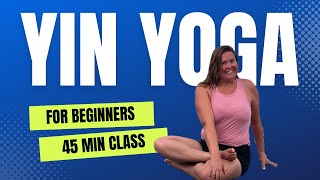
In this 45‑minute YouTube class, the instructor leads a beginner‑friendly morning yin yoga practice. She begins with a brief personal anecdote and outlines the minimal props needed (blanket, bolster or pillow alternatives) and encourages viewers to choose their own music or silence. The session opens with a seated meditation focusing on nasal breathing to calm the nervous system, followed by a clear explanation of yin yoga’s three tenets: finding a point of stress, discovering stillness, and holding for time. The instructor guides the class through a sequence of poses—Butterfly, tabletop moon stretches, Child’s Pose, Seal (backbend), Happy Baby, gentle twists, and a final shavasana—offering detailed cueing, prop variations, anatomical insights about connective tissue, fascia, compression, and synovial fluid, as well as mindfulness cues about self‑awareness and personal comfort. Throughout, she emphasizes listening to one’s body, adapting poses, and the mental benefits of long holds. The video also includes personal background (37 years of practice, 17 years teaching, teacher‑training offerings), promotional calls to action (subscribe, comment, online yoga teacher training), and a closing visualization using chakra‑based light meditation. The tone is instructional, encouraging, and supportive, aiming to make yin yoga accessible while fostering self‑care and community engagement.
Chapters
This is morning yin yoga for beginners, and I just went on a walk this morning with my dog, a nice long walk, and I'm excited to do some yin yoga with you. You will want a few things for this class: a blanket, any kind of blanket, it does not have to be a Mexican style blanket, any kind of blanket will do, a nice fuzzy one, a throw blanket of any kind, just so, you know, it helps you to stay warm and it's something that you can sit on. I like to have a bolster. If you do not have a bolster, that's okay. You can use a couch cushion, you can use a couple of pillows, you can use, um, a like a different kind of throw pillows. Anything that you have will work. You, if you want to, you can pause this and go and get some blankets and stack stuff a pillowcase and make a nice sturdy— it's really the same size. Now this was only $35. I got it on Amazon. I'll include a link below because these are the ones that I used at my yoga studio and I really love them. But I want to get started. No reason, no reason to waste time. Let's go ahead and get started. If you have— just making sure microphone's on— if you have music that you want to listen to. I'm not going to play music because I want you to choose your own music. I like music myself, um, but I also like silence, and I feel like today I need some silence. So if you want to sit onto your blanket, it'll give your hips a little bit of a lift. And we're going to start with a meditation. We're going to go for about 45 minutes today. Nothing too heavy, just a nice chill morning yin yoga. All right, if you're new to yoga, if you're new to yin yoga specifically, or you're new to yoga, this is going to be a great class for you. It's really easy to follow along. If you have any questions, please leave them in the comments and I'm happy to answer them. All right, coming into a nice easy seated pose, that could be crossing your legs for you, that could be extending your legs out. It doesn't matter. You could also sit underneath in what we call Hero's Pose. Whatever feels comfortable for you. We're not together. I need you to do what feels comfortable to you. If I ever give you a direction that doesn't feel comfortable for you, don't do it. Do what makes you feel comfortable. That's the most important thing. We're going to start with our meditation. So coming into your variation of the easy seated pose, lengthen your spine, relax down through the shoulders, and if it feels good, let your eyes close. Taking a deep inhale through the nose and a deep exhale out the mouth. Ah. All right, that's the last time we're gonna breathe out the mouth. We're gonna keep breathing in and out through our nose in order to lower our fight-or-flight response and to calm the nervous system. So deep inhale and deep exhale. Just let that breath go through the back of the throat. Inhale. Exhale. Inhale. Exhale. Just feeling your whole body start to calm down now. Continuing your in and out through the nose, inhales and exhales. We're letting every part of our body just relax and release. We're letting ourselves come fully into this space. For the next 45 minutes, we're gonna completely dedicate this time to ourselves. If there's anything that you need to do after this today, we're just going to let— leave that on a shelf. We can come back to that later. Right now we're here together practicing our yoga. Really nice gentle flow today, accessible for most people. Modify to your own needs. Know that this is all about you supporting you. So many people do not focus on themselves. So many people focus on everyone else. And the reality is, if we do not take care of ourselves first, eventually we will break down and we will not be able to take care of others. So we've got to do this practice. So try to dedicate yourself to finishing out the 45 minutes. Try to dedicate yourself to being here fully for yourself, fully in this practice just for you. This— you deserve 45 minutes out of the day just for yourself. Let's have a little stillness in this pose as we just focus on our breath. And then slowly opening your eyes, allow yourself to come into the space. We'll start with our, our first pose, which we call Butterfly. Butterfly is just extending the feet out. Just want to move back a little bit so you can see me in full. So in this pose, you're just going to extend the feet out and bring the soles of the feet together. If you had blocks, you could just stick them underneath your knees if you wanted to, to help you relax a little bit more, but it's not necessary. I'm not going to use them today, um, because I'd like you to see how to do these poses without props. And if you have a bolster or a pillow or a pillowcase that you've stuffed with blankets or a couple of blankets that are stiff, you can use that. And we'll just inhale, lengthen, and then exhale, just fold. Now if you don't have a bolster, you don't need one. Yin yoga was designed without props. You can just fold fold forward here, and this is completely acceptable. Again, a bolster is a nice addition to yourself, just something that you give to yourself, a nice gift. And, um, I really like this particular one. It's very well made. I'll leave a link below to it on Amazon. Like I said, these are the same ones that I used in my yoga studio. And then, you know, At least then you know you're getting a good one. So lengthen through the spine and fold forward if you haven't already. We'll hold this pose for a few minutes. So the thing with yin yoga is that we're holding poses for a long time, so there's 3 tenets of Yin Yoga, and the first is that we want to come to a spot where we feel the pose. So just where you start to feel it. So for me, I'm feeling it here in my hips, a little bit in my ankles. I'm feeling it in the inner parts of my legs and a little bit on the outer parts. If I think about it, I'm feeling it a little bit in my low back. So just take a moment— where are the different parts are you feeling this pose in your body? And then we'll come to the second part of Yin Yoga. So there's three tenets. We're going to come to the second tenet now. And the second part of Yin Yoga is the finding stillness. So just find that spot where you can be still for a few minutes, where you can hold this posture. And then the third tenet is really easy once you get there, and we'll just hold for time. So that's the third tenet, hold for time. I'm just going to hold this pose for time. Breathing in and out through the nose. It's super windy today. Everything's moving. And that's just really like our yoga practice. Can we hold these poses even when it feels uncomfortable, even when it feels difficult? We find that stillness and hold the posture. That's really the benefit of Yin Yoga, is that we're doing these long holds. We're not moving around a lot. We're not having to do a lot of physical movement, but this— the mind, the mind makes it a little bit difficult for us because it's these long holds that can be really challenging. We'll just hold for another minute here as we breathe in and out through the nose. If you find that you want to back off a little bit, please feel free to do so. If you find that you want to come a little bit deeper you can do that as well. Whatever feels right to you in your body, however it feels like you want to do this practice. It's the most important thing is that we focus on our own needs, on our own self. We're not together, we're far away from each other and on these screens, and so I can't be with you and know how your body feels. I can't ask you questions about your body, so I'm relying on you to take the control of your own body, to take awareness of your own situation. And if something feels painful, backing off. If we're just experiencing a feeling of stress, then that's normal, and we can sink into that more. But you've got to make that decision yourself. And that's why the yoga practice is really a practice of learning to connect with yourself and having a deeper awareness with your own body. We'll go ahead from here and just really slowly roll our way up. Good. Doing great, doing great. All right, we've been in this pose for a long time, so we don't want to just pop pop out of it. We'll want to really gently move out of the pose. So let's take our hands underneath of the knees and very slowly bring them together. Every movement that we do in our yin yoga practice is slow and intentional. Bring both hands behind your back, and then we'll just do some windshield wipers with our legs. Gentle back and forth movements, nice and slow. This helps us to counterpose the pose that we just did. Good, you're doing really great. I'm glad that you're here. Keep going, keep going, we've got a little bit more time. Yeah, you're already 33% of the way through. Okay, let's come to lying on our stomach. So first we're going to come into a tabletop pose. You got a blanket, you can just move that out of the way. We'll come into our tabletop and we'll do what we call moon stretches. So just turn and look at your right tailbone as you let your right tailbone come towards you, creating like a moon with the side of your body. And then switching sides, creating that moon with the other side of the body. And we'll do this a few times on our own, just nice and slow, moving at your own tempo, at your own pace. Creating your moon. Really easy, gentle flow. Simple movements of the body. Alright, we're gonna come into a child's pose. So you can bring your knees nice and wide if that feels comfortable to you, or you can bring your knees together. Traditionally, way back when I started doing yoga 37 years ago, um, everyone did this pose with their knees together and their arms back behind them like this. And over the years that has kind of changed. Because we've gotten to know bodies a little bit more. And honestly, yoga, the original yoga, was designed for young Indian men's bodies, which are long and lanky and thin. And now it's a lot of people doing yoga who don't have that body type, so we've changed it to fit that. And yin yoga is something that is completely just Western. It's— it was created by a Westerner named Paul Grilly, so it has nothing really— I mean, it's like an offshoot of the original yoga, but it's not really like it. So you can just go ahead and fold forward. Now I want you to try two different ways: bringing the arms back or bringing the arms forward. Now I find for me that sometimes, not all the time, but sometimes when I bring my arms forward I feel a pinch right here in my neck and shoulders. If you're feeling that, try bringing the arms behind you and seeing how that feels different. It might feel really good to do that. Also, if you have your bolster friend, which I really hope that you get one if you don't have one yet, because they're so awesome, you can just bring your head to one side and lie on that bolster, arms back or arms extended, whichever feels most comfortable to you. So remember our 3 tenets of Yin Yoga, right? Number 1, get into the pose to a point of stress, right? Just find, find a little bit of stress in your pose. Where you can feel it. Not too far, you just want to feel it. And then find stillness in that pose. You want to find so you're not moving. And then after you find stillness in that pose, then I want you to hold for time. And those are the 3 tenets of Yin Yoga. So now we're going to hold for time. Breathing deep in and out through our nose. So Yin Yoga was founded by a man named Paul Grilley, and if you are really interested in yoga anatomy, he has an incredible, incredible, incredible yoga anatomy course. It's absolutely amazing and astounding and fantastic. He talks all about anatomy of yoga in such a way that is really, for me as a yoga teacher, someone— I practiced yoga for 37 years and I've been teaching for 17 years now, and what he had to say about the anatomy of the human body in relation to the yoga practice was revolutionary. And he said that yoga is really like our bodies. When we do the yoga poses, we're feeling one of two things. We're feeling either tension, which is where our muscles are restricting us from going deeper into a pose, or we're feeling compression, which is where our bones are hitting each other and so we therefore cannot go further into a pose. So that's like where a joint, you know, um, connects and is stopping us from moving further into a pose. So when you see all these people on Instagram doing really incredible poses and postures, know that that is their— that's their chemistry. That's the way their bones are made. That's the way their muscles are made. There's, there's some things that we can do, and there's a lot of things that we cannot do just because of the way our bones are structured. So just the, the real practice is feeling good in the pose yourself. It's not— the real practice isn't looking like someone on Instagram who has hypermobility. That's, that's not— I mean, that's not even what yoga is about. All right, let's go ahead and really slowly walk out. I'll talk more about that in a minute. Really nice and slow. I feel like a head rush when I came out of that. That was amazing, right? Bringing the knees together, and let's just do a nice simple twist to just kind of counterpose. That long hold in Child's Pose that we did. And we'll go ahead and twist to the other side. Good, you're doing really great. I'm so glad that you're here. Thank you for practicing with me today. Thank you for sticking out. I'm glad that you're still here. I love it. I love what you're doing for yourself. It's amazing. Let's twist again to the other side, breathing deep in and out through the nose, just keeping that gentle twist going. Make sure we keep the spine nice and long here so we get the full benefit of the twist. Switching sides. Good. And now we're going to lie on our stomach. Now you could just lie on your stomach if that feels good to you and bring your hands opposite elbows so that— I'm going to move the camera back just a little bit so you can see me. Boop boop. All right, so bringing your hands opposite elbows just like this so that you can be in that nice cobra. And then if you want, you can bring your feet up if you want to feel a little bit more intensity. If you have Mr. Bolster, you can use that. To do your backbend as well. So either option really doesn't matter. My mini freezer is in the way, so I have to lift my— I have to lift my feet up because of mini freezer. Usually I am doing yoga in the tent outside, which I love to do, but today It's too windy, it's too windy for that. So we're gonna do our 3 tenets. Number 1 is that we find our point. So wherever you found that you want to be in this pose, so if that's you want to be on a bolster, if you are hands on elbows on the ground, the main thing is just feeling what sensation you're trying to create in your own body. So how are we trying to create this backbend? What are we wanting to make happen in the backbend? You know, what, what sensation are you wanting to feel? Like, where are you wanting to feel this in your back? And where do you think you can go to and hold it for enough period of time? Then the second part of the, the Yin Yoga practice is to find stillness in the pose. You could even do this number when you bring your arms forward if you want. I think I'm going to try that for a little bit. That actually feels freaking amazing. You could do, you could do this without the bolster too. I just don't like to hold it that long that way. That's called Seal Pose. And then the third tenet of yin yoga is to hold for time. So we're going to hold for time now. All right, so the point of yoga is not that we achieve a certain posture or we get a certain aesthetic or our pose looks a certain way. The point is that we come into the pose and then find what feels right for us individually, right? So, so many people think that yoga is all about just this perfect alignment, and for years and years and years I felt that way too. And there's nothing wrong with alignment, and I think that alignment can be really important, particularly in a fast-paced yoga practice like Ashtanga or a power vinyasa, or even just a regular vinyasa flow. Alignment can be seriously important because you can hurt yourself. People— chaturanga is the number one way, the low plank position, that people hurt themselves. And I'm not going to go over chaturanga here, but I do an online yoga teacher training and intensive, and I go over all the poses really, really thoroughly and teach people how to teach vinyasa in the 200 and and then the 300-hour, which is like your master's level of yoga training. I teach people how to do, um, how to teach Yin, how to teach Ashtanga, how to teach, uh, Vinyasa, chair, multiple different kinds, restorative. Anyhow, um, so I'm not going to go over that today because we just— that isn't the practice that we're doing and we don't have enough time. But that's a place that people hurt themselves a lot. But we can't hurt ourselves if we're really paying close attention to our own bodies, if we are understanding our own bodies, and that if you are doing what feels right for your body, body, regardless of what I'm saying or any other instructor saying. Like always in yoga, to thine own self be true. It's really important that you learn to focus on your own body and your own needs and not on what someone's telling you to do. So as we're in this pose now, we're holding it for time. Let's take a few moments to just feel— where are you feeling it? Where are you feeling it most? For me, just a nice rollback of the shoulders helps me to really get a nice broadening here of my shoulders and really feel a new sensation. And then I'm feeling that just a little bit up in my lumbar spine. With my knees bent and my feet up, I'm feeling it even more. And I found that for me, it was nice to take the knees a little bit wider. You wouldn't always do that if you were in a vinyasa class, that would be a massive no-no, you wouldn't do that. But our yin practice, what we're focusing on is not muscle. We're focusing on connective tissue. And that's why yin is done in a cold room. It's not done in a hot room, it's done in a cold room because we're doing that focus on the connective tissue. And we can't get to the connective tissue if our body is all warmed up. So when I say connective tissue, what I mean is we're working on our fascia, which is like this web that goes through our whole body and connects all the muscles and the ligaments and the joints and everything keeps us all together. And then we're also working on our joints. We're doing what we called earlier compression. So we're doing a little bit of compression. So right now I'm doing some compression on the vertebrae in my lower spine, and that's where my vertebrae are compressing together. So there's only so far that I can take my backbend because of that compression, right? There's only so far that my bones will go until they're, they're touching each other, and that's going to be very different for each of us. The other thing we're working on in our yin yoga practice is that synovial fluid sac, that sac of fluid that's in between all of our joints, and that is just being moved around and getting more viscous and creating more mobility for us. The beautiful thing about a yin yoga practice is that it is allowing us to have more mobility in our regular lives, and that's really important, and probably more important than just doing a yoga class. The other great thing about yin yoga is the mental aspect, right? And that's the same with a regular Vinyasa yoga class or an Ashtanga class or a flow class is that, you know, you're getting into the mind. But I find that the yin practice is even more difficult. So if you're still here, I'm really excited because that means you can do hard things. The yin yoga practice can be very difficult for people because we're doing these really long holds and we're staying in these poses for a long time. And we have to be quiet and silent in them, and that can be really difficult. All right, go ahead now. We're gonna just— if your legs are up, just bring them down. And just, if you have a bolster, just slowly move it out of the way. If you don't have a bolster, just come to lying down and let your head fall to one side. Maybe make a pillow out of your hands and then let that knee to the elbow that you came up to on that side— let that come up. So we have a nice easy counter pose here that's opening the hip and also relaxing our spine. I'm just coming back to the breath here, trying to breathe in and out through the nose. Let's just send nice deep healing breaths to the parts of our body that we've been working on. And bringing our mind back to the practice. And then I want you to just bring the leg down and switch sides. So we're gonna turn our head to the other side and bring our knee up towards the elbow on the other side. For me, that is on my right side. I turned left first. So we're gonna do the nice hip opener here, breathing in and out through the nose. All right, then go ahead and bring that leg down and just roll over. We're going to find our way to lying onto our back. Ooh, we're in the final stretch now, into the more important parts of our practice, into the more important poses that we're doing. Just gonna hug your knees into your chest. Maybe you bring your hands underneath your knees, whatever feels most comfortable to you, and just maybe just roll around a little bit here. Another option is to bring your hands onto your knees and just create circles, maybe in the same direction, maybe in opposite directions. Whatever feels good to you. I want you to really connect with your own body, your own practice. Anytime you're practicing with me, anytime you're taking any of my classes, I want you to really just connect into what feels good to you. You know, I want you to really know your own body and start to just make those movements on your own. And you know what the really cool thing about doing a practice, um, on the internet versus in person is that it doesn't matter if you do something totally different than what I'm doing because there's not a bunch of other people in the class that would be disrupted by it. So literally we can just kind of just vibe together here, which is pretty fun and amazing. All right, we're gonna do Happy Baby. You can do a half happy baby. Grab onto one leg, let the other leg come down straight. Um, you could just grab onto your big toe if you want. You grab onto the outside of your foot if you want, and that'll be a half happy baby. If you want to come into a full happy baby, you can do both legs underneath of the knees or I like to do a toe lock. That's my favorite. Everybody's going to be different. Grab onto the outside of the feet, maybe, if you want to come even deeper. Again, you can do the half one where you release one leg. You can even keep that bent if that feels good to you. We're just focusing on our hips here and just getting a nice opening, rolling back and forth. I'll let you know when to switch sides. So there's also in our, in our yoga practice, in our yin yoga practice, and in our regular yoga practice, this aspect that we're really missing out on. And I don't know about you, but for me, I miss out on this aspect all the time, way too much, all of the time, and that is having fun. I just take things so seriously. I'm always just taking my life seriously. I'm always like, "I gotta do this. If I don't do that, I'm gonna create that. And I gotta do this, and I gotta do this more, and I have to teach more of this, and I'm gonna do this, blah blah blah." And you know, it just gets old. It just gets old. It's not fun. It's not interesting. If you're doing one side, just switch to the other side so you can just do your half happy baby on the other side now. And I think that the reality is, is that when we die, we're not going to be like, wow, I wish that I'd rode myself more, you know. Um, I think we're going to be wishing that we'd maybe had more experiences for sure, or that we'd taken more chances, or that we'd allowed ourselves to do things that other people didn't want us to do, or we perceived that other people didn't want us to do. But I don't think that we're gonna wish that we were meaner to ourselves. And I think that— I don't know about you, but I really talk to myself in, in a way that I would never speak to another person. All right, let's go ahead and just bring both Knees back up to center. We're gonna do just some easy twists before we do our shavasana. We're gonna start with the right side first, and this is for digestion purposes because the way that food moves down our intestines, we want to do the squeeze on the right side first. So let the knees come to the right, and if it feels good to you, you can turn and look to your left. Now if you got your Mr. Bolster, I feel like we should give the bolster a name, and then when you get your bolster, I want you to comment on the video and tell me what your bolster's name is. You could use your bolster for the twist too. That is so nice, y'all. It's just, it changes it. It changes how you feel it. If, again, if you don't have a bolster, grab a couple pillows. How— takes. Maybe stuff 2 pillows in 1 pillowcase, that works too, you know. But still, this was not very expensive and it's really nice. Just— you deserve it, treat yourself. If you want to, you can turn your head to the left. If that doesn't feel comfortable, you don't have to do that. Just do whatever feels good to you. We're just doing this nice easy twist just for a few minutes. Bring your hand onto your left knee and help your twist a little bit if that feels good to you. Just literally whatever, whatever you want to do. And you don't need a lot of space for yin yoga. I mean, I'm in a camper right now, right? So I can't even stand up and reach my arms to the sky without touching the ceiling, but I can do my yin practice because because I'm totally here on the floor. So do what works for you. Alright, we're gonna just really easy switch sides. You don't need a bolster, but if you have one Switch them over there. And now we're going to twist toward the left. So if you— I used to feel this pain all the time before I became a vegetarian. Well, vegan. I've been a vegetarian a really long time, but before I became vegan, I would eat a lot of junk food. And, um, I would always have constipation, but I didn't know that's what it was. And I was having these like pains right here in my upper left stomach area, and I was like, what is that? I'm dying! And it was just poo. It was just like hard poo because I wasn't having enough fiber. But then I say all this because this pose helps to move that through. So if you're having that problem, start on the right side, hold it for a while, and then move over to the left side and hold that for a while, and that will help to move it through the intestines. A lot of yoga is about digestion and moving things through the body. So, we're just going to hold this for a few more minutes, just chilling out, just relaxing. Maybe taking a moment to close your eyes and starting to think about your gratitude to yourself for doing this nice morning yin yoga practice for beginners and everyone. It's really for all of us. I picked that title because that's a good one for YouTube, but really the yin practice doesn't change a whole lot. There's no like I mean, I guess you could go deeper always, but like, there's no really advanced-y in yoga. Misnomer. Oh, you're perfect just the way you are. I'm so glad you're here. Thank you so much. Like, always just— I'm so grateful that people come to my classes. I'm always so grateful that I still get to teach yoga. I have moved from career to career to career my whole life. But I've been doing this for the last 17 years, and that's a really long time for me. Like, the longest I ever held any other job was like 5 years, and that was like, oh my gosh, this is amazing, I've been doing this for 5 years. Um, so I feel like I really found what is my own bliss, and I really love doing and sharing with the world. If that's something that you want to do, if you want to share yoga, I do, um, an incredible Online Yoga Teacher Training, and I do it one-on-one. I only take clients on one at a time, um, and each week you get new video released, and then at the end of the week you'll meet with me for an hour or two and we'll talk about your assignment and we'll talk about what you learned and help you put that into practice in your own way. All right, go ahead and bring it back up to center. We're going to come into the most important pose. Please do not skip this. We're going to do shavasana, so letting your legs come out straight. I'm going to move over to the side because my cooler's in the way— my freezer. Let your arms come to your sides. If you have a blanket and you want to use that to cover you, feel free to do that. I'm going to use it on my feet, get my bolster out of the way. Bringing the arms to the side, take a deep inhale through the nose, sigh it out the mouth. Good. Breathe in through the nose and sigh it out the mouth. Let's let the relaxation start at our feet, letting each toe relax. Letting the bottom of the feet relax, relaxing up to the ankles, and then to our calves, to our shins, letting our knees relax, relaxing the entire backs of the legs, relaxing the quads, letting our hips relax and our stomach, let our glutes, our bum-bums relax. Your back, your chest, your arms, fingertips. Let it all just release. Let it go. Let your shoulders relax. Let your throat relax. And let your face relax, your tongue in your mouth, your nose, your eyes, your lips, the crown of your head. And I just want you to imagine a light coming from the sky and moving through you from the crown of your head through your whole body. Right now my light is yellow. Yellow light is associated with Manipura. It's associated with the solar plexus, the chakra of power. It's right here in our stomach. So I'm channeling the light of power from the universe so that I can go out from here and create a powerful, incredible day for myself. You can choose my light, or you can choose one of your own. Just let it fill your body. Slowly begin to wiggle your toes and your fingers very, very gently, letting your awareness come back into the room. You can reach your arms overhead if that feels good to you and stretch from your fingertips down to your toe tips. I'm so proud of you if you made it all the way to this part. You are amazing, and I know not everybody does because I see this too. Statistics on the YouTube of how long you watch the video. Rolling onto your right side. Awesome, awesome. And then let's just use our left hand to press our way up, coming into a nice easy seated pose. We'll go ahead and face each other for our final bit of practice. Thank you so much for practicing with me today. I'm really glad that you were here. Um, it really inspires me. I would love to have you subscribe. I would love to grow this channel. I would love to have more people come to it. Make sure you like the video and comment. Let me know some stuff. I want to know about you. I'm— we're separated. I want to know, I want to know about you. All right, bring your hands to the heart center in Anjali Mudra. Take a deep inhale through the nose. Om. The light within me honors the divine, beautiful, amazing, fantastic light within each and every one of you. I appreciate you so very, very much. Thank you for doing yoga with me today. Namaste. Good job, everyone! I'm so proud of you. Thank you so much for joining me. Please do subscribe, hit the like button. And I shoot these live on Instagram and then I will upload them to YouTube, so I would love for you to join me on either platform. And if you would like me to dedicate a class to you, I would love to do that, so leave a comment below on what you want or send me a DM and I'm happy to do that. If you want to become a yoga teacher, let me know. You can go to www.yogawithcarrie.com yogateachertraining.yoga to find out more. I'll see you in the next episode. Thank you for practicing yoga. I love you. Have a wonderful day, friends. Mwah! Bye!







