Remembering David Newman: A Bhakti Legacy of Love, Music, and Grace
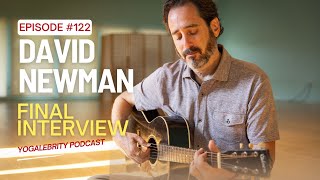
In this Yoga Liberty Podcast episode, host Angelica Govard memorializes the late kirtan artist and yoga teacher David Newman, exploring his multifaceted journey from a 1980s singer‑songwriter and law student to founding the pioneering Yoga on Main studio in Philadelphia (1992‑2020). They discuss his yoga lineage rooted in Vini/Desikachar’s Raja Hatha tradition, his gradual shift toward bhakti yoga and kirtan, and the musical influences that shaped his work (Krishna Das, Bhagavan Das, Jay Uthal). Newman recounts the creation of signature songs such as “Love Belongs to Everyone,” “Travel Well,” and the album Stars, describing his compositional process. The conversation moves to his recent venture, the Ayurprana Listening Room in Asheville, a venue dedicated to sacred and conscious music, and his collaborations with artists like Sean Johnson and the Wild Lotus Band. They also touch on his experimental foray into cryptocurrency during the pandemic, his philosophy of value as fluid like breath, and his practice of “conscious uncoupling” after separating from his partner while co‑parenting. Newman shares his teaching and mentorship model (private Zoom sessions, in‑person gatherings, festival appearances), his perspective on modern yoga culture (balance of alignment vs. flow), and his core life mantra: “be present and be kind.” The episode concludes with practical ways for listeners to connect with Newman’s music and teachings via his website, social media, and upcoming performances.
Chapters
Welcome back to the Yoga Liberty Podcast. My name is Angelica Govard. Today's episode is especially meaningful as I'm sharing a conversation that I had with beloved kirtan artist David Newman. As many of you know, David passed about a year ago from this earthly realm, and I hope that he is with Neem Karli Baba. But he left a huge space in the hearts of so many of us in the yoga and devotional music community. David's music, wisdom, and kindness touched countless lives, including my own. In this episode, you'll hear David speak about his journey, his devotion, and his incredible gift for bringing people together through music and mantra. In honor of David's legacy, I want to let you know that there is a GoFundMe supporting his child, which will remain open until April 20th. If you feel called, please consider contributing. The link is in the show notes. David, thank you for everything that you've given to this world. May your music and spirit continue to uplift us all. And with that, let's dive into this very special conversation. Welcome to the Yoga Liberty Podcast. Today I am so excited to have David Newman as our guest on the Yoga Liberty Podcast. Each week we feature a different yoga teacher, their story, where they came from, and to inspire you in case you want to become a yoga teacher. There are lots of different paths to teaching yoga, and we want you to know exactly what those different ones are. So my name is Angelica, and welcome David Newman.
Thank you, Angelica. Good to be here.
So tell us, what was your life like before you became a yoga teacher?
I have no recollection. That's when life started. But I'll try to drum a story up just for the fun of it. Okay.
Okay, sounds great.
Um, wow. Well, I became a yoga teacher officially in 1992, and so I was 29 years old at the time. I was just, uh, finishing up my Saturn return. So I had a few incarnations even before that. Um, I was living in Los Angeles as a singer-songwriter, um, in the 1980s, and then shifted to working in the music industry. And then from there, decided in, uh, the late 1980s to move from Los Angeles to New York to go to law school. And I started law school in, uh, in 1990. Um, while I was in law school, I was in the West Village of New York City. I met a yogi who was traveling through and, um, got deeply impassioned by yoga. And, um, it was incredible. It really changed my life, especially being in graduate school and living in New York City. Um, you know, one would really have to cope with stress on many levels. So, um, I was studying law and studying yoga And at that time, I was— I think I was practicing maybe literally between like 2 and 3 hours, 2 and 3 hours every day. And halfway through law school, felt that maybe law wasn't my calling and that I wanted to teach yoga. At that time, they're really— the yoga center thing really hadn't happened yet. In New York City, it did a bit. There was Jivamukti Yoga, there was Laughing Lotus Yoga. But when I would go back to visit my home in Philadelphia, there was no yoga centers. So, um, in 1992, um, in June, I graduated law school. In the— I took the bar exam in August, and in October, um, I opened a yoga school in Philadelphia, which was kind of the first of its kind. It was called Yoga on Main, and it was there for 30 years. Um, it closed, uh, you know, after COVID. But it had a long history with me as part of it for like the first 15 years and then not so much a part of it for the 15 years after.
Wow. That's amazing. That's really incredible. 30 years. Yeah. When I started, um, my yoga studio in Las Vegas, there were only like 3 studios here in Las Vegas, but now there's like 300. It feels like they're on every corner.
It's really grown. When I told people in my life at the time that I was opening a yoga school, they, they just thought it was the craziest, stupidest thing. I remember being next door to the yoga center when we were building it out, and I saw, you know, the father of an— of my very first high school girlfriend, and he asked me what I was doing with my life, and I told him that I was opening a yoga school. He said, ah, no one's into yoga, you'll, you'll— that will never work.
So, you know, it's interesting. It's interesting because, you know, my, my dad had a, a very similar reaction when I told him I was leaving my corporate job to open a yoga studio. And, uh, he was like, why? Because I was making like $150,000 a year in corporate. And, but, you know, I was deeply unhappy. And so I wanted to do something that would change people's lives, and the, the yoga studio was really like— yoga was just a conduit to help people find happiness. But it's interesting how we don't value soul work. And honestly, from my perspective, you know, now at this point I've made way more money as a yoga teacher. But one of the things that always struck me is Krishna Das had said that he didn't set out to teach yoga. It's just people kept asking him to do it. And that has been my experience as well. Like, people just keep asking me to, to help them or to teach trainings or to come to their studio. And I wonder, is that a similar experience that you had?
Uh, yeah, most, most definitely. Um, I mean, yet a combination of that and just an inner desire to want to teach and to projecting that out into the world. I've never been the kind of person where I could do things that I wasn't passionate about. So I feel like our passions, you know, attract everything. So yeah, the invitation, I would say, if I was to, you know, um, describe it was came from within.
Yeah, I think also many men at the age of 29 have this like reckoning within them where it's just this massive shift in values of what it is that— I, I don't— there's something magical that happens to you all at 29 where you're like, wait, I have a whole life ahead of me and this isn't how I want to live it. You know, so it's interesting to hear you say that '29 was the year that you decided to make that shift.
Well, yeah, it's also— '29 is Saturn return in astrology, and often, um, with my understanding of that, you know, you think your life is going in a certain direction, and then when Saturn does its full cycle around your chart, you, you, you know, you kind of have— depending on, on your consciousness either a rude awakening or kind of a, you know, an expansive awakening. It depends on how primed you are for that moment, I guess.
Yeah, yeah. And so you started— when you got certified to teach yoga, this was way before Yoga Alliance and all of that nonsense, but, um, when you started to teach yoga I know that you— did you actually get to meet Neem Karli Baba?
So, um, bhakti yoga came into my life a little bit, a little bit later from the time that I started teaching yoga. My initial yoga lineage was, um, more of a Raja Hatha yoga lineage. It was, uh, Vini Yoga in the tradition of TKV Desikachar and T. Krishnamurti. So I studied with Jessica Char, I studied with Gary Kraftsow, I studied with a woman named Sonia Nelson in New Mexico, um, and I, yeah, I would go to India, to Chennai, to the, to the, to the mandir there, and, um, brought Jessica Char to Philadelphia and studied with him at Colgate University. So, um, that was really when I first started teaching, I was in that lineage, um, and then after I opened my yoga center, you know, and taught. That's when bhakti kind of emerged in my world.
So for those of you who don't know, Krishnamacharya is also the teacher of Pattabhi Jois and, um, B.K.S. Iyengar. And so basically every— almost, almost every form of yoga that we do in the United States today, from a physical standpoint, from the third limb of yoga asana, is that uh, it comes from Krishnamacharya and his lineages. And Desikachar was his son and kind of his third major student, um, to make an impact on the world. So that's really, that's really incredible and pretty amazing.
Yeah, Desikachar was a pretty amazing soul. He was funny and, um, very charismatic and cordial. And, um, yeah, it was a lovely person to be around. And Gary Kraft, you know, I'm not sure what Gary's up to these days, but he deeply inspired me. He had a way of just bringing the yoga teachings into a very consolidated, organized— you know, I mean, again, I was a law student at the time, so I was a little more in that part of my brain. So when Gary came along, he kind of had systematized things. He was a student of Desikachar's as well, in a way that really made a lot of sense to me in terms of sequencing and counterposing. And, um, it— yeah, it just all— that's when it all just clicked for me.
I think that's a magic that's really lost today in a lot of modern asana yoga. The idea of balancing out sequences with poses and counterposes and contraindications. And, you know, alignment is like a dirty word now, I find. And a lot— I interview a lot of people, and I interview people like us that are much older and interview TikTok famous 20-year-olds, you know. And the younger people, I find them say things like, uh, everything that BKS Iyengar did was wrong, and alignment is awful, we should just flow and feel our bodies, and who cares if our knees go past our ankles. And it, you know, I think that there's room for both, but, um, it's so refreshing. I think that there— the voice of people who have worked with some of the masters is desperately needed in social media sphere.
Um, well, you know, Jessica Char and that lineage, the, the beauty of it was very— there was very little dogma, you know, like just taking a simple issue of, you know, having your legs straight or bending your knees, you know, it was really a person-to-person scenario depending on how the makeup of that person's, um, you know, anatomy was, how their body operated. So every pose that we did there was always infinite possible adaptations. So it wasn't like you do the pose this way. It's, you know, really honoring a person's body and a person's condition at that time in their life. One of the beauties, like, about Krishnamacharya, you know, was what he was preaching toward the end of his life was very different than what he was preaching younger. And wasn't that he, he had moved on to something else, but as an older person, he was seeing the value in changing things around to make sense for the time of life you're in. So I think it would— anything in life, not just yoga, just that adaptation to what's— what the moment is calling for is to me a big part of the essence of yoga.
When did you start moving into this more bhakti style of, of resonation for your own practice and for what you offer to the world?
Yeah, well, um, when I was in the— working with Desikachar and Gary and Sonia, they— I was part of that lineage, was Vedic chanting. Um, so that's when I started learning about Sanskrit and chanting. And so that was the first time that I, I think I, as a musician, because I, I've been playing guitar and writing songs since I was an early teenager. Um, so when I, when I got introduced to Nada Yoga through Vedic chanting, that was definitely an awakening for me. Um, but after I opened the yoga center, I, I started to become aware of, uh, you know, yoga music or kirtan, or, you know, there were musicians and seekers, um, yogis who were blending the tradition with some really kind of Western instrumentation and production. And so I Because I was teaching yoga, I was listening, you know, to music in that genre. So I became exposed to Jay Uthal, you know, he like the Shiva Station album, or at that time Krishna Das had made, I think it was called One Track Heart, was his first album. And then I was exposed to Bhagavan Das's music, and I started listening to these mantras and to this music. And as both a yogi and a musician, it was a huge aha for me. And then, then noticed that all three of them had the same guru named Krolibaba. And so just the way I am, my personality is when I find something I love, I just like to share it with everyone, for better or for worse. I think it's for better. Um, nonetheless, since I had a yoga center, I just started reaching out to these people, and I invited Bhagavan Das to the yoga center. I invited Krishna Das to the yoga center. I invited Jayatal to the center. And so it just kind of all snowballed from there. And then being a musician, then I picked up my guitar, I bought a harmonium, and I started learning these mantras. And because I was a songwriter from a very early age, I saw that many of these musical kirtan luminaries were taking these ancient mantras and then writing chord progressions and, you know, modern melodies. And so I just started getting creative with that and kind of all expanded from there.
You have, um, in, in my opinion, I hope this is okay for you, but I feel like you have a very George Harrison energy to you, um, and your music reminds me of his music very much, especially some of his, um, you know what, when we went to India, we went to the ashram that the Beatles stayed at Yeah, that was pretty amazing. Um, I know it's not, you know, now it's like all like falling apart, but it was like you could sense the energy of the place was really incredible. I know you take a trip to India. Do you still do that every year?
Uh, I was going for a while, and then after 2020 I took a break, and I haven't gone back to India. But, you know, for me, talk about George Harrison, the Beatles, you know, I've always felt like my lineage is Western singer-songwriter. And Eastern, you know, bhakti yoga. So it's always been a natural inclination to want to bring those worlds together. I think it served me as an artist because, you know, we are bringing this music to a Western audience. So for a lot of people, you know, they were hearing the mantras, but they were also hearing it contextualized in a musicality that was very familiar to their ears. So it was something I just organically did because I wanted to. But by the same token, I think it really resonated with a lot of people who enjoy both of those worlds, seeing them come together in the music.
I think that probably my favorite song that you've done is "Love Belongs to Everyone." Aye, thank you.
I just played that last Saturday night here in Asheville. That was a song, interestingly, that was on an album I did called "Stars." And I think Stars may have been like the album that I infused most of myself into because it was the album that I played most, uh, more instruments than I typically played on other albums. And then when you're a writer, you, you write a song and then you hear it in your head, and then when it's done being recorded, you know, it's typically different. And sometimes you feel like it succeeded to a greater or lesser degree. But that particular recording I was very pleased with. When I was finished with it, I just felt like, you know, because I've, I've done like, what, 11 albums, and not every song, you know, came out like in a way where I just listen and go like, whoa. But that was definitely one. It just, it really came together in the studio for me.
Yeah, it's a beautiful song. That entire album is probably my favorite.
Oh, thank you.
Yeah, I really like it. I did, when I was in Goa there was a harmonium and there was this guy that was like up on the stage and he was playing. And I went over and I was like, can I play something with you? And I played, um, Travel Well. And yeah, and he was like, whoa, you know, like, come on, chanting Asatoma. And he's like, why, why is this white girl know this stuff?
Did you learn that at Shawn's immersion? Because I know he teaches Travel Well. Did you? I did.
Yeah, I did.
That's a nice one to pick up. You know, there's a few songs of mine that, you know, I love writing songs that are really simple, you know, if within the simplicity there's some, you know, it's interesting to listen to. And Travel Well was one of those songs, you know, it's just, it goes from A to G and that's it. There's two chords the whole song. Like, I did a song called Stay Strong, which is D and A, two chords. Not all my stuff is that simple, but if you can write something that has like two chords and make it interesting, I always feel like that's, that's a win. And so Travel Well is another piece that is very meaningful to me.
Yeah, I know you told me, uh, at Bhakti Fest— will you be at Bhakti Fest this year?
Not this year, no.
Oh, well, um, one year at Bhakti Fest you told me the meaning behind that song, um, and so I would love if you would share with everyone about, uh, Travel Well.
Yeah, it was— I wrote it after that, uh, you know, it wasn't like the first, but it maybe it was like the first like really significant school shooting. It was Columbine.
Columbine.
Yeah, Columbine. And, you know, I was— I had, you know, just become a father. And you hear that news, and to visualize the horror of that situation, it's just like stabs you in the heart, you know. And so typically, when I feel like strong emotions, whether it's grief or sadness or anger or like, whatever it is, I— one of the ways I typically process that, well, it's either through a practice, but, you know, part of my practice is, is creating, is writing music. It helps me move things through. So in the pain of— and the aftermath of that experience is— was when I wrote the song Travel Well, and it was just a prayer for those souls to just travel well on their journey. Since then, it's just, you know, it's also become a song that I dedicate if somebody comes to a concert and somebody has just died, or it's, it's just wishing a soul well, whether they're, you know, embodied or not embodied, just sending out a prayer for them to have a graceful journey.
I know there was, uh, one particular yoga teacher training group I've done, um, I think now 28 in-person teacher trainings, and, um, there was one particular training group that just absolutely loved that song. Song. Um, it was really their favorite and they latched on to it and they all sang it. Um, so it's been a really big part learning that song from Sean. Sean Johnson is Sean Johnson and the Wild Lotus Band, who, um, are from New Orleans, and they host a, um, bhakti immersion, uh, every year. He just finished one up. It's amazing. But you and Sean do a partnership, um, usually around New Year's, correct, where you do a similar thing. Can you talk about that a little bit?
Yeah, we've gotten together for a week-long program. It varies, could be anywhere from 3 days to 7 days, um, called Bhakti Bliss, where we support people in finishing up the year and beginning the next year in a really open-hearted, positive space. So we did it at Kripalu in Massachusetts for, um, yeah, over 10 years until 2020. And then, you know, with the rest of the world, we took a break. We did it online, and we've been thinking about, um, you know, resurrecting it in person, uh, but Kripalu isn't yet really set up for it. So, um, we've just been thinking about where we may want to do it, but we, we haven't decided yet.
So many bhakti yogis on the West Coast. We have many wonderful places out here in the desert. It's spiritual and amazing. There's no place more spiritual than the desert.
We're open, so definitely throw out ideas. Um, we're not fixed on it being in any particular place. So much— so many of the people, you know, who came to that program were either in New England or somewhere on the East Coast, but You know, life has changed. So, you know, we're— who knows where, where it will rear itself again. We'll see.
Be surprised on the West Coast. The West Coast people, it is the best coast. There's a reason why it rhymes. So, uh, you have recently moved to, um, Asheville, North Carolina, and opened a music center, um, which is pretty amazing. I wish that I could go because that actually sounds like like completely my vibe. I, when I lived in Cincinnati, I went to college in Cincinnati, and I used— there was this jazz club downtown, and I would go to it all the time and just like listen to the jazz, and I'd buy my obligatory drink and set it to the side and not actually drink it, and I just was there for the music. And I, I, I, you know, I've only seen it online, but I, in my mind, your music center has that same kind of underground vibe of just music that's from the soul. So if you could talk a little bit about, um, your music center, I would love to hear about it.
Yeah, it's called, uh, Ayurprana Listening Room, and I think it's, it's really, from, from what I can tell, because I've, you know, traveled all over the world and played lots of music venues, I can't think of one like it because it's, it's a full-on music venue with, you know, a, an elaborate sound and lighting system, amazing acoustics, sloped floor, beautiful woodwork, um, and it's focused on sacred music, conscious music, medicine music, kirtan, and, uh, those two worlds coming together. I haven't really seen that, so it's been a great blessing and an honor to curate that venue. And it's very diverse. I mean, you know, we do all kinds of music. We have Victor Wooten coming in July, You know, it's been kind of an unexpected joy in my life, and it manifested in a really magical way. Just the fact that I'm living in Asheville and curating a music venue. And Asheville was the perfect place for it because I had no idea what would unfold. But when I started hosting these concerts, you know, they've all pretty much been sold out. And so Asheville is the perfect place for this because it's a really conscious city. It's a music city. And there was really an empty hole. There was nothing like it of its kind. So as you know, matter of fact, the first conscious event we did was Shawn Johnson and the Wild Lotus Band. And yeah, the room is packed. I just played last, you know, last Saturday night and we sold out. It's just been incredible. It's been an exquisite manifestation of grace. And, you know, after touring and traveling and receiving the goodwill and love and hospitality of so many hosts, it's really fun to kind of shift roles and afford that opportunity to all these incredible artists, to welcome them into our space. So it's kind of a form of giving back for me in a way.
That's really amazing.
Last Saturday was funny because I was like you know, playing both, both sides of the spectrum. I was the, the venue host and the artist as well. So that was a, that was a funny thing to experience.
That's really awesome. I'm so glad that you did that. And I think, um, Asheville is a great place for that to start, but hopefully it spreads out to the rest of us and comes to the West Coast.
But, um, I see a planet where this kind of music is just filling arenas, you know.
Yeah, that would be amazing. That would be amazing.
Yeah, it may not be planet Earth in my lifetime, but there's plenty of other options.
You know, that kind of leads me into something that, um, I found really fascinating that you were, um, doing during all the shutdowns. One of the things that you did was you had a course on crypto And you talked about it's kind of like infusion with you, I kind of, with yoga. I don't, I didn't know a lot about it. I checked it out because I was like, this is an interesting offering. Um, are you still doing that? What was that like? Tell me about it.
Yeah, minimally. I, I, um, I had, you know, obviously wasn't, at least in that first 6 months or what have you, however long it was, didn't have the opportunity to travel and tour. and I was just meditating upon value and, um, yeah, just earning a living for myself and my family. And I just put a prayer to Lakshmi, the goddess of abundance, and I heard from a musician friend of mine soon thereafter who had told me how well he was doing, uh, trading cryptocurrencies. And believe me, that was like far this thing, you know, from my focus. And he started to, to teach me about it. And this is a man who is a kirtan singer and a bhakta and a yogi, and who really, you know, conceptualized and perceived the movement of cryptocurrencies as the movement of consciousness. And, you know, feeling into kind of group psychology and the, the movement of emotions. And he perceived it from a very sort of deep, uh, spiritual, psychological, intuitive way. And so being that I had all this new time on my hand, I just, you know, we would spend like a few hours a week, him mentoring me. And then I just started to, you know, learn how to read, um, uh, financial charts, in this case cryptocurrency coins, and how to move cryptocurrency. It's kind of like Quicksilver. And it was fascinating and it was sustaining for me over like a good year and a half. And it was just fascinating on so many levels to really understand the fluidity of value that is just not this paper that I have and then you have and then, you know, you provide a service and I give you this, but just how to feel it in a much more fluid state. So I got— I feel like I learned a lot about value in that as things started to open back up again and I got more into my creative side, I'm not as active in it anymore. But like anything in life, it served that moment for me.
Yeah, it's really interesting that you say that about learning value and, and exchange through energy exchange through crypto, because I started my yoga studio with money that I made playing poker. I had been laid off from my job and I had recently gotten my yoga teacher training and I was teaching yoga to poker players and they taught me how to play poker. You know, I live in Las Vegas and so I was going through a bankruptcy. I had no way to make money and nobody would hire me. I was overqualified, you know, blah, blah, blah. And I was teaching yoga at 24 Hour Fitness, making $20 a class, you know, which is not enough to make it. And I started playing poker. And I won this, like, huge pot, which is how I opened my first studio. But poker really taught me the lessons of money is an energy that, that it can be, it can be gone in an instant. And that doesn't have anything to do with your worth. We put so much value on, on the financial as a society, as this, this goal and this, this ideology of hoarding. But there's no way that we can get more money without releasing money. Like, It's a flow.
That's right. And just being in tune with the transitory nature of it. Now, I would say that I perceive value in various different contexts, but they all feed into each other and we don't own anything. I look at all forms of value in the same way that I look at breath. You breathe in and you don't hold on to it for fear of not being able to take a next you know, your next exhale. You just breathe in, you breathe out, and everything flows through us, whether it's breath, whether it's finances, whether it's a relationship. Everything's constantly in a state of flux, and, um, we're constantly in a state of flux. So when we're just aligned with the movement of consciousness, even though it appears to take on a form, uh, life just has a very graceful yeah, fluid quality. It's a nice way to live.
Yeah. Yep. You're actually the first person that I ever heard use the term conscious uncoupling when you and your partner decided to shift the way that your relationship works. And that's another thing that I think we all hold on to, is the ideology that relationships have to look a certain way.
Absolutely. I was joking to a friend yesterday. I said, you know, in the spiritual world, being present in the moment is always acknowledged as a value except in relationships. You know, that was kind of a joke because, you know, it's like there's so much conditioning and agendas around, you know, what the nature and the form and how long it's supposed to last and da da da da da, you know. Yeah, I was married to a woman named Mira, and we have a daughter together named Tulsi. 5 years ago, we decided to just allow the form of our relationship to change. And, you know, we're not— we haven't been together in 5 years. But, you know, we all moved to Asheville from Philadelphia. She got a place in a little area here in Asheville. I got a place, and our daughter spends time with both of us, and we're great friends. And you know, we were just willing to maintain that connection of love and just to say, well, the nature and the form of this relationship wants to move somewhere else. So like I said, you know, whether it's money or work or relationship or all of it, it's, it's all— it really is consciousness taking on a different texture, a different form. And if you see them all as distinct, you know, you're going to clasp. And, and that's hard, you know. I always say, like, when I teach and I talk about this fluid way of being aligned with consciousness, not form— but believe me, I'm a bhakti, so I love form, the joys of embodiment. I'm not like one of those sort of dry, you know, um, what's the word, like detached, impersonal, you know. I really appreciate the joys of embodiment. But my point is, is that when I teach, I teach about letting go, really. And often one of the mantras that I hear more than any others is somebody will say, you know, I hear what you're saying, but it's so hard to let go. That's really the mantra over the years that I've heard the most. And one day it just clicked, and I spontaneously responded, and I said, well, you think it's hard to let go, but It's actually easy to let go because letting go is our natural state. What's hard is holding on. And it's like, people, oh wow, yeah, it's the pain you're feeling is not because it's hard to let go. The pain you're feeling is because you're holding on. It's not a natural state of being to, to be in a constant state of contraction, holding on to something. That's what makes for pain and suffering.
Wow.
These are just my— obviously my perspective and based upon my experience.
Yeah, I think that's really insightful. I think that's really insightful. I think that many people would have a fear, you know, taking the relationship for example, that if they were to change and shift their relationship with someone that they were married to or that they had a partnership with, and then they continue to be friends with that person, have a connection of some sort, that they would never be able to then enter into another relationship, um, that that would always be in the way. But you've shown that that is not actually the case, that there can be like this more fluid flow to that.
Definitely. You know, I— obviously we're all human beings, um, I— there still is that impulse in certain situations to, you know, contract around something. But whenever I see that show up, you know, my, my, my then second impulse is, is to just to release it. Um, and, um, it always— it's through the release that whatever the remedy is, or whether whatever the solution is, or whatever the insight is always comes. It doesn't come in the contraction. It's hard to be receptive when you're in fear.
There's a reason why Rich Roll calls it flow. Right?
Exactly.
Yeah. Yeah. So if someone wanted to work with you, or they wanted to connect with you, obviously they could get your albums, they're on Spotify, they're on iTunes. I know I have them myself. But what are some other ways that people could maybe actually work with you?
Yeah, most of the work that I'm doing now, because, you know, I'm— I, I took on this position with the Listening Room, and through that I'm also doing some other really cool things. We're, we're creating a streaming platform that I'm curating, um, and creating content for, as well as editing some books for the Ayurvedic Institute, among other things. It's, it's just loads of fun. But I continue to take on, uh, private clients and mentorship scenarios. So I typically do that in the evenings and on weekends. And my approach is supporting people and living with an open heart and assigning mantras. And I do have musicians who come to me and I help them delve into the bhakti and kirtan practice. So most people that I work with now are my private mentorship clients, students, and I do that on Zoom. Although for those in Asheville, I also do local meetings as well. I also do some traveling now, you know. I'll be playing at a festival in Milwaukee, Milwaukee Kirtan Fest, and I'll be playing at Bhakti Stock in Vermont. So if they want to see me in my conscious spiritual rock star mode, they can come see me with my full band. I always say I have nothing in between. When I present, it's either like lullaby, really like gentle fingerpicking guitar mantra, or, or I'm with like a full band and I'm jumping around the stage like a lunatic. And, you know, uh, I like those polarities, so to speak.
I think I've, I've seen you perform a number of times, and I would say that's an accurate description of all of my experiences.
Where have— like, have you ever gone to any of the big festivals?
Yeah, I've been to Bhakti Fest many times. I remember staying up very late at night one time, uh, and just listening to you just jam out on stage and dancing in the back. And, um, you know, uh, like I said before we started the recording, I saw you at the Standard Miami. I've seen you in Miami a few times when I first started like doing, um, teaching yoga, you were actually one of the first bhakti people that I had ever seen. But my first exposure to bhakti was, uh, Lauren Russo. She's a teacher, and I went to her Ashtanga class where they were doing Mysore style primary series. But she was— she also has worked with David and Sharon, Jivamukti founders. And so she was like kind of doing a Jivamukti spin on Mysore where she was playing the harmonium. And that's the first time I saw the harmonium, and I saw it and I instantly was like, I must learn to play that.
And bhakti just, yeah, pulls you in.
Yeah, yeah. I think that, um, I love exposing people to bhakti because it's, for a lot of white American people, it is something that people are not taught to connect with. They're not taught to connect with their voice. Suzanne Sterling talks about this a lot, that, you know, women were told to be quiet, to not speak out, to not express in this way. And, you know, I know when I was growing up, my mom was a voracious singer, and she would go to church and she would just sing really loudly, and I would just be mortified, you know? Right. And so I grew up being like, I'm not a good singer, because I didn't want anybody to think I was like my mom.
Yeah, people that— what part of, part of my work is supporting people and letting go of the baggage they carry around and the judgments they carry around about their own voice. I remember during a workshop where I was supporting people and sharing their voice individually, a guy came up to me at lunch and said when he was 6 years old— he, during the workshop, you know, he was in his mid-60s— and he said when he was 6 years old, the, the choir director came up onto the stage and whispered in his ear before a performance, you know, move your lips but don't make a sound. And he said that in the workshop, which was like literally 60 years later, that that was the first time that he had ever let anybody else hear his voice. So it's like what you were describing is, is not uncommon. And it's, it's sad. It's such a beautiful gift. You know, we're all born with an instrument And, uh, it's, it's really tragic that people keep that instrument just, you know, in a case, so to speak.
Yeah, yeah, releasing the vashuddha and allowing the expression of the self. And I always tell people that, you know, your voice was created by God, Spirit, Universe, higher power, divine, whatever you call, you know, your connection. And they made your voice beautiful exactly the way that it is intended, the way that it sounds. And so allow expression of that, because at the end of the day, the only person that matters is you and your connection to spirit.
It's beautifully said. That's exactly how I feel.
Yeah. Well, um, also you can connect with David at, um, @davidnewmanmusic on Instagram. Are you on anything besides Instagram?
Yeah, a lot. You know, I, I have a Facebook music page which is probably my, my number one, uh, social media channel. Um, yeah, it's David Newman and, uh, it's a band page and people will recognize me there.
And, um, is there any way we can entice you to go on TikTok and share?
I, I, I know you're, you're pretty active on TikTok and I mean, I, I— believe me, I fully understand the value of, of connecting on all channels. I just feel like for my own life, you know, the direction for me is less social media, not more. But, you know, who knows, maybe I'm, I'm missing the boat here.
Well, I think of social media as service work, right? I don't do it for myself. I— if I— if it was me, I would have no social media. Like, 5 years ago, I had nothing. I had no presence on social media whatsoever. I didn't want anything to do that. We don't have an Alexa in our house or anything like that. I'm hesitant to have my phone. I want a dumb phone. I don't want a smartphone. But the amount of people that I have been able to connect with and cultivate and help build up— there are so many young women that I have been able to work with online that have never had anyone say to them, you're doing a great job, you're on the right path. This is the— this is what you're doing is okay, you're all right, you know. And so that connection and that voice that so many people in our age group, you know, I don't, I don't actually know how old you are, but I'm about to be 50, and so I assume that you're around my age.
Um, a decade older, I'll be 60 this year.
So, well, happy birthday. But there we have so much to share. You have so much to share, and I, I hope that you, um, will share more because you do— I, every time I interact with you, whether it's in a concert or it's here or on social media, it's always an enlightening experience.
So thank you, Angelica. I appreciate it. And you have one of these days. Is it different than Instagram? Isn't just similar?
Your Instagram Reels, download them without the watermark. I'll send you a link on how to do that. And then upload them to TikTok. That's literally it. It's the same thing.
Okay, well, I'll meditate on it.
Okay. Uh, you also have a website, right?
Yeah, davidnewmanmusic.com.
All right, well, thank you so much.
One thing that just— one thing that bears repeating is that, um, David Newman is a very musical name, and so there is David Newman the soundtrack composer There is David Newman, the tenor saxophone player, and there's David Newman, the, the chant artist, so to speak. So just let people know that they may go looking for me and find other David Newmans, and just to be patient, they will find me and they'll recognize me.
And also, they should not confuse you with your brother-in-law Randy Newman.
I think the other David Newman is related. They're all soundtrack composers. Their father was, um, Lionel Newman, two sons named Tom Newman and David Newman, and they're all— and Randy Newman is like a cousin, and they're all like the top Hollywood soundtrack composers.
So Randy Newman, if people that don't know, Randy Newman has— he's written a lot for Hollywood, but he has, he has kind of funny joke music. But they— David and Randy are not related. That was just a joke.
No, we're not. And I remember one time his cousin, the other David Newman, you know, was performing like the Star Wars soundtrack at Hollywood Bowl in Los Angeles. And I got an email asking me what I wanted in the green room and what my rider was and where they should send the check.
And, you know, you were like, send the check to—
that would not have been very yogic. But nonetheless, it made me laugh. And we actually had our royalties confused at times. So, you know.
Oh, wow. Well, it pays to have a unique name like mine. But if you could leave everyone with one word of wisdom, one thing that you really want everyone to know before we go, what would that be?
Can I set it up and then—
Yes.
So, um, I started meditating, doing TM, when I was about 12. And so now I just divulged my age. I'm going to be 60, so that's like almost 50 years of spiritual practice. Um, I, I've really been thinking about the simplicity of the practice and really getting down to the bare essence because there's so, you know, there's Hatha yoga, there's mantra, there's meditation, all forms of yoga, all forms of meditation, books on this, books on that, Buddhism, Hinduism, Buddhism, you know, whatever. I do think about the distillation and the simplicity of, of the spiritual path. And, um, I, I've really come up with, um, 4 words that I, that I think distills all of it. I'm not going to share those today, but, um, no, I will. I'm just joking.
Anyway, I was like, yeah, please.
No, it's be present and be kind. That to me is, is everything in a, in a multivitamin.
Okay. All right.
I find that, um, the suffering comes when I'm somewhere else, when I'm not here. And by the same token, I find that the mind is a funny little character and, um, always wants to assert itself And so I'm hyper attentive to being kind. So when I'm present and kind, life is good. And there's really not much more there that I think anyone needs.
Well, thank you. Those are wonderful words to leave us on. And if you enjoyed the Yoga Liberty podcast, please do make sure to subscribe, follow @DavidNewmanMusic and @YogaLiberty. On Instagram and all the other social platforms. Thank you so much for being our guest today. I appreciate you.
Thank you. Namaste, Angelica, and to all those who are watching and listening, peace and love.







