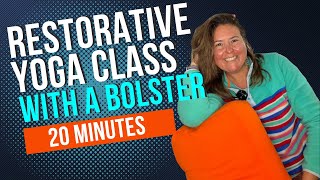
In this 20‑minute YouTube video, Angelica, a yoga teacher with 17 years of experience, leads a short restorative yoga session centered on the use of a bolster and other props. She begins by introducing herself and promoting her 200‑, 300‑, and 500‑hour Yoga Alliance‑approved teacher‑training programs. The practice starts with Baddha Konasana (bound angle pose) supported by a bolster, blocks, and a blanket, with a focus on nasal breathing to calm the nervous system. Angelica explains the origins of restorative yoga, crediting B.K.S. Iyengar and noting its Western adaptation. She then guides a gentle supine twist over the bolster, offering options for head positioning and emphasizing breath awareness. The next segment is a bridge pose (Setu Bandhasana) performed on the bolster, with variations for knee bend or leg extension, and a discussion of how backbends improve body awareness and everyday quality of life. After the physical sequence, Angelica leads a seated meditation that visualizes a strong energy rising from the base of the spine to address personal challenges, reinforcing the message that inner tools for strength already exist. The class concludes with gratitude, an Anjali Mudra seal, a final Om, and a call‑to‑action to subscribe, like, and explore her online courses and resources.
Chapters
Welcome to a short yoga practice with a bolster. We're just going to do a short practice today, and I'm really excited that you're here. It's going to be very chill and very awesome. My name is Angelica, and I've been teaching yoga for 17 years. I host online yoga teacher training, 200-hour, 300-hour, and 500-hour yoga Alliance approved yoga teacher trainings. If you want to just learn more about yoga and become completely entrenched in the philosophy of yoga, the anatomy of yoga, the, uh, chakras, the postures, how to teach yoga, it's an amazing course. I teach it one-on-one and I teach online, so you can check that out in the description below. And I would love to meet you and get to know more about you and your goals and help you Become the yogi, be all the yogi you can be. Anyhow, today we're just going to be doing a really chill practice though, so let me go ahead and get this started so that I know where we're at in time. And grab your bolsters, let's get started. Okay, first part of the practice, we're going to do the quintessential restorative yoga pose, which is the baddha konasana. So you want to take your bolster and just put it to the side where you can lay on it. I'm going to use a couple of yoga props. If you have blocks, you can certainly use those. These are called eggs. They're oval shape and they conform in shape to your body, and that's why I really like them. There's a link in my bio. I do not get an affiliate, I just think that they're really awesome. So if you want to grab some, you certainly can. Bring your— the, um, base of your, your bum there to the back of your bolster. And a lot of people like to bring the soles of their feet together in this. You could also extend your legs out if that feels comfortable to you. And then we'll just lie back onto the bolster and let our chest open really nice and easy. Restorative yoga, if you've never done it before, is really relaxed and it's approachable for all levels. Um, Restorative postures typically, I mean, 99% of the time use a lot of props. They were created by a man named B.K.S. Iyengar, and he wrote an incredible book on restorative yoga and using props in yoga. And then we just kind of started to do it more and more in the West, and I don't think that it really was ever really a yoga in India that was really widely practiced or anything like that. That Indian yoga tends to be way different than what we do. Anyhow, it's meant to just relax you and to be kind of like a meditation in posture. Now, if you're in the Baddha Konasana and you have some blocks you could just put them right there underneath of your knees or just pass under your knees, and that will help to really just let you relax and open up in this Baddha Konasana. And this is kind of like, out of all the restorative poses, this is the one that people really do a lot. You'll notice that I put, um, a blanket underneath of my ankles because that just felt more comfortable to me. It's a beautiful day today. We're blessed to not have snow, so I get to be outside teaching you this class. Let yourself just melt into the bolster, and if you want to close your eyes for a moment here, we're going to go ahead and hold this pose for a while and just breathe in and out through the nose. We want to breathe in and out through the nose because it lowers the fight or flight response and helps to calm our nervous system. So if you do only one thing today during your practice, let it be the breath. The breath is what's going to really allow you to find that sense of relaxation that you're looking for, that sense of distressing that you're wanting to create for yourself, that's going to come from the breath. The poses are really secondary to the breath. We'll just hold this for another 15 seconds as we breathe in and out through the nose. And then go ahead and just roll over onto your side, coming off of the bolster nice and easy. That always feels so good, right? Okay, hang out with me here today till the end and you're going to feel super chill. All right. We're gonna go ahead and take our bolster, bring it right here in front of us. We're gonna do an easy twist over the bolster. So if you're looking for a bolster to get and you don't have one, you can check the link in my bio because— or in the description because, um, like this this is Instagram or something, uh, because this is an incredible bolster and I love it. And this is the same bolster I had at the yoga studio. Okay, so before I taught online, I owned yoga studios and I always bought this kind of bolster. So you're going to come with your— just to the side like this. Here's without the bolster, and we'll put the bolster back here. And then you're just going to lay to the side. And that's going to create a nice twist for you. Now you could turn your head toward your knees, or you could turn it away from your knees. That also feels amazing. I'm going to turn towards my knees just because of the microphone. Let's bring it back to the breath, in and out through the nose. Having our nice breathing exercise here. Let yourself really melt into the plastic. When it feels good, go ahead. And very slowly roll your way up. We're going to switch now to the other side, so you're just going to come over to the other side and go ahead and lie onto the mat or onto the bolster. If it feels good, you can turn your head, or you can turn your head towards your knee, whatever feels good to you in this twist. The bolster is just so soothing and relaxing. It really helps you to feel supported, and it really helps us to release. Bring it back to the breath, breathing in and out through the nose. Good. And just slowly roll your way up. Ah, that feels so incredible. I really love that twist, and the restorative yoga with the bolster is so amazing. All right, we're going to go ahead and do another backbend. We're going to do a bridge pose. So you can just put your bolster on your mat and take my blanket and put it over here so I have something on my head. You could of course just do this pose with your but not lengthwise. I'm doing it sideways so that you can see the pose. And just put your sacrum onto the bolster and just roll back. Now, if it feels good to you, you can keep your knees bent in this like Setu Bandhasana, Bridge Pose, or if you want, you can extend the legs out And that sometimes feels really— that chair is in my way— that sometimes feels really nice when you're doing the bridge with the legs extended. It gives you more of a back bend. It's a little bit deeper. So whatever you want to do, however you want to do the pose, whatever sensation you want to feel. I mean, I think that's mainly the the big thing is what is the sensation that you're trying to feel. In our yoga practice, we're always wanting to create a connection with our body. We're wanting to know more about our body, where our body's at, what our body feels like, how we feel in a pose. And it's this idea of becoming really connected to what our body is doing so that we can understand any kind of ailment or dis-ease that we're having, not feeling at ease, the dis-ease in our body. And we can know that that's happening before it becomes out of control, and we can start to take action on caring for our body. One of the great things about backbends too is that it's just not a natural way of movement. We're not doing a lot of backbending in our regular life, so when we do backbends and we hold them for a period of time, it really helps us to have a higher quality of life in the rest of our everyday tasks. So I love the backbends, I love restorative yoga because it's really just allowing us to do that over time instead of being really focused on having to hurry up and make it happen in a fast practice. It's also just a lot more accessible for so many more people and different styles of bodies, um, that are all beautiful and divine, and each of us deserves to have a little bit of yoga in our life. By that I mean yoga asana. We all have yoga, we all have the yoga of the mind, but yoga asana, sometimes people don't feel like it's approachable for them. If you find your mind wandering, just bring it back to the breath, breathing in and out through the nose. And then when we're ready, you can do one of two things. You can press your feet into the ground, lift up your hips, and pull the bolster out from underneath of you. That's not what I'm gonna do. I'm gonna just roll over onto the side off of the bolster because that makes me feel more comfortable. I just like the roll. I like the roll. Okay friends, now we're going to do a little bit of a meditation. So go ahead and sit on your bum. If it feels good to sit elevated on a folded blanket, on a prop, or even on your bolster, You can do that. Pull your pants up. Pull your pants up. Any way that it feels comfortable to sit. Maybe that is crossing your legs. Maybe that's extending your legs out straight. Maybe that's sitting in a chair. Maybe it is sitting with your back to a couch and extending your legs out. Really, like, whatever feels comfortable to you. I am not here to judge you. I'm here to love you and be grateful that you are sharing this class with me. So thank you, I appreciate you. All right, let's get nice and deep into this meditation. Lengthen through the spine and relax down through the shoulders. Take a deep inhale through the nose, exhale out the nose. See if you can bring the crown of the head over your tailbone as you begin to breathe in and out through the nose again. Letting your awareness come in— awareness— letting your awareness come into the breath. Nice, you're doing really, really great. As soon as your awareness comes to the breath now, take a moment to bring into your mind anything that is causing you some upset or that you're struggling with. And it could be something small, it could be something big. And as you think of that thing, I want you to imagine that from the base of your spine is coming a strong, powerful energy. And it's moving up through your body to your head and it's grabbing onto that problem. And inside of that energy, it's saying, I've got this. I am strong enough to handle this. I know exactly how to react in every situation that challenges me. I have all the tools within me that I need to be strong. And just breathe in and out through the nose, allowing yourself to identify with that energy of strength. Bringing your awareness back to your breath if you've started to fade away, knowing that within you are all the tools that you need to succeed in life, all the tools that you need to conquer anything that might be bothering you. It is all within you. You are strong. You are powerful. You have made it through worse. I want to take a moment to thank you for coming to class today, to taking that time to take care of yourself, to focus on yourself and your awareness of your own body, your own mind, and to improve the quality of your life. Bringing your hands together in the heart center in Anjali Mudra, we'll seal this class with the sound of Om. Taking a deep inhale. The light within me honors the divine and beautiful light within each and every one of you. I thank you so much for coming to this class today. I really, really appreciate you. Namaste. Thank you so much. I'm really glad that you came to class today. It means so much to me. Do hit the subscribe button so that I can see you again, because I love having you in class. And when you do subscribe, that shows me that I'm on the right path and that I'm doing the right thing. So, um, also hit the like button. There are a ton of resources in the description. I have a lot to offer, uh, and a lot of different online courses and lots of things that I made just for you. And if you would like to become a yoga teacher, definitely reach out. I love working with people and helping them make their dreams happen. So, mwah, namaste. Have a wonderful day. Thank you for watching.