How to Flip Land When Sellers Don't Trust Investors
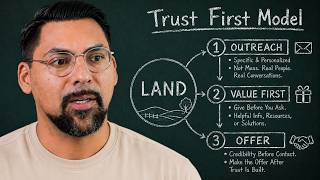
Anthony Weiler explains why mass-mail blasts and lowball offers no longer work with land sellers in 2026. Sellers have gotten savvier and skeptical, so he outlines a trust-first approach: personalized outreach, multi-touch sequencing before the offer, transparent exit strategies, and low-competition market selection instead of volume tactics.
Chapters
Alright, let me ask you something here. When did sending your marketing out start feeling like you're throwing money into the wind? Because if you've been in the land flipping space for any amount of time, you've definitely felt it. The same campaigns that used to get callbacks, those are getting ignored now. And sellers who used to be open to conversations, they're hanging up way faster now. And offers that used to get accepted, those are getting laughed at. And the instinct for most investors is to just send more, more mail, more texts, and more calls. But here's what nobody in the space is willing to say out loud. The tactics aren't failing because land stopped working. They're failing because sellers in 2026 are a completely different audience than sellers were in 2021. And the gap between the investors who understand that specific shift and for the ones who don't, it's getting wider every single month. And in the next 20 minutes, I'm going to show you exactly what changed, why it changed, and the framework that the investors who are still winning are operating from right now. And it's not what most people in this space are talking about. My name is Anthony Weiler and I I've personally analyzed over 1,000 land deals across 50+ counties, and I've coached over 300 students through their first high-ticket land transactions, which means I'm not looking at this from just my own deals. I'm seeing patterns across hundreds of active investors in different markets, different states, and different experience levels all at the same time. And what I've been watching happen in real time over the last few years is a thing most people in this space are either ignoring or flat out refusing to acknowledge. So one, what the old way actually was and why it worked. Why it's breaking down right now and the framework that's replacing it in 2026. So first, I want to be completely fair to the model that built this industry because the old approach wasn't wrong. It worked. And for a specific window of time around 2019 through 2022, it worked really, really well. And the core logic was always sound because you find motivated sellers, you buy below market value and sell roughly at market value. Now, that logic is not what's broken. That logic is still correct. Now, what defined the old approach was how you executed that logic. It rested on 3 key pillars. So pillar number 1 is going to be the mass blast approach. So you send as many pieces of mail as possible, text as many landowners as possible, and make as many cold calls as possible. Sound familiar? The thinking is simple. The more people you reach, the more deals that you'll find. Now, the second pillar is blind lowball offers. Send an offer anywhere from 30% to 40% of perceived market value before you've even spoken to the seller, before you built any kind of relationship, and before you've given them any reason to trust you. Just Here's a number, take it or leave it, and that's it. Now, the third one is speed over relationship. You get it under contract as fast as possible and you figure out the rest later. Two-week close, quick cash, and sign here. And again, for a period of time, this generally worked. And because sellers hadn't seen it before, the first time you got a letter in the mail from a land investor, you didn't know what it was. You might be curious, you might even be interested, and the competition was low enough that your offer was often the only one that they had received at the time. And the seller didn't know what their land was worth. The investor did. And that gap was what gave you the edge. But here's the thing about edges. When enough people discover them, they disappear. This is important. I want to give this a name because when you can name what's happening to you right now, you can actually do something about it. Because what we're experiencing right now in 2026 is what I call the seller sophistication curve. And it's simple. Sellers are no longer the same audience that they were 4 years ago. They've been marketed to repeatedly by dozens of investors using identical tactics. The same envelope, the same letter format, the same generic headline, the same text message templates that every course in this space teaches. They know what a blind offer envelope looks like before they even open it. They know what a generic "We buy land" text message means the second it hits their phone. And they've heard "I can close in 14 days" from 5 different investors who didn't close in 14 days. And the information symmetry that made the old model work, it's gone. Sellers in a lot of these markets now know roughly what their land is worth. They've Googled it, they looked at Zillow, and they've talked to their neighbors who've sold. And this changes everything. Now, here's where it gets worse. When every investor looks and sounds exactly the same, sellers don't choose the best investor. They choose the highest price because that's the only differentiator that they can see. So what happens? Investors start offering more to compete. Margins compress, and deals that used to make sense at 50% of market value now require 65%, 70% offers just to get the conversation going. And your profit on that deal just got cut in half. That margin squeeze, that's not bad luck. That's the direct result of a market where the trust has been destroyed and the price is the only language that's left. And there's one more layer to this. The land flipping space has an extremely low barrier to entry. Anyone can take a course, pull a list, start sending mail and text messages next week, and a percentage of those people overpromise and underdeliver. They tell sellers that they're closing weeks and then they disappear. They get a property under contract with no real plan to fund it and they back out of it the last minute. And every single one of those interactions makes it harder for you because now you're not just a land investor, you're a land investor that a skeptical seller is measuring against every bad experience that they've ever had. You start every conversation at a deficit. You're not at zero trust, you're at negative trust. And the answer most investors reach for— send more. But if the root problem is trust, volume doesn't fix that. Sending more generic outreach into a market that's already burned out on generic outreach That doesn't get you more deals. It accelerates the problem. So what actually works? I call it the trust-first approach, and the shift is fundamental. The old model said reach as many people as possible and ask them to do something immediately. The new model says give value before you ask for anything. That's the framework shift. But let me make this specific because give value first sounds abstract until you see what it actually looks like in practice. So first, we need to be specific over generic because generic outreach says Hi, I'm interested in purchasing your land in Lee County. Can we talk? And the trust first outreach references the specific parcel, the specific layout of the land, and the specific situation the seller might be in. It shows before they've even responded that you're not a bot, you're a real person who actually looked at their property. Now, that one change alone separates you from 90% of other investors in their inbox. Number 2 is multi-touch sequencing that builds familiarity because the old approach was one letter, one offer and you moved on. And the Trust First approach builds a sequence. The first touch is where you introduce yourself and you show that you know the property. And the second touch is where you follow up with them and you give them some information, some sort of value. And the third touch is where you actually present the offer, which by at this point they heard from you twice already. And by the time the offer arrives, you're not a stranger. You're the investor who actually took the time to work with them. Number 3 is transparency about your exit strategy. And this one is uncomfortable for a lot of investors to here, but it's one of the most powerful things that you can do is that you need to be transparent with the seller about how you operate. You're not hiding the fact that you'll resell the property. You're explaining exactly how it benefits them. A quick close, no realtor fees, and no waiting 18 months. Sellers who feel like they're being deceived, they'll back out. And sellers who feel like they're working with someone straight with them, they'll close. Now we have market selection as a trust reset. And here's one of the most practical things that you could do right now if your response rates are suffering. Leave the saturated markets. If you're marketing in a county where 10 other investors are hitting the same list, the sellers there are burned out. No amount of better messaging will fully overcome that. But there are entire counties right now in the Midwest, the Southeast, where almost nobody is working because sellers in those markets haven't been burned. They haven't gotten 5 identical texts this month and they don't have their guard up. You walk in with a professional, personalized, trust-first approach. And you have a competitive advantage that feels almost unfair. Fresh market plus trust-first approach. That's the combination that's winning in 2026. Now we have content and branding, and this is the longer game because the investors who are going to dominate this space over the next 5 years are building something that compounds. When a seller has seen your YouTube video, when they've read your content, when they recognize your name because you've shown up consistently in their world, they don't put you in the same pile as the generic mailers. They call you. You don't have to outspend the competition, you have to out-trust them. And right now, almost nobody is doing that in this space right now, which means the window to build that position is wide open. But it won't stay open forever. So before you do anything else, I want you to do one thing— not a checklist, not 3 action steps, just one thing. Go pull up the last outreach you sent to a seller— a text, a mailer, voicemail script, whatever it was— and read it like you were the seller receiving it and ask yourself one question: would I trust this person? That's all you need to ask. Not does this technically work, not is this compliant, not did someone on YouTube tell me that this converts. Would you, knowing what you know now about how saturated this market is, would you trust the person who sent that? And if the honest answer is no, you know exactly where to start. Not with the bigger list, not with a higher volume campaign. With that message. That's the root. You fix the root and everything built on top of that gets better automatically. And here's what I want to leave you with: the trust crisis in this space is real, but it's not a threat to everyone equally. It's a threat to investors who keep operating like it's 2021. And for the investor who understands what's actually happened and adapts to this moment, it's the best opportunity this space has seen in years. Because when the crowd is still doing the old thing and you're doing something fundamentally different, you don't have to be louder than them, you just have to be more trusted than them. And that's the race that you can win. Regardless of your budget and regardless of how long that you've been doing this. Now, the trust-first approach only works if you're in the right market to begin with, because even the most personalized, credible outreach falls flat in a county that's been burned to the ground by hundreds of other investors. The market selection process is what makes everything else I showed you today actually function, and I broke it down exactly how to find those markets, the ones where sellers haven't been burned, competition is low, and deals are still moving, in the free training that's linked right here on your screen. That's the next place, and it's the one most people skip, which is exactly why most people keep struggling. So watch it now, and I'll see you there.
More from Anthony




How Vincent made $76,000 in profit with High Ticket Land Flipping while working a 9-5