The Real Estate Playbook is Dead. Do This Instead.
Anthony Weiler argues traditional real estate investing is broken for new investors and pitches land flipping instead: buy undervalued rural parcels near growing cities from motivated sellers, fund deals through partners, and flip for $25-$40k profit per transaction. Startup costs run $3-$5k with 7-10 hours weekly.
Chapters
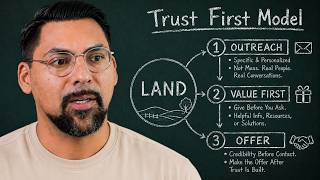
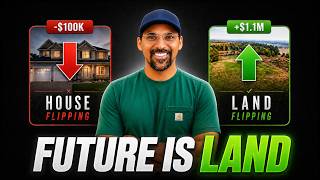
If you've ever looked into real estate investing and felt like every single path forward either required more money than you have, more time than you have, or more risk than you're willing to take, you're not wrong. Because the traditional real estate playbook that people have been following for decades now— buying a property, getting a mortgage, renting it out, and collecting passive income— that's dead. And in the next 15 minutes, I'm going to show you what replaced it. A model that most real estate investors have never looked at that requires no mortgage, no tenants, and no renovation budget. and it also puts $25,000 to $40,000 of profit in your pocket on a single transaction. My name is Anthony Weiler, and by the end of this video, you're going to understand exactly how this works step by step from the first contact with the seller to the wire hitting your account. So let's get into it. Now, let me be direct with you about something that most real estate content will not say out loud. It's that the rental property model is dead. Not struggling, not harder than it used to be. Dead for the average person trying to start from scratch today. And here's why. So to buy an average single-family home as a rental property today, You need a minimum of 20% down just to get a conventional investment loan. So on a $350,000 house, which is close to the national average today, that's $70,000 out of pocket before you paid a single closing cost. Then we have to add your closing costs and your reserves that the lender requires and work the property needs before a tenant actually moves in. So you're realistically looking at $80,000 to $100,000 minimum just to get started. Then what happens after that? You have to find a tenant and the tenant becomes your business. So think of maintenance calls, vacancies, late payments, the 3 AM phone call because the furnace stopped working. And after all of that, in most markets today with current interest rates, the monthly cash flow on a single rental property after mortgage, taxes, insurance, and maintenance is close to zero or negative. The math that made rental properties work in 2012 or 2015 does not exist in today's market because the model is dead. So next up we have fix and flips, which unfortunately are also dead, at least for the person who doesn't already have contractor relationships. Deep renovation experience, and at least $100,000 or more to deploy. Material costs also went up dramatically and they stayed up. Contractor availability is a constant battle. We also have carrying costs with current interest rates that eat your margin while renovation drags. And we haven't even talked about the competition yet. We're talking about institutional buyers, experienced flippers with decades of experience and relationships that probably had an HGTV show at some point, and they could see deals way faster than you can, and they sure as hell can move way faster than you can. So one bad estimate, one contractor who doesn't finish, one market softening while the property sits, and your profit becomes a loss at that point. So now let's talk about wholesaling houses, which is where you get a property under contract and you assign it to a buyer for a fee. And this went from a genuine opportunity to one of the most crowded entry points in all of real estate today, because it's the same markets, the same list, the same offers from hundreds of different investors competing for the same deals. And the average assignment fees have compressed significantly because of the competition. And the marketing costs required to generate consistent deal flow make the numbers much harder than the YouTube math actually suggests. And if you've looked at all these options and you felt stuck, that's a completely reasonable feeling to have because for those options, for most people starting from scratch today are either dead or dying. Now the question is what replaced them? Land flipping is simple because you find people who own land that they don't want and you buy it below market value and you sell it to people who want it at a profit. That's the entire model. You buy low, sell higher, and you keep the difference. And the reason this works and the reason it works consistently comes down to one specific type of seller. So let's start with Profile 1, which is the inherited landowner, which is how I acquired my first deal in Lee County, Alabama. So someone's grandparent or parent left them 10 acres somewhere that they've never been. They live in a different state and they have no plans to build on it. And they're paying property taxes every year on something that they've never seen. They don't want to list it with a realtor and wait 18 months and pay commission. They want a check and the problem off their plate. So profile number 2 is going to be the forgotten landowner. So someone who bought land 20 or 30 years ago thinking that they would retire there or build on it, and they just never did. And the idea that they had in 1995 just never materialized. And now that they're older, they just want to cash out. So an example that I have was 10.5 acres that I closed in Perry County, Ohio. Older gentleman wanted to build a cabin retreat for children and just never got around to it. And the land was overgrown and wanted to get rid of it. Now, for profile number 3, we have the burdened landowner. So you're paying a very small amount of taxes every year on raw land and there's no income for it. There's no use for it. It's a pure financial drain with no upside for them and they just want out. And these sellers exist by the millions across the United States. The land just sitting there isn't going to fix anything and they're not going to wait 18 months to list for a realtor. They'll gladly accept significantly below market value because the alternative to them is continuing to pay taxes on something that gives them nothing when they need cash now. So here's the basic math for you. So let's say something's worth $100,000 on the open market and you buy it for $45,000 to $55,000. and you want to sell it anywhere from $80,000 to $90,000. So it's priced below market value so it moves quickly. And that difference is your profit. So one transaction, you're looking anywhere from $25,000 to $40,000 of profit on one deal. Now, before I walk you through exactly how this model works, I want to answer the question you're probably already asking yourself now, which is why land? Why not a different type of property? So reason number one is that land doesn't depreciate. So a house has a foundation that can crack, a roof that needs replacing every 20 years. Plumbing that fails and systems that break. Land has none of that attached to it. It requires zero maintenance and it doesn't call you at 3 AM. And God isn't making any more of it. The supply is permanently fixed. Reason number 2, which is my favorite, is that there's no tenants, no contractors, and there's no banks you have to deal with. When you buy land below market value and sell it, there's no tenant to manage, there's no renovation budget that can blow out. And for most transactions at this price point, the end buyer is not getting a traditional bank mortgage on raw land. The transaction is simpler, faster, and cleaner than almost any other real estate deal. And reason number 3, which is very important, is that there's almost no competition compared to all other real estate. 95% of real estate investors focus entirely on houses. They are all competing for the same properties in the same markets with the same strategies. Now, the rural land market, specifically 2 to 30 acre parcels in the right counties, has a fraction of that competition because most investors walk right past it. And that gap is your opportunity. Now, reason number 4 is that this is done entirely from your computer. Every single step of this business happens remotely. So finding property is done with data tools. You're contacting sellers through text, phone, and mail, and you're evaluating deals done through mapping software and county records. And selling the property is done through online platforms. And I've closed deals in states I've never even visited on land I've never physically seen. So let's get into market selection, because not every county in America is the right market for this model because we're looking for specific signals. So land that is actively selling, ideally selling on average 90 days or less, and in areas where people are moving towards, not away from. The target is 1 to 3 counties removed from a growing metro area, but we need to be rural enough to where the competition is low. So close enough to a city where buyers exist. So let's think of outside Columbus, Ohio, outside of Nashville, outside of Charlotte. This is where the model works consistently. So once we have our markets identified, we have to build your list. So you pull records of landowners in your target county using data tools specifically built for this. Then you filter for the most motivated profiles. So think of out-of-county, out-of-state owners, people who own land for 5 years or more without selling. There's no debt on the property. And these are the people most likely to accept an offer that works for you. Now, once we have that list, we need to start reaching out to sellers. So think of text messaging campaigns, cold calling, and direct mail. And the goal of outreach is simple here. We find the people who are open to selling, and most of them won't be. We're looking for the ones who are. And the nice thing is modern tools automate the initial contact and follow-up sequences, so that doesn't require you to be manually sending messages all day. Now, step 4 is being able to actually evaluate the deal. So when a seller responds and is open to a conversation, you have to evaluate whether the numbers actually work for you or not. So you have to look at what has similar land sold for in this area recently, how fast is it selling, and what can you offer to still have a healthy spread. That is the core skill of the business and it is learnable. Now, step 5, we have funding the deal. And this is the part that surprises most people for some reason, because you don't need your own capital to close these deals. 75% of first high-ticket land deals are funded by joint venture partners or transactional funders, not personal capital. So here's how this works. So with JV funding, a partner funds 100% of the purchase price. You just have to find the deal, you manage the sale, and you split the profit. They bring the money, you bring the deal. And with a double close, a transactional funder wires the purchase price on the closing day and the end buyer's funds, repays them the same day. You just keep the spread from that. And the fee for a double close is typically half a percent and at the very high 5% of the purchase price. Either way, you're not draining your bank account to get into this business. So you list it below market value so it moves quickly through a flat rate broker on the MLS, which automatically connects to Zillow, Realtor.com, and Redfin. You also want to list on land.com and Facebook Marketplace because your buyers are families looking to build, recreational buyers, investors, and people who love cities and want land that they can actually use. So price it correctly in the right market and it sells. Sells. Now, step 7, which is my favorite, is the actual close. So a title company or closing attorney is going to handle the transaction. The seller gets paid, and most importantly, you keep the spread and you just move on to the next deal. Now, let me make this real for you. A 10-acre parcel in Perry County, Ohio, purchased for $55,000, sold for $95,000. That's a profit of $40,000. And a 5.1-acre lot in Muskingum County, Ohio, purchased for $40,000, sold for $82,500 in 2 months. That's $32,500 in profit. And the crazy thing is, these are not exceptional deals. These are an example of what this model actually produces in the right markets with the right approach, because our average net profit per deal is $25,000 to $40,000. So 2 deals a year is $50,000 to $80,000. 4 deals a year is $100,000 to $160,000, all while keeping your current job, all without a mortgage, without a tenant, without a renovation budget that can blow out on you at any time. And the startup cost for your first marketing campaigns, the data tools, the outreach platforms, the basic business setup runs $3,000 to $5,000. That's it. Not $70,000 for a down payment, not $100,000 for a renovation budget, just $3,000 to $5,000 to get your first marketing campaign up and running. I want to be straight with you about this because this is not for everyone. This works for someone willing to put in 7 to 10 hours a week consistently, and it works for someone comfortable enough learning a systematic process and making sure that they follow it. It works for someone who can handle the fact that most sellers are going to say no and understand that that's just part of the model, not a sign that it's broken. And it works for someone looking to build real income from a real asset class, not a shortcut, not a lottery ticket, because this is a real business. It requires real effort and it produces real results for the people who treat it that way. And if you come here looking for something passive that requires nothing, this is not that. This is not for you. But if you came here looking for a legitimate model that most investors have completely overlooked, with lower barriers to entry, less competition, and higher profit per transaction than almost everything else in real estate today, you found it. The traditional real estate playbook— the mortgage, the rental, the tenant— is dead for most people starting from scratch today. Land flipping is what replaced it. A real business, a real asset class done entirely from a computer with no tenants, no contractors, and no mortgage required. And if you want to go deeper, the next video is sitting right there on your screen. So click it now. And if you want to go even deeper with me directly, take a look at any of my programs. The link is right below in the description, and I'll see you in the next one.
More from Anthony




How Vincent made $76,000 in profit with High Ticket Land Flipping while working a 9-5