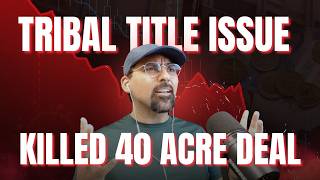
A 40-acre land deal in Oklahoma fell apart when the title company discovered a tribal claim on the property, costing the narrator $75,000. The tribe disputed the original transfer and refused to negotiate, forcing the deal to collapse. The experience taught him to always trust title companies when they flag issues and to research tribal claims in abstract states.
Chapters
I was about to make $75,000 on a single land deal. I had 2 sellers ready. The contract was signed. A buyer was lined up. Everything was clean. Then the title company called me and said 7 words that changed the entire deal. There's a problem with the tribal claim. So this was in Seminole County, Oklahoma. There were 2 parcels and 40 acres in total side by side that were owned by 2 brothers who lived out of state and had held the land for years and just wanted to get rid of their property. Both of them answered my outreach and both of them were happy to sell. There was no tension, no hesitation, and no strange backstory. And if you've ever done land deals before, you know how rare that level of alignment is. We had the signed agreement within 2 weeks and the projected profit on this looked really strong. The comps were clean and the buyer demand was there in this county. It felt like the kind of deal that every beginner dreams about. And that is exactly why this lesson matters. Once the contracts were signed, everything moved to title. And in most states, that means a title search and title insurance. But this is Oklahoma, and Oklahoma is different because it's an abstract state. That means you just don't look back a few years. You look back decades, sometimes even over a century. Every transfer, every lien, every dispute, every encumbrance in the history of that land. We paid a few thousand dollars for the abstracts and the legal review, and that's normal in an abstract state. And a week later, the title company called me. They told us there was a tribal land dispute involving the parcel's history. So the tribe believed their original transfer decades ago was invalid, and they were working through the legal system to reclaim it back. And that's when the title company told me clearly, they're like, we can't insure this land. This deal cannot close. So there are moments in this business where the room gets quiet and all you feel is the weight of what you just heard. And this was definitely one of those moments. I'm not someone who gives up the moment a deal gets complicated. So I ended up reaching out to the tribe respectfully, professionally, and looking for clarity. I'm not trying to fight their claim or negotiate against their position. I just wanted to understand if there was any legal path forward that honored their rights and still allowed the sale. They were respectful. They were clear. And the answer, unfortunately, was no. They were pursuing their claim and didn't want the land transferred. The deal wasn't delayed. The deal wasn't repairable. The deal was just simply over. That's that. So we lost a few thousand dollars in abstract cost and we lost weeks of work. We lost a $75,000 projected profit. But the biggest loss out of all of this was the opportunity, because while we were focused on this deal, we weren't working on anything else. And emotionally, as a business owner, that was a gut punch. No investor enjoys watching a deal collapse after putting everything into it. But this moment right here forced me to become a better operator. And that is why I'm sharing this with you today. The first lesson that I learned from this is that sellers don't always know what they own. The brothers weren't hiding anything from me. They genuinely believed that the title was clean. Most landowners do, especially if they inherited the property or bought it decades ago. Their belief is not the same as legal reality. And that's one of the many reasons why there's title companies and closing attorneys. The second lesson that I learned was that abstract states require a higher level of caution because abstract states expose issues rooted deep in history. You could spend money before you even know if the deal is clean. This is normal, but this is also the part that scares beginners if they're alone. And it makes complete sense because you don't know what you don't know. The third lesson is to trust your title company when they say a deal cannot move forward you're going to want to believe them 99% of the time. They're not being dramatic. They are protecting you from lawsuits, future buyers, and legal liability that can follow you for years. If we had forced our way through, the consequences would have been severe. I also learned that professionals walk away. A beginner sees the dead deal as failure, but a professional sees that as protection. You don't need to win the game by forcing every deal to close. You're going to win the game by closing the right deals, the clean ones, the safe ones, the ones that protect everyone involved. Now, this is why Beginners need support because none of this information came from YouTube University. None of it was obvious, and none of it was something a beginner could just simply figure out on their own. This deal taught me how complex land can be if you try to navigate it alone, and that's why I focus heavily on clean title, safety diligence, and legitimate investing. There's no shortcuts and there's no hacks to this. This deal ended up making me sharper. I ended up adding tribal research to my due diligence for certain states, and I changed the questions that I asked for sellers. I set clear expectations with partners. Refine my checklist, and I strengthened my relationships with title companies. Every improvement I made afterwards came from losing this deal, not winning one. And those improvements has helped me close dozens of clean, safe, profitable deals since then. Not every deal is a win, but every deal teaches you something that makes the next one easier. If you want to learn how to work through deals safely and understand title issues and build a real investing foundation, I built a free community where I break down deals like this in detail. You'll find real case studies, real due diligence checklists, and real conversations about what can go wrong and how to avoid it moving forward. The link is in the description and I'll see you inside.