The Not-So-Secret Insights on all things AI and Marketing with Google Canada
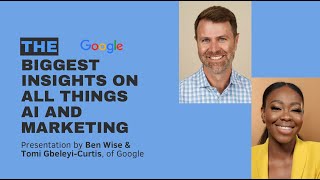
Google's Tomi Gbelay-Curtis and Ben Wise break down how Gemini and AI tools are changing marketing. They frame AI as a multiplier across three areas: matching customer intent, adapting creative across formats with generative AI, and measuring results in a cookieless world. The core shift: marketers need real-time social and search monitoring instead of static calendars.
Chapters
Hi everyone, I am Tomi Gbelay-Curtis. I'm part of the partnerships team on Google Ads team. And prior to joining Google, I bootstrapped a beauty company that was featured in Vogue, The New York Times, and several publications. And that gave me firsthand experience into growth marketing.
All right, my name is Ben Wise. I've been at Google for almost 13 years. I lead the programmatic media sales team. It's my first time at TechTO, and it's nervous enough being in front of such a big crowd. Thank you. But the vibe of that open mic was just so much energy and so much goodness that now I'm doubly nervous. So thank you very much for that.
Yeah, definitely awesome vibes. So let's definitely, let's get into our conversation for today. We used some help today to craft our agenda. We used Gemini. How many people in the room have heard of Gemini? Oh, wonderful. Quite a number of us. So Gemini was our co-creator for today's agenda. And the first question that I asked Gemini was, what are the key areas that are going to equip marketers with the best tools for the future? And these are some of the trends that Gemini mentioned that marketers need to take notice of. One was personalization at scale. Two, interactive and immersive experiences. 3, the evolution of influencer marketing. 4, the rise and continued rise of short-form video. We only have 10 minutes today, so we can't get into all those topics, but what we are going to discuss is the swift shifts in consumer demands that are going to impact future marketing decisions. And of course, AI. I think we can all agree that AI is a bit more than a buzzword now. It's more than an acronym to throw in your pitch decks and in your company name to boost valuation. AI is here to stay, and it's going to influence how consumers interact with brands. So this is just an example, just showing you proof that I did use Gemini for today's event. So let's unpack some interesting trends. I want us to travel back in time and think of where you were in the early 2000s, like the Y2K era. If you could anticipate what buying behavior and marketing would be today, your mind probably would be blown away by the way we interact with brands and the way consumer buying patterns are today. So how can we prepare for that? For 20 years from now when we are in the future and we're dealing with unpredictability and change. So I'd like you to imagine that you're on a roller coaster, but not really a fun one. It's dated. It's rickety. You're white-knuckling on the safety bar. And every jerk and turn, you're panicked. I would say that that's synonymous with the consumer demand journey that we see today. And the advertising landscape. So what we've seen is a number of unpredictable shifts with global crisis, viral social media trends that are creating really wild swings in consumer demand. Demand for a product can go up instantly. We saw an example with Stanley Cups, but also that demand can plummet unexpectedly as well. So what are the ways that we can deal with these wild swings? I would say one is definitely not just relying on our trusty marketing calendars, historical trends, content calendars. I know some of you mentioned social marketing, you probably are used to using some of those. What would be important is also using those live insights, keeping attention and paying attention to social sentiment, paying attention to changing search patterns. The more we can adapt to patterns as they're happening live, the better it would be for us in order to manage the change that's coming. The second would be, of course, being proactive, but not just saying that we are, but embedding that and using tools such as Gemini and AI that's embedded in Google Ads products to stay abreast of the future. The customer interaction, the ways customers want to interact with us is different. We have to adapt to the way buying behavior is today, which is very it happens in different journeys and not just a linear process. So these are just, if you look through some of these unpredictable events, what has been the impact of that? It's essentially in some cases when products are out of stock, that erodes customer trust and it impacts our relationship with those customers. I know many of you in the room are aware that Google has billions of searches every single day. But something you might not know is that 15% of those searches are brand new. There's a question that nobody has ever asked before. And I know for some of us in this room, we might be familiar with concepts like the metaverse and cryptocurrency now, but if you think about it, that wasn't the core of the conversation 10 years ago. So we need to be prepared for new vocabulary, new words that will be added into our lexicon that consumers are going to be searching for. Can someone share maybe something they've searched for that, obviously safe for work, that you don't think anybody has ever searched in the last year? So while we can use our content calendars to plan for expected events, like Taylor Swift's coming into town and how that would impact the economy, like the Olympics or the continued immigration growth in Canada. We can use our content calendars to plan those. However, the way that we can prepare for the future is with having those tools. But even though I've shared a bit about trends, at the end of the day, those timeless things are important. Understanding the consumer journey, regardless of the change, those— I want you to leave not just with the sense of we have to chase trends, those timeless pieces of understanding the customer journey, understanding what they want, making sure our value proposition is just beyond us wanting to generate profit and get exits. At the end of the day, while these trends are going to continue, those timeless pieces of our marketing strategy are going to remain. So that's basically an overview of some of the key trends that are going to impact our next couple years in marketing. And Ben is going to go over how you can use the tangible ways that you can use AI in your marketing strategy with Google, of course.
I got two mics. I'll use this one. All right. Now, I don't know about anybody else here, but after listening— a little dance here. After listening to all the, everything that Tomi just shared, is anybody else feeling a little bit scared, a little bit intimidated thinking how do we go to market? We have technology changing. We have consumer behavior having higher expectations. We have more marketing options than ever before. It's a lot to deal with. Now the upside is that our consumers, our customers that we're trying to reach have never been so connected. Which means they've also never been so accessible to us as marketers. The flip side is reaching them at the right spot has never been so complex as before. Enter Google's AI. Now, the first thing I want everyone to take away is that AI is not competition. AI is a multiplier to your business. Now, to get that multiple, to get that benefit, we're gonna talk through 3 areas. Your customer connections, how to turbocharge your creative, and how to do all of that with confidence in your data and in your measurement. Well, thank you. So let's start with how we connect with our customers. So we've already heard the consumer journey is changing. It used to be, you know, 10 years ago, it seemed very linear. Now it's basically a jumbled mess. The targets that you're trying to reach are very, very fast-moving and constantly changing. In fact, what we find is we did a study and it said that 61% of consumers looked at 5 or more different channels over the course of 2 days to make a purchase. That's doing searches, watching unboxing videos, reading product reviews, and that's the highest that that behavior has ever been, even higher in the depths of COVID when we're all sitting around in our bedrooms with nothing to do but surf the internet. So, the reality of marketing is that success has always come from this idea, you get the right message to the right user at the right time. That sounded simple 20 years ago, but today that is more complex than ever. It's a constantly moving target. The reality is that there's no level of human analysis that will be able to crunch all the numbers, crunch all the data, look at all the options that occur today with your marketing. Thankfully, AI tools are perfectly suited to do a lot of that— excuse me— to do a lot of that heavy lifting for you, adapting your marketing to meet each unique moment for your customers. From the moment they place their search, connecting the intent of that search to the right campaign, figuring out what is the right ad to show that person, and finally, how do I bid? What is the value commensurate to that user that I should be bidding on that? It's more than ever before, but the good news is that AI is already built into every one of those steps to help make that happen effectively and efficiently. But finding and reaching the right user is just half the battle. The second step is you need to show up with the right message, the right creative, and the right format for each unique moment. And when you think about all the options, it's mind-boggling. You've got text, you've got images, you've got audio, you've got video, and on and on. And then within each of those, there's a whole bunch of versions just to themselves. You take video, you break it down to short form and long form, and there's skippable, non-skippable. You've got horizontal, you've got vertical. How do you possibly manage all of that? Now, if we dive into video alone, and Tommy mentioned this earlier, consumers are loving short-form video, but we're finding this as part of a trend that kind of seems almost contradictory. On a given day, YouTube Shorts sees over 50 billion, that's billion with a B, 50 billion views on any given day. And as much as we hate to admit it, and it's not in our corporate-sanctioned speaking notes, there are other short-form video platforms as well. Now, these are quick videos that you film with the phone in your pocket. They're not scripted. They're quick. They're on the go. But at the same time, the other end of that spectrum, we're seeing users do almost the exact opposite. They are loving long-form content, whether that is my kids watching like 2 hours of MrBeast on the big screen, watching live sports, watching news, watching full TV shows. People love watching things on the big screen in their living room, and that feels kind of contradictory— short form on your phone, long form in your living room— but the reality is it's the same trend. That trend is an explosion of choice for customers and consumers. Now How could you possibly develop your creative for all of those options? It's enough to scare even the most seasoned video producers. But again, we can turn to AI, not for everything, but AI can take their human creativity, take that spark that is unique to you and your brand, and then adjust it and adapt it to all of those different places so that you can show up in those moments in the way that meets your user as best as possible. Now finally, how do we do all of this with confidence in our data and in our measurement? We know that AI, generative AI, as amazing as it is, is not 100%. It can hallucinate. You can get all sorts of wonky answers. I think a lot of this comes down to the data that you have as a company. That's what kind of goes in. So think about it. The better your data, the better the AI is going to perform. The better the AI performs, the better performance for your marketing. And that is a virtuous circle where it then creates more and more positive data in that beautiful feedback loop that gets more effective with each go. And at the same time, we know that third-party cookies are going away. And that leaves gaps in a lot of the digital measurement that people have been using for years. But we're finding that AI tools and the modeling that it's capable of doing is proving extremely effective at filling in those gaps. Kind of reminds me of like Jurassic Park, taking that little bit of frog DNA to fill in the bit of the dinosaur DNA, but it works really effectively without T-Rex chasing everybody down. So, if we can leave you with one final message, it's this. AI is your business multiplier. You are not competing against AI in your marketing. You are competing against another marketer who's using AI. Yes, Google has lots of wonderful tools. Some of those others who shan't be named also have wonderful tools that are building AI into everything that happens online. I think that's great. It gives you a lot of capability, but the reality is we are just We're in the first inning. We are just scratching the surface of the endless possibilities we can have here. And so as a takeaway, everyone will get an email tomorrow that includes a one-slide checklist to help everybody get started. It's gonna go through kind of the foundation you need to set in place, get that data in a good place. How do you update the execution of all of your marketing? And how do you think more broadly of the mindset in your corporation or in your companies that you need to leverage all of that. So we can leave you with this: please don't wait. Start acting today. Thank you very much.
The first question that we're gonna ask actually came from Gemini, so I asked it. And I asked Gemini, which by the way launched in Canada in February, February the 8th, Recently, and it's amazing. Very recently. So I ask, what should I ask the Google team about Gemini if the audience is in marketing? And this is what Gemini is asking to ask you. How do you see large language models like Gemini AI transforming the marketing landscape in the short term?
Thank you, Gemini, for the softball. No idea what was going to come up there. Do you want to? Yeah, you can. OK. So I would say I think the future of large language models is fascinating, but I don't think it's there yet for a lot of marketing. I think that idea of hallucinations for a lot of brands is just today is too risky. You can't be Nike and say, just do it 99 times out of 100 and have the last one say, just done it. You've got to say, just do it 100% of the time. Where AI is going in marketing is not going to be these massive models that do everything like Gemini or ChatGPT. Sorry, I named them Gemini or others. Damn it, damn it, don't, don't tell PR. We're watching somewhere and they're going to get me. Um, no, I, I think those are wonderful in so many ways, but also many ways are kind of novelty. And I think when you think about the most effective use cases for AI, it's going to be an AI model that is built specifically for that use case. So we walked through like the search, the bidding, the creative adaptation. All of those are going to be their own unique AI tool that is going to be so good at that one thing compared to some of those large language models, which right now are really good at lots of things but not perfect at anything.
OK, well, what we've taken away from that is never name your enemy. Never name your enemy.
Thank you.
We have 2 more questions.
That's the only thing you can— Short questions.
2 questions.
Anyone have any questions for Google?
Yeah.
Yeah, so I think you kind of touched on this.
I know we were not experts to comment on this, but how do you think marketing roles are going to be impacted with the, as you mentioned, the specific use cases for particular marketing practices in a company? And how do you think marketing roles will evolve? Do you think they'll be marketers will be aimed at using those AI tools in their roles or will replace those roles and people who are not in marketing will just utilize the tools to fill those gaps?
Yeah, I would definitely say it is the former, where marketers are using the tools. And I think that was one of the things that we mentioned where it's not that you're competing directly with AI tools, but other marketers that are adept at using it, that are curious about it, that are testing out things with the API, like Gemini, for example, like Alex was saying earlier, is available in Canada, you know, try it out. Like we have access to Gemini Advanced and you do too. You have to pay for that also. But I do think it's more about the tools, getting familiar with the tools, being adept with the tools versus AI replacing jobs. Because at the end of the day, there is a creativity that you bring to the table. And I think that even, you know, opens up, you know, when we're discussing performance marketing, you know, versus brand, there's definitely that element that we as humans bring to the to the table that I don't think that regardless of how good and impressive it is, it helped us with crafting today's conversation, you still need that human touch to connect with other humans.
Question in the back.
Hi, thank you very much for the presentation. And I really like the point about specific models that can tackle specific issues in the marketing industry. Specifically for personalization of marketing, because I also work in our company for the last 5 years to develop an AI that can find the right music based on the story of the music brief. And my question is, how do you see the future of adaptive and personalized ads and marketing for users? On the fly. So you can imagine like the user opening a video and for every specific user, they see their own video, their own sound, personalized for them.
Personalization.
Okay.
I'll take this and you can jump in as well. While that is an exciting prospect, I do think we have to balance privacy with that as well. Ben had mentioned us moving to a cookieless world and that's kind of always sort of the rub when we get to the possibilities and the wonderful tools and the wonderful outcomes that AI can do for us. I think Gemini itself had said personalization at scale is going to be a pathway or one of the tools that would be useful. But I do think we'll have to balance that with privacy as well. Like what information is that consumer giving up to get that personalized information?
The one thing I'd add there is to think about not just the technology side of personalization, but think of the user. Do you want an ad that says your name on it and says like, "Hey, we know you were at Lava's an hour ago and you forgot to buy your toothpaste." No, that shit's creepy. I remember being in a meeting a while ago where someone on the creative agency said, "Our creative idea, we're gonna go super personalized. We can't actually get people's names, but we're gonna take the 25 most common names and put those in their ads so some people will get the right name." I was like, maybe we should rethink that. I mean, most people are gonna get the wrong name, but the people who get the right name are gonna be creeped out. So I would say, to me, more of it is about what your consumers are actually wanting and what is the business objective you're trying to achieve. For the most part, the technology is already there or will be there soon. I think the real challenge is understanding where personalization, where the limits of personalization are, in terms of what your consumers actually want and actually drive business value.
Well, listen, I know there's a million questions, and we are so privileged and honored to have Google in the house. Thank you very much, both of you, for being here. They will be around, Tommy and Ben, and if you have questions throughout, please come and get them. And listen, thank you very much. You guys were awesome. I'm a bad host because I didn't introduce you properly, so I just want to make sure I remedy that a little bit. So first of all, Tommy, you've been at Google for how long?
3 years.
And you are the Senior Sales Lead, New Business. So if you're a startup and you're thinking about stepping into the space, come and talk to Tommy. And Ben, as he mentioned, has been at Google for 15 years, a long time, and you run programmatic. So all things digital programmatic, and if there's any questions, particularly with any startups that are in the room, Come and reach out to them. Okay, thank you so much.
More from Ben

The Franklin Effect: Turn Your Biggest Critic Into Your Strongest Supporter (Psychology Explained)