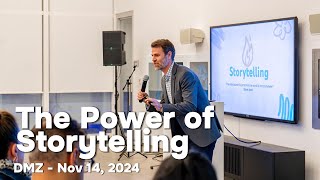
In this presentation, Ben Wise, co‑founder of Captivate, introduces the company’s mission to bring academic psychology into everyday business practice. He argues that human decisions are fundamentally emotional, not rational, and that stories are the most effective tool for accessing those emotions. Wise explains the psychological concept of reactance—people’s instinct to resist new information that challenges their worldview—and shows how storytelling acts as a “magical key” that lowers that guard. To illustrate the commercial impact of storytelling, he recounts Rob Walker’s Random Object Study, in which Walker bought 100 cheap, random items (total cost $125), paired each with a crafted story, and sold them on eBay, generating $8,000 in revenue—a 6,300% return on investment. Wise emphasizes that such ROI demonstrates the untapped power of narrative for businesses, positioning storytelling as a high‑leverage communication strategy.
Chapters
My name is Ben Wise. This is my partner in crime, Darren Chew. We are the co-founders of Captivate. We're all about taking the psychology and the research out of the ivory tower of academia and making it useful and accessible to everybody in your everyday lives and especially in the business world. Now, one of our founding principles is the idea that humans are inherently emotional. We like to think we make rational decisions and we consider facts and logic and data and all that stuff, but it turns out that could not be further from the truth. And we love stories so much because there is no way more powerful than a story to tap into somebody's emotion. Now, there's a psychology concept called reactance, which basically means If somebody tries to tell you something that's new or is different than your worldview, you put a wall up. You put up your guard. And stories are like this magical key to bring that guard down, to let somebody drop that fence in front of you so that they're open to what you might want to tell them. However, we are actually not the first people to think about this, shockingly. Um, this is an amazing study that we really love, all about the power of a story. So Rob Walker is an author for the New York Times, and he started what he called the Random Object Study. He went out and he bought literally 100 totally random, used, very cheap items. Everything was under $2. And I guess when you are a New York Times writer, you have lots of writer friends. He sent them out to 100 different people and said, can you write me a story for each one of these objects? Slowly, he got them all back, and with each object, he posted it for sale on eBay and included that story as the description. So here's one example. He took a cheap used globe that he bought for $100— or not $100, he bought it for $1.50— with the story on eBay. Anybody want to guess how much he sold it for? Oh, oh, we're back. Okay, sorry about that. All right, okay, anyways, and this was not a one-off object. It's not like this was the only one of 100. On those 100 objects, he spent a total of $125. When all is said and done, he realized revenue of $8,000. Can you name a single company in the world with a 6,300% ROI? Companies would kill for that, and that is the power of story.