2,000% Growth in Six Years: How O'Shea Trades Transformed Their Customer Journey | Podcast Ep. 105
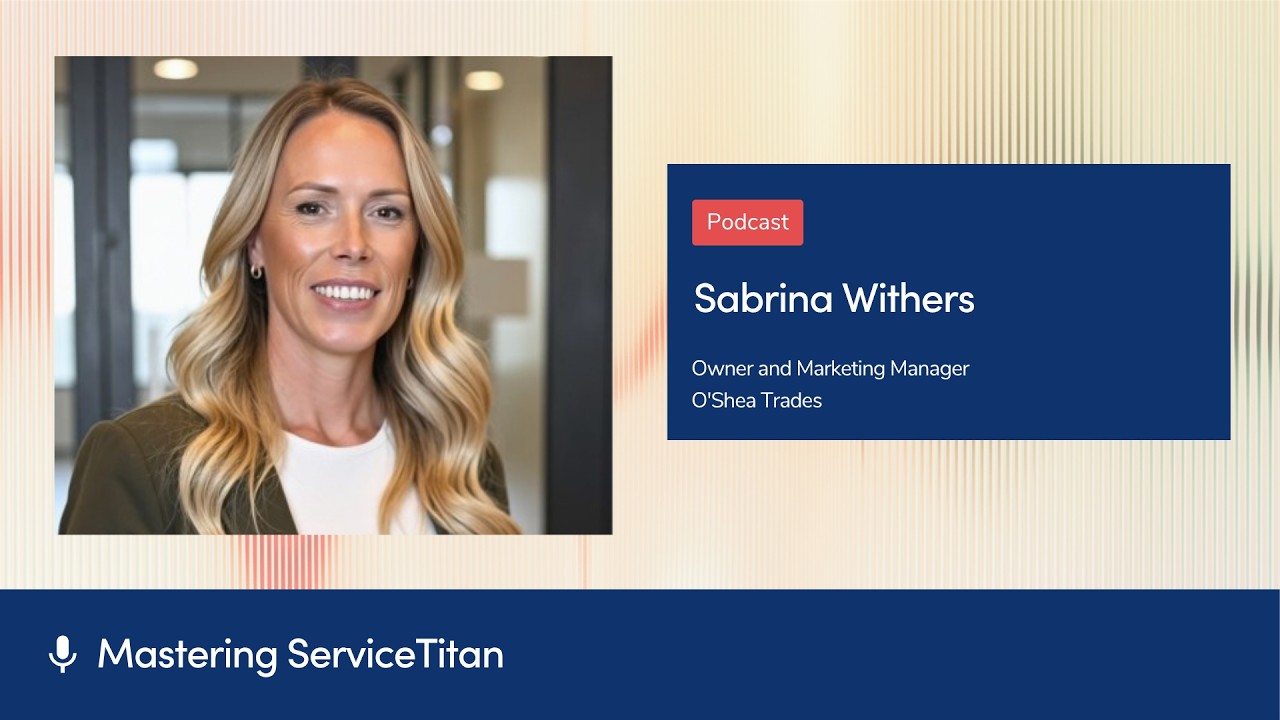
In this episode of Mastering ServiceTitan, host Josh Liu interviews Sabrina Withers, marketing manager and owner of O'Shea Trades, about how the company achieved nearly 2,000% growth over six years by overhauling its customer journey with ServiceTitan. Sabrina recounts the chaotic, data‑poor state before ServiceTitan, where labor utilization, marketing source tracking, and job visibility were opaque. After adopting ServiceTitan’s core platform, along with Marketing Pro and Scheduling Pro, O'Shea gained end‑to‑end visibility of every touchpoint, automated workflows, AI‑driven communications, and precise ad‑to‑revenue attribution. The conversation dives into practical tactics: building marketing automation workflows, designing quote‑follow‑up sequences, training CSRs and technicians in emotional‑intelligence‑based referral asking, creating effective leave‑behind brochures with QR‑code tracking, and using audience segmentation to route customers into the right automated journeys. Sabrina also explains how O'Shea rebranded from a plumbing‑only business to a multi‑trade service, using gentle cross‑sell messaging and a 1‑to‑10 value‑to‑price philosophy. The episode wraps with actionable advice for other trade marketers: start messy, iterate, empower field staff, and focus on transparent, value‑first communication.
Chapters
We've got to be there as the guide, right? We don't need to be the superhero. We don't need to save the day. At the end of the day, the customer knows what they need for themselves, for their home. It's just up to us to give them the different options so that they can look and say, actually, yeah, this is what suits best for us.
Welcome to Mastering ServiceTitan, where you get expert advice from power users. I'm your host, Josh Liu, and today I'm joined by Sabrina Withers. the marketing manager and owner at O'Shea Trades. We are diving into the topic of improving your customer journey as you scale your business. So Sabrina, welcome to the show.
Thank you. Thank you so much for having me on.
I'm so excited to have you on. You're the first customer we're talking to from Australia, and it is morning over there and afternoon for me. So first time to talk across such a large time zone change. Excited to dive in, but for people who don't know you, could you maybe share a quick intro of how you got into the trades and O'Shea in general?
Yeah, absolutely. So about 15 years ago, my husband, then partner, decided that he wanted to get into a hands-on job, wanted to get into the trades. It was recommended that either he be a plumber or an electrician. They're the best trades to get into. And yeah, decided to jump into plumbing, which was pretty cool. So he did his apprenticeship, finished up his apprenticeship and decided that the journey of entrepreneurism was for us. So yeah, jumped in, started our own business. And then about 6 years ago, we were introduced to home services through the acquisition of O'Shea. And yeah, with that, it's just been a whirlwind, a big, big journey, big learning curve, but it's been pretty cool.
And last time we talked, you shared this insane percentage growth over the last 6 years. Could you just brag a little bit about the growth and scale that you guys have had?
Yeah, we've had about a 2,000, just shy of 2,000% growth over the last 6 years, which is Yeah, pretty insane to reflect upon, but a pretty good reflection upon how many people we've been able to help, how many homeowners we've served, and yeah, how many team members we've been able to grow too, which is pretty cool.
I'm curious to know, maybe you can paint a picture of what the customer journey was like before ServiceTitan, and then we can contrast that to what it's like now and then share some tips and tricks for people. But if we rewind the clock, what was the customer journey like before ServiceTitan?
There wasn't really a journey. There was a lot of things happening for the customer. There was a lot of thoughts and ideas on how, how we should be running it. We'd always run off training systems and been educating our team, but there was no clear data or clear system or flow to what we were doing. So a lot of the time we thought we were doing something that wasn't actually occurring. Whereas when we brought in ServiceTitan, you can see every touchpoint of the customer journey. So we know there's There's automations, there's workflows, it's a system and a process which has allowed it to be duplicatable and hence the growth that we've had within the company as well, which is pretty cool.
Right. Do you remember any specific areas of the business where you didn't have visibility or maybe parts of the job cycle that you were like, I'm not really sure what's going on there? Or do you remember?
Yeah, there was a lot of parts. There was definitely a lot of parts, probably from getting on the ground, having the labor utilization visibility. You think that you're doing well and then realize you've overloaded a guy. like a job with too many guys on the site through to your marketing visibility. You've got no idea where someone's coming from. So now we can sort of see the whole customer journey from the first touchpoint of where they've spoken to us to where they've called to every attribution within the job, which is definitely what allows you to scale it, right? You can see exactly from, you know, if we track backwards through the journey with the customer, if we want to achieve this sort of growth, we go back on numbers here, we go back on numbers here, you know, and the input for it would be. more marketing leads in this one specific area and we know what it's going to result in at the end, which is pretty insane transparency for, you know, a mom and dad business that we'd started ourselves and just sort of grown tips and tricks along the way to be able to have that sort of visibility and also to teach it forward to other people. Like, it's pretty cool now.
Right. Can you paint a picture maybe now of what the customer journey is like with ServiceTitan and all the cool things that you've implemented to make it really smooth?
Well, there's a lot of cool things. There's definitely a lot of cool things. And it's definitely pretty daunting, like for other people who are watching or hearing this, I know how daunting it can be when you're looking at bringing in a new system and you're like, I don't know if I can do it, but we've been very fortunate how supported we've been along the way, not only with ServiceTime, but with the community as well, which has been pretty cool. From the start, you know, seeing the transparency in how our Google Ads are performing now, which is something we would never had. You could see it from Google point of view, but not see it going into your system. From that to the automations, the AI automations are pretty insane. Yeah, workflows and systems, like there's just a clear process behind everything as well. And I think having a system that allows you to plug in and see everything seamlessly definitely helps. Then it flows into, you know, our finance team, it flows into our operations team, like they've got visibility. about what they're doing too, which is awesome. I think my area of genius is marketing, right? So for me, having that, the data and the attribution is not something that I would have thought even 3 years ago it could have been possible to know like we know it now, which is awesome. Wow.
Yeah. Let's dive into some of the marketing. So before you said you would have Google and it would be a separate platform. You could see performance just within that little silo and it was completely disconnected to what was happening. Like with your customers and how like revenue that you're bringing in.
Absolutely. And because, so you look on the Google Console platform and you can see all the data and it will tell you who's looking at it, it will tell you what's performing, your clicks, everything else. But when you go into your, your CRM or into your own system internally, you can't see how it connects. You can't see how those pieces join. You can't see the revenue attribution. It's at best a gut feel about how it's actually performing. Whereas now there is attribution where you can see exactly which customer came from which ad, what the conversion rates are like. You can see which sales technician on the field or in the field has been the person to convert those based on which ads they were. So there's very, very clear metrics that allow you to duplicate what you're doing already, which is pretty cool.
So you guys are on Marketing Pro, right?
We are on Marketing Pro.
Cool. Yeah. What was like the first few big challenges or like improvements that you made when you adopted ServiceTitan and MarketingPro that you wanted to fix like right away?
The first challenge was just really getting my head around the capabilities of what we were about to install and what we were about to run with. Because so often you can see something on a surface level, you send out a letter and the letter's physically there and you can see what's going on. And so when you're going to implement something where there's a lot of backend work, it's very treacherous, very hard to work out. So I think for us going back and saying, okay, if we want to have these communications with the customers, at what point do we want triggers? At what point do we want to send it to certain people? Who should it be touching? So working out that whole customer journey of if we were having a conversation with the customer, what would it look like? And how do we carry those conversations to a platform essentially where it's run by automation and AI? So yeah, for us implementing that was a really big change. And even now having conversations with other business owners and they're like, how did you do it? What, you know, how did you feel about it? And again, it's just like, we'll just take it back to if you were having a conversation with someone, how would you approach the conversation with someone? You don't want to go out and, you know, if you're having a face-to-face conversation, you're not going to go give them a piece of catalog or something to look at. You're going to have a conversation naturally. So in every touchpoint of your marketing. Keep it the same conversation, the same care, the same, you know, the same essence of what you're doing. So.
Can you share a little bit about what that conversation might look like, maybe for on the prospecting side when you're trying to find new customers for the business?
I don't know. So conversational-wise, it's very different. So I will point out the difference between how it's done in America and how it's done in Australia. We don't have the privilege, I would say, or the availability to go out and to buy lists. So for us, they are very, very strong on You need to get people opted in. You can't just go and access lists of data, databases of people. So for us here, our prospecting would be really around cold market conversations, referral, really building out based on our existing database of customers, because you literally just can't go out and have a conversation and cold email someone. So for us, a lot of it has been built out on our existing customers and then also looking at where our customers hang out. So having conversations with our customers, getting to know them. If they say that they found us online and it's not something we've been able to track very easily, it's been about trying to work out how we do find out where they came from. So using unique tracking phone numbers has been a really big one for us, putting the tracking links into different sources as well to see the customer journey. Their first touch attribution is, you know, that they've jumped on a Meta ad, just being able to follow their journey all the way through. Yeah.
Wow, there's so many things I want to dive into. One is referrals and another one I'm curious about, I bet you guys are really good at cross-selling because you do so many different trades. And so I'd love to dive into those too. Yeah, maybe here in America we are a bit spoiled with those lists. So I bet you have great tips for referrals. Any advice or tips on, or strategies on what has worked really well for you guys when it comes to generating referrals from current customers?
I think our best has always been our customer service representatives and our techs out on the field. When you introduce natural conversation, You know, if a customer's had a great experience, why wouldn't they want to go and tell their next-door neighbor? Why wouldn't they want to go and tell a friend about the experience? So it's really talking to your customers and finding out for them what's the driving force for each of your, you know, each of your target markets, your customers that you're working with. What is it that drives them? Is it that they want to be able to get a $50 discount? Do they want a coffee card? Do they? You know, just having the conversations with them to find out. I think for our customers, you know, it's been very, very different. So being able to go out and say, all right, we're going to give you a free plumbing inspection on referral. For some people, that is exactly like, they're just that peace of mind knowing that their home's looked after. The fact that they've been able to help someone else and in return they've got something small as well, they've been really happy with. So yeah, I definitely would recommend getting to know your customers, having really good conversations with them and get your customer service and your techs just talking about. Talking about your business and why, like, why you, why you.
When it comes to training your CSRs and the technicians to do this and to have this conversation, are there any talking points or like points along the journey that are especially good for this moment in this conversation?
We do a lot of training on emotional intelligence. I think for some people you can quite naturally pick up and have a conversation with absolutely anyone at all. For other people, it doesn't come so naturally. So getting people to put themselves in the position of our customers, it's never a good day to have to ring a plumber. You know, if you've got an issue, it's not a good day. You're not there and it's not the same excitement as going out and buying a new car or something really fun and shiny. If you're calling, it's because you've got an issue. So to be able to give the peace of mind and wrap that experience, you know, as a 5-star experience for the customer, and then to be able to tell them You know, yes, we've been able to help you. Here's our other services that we could do to help you. But also, do you know someone else that we can help? And really putting it back to understanding people and what, you know, what feels good for people. It feels good to help other people. So I think for customers, it's pretty cool to have the opportunity too.
And then when it does come to that incentive, like you were saying, customers are motivated by different things. How do you get the technicians or the CSRs to figure out, hey, which Which things should I offer here to maybe push a little bit to get that referral?
This is one thing with any area of marketing that is just such trial and error. You just, you can't be sure what works for one's not going to work for the other and seasonal changes, things are very different, but I think it's definitely the conversation. So allowing the customer service team to not work on strict timeframes that, you know, you need to have a conversation wrapped up within 3 minutes. If it takes you 6 minutes to have a conversation to really get to the root problem, To work out how you can best solve this for a customer and how you can work in with them and what it is that they specifically need, like giving them the time to have those conversations and then reviewing the information afterwards. So if you find that, you know, you've run a promotion and it's worked really well, and whether it's a referral promotion or whether it's a free inspection for a customer, however, whichever promotion you're running, going back and really looking at the data and then deep diving into it. I think as well, in line with that, having the availability to go back and to listen to call recordings for us has been huge as well, because we're able to find out at what point there's trigger points where the customer service team has really connected with the customer and how it's made a big difference.
Do you have any recent promotions or favorite ones that have worked really well that maybe you can share about?
When it comes to like acquisition and retention segments, I think our automated emails do really well. Just general automated emails around the customer journey. So they've come into the journey, you know, welcoming the customer into the journey, what they can expect from here. After the technician's been out and done the work, it's, or even gone out and sold the work, sorry. It's around reaffirming to the customer why we are the right company, what we're going to be able to do to help and where the process lies from there. So they know what to expect. And then yeah, right through to when we've finished doing work with the customer, just getting that feedback on what the experience was like, how they found the process. How they found the team. Is there anything else we could build on to add extra value or extra, you know, extra care to the customer as well? So yeah, I think the automations are really good because it allows our customer service team that time that they can have the 6-minute conversation if they need to.
If there's someone out there who doesn't really have much of this automation set up, maybe where would you start? Like which, at what point in the customer journey would you start with if they were going to do this for the first time?
When we first started to look at how we could build our AI and how we could get it to help where we were at, we didn't want it to take away like the people. We didn't want it to take away that connection, but we looked at every touchpoint that could have been taken from an automation. And it was like, all right, if an email is going to be sent, we don't need to physically type out an email every single time. We can put that into an automation. And that's a touchpoint the customer would have had anyway. But it can be automated now. So it's really about just finding those touchpoints of things where it adds value to the customer because it keeps that connection there. It lets them know what to expect. It gives them that peace of mind. It just allows it to be less manual handling. So yeah, we quite often will look at things and we'll say, you know, what can we automate? What can we delegate? What can we eliminate? And it's like looking at the 3 of those and saying, okay, if this is our customer journey and this is the touchpoints we want to have for them. Automate number one, delegate if we can't automate. And then as I said here, if it's not relevant, don't keep it in the workflow.
Yeah, the impression that I'm getting that's really nice is that it seems like from the very beginning when a customer interacts with O'Shea all the way through the end, it seems like they just know what the next step is and what to expect at all times. Like there's no question mark or like, hey, what's going to happen? There's no uncertainty, I guess. And I'm just getting the impression it feels like you're like there holding their hand, like each step along the way. That's our job.
Home service, that's our job. We've got to be there as the guide, right? We don't need to be the superhero. We don't need to save the day. At the end of the day, the customer knows what they need for themselves, for their home. It's just up to us to give them the different options so that they can look and say, actually, yeah, this is what suits best for us. This is the best option for me, for my family, for my home.
So. So speaking of, uh, helping them with, with their needs, you guys do so many different trades. So like if someone comes to you and they're, they have their plumbing issue and they get that fixed. How do you then like gently, or, you know, they just spent some money with you guys, like how do you gently just educate them on all the other services you offer and build that long-term relationship with them?
Yeah, so it actually started from the start when we came in to do a rebrand. So we originally started as a plumbing company. We purchased a multi, like multiple plumbing companies and brought those together. And then when we decided to go multi-trades, we were like, how are people going to know who we are and what we're about? We've been known for over 40 years at this stage for doing just plumbing. How are we going to do it? And so when we undertook our rebranding, it wasn't just putting O'Shea there. Our logo is very prominent around all of the different services that we offer. So if someone sees the logo straight away, they can see all of the different services we offer. They're not left scratching their heads. What type of company is this? What do they do? From there, we would introduce different marketing materials. So all of our marketing materials will talk about all of our different services and it's A very gentle introduction. It's not like you must buy these products. It's like, hey, we also offer these. So if you've had a great experience with this, why not try this? And then really heavy with the education with our team around the cross-promotion of trades. Because I don't know, you know, for you personally, I've had some experiences with trades in my home before where I'm like, that is terrible. And I would hate for someone else to have faced that. So when someone equally has had a great experience. You want them to just go and embrace that. Like you want to feel good about having someone into your home. For a lot of people, they might not have ever had a tradesperson into their home. So it's really important for them to, you know, know, like, and trust who they're working with and really build out a relationship that's a long-term relationship, right? So it's not just you've called someone from Marketplace, they've come and done some work for you when you can never find them again. So for us, it's really about every touchpoint, just communicating here, this is who we are. This is what we can do. This is how we can help you. If you have any these problems perfect. If you have problems beyond this, let us know. If we don't do the service, we'll find you someone or recommend you or plug you in with someone who can help too. So.
Is it at every touchpoint? It's kind of like a footnote almost of like a by-the-way coverage across everything, or are there specific points where like maybe you put it more at the forefront?
There's definitely points where it's more at the forefront. So take for example, when a job is finished. So when the customer's finished, that we've wrapped up, they've experienced their 5-star service, and we have an automation that goes out and says, you know, yes, you've used us for this service, but did you know we also have these services as well? And they're quite complementary in what they're doing. So if we've just finished doing the guttering or a downpipe, so a downspout or something, I think you call it quite similarly over there. If we finish doing something like that, it might be like, all right, we can offer you a free inspection of your drains. You know, as part of the service. So it's really just connecting the dots around each part of the home.
Got it. Okay. So yeah, you finish with one thing and then immediately kind of like piggyback off of it by offering—
Yeah, just educate them. Yeah, absolutely. And it's all about the value to the customer, right? We aim to offer a 1 to 10 value ratio. So for every dollar that the customer spends with us, we aim to give $10 in value. And the value is not necessarily giving product, product, product. It can be in education. It can be in a free inspection of their home. It could be in, you know, servicing education to the customer. Did you know that the lifespan of this product is this long? These are the things you should be looking out for so that when something does happen, they're not completely blindsided and panicked by it. They're like, actually, I did know to expect, you know, that my hot water service, the lifespan on it would only be this long. So now that it's happened, okay, I'm prepared. It's not such a panic.
And then that way it doesn't feel like, oh, they're trying to sell me something. It's like, oh, we're just trying to educate you, give you more information that you didn't have before, and it's not going to cost you anything. It's like better to be informed, it seems. Do you have any stories or does anyone come to mind of a customer service representative or a technician who was really bad at generating referrals before or really bad at cross-selling before and then got good? And how did they make that change? I'm sure there's a lot of people out there who are like wishing their team could get really good at this and maybe you have some tips to share there.
I would definitely say build your marketing materials around it, right? Build your marketing materials around it because we underestimate the need for like marketing literature. So something as simple as a brochure, a brochure giving information about who we are and what we do. It's a leave behind for the customer. It's something tangible that they can sit and they can look at because it's all very well to go and say, all right, we've got all these emails. We've got all these workflows, but you see the content that's coming at us in a digital day and age, it's thick and fast. And so quite often you can look and you can scroll past it and not think anything of it. Whereas if you've got something literally sitting there on your counter at home, you'll walk past it a number of times, you'll pick it up, someone else walks into the home, they'll pick it up and have a look. So I think, yeah, when it comes to it for us, having good quality leave-behinds, just giving information about us as a company, how we can help our customers, how we can be their guide to solving the problems that they have in their home, I think is a really big one. And then just having general conversations. If someone doesn't need you, they don't know, they don't care. They're not looking for you. They have no need to be aware of your existence, but it's really about having those touchpoints there that when something does happen, they know who to call because they've already built that rapport and got that peace of mind that you are the right company.
That makes sense. Ooh, I like this idea of the leave behind. What do you think makes a good leave behind versus one that people just ignore?
Not an ice block. Definitely not an ice block. You see so often people go in and they'll They'll say, you know, here's me, here's this, and then it comes up and it's just, it's so busy. There's so much information. It's just like, whoa, it's overwhelming and overstimulating to look at. So I think quite often it's just taking a moment to step back from what you're producing. You know, if you've got it together, is there too much information there? Is there the right amount of information? Because you want enough for someone to want to engage with you without overwhelming them and them saying, well, these This is going to be a lot to deal with. So yeah, I would say definitely create something, take a step back, go to your ideal target market and to your customers and say, what do you think about this? Just have conversations, you know, where to lead this. And then also be open to testing and measuring things. You know, if you're going to create things, create a couple of things, get people to have a look, see what responds well. With ServiceTitan, we've actually got different tracking phone numbers in things. So put different tracking phone numbers on marketing material to see what gets a better response rate, which is also a really good want to be able to see.
Got it. So you can A/B test or ABC test a few brochures, but then just put a different number at the, at the end of it. And is that the call to action usually on the brochures, the phone number at the end?
Yeah, most of the time it will have the option of that and a schedule online as well. I think in this day and age, I'm very big on it. If I'm going to go to a hair salon, I don't want to be waiting until 9 o'clock in the morning to book. I just want to book and know that, that I can turn up at that time. So I think when it comes to home service, having that peace of mind as well. You know, quite often we live quite busy lifestyles. So to be able to just jump online and say, all right, this is the time I want, this is when I want it. And to know that it's no longer on the top of your mind that you need to do this, it's already looked after. So yeah, that's probably another really big call to action for us as well.
For the schedule online, do you guys, what do you guys use for that?
We use Schedule Pro.
Oh, Schedule Pro.
Okay.
So you have that on all your brochures. Do you guys do a QR code or just leave a link? For the website?
No, it's a QR code. Yeah, most commonly, most commonly QR code and then phone number for people to call. And as I said before, like with us, it's, it's been a game changer for us just having the transparency of what people prefer because it's very interesting to find for different business units, there'll be different demographics of people calling at different times of day, the services that they'll use. So whether they'll call opposed to going and schedule online, whether they will Do a chat with our website. Like there's just, yeah, having that transparency because there's so much information is really cool.
Wow. I like that. I know we went kind of deep and really nerdy on the brochure, but it's the first time I've talked about it on the podcast. So thank you for sharing your tips there. Any other like favorite ServiceTitan features when it comes to either Marketing Pro or Scheduling Pro that you think are underrated or people should know more about?
I would definitely say building out workflows. Because I know that you can send out emails as in, you know, mass marketing emails to say newsletter or this is about us, this is what we're doing. But I think working out the customer journey and the customer workflow is grossly underrated, how we can affect them and help them at different touchpoints. So yeah, I think that that's definitely grossly underestimated, just the power of the right email that's speaking directly to your customer, the difference that that can make.
Interesting. Yeah, the mass email seems like the old approach and the workflow seems way more personalized. Do you have any examples of a workflow you implemented or maybe someone, one that someone can copy and paste for themselves?
Yeah, definitely. So I would say quote follow-up is probably a really big one. So we have 3 different touchpoints of quote follow-up after we go out and we present the estimate to the customer. You say don't proceed with the estimate on the day. It's just really gentle conversational Pieces to say, you know, thanks for having us into your home. Great experience. You know, what's your thoughts and feedback? So it's just opening the dialogue to conversation with the customer. So rather than it being like, hey, we've been here, you need to buy this, it's going in and saying, all right, how could we have added more value? What could we have done for you? Have you got any questions about the process? And then, yeah, just another gentle reminder a few days later just to say, hey, we're still here. You know, we're sure you've been thinking about it. How else can we do it? But in line with that, the really, really cool thing, and I sit in the marketing side, but when I talk to our service techs and our sales team, that they can view how many times the customer's looked at a quote, which is a really good prompt to be able to see how you can better assist them. If someone's looking at it a great deal of times, is it that they haven't had all of their questions answered? Is it that they're nervous about you being the right company to execute the work for them? So it's really about how do you get that dialogue opened again?
Mm-hmm.
To give them that peace of mind that you can help them, that you are the right guy, that you do have the solution for them. So there's a lot of data, but when you learn to understand and to navigate your right way around it, it's, it's definitely a game changer.
Wow. That's interesting. So they can see like, oh my gosh, they opened it like 17 times. I'm like, I'm curious what they're thinking about. So, okay. Technician goes into the home, they create a quote, and then they walk out without the sale yet. What's the specific timing of your automations? And then how does the technician keep track of how many times they're opening it and when do they intervene?
You can set automations to let your technicians know how many times the customer has opened it so you can be alerted to it every time. Or you can have it so you log into the specific job and when you log into the specific job, it's got the information around the access. For us, we try to keep it as streamlined as we can for our team. So we allow it that if they're sent an estimate, they can log in and have a look rather than automation sent it because otherwise that can distract them from, from what they could be doing otherwise. And then in terms of our quote follow-ups, our quote follow-ups are sent out within 24 hours, within 4 days, and then within, by the end of the week. So the exact timing, I couldn't tell you off the top of my head. So.
It sounds like there's 3 touchpoints after the quote goes out within a week or so. Do you find that customers reply more to those email, the quote follow-ups, or do they reach out to the technician? Personally, or how do you guys manage those different responses?
Yeah, so we actually have got a number of different follow-up systems in our system. So we have those, we have text message follow-ups as well. And then we also outbound, so call the customer just to see if they've got any questions about things at all. And we do find that there's quite a mix. There's no set one-size-fits-all when it comes to it, because even when we do a lot of things, we will segment it per business unit to have a look at the different trades and how People respond differently, but I don't think there's a one-size-fits-all when it comes to this. It's really about building out different options and saying, okay, if we can't get a customer, some people are very busy with children and don't get the opportunity to answer phones like they would like to. Other people will see a text message and dismiss it. Others, you know, email, they're sitting at their desk at work. It's the best way to catch them. So I think building out workflows that you can catch people at different touchpoints just to let them know you're there without being spammy. Again, conversational is definitely, definitely worth the time to build out.
Okay, maybe last super detailed question, but how do you guys, do you guys use tags or like, how do you guys use something in server-side to clarify the data to put the right person into the right workflow? Does that make sense? There's so many trades across so many stages with your business in particular. How do you make sure the right customer is in the right automated workflow?
Very good question. So the audience segmentation, the audience segmentation, the way that it's built out now is very, very clean and very intuitive. You know, when you get onto, on the internet and you're searching for something and then there's like just an obvious next step of where you should go, the way that you can build out the audiences now is quite the same. So when you go in there, it's including customers who have certain attributes about a job or have done certain things, but then excluding people who might not have been interested, have might not have gone ahead or may have had, you know, work that's currently being done. So you don't include them in a workflow to say, hey, we can offer this as well. Let them get through the journey that they're currently on before we build them out into the next one.
So yeah, we covered a lot and thanks for letting me put you on the spot so much with like the super nitty-gritty details within the marketing. I think there's a lot of like nuggets in there people can pick up to improve their customer journey. Maybe to wrap up, it's a big topic, improving your customer journey while scaling. I think my question is, if you can have like a microphone to the trades, to all the marketing managers out there, what would you wrap up with in terms of advice and maybe some encouragement to just get started?
Look, I think to do it, you just need to get started. I think so often we can get overwhelmed by the distractions of what everyone else is doing or what someone else says that they can do. And you're like, well, I'm not in that position, but I think Sometimes it needs to be messy. Sometimes you just have to rip that bandaid off, get the work started, and then finesse the process as you go. So have the conversations with your customers, have the conversations with your team, you know, your CSRs, your techs, they're in the field, they're talking, they're rubbing shoulders with your customers. They know who they are and what they want. So just rip that bandaid off and just go for it. Just get started.
Amazing. Thank you so much, Sabrina, for your advice and for all the little details along the way. And thank you all for listening. We'll catch you on the next episode.
More from Bill



ServiceTitan Virtual Agents: Simplify Before You Scale | Podcast Ep. 110 | Mastering ServiceTitan



Life After Live Events: How to Turn Post-Conference Energy into Real Profits | Podcast Ep. 297




