A Business Coach’s Perspective on the Trades | Podcast Ep. 109 | Toolbox for the Trades
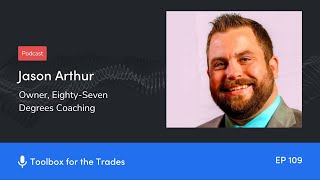
Podcast interview with Jason (owner of 87 Degrees Coaching), discussing his background in HVAC/home services, why he launched 87 Degrees, and practical guidance for contractors on budgeting, KPIs, profitability vs. cash flow, and scaling past common growth plateaus. Emphasis on building inclusive budgets down to net-profit level, using P&Ls and KPIs to identify "brick walls," involving employees in reporting culture, and seeking external help (coaches/mentors) when needed. Episode closes with a client anecdote and contact information.
You are the owner at 87 degrees coaching a service titan certified provider. You've been a guest on our webinars before. I'm so excited to welcome you to Toolbox for the Trades.
Well, thank you. I'm excited to be here and thanks for having me. It's been, it was a lot of fun doing the webinar, so I'm looking forward to the podcast.
You have a treasure trove of knowledge, so you are. I welcome you to collaborate with me anytime. Seriously. But before we even get into some of the things we're going to talk about today, we're going to talk a bit about budgeting, we're going to talk a bit about profitability versus cash flow. But I want to know first and foremost, how did you get into the trades?
So back in 2002, my dad bought an AC company he worked for a big corporate company that transferred us down to Florida from Indiana back in 99. And when he bought his company, I started going there after school on weekends and had fun just kind of tinkering around the warehouse. And Once I turned 16, I was able to take a class called OJT and it was on the job training in high school. And so I pushed to let my or have my job be at the office. And so I would go to school until like 10 or 11 o' clock in the morning because it started at 7 and our last two or three periods of the day were OJT. And so I would go and go to the office and start working. And that got me into the warehouse learning what things were, what flex was and how to sling, duck and load trucks and go to the supply houses and grab things and never really stopped working there. So through high school I was pretty close to working full time between those days after school and then the weekend and then when I went to college I kept working there and did a little bit in the field and, and a lot in the office and on the business side. And that's the short version of it. It started when I was 16 and just kind of carried on.
That's awesome. I've actually never heard of an OJT option in schools, which tells me it's probably not that common and something that we should 100% bring back.
Yeah, it was awesome. I loved it. You get got school from 7:05 to like I said, 10 or 11 and then you're off the rest of the day. It was fantastic.
That's incredible. I envy that schedule. All right, so tell me about 87 degrees coaching. What prompted you to start it. And why should folks partner with you to help them run their business? Sure.
So the idea, ever since back in 2002, the idea was to have my own company one day or transition into that company or something, but be a company owner and through life's crazy events ended out here or ended up out here in Orlando. And last year about this time actually I was at lunch with somebody and we're talking about future and what was going to happen years down the road. And. And he was trying to get into the air conditioning industry and he said had I ever considered consulting for equity? And so finding companies that needed help and consulting and whatever improvements came up, I got a percentage of it and eventually acquired the company. And I wasn't real thrilled with that idea. I thought it was probably messy and difficult. And honestly I hadn't ever considered coaching or consulting and got home and a week or so later was talking to my wife about it and started having a serious conversation and realized that what I enjoy about the trades and business in general is growing and identifying trends and metrics and KPIs and identifying what problems are and then solving those problems and realize that, you know, what with my skill set and what I know and then my personality, that might actually be a pretty good fit. And so started digging into that market. And a year later or so is when 87 degrees officially launched. So it was just a innocent conversation that started at lunch one day and then it turned into a real possibility and now it's, it's real life. So it's pretty cool. As far as why I think people should work with me, one, because I'm awesome. But two, because two, you know, you'll see lots of coaches. There's lots of coaches and consultants for everything out there, just general business. There's some that get into our, our niche of home services. There's some that just do air conditioning. But a lot of them don't have as much varied experience. Sure there's guys out there that have grown companies larger, faster or have more years of experience. But where I think I kind of separate myself is two different areas. One, I've been on the small mom and pop side and I've been on the big corporate side, you know, statewide company, multi location, large company. And I've been through, been through the first recession back in 08, 2010. I've been through Covid, been through all sorts of different challenges within our economy and still figured out ways to continue to grow and scale. And again, I know there's people that can say that, but there's not a whole lot that have focused strictly on the trades and how have seen both sides of the businesses. So I mean, you know that most AC companies and most home services companies are started by service techs or installers or sales guys that are really good at their trade and they get tired of working for whoever the owner is and bringing in those paychecks and so they go start their own company. They're great technically, they know it forwards and backwards, they know their trade better than anybody else in the area. So they go start their company and what they find is they get stuck in a, a loop, for lack of a better term, around $2 million. And each trade that, that revenue is a little bit different. But here's the way a lot of times in the average company boils down is you're going to have an owner operator out in the field. You're going to have a spouse or a child or a family friend or just a, you know, a regular employee in the office as your csr. Sometimes you have an office manager, then typically you've got a couple other guys out in the field with you and sometimes some part time guys. And normally that revenue is going to be somewhere around $2 million. And the reason for that is it's hard to take that leap and know where to take that leap and what things need to be done to go from being an owner operator to running your business. And I've got a complete 180 degree differ, 180 degree different experience in the trades than that. I, I've got enough technical experience to tell you what a condenser looks like and where an air handler goes and probably to, to install that condenser, but that's about it. My whole experience has been on the business and management side. And so I've built. Now let's rephrase that. I've, I've focused on building the businesses over the years and identifying KPIs and metrics and how to scale what I call brick walls. So a brick wall is anything that might slow or stop your company growth. And so between using Your budgets, your KPIs, your metrics and historical performance, you're, you can figure out what issues you're going to have coming at you before they come at you so you can develop a plan to scale that brick wall.
Scale that brick wall.
So that's a very long answer to a short question.
No, it was, it was a long question and it was a two parter too. And you answered it beautifully. I thought that was really interesting, the concept that one gentleman posed to you, which was, hey, would you like to do some consulting in exchange for some equity? Because that's something that I've experienced in the tech world, but I haven't actually heard brought up in the early stages of home services. So that's interesting. Did you actually end up taking that deal?
I did not. So he, he, he didn't have a company that he wanted me to do it for. He wanted me to help. He wanted us to be a team and go do that. And he actually, his experience was in the tech world and some other investment places, which is I'm sure where he got it from. But that wasn't something that I thought was going to be a, a viable option or if it is, it wasn't the route I wanted to go. I feel like it's going to be hard to find the guy that's willing to give up his company in the next few years for somebody to come in and help.
Sure. The only reason I bring it up is we actually did a webinar on Service Titan a few years ago and talking about giving employees equity in the company. And I just think it's really interesting whenever that idea crops up in the home services space, especially because it's proven that the opportunities, the business transactions that are happening in this space are so astronomical and unbelievable. It's, I love that equity is starting to play a role and it's peaking people's interest. Total tangent on my part. Let's pivot. I love your background. I think it's so cool. I, I, I quite frankly, I envy your technical expertise because I feel at this point I am definitely at least dangerous in dinner conversation when it comes to how you should run a home services business. But that technical component, I do, oh my goodness. God bless to anyone who understands that. I do not. And I also love that you highlighted the difference between mom and pop and that you've also worked for these big companies. So tell me about the you've had at the big company and how you can help those folks that are maybe stuck at that $2 million mark.
Sure. So I spent almost eight years at a large statewide company when I first started there, that division. So I oversaw our consumer division. So that'd be replacement service maintenance was about $2 million a little bit over that when they finished in 2014. So they're finishing their year when I started and December 14th. And through my tenure there, I focused almost primarily the entire time on the consumer division. There was a couple years where Kind of went up a little bit to president, CEO of the company, but focused mainly on the consumer division. And so when I left there, we were on trend for $20 million. And this is actually, that's where I really learned the importance and how to build and scale and identify problem areas before you get to brick walls. And brick walls. Yep, your brick walls. And so that was all through KPI's business metrics. Learning how to do a real budget and what goes into doing a real budget, how to use your historicals to predict the future and then also to develop in areas of opportunity or develop your issues. And that's probably, if I had to put it just in a couple of sentence, the biggest difference is when you're in a big company, you have to do that to be able to identify how and to meet the, your owner or the, you know, the board's expectations or whatever that situation is, but to meet those expectations, because there's expectations a lot more than what you might see at a small $2 million company that they're happy, they've got cash flow, things are coming in and they're not sure exactly how to grow. So those are the biggest, like I said, that's the biggest difference, if I had to put it in one sentence, is the expectation to growth and then knowing your numbers. You know, I'm a firm believer in knowing your numbers and I know that's where that got instilled, at least hit home all the way was was there because back in, on the smaller company side as well, we were all about knowing our numbers, but they're much smaller numbers and much easier to manage. But the problems were just as hard to solve.
Totally. I love that answer. And I think it's really interesting to talk about numbers in, you know, from smaller companies going into big companies and how to manage that. And we've mentioned, we've mentioned budgeting a bit in how you've answered these questions. We've mentioned brick walls. So what do contractors need to know about budgeting? Especially coming from the big shop that you did.
That it's important. A lot of people think a lot of owners, a lot of employees, a lot of managers across the board don't put an emphasis on budgeting. They kind of take what comes hope that the next month or the next year is better than the previous. But knowing at least where you're going helps across the board and expectations of what you need overhead wise, when it comes to trucks or CSRs or, you know, making the step and hiring a manager or what field or revenue producing employees you need operating without a budget is just kind of hoping that things go well. Because if you do a budget properly, it's not just saying, all right, this year I did $2 million, next year I want to grow 20%, so I'm going to do $2.4 million. It's identifying what you need to do that. What are the market conditions, what challenges do you have in front of you, what opportunities you have in front of you, when's the next economic downturn going to come and what does that mean for your operation? And how can you capitalize and gain more market share? Or do you just hunker down and hold on and hope nobody steals your market share? But it helps you visualize what's coming, it helps you re or forces you to research what's coming and then helps you get prepared to know that you know what, you've got this under control and here's what I'm going to do and here's how I'm going to do it. So I was out at Toolbox Live, both in Atlanta and in Dallas over the last few weeks by Service Titan and had an opportunity to talk a lot about KPIs and metrics and then comparing those to your P and L and creating action items from your P, L. All of those tie in together. You can do one piece, but it's not going to be as effective if you do all of them. And once you do all of them, it creates a reporting culture where you're holding yourself accountable, your company accountable, and your employees accountable to what your budget is, what your KPIs are, what your metrics are, and what your P and L ultimately says. And then you identify ways to fix whatever issues you identify out of that reporting system. But most companies and the home services industry, because they are around $2 million, and I explained the average company structure earlier, they don't have time or honestly sometimes the ability or knowledge on how to do a budget because they've been in the field and running and learning their trade. They haven't been focused on the business side. And so even if they want to do a budget, they may not know where to start. And that's, you know, perfectly normal. More companies are like that than they aren't. And that's one of the things I can help with as well, is is developing not just the budget, but the process to do the budget so you can do it on your own moving forward and know where to look and how to put it together and how to operate off of that budget. The worst thing that I always think could happen when you implement something new. Whether it's a budget, it's going, it's developing a plan to get a P and L done. It's how to be better on service Titan, it's how to sell better in the field, is you have somebody come in and you teach or talk about it, where you go to a seminar and you hear all these great ideas, but then you get back to the office and maybe the operation gets in the way, you don't do any of it. Or you now have a budget book and it's in your hand and you stick it on a shelf and then it just sits there. You don't do anything with it. Except for when budget time comes around again and you pull it back down. You're like, oh, yeah, that's what we were supposed to do. Let's see where we were. So there was no accountability to it, There was no tracking to it. Basically it was just an exercise that you did to check a box, which isn't going to do yourself any good. It's not going to do your business any good. So that would be the, the caveat to that is if you go through the trouble of making a budget, make sure you hold yourself accountable and your employees accountable to it and you follow through.
Yeah, I think it's so interesting when we talk about, because this comes up on the podcast all the time. You know, going to a seminar or going to a conference, going to something like Toolbox Live, taking classes, learning a lot, taking notes, getting a planner, doing all this stuff. And then when you go back to your day to day every life, it's so easy to not integrate what you just learned into your existing processes. And it really is a mind switch. I mean, if you're an owner, operator operating at 2 million, who maybe still even goes out in the field every once in a while, it's really hard to transition your mind from, I am a technician working on a project, I must get this done and I will have a finished project done to working with something as abstract as numbers.
It's a tough transition. You said it right on there. That's, that's hard because it's two completely different hats. It's two completely different mindsets. One is get the job done, get them cooling or the roof fix or garage door fixed. The other is, all right, how do I, how do I manage the business? Whatever that is in front of you that day or that week, but completely different things. And those are some of the areas that I want to help in or do help in with contractors is identifying those areas and how they can improve, how they could be more efficient, how they could grow, etc.
I love that. So when we first spoke about this topic, you said it's really important for a budget to be inclusive and real. What did you mean by that?
So doing a budget just for sales. So again, take my example from earlier. You know you did $2 million last year, you want to grow 20%, so you're going to do 2.4 this coming year. That's better than nothing. But that's not a complete budget. You should take it to a net profit level. A lot of people stop at a sales number and they'll just throw their sales revenue goal at their salesperson, say all right, here's what you're supposed to do month by month. Or they'll come up with that number right before the month starts and say, all right, we need you to go do $400,000 in July. That's a good sales goal for a salesperson. But as far as a budget for a company, it needs to go to a net profit level. And that's another daunting task to add on top of a daunting task. But the point of that is to identify where your break evens are. So you're going to have, in every industry we have shoulder months, so we have, you know your peak and then it comes back down and you call them shoulder months. And you're not going to be obviously bringing in as much revenue in those points or in those, those months and not going to be making as much net profit at that time. So you need to identify and make sure you've got enough revenue to cover all of your expenses. And that's what not only putting together a budget is going to do, but taking it to a net profit level is, you will understand better where you're able to spend and where you need to cut back. Once you start doing this and you learn about the process, you're going to be able to use some industry standards on percentages of overhead. So below the line expenses. You know that, you know your insurance should be no more than X percent. You know that your payroll should be no more than X percent. You know you've got X percent available for trucks. And so now not only do you have the budget and a number put in front of you, but as you're moving forward and you're looking a truck breaks and you know you need to replace it, you know where you're trending you know, what your budget is to allocate towards a new truck. So I, I, the importance of doing a complete budget down to a net profit level I don't think can be overstated because of the ramification or implications it has on your future operation and knowing exactly where you are. You know, one thing I do hear often from contractors is that they've got money in the bank, they've got cash flow. What do they need a budget for? Or, you know, I put that a little bit crass, but that's, you know, kind of where we end up in conversations. And those two things are completely different. So you could have money in the bank to pay the mortgage and, and get all your employees paid. Employees paid. And pay yourself a nice decent living. But that doesn't mean your company's profitable. You know, a lot of people think because they have money and, and they're not negative in the bank account that their company's profitable. But those two things can be mutually exclusive, meaning because of your payment terms. So if you're on terms with any vendor, so with, with your manufacturers for, or your suppliers for materials or your manufacturers for equipment for your payroll, you don't pay payroll ahead of time, you pay it two weeks later. So you don't know, because there's cash in the bank, how your previous month actually turned out profitability wise. So there's a difference. And that's why P. Ls are important. There's a difference to money in the bank or profitability. And that's what your P and L and your KPIs and metrics will help tell you.
So I don't run a business. Obviously I'm on, I'm on service titans payroll. I want you to know, as you're speaking, I am applying all of this to my personal finances. And I'm like, oh no, oh no, oh no. What Jason says it makes, it makes sense. And I wonder if that's, I wonder if that's the reaction that you get from contractors when you break down the difference between profitability and cash flow.
Yeah, it, your personal budget's a perfect example of it. And most people have some sort of a budget. Some don't, but. Well, actually quite a few don't. But running that example and then just making it larger, the business kind of opens people's eyes to it. So similar to what you, you know, you just landed on that, you know what, just because you have money left at the end of the year doesn't mean you lived within your means or the exact Opposite. And that's all that, you know, budgeting and using your P and L is going to tell you. Is. Is the company living within its means, or are you in a growth stage, or are you just spending money that you think you have, but you don't, and now you just killed your profitability.
So this is a common tangent that I go off on in my personal life when it comes to business. I just, I really feel that the education system fails us in several ways, but one of them is being savvy when it comes to finances and money. And I imagine that the way it's affecting me right now in this moment, as it pertains to my personal budget, is the same way it is pertaining to contractors who, again, have this role of, okay, I'm a technician, I'm an install tech. I. My job is to get the unit in, make sure it's working fine, you know, have. Give a good experience to Mrs. Jones, and then I'm good to go. But then when you again, I said this word because I think it's so important, the abstract of numbers, you're like, oh, ugh. That's all I. It's not really a question. It's more just a statement, more just a noise coming from my gut about how uncomfortable I get when I think about money. And I'm wondering if your clients feel the same.
I think everybody does. You know, whether. Whether you're a business owner or, you know, just a employee somewhere and just living your life. Nobody likes to go through a budget. Nobody likes to have constraints. Nobody likes to know that maybe things aren't going as well as they think they are, because if you don't look, you don't ever truly know. So, you know, I think that reaction is. Is kind of universal, whether it's personal or business, and it's a scarier prospect on the business side because that's how you as the owner are supporting yourself and your family or employees, whatever your personal life looks like, and your employees and, and their families. And, you know, there's a lot more at stake ramifications to that and a lot more at stake to that than there is to your personal budget. Oh, you know what, just put on the credit card and I'll worry about that later. A lot of business owners do the exact same thing, and then eventually there's going to be a point where it tips over and it's not quite so easy to identify. And having a budget or running by a P and L is not going to stop those things from happening. It's just going to open your eyes to what you should do. Doesn't mean, you know, you've got it in front of you, doesn't mean people follow it, but you know, at least opens your eyes to it and helps you know what direction you need to be going or what things you should be doing.
Got it. So I think you did a great job of explaining why it's so important to budget to the profit level and not to the sales level. Is there anything else you want to share about budgeting?
It's not an easy task. You know, there somebody spoke about it at one of the conventions we were at and they said that they would do theirs in a few days. I would take a few weeks to do it. And here's why. Go and put it together the first time. And you put together, based off of previous year sales of what you're buying. We're talking strictly on a sales level at this point, but put together your sales numbers of what you think they're going to be and then you go back and look at it. A couple days later, you're going to be in a completely different mindset, a completely different mood, completely different ideas, good or bad, and you go back and look at it and does that still make sense? And then you make your tweaks and use tools. So I'm a big believer in tools. So don't just throw a number on there because you think it sounds good. Figure out what it would take to actually do that number. By department, by month, by week, by day. How many technicians does it take, how many sales calls you need, how many service calls you need, what's your average service invoice? What's your average sales amount or sales revenue? What's your closing ratio? How many service techs do you have? So how many calls could you even do it? And run it back to all of those KPIs and metrics that are out there that you can go through that service Time helps you do so easily and make sure you've run those numbers forwards and backwards, sideways and upside down. And it actually makes sense because if you go through the effort, putting it together, you want it to be good. But even more so if you have your employees get involved in it and they go through the trouble of putting together a budget and the next year they just see it sit on the shelf. They're not going to do a whole lot next year or they do it and you guys, you know, it just gets blown out of the water. Good or bad, it's not an accurate Budget. What's the point of doing it if it's not going to be accurate? Yeah, now there are. It'll take some time to learn and, and get good at it, but make sure you take the time and effort and learn what goes into it. How does it work? How can you get more specific and more exact? You know, it's great to blow budgets out of the water on a good side, but at the same time that wasn't an accurate budget. Then what did you miss? Budget to be off by 10, 15, 20, 30% because something happened that you weren't expecting. So why did something happen that you weren't expecting? Luckily it was good. But what was it?
Yeah. And you just alluded, I think, to another.
If I had one, if you had.
One thing to say, go ahead.
Yeah, I was saying. So if I wanted to summarize all that, it would just be to be specific and make sure you work your numbers backwards.
I agree, I agree. And that's actually something that's been said before is find the KPI you want to hit and work backwards from there. If we were to put it in the most simplest terms. Right. And you hinted at something in that last answer that I also think is really important, which is rallying your employees together and making sure that they know what the targets are and how to operate within the budget. So I imagine a giant component of this, not only integrating it into your own personal day to day, weekly, monthly, whatever your processes are, but also integrating it into your employees processes. Mm.
Yeah. So just like you can imagine with anything else that you just come in one day and you heard a good, you know, podcast or you saw read in a book or saw on, on a show, you come in with this great idea and hey, we're going to put this into place and you just shove it down your employees throats. The chances of that actually getting adapted to and part of your culture and your process and procedures is slim to none of the. Getting them involved in that process and telling them why you're doing it, what your goals are, what you're looking for, how we're going to change our culture to be a culture of reporting and KPIs and metrics and budgeting and why we're doing that is going to get you success. Obviously you're the business owner, you can do, you know, however you want. But the better, the more effective. I don't say the better, the more effective way to do that is get everybody on board, let them know what's going on. This is your vision this is your company, here's the way we're moving, and then have everybody start working in the same direction.
Got it. So as an employee who was responsible for doing all of this number stuff, working in the operations of a big enterprise, is that how you yourself are motivated to follow these budgets internally at your previous employers?
Yeah, that's, that's how I got turned on to them, was because it was such a big deal there, you had to know your numbers, you knew where it went. I'd never been part of a formal budgeting process until eight years ago, at least not to that extent. You know, we were more when we were the smaller company, I was part of the smaller company more. What I talked about earlier, that you're going to make a sales budget by quarter or so. We do it, you know, kind of biannual, but nothing ever to a net profit level. And so I saw the, the ramifications of that so that I can speak personally, personally to that. The other side, how I got on board with it was because I saw the impact that it had. We were a company that had some great, incredible growth for a very long time and saw how that was built. And that was built by relationships, by budgeting, by knowing your numbers and by having a very extensive budgeting process and then a very extensive budget meeting to discuss that with the entire company. But the owners of the company did a very good job of getting everybody involved, expressing the importance of it and then having support systems there in case you needed help to figure out what you were doing. So that's, honestly, like I said, that's how I learned the importance of KPIs and metrics and budgeting and P Ls and creating action items. And a lot of things I talk about is from doing that for the last almost decade.
Totally. I've told this to you before and I'm going to say it again. One of my favorite things about chatting with you is like me, you are a fast talker. So very sorry to any of our listeners who listen at double speed, but I want to, I want to rest for a bit and just ask you, quite frankly, you know, what's it been like working with clients?
It's been great. So my original plan was to start in September of this year, ended up starting officially full time on this, getting the last thing set up in June, and then really went live shortly after that. And things have launched much quicker than anticipated. It's really cool to see all the different companies out there that are in different stages and, and exactly what I was hoping for is to get exposed to companies in different areas of not only the country, but in different industries and in different stages of their growth cycles and their challenges in front of them. You know, I've got at this point, I think a client in seven different states. I've got every trade at this point. You know, we consider the trades and so it's fun seeing the experiences they've had and how their companies are shaped and how they look. It's been interesting seeing even though the problem is a little bit different, the solution seems to come back on all of them to exactly what we're talking about now. And what we did back over the last couple weeks is knowing your numbers, identifying your numbers and then how can we manage to those. And it's something that almost every one of those owners have said that they've been working on, they've been trying to figure out how to get it done, but they haven't quite gotten there yet. And even if they had, they don't know what numbers they should be managing to and kind of the direction to go to. So the thoughts I had when I first started the company or before I started it are all starting to show true that the average company is what I thought it was and what the data shows. You know, it's not my thought. I didn't just sit there and think, oh, you know what, this is your average company, but through what the data shows, doing research on the industries that all is bearing out and shows that there's a good need to be able to help, coach and help or to coach and help companies along through this stage so that they can know the business side and start growing and scaling their company on their own. It's been a very eye opening and rewarding experience to be able to jump in even you know, at this early stage to help with these companies.
I'm so happy I'm catching you at this early stage too because I've had a lot of coaches, a lot of best practices organizations on this podcast have been doing this forever and I think it's really great and refreshing to see you who's just started this and you're really where I think a lot of our listeners fall into getting either starting their business, just getting going with their business, or maybe they're stuck at that 2 or maybe 5 million, $10 million mark and they're trying to push through. You too are at the start of this really incredible business journey. So I want to thank you for allowing us a peek into it and I'm really excited to see where you go next. Still more questions for you. Namely, I know it's been a short time, but do you have any memorable client stories you'd like to share?
I don't know if it's memorable. This one was one of the first clients that came on or companies that came on. We were talking about the importance of review in their P L and they had a pretty good hang on or hang of their numbers and what they should be. And so we did our first P L deep dive after month end. And they knew typically what their gross profit was, what their net profit was, and, and knew all those things already. They'd already, you know, learned it on their own. And he at one time had run a larger company as well, so he had that experience. But as we're going through it, I was pointing out some things and we end up digging into their cost of goods sold on the material side and find that they had three, two or three different issues in one month. And that ended up being like a 30, I think it was $37,000 swing. And their P and L to the bad side. So their piano ultimately said that they were losing money and they were confused as to why. So that's why we're digging into it. And this kind of just expressed the importance of going through your P L on a monthly basis and doing the whole action item thing. And that was something that they knew their numbers, but they didn't ever take it to a point unless something was severely off of going through. Obviously that one area was severely off, but we kept going. And I said, well, your labor kind of looks off and their normal range of labor, or they're off like a half a percent from their normal range of labor. Like, yeah, that's not a big deal. It's only half. Let's, let's look at it anyway. Just, you know, entertain me. And so we go through there and we find that there was an overhead employee manager in there that shouldn't have been. So we were able to take that out and help it. And then there was actually an employee. This is where it's entertaining. Not, not to them, but it was to me. There was an employee in there that had gotten paid $3,000 extra on the last payroll period because somebody fat fingered it when they were entering it on the payroll day. And so it should have been a certain number. And they accidentally hit the number right above it and made it $3,000 more. And of course, that employee didn't come and say anything because, you know, they got A big payday. Fortunately it was, it was soon enough after that happened that the money was still there and they were able to get it back. But kind of an amusing story, like I said, they didn't think it was amusing when it happened, but kind of an amusing story to express the importance of. Make sure you check and you know your numbers. Because if they hadn't known their numbers and if they didn't make it a habit to at least go over it and if I hadn't been there to say, you need to look at this, then they just would have lost that three grand and never would have got it back. There were some much more significant possibilities out of that. And the one pre or the cost of goods sold was a bigger deal. It was things they ordered. They just built it in the wrong month, they being the vendor. But it was interesting that they almost were out $3,000 if, if they hadn't gone through and reviewed their P and L. So like I said, I, I think it's entertaining they didn't and they, they probably still don't, but, but it's.
A great example, It's a great example of really having to go through, set those, know your numbers, know what goals you're trying to hit. So this way you can identify problems like this before they become a problem. Because I guarantee you, if they didn't have that budget, if they didn't look at their P and L in a really intentional way, they never would have noticed that. And that's $37,000 that would have been unaccounted for, plus a $3,000 that were, you know, unintentionally given away. Nice little.
And that happens. Yeah, yep. And that happens more often than people think. You know, even with best intentions, mistakes happen. So, you know, somebody accidentally hit the wrong number, the vendor took their big stocking order that they were making for the next month and they put it into the previous month. It was still money they owed, but cash flow wise, they would have lost 30, almost 40 days because they put it into the previous month. So, you know, there's. When I talk about that, whether it's at one on one with the client or at the, the events, people kind of just laugh it off and think I'm joking about it. But I guarantee you, if you go through your piano, you're going to find something somewhere that there was a mistake, that you paid for it out of pocket, or it's making your numbers look worse than they actually are because it was allocated to the wrong department the wrong month, the Wrong business unit, the wrong something. So there's a lot of importance there. And a lot of people think that a P and L doesn't really matter unless you're going to the bank or trying to get a line of credit or get a new truck or something. But it's how you know what your business is doing. It's truly telling you the health status of your business. So there's a lot of valuable information in there.
Awesome. Is there anything else you would like to share with our listeners, Jason?
Yeah. So I think the biggest challenge that myself and any other coach or consultant is up against as a speaking to like a broad audience of all of the trades is that I think a lot of owners are reluctant to admit that they might need help on any topic. Really. I mean, it could be anything. It could be something I do, it could be something, you know, it could be anything. CFO coaching, it could be, you know, HR support, it could be anything. The sales training, CSR training, phone training, any of it. So don't be hesitant to reach out and get help in whatever area you need help in. You know, it's not a hit to your ego to admit that, you know, you might not know this section really well. Nobody knows everything. And you know, one of my previous bosses used to say, don't recreate the wheel when somebody's already created it. And I love that saying. You know, there's people out there that are really good at their little area. Mine happens to be numbers and KPIs and metrics and. And all of that. I've put together a bunch of budgets and I know the KPI side of the trades, I know the metric side of the trades. If you don't, don't waste six months, a year, two years, or even worse, never do it. Reach out and get some help. If you don't know the HR side real well, reach out and get some help. If you don't know sales training, reach out and get some help. It's. Nobody will think lesser of anybody. If anything, I think it's more accepted and more encouraged now than it's ever been to have a mentor, to have a support system around you to reach out and get that information so you can grow your company beyond what you ever thought you could and get that help and that support from wherever that means that could be a best practices group, it could be service titan, it could be a coach or consultant, it could be a mentor, whatever it is. But you don't have to do it on your own. You're not on an island. Get some help.
I love that. How can people get in touch with you?
Through my website, which is www.87. So the number 87 helps h e l p s.com or my email is jasony7helps.com.
I love that. All right, Jason, My favorite question of the podcast, not to say that I did not enjoy all of this wonderful content and I'm frantically thinking of things that I should really check on personally, but if you had to choose this. I just turned this entire podcast to Jackie doesn't know her finances. I do.
I do know personal, but I do know my finances.
I just this broad attention to the fact that maybe I should be looking a little bit at them a little bit harder. And we are recording this at the end of the year where I think everyone is fatigued. All right, gonna stop justifying my personal joke thread throughout this. Throughout this episode. If you had to choose a so song to be the soundtrack of your life, what would it be?
So I like music. I. I listen to a lot of country and I. Well, just really anything. But I'm not a. Like, I'm not a fanatical song enthusiast, but there is one song, it's My wife and I song. It's this by Darius Rucker. So that would probably be. If I had to pick a song, that would be it. Not necessarily my life, but my life with her and our family. So, you know, the life for the last ten years or so. That's the song. I'll go with this by Darius Rucker.
Wonderful selection. Jason. Arthur, thank you so much for being a guest on Toolbox for the Trades.
Thank you for having me.
More from Bill



ServiceTitan Virtual Agents: Simplify Before You Scale | Podcast Ep. 110 | Mastering ServiceTitan



Life After Live Events: How to Turn Post-Conference Energy into Real Profits | Podcast Ep. 297




