Australian State of the Trades Report 2026: Operational Realities for Aussie Contractors
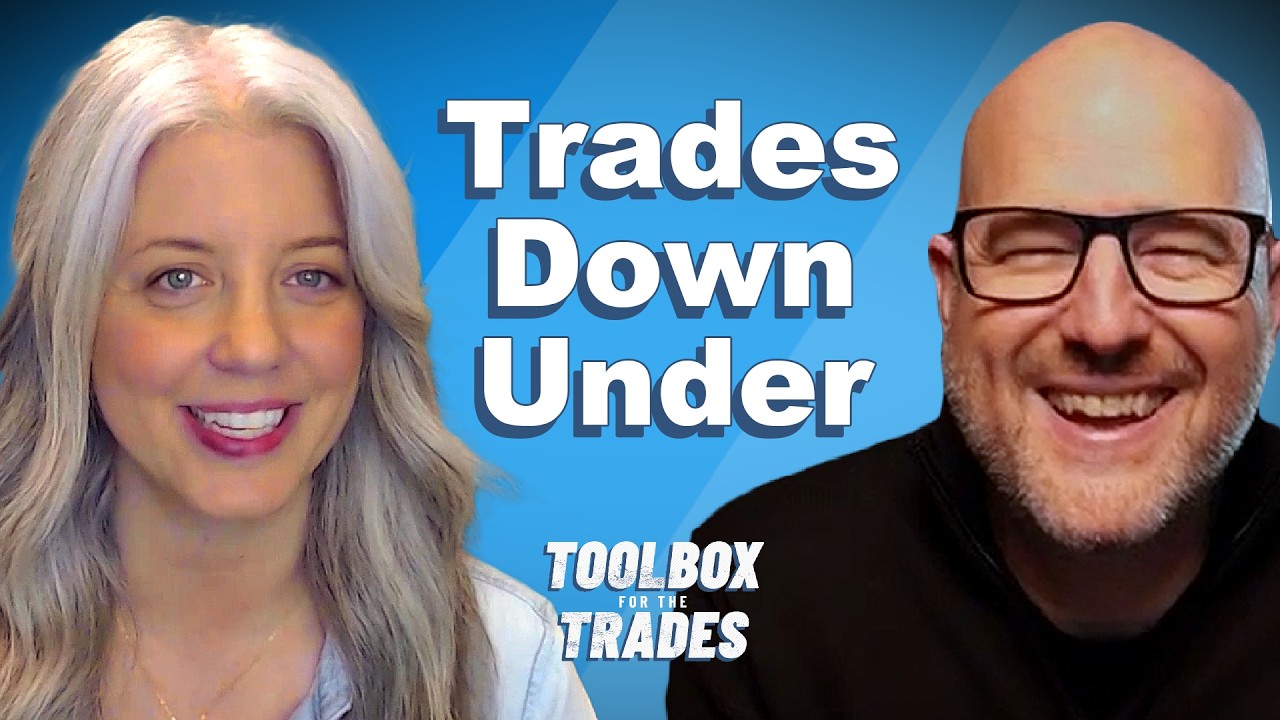
This content was created by Bill Brown. This content was uploaded by Bill Brown. This is a YouTube podcast episode titled "Australian State of the Trades Report 2026: Operational Realities for Aussie Contractors" (thumbnail: https://i.ytimg.com/vi/OnIPA6AlnLs/maxresdefault.jpg) published 2026-09-01T14:56:01Z. Host Amanda Salvatore interviews Adrian Fadini (founder of Trades Formation / Trades Talk, former plumber) about findings from a February 2026 survey of 1,000+ senior decision-makers in Australian trade businesses. The conversation focuses on industry trends and practical operational guidance: steady demand but inward focus on tightening operations, cash flow and profitability as top priorities, a large rise in billing/accounts-receivable pain points, the move from hourly to flat-rate pricing (and how to implement it), technician training and cross-shadowing, use of tools like ServiceTitan and billable-rate calculators, AI as a tool (63% see relevance but only 38% adoption), change management and retaining business momentum, and strategies to mitigate fuel/interest-rate pressures. Tone is coaching-focused and practical, aimed at owners, leaders and technicians in trades businesses.
Chapters
Hello contractors and welcome to Toolbox for the Trades. I'm Amanda Salvatore, and today Adrian Fadini, founder of Trades Talk in Australia, is back on the podcast, this time to discuss the 2026 Australian State of the Trades report. We dive into the data and examine the trends shaping the industry down under. Adrian offers incredible advice for leaders looking to invest in AI, how to avoid common billing pitfalls and how to navigate an ever-changing economy. No matter where you're located, this episode is for you. I hope you enjoy this conversation as much as I did. Adrian Fadini, you are the founder of Trades Formation, and today we are talking about our findings in the Australian State of the Trades Report. for 2026. Welcome back to Toolbox for the Trades.
G'day, Amanda, how are you?
I am doing well. For those who may have just heard you speak for the first time, you are in Australia and you are dealing with and coaching some of the best and brightest trades businesses in Australia as well as New Zealand. We've had you on the podcast before. We're happy to bring you back to talk about the report. Really excited to have you back.
Well, Amanda, thank you so much. I'm very, very excited to be back for a second time. I honestly pinch myself. I'm a very lucky man. I get to work with, like you said, the best and the brightest in Australia and New Zealand. I recently got back from New Zealand and I didn't realize how much I said g'day in my life until I went to another country because Kiwis don't say g'day, but it's, yeah, like at the end of the day, we're Australian. Very proud of our country, but more importantly, I'm so proud of our industry. It's really taken off. We're seeing some amazing things happening. And like you said, I'm constantly in an airport or traveling around Australia, going to spend time with business owners and technicians. I actually started doing some ride-alongs this year for the first time in a long time, which has been great. So I'm originally a plumber by trade and getting back out in that field and seeing a bit of what's happening in the field has been phenomenal as well.
I love that. I gotta ask, going on those ride-alongs and, and, and following, what's the best part of having boots back on the ground?
Well, I'm going to be selfish, and the first of— first and foremost, it makes me feel younger again. So I feel young to start with, but then I'm hanging out with the boys. I'm getting to, yeah, connect with the technicians because I'm always training the owners and strategy and things like core values and marketing and finance as well. But then also too, I'm We're probably understood or recognized as the best sales trainers in Australia and New Zealand, which is a very, very honorable title to have. But then you get back in the field and then you get more insights. I mean, the world has changed a lot. People communicate differently. I have a lot more empathy for our technicians. It's funny how you seem to forget stuff as life goes on about, oh yeah, I forgot about that aspect of the physical difficulty of the job perhaps. And I think it's really important and we're jumping straight into some coaching stuff. Everyone needs to be cross-shadowing in every single role. I think if you're a CSR, you have to go in the field for a day. If you're a technician, you have to go in the office for a day, especially on a Monday morning when the phones are ringing off their head and get the understanding of what it's like because you're just answering the phone and it's a very minimalistic view. To answer your question, it's to get an insight and a perspective. That sometimes we forget of what it's like to be in the shoes of the tradesmen in the field.
I know that Jackie, the last time you were on the podcast, Jackie asked you what was the best business advice that you've ever received. And I figured I'd flip the coin today for our icebreaker and ask, what's the worst business advice that you've ever followed?
Okay, so what's the worst? I think without a doubt, you can do it all by yourself. That has got to be by far the worst piece of advice, or you don't need them, or you don't need this, or you don't need leadership, or you don't need a mentor, you don't need a coach, or you cannot succeed on your own. You must have a team, right? You must have a team. And the team could be your staff. It could be, like I said, some sort of peer to get information from. I'm very fortunate, even as I get older, I've still got a lot of people that know a lot more around me. We talked about Alan Raw. Before we jumped on the podcast, I see her weekly, which is a blessing. She's a wealth of wisdom and enthusiasm as well. But I think without a doubt, without a shadow of a doubt, the worst advice I ever got was you can do it by yourself. That is definitely the worst advice.
You got to do it with a team. Absolutely. Before we dive into the report today, can you give us a quick intro? I know we kind of visited a little bit of what you do, Right now, but could you, for those who maybe not know, tell us how you found yourself in this industry?
Yeah, so I was the 3rd plumber in the family. My father, my grandfather, and myself, all plumbers. My grandfather immigrated from Italy in the 1950s to help out with this massive scheme called the Hydroelectric Scheme down in Cooma. My dad started a business in Canberra. My dad and I worked together for 1 year and decided it was best that I went another way. He was in construction. And nothing against construction, but I, it was not for me. I just did not like construction. I loved people. I love solving problems. I like the speed of what we call home services, or in Australia, it's often referred to as maintenance. I got into a company and then I built my own business called Plumber to Rescue, which I exited in 2012. And then in 2015 is when I fully started transformation. And it's been now 11 years and we work with companies all around Australia, in New Zealand. And like you said at the intro, we're so fortunate to work with the best of the brightest. We're the highest rated coach in Australia and New Zealand. We are very, very proud of what we do. We get some profound results where a lot of other companies either put them in the too hard basket or aren't prepared to roll up their sleeves. We're not as large as some of the other coaching organizations, but we're very, very hands-on and very, very tactile and intimate with our clients as well, in the sense that we want to roll up our sleeves and help them get the results that they deserve.
Speaking of results, we're here to talk about this report. Let's dive in. We surveyed over 1,000 senior decision makers in Australian trade businesses this past February 2026. You've got this front row seat to the biggest trade businesses in Australia and New Zealand. As we're rolling into the second half of the year, what's on their radar?
Yeah, there's a lot on their radar at the moment. Markets are shifting. That is definitely a concern. I think we'll touch on it later about the fuel and interest rates in Australia. Economies are slowing down. So therefore people that, or businesses, I should say, not so much people, businesses that were, and this is the biggest thing. Everyone goes, no, I'm fine. I don't need any support. I don't need any help. I don't need any external In like inside, and this is the funny thing, right? No human being or no business owner can see their blind spots. I can't see my blind spots, right? You need external perspective to be able to identify those blind spots. So when, when the economy's booming or going well, everything feels like it's fine and sales solves all the problems in a business because there's revenue and you can be a little bit inefficient. But as soon as the market slows down, All of a sudden, you need to be better at your marketing. You need to be better at answering the calls. You need to be better at sales. You need to be better at actually getting the job done. You have to be really on point. I would say the biggest thing is rather than looking externally, they're looking now internally and trying to see what they can tighten up in their operation to make it way more effective and efficient.
This leads me to my next point. So within the report, we're seeing that Demand is steady. Over 40% of businesses grew revenue and are expecting more growth ahead. But like you said, their focusing is shifting inward and about tightening their operations rather than chasing more work. This is matching what you're seeing with boots on the ground.
Mm-hmm.
What should they be considering or looking at as they're looking internally? about their operations?
When new clients are coming to me, and some clients have been with me for a little bit, what they're saying is, yeah, we're still going, but we're working so hard for that work. Like, we're really— if you can take the analogy of a car and a car's got a tachometer, like a rev, the gauge on the car that does the revs, I can't remember the proper name, but you get the point. And redline is at like, say, 6,000. And what's happening all of a sudden, they're redlining. Everyone's at full capacity. They know they can't possibly grow. until they become better internally. And that's better SOPs, better software, better reporting, better data. Obviously the reporting gives them the data that they need and they definitely want to grow. They 100% want to grow, but they said right now growth would kill my business. And that's where we come in and we can help them get a little bit of, take a little pressure off the engine, get the redline, all the revs down so they're not on redline. And that's when we start to go, Like you said, internal, not external. And you go, all right, what are we doing that we can improve upon?
You have a quote in the report that's brilliant. Don't fix the symptoms, fix the actual model. I know that a tool like ServiceTitan is often seen as maybe the magic key or the magic wand that's going to fix everything. But in fact, it's just there to help and show you What's going on within the business, within your business model? What do you mean by fixing the symptoms? What does that look like in practice?
Yeah, absolutely. Look, if the word I use, and I like to read, and I only discovered this word a little while ago, a panacea. A panacea is a cure-all. And I'll get this amazing software which solves us tight knees and then all my problems will be fixed. And What it does, it magnifies. If you're an amazing business, it makes you 10 times better. If you're an okay business, it'll make you more okay, if that makes sense. It'll highlight more of the issues because now you've got great data, you've got great insights, and you can see what's going on, which is also a great thing because if you don't know those things, you could end up going out of business as well. You need to understand that it won't cure everything. And it's like, I make the analogy all the time. If you're learning to drive, right? If you're learning to drive, you don't buy yourself a Ferrari. First of all, it probably costs a bit too much to buy one, but you start with a little car, right? You get to understand what that little car is. So then you know how to drive well. ServiceTitan's the Ferrari. It's fantastic. It's amazing. It's really, really a great, the world's best software without a doubt. So what has to happen is you've got to go back and start to fix all those challenges and issues inside the business. So yeah, it really helps you find them, which is great. And a problem identified is a problem half solved. The question comes back to, do I understand my core metrics of my business? Do I understand what the core business is? Okay. What is a root cause and what is an external symptom? And like, business is simple. Like it really is simple. It's, do I have enough leads coming in the front door? How's my CSR conversion rate going or booking rate? Then are we booking? I never call them jobs. I call them sales opportunities or booked appointments. And there's a psychological reason I do that is because I don't want a technician driving to a job because he kind of checks out and he's not really thinking. He's driving to an opportunity that's up to him, dependent on whether or not he is on and connects with the client. And then it's all about his tech conversion. And his tech conversion leads into average ticket. Average ticket leads into The cost of goods sold. And then of course overheads are not their problem. They're the owner's problem. That is the foundation, the spine of every home services business, whether it be in Australia or New Zealand or America, or even for that matter in Canada or Britain or any of those countries. And if you don't understand that spine and it really is, I know it sounds like we simplify it, but that is it. That is the core business and things on the periphery of that are the symptoms. And so often business owners get stuck in this, in this hamster wheel of fixing this and fixing this fire and fixing this fire and fixing this fire. And if they just stopped for a second, took a helicopter view back out, breathed and looked at the holistic view or helicopter view, then they'd actually see that, hey, the root cause is X or Y or whatever it may be. And if I fix that, I'm actually going to fix 3 or 4 different little fires rather than just going from the next one to the next one. The actual whole business.
For someone who's listening who suspects that their model might be the problem. What's the first question that they should ask themselves? How should they get into that helicopter and get a holistic view?
Awesome question. Awesome question. What I would do, because, and not all, but some have multiple fires burning at once. The very first thing is cash. Like if you don't have cash in the business, you can't, I can't remember who made this quote and Alan says something similar too. Cash is not that important, but without it we die. All right, we suffer, the business suffocates, right? It's up there with oxygen, right? Something to that effect. If you don't have cash first, right, cash flow in the business, and the next one is profitability, and that's all on good sales. And I would be looking at, okay, cool, you can't cut your costs to profitability. You definitely have to sell, but as in sell honestly, ethically, and morally. And you've got to start to look at, okay, what are kind of like when, if you looked at first aid, if someone's got something wrong with their heart, their airways, or potentially maybe the brain or something like that, that's like a catastrophic failure. So definitely cash sales and also too profitability is low, those catastrophic failures. If they get interrupted or something happens to them. And that also too, if you go further up the pipeline too, how's your lead funnel going too? So you've got to be able to sit down, have a look at where these blockages or failures are sitting inside the business and saying, okay, is that a catastrophic one if it doesn't get addressed straight away? Or is that something I can— I've got lots of revenue and sales and I'm getting, I'm collecting my cash. Like if I'm collecting my cash, then I'm not In a super bad position, I still gotta fix all the other problems. But if I'm not collecting my cash and the business is making sales, we gotta get that money in the bank.
What would be your advice to somebody who feels like all they do is put out little fires all day long and that they can't get that aerial view, that maybe they don't have the time or the energy to be able to really take a holistic approach?
Sure. Look, it's not nice to hear this, but I've had to do it myself. I'd ask, what part am I playing in the fires in my business? Because often it's my leadership as a business owner. Often it's the leadership of the companies I coach. And it's not that, in actual fact, that's actually probably the easiest thing to fix because you're in control of your own behavior and the way that you show up. If I'm the one that's all the, everywhere I go, there seems to be fires in my business, obviously then the common denominator is myself. Yeah. And I see this so often that business owners get distracted with bright, shiny objects. They're running a trades business, but then they're building a house over here and maybe even an investment property or getting into another business venture or something, and they're not focused on their core business. And that is often why they're not giving their core business the attention and time that it needs, and therefore fires are popping up. So it comes back to self-reflection. self-reflection and their own personal leadership as well.
You spoke about cash earlier. Cash is oxygen. You need it to survive. Another major takeaway from the report is that 57% are now citing billing and accounts receivable as their number one pain point, which is up from just 20% last year. So that's a 37-point jump. Where is this disconnect? And how can a business course correct if they're finding this issue for themselves?
Yeah, 100%. So I'll go through 2 different scenarios here. Let's say it's a, um, an Australian, obviously Australia and America at different stages of maturity when it comes to the home services model. Let's say it's an Australian business that's completely adopted the home services model. Let's address that first. So they might have some pure sales technicians do jobs up to 90 minutes to 2 hours, then hand them over to some installers. And then you might have some guys in the middle that are sales and service, and they will sell and do their own job. And the majority of guys that are in that pure sales role that will sell the job, communicate with the client, build great empathy, great connection, then move on and pass that job to an installer. Typically the installers want to be installers because they're more technical kind of guys. They're not super people persons. And all of a sudden, they've never received a single moment of training on how to talk to a customer to collect money. So then all of a sudden they'll do everything in their natural, they'll stick to what they're good at. I'll do an amazing job. I'll clean up. I'll take all the rubbish. I'll clean the work area once I'm done. But I don't want to ask the customer for money, right? So it is as simple as how do I teach and start with an SOP and some training to back it up? How do I teach my installers who are absolutely gifted in their technical ability, but not as gifted as they could be in their communication skills and teach them how to ask for money. Okay. That's how simple it is for myself. And then it's also to empowering them that they know that the CSRs or someone that's spoken to them in the past, they know that it's been, I love to say pre-framed. A lot of other people use, I love NLP, which is neuro-linguistic programming. And pre-framing is a great thing to make sure that a customer is ready for something that's about to happen. And it could be the CSR on the incoming call. It could be the sales technician. Anyone that actually has that conversation with the customer before the installer comes to do the job. Oh, when John our plumber is going to come in and he's going to complete the work and everything's done and he's cleaned up and then he'll have a walkthrough and show you everything that's been done today. He's going to collect payment and you can pay by credit card, bank transfer. If it is bank transfer, he has to just wait, get a receipt before he leaves today. And if the technician that's the installer knows that that's been pre-framed, that's going to help as well. Because it's not like a conversation completely out of the blue. When I look at the State of the Trades report, we still have way too many Australian businesses on hourly rate, right? When we have them on hourly rate, what happens is, and that's charging the customer, it's X amount per hour. And it sounds like, I mean, I had my business over 25 years, 22 years ago. And we were in, we were into flat rate in 2004. Okay. So, so what's that? 20, yeah, 22 years ago we started flat rate. I started the business even earlier than that. And I still don't understand how we haven't in Australia. I think maybe as an industry, we have to have a bigger push to get everybody to upfront pricing. It's honest. It's ethical. It's moral. It's all basically worked on the best way for everyone to win. The customer wins. The actual technician wins. They get paid what they're worth and the company wins because they stay in business. Like we have an epidemic with bankruptcies in Australia, like the bankruptcy rate. And I don't know the numbers in America, but a lot of businesses are going broke. And that's because they pluck a number out of the sky. They talk to their old boss, they talk to somebody else, and there'd still be a massive amount of businesses in Australia that are on the hourly rate. So when the State of the Trades report went out, it was not just talking to modern home services businesses or maintenance businesses. It was talking to the entire industry. And there's still way too many customers out there that are, sorry, beg your pardon, my customers, too many trades businesses out there that are doing hourly rate. And therefore they don't think they have to collect payment. It's like, oh, the office will collect it or they'll ring up later or they'll leave an account. You can't, I mean, not that I get haircuts often, but you can't go to a barber and pay 7 days later, right? You can't go to McDonald's and pick up your burger and fries and pay at a later date. There is still a massive proportion of Australian and New Zealand trades.
Yeah.
that are sending invoices for 7 days or 30 days, et cetera, for COD or moms and dads customers in home services, which to me is, um, very, very alarming. It is a real concern because like states have been doing it for close to 40 years now. We really need to adopt this flat rate. And that's something that we do at Transformation is help build price books for companies and tailor it to their overheads and their pricing as well.
I was going to ask, what's the shift look like from hourly rate to flat rate? If someone listening right now is like, you know what? That does make a lot of sense. How do I even attack this? That's, I feel like that might be a really huge undertaking.
100%. Look, and it's a lot of, some companies will say, no, no, no, I'm not hourly rate. I quote everything. If you're not quoting it from a tailored price book that fits your business and fits your overheads, you're still on a very archaic system, right? You need to also too, if that's the case, this is a symptom. Okay. Talking about business model issues and cause, so symptoms as well. If that's happening, I guarantee this is what's happening in your business. Your techs are ringing up. How much do I charge for this? How much do I charge for this? Or should I do that? And then the actual either manager or business owner, if it's a smaller business, is getting bombarded by phone calls. And that is not, that is a, like back to what we said before, that is a structural problem of your business. And the fact that you're getting those phone calls is a symptom. So what success looks like in this is having a fully customized book That is your pricing, not somebody else's pricing, worked out on your overheads, your capacity of hours, what your fuel costs and what your insurance costs and your rent costs, every single hidden cost that you could possibly think about. And the transition is actually, I know this sounds like we're going a bit deep for trades business owners, but it's a change management piece. It'd be no different to adopting service type. It's changing your workflows. It's changing your mindset. It's changing your technician's mindset. There's a lot of change involved and it has to be managed very, very carefully. So you take everyone on that journey because if you don't do it well, you're going to lose good tradespeople. You're going to lose buy-in from your team. And if you lose buy-in from your team and your business is going okay, it could fall apart real quick. And I often say, if you have momentum in your business, you must, it's your responsibility as a business owner to hang on to momentum. Business momentum is precious. Okay. And you must hang on to that with 2 hands in order to keep the business moving forward. Make sure that all your team members are safe and their job security is safe. Your customers still get the great service they're supposed to get. And yeah, you've got to manage it. And without sounding biased, you have to use an external party. Look, great, use us, but you could use somebody else as well. It definitely needs someone to help you manage that process of going from hourly rate Working out what the right labor rate should be for you. I actually changed this recently to billing rate because there's not a labor rate, it's a billing rate. We have a little tool and I'm happy to have it as a download if you want, if you want to give the listeners something. I'm sure the American listeners have seen this a million times over, but it's a billable rate calculator. You sit down, you work out what everything costs. It punches out a number. And Amanda, the scary thing for 99% of Australian and New Zealand, uh, business owners, and to be fair, I go to America at least once a year as well. And it's still funny, I do hear guys sometimes doing hourly rate, very rarely, but still I hear it from time to time. And they almost fall off their chair when they find out what that rate is. They think that they're doing the right thing at somewhere at $150, $180 an hour, or maybe even as low as $120 an hour. And then when they work it out correctly, their billable rate could jump up to $400 an hour, which is absolutely terrifying for them. that includes overheads, includes all the expenditure that the business has. That's a hidden cost. And then people go, oh my God, how do I actually run a business? Because I've been a quarter of that for so long. So it's, yeah, it's all based in science. It's not plucked out of the sky. It's based in a mathematical formula that really makes a lot of sense when you sit down and work out what you need to charge.
You talked about this idea of change, about momentum, and We've gotta talk about it, AI. So that is the hot topic for everyone right now. We learned from the report that businesses are truly looking to utilize AI, but it's been a slow adoption. So 63% believe that it is relevant for their business, but only 38% are actually adopting it and using it. Why do you think that is?
Look, I love data and I love statistics because they always tell me a story. And I would say that's almost exactly the same ratios of businesses that I go into that don't have a vision for the business. Let's call AI what it is. AI is a tool, right? AI is no different to your wrench if we're talking American language or your multi-grips in Australia for the plumbers or your multimeter if you're an electrician or a sparky is what we call them here. I'm sure you call them the same thing. AI is a tool. That's what it is. So if I don't have a vision for my business, if I don't have a business plan, if I don't have milestones, if I don't have rocks, obviously there's great, great terminology through great business education books about the concept of rocks and being 90-day targets and so on. If I don't have that clear vision, then how do I use AI, right? But when I have an absolutely clear vision and a plan to follow, then AI becomes a tool or even ServiceTitan for that matter, becomes a tool for me to enable my vision. So I would almost guarantee from, and again, I'm putting my finger in the wind and remembering figures off the top of my head, that's about the same ratio, I would say, of companies that I come to that have no idea what the future looks like. They're just in the moment surviving day to day and go, yeah, I should use AI, but I don't know what for because I have 24 fires burning around me. Okay. So then when you start to slow down, put the tools away, come up with a strategy, And I love this proverb, tactics before strategy is the noise before the end, right? So using AI as a tactic or a tool, okay? So you must have a plan, you must have a strategy. And once you have those in place, then you can select the right software, the right tool, the right everything else that goes in, even the right team members, because then they become a way to enable the vision that we aforementioned.
Is there a difference between having a vision for the business overall versus having a vision for what you want AI to do? Specifically?
I don't think they should. I mean, I think should's a strong word in this context. I don't have a vision for AI at all, but I do have a use for AI. We use AI, like we've come up with this amazing role-play tool that we've built. It's phenomenal. We've got it in different behavioral styles and it's been phenomenal. Did I have a vision for AI? No, I wanted a tool to help my technician or my clients' technicians become better at sales. So the vision was for the business, for the outcome that I'm trying to achieve for the technicians and for the businesses they're a part of. And then the tool that I selected was AI to build that because it was the best tool for me.
Yeah, it sounds like you really have to understand what you want to do fully as a business and then see how AI can facilitate those goals as opposed to AI being the goal.
Absolutely. That is exactly the— if that's the message everyone gets from today, that's exactly what I'm trying to communicate. Thank you.
So with Australia, and I feel like this is happening in America as well, as well as globally, but there is a fuel crisis and interest rates are going up in Australia. How should businesses look to mitigate those risks?
Well, I tell you one thing not to do. Don't start looking at putting your technicians on the shortest possible run. That is probably the worst thing you could possibly do. I'd start looking at getting the right technician in front of the right customer. That's a loyal customer that's come back to you. Prioritize loyalty every day of the week. Make sure you get your best technician that knows what they're talking about and knows how to fix these problems or even replace whatever they need to do, whether it be a ducted system unit or plumbing or whatever the case may be, and still focus on service over let's save a few bucks on fuel. So that's number one. Don't shorten the routes. Get the right technician in front of the right customer at the right time. Okay. Then second of all, review your billing rate calculator. If it goes through, like if we go through a hyperinflationary period, what that means for everybody listening is that stuff starts going up. Like I think Zimbabwe had it in the '90s and Argentina had it a few years ago. And like you'd go into the shops in the morning and an apple was say $2 and the afternoon it was $2.50. That's hyperinflation. God forbid if that happens. If we go to something maybe not that intense, but something of that nature, you've got to be looking at your billable rate calculator on a much, much more regular basis. So sitting down, looking at what they cost, looking what the fuel costs are jumping up to. And the beautiful part about ServiceTitan as well is you've got dynamic pricing. You can get in there and you can adjust your rate pretty quickly because what happens is as soon as your overheads change, as soon as your Costs of running the business change, then you can go in the backend of ServiceTitan and make the changes that you need to make. And if you haven't made that leap yet, look at your billable rate calculator, look at what it costs and look at what your labor— oh, sorry, I keep saying labor. It's a bad habit. Your billable rate calculator needs to be because fuel is still one of the largest costs inside a business. Like obviously labor and marketing are going to be higher than that, but fuel could potentially, like I hope not, but could be up there, if not higher, as we move forward. Into a potential fuel crisis. And to be fair, I mean, this rule applies for anything. Like if fuel does go up, the other thing that will go up will be material. Everything will go up. If fuel goes up, everything goes up. So material costs will go up. Cost of running the business will go up because you need to get vehicles to pick up and drop off materials to your suppliers that you buy your supplies from. And in your billable rate calculator, so we're crystal clear, your materials are not in that. This is about your overheads. This is about meeting your requirements to make a profit on all of that non-income-producing side, right? Your breakeven point. And then on the other side, we have cost of goods sold, but you still will have to manage that as well and make sure that your gross profit is correct for all of the jobs that your technicians are doing in the field.
So based on the data from the report, as we're kind of coming down from this conversation, Is there any trends or anything particular that you're interested in seeing unfold in the industry in the next year?
It definitely is the best time in the world to be a tradesperson. I'm going to get emotional. I'm very passionate. I love our industry. Everyone that knows me, I wear my heart on my sleeve. And I've been in this industry since I was 17 and I'm 51 now. And I am so proud, excuse me, so proud to be a plumber by trade. And what I'm seeing in the report, but in the industry as a whole and even worldwide, right? Especially with this big move to AI, we're getting the attention and the value and the appreciation that is deserved of a tradesperson, right? Like we had, obviously COVID was a horrible time for the world, but guess what? In Australia, we were considered essential workers. And I think that really summed up how important trades are for the whole world. Like, you can't do anything else with plumbing, electrical, and air conditioning. And like, I laugh, I've been to Phoenix and people say Australia's hot. Like, Phoenix wouldn't exist without air conditioning. Like, Phoenix is insane. We think Australia's hot? Like, that's another level. And again, this just proves that without trades and if We're in a pretty average place in the world if we don't have plumbing, electrical, and air conditioning and pest control.
Yes, yes. No, the trades are essential. And like you said, COVID highlighted that. I hate to say beautifully, but it definitely highlighted that.
Yeah, I'm a big believer in duality. For everything bad, there has to be an equal good. And that definitely was the good that came out of that horrible, horrible situation.
Exactly. Exactly. Before we go, do you have any final words that you want to leave our listeners with?
Believe in yourself. You get emotional again. If you don't believe in yourself, how can your team believe in you, right? How can your clients believe in you? If you're a technician listening to this, I believe it's like universal law that you've ended up in front of that customer. Make sure you're there, you stay present, you connect with them heart to heart, not head to wallet. Make sure you realize you're there to make their life better. And as an outcome of making their life better, you'll get paid what you're worth and your business will make a profit. And everybody in that scenario will win. It's a triple win, win, win, win.
Adrian Fadini, that is a beautiful way to end this conversation. I want to thank you so much for all of your insight, all of your enthusiasm, all of your vulnerability. And, uh, we look forward to having you back on the show.
Amanda, it's an absolute pleasure. Thank you so much for having me back.
More from Bill



ServiceTitan Virtual Agents: Simplify Before You Scale | Podcast Ep. 110 | Mastering ServiceTitan



Life After Live Events: How to Turn Post-Conference Energy into Real Profits | Podcast Ep. 297




