Expanding a Plumbing Business in Rural Areas | Podcast Ep. 160 | Toolbox for the Trades
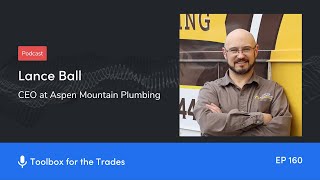
YouTube podcast (Toolbox for the Trades, Ep. 160) interviewing Lance Ball, CEO of Aspen Mountain Plumbing (Rock Springs, WY). Lance recounts entering plumbing after losing a job after 9/11, completing apprenticeship and licenses in Nevada, moving back to Wyoming and founding Aspen Mountain Plumbing in 2013 with a $3,000 loan and a used van. He emphasizes a customer-centric approach (providing options, boots/booties, communication), operational adaptations for rural Wyoming (stocking critical parts, zip-code diagnostic fees, custom truck/bin organization), use of ServiceTitan, and a new franchise strategy to expand service across distant Wyoming towns. The episode also covers brand elements (aspen leaf logo shaped like a water drop/wrench, brown-and-gold colors, radio jingle) and lessons learned about marketing, tracking numbers/pricing, and going "all in."
Hello, contractors and welcome to Toolbox for the Trades. My name is Jackie Aubel and today I am chatting with Lance Ball, the CEO of Aspen Mountain Plumbing in Rock Springs, Wyoming. Lance spoke about his journey to becoming a master plumber, the unique challenges of running a business in a rural area, and shared some secrets about his new franchise strategy. I hope you enjoy our conversation as much as I did. Lance Ball, you are the CEO at Aspen Mountain Plumbing in Rocks Springs, Wyoming. Today we're going to talk about how you run a seven person company that looks and feels like a much larger business. And we're going to talk a little bit about how you are flourishing in a rural community. I'm so excited to have you on the show today. Welcome.
Thank you. I'm excited to be here. Thanks for inviting me.
Of course, of course. So let's get into it. We're going to kick off this conversation like I always do with an icebreaker. And I would love to know, Lance, if you could pick a new skill in an instant, what would it be and why?
Mind reading. I'd be a mind reader.
That's a fantastic skill. Can I just say that, oh my.
Goodness, so many things there. If I just knew how the, the person was thinking, I would be able to be a step ahead. Especially when it deals with customers. You never know how they're going to take a conversation, whether they're coming in mad about something or happy about something. You never know when you take that phone call. Right. And so it's, it'd be nice to have that skill, being able to read.
I love how you're thinking about using this skill to better understand your customers and not for evil, which I'm pretty sure most people who obtained that skill would devolve into immediately.
I could see that happening. Yes.
I'll check up on you in about two years and you'll be running Aspen Mind Reading and Co and all of this stuff. You'll be a billionaire.
If I had that skill, I probably wouldn't be in business.
Yep, totally, totally, totally. Anyway, fantastic answer. Start from the beginning. How did you get into the trades?
Well, it was kind of 911 is how I got into the trade. I was working for a credit card company in Las Vegas and our corporate headquarters was in the towers. And so when 911 took place, our entire corporate leadership was gone. They were victims. And so I went to work and got a pink slip, pretty much said, you're without a job. And so I didn't know what to do. I, I'd been at the company for about six months. I was really happy. I was planning on being there for a long time. You know, I had a good position. It wasn't hard work, and I just really didn't know what to do. I. I was never smart enough in high school to get a good scholarship to go to college. And my family, I'm raised by coal miners, so they were making ends meet as best they could, and that was about it. So they couldn't afford to put me into school, and so it was up to me. And so I was telling a friend at church one Sunday that I lost my job and I didn't know what I was going to do. And he had just finished his master's license and just opened up his own business and needed help. And so that's how I got into plumbing, and I've been doing it ever since. So God just puts you in a path, you know, I'm a religious person, and know when you look back on it, that's exactly what happened, is God knew the right way.
Yeah, it's crazy. So just for the listener, when Lance told me about this background story, I kind of took a step back. I'm from New York City originally, and I was. I was young. I was still in grade school when that happened. And, you know, thinking about all of the ramifications, not just for the poor folks who lost their lives that day, but also for all the businesses that were affected, I mean, that. I. Yeah, it's unique. I've never heard anyone give that answer on this show before. But I am very happy that you're here, and I'm excited to talk about how you went from learning the craft through a friend in Las Vegas who is willing to help, to now running your own operation up in Rock Springs, Wyoming. So I know that in between you and you learning plumbing and you starting Aspen, which you did in 2013, I'd like to know a little bit about what kind of happened in between you learning the trade and then deciding to start your business a lot.
I. Yeah, I went through my apprenticeship. I did a private. Private schooling, basically down there with them. He sponsored me. And in the state of Nevada, you have to have a sponsor to do an apprenticeship, and some of your school classes are done on college courses, and then you go to labs and stuff like that to do the. Your physical stuff, and then you work. Right. And that's basically what it is in apprenticeship. You're basically working and doing your school at the same time. So I did that for four years. I got my journeyman's license. And there you have to have a couple years under your belt in order to get your masters. And so I did that. I got my master's license. I worked for him until I got my journeyman. And then he had to shut down. He had a child with a disability, and he couldn't afford the. The. The bill, so he had to go back to work for somebody. So I bought out his customers and started my own little business down there called Snake a Drain. I did not know anything about business at all, and I just took a shot in the dark. So I was doing that as much as I possibly could, but I was also working other jobs because I didn't know how to do it right. So I worked for a lot of different companies down there. I ended up being a plumber at the McCarran International Airport, which now it's Harry Reid National Airport. But I was their night plumber for a while. So a lot of different ins and outs. I did filtration. I did service work. I did new construction. I did basically, if you name it, with plumbing. I. I did it. So I got a good vice, good array, I guess you could say, of different aspects of plumbing. Put me. Actually was really. Developed my skills really well in the trade. It put to me, put in my mind the knowledge that I needed to really make myself versatile in the work field. I went through a bad divorce down there, and so it was like, you know what? I have nothing here. I'm going back home to Wyoming because that's where I'm originally from, is Wyoming. And so I went back home. I didn't go back to Kemmerer, where I'm originally from, but I came to Rock Springs because that was the next biggest city near where I was from. And so I came back to Rock Springs, missed my hunting and my fishing. My outdoor life. Didn't get that.
Yeah, I can't do much of that. Can't do much of that in the Nevada desert, that's for sure.
That was a big reason why I came back, was my family was up here, and then I missed my outdoor life. And so I came up here. I worked for a company, actually the oldest company at the time here in southwest Wyoming. I worked for them for about two years as a service plumber. Just was amazed and shocked, number one, how far behind in times they were. Everything was like a step behind. Like, they were five years behind the technology of plumbing in Vegas. So it was like, why aren't you guys doing this? Why aren't you guys doing that? You know, and then another thing that they didn't do is the customer service. They were just not good with customer service. They just didn't really care about the customer like I had been taught. Right. And so I worked for them for a couple of years. They had a kind of a downfall. It was in 2008 when we know that there was kind of a recession and I got laid off because I was making the most money because I had a master's license. So within about three days, I had no job.
Once again.
Yeah, yeah.
You know, your control, that really threw your life up, up in the air.
Kind of the story of my name and my game. Until I started Aspen Mountain Plumbing. So I went to work for another company, another plumbing company. I was their new construction supervisor in charge of residential. And then I was doing warranty work on the side. So any type of warranty calls that came from that new construction, I would go take care of it. So I was kind of doing service, but I was kind of doing new construction. It's kind of a weird thing. I ended up working with them, ended up becoming basically the general manager of their operation for a while. I did that for a couple years. And then I was like, you know what? I just need a break from plumbing. I think it was more of a mind reset more than anything. Yeah, I was kind of stressed out. Things weren't going well. I just got married again, you know, so it was like life was in a different place. And so I needed. I needed a break. And I went to work for a maintenance company for an apartment complex. I was their supervisor of maintenance. I liked it, but I didn't. And what I mean by that is I liked dealing with the residents and the customer. Right. I did not like the work because it was like painting and trim work and carpet repairs and drywall repairs. Yeah. Plumbing was a part of it, but it wasn't plumbing. It was. It was doing a bunch of different things. And I just. My niche is plumbing. That was my thing. So I realized that. And I realized that the only way I was going to be able to find a place that I was at peace was if I started my own thing. And that way I could do the plumbing the way I wanted to do it, do it right. The first time I could provide the options, that was a big deal for me. I liked providing options to the customer. And up here, it's a broke fix mentality.
Yeah.
What I mean by that is the plumbers go into the home. This is your problem. This is what it's going to Take to fix it. No options to the customer. The customers kind of just got their hands tied while the plumber takes over. Yeah, and I didn't like that. Didn't like that. That's not who I am. I'm one that likes to give my customer a choice. I like them to take some of that power back and have control of their home. And so I was like, I can provide options. I can do all these things that, that they're not doing. And telling my wife that I was going into business, by the way, was a whole different conversation. It was nuts to say the least. But I did it. And I said, you know what? I'm going to take what skills I have. I had my own hand tools. I bought what I needed to get myself started. I borrowed $3,000 from my father in law because I didn't have a lot of money. And I bought a used work van and that's how I started Aspen Mountain Plumbing. It was me in the truck just doing what I knew how to do. Yeah, that was 10 years ago, believe it or not.
That's crazy. What I'm really hearing in your story is a master plumber who's trying to find his niche. And it turns out that your niche is this entrepreneurial side of the trades. And part of it is because of how passionate you are about this customer service. Where do you think that passion comes? Do you think it comes from what you learned in Vegas, who you are as a person?
I don't. I think it probably started I served a mission for my, for my church for two years prior to going to Vegas, and I think it probably started there. As a missionary. You kind of have to have care about other people in order to want to share with them the message. Right. I think that's probably where it started was there and maybe it was before that. I don't know. I come from a small town where everybody cared about everybody. Right. So much that everybody's in everybody's business, Right?
Sure. Yeah, sure.
But maybe that's where it started. I don't know. Yeah, maybe it was just a natural thing. I don't know. I don't know the answer to that, Jackie.
No, I think it's. I think it's an interesting self. Self analysis for you to do. Like, I wonder why I am like that. But it definitely comes off just in the way I've communicated with you in prepping for this podcast and how you tell your story. I can tell you're a very genuine person and someone who is always very thoughtful of the people that he's interacting with. So that comes off. Actually, I'll just tell you in my short interactions with you so far.
Well, thank you. Appreciate that. But yeah, I don't know. I really don't know where it comes from. Well, maybe I have to think on.
Well, this intuitive want to provide incredible customer service that you describe has really let you set Aspen Mountain Plumbing apart from your competitors at this point, at this stage. You know, you've been a business for 10 years. You started with a loan of $3,000, a used work van and your own tools. So looking back now, where you are today with a phenomenal brand, with a small but hardworking team, I think is really commendable. And I'm curious how you think in your rural community how your desire to provide exceptional customer service really accelerated your growth.
I think that was a huge part of it. I think businesses started out kind of on the mentality of taking care of each other. Right? Taking care of other businesses, taking care of the customer. That's really how businesses started out. And unfortunately in our fast paced world, it's become more about the dollar and less about the individual. And don't get me wrong, the dollar's important. You got to keep that dollar rolling in order to keep taking care of that individual. Right. But that aspect of taking care of the customer has really gone out the window in a lot of different ways. And I think that people love that. They love the fill of being taken care of and they know, genuinely know when a person really knows what they're talking about and really cares about their home compared to not. Right. You can sense it when somebody comes in and they're telling you, hey, this is what's wrong. And they're really educating you on it and they're really showing passion and care towards your home. And that's small steps, Right. That can be like from putting booties on your feet.
I remember you said in our pre interview that you used to buy your own booties but when you worked at other companies it wasn't provided for you.
Yeah, I always bought my own booties. I'd go to the paint supply house and buy them. But it's just little things like that, you know, Mrs. Jones takes so hard at taking care of her home and keeping it clean.
Yeah.
And then plumbers walking in with these muddy, mucky, dirty boots, especially in Wyoming weather, you know what I mean? It's. You just don't care about their house and that's the first sign that you just don't care about their Home. So that's, that's a sign to the customer that this person cares about my home, they care about me on an individual basis. It's more than just a job.
Yeah. And I think also you're talking about providing options and providing the customer with the choice. By giving them that choice, you're almost acknowledging the respect for the home. Because, you know, a lot of homeowners, like when you're entering their home, you are entering in the most expensive thing they own. You're entering into their retirement plan. I think, I wonder, actually, I'm curious if you think this, if I was a technician putting myself in their shoes, I go to home after home after home. At a certain point I may just, okay, that's where I work. But it's, you know, taking moment to a moment to appreciate what you're actually fixing and how you're impacting this family long term.
I agree 100% with that. I think that as a technician, the men, the mindset has to be there before they even get to the home.
Yeah.
You have to really in your mind say I want to take care of this person on a personal level. And, and that's not the same for everybody. Right. It might be like, hey, this, and, and, and this is why I, I do it. It's one of our core values here is, is talk less and say more. And, and what I mean by that is listen to what they're saying. Adapt your options based on what the customer is telling you. Like it might, it might be something like, hey, you know, I've had this leak in my garden hose for months, but my grandson came over and now it's froze and he slipped and fell on the ice. Well then I'm going to build my options based on the safety for that family. And when I explain it, it's going to be like, I know that safety is a huge thing for you and this is something that we need to look for. It might be something as remote as, hey, you know, this, this little leak can turn into a huge flood and that could be a disease carrying thing for you down the road. And that's how I would explain it. Right. It's not to scare them, but it's because they, they need to know the safety features of it and that's how you provide the option. So that's what, when I say like customizing it, that's what I mean by it is listening to the, to the homeowner and then building off of what they're saying.
Yeah, you're leveraging your Expertise, and you're sharing what you know as a master plumber, and I'm sure what your other techs know as accomplished plumbers. So this way the homeowner can make the most informed decision.
Exactly.
I. And I think also probably if you're surrounded by competitors who have a if it's broke, fix it mentality, coming in with those options, like, oh, my gosh, what is Aspen Plumbing doing here?
What is this?
What is this iPad? What am I looking at?
All the.
Oh, wow, I didn't see that. So is that also contributed to giving you this. This look that you're bigger?
Absolutely. Absolutely. And. And it starts before that. It's even the text message that goes out within the dispatch, that level of communication from beginning to very end. We've got people answering the phone. A lot of them just go right to voicemail or something, you know, or an answering service. It doesn't go to a person right there ready to take care of your problem. Right. And so every aspect of that, you know, from the answering the phone to the dispatching to the technology that we're using, the providing the options, all that makes you look huge. It really does. Because who can afford that stuff? That's what people think. Right. Who can afford this kind of stuff? It's got to be a big company. Well, not really. Right. It's just about how it's been maintain. And a lot of that comes from Service Titan. A lot of that little steps comes from Service Titan.
Thank you for mentioning that. Your check is in the mail.
It's my favorite.
But we appreciate obviously, you doing that. That's how I know you. I know you because you've worked with a lot of my colleagues at Service Titan. They were like, you got to talk to Lance. He's so great. So here I am talking to Lance. And Lance, I want to know between 2013 to now, we're recording this in 2024. So you hit 10 years of business. Congratulations. I would love to know what were some of the early challenges you faced in your entrepreneurial Jo journey, and how did you overcome them?
Biggest challenge, I think, has been adapting for our area. We have extreme winters, extreme winters here in Wyoming. We're up in the Rocky Mountains, and we get some bitter cold and some heavy snows, and because of it, we get shut down a lot. Our roads get shut down. So inventory is a big one. We had to adapt. The very first couple months I was in business, I called for parts from the parts house, and they're like, sorry, we didn't get Our truck in. We don't have those parts. How am I supposed to do the work if I don't have the parts? Right. And so that told me, Right. Right then and there, that I've got to keep on hand the most vital parts. I got to keep those on stock. And in Vegas, that wasn't a problem in Vegas, I just called the warehouse. It didn't. They didn't have it. The one across town probably did. Right. It was a big enough place, and we never had to worry about that. So that. That was number one, is you have to adapt for your area. Not every area is the same, and I would say it's probably the same in every area. Not every city is the same. Even if it's in the same state, it might not be the same. Right. Some cities are closer to others. Right.
Well, even I was talking for webinars maybe like two or three months ago, right before the end of 2023, with a brother, sister duo who are in Texas, and they were explaining to me how there's, like, 50 different tax codes in the areas they service and how they calculate pricing that way. Not an inventory example. But I think it's important for folks who listen to the show who are trying to grow and streamline their business, that a lot of the advice we share here is great advice, but you also need to take into consideration, where am I? Who am I serving? What kind of, you know, what kind of changes or external factors may occur to my business that I can't control. Like you. Snow and closed roads, which forces you to have more of an inventory than a lot of people I hear on the show saying, oh, yeah, don't keep an inventory because that's just money wasting away on the shelves. But in your case, you kind of have to do it.
You have to do it in order to make the money. Yeah. And. And you know, it. Based on the tax thing that you were talking about, you know, we. We do something unique, too, because we are miles away from other towns, and so we have to travel. So that puts my guy behind the windshield a lot longer. And so what we do is we've actually based our diagnostic fee based on the zip code. So, you know, if you're local, you get a lot less cost because we're not traveling as far. But I have towns that are 100 miles away that I service. So, I mean, that's a. That's an entire day for my guy to be gone, take care of the job, and then come back home. So, you know, I have to adapt that and by. By doing those diagnostic fees at a different level based on the zip code. That's how we adapt for that.
So if you're sending a guy out, he has to drive 100 miles, the diagnostic fee is likely high to cover.
Cost of a lot higher than what we would be here. Right, in Rock Springs.
Exactly. So what kind of. What do you say to the customer who's like, oh, my goodness, that's such a high fee? What's your script in response to that?
Number one, most customers realize that they live in a small town out in the whale wilderness, and nobody's even going to want to come, let let alone give a high fee. But we just tell them, you know, this is how we pay our guy to come and actually take care of your. Your. Your job. And it's not like we'd be sending him there if it wasn't for you. It's not a vacation for him. It's his job. And so to pay our guy to come and take a look at your problem and take care of your. Your house, that's our prior highest priority. We have to charge that now that we waive it if they do the work.
Yes. So that makes sense. And also, you brought up, you know, your rural community, like the challenges you experience being in rural Wyoming. Now you're growing, you're trying to expand because you've built this successful foundation on which Aspen Mountain Plumbing is looking to grow. But you are being met with a kind of interesting challenge in that all these towns are so far away from each other. So how are you trying to combat that while also allowing for growth?
Well, starting this week, we just opened our first franchise.
Yay. Oh, the timing worked out. Congratulations.
So, thank you. We wanted to expand. We're as big as we can get here in this local area. I serve as a pretty good radius, as I mentioned, you know, But I decided that in order to serve other communities in Wyoming, and that's what we really want to do is help all of the state of Wyoming with plumbing. I had to do something, and so I did a trial last year in October, I opened a small little shop in a town that we serviced at 70 miles away. And I thought we'll just keep it stocked with parts and then we'll service it from Rock Springs and see how it works. And we'll just kind of see if I can do different shops and then me put a. A manager there and maybe a tech or two to. To cover it. That didn't work so well because winter time came and the Roads would shut down, and we had no one to service that town. And so it was like, well, okay, even if I had somebody in the town, if I didn't have somebody there manage it right, I wouldn't be able to get there. So we've got to figure something else out. And so I thought through hard and long about it, and we decided, you know what, the franchise model is almost perfect for the situation where the person becomes a business owner, they take responsibility for running the whole show, and then I franchise them the system that we've set up here, that's so successful, and they basically run with that. And that system goes to even our trucks. Jackie, Believe it or not, our trucks are custom built for us. And we basically have a bin based on our categories and service type. So, like, we have a water heater bin, we have a faucet bin, we have a lavatory bin, we have a gas bin. I mean, we have these bins that we have built based on our categories that we built inside our service titan. So if they guys sell that task, then. And it's in that category that they know that it's going to be in that bin.
Love it. Yeah, I've heard about this bin system being used before. So everything they need, is that just parts or does that include tools? Like, is that just end to end?
So basically, we use the back part of our truck mostly for tools and pipe. Okay. We also keep our ladders in there because we get snow and ice here, and ladders on top would build snow and ice on the ladder. So to adapt that, we put our ladder racks on the inside of our trucks. It's called a jet rack system. It's kind of cool, but we basically keep our tools and equipment on the inside, and then all of our parts go in the bins.
Very, very cool.
Yeah.
I'm curious. You know, one of the questions I wanted to talk to you about, because you also have a phenomenal brand, too, because that's when I'm thinking about a franchise, Someone who wants to come in as a franchise. I'd love to hear about. You've created this wonderful brand. And can you actually very quickly describe your logo for the folks who are listening and then just tell us a little bit about it.
Yeah. So the logo is basically an aspen tree leaf in the shape of a water drop and a wrench. We have a mountain south of Rock Springs called Aspen Mountain. It's a place I love to take my kids in the summertime. We go up there, we build a campfire, and we Cook hot dogs over the campfire. So I have a passion for this mountain. It had some emotion with it. And so it came time to naming our business, that's why we named it Aspen Mountain Plumbing was because I had that attachment to that mountain. And so that mountain transferred to the tree Aspen. Right. And that's how we got our brand is it came from that, that gold leaf. In the fall, the leaves change red, yellow, orange. And so the gold leaf fit perfectly with the colors which represent Wyoming's only university of Wyoming. Their only four year college in the entire state is brown and gold. And so we adapted our colors to match the state and then the brand was drawn up and designed for us based on our name.
Amazing. So when you're opening these franchises, this person who's going to take ownership is getting a really nice brand that you've thought out and that has good brand reputation. They're getting this incredible bin system, truck organization system. They're getting service titan, they're getting all the things that you've invested in to make Aspen Plumbing what it is. How do you choose who you franchise to? Because that's like almost like giving your baby to someone.
That's a great question, and this is one I've pondered on many, many times. I basically do an interview like I would with an employee, but instead I'm asking questions like, why do you want to do this? What is your purpose behind it? Because I want to fill them out. Because basically what I'm doing is I'm trying to photocopy myself and the care I have for my customers in that person. Our first one actually ended up being really lucky. And he was taking coaching with my business coach and I met him there and he didn't even have his business started yet. And he was talking about going into huge debt to start this because he didn't have any tools, no equipment, nothing like that. And I was like, this is an opportunity, I'm going to jump on this opportunity. So that one kind of fell in my lap. But yeah, I've actually prepared questions like I would in an interview for employees to ask the person that's buying the franchise. And obviously they have to have certain qualifications. They have to have a master's license and things like that. It's been more how, how is this person going to be able to reflect me?
Yeah, yeah. It's got to be a really hard thing to fill because I think we're really, sometimes we're blind and biased when it comes to ourselves. I mean, obviously I know you are very Passionate about customer service and that's something really important to you. So the last thing you'd want is someone on the other side of the state doing not great customer service. Right?
Exactly.
I'll be really curious to hear an update once you've opened a couple and once. This has been going for a while, but like, is there a clause in there that's like you can take the franchise away if it's not performing? Like, what does that look like?
Yeah. So it was a lot of legal work. I'll be honest with you. I spent hours with my lawyer's office going over this. Basically right now we've got it on a year to year contract and there's a clause in there that says if they tarnish the reputation of the brand that we've built in any way, shape or form, that we have the right to come in and give them notice that we are finding somebody else to do it. I'm treating it just like I would hiring. I'm actually going to be advertising for the position. Right. Just like as if I was hiring. And I've set up an email just for, for the franchise side of it. So there's a lot that goes into it, a lot more than I expected when I took it on. But you know what, if you don't challenge yourself, you never grow.
Sure, yeah, 100%. I love that. And I'm wishing you the best of luck because I think this is a really brilliant creative solution to what you're dealing with with in your particular location and I'm really eager to see how it turns out. You mentioned a business coach. You mentioned a business coach and I know that this business coach was the person that really opened your mind to making a profitable business and kind of teaching you the business side of things. So looking back on, you know, the most important things you've learned and what you're trying to pass on to your franchises as they grow. What are some key lessons there that you're like, yep, this is a must need to know for any business owner.
Number one is the whole concept of marketing. As a plumber. You see, you hear advertisements, you see advertisements everywhere you go, but you don't really consider how important that is to a business about that brand recognition. I mean, if I tell you McDonald's, the first thing that comes your mind is the arches. Right? I mean, and that's brand awareness. That's just them doing a really good job at marketing their brand. And so I think that was the very first thing that I learned. Well, probably the very first thing I learned from it was my numbers. How to really calculate my numbers and know exactly what I needed to charge, how to do the building of my pricing because it is individual. And with a franchise, that's been kind of a challenge. The good thing is, is I've got more overhead than they're going to start out with. So the price book is okay. Now when that starts becoming more, then that's when I'm going to have to kind of adapt it to where it fits. Everybody. I think that was probably number one was numbers, but number two is probably marketing and, and really building that brand and, and making it more than just a name on a business and a logo on a truck. Right. Really creating that image. We have it now to where we are highly recognized. We even have our own radio tune.
Oh, I love it.
And people are asking all the time, the radio stations, how do I get a tune like Aspen Mountain Plumbings? So it's little things like that that I didn't really know about before. Having a business coach, he really taught me those little kind of things that having that business mind really, really helped.
Quick thing and we can cut this if. No, but would you mind giving me the radio tune so I could play it on the show?
You betcha.
All right, awesome. I'm sure folks would love to hear it. So we'll close out this episode with the tune so everyone can hear this. But Lance, honestly, this has been a really wonderful, tight conversation and I know you've shared some really incredible insights. I'm really excited about Aspen Mountain Plumbing and I'm not in Wyoming, so I cannot wait to hear how things go for you in the next year. So please keep in touch. Before we wrap, is there anything that we should have talked about that we didn't get a chance to?
The biggest challenge in anything is just putting yourself full fledged right into it. Right. Any decision you make in life, you just got to go all in. And as you do that, you're going to grow and become more. And I mean, I look back on the 10 years of business and every decision that I made that really significantly changed Aspen Mountain Plumbing was, I made the decision and then I went all in. And so there's always that fear. And it's a natural thing with humans is we've got this side of us that we're, we're always cautious. We don't want to, we don't want to burn ourselves in the long run. But there's always been that phrase with no, no risk, there is no reward. Right. And so you gotta just make an assertive decision and then just go all in on it. And I really think when I look back on where we've come and how we're going, it's been okay. I make a decision and I just go forward. Am I going to fall? There's a good chance of it, but sometimes you got to take that risk in order to really reap the reward. So for all the listeners out there, just if you're pondering doing something, do it. You know, stop thinking about it and just do it. It's so much more when you just go forward and just push.
Yeah, I agree. I agree. That's phenomenal advice and so good to end on. Lance, it was truly a pleasure to chat with you. I look forward to catching up with you in the future. And thanks again for being a guest on Toolbox for the trades.
Thanks for having me, Jackie. It's been a pleasure. Everything's going to be all right. Everything's going to be just fine. Everything's going to be okay. Cuz we have each other.
We have each other.
We have each other.
More from Bill



ServiceTitan Virtual Agents: Simplify Before You Scale | Podcast Ep. 110 | Mastering ServiceTitan



Life After Live Events: How to Turn Post-Conference Energy into Real Profits | Podcast Ep. 297




