From Handy Journeyman to TEDx Speaker | Podcast Ep. 92 | Toolbox for the Trades
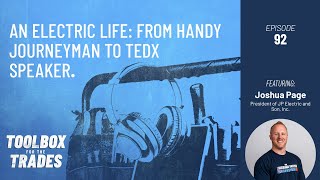
This is a podcast interview with Joshua Page — owner of JP Electric and Son, Rural Electric, and Patriot Electric — who describes a difficult childhood (mother's brain cancer and death, running away at 13), discovery of trade school, and a path through apprenticeship to becoming a master electrician and instructor. He recounts entrepreneurial experiments (infrared thermal imaging, foreclosed-house remediation), founding JP Electric and Son in 2011, and later acquiring two legacy firms (Rural Electric in 2015 and Patriot Electric in 2017), now operating about 14–15 staff across three companies. Page also discusses trade-advocacy work (career-day talks, TEDx talk, a children's book series 'What Does Your Daddy Do?') aimed at making trades appealing to youth, and shares a key leadership/personal lesson: prioritize family first, business second.
Joshua Page, you are the owner at JP Electric and Son. You are a TEDx speaker. The very first TEDx speaker we have had on the podcast. The trades saved your life and now you want to pay it forward to the next generation. Welcome to the podcast.
Thank you so much for having me. I really appreciate this opportunity. I'm honored and really humbled to even be on this stage and to have this opportunity to be with you. So thank you so much.
Oh, no problem. I'm really excited to talk to you. So I'm going to kick off this podcast the way I do every single one, which is how did you get into the trades?
Okay, so it was Friday night. My mom was dropping me off for football practice. It was my father's weekend, so he was going to pick me up after practice. Mom barely made it out of the parking lot because she was so nauseous on her way to the hospital. Mom got admitted into the hospital that night. My dad got a phone call the next morning. Yeah, we'll be right there. My dad rushed me to the hospital and it was in that waiting room with the rest of my family, aunts, uncles, grandparents, that I found out my mom had a cancerous brain tumor. She was put into surgery and I remember the nurse bringing me down to see her in the ICU and the sounds of the shuffling of the nurses and doctors feet, the beeping of the machines in the distance. And there's mom laying on a hospital bed with a big bandage wrapped around her head and wires all over the place. And I don't know if it was the smell of that hospital or just seeing my mom like that, but it made me sick to my stomach. And we would spend the next few months to almost a year going back and forth to that hospital for chemotherapy and radiation treatments. And I hated it there. The only good thing about that hospital was in the cafeteria they had an ice cream machine and they had chocolate and vanilla and the mix. And you could get, you know, you could mix your flavors and put any toppings that you wanted onto it. That was the only good thing in that hospital. Now back home in our living room, we had on the back wall was this big couch and on the towards the front of the house was a window. And that was mom's perch. She would sit up on that window and she would watch me and my friends play football tag. She would watch the cars go by. She would watch people walking their dogs like that was her spot. If you wanted to know where mom was, she was right there watching, you know, know she was so nosy. She would be watching everything on the front lawn. And eventually that couch was replaced by a hospital bed. The same hospital bed that I saw mom in that day in the icu. And mom would get worse, and she was stuck to that hospital bed. And there came a time that my family made the decision that she couldn't take care of me anymore. So I went and lived with my dad. And a few months later, I was sleeping on the top bunk of my half brother's bed. He was big in a Barney, so he had Barney curtains and sheets and blankets. And early morning, my dad, all six foot two of him, came into my room. He shook me awake and said, josh, wake up. Your mom died this morning. I was 13 years old. I just lost my best friend, my mom, to cancer. And I was living in a house that I only visited every other weekend since I was, like, 2 years old. Me and my stepmother never got along. We just never saw eye to eye. And I stayed there for a few months until I decided I had it. I was gonna run away. So that day, I put my mountain bike out on the side of the garage. And that night, I had a bedroom in the basement at that time, and there was a basement door. So I unlocked the basement door and I kept it that way, and I went to bed. And about 11:30 that night, I was laying in bed with my heart just. Just beating out of my chest. I was so scared, but I knew I had to do it. I had to get out of there. So I snuck up to the basement door. I opened the door, and I put one foot out. I looked around. It was pitch dark. I said, this is it. I ran outside. I shut the door behind me. I grabbed my mountain bike, brought it over to the chain link fence. I threw it over to the chain link. I climbed up and over the chain link, jumped on my bike and went riding. And it was just me and the pitch dark. At 13 years old, I was scared. I didn't know if the cops were gonna get me, if some bad guy was gonna get me. But I was going to my girlfriend's house. It was about 20 minutes away in another town. Been there plenty of times. And I just rode as fast as I could. And I got to her house, and she lived on the second floor. It was a raised ranch house. She lived on the second floor, and her window was on the left side. So I picked up some pebbles and I threw it up at the window. Tink, tink, tink. And the light went on. I was like, yes, and then the front porch light went on, and all of a sudden, the front door opened, and out stepped her mother. Busted. I was like, man. So I said, I'm not going back to my dad's. Call my aunt. Have my aunt pick me up. Which my aunt was my mom's sister. I said, have her pick me up, because I'm not going back to my dad's. My aunt picked me up. She brought me to school the next morning, and unfortunately, I had to go back and live with my dad. That was just the way it was now in all of this. I was a C and D student. I knew I wasn't going to college. I hated school. But I found out about this. This school that you only had to go to academics two weeks out of the month, and the other two weeks were in a trade. And I was like, sign me up. Yeah, that's what I want to go. I just want to go to school two months. Two weeks out of the month now. Growing up, I always liked the animatronics in the movies and the makeup and the gore and all that. So I was like, I'm gonna go to trade school to be. To go into cosmetology. That's where I'm going. So when I got there and I went through exploratory and found out all about the different trades, well, I quickly realized that I couldn't picture myself doing French tips, French braids, and manicures for the rest of my life. So I said, I'm not going to do cosmetology anymore. I liked plumbing, but I honestly failed out of plumbing, so I couldn't take plumbing. I had a lot of friends that went into electrical, and I said, you know what? I'll go into there. That's fine. High school was not easy. I was suspended every single year except for my senior year. My sophomore year, I had summer school for electrical related. Literally, the schoolwork to do electrical work I failed out of. So I had summer school. Junior year, I ended up running away again. This time I had a car, didn't have my little Huffy mountain bike anymore, and I just didn't go home. And I went and lived with my aunt, and I spent the rest of my high school years with my aunt. It wasn't until senior year that I really was like, oh, my God. Like, this is my last year. I don't. My mom's dead. I don't talk to my dad, and I'm living in the breezeway of my aunt's house. I really need to smarten up and figure out my life. And I did. And I graduated high school and I started working for a big electrical contractor. And that's, that's why I say this. The trades really saved my life because if I didn't go to that trade school, I mean, think about, I was 13 years old, my mom died, I ran away. I could have done a lot of other bad things with my life, you know, a lot of other poor choices, but I didn't. I don't know why. I just, I just always had the drive to push and push and push. And When I turned 18, my saying was, I'm 18, I do what I want. And I literally told everybody that. And it wasn't, it wasn't like cocky, it was just like, I'm finally free. I can finally do what I want. And I think literally since that day, I literally have done what I wanted and I pushed for it. And if people say no, I continue moving forward and continue moving forward. And I think that's why the trades really saved my life is I. As I figured out my place in life, I figured out my purpose and I. And I found my meaning. Right. If that makes any sense.
No, it definitely does. And thank you for going into so much detail. My heart breaks for 13 year old you. That must have been so difficult to go through and.
Oh yeah.
And again, just being able to find a trade and not get into other avenues that are common for kids who don't get along with their dads and have lost their mom prematurely, I mean, that's pretty incredible. So thank you for sharing that.
Absolutely.
So you did electrical, you got into electrical and you were working for a big electrical contractor. Tell me how you went from doing that to running your own business.
Well, the story doesn't end there. So I went to work for the big electrical contractor and I think it was like two or three years in, I got my journeyman's license, I tested, got my journeyman's license, and then immediately went back to get my master's license. And this big electrical contractor had a school, so we had 180 apprentices. Every Saturday would go to school from 7am to 1pm and it was in the basement, but it really was all classroom set up. It was a school because the contractor was so large. Well, I graduated from that school and got my license. And at 23 years old, I became their youngest instructor to ever go back and teach.
Oh, wow.
So I was 23 years old teaching level three electrical apprentices, which was really neat. You know, it was fun. I Worked there for about eight years. And at that time, me and my girlfriend that I met at 19, we were married. Now we're still married. We're celebrating 15 years in August, actually. And I had a son. And I remember growing up, and my dad was never really there at the baseball games or would be there or would be late, wouldn't be able to get a ride home. Mom was there. It just. It was all of those things coming into my head. And I said, you know what? I have to. I don't want to be. I don't want my son to be like that. I don't want him to be searching. I want to be there for him. So I said, what can I do? So that way I'm always there for him. And in my master electrician class, the teacher was talking about creating or starting a niche business. He said, I want you to go home and go look in the phone book. No one has a phone book anymore, but look in the yellow pages. Look up electrical contractor and see how many are in the phone book. He said, that's your competition. So, okay. So I went home. There was probably 15 or 18 of them there. We don't live in this huge, huge cities or anything, but still, that was competition. He said, find something niche. So he mentioned a word. He said, infrared. I said, infrared, huh? So I looked into it. Have you ever heard of infrared testing?
I mean, I have an idea. I don't think I would pass a test if you asked me on it.
Okay. So infrared testing, they use it on a lot of different things. But specifically what I wanted to use it on was electrical panels. So it's a camera, and you can. It detects heat signature. So you can see if you have a bad circuit breaker or a loose wire based on how much heat is coming off of the circuit breaker and wire. You can also do flat roofs for water. You can do in your home for air infiltration if you don't have insulation. So I started looking into it, and I was like, wow, this is really cool. You know, that's. That's what I want to do. But the camera was $20,000, and I just got married that year. I was like, I can't afford that. Well, when we got back from our honeymoon, the stars aligned, and a company wanted me to hold the master electrician's license for their company, and in return, they would Give me a 0% loan to buy the camera that I wanted. So in the same year that I got my master electrician's license, I married the love of My life, I started a business called Infrared High Tech Solutions where I was doing infrared thermal imaging. And you can even use it on horses. I was trained in New Mexico on saddle fittings, hoof imbalance on horses. So the saddle fittings, for anyone's listening, that does that, that works with horses. You would literally put the saddle on the horse. You would, excuse me, you would scan the horse. You put the saddle on the horse, ride the horse around, take the saddle off. Then you could scan the back of the horse again. And any hot spots is going to be where it's irritating to the horse.
Oh, wow.
And you'd see that in the camera. So it's pretty neat. So I did that for a few years in the company and I was, you know, side work. I was literally running into the porta john, or I don't know what everyone calls them, but we call them porta johns, the outside toilets in the freezing cold. Or, you know, the hot summer months when I was working on construction sites, answering my cell phone, yeah, I'll be there at five o'. Clock. So I, I would find the nearest McDonald's, I would go in, I would change, and I'd come out with this little polo shirt and khaki pants, and I, I'd go and do infrared testing for a customer. You know, it was, I was just hustling, you know, everywhere. I did that for a few years. And then I said, you know what, I really want to, I really want to go out on my own. I want to start this business. And I really, you know, I want to do it. So I left the big company. Health insurance, two weeks paid vacation, good pay. We had a house now for about a year. And I asked my wife, I said, I really, I really want to do this business. I think we can do it. And she said, okay, let's give it a shot. So I left, started infrared testing, and I did well for about a year, year and a half. And I got kind of bored, to be honest, because I wasn't doing electrical work. I wasn't doing it with my, my hands. I was going to a commercial facility. I was scanning, you know, just take, literally taking pictures of electrical panels going home, creating a report, and that was it. And I was hoping that I'd be able to fix the problems, but they already had their own electrician, so I could never fix them. Well, so I got bored of that. Business wasn't really coming in. Well, that was about 2000, 2010. About 2010 or so when the housing crisis hit right in my Mind, I'm thinking niche business, right? From my instructor in the master's class. What else can I do? Niche business? Well, isn't the smartest thing as a master electrician to do is to get into foreclosed houses? So that's what I did. So I. I started getting into foreclosed houses where I would legally get paid to break into the house. I would change the locks, board up the windows, throw away the trash, and with a Home Depot shop bucket, I would suck up 6 month old diarrhea from the toilets. I'd have to winterize the whole place. Winterize toilets, sinks, clean out the fridge. And I'm telling you, you've never smelt anything more horrid in your life than a refrigerator with ground beef in it that hasn't been open in six months, I will tell you that. So I hired an old friend of mine and I said, I need help specifically because I got tired of doing the toilet thing. So I paid him an extra $20 for every toilet he did. So I didn't do it. There was plenty of times that we were, you know, around the corner of the house because we were losing our cookies. We just couldn't handle it, you know. So about six months I did that. We did over 250 foreclosed houses again. And then I woke up.
Electrical work. Sorry to interrupt, but I just want.
Oh, yeah, absolutely. And so about six months, 250 houses, and then I woke up one morning, I said, josh, what are you doing? You're a master electrician. You're working on foreclosed houses. Like, what's going on? So I stopped that, did handyman work. I was putting up fences, I was dusting vents in people's houses. I was getting poison ivy every other day. And then that kind of slowed down and I went to work for an electrical company. I said, you know what? I'm tired of it. I'm just going to go work for someone else. That lasted two months. Two months later, we had this huge nor' Easter snowstorm. It was around Halloween in 2011, and. And everyone lost power. And everyone was calling me. They're like, I need a portable generator. I need you to put wires back on my house. I was like, I think this is the time. So I went back to my wife. I said, I think I want to go on my own, but this time I want to be an electrician. I want to start my own electrical company. And she's like, okay, I support you. Let's go. So I went back to the To. To the employer. I said, I'm leaving. I'm going on my own. I'll see you later. And since 2011, it's, you know, we 10, we celebrated 10 years last year and we have grown a ton. But I think, as I think back of everything I've done, from foreclosures to, you know, shop vacs to handyman services to infrared to everything, I feel like those are all stepping stones on this way of, to becoming an entrepreneur, a business owner, a leader, where I've got so much experience behind me. You can't tell me some things that I'm not going to know or I haven't experienced, I haven't done for myself. I've been in the trenches. I understand it. I've done it probably way more than most people have, you know, just. Just diversified that background. So I hope that answers your question.
No, it does. And it really highlights how, you know, the path to success, whatever that means to you, is never a straight line. Right. There's oftentimes a lot of detours that we go through. It's because sometimes even circuitous. And I'm glad that you ended up back in electrical and just using that incredible license you had at such a young age. So you mentioned that you hit a crazy amount of growth. I know you own a couple businesses, actually, so I would love if you could just share your portfolio. Which businesses do you have? And especially electric company. I would love to know how many people you have there. Just so the folks listening can get a sense of where you're at, growth wise.
Yeah. So I started JP Electric and Sun back in 2011. We built it up really rapidly. There's probably 12, 13 of us at the time, within probably like two years. And then in 2015, I heard of this company called Rohl Electric in town, and the owner wanted to sell. And now this is a company in the trade school that I went to, they had a big banner up in. In the shop class, Rural Electric. So I'd always see it. I'd always see their vans. And when he said, oh, he wants to sell the business, I was like, you know, maybe. Maybe I could buy. I don't know. Remember, I'm a C and D student. I wasn't the smartest, you know, I had no clue. I bootstrapped everything. I was like, you know what, Let me just have a conversation with him. So I called him up out of the blue. I don't know him. He doesn't know me. And I said, I hear that you're looking to sell your Company. It was a 61 year old company, great following. And he said, yes, but not to you. I'm talking with another contractor that's already purchasing it. That was a Friday, said, okay, no problem. I hung the phone up. I thought about it all weekend long. And I never push the universe. I'm a firm believer in everything happens for a reason. No matter what it is out there, if you're having a bad day or a good day, there's always a reason. So I never try to push the universe. But there's something about that phone call that I said, I just have to make another call just to see if I can meet with him. So I called him on Monday. I said, I'm still interested. I just want to see if we can sit down and talk. He said, well, you know, the other contractor actually backed out yesterday. I'll sit down with you at Dunkin Donuts, but no promises, no problem. Three hours later, he's given me a tour of his, of his whole shop and said, before we move forward, I want you to meet my wife. No problem. About a week later, I met with him and his wife. Two hour conversation, three months of paperwork and September 2015, I became the new owner of Rural Electric. And at that time there were only three employees, but they had a huge following. Right, so now we've got JP Electric and Rural Electric. And we moved into Rural Electric's shop, it was the next town over. We took everything from JP Electric and moved it into Rural Electric. Still have the two different vans. One's white, one's a dark blue. I kept the lettering the same. I kept everything because I was too stubborn to remove my name or merge them together. J.P. electric and Son. And I just didn't want to lose a Rural Electric name because they've had so much history. So that's 2015, 2017 rolls around and I get a phone call from another owner in a completely different town about 45 minutes away, closer towards Boston, and said, I hear that you are young, you're growing, you're ambitious and you purchase another company. Would you like to purchase mine? And I said, absolutely not. I got two. Way too much. I gave that one about two weeks and I said, you know what, if I can get a good deal, they're in a town I really wanted to push towards. Let me give them a call. I don't know why, but we met at a Dunkin Donuts again and we talked for about two hours and again, same thing. About two, three months later in 2017. It was actually, yeah, September, October 2017, I purchased Patriot Electric Contracting and service out of Concord, Massachusetts. That story doesn't go so well though, because Rural Electric, when I purchased them two weeks prior, I met with all the employees. We shook hands, we went over how I wasn't going to make any changes. Their pay structure, vacations, all of that. It went so smooth. Patriot, the owner did not want to do that because he wanted to really conserve him. He thought if he told his employees that everybody would leave, he would lose everything. So he didn't want to. So we closed on a Friday and on Monday morning I walk in and said, I'm the new owner. Within three months, all three electricians quit.
Oh, my goodness.
So I just paid hundreds of thousands of dollars for a company with a 35 year background with no electric because he didn't do what I asked him to do, you know, so that is not how you should be buying a company. And I've learned a very valuable lesson from there. But even after that, they had an electrician there that was there for 20 years making very good money, like 6 weeks paid vacation. Well, I didn't know it until about three months after he left that for two years, he, he was asking the owner to purchase a business and the owner kept telling him no. So then this guy steps in and he's like, are you serious? I've been asking for two years and then this guy steps in. I didn't find that out till afterwards. So I took it personal, very personal, especially spending all that money. But it really had nothing to do with me. It had everything to do with the previous owner. So here we are, 2022. We're still running with a few apprentices that have become licensed from that company. We still have the same client base even more, and we're still running and operating three separate companies. Three vans, websites, Facebooks. I'm sure a lot of people don't agree with me, but it's just the way that I have it for right now because they have so much history, especially in the conquered area. Everything is patriotic. Patriot lock and key, Patriot Plumbing, Patriot Electric. It's everything to do with Patriot because of the history of Concord, Massachusetts. So it's tough. It's three phones, three names, three business cards, three shirts. I've got this one and then I had to put them on here. It's tough, but it's just the way that I'm operating it and it's working for me now.
Got it. Well, thank you for sharing that and thank you for sharing that giant lesson about Acquiring Patriot.
Wow.
I was just. My eyes were very wide and my mouth was open when you were telling me that story. How many employees do you have across all three businesses?
So right now I think we're at like, 14 or 15. We're still relatively small. I know there's a lot of companies out there that are going to hear this, and, you know, they've got 100 employees, 200 employees. We're still relatively small, and, you know, just like the rest of the country, tough to find any help, never mind good help. Right. So it's very, very tough. So we try to take care of our employees, our office staff, as best as possible, give them a wide range of different jobs, whether it's commercial, residential, generators. Just try to do everything we can to make them happy and to take care of our customers.
You actually just gave me a perfect segue into one of the main things I want to talk to you about, about, which is the topic of your TEDx talk, which is all about making the trades cool. Again, for lack of a better paraphrase. Can you tell me how you started in this crazy journey of going to different. Going through different types of industries, different types of work? When did you start going to high schools and talking with high school students about the value the trades can offer their lives? Because it sounds like it's made a pretty incredible impact on your life personally and then just on these high schoolers in general. So talk to me a little bit about that.
Yeah. Who? I just got chills. And you're saying that. I think it was probably like five years ago. I think somebody just asked me if they would come in for a community day, for the career day. And I was like, you know what? Yeah, I'll go in there and speak about being an electrician. But I honestly did. I did the opposite. I told them my story. I told them the same story I told you at the beginning of this podcast and spoke, like, maybe for five minutes about being an electrician. And then I just got invited to another one and to another one and to another one, and I started thinking about career days and getting kids involved and just asking questions. And I've done that my whole life, really asking questions. And as I've grown older, I've tried to ask better questions, right? If you want a better answer, you ask a better question. And to me, it was always like, what is wrong with the trades? Why don't kids want to be an electrician or a welder or a carpenter? What's wrong with us? And I always felt like we had the stigma that, oh, I don't want to do that because I want dirty hands. Or you know, that guy's got dirt underneath his fingernails, or the plumber with the whole butt crack hanging out. Or, you know, all these guys are dirty and they smell and it's like, where does that even come from? You know, I don't even think that's, I don't even think that's our generation anymore. Maybe it was at one point, but it's not. And, and then I started thinking, okay, well if the kids see that and they don't want to, they don't want to, to be dirty or they don't want to work hard or whatever the excuse is, where are they going? So they're going to college, they're going to get just a job, you know, or they're going to the military, which is fantastic. And then I started thinking and asking deeper questions. Who's pushing them to that? And then I figured out it's, it's really, in my opinion, I think it's the parents. I think the parents are directing as we should, right? We got to nurture our kids and have them grow up correctly or do the best job we can. But I think they're always pushing them towards college because it seems like we have this stigma in the world that, or at least in the United States that if you don't graduate from a four year college and get a degree, you're useless, you can't make any money. And that's obviously not accurate. There are electricians and plumbers and tradesmen that are making millions of dollars a year. So that's not accurate. But why is that the default? Why is college always the default? I was talking to a banker the other day. She had a 23 year old, stays home, lives in the basement, had no clue what to do with his life. And I said, what did you tell him? She said, I told him you should take some night courses. Why? Just because he has nothing else to do with his life, you tell him to go to college? What about, is he working on his car? Does he have a dirt bike? Or did he climb trees when he was younger? Maybe he could do something in the trades. Why don't you ask a local electrician if they're looking for any new employees, any apprentices or a welder or a carpenter or any of them? I'm an electrician, but I speak for all the trades. I'm just in love with getting kids involved with the trades because I've seen it. We don't have enough. And to even go deeper on why college is not the only option, I don't anymore. But I used to do the 15 hour code updates on the weekends. Well, when I would go to them, there'd be about maybe 150, 200 people in the code updates. And all I would see would, would be a sea of white hair, just white and gray. And I'm like, where are all the kids? Where's the 20 year olds? Where's the 30 year olds? It's nothing. It's just a sea of white hair. And I started doing more research. So about five years ago in the state of Massachusetts, the average age of an electrician was 52 years old. They had a study, there was about 32 to 33,000 licensed electricians in the state of Massachusetts. 25,000 of them were over the age of 52. What are we going to do when all those people retire? You know, we're going to be. And this was five years ago. This was before COVID before any of us, any of this stuff, before the mass exodus of employees across the country. And I said, man, we've got to make, we've got to do something. So I think that was the big, the big hit for me on helping with Career Day, on helping with giving them another option. And then it's just spiraled since then that, you know, college is not the only option, that we should have the trades on the ballot form, like, hey, you want to go military? Awesome, perfect. You want to get a job? That's okay, great. You want to live in your mom's basement? No, that's not, that's not on there. You want to go in the trades? Sure. Great. You want to go to college? No problem. You know, I said on the TEDx, you don't want this guy being your brain surgeon. Right. So obviously college, it needs to be an option, but it's not every option for every kid. You know, some of my best employees were the ones that didn't do well in school. They didn't really want to go to college. They kind of lost, but they were great with their hands. And that's who we are in the end.
Yeah, 100%. And we talk about the tra, the labor shortage a lot on this podcast because obviously every single person I interview has the same issues you do, which is I cannot find good help. So we need to start nurturing it. And there was one story you told me when we first stopped, we first talked, that I would really love it if you could talk about on the podcast. So from doing these high school talks, telling your story, telling how the trades has really saved your life, you have gotten some apprentices who have wanted to work with you. And there was one guy in particular that really made an impression. So would you mind telling us a little bit about that?
Yeah, absolutely. So pandemic started February, March, I think it was the beginning of the summer of 2020. I had this kid give me a call, said he wanted to do an interview, and that was when, you know, we were super scared of everything. So I said, yeah, we'll have the interview in our warehouse, like, 20ft away from each other. And he showed up, and I'm like, where? Like, where is he? And it was a big truck with it with an old man driving. And all of a sudden, this short, little chubby kid gets out on the passenger side and comes in, and I'm looking at him like, you. You here for the interview? He's like, yeah. I'm like, how old are you? He's like, 15. I'm like, okay. I'm like, how'd you get here? He's like, oh, my grandfather dropped me off. I'm like, so I did the interview, and in my head, I'm thinking the whole time, like, this is big liability. He's, you know, stupid, got baby fat. Like, I don't know if this is gonna work. He's like, yeah, I just started at, you know, the. The trade school up the street, which is where I went to. I'm like, oh, that's cool. I said, but you're a little too young. Like I said, give me a call another year, right? So he must have called me, I don't know, like, six or eight times. He texted me. He called me, said, I still want to work for you. I said, yeah, that's fine. Give me a call in the summer. So this is 2021 now. So he gives me a call the beginning of summer of 2021, and he was trying to set up an interview. And I said, I don't have time. You know, every. Every time he would text me, I just. I was always on the road. I just didn't have a chance to get in touch with him. So I said, call my office. I'll have my admin assistant set up the interview. I said, I can't make any promises. Let's just sit down. So we sit down, and he grew a little bit. Still a little chubby kid. And now he's 16. He was gonna get his license to drive in, like, another month or Something like that. Still, his grandfather brought him. So we're talking, and I'm like, if you were to get hired, how are you gonna get here? He said, well, my grandfather would drive me. I said, are you sure? Every single day? Yep. No problem. They will drive me every day. Okay. So I started thinking to myself, well, maybe we could use them for the summer. Maybe just put them in the warehouse or something. I said, before I make a decision, I have a question for you. And he said, what? I said, why me? I said, why have you been bothering me for over a year? I said, you've texted me. You've called me. There's plenty of other companies in the area. You live 25 minutes from this office. Why me? And he said, to be honest with you, when I was in eighth grade at the high school, you came in and gave a career day speech, and he said, you told your story. And I grew up the same way as you, and I didn't like school, and I knew I wanted to do something different. And when I went home, I told my mom and dad that I wanted to be an electrician. He said, that's why I want to work for you. And I'm like, oh, my God. I'm, like, crying, and I'm like, you're hired. Like, come on board. You know? So it was in that exact moment I was like, I think you're on to something, Josh. Like, no matter what is going on in life, if I can take these small opportunities to change a child's life, the next generation's life, get them involved with being an electrician or the trades, and let me remind you, I had 30 minutes to speak to them. 25 of them was about my story. Five minutes was, you need this many hours to be an electrician. This is a linesman's flyer. It was five minutes on the. On the actual profession. But it was my story that. That inspired him to get into the trades. So he. He was actually. He just left, to be honest. He just left about a week ago. He went to go work with another company that was doing some bigger things, more commercial projects. But he left on great terms, and he was a good kid, and he is going to be a phenomenal electrician when he gets licensed. Phenomenal. So I'm. I'm very happy that we have.
That's awesome. And I honestly, like, you already told me this story, and I kind of was, like, tearing up again when you. When you told it, because it's such an incredible story about the impact we can have on younger generations. With when we don't BS them, when we tell our story, and when we really, I think when people talk like, how do I get the people interested in the trades? Every single person I've had on this podcast has a phenomenal story of how they got into the trades. That's why it's the first question I ask on the show. And I'm like, if you just say that, I guarantee you you will get people interested. Which brings me to my next question, which is you are actually in the process of writing a children's book about the trades, which I love. So why don't you tell us a little bit about that?
I can't wait until it's done. It is so much work. So again, the pandemic we were are an essential business. But I decided as a company right in the beginning, I said, you know what? The governor wants all, all non essential businesses to shut down for two weeks. This is right in the beginning. And I told my entire staff, I said, we are essential, but I don't want to go through this pandemic and then puff my chest out in the end and say, well, I'm glad we never shut down. I just didn't want that because that was March. Like nobody knew anything. So I said, let's just shut down for two weeks. I was scared out of my mind because I didn't know what I was doing. And I just said, let's just, let's just shut down. So we did. Well, this guy can't just stop. So my brain was going the whole time and I said, how, what can I do? And how can I do it? So I literally wrote two books. One I don't even think we talked about, but the other one I said, if I'm going to these career days and they're 9th to 11th grade, they're going to a regular high school. Some were 8th grade if they snuck in like, like that apprentice did. But the most of them are 9th to 11th grade. So I can inspire them, I can motivate them, but they most likely won't jump ship to a trade school when they're in high school. They would probably do it after, after high school. So I said, what else can I do? My wife's a daycare owner. She owns a very large daycare. And I said, what if I plant the seed in the young child's mind that the trades are cool? Like all the cool things. So what I did is I created a Google form and I asked a bunch of questions and I put it out on Facebook. I said, anyone who's in the trades, please put your trade on there. You don't have to put your name, just put your trade in. All the cool things that you love about your trade. So I had horse farrier to cosmetologists to welder, carpenter, electrician, plumber. I had everything on it. And I was like, sweet, this is awesome. So I started writing the book, and it's literally about. It's fourth to sixth grade. That's kind of where I wanted to plant that seed. And it's career week in school, so the teacher asks the little boy what his father does. His father's electrician. He has no clue what his father does, so he just knows the electrician. So he goes home and asks his dad, and his dad tells him all the cool things about it. And I'm not going to tell you the rest of the book, but that's. That's what it's about. So the book is finished, it's edited. A publisher picked it up. The illustrations are in progress. I'm going through them right now because a couple of them, I was like, oh, I don't like the way they look, or it's a process, I'll tell you. I didn't realize this, and I'm, like, getting wicked anxious. Like, I just want it to be done. But I'm so excited because I think it's going to make a huge impact. And I can't wait, literally, to have the book in my hand and I want to read it to all the kids at my wife's daycare. I'm just like, that's, like, what I want to do. And if I could get the book into scholastic, oh, my God, that'd be like hitting the grand slam. That'd be so fantastic. So that. That's really what I want. That's what I was thinking. I said, you know, career days are great. I mean, at high schools, but how can I get it to the younger generation? You know, make the trades cool again, all the cool things. That's. That's my process. My. My thought process.
Awesome. And what's it. What's it called again?
So what does your daddy do?
I love.
So what does your daddy do? Is going to be a series. And then if it works out good, we're going to be doing some other things with that topic, per se.
Josh, I know this is going to be a longer episode because there's one other thing I really, really want to talk to you about. Before I ask it, though, I have to say we've Mentioned Dunkin Donuts twice. And you used wicked as an adjective just now. I'm just loving, I'm loving the Massachusetts vibe. I'm a New Yorker, so I too have a love of Duncan. I don't even realize it, but you mentioned your wife a few times. She sounds just incredible, super supportive, an entrepreneur on her own. When we first spoke, you mentioned that, you know, as you were trying to grow your business and do this really incredible thing for your family, in your process of doing that, you were actually doing the exact opposite. So I have a question on the show that I usually ask, which is, you know, if you could go back in time and give yourself one piece of advice, what would that be? And I have a feeling that this advice would be. I know what that advice would be. So I would love for you to talk a little bit about that and impart some wisdom on some of the younger folks now who are listening to the show and thinking about how do I become an entrepreneur in the trades and what was that big lesson that you learned?
Yeah, so, ooh, am I getting teared up just because I haven't really told this story to many people? That was a tough part of my life. We were about year nine in marriage, which was year five in the business, and I had no clue what I was doing. You know, I started the business with $750 in my pocket, a beat up old Comcast van from New Bedford and just worked my ass off. Right. I had no clue. And if I didn't know, I would research it or I would watch. I'm very visual person. I can learn a lot just by watching you. Right. So I, I was, I would think back of the big electrical company that I worked for, what that owner did. And when I worked in the office there for a little bit doing some estimating, it was like 4:30 in the morning. I would go there to get prepped and ready. Like I just, I kind of wanted to show off to the bigger project managers. Well, there's one morning that I drove in and the president had a corner office, glass on both sides. And I just see his head doing this and I'm like, what the heck is he doing? Just, just doing this back and forth, back and forth. So when I got into the office, I asked the project managers, I said, hey, what is he, what was he doing early in the morning? He said he's doing sit ups. He comes in, in the office at 4am, he drives to the office, he drives his car into the office, then he runs from the office Excuse me, from his car to the office, because he has a car phone, he didn't have a cell phone. So if somebody called him between the car to the office, he wouldn't be able to answer it. True story. So he had the car phone, he didn't have a cell phone. He would run to the office. Once he got in the office and someone called him, he'd be in his office, you know, in the building. And they could page him at that early in the morning. So he would, he would be in there at 4am he wouldn't leave to 11pm that was his life during the day. If he had to drive somewhere, somebody else was driving him. Because at one point I think he almost got into a very bad accident when he was reading plans while trying to drive. So he's in the back seat, he's looking at plans, he's got a car phone, he's get the facts. This was a few years ago, right? But so that I modeled that, I said, you know what, I've got to go into the office early. Like that's what he did. I've got to do that. So I'd go into the office at like 4:30, 5:00 clock in the morning and I wouldn't, I wouldn't go home until like 9, 9:30 at night because it was starting to get dark. And I thought the more hours I put in, the more successful I would be. You know, I watched other business owners, they would dress up, you know, they're successful, they would dress up. They literally wear like fancy black shoes and you know, khaki pants that, you know, we're all, all ironed down and the polo. And I said, that's how I've got to dress. So I literally dress like that. And I would end up on job sites, climbing the ladder and you know, working with customers. And I'm all fancy guy, right? I look at another business owner, I'm like, like, man, he's really successful, he makes a lot of money. But I don't ever see him laugh. He's very serious. I've got to be serious now. Never laugh. I wouldn't laugh. I'd be serious. My wife would try to joke around. Nope. Because I'm a businessman now. This is what I do. I'm building this business for my family. I have to dress a certain way, I have to act a certain way. I have to go into the office a certain way. And I didn't realize that that was all wrong, right? I put the business first, then my kids, then my Wife. And it wasn't until. Wasn't until one night going through McDonald's drive thru that me and my wife were having the biggest argument of our life. And I said, maybe we weren't supposed to be together. Maybe we weren't supposed to do this. And that was the lowest part of my life. It really was. I was doing it all wrong. I was. I was. I was copying everyone else because they were successful. And I thought that's what I had to do. And it took about a month or so to really, really figured myself out. And I said, josh, you can't do this anymore. You're. You're doing all of this for your family, you know, doing everything, working so hard for the people you love, but you're literally going to lose everything you love because you're working so hard. And I said, that's it. I'm not doing this anymore. So I immediately flipped the script. I went my wife first, my kids second, my business third. And when I made that switch and started delegating more at work, started planning my day out more weeks ahead of time, scheduling myself at home to bring my kids to school, when I go home, the phone gets shut off. I wouldn't answer emails, or at least not in front of my kids. I. I would try not to answer the phone in front of them. Once I made that switch, the business literally blew up. I was busier than ever. I was more profitable, we were making more money. I was happier at home, everything. And I was like, oh, my God. I don't know if somebody told me that before. If I would have believed it, I had to experience it myself. But I don't want other people making the same mistake I did because that almost took everything that I loved and known away from me. So if there's anything that anyone's gonna learn from this podcast, it's always put family first. Always, always, always. You are building this business for them, not against them. I think that's. That's what I get out of it. And. And just because of that, it's been five years now. Five years in business. That's when that happened. I've been in business over 10 years now, and me and my wife are, you know, madly in love. She. Her business is growing, my business is growing. You know, writing the books. We're taking more vacations than ever before. I take every Friday off during the summer so I can spend it with my kids, and we do little vacations on the weekends. I mean, just. I'm living the life I've always dreamed to be perfectly honest, and not that I wanted it to happen, but I'm very. I'm very grateful that that argument in that McDonald's drive thru happened because it flipped my entire world for me. On purpose. Right? I told you before, I don't push the universe. Everything happens for a reason. And at that point, I was stuck in the suck. But I'm glad it happened because I wouldn't be who I am today if that didn't happen.
Thank you so much, Josh. And thank you for being so vulnerable with that story. The reason I wanted you to tell it is because I've heard this talked about before, but not as directly as you've done it, which is a lot of people, when they become owners in the trades, they do what they see other people doing and they emulate who they want to be. And I think your story spread speaks to. That's not necessarily the right way to do it. And you have to figure out your individual priorities and what's going to work for you, make your business work for you, because that's the reason we're doing it. So thank you so much for being so vulnerable and telling that story. I really wanted to talk about. Absolutely. We're going to end it on a light note. I've really loved talking to you. I've really loved listening to everything you've said. I'm sure our audience will love it as well. But my favorite way to end the podcast these days is to ask, if you could choose a song to be the soundtrack of your life, what would it be?
So I'll be perfectly honest, I had no clue. And I was freaking out five minutes before I was supposed to get on with you. And I texted my wife and I said, I need a song. I don't know what it is. Please help me right now. And she. She said. I literally wrote it down. She said, mayo Female featuring T Pain, all of the above. And I was like, okay, so if you want to listen to that, I guess that. That'd be. That'd be me.
Lindsay. Lindsay's recommendation, which honestly is probably the. Honestly out of the mo. Out of everyone in your life to ask that question to. Lindsay probably had the best answer. So I can't wait to check that out later. Josh, thank you so much for being a guest on Toolbox for the trades. I really enjoyed chatting with you.
More from Bill



ServiceTitan Virtual Agents: Simplify Before You Scale | Podcast Ep. 110 | Mastering ServiceTitan



Life After Live Events: How to Turn Post-Conference Energy into Real Profits | Podcast Ep. 297




