Grow Big, Stay Human: Lessons on Technology and Client Care | Podcast Ep. 245
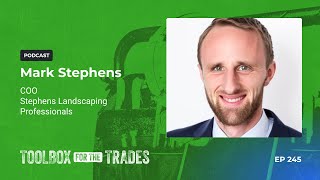
Podcast interview (host Amanda Saboteur) with Mark Stephens, COO of Stevens Landscaping Professionals (New Hampshire). Covers the company’s origin (high-school project → full business), recent scale (reported $22M revenue last year), and a deep dive into how technology and data (Aspire software, GPS/Trimble, excavator-integrated GPS, NCon tilt-rotators, fleet/fleet-management APIs) combine with deliberate people/process choices to deliver personalized client service in a seasonal lake-region market. Key themes: job-costing and auditing recurring revenue with Aspire, tooling that increases field productivity and recruitment (tilt-rotators, in-cab GPS), custom construction trucks to keep crews supplied, a single-point-of-contact account model, and proactive data-driven capacity planning to scale without losing company DNA.
Hello and welcome to Toolbox for the Trades. My name is Amanda Saboteur and today I speak with Mark Stephens, COO of Stevens Landscaping Professionals in New Hampshire. In this episode, Mark and I will dive into the balance between technology and personalized customer service, exploring the specific tools and processes that have helped his company thrive. With grit, determination, and an eye for data. What started out as a high school project has turned into a company that generated 22 million last year. A true success story. I hope you enjoy this conversation as much as I did. Mark Stephens, you are the COO of Stevens Landscaping Professionals, and today we're talking technology and tools that keep your business cutting edge while keeping things personal. Thank you so much for coming onto the show.
Yeah, thank you for having me. Super excited to be on this show and share some of my industry knowledge and kind of how we got from where we started to where we are today.
It's a really great story. For any listeners who are unfamiliar with the origin story of Stevens Landscaping Professionals, you're in for a real treat. It's a very cool story, but first and foremost, we're going to start with our icebreaker. You're in New Hampshire, so I figured, and this episode comes out in October, so I figured why not dive into fall? What's your favorite thing about fall and why?
Probably just the crisp, cool mornings, the fall foliage, the ever changing kind of landscape in New England. Business wise, we have two big pushes. It's our spring push and our fall push. So we're kind of, you know, as I call, we're headed into playoff season. So it's kind of a sense of energy in the team. You know, they know we're at the final push to kind of, you know, make the biggest changes we can on our clients properties, you know, before we come into the winter season. So it's an exciting time here for sure.
Oh, I bet. As an east coast girly who now lives in California, I miss, I miss that fall season for sure. And you're in a great spot for it, so I hope you enjoy. So let's get into it. How did you find yourself in the industry?
My chore growing up was mowing the lawn at my parents house. It wasn't, you know, just a push mower or something like that. We had a commercial mower luckily at the house. So that was kind of my chore. My hobby was actually motocross. We had a neighbor that lived next to us that had a big open field and I asked him one day, can we build a little jump in your Field, you know, to practice motocross and stuff. My dad had a tractor. Fast forward. We built an entire motocross track, full board track, you know, a mile long. I think at that point I just realized I really loved the outdoors. Word. Loved working with equipment, loved working with my hands. And that's kind of was what initiated, you know, the first thing in 2007. My brother then went off and started a mock business as a senior project in high school. And that's really when the business kind of started. In 2007, that mock business really turned into more of a legit business. In the summer that he graduated that we had started Steven's Landscaping. So started off just mowing some lawns and.
Yeah, that's wild to me. I. I love this story because it starts off as this high school project. It starts off as your chores, and you start mowing these lawns. And now last year you had 22 million in revenue. You have grown this business exponentially. So I'm really excited to find out how you guys got here. Before we get into the nitty gritty, could you please explain what Steven's Landscaping professionals specialize in and your unique market? Because you have this different clientele, you have these different services, and I think it's important for the listeners to understand what you do and who you work with for the rest of the conversation to really, to really land with them.
So we're. We're in a very unique market. It's stead center of New Hampshire, we call it the lake region in New Hampshire. Many lakes around the area, Lake Winnipesaukee, Squam Lake. Really our goal is, is to be that, you know, trusted partner for their second, third, fourth, or primary home. Right. And we offer, you know, right from design services to our build services to our enjoy services. And really our purpose at the end of the day is enhancing lifestyles. Whether we're enhancing clients lifestyles, we're enhancing employees lifestyles, we want to be that single point of contact and that partner for our clients that, like, they don't have to go anywhere else, you know, to get any sort of service on their, you know, on their property. So we've really, you know, kind of built a niche where we can be that single service provider all the way from designing your landscape to installing your landscape, all the way through maintaining, you know, the landscape and maintaining, you know, the home itself as well.
Yeah, I recommend anyone who's listening to check out the website to really get a grasp on what work you guys are doing. It's Gorgeous. It's incredible work. So, yeah, thank you.
It's. It's just, yeah, it's such a unique place. It's. Every site has its own challenges and stuff like that and we'll get into that as, you know, as we get into, you know, more of the podcast here. So.
Yeah, absolutely. Yeah. So today we're talking about the balance between technology and also creating a personalized customer experience. Right? You have this unique market. Let's dive into technology first. How has using data transformed the way you make decisions for the company? And are there any specific examples of when you used the data to help solve a problem or better yet, even find a new opportunity?
99% of our decisions are definitely based on data. I think the one that stands out to me the most was job costing around our reoccurring revenue. So the majority of our kind of landscape maintenance model before Spire, we really didn't have great insight. You know, we knew as a division that we were, you know, profitable. We didn't know on, you know, which property we were making money on, which property we weren't making money. And so after we had a couple of years of diversity data within Aspire, we had done a complete audit of our entire reoccurring revenue business. And it was eye opening. There was places that, you know, did contracts that we thought we were making money on that we weren't making money on. There was a lot of holes in areas of estimating production. And so it was about a two year project in total. But we had gone through every single one of our reoccurring revenue contracts, audited it and made adjustments and did it in a step process. So it didn't happen over one year. We did it, you know, over the course of two years. We also had revamped, you know, how we do estimating again, Lake Nasaki has its unique challenges. These aren't postage stamp lots at the end of the day, like, each property is unique in its own. So estimating is definitely a challenge. You know, there's not very black and white production rates. At the end of the day, if we're going to offer a new service, right, we use data, we go out to our customers, we figure out what they need, what their pain points are, how many different vendors are they managing to manage their property. At the end of the day, really the goal is we want to be that single point of contact.
When you get to look at this data, you're really taking a holistic approach to your business and taking a deep dive into what is working and what's not and being able to trim that fat in those two years. What would be your advice to somebody who's thinking, okay, I have this data within Aspire and I want to utilize it to my advantage. What would be your advice to somebody who wants to take that project on but feels like maybe it's going to take too much time and they're a little nervous about implementing that sort of change?
There's a lot of noise, you know, in business, right? You can chase all these great ideas that you see or hear about and I think staying laser focused on what you, your objectives are. You know, we really, we have quarterly planning sessions, we have annual goals that we're trying to, you know, accomplish. And we make sure that whatever we're doing is supporting those goals and getting us to, you know, that one year target of where we want to be. Don't be scared. Just, you know, try it. Truth up your data, look at it at different ways, but don't, don't be scared of it. At the end of the day, you know, once you get to a certain size, I think you have to be very cautious of going with your gut for decisions. And I think you really need to trust the data, right? The data is, at the end of the day, as long as you're putting good data into the software, you're getting good data out of the software and you need to trust that data. It can be overwhelming. It's a lot to sift through. There is a lot of noise sometimes in data. It can tell a story for sure.
It can tell a story within Aspire. Is there any other technology that you leverage?
So we use everything within Aspire. The only thing we've dragged away from just a little bit is the equipment module. Because we were looking for something that offers, offer a little bit more for our fleet as we've grown to, you know, a little over 100 trucks and probably another, you know, 50 large assets, executor skid series and stuff like that. But we really do use everything from the client portal all the way down to, you know, Crew Mobile and everything in between there. And I think it's important, you know, we've been on other softwares before. We've used portions of it, but didn't use it in its, you know, entirety. And we always lack data back then because again, we didn't track things. So I think if you're going to do it, really just like put your head down, make it a priority. It takes time. It takes time. But in the long run, I couldn't imagine running a company like this without some sort of software. And Aspire has been a great partner on that with us.
Beyond using Aspire, I know that you're using some really cool technology, especially with these with landscaping. So I'd love to dive into that. What have you been using that has helped with your overall operations?
We have a great accounting software, we have a fleet management software, an HRIS software and a design software. And a lot of those do communicate to each other through APIs and whatnot. And really that's kind of our software backbone or operations that we have, you know, that we use within the company when it comes to equipment technology innovation out in the field. Let's start with NCon. So go back probably five, six years. We had a pretty technical job on the lake. Tough access, tight lot. And that's when tilt rotators and NCON were just starting to hit the market in the US They've been widely used overseas for many years. If people are not familiar with an NCon, it's basically a tilt rotator that can go on the end of an excavator that allows you to just really do a tremendous amount of more work in production, a lot safer, efficient. It also has helped kind of bring new talent in. Right. People want to work for a company that is investing in technology, investing in the latest and greatest things. I always have this funny story. I have a really good friend, high school friend that still works for us. He was the best person I knew at video games at a young age and he is likely now one of our best operators in the field. Just that hand eye coordination and there's so much going on. There's so many things you can do inside that excavator, from the seat of the excavator without getting out. So the NCon's definitely something big in the field that we've invested in. It's pretty much a non negotiable on. Any excavator that we buy nowadays has an N con on it and the amount of work that we can do, the capabilities of it and the fact that we're really reducing risk, you know, when it comes to safety and that's a big priority here at Stevens Landscaping is making sure that, you know, all of our employees can get home safe to their families at the end of the day.
I love that. I love that. I also want to go back to what you said before about getting employees excited through technology. Bringing technology into your business is going to be bringing also new talent who has this unique person perspective Right. And I love that that is a selling point to come work for you guys.
Yeah, it's really, you know, especially in New England, I feel like, unfortunately it is a little bit further behind in technology and innovation for the most part. So, like, you know, we have these great operators around, but they're just stuck doing the same old type of work or the same old old equipment. And you know, once they see our videos on Instagram or social media, you know, they're like, wow, you know, that's somewhere I want to work. Right. You know, I want to be part of that team that is leading the industry.
Love to hear about the GPS you're using for landscaping. Let's get into that.
Yeah, yeah. So we use Trimble. We've been using Trimble for probably about four years now. Trimble is a GPS layout tool. Our designers, you know, does that. We have design in house, so we do all our design in house, which allows us then to transfer that design over to Trimble, which is our GPS software, and then allows our teams on site to be able to go out and do their own layout, see where patio is going to be, see where the elevation of the patio is going to be, see where the stairs are going to be, trees, you name it, we can lay it out with gps. It hasn't just helped the crews in the field staff, it's also helped efficiencies and production. And we're not Building a patio 10 extra square feet than what we had proposed because we're laying it out exactly per design. And that's key up here in the lake region as well because we do have a lot of permitting requirements that we have to, you know, strict requirements around Lake Minnesaukee or other lakes that we have to follow. Right. So our team is not second guessing. They're not calling a project manager all day long asking, you know, where is this patio exactly end or where do these, you know, walkways go? Or all of those types of things. Right. They literally have it right on the screen on the tablet. Can walk around the site and lay out, laid it out perfectly. We did just invest this year for the first time and we put GPS inside our excavators as well now. So we have two excavators that we're working with right now where we can basically everything that those crews were able to see on site before on that tablet, they can now see inside the excavator and they can also see their bucket on that same screen. So if they're, you know, digging to prep a patio or something. We're not over digging. We don't have to over excavate. They don't have to get out of the machine and pull tape measures of pound stakes in the ground. Right. They literally can do all that from, you know, the cabin of the machine. We've had that for about a year now. And that will probably follow the same trend as ncon, which will be. All of our new excavators will be outfitted with that from the get go.
I'm sure that that's helped with time management, with how you are utilizing your time, how you're spending your money and just getting the job done sooner. And you have these huge jobs. So I, I'm sure that's saving so much money and time.
Absolutely. Yeah. And these jobs are complex, right? I mean there's jobs that have 50, 60ft of grade change with retaining walls and everything has to line up perfectly. You know, we're on a really complex job now that we've been on for a little over a year that has thousands of feet of retaining wall and you know, steps in between and every inch matters as far as grade and stuff like that. So it's been a huge help. The staff out in the field love it. And you know, every time we introduce someone to it, they're like, wow, you know, didn't know this technology was out there. So yeah, it's, it's pretty sweet. It's pretty sweet.
Yeah, it's very cool. Speaking of efficiency, can you tell our listeners about these customers, construction trucks that you have built, what makes them special and really what inspired your need for them, you know.
Yeah. So we again, we're always trying to make things better here at Stevens Landscaping. And we had gotten feedback from our field team that just like predominantly we do, you know, large landscape jobs that we're on for, you know, anywhere from three months to two years. Right. And so we can kind of set up shop there. But you know, there's always delays here there that we need to jump out and do another job there, another job here, you know, know, a small enhancement or something like that. Constantly, you know, our crews were showing up to jobs without the correct tools, having to run around chase things. And so we kind of took a step back last winter after having that conversation with our crews and said, hey, you know, what do you guys think about this idea? So I had pioneered this idea that, you know, we're going to build these, you know, new construction trucks. There's been some out in the industry similar, but not, not anything specifically like this. And so basically what we did is we got the new Mac MD6 is outfitted them with a box behind the cab. So we have an 8 by 8 box behind the cab that stores every single tool that they would possibly need. So that if they're jumping from job to job, everything is on board at all times. So there's no loading up tools in the morning, there's no unloading trucks in the afternoon, there's no putting tool. Again, we're seasonal so there's no putting tools away at the end of the season. Everything's undercover, everything's locked up. And then behind that there's a dump body so that we can take material with us. So we've pleated almost all eight of those to start. We kind of went with the first batch of eight to convert eight of our crews over in the feedback. Just talking to someone this morning actually. You know how you like in your new truck. And the feedback has been awesome, right? They jump to a small job and they have every single tool they would need in that truck ready to go. They're loving it, right. It's definitely making their day to day job a lot easier as well.
I think that is also an indicator of how much you care about your crew, how much you care about making sure that they are doing the best job that they can do as well.
We're really frontline focused at the end of the day, right. We want to support our staff, we want them to be heard. If they give feedback, we act on it. So yeah, that's super important to us and I think that's why we have been able to grow so fast. So we built a really strong team that, you know, returns year after year. And you know, I think at the end of the day our, everyone's divisions are aligned and so we're just all rowing in the same direction.
Let's talk about this unique market that you're servicing. We're talking about people who are homeowners who, this may be their vacation home, this may be their, you know, they might be there on the weekends, they might be there once a year. It's. Or they might be there every day, who knows.
But yeah, there's a full mix for sure.
It's a whole mix. So how do you balance the need for efficiency and automation while also providing this high touch personalized experience for your clients?
On the reoccurring revenue side, we've basically created what I call pods or mini business units. So we've created a structure where our AMs are a single point of contact to our clients once they get into our reoccurring revenue. If they're just in design build, right, their product manager is their single point of contact at that point. But once they enter reoccurring revenue, our account managers are there for client relationships. At the end of the day, we don't stretch our ams, you know, too thin. They're there to focus on, again, client relationships and quality. We then team them up with a production supervisor and then a list of crews that constantly work on the same properties underneath the same managers. So it's a very clear vertical as far as, you know, client communication and making sure that things don't get lost in translation. We have held back a little bit on automation. We are, you know, working on things as we speak to make some adjustments. As we know we need to interject automation slightly. But for us, we don't want to lose our DNA of how we got, you know, from $0 to 22 million. Right. Like, we want to make sure that we have that same DNA of 50 million. And that's client experience, a high client experience. Our clients value their time, right? And so our goal is to provide them with a high level of service that takes the least amount of their time to manage us. Right. And that's value to them as well. So it's a very delicate process. You know, we're going on 16 years in business and we're kind of going all the way back to step one, you know, from when a lead comes in and auditing that portion of the business and making sure that we're giving the best client experience while still being as efficient as possible.
It's definitely that, that push and pull. So there are certain things that you definitely, you find it easier to automate, but there's this personal touch that your clients expect and are here to experience. So it's, I can imagine it's a, it's a bit of a process to find that balance.
It is. And it takes a lot of like, you know, again, we don't just offer landscape maintenance, we don't just offer landscape design. Right. Like, we offer a large suite of services. So it's, you know, internally is probably where we're going to roll out a lot more automation, you know, for operations internally versus external to our clients. For us, it's extremely important that, you know, we have really strong cross collaboration between our departments so that we're providing a seamless experience to our clients.
So you talked about your single point of contact model and you're avoiding the phone tree what are some of the processes that you've put in place to ensure your clients are experiencing that personalized touch?
I'm all about efficiencies. I'm a data person. My brother's also all about, you know, client experience. So it makes a great balance. Right. We decided that, you know, a phone tree is not what we want at Stevens Landscaping. We want someone to be able to call, get the personal touch, talk to someone. Right. But with that, we also want the client experience to be like a quick turnaround. We don't want someone to wait for a callback. You know, we want to be able to act on things quickly and also make sure nothing, you know, falls through the cracks. So we've implemented a internal ticketing system that we make sure that all communication is tracked. There's people that, you know, hold others accountable, people that are managing that ticket system and ensuring that nothing falls through the cracks. I think that's, you know, one of the. And again, I talked about this earlier, we're, you know, refining that process slightly still. But, you know, you have someone that ANSWERS A phone 24 7. You know, we have an after hours line because we do offer property management for emergency services and stuff like that. So we really do have a good kind of, you know, system and process around that. Well documented, followed by all. And, you know, we don't seem to have too many issues where things fall through the cracks or, you know, someone calls back and said, didn't get a call back. Right. We set clear accountabilities, clear expectations to our employees of what we expect to be done and what. In what time frame.
You are clearly very deliberate about what you do and the growth of the company. But I would love to know what is the biggest challenge you're currently facing and are you using technology or data to address it?
I think the biggest challenge we're facing is scaling without losing our DNA. Right. How did my brother and I start this company? What were we doing? Well, and as we continue to scale, making sure our employees that we're bringing on have that same DNA. Are we using data? Absolutely. Yeah, we definitely are. We're constantly looking at data to figure out capacity. When is something going to break? Right before it breaks, though. So we're always modeling things to know. All right, at what point or what level do we need to add another account manager so that the DNA of giving that personal touch to our clients. Right. Doesn't break. And instead of waiting for feedback from clients that, you know, they're getting a poor customer service from the ams because the aims are overloaded, right? We know those points of when, hey, we need to pull the trigger on adding another AM and we need to split up those zones and that goes through. You know, there's so many different things, whether it's financial modeling or people modeling our processes, you know, modeling those out and figuring out different breakpoints. We really try to, you know, be proactive versus reactive in these situations. And we're proactive with using existing data and modeling off that existing data. And we've been pretty on point to be able to figure out when those breakpoints are going to happen and get to them before they become a major issue. Have we absolutely had some major issues? Absolutely. If anyone tells you they haven't in business, they haven't ran their own business, right? It doesn't come easy. It takes, you know, a lot of grit, determination. It takes failures. But learn from your mistakes, for sure.
Your story is so inspiring. It's a movie, truly. Like starting out in high school and you're here today. I'm sure a lot of people who are listening or hear your story are thinking, how can I do something like that? So what's your advice for someone who is entering into this profession, just starting out and wants to grow a business like yours?
I didn't bring this up earlier, but I actually didn't go to college. College wasn't, wasn't for me by any means. I picked up a lot of my knowledge with surrounding myself with different entrepreneurs, people that have been through, you know, starting up businesses, et cetera, and kind of created a nice little peer group. And they weren't landscaping businesses necessarily. It's just people that have been through startups. I think the other thing is, and I said this earlier as well, there's a lot of noise out there, right? There's a lot of ideas you can chase. There's a lot of different, you know, directions you can go. I think really focusing, you know, and honing in on, you know, certain portions of the business when you start is what's important, right? You focus, you win at what you focus on. Implement software early. Don't try to operate without software. We made the mistake, you know, our first three to four years didn't have any software at all. Everything was up here and it was challenging. It was challenging. Right now I can, you know, leave 7, 10, 12, 14 days and I know that my team has everything covered and if I need to get, you know, a quick data or look at something I can get online, look at that data on the software and it's definitely way easier to implement software at the beginning of the business than at the $1 million mark or $3 million mark or so on and so forth, for sure. And then I would say, you know, don't be afraid to fail. I have failed many times. I have made many mistakes, for sure. But one thing I will say is learn from your mistakes. Right. And I would say the other thing is that, you know, success doesn't come without grit. Like, you need to put your head down. You need to fight through the hard times, and you need to challenge yourself. We say never stop learning. You know, grit like those are two of our key core values that, like, we live by day in and day out.
Mark, that's great advice. That is great advice. I want to thank you for coming on to Toolbox for the Trades. This was a great conversation, and I know our audience is going to enjoy. Thank you so much.
Yeah, thank you for having me. Very much. Appreciate it.
More from Bill



ServiceTitan Virtual Agents: Simplify Before You Scale | Podcast Ep. 110 | Mastering ServiceTitan



Life After Live Events: How to Turn Post-Conference Energy into Real Profits | Podcast Ep. 297




