Hiring in the Trades: Strategies for Building a Great Team | Podcast Ep.212 | Toolbox for the Trades
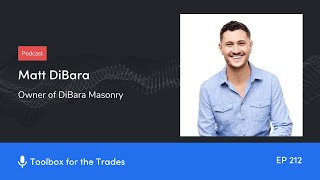
Podcast episode (Toolbox for the Trades Ep.212) featuring Jackie Aubel interviewing Matt Dabara (owner, Dabara Masonry; co‑founder, Contractor Consultants). Matt describes a 106‑year family trades legacy, moving and growing Dabara Masonry on the West Coast (≈15 crews), a severe hiring crisis that cost the company over $1M, and how that led him to create repeatable hiring systems and a hiring-services business that places many hires monthly for contractors. The episode focuses on a practical, marketing‑informed hiring playbook: audit your hiring presence, generate candidate demand (career videos, headline A/B tests, multi-platform posting), speed-to-lead and quick vetting, paid skills assessments, referral incentives, and 90‑day retention processes (frequent check‑ins, honest employee audit).
Hello, contractors, and welcome to Toolbox for the Trades. My name is Jackie Aubel and today I spoke with Matt Dabara, owner of Dabara Masonry and co founder of the contractor Consultants. Matt and I spoke about how he brought Dabara Masonry to the west coast, the in depth work he did to solve his own hiring crisis, and how he's doing the same for contractors nationwide. I hope you enjoy our conversation as much as I did. Matt Dabara, you of Debara Masonry and co founder of the Contractor Consultants. Today we are going to be talking about how to motivate the next generation of contractors to join the trades. Welcome to Toolbox for the Trades.
It's great to be here.
I'm so psyched to talk to you. So you reached out to me about a year, year and a half ago about you coming on the show. You have been doing so much in the industry and I can't wait to pick your brain. But before we get started, we are going to kick this off with my favorite icebreaker. So, Matt, what song, if any, would be the soundtrack to your life?
The Eye of the Tiger by Journey. That's the one.
Are you kidding me? Can I just say, I did another episode I recorded today and they also did Journey, but it was Don't Stop Believing.
Really?
Yeah. So I guess it's like, I don't know, something's in the air. It's a Journey day.
That's Eye of the Tiger's Journey. Right? I didn't mess that up. I think it's Journey. Right.
I'm very positive it's Journey. But that still is so funny. So why Eye of the Tiger?
I just think I've always been looking for the next thing in the trades and been very goal focused and I just remember being in the field and just always looking at the next position above me and saying, how do I get there?
Okay, so. Because I'm sure people are. That's a wonderful answer. But I'm sure people are yelling at us. It is not Journey who sank sings I have the tiger. It is a band called Survivor who I is a band called Survivor. So always looking for the next thing. But it definitely has a Journey vibe. That song. I will tell you that.
So I should know that. I should know that.
There you go. That'll do it. All right, Matt, so tell me, how did you get into the trades?
So my family's been in the trades for. We can track it 106 years now. My great grandfather, so grandmother's father, grandfather's father, both came from Italy to America. Bought land, built their homes from the ground up, and they loved construction. And it passed down to my grandfather, father, uncle, and then me as a youngster.
Oh, my goodness. So, like, did you ever have a choice to not be in the industry or not be in the trades?
My dad did it right. And my grandfather, they said, look, you're going to learn the industry no matter what, because you're going to understand what your family did to build the life that you're walking into. But be a doctor, be a lawyer, do whatever you want. Just learn what it means to work with your hands.
Got it. So what happened in your personal life that made you ready and willing to accept the mantle of owner of Debara Masonry, this 106-year-old legacy here?
Well, I think I didn't know any better. I think I didn't have a lot to compare it to, which in a lot of ways was great. I didn't know that being dirty all the time was, like, a weird thing till I was in high school. Maybe it was just I was around trades people my whole life, so it was kind of our own little bubble. But I knew my dad worked a lot, and one of the other businesses I started, which I'm sure we'll talk about later, was built around the fact that I didn't see my dad at all. And if I wanted to spend time with my dad, it was like, hey, go out and work with him. For me, it was that as a kid. And then I just fell in love with the trades in the industry from there.
Got it. So how young were you on your first job site?
First job site, I was nine years old.
Sick. Sick With a nice oversized hard hat that you were just swimming in.
Yeah. And work boots. We did a little ceremony. My dad took me the night before to Walmart and bought a pair of work boots. And it was like, tried them on, and he was like, these are going to be your first ones. So that was like the kind of rite of passage and the rest is history.
Amazing. That is such a cute story. I'm really happy that you shared that story, that anecdote about how you never saw your dad growing up. My dad, the first 10 years of my life, was working a ton, working so many hours at his carpentry business. And that actually really aligns with the whole story of Service Titan. So our founders started the software because they remember their dads working to the bone, day in, day out to provide for their family. And that seems to be where kind of the founders of Service Titan, you and me, we Kind of all have that same thing in common.
Yeah. I think when you really see it, and especially like growing up, I grew up on the east coast and I remember like, you'd wake up in the morning at 4 in the morning, shovel out a truck just to get the truck out of the yard, and then you work all day and then come back and you'd buy supplies. Like, I mean, what it means to work a 16 or 18 hour day, like, to see that, because I would just see my dad come home tired and dirty and sometimes a little grumpy, but I didn't know what that meant. And once you experience it, there's like a certain level of understanding where you're like, wow, I really understand at a level and I'm really, really appreciative.
Yeah. When did you make your way out to Glendale, California, which you also happen to be in? I didn't realize you were an east coaster.
Gosh, it would have been about 10 years ago.
Oh, my goodness. All right, great. So is Debara masonry still on the east coast?
Yeah, much smaller, but it's still out there too.
For those not familiar with Dabara Masonry and your other business, the contractor consultants, tell me what kind of work you do at both companies.
So Debara masonry is predominantly masonry and concrete. So, so residential, commercial, and then we do a little bit of like government prevailing wage industrial. So that's the mainstream side. And then on the contractor consultants, we're a specialty hiring company, so we help companies, we take over the hiring process for them and have found a way to streamline the difficulty of finding great people.
Awesome. Awesome. We've had a ton of hiring experts on this show before, but I know this is an issue that people are always looking for help with, so I can't wait to kind of get in there and get your takes here. So when you took ownership of Debara Masonry, were there any challenges you had to overcome that were unique or different to the previous generations in your family?
Yeah, I mean, the, the biggest thing with us was the integration of technology. I think my grandfather was gifted in the trades and he just knew things. Didn't know why he knew him, but he knew them. And so my dad's quest was to understand the technical component of what my grandfather knew. So, like, different mix designs. And he'd be like, hey, sprinkle a little bit of this over there. Spray this corner. And my dad would be like, why? And he's like, yeah, just that's how you do it. And so that was my dad's contribution. And Then mine was around the business and the growth and technology, and my dad wasn't as excited about that. And so that was really hard to get him to adopt to new ways of marketing and growing the company.
Got it. So debara masonry, you said it's smaller on the east coast. Does it also exist out here on the west coast? What's going on with the company now that you're here?
Yeah, so I actually built the business here. I brought it across the country. So it's like an Italian restaurant. I packed up the secret recipes and brought it over to the west coast. And so, yeah, we've got 15 crews now, and we've come a long way.
Okay, I need more information. Did you just always want to move to. To Los Angeles or like, what brought you over here?
Oh, gosh. I don't want to detour too much, but basically there was a time for about a year and a half when I was in college where I wanted to do some new marketing efforts. And my dad was like, listen, if you think you know better, just go out and do it. So I got licensed on my own when I was, I think 19 in school. So I was double majoring, and then I was running this company on nights and weekends, and I referred my dad a major project. So I was getting so many leads that I was then calling my dad and saying, hey, take this project. And he's like, where'd you get this? I'm like, from that marketing stuff that you said probably wasn't too good. And he's like, oh, but me going on my own gave me the confidence. And I was always excited to move somewhere warm. And I had a friend that was moving out here, and I said, well, let me give it a shot. And my dad was excited. And so that kind of stemmed the cross country trip and the business grew.
Amazing. So debara masonry, you packed it up. Family recipe has brought it over here. It's doing great. And tell me a little bit about how the work that you were doing at the bar masonry kind of sparked you to start the contractor consultants.
It happened on accident. We, about three years ago, had a big problem with hiring. I had two celebrity homes I was doing work on. I had this massive government job. We're doing the Veterans National Cemetery. We're doing all the stonework there. And I remember thinking, gosh, my great grandfathers would be so proud of this moment. Coming over with nothing to where we're at. And we had so much work. And I grew up and really started taking over the business and like, the financial crisis, when I thought that as long as you had enough work, you were fine. And so I was like. My mentality was, sell work and we'll get it done. I hit this big hiring crisis and lost, I mean, like, well over a million dollars. And. And I mean, it was. It was bad. Like, we couldn't get jobs done. We couldn't take on more projects. And so I told myself that I would spend as much money as it took, as much time as it took, but I was going to master hiring. And that set out like two years of just like. I mean, I did every interview. It was obsessive. I documented every single headline, job description testing. We had over 50 recruiters at one point working on these jobs across the country. Like, it was insane. But it lent to understanding and having a formula that then became something we built a course on. We got really good visibility by ZipRecruiter. The co founder is actually a client of mine, and he was like, this is amazing. And then that spawned into kind of us doing it for contractors.
That's awesome. So what did you learn getting so obsessive about this? And were you ever able to pinpoint what it was that exactly happened three years ago that made it so hard for you to hire? Was it just the pandemic?
It was prior to the pandemic. I struggled before the pandemic. It was like the tightening, so to speak. Every year was just getting a little harder. And my team was warning me. They're like, hey, Matt, this subcontractor that we partner with, they don't have availability. They're too busy. Or this person that normally he's kind of semi retired, but he'll help us out. He doesn't want to touch it anymore. He's got his own stuff. And so it was this slow and steady tightening, and I wasn't paying attention. I was like, do you see how many millions and millions of dollars of work we have sold? Like, we're fine. It came back to bite us. And so in 2008, we saw a lot of people leave the construction industry. People were telling me to leave. I mean, when I was making life decisions, they were like, what are you doing? Going in the trades, like, go to school, get a normal job, don't do. Like, that was the messaging. And I think we were starting to see that accumulation and the consequences of that, you know, four or five years ago. And that's really what I think led to the hiring issues that I had.
Yeah. So people leaving the industry in the financial crisis and now the chickens coming home to roost type of thing. When the pandemic showed up, we didn't have as many people willing to.
Exactly.
Got it, got it. Oh, wow. Well, good for you for sticking your guns when people were telling you not to do it. That is very good backbone on you, sir. So tell me a bit about some of these hiring tips that you've learned in your time, like in the trenches trying to solve for this problem.
Well, the biggest thing I learned was it's a system. Because every time I would have a breakthrough, I kept looking for that golden nugget that I was like, this is going to solve my issue. For example, the first thing was, how do you get candidate demand? Right? How do you flood yourself with candidates? And once I figured that out, I was doing traditional like one hour interviews with like 10 questions and it was like, okay, now you're getting 10, 15 applicants a day. How do you do that? So I was like, okay, now I have to figure this out. And then it was like, I'd go to hire people and I bring them in the office and they'd be like, yeah, I'll take the job. And then a week later they'd shop the offer letter at their current job and never come to work. So it was like you had to get the whole cycle to work. You had to find candidates, vet them quickly, know how to hire them and get them to sign the offer letter and then know how to retain them and keep them in the company and keep them motivated. If you can do all four of those things, then you have the cycle and it starts with generating that candidate demand. But the first thing is actually taking an internal look. So most companies, and I find this so, so fascinating because at this point with our company, there's over 50 people at the contractor consultants. It's not abnormal for US to hire 110 people a month for our clients. A lot of hires. So we've got the model down. But so many people are like, I've tried everything, there's nobody out there. And I'll often ask them, I'll say, well, who are your hiring competitors? And they'll say, well, I don't know. And they'll say, well, locally, like if you, let's say you're looking for an H Vac technician, have you typed in H Vac tech jobs Los Angeles? And see who comes up, what pay they're offering, what incentives. It starts with that really honest audit of what does your company look like online from the hiring space. And then who are your hiring Competitors. And most people, like, that's the first big breakthrough.
Yeah. And what are some of those, like, big aha moments that you've seen in your clients, maybe in your own work that was like, oh, shoot. I didn't even know that this was happening.
Going back to me years ago, before we rolled this out with clients, I had a company that was offering ridiculously good benefits, and the pay was much higher. And so I had to find ways to position certain things. But I knew that the onboarding and training was. Wasn't great in terms of, like, we've interviewed people that work for them, and they were like, oh, it took too long and there's no growth. And so I was able to start to understand the hiring landscape and get ahead of it and say, okay, we can't, you know, our pay is X. But here's the other things you get. It's very similar to how you'd approach acquiring clients.
Right.
Like, most people know who their competitors are from a client acquisition perspective. Right. Like, they know pricing of their competitors. Typically, you know who they are. But on the hiring side, we don't often know that. There's a lot of power in understanding how to make yourself look better and position against maybe some of your weaknesses.
Interesting. So doing this audit, seeing who you're hiring, competitors are figuring out where you can highlight some things that you offer that your hiring competitors don't. So maybe you're not the highest paid opportunity, but you have the most comprehensive benefits package or you have a really systemized onboarding process, which can be really desirable for people that are looking to grow a career and to really get started in the industry.
Like a specific example. So we had a demolition contractor years ago as a client, and he's like, look, I can't afford to pay these. Wait. Like, I'm a small, medium company. These are massive corporations that I'm competing against. I can't afford to match these benefits in this pay. So what I realized, though, is that one of the things that he had that was really unique was this, like, family field of the business and how much he cared about. And so we said, well, demolition, you're out there swinging a hammer all day, like, a lot of physical work. So what if you offer just a professional massage to all your employees once a month? And so we ran out the numbers of what that would look like. And he's like, yeah, this is much more affordable than some of the pay increases that I would have to do. And it shows that we care. It aligns with our core mission. So we did that and that became one of the key hiring benefits. So we look for like, what's the elevator pitch to work at your company. So if you meet a prospective candidate and you're out and about, it's like, hey, you should work here. What's 1, 2, 3 bullets that that person goes, oh, I want to apply. His was, yeah, we give paid massages once a month. He's like, we do these awesome team get togethers every week. We do an awesome team breakfast at our, at our yard. And then the third one was they have this like a spinning wheel that they do with these company branded chips to reward good stuff. And so that's like one example of how can you be a little bit different and leverage the gaps in the hiring space.
Oh, I love that. That's great. So doing this audit. And so once we've got our audit, we've got all the things that separate us from the competition. Now we're going into generating candidate demand. And also, I don't know if you know that you're doing this, but you are mapping this to like the marketing funnel. I don't know if that is intentional. It probably is, but it's helping me organize my thoughts. So thank you for that.
As soon as you start thinking of it like how do you get customers? And you start mirroring it. Because one big breakthrough is most clients don't have a career video, a 60 to 90 second video. So you might have one that showcases your work. So you might have something on your website where you go and you click and it's like the beautiful work that you do and like shows your trucks and all that. But what about on the hiring side where if someone's applying and instead of reading just a job description, they see this video of 60 to 90 seconds and it's like testimonials from your team and cool things you do and the jobs you do. So we call that a career video. And it's an instant edge. It's fairly easy to do and all the really good hiring assets, so good visual graphics, pictures of work you've done, but making it appealing and easy for companies to or candidates to get excited to apply at your company.
So career video showing the work you do, showing the values you have. Can you give me an example of what a really good career video might look like? Or maybe one of your clients that had a really good career video?
Yeah. So usually they start with testimonials from people working there. So I've worked here for this amount of time. It usually Cuts into like some of the cool projects that you get to do. The facilities, the people, and the big thing there is to just be authentic. So if you're listening and you're a smaller company, like you know, we were years and years ago, it's like just the authenticity because not everybody's looking to work for a large company. Everyone's looking to work for a small company. And there, there are opportunities on both sides of the coin. But just being really authentic with who you are in the video and then getting that testimonial from people who work there, just them describing it and showcasing your work is what gets people excited.
Got it. All right, so we've got our audit. We're generating candidate demand through our career video. What thoughts, if any, do you have on job postings and how to like alter job postings besides from just adding the career video.
So career video is great. One of the things that we found that is still to this day blows my mind is the power of headline testing on job postings. So before you even click on it is we found a 2-3x in qualified candidates by just testing headlines and making them more about the excitement of the job. Like the typical one is like hiring tech or basic. It'll be like, you know, project manager wanted. Like that's the old school way of doing it. The new way is like transforming vision into reality. Project manager, you know, hiring project manager, like little things that catch the eye of the person can double or triple the qualified applicants.
That's awesome. All right, so a B testing just like you would on a PPC ad or on something like that. All right, we're still following the marketing outline here. So audit generate demand. You mentioned once you got the demand originally used to do hour long interviews, 10 questions each. How do you vet those people quickly? Because I think that's the third step, right?
Yeah, there's a few other ones, but basically the vetting side, it's getting them as fast as you can. Speed to lead. So ideally within 3 to 10 minutes. Like when they apply, it's priority, treat them like customers, treat candidates like customers or clients. You use that word like that is really, really important. So speed to lead and then having really good quick screener, informal questions. And I always think of it like if you've ever eaten at a restaurant and there's a line of people and then you see somebody get escorted to the front of the line and you're like, wait. Well like how did they, what do they have a reservation? Like what did they. I've been waiting at this line. You want a process that does that so you get to them quickly and you identify. Is this person not a fit? Quickly? Are they somebody who needs to go through the normal process, or is this somebody who's probably amazing and I need to get them to the front of the line as fast as possible because they're not going to be on the market long. Maybe they just moved to the area. Maybe something happened with a company that just got bought out and they're not happy with the culture. Being able to escort people to the front of the line quickly is a really important strategy.
Okay, so. And how do you determine who gets to cut the line?
I'll use Dabar Masonry as an example. Like back when we were hiring for a project manager, if I saw somebody who came in and they had done this exact role for 20 years at three different companies, and we called them up and we could understand the event as to why they're looking, and they're like, yep, I've done this. Yep, I've done that. We would get them scheduled as fast as humanly possible. It's the same thing as, like, a customer saying, hey, my plumbing's broken and I can't shower and I need this fixed right away. It's like, well, you're not going to be like, oh, I have an appointment next Friday. Like, you're going to be like, great, let me see if I can get somebody out there tomorrow or same day, ideally. Right. Within an hour. It's the same kind of philosophy of looking at people and teaching whoever's doing the qualifying to say, hey, this person, I think they're. We call it an A plus or 10 out of 10. It's like, move them right up, get them for an interview, and in person is fat. Or the next process is what's called a skills assessment. And that's a paid assessment, typically where they demonstrate the skill set. So we used to bring, like, when we first instituted this five years ago, four years ago, or whatever, we used to have people come to my yard and I'd have a sheet of paper face down. They'd flip it over. I'd show them what to build. The block and the brick were there, and they would just mix their mortar and start building. And they were paid for the day. They'd sign an agreement, and we got to demonstrate their work. So great. People in the field would go informal interview right to a skills assessment, and the person qualifying them had the authority to move them right through.
Oh, great. All right. So it sounds like Are you still doing this at Debara Masonry?
Oh, yeah, yeah.
Oh, yeah. That's awesome. Okay. So one of my favorite people at Servicetitan, she is a customer of ours, but she also works as a subject matter expert at Servicetitan. Angie Snow. She talks a lot about the call center in general, and obviously we've talked about hiring for the call center. She's like, my interview process always involves asking someone, how is your day going? Because if they respond with, oh, you know, I hit traffic, like, it's a very negative type of response. She's like, I'm already on guard that maybe this person isn't a good fit for our company, because I want someone who's going to always have. Be able to put a positive spin on things. Do you have any little quirky identifiers like that?
So there's one that's we've got years of. Of. Of data behind. And it's when I was taking over the hiring process and trying to figure all this out and consultants and certain things I was able to figure out and other stuff. It was just so much repetition. One thing I found is, and I remember the interview I did this on, and a light bulb went off for me. But I had somebody talk about how much they love the work, right? I was hiring for a foreman, so a skilled person in the field, and he's telling me how he builds, you know, brick and stone and concrete, and he loves the industry. And I said, oh, do you have any pictures? Do you have any pictures you can show me on your phone? And he's like, oh, you know, I don't. He's like, I forget to take them. And I found a direct correlation between field team members and taking pictures at the end of the day of the work. Like, everybody on my team for their own gratification, for their significant other, their partner, or coming home and showing their families. So asking if they have photos of the work, of what they do, and going through that. And then the next layer of that is the question, what was your involvement in this project? So saying, you know. Cause the next layer to that, once I figured this out, was, okay. But some people are like, I built this whole thing. And you're like, okay, what was your involvement in this project? It's a nice way of saying, what did you contribute to this? And then you'll be able to kind of discern, okay, were they the person in charge? Did they figure everything out? Or were they somebody who. Maybe they had someone else who was guiding them. But those two things for hands on roles, really, really powerful.
That is really, really smart. I have seen that a ton when I've talked with technicians on the service titan side of things, where they are very quick to show you like really clean installs and stuff like that. Very good hack. I like it. So we've got the audit, we've got generating candidate demand, we've got vetting speed to lead, we've got a skills assessment. What else do we got going on in this wonderful hiring ecosystem that you've created or system that you created, there's.
So much but I mean a few actionable ones that you can use speed to lead. We talked about going back to the very beginning, asking yourself, would you work for you? And googling your company name, seeing what comes up. You know, if you just google your company name, would you work for you? Meaning, you know, do you see photos, is there reviews? What's your Indeed or Glassdoor look like? I think that's one thing I left out a diversifying your approach so you can easily post to 20 plus job platforms. There's LinkedIn, there's social. So getting it out to as many places as possible. A lot of people it's like zip and indeed are the main ones and kind of stops there, you know, to as many places as possible. A lot of people it's like zip and indeed are the main ones and kind of stops there. So diversifying your approach and then leveraging your current team. So a really good individual team incentive, incentivizing at the individual level if you have the bandwidth is best. So a lot of people will be like, all right, we'll get everyone together and say we're offering X. If you know anybody, that's good. But what's great is if you're doing some type of review or a one on one saying, by the way, we have this new initiative and if you know what they like offering them something specific if you can do it. Because like we had somebody who I knew loved to take their partner on like weekend getaways. And so for that person it was an Airbnb gift card. For someone else it was Dodger tickets on my team. For someone else it was a gift card to a fishing and tackle store and we found multiples higher number of referrals from the current team just based on the fact that they were motivated by the incentive.
That's great. That's awesome. So engaging with your team, making sure that you're getting this information out as broadly as possible and not just relying on kind of the tired and true job Posting methods to get the word out 100%. All right, let's talk about retention. What does it come to when you actually, okay, you're a good fit, you're hired, they accept the role, they come into the job. What thoughts do you have on making sure that they're going to stay there and they're going to be happy?
So there's a couple of things we found and we, I remember we were building out the course like we, we tried to really simplify this. So the first thing is looking heavily at the first 90 days of employment. It will re recommended. And what we've done and tried with clients is you have a two week check in, you have a 30 day, you have a 90 day, all eligible for a raise. But the goal is constant and open communication. So you can get ahead of any little things early. The little stuff of like, hey, I was promised a new, you know, X, Y, Z or I didn't get this uniform. It's not like that. You create a space for that person to tell you. So honest and open communication with frequent check ins, making sure you have a really good onboarding checklist. Because it's sensitive in the beginning, right? Nerves are high. It's a new role and ideally it's a new career for the person you're bringing in. So really good onboarding process. Have a process for open and honest communication. We had, I forget the stats years ago for us at Dabara, but It was like 90 some odd percent of candidates got a raise at the 30 day mark. Like it was. And that was a really cool hiring stat. It was small, but it was like, hey, we want to show that we're behind what you're doing and all this effort's not going unnoticed. So honest and consistent communication. The big one is we created what's called an honest employee audit. And so we studied the key areas of employee satisfaction and we built a 1 to 10 scale questionnaire. So like do I feel fulfilled at my work? Is my voice heard? Like we took the key areas of satisfaction or dissatisfaction and we turned it into a one to ten scale and we call it an honest employee audit. And you can send that out to your team and have them, it's completely random, they just click the buttons 1 through 10 and there's an open response. You'll find a lot because you're not relying on department heads to tell you how the team's doing and you're not relying on the pressure of one to one. For some people that's a lot to do. So this Assessment allows you to get the data in real form and look at it and go, oh, I feel unpaid. What you know, in equal or greater contribute than I contribute to the company 1 through 10. Right. So you get these averages and you can look at it and go, hmm, compensation is not. Or maybe it's much better than I thought, or it's not as good as I thought. You can work and create culture initiatives based on where the team's really at.
Got it. All right. Very, very cool. So that was a crash course in hiring from Matt Dabara. When you and I first chatted, you said, in addition to wanting to get more people into the trades, you also want to get more contractors home for dinner. Now that I know a little bit more about your background with your dad, I can see how this hits hard for you. So tell me a bit about that.
Yeah, I think that was one of the things looking back was when I co founded, we built this amazing team to solve the issue of hiring. That was our ethos is how do we build a company that started solves hiring for construction companies, but from the lens of a contractor because recruiting fees are too high, and I think they wait for people to be in too much pain. Staffing agencies aren't great for culture. A lot of times you don't own the data, so you don't want to try candidates. And so we built this company. Our end goal was to get company staffed so well that the team is less stressed and people are home for dinner. I remember my dad as a kid, he'd get a phone call, you know, driving home, or he would call us and say, hey, this happened at a job. I got to run out. And that always bugged me. And so that became like an ethos in our company.
Okay. I love it. I love it. So what's on the horizon for Dabara Masonry in Los Angeles? In the Los Angeles location. And what about for the contractor consultants?
I think Dabara will stay, you know, relatively similar to where we are right now. And then for the contractor consultants, we're in Canada right now, so U.S. canada. We might expand to the European markets and just lots of helping contractors.
Awesome. Awesome. Well, well, Matt, thanks so much for stopping by Toolbox for the trades and sharing all of these incredible tips. I really appreciate it, and I can't wait to see what you're doing in the next couple of years.
Thank you for the opportunity.
More from Bill



ServiceTitan Virtual Agents: Simplify Before You Scale | Podcast Ep. 110 | Mastering ServiceTitan



Life After Live Events: How to Turn Post-Conference Energy into Real Profits | Podcast Ep. 297




