How Scorpion’s Capacity Marketing Engine Aligns with ServiceTitan’s Power Users |Podcast Ep. 43
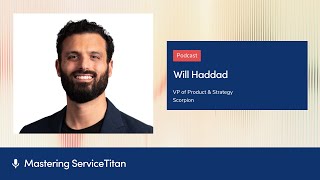
Podcast interview (host Josh Liu; guest Will Haddad, VP of Product & Strategy at Scorpion) about Scorpion’s Capacity Marketing Engine and its integration with ServiceTitan/Marketing Pro. The product reads availability data from ServiceTitan to drive automated campaign deployment, budget allocation, and throttling to avoid wasted ad spend when crews are full and to boost spend when capacity is low. The episode covers why capacity-driven marketing matters (revenue loss, cancellations, technician utilization), compatibility with Marketing Pro/Ad Optimizer (including adjustable/adaptive capacity), an exclusive API integration between Scorpion and ServiceTitan, early results from initial customers (budget conserved ~10–15%, cost-per-lead reductions up to ~25%), target customer fit (residential service contractors, not commercial/long-term projects), and roadmap items (adding weather and conversion signals as inputs).
Questions this video answers
2017 (has been with Scorpion a little over eight years).
About six weeks (Will: "we just launched this product maybe six weeks now").
Conserved budget in the range of 10–15% for some customers.
Cost-per-lead decreased by up to 25% in some early cases.
Yes — Will states the API integration used is exclusively built and offered to Scorpion at this time.
This product isn't necessarily to remove the human service element from our teams. It's more of to catch the moments in the extremes. You want to catch those in advance. We want to be proactive.
Welcome to Mastering Service Titan, where you get expert advice from power users. I'm your host, Josh Liu, and today I'm joined by Will Haddad, the VP of product and strategy at Scorpion. We are diving into Scorpion's new capacity marketing engine and its integration with Service Titan. And so will, welcome to the show.
Awesome. Thanks for having us, Josh, and looking forward to be here. We got some really fun and exciting things to talk about today.
Yeah, we've got so much to cover. But before we jump into Scorpion and all the new stuff, can you please share a quick intro of who you are and how you got to where you are today?
So I've actually been with Scorpion for a little over eight years now and I've gotten the privilege to kind of do quite a few different things since joining the company in 2017. You know, at that time we're really starting to emerge in the home services marketing space. I think when I first joined the team at Scorpion, there was, there was a very small group dedicated to it and now it's our largest function within the business. So I've gotten to really ride the wave of just tremendous growth in the industry, tremendous growth at Scorpion, working with the home service clients. I've worked directly with with, you know, I think up to 500 different local brands at this point directly on their digital marketing strategy. I've seen how some of the best in the business run their marketing, you know, 30, 40, 50 plus million dollar a year businesses, all the way down to startups who are just getting their first website, you know, and trying to hit their first million. And all of it is fun and exciting. Before that I was, I was doing nonprofit fundraising and also digital marketing for different groups and engagement led me here into Scorpion in the digital space.
Very cool. It's cool to hear that you didn't start out in product, but you were like deep into marketing at nonprofit and then directly with the industry here. What made you shift into product and working on like the strategy?
I really, in my time working directly with business owners, I've just always been a very naturally curious person and just would always ask a lot of questions. I want to know why things are the way they are, why do they use what they use and just, I don't know. I think it is kind of led with curiosity and it got me to really understand the business Understand what works in marketing. And so just having a lot of context has helped me to now drive our different product strategy in different areas. And what can we do, what can we automate, what can we build to help, you know, the marketing results be better or to help the clients be more, more successful in their operation? And so that's kind of the context that I've held that has followed me through my, my eight years here at Scorpion.
That makes sense. I know serviceign and Scorpion has like a really big overlap of customers, but in case people have not heard of Scorpion, could you please share a little background of what you guys are and how you serve people?
We are a digital marketing and technology company that is specialized and focused on the trades. We have some other service businesses that we operate in different industries, but a big primary focus for us is in, is in the trades. And that includes the green industry. So plumbing, H vac, electrical, landscaping, roofing, pest control. I mean, just kind of any residential service contractor. We build digital marketing solutions to help our customers be found when they need to. When customers are looking for their services, we help them grow their revenue by putting together marketing strategies to help them, you know, drive better growth and success for their business. Also have a suite of technology solutions and products that help them, like, understand the leads that they're generating and understand their business operation and how are things functioning and how could things improve. And that's the part of the business that I'm, or the part of the product that I, I, I particularly focus and specialize on.
Gotcha. And I know there are so many digital marketer marketers out there, so many different agencies and whatnot, and I know Scorpion's a little bit different and very white glove. How would you differentiate what Scorpion does versus some of these other agencies out there?
Yeah, I think for us, look, we make an enormous reinvestment back into our business, into technology. And we have the resources and the team and the knowledge and the scale to understand data at a very large level. And that enables us to build technology and products that I think most digital marketing agencies out there, or smaller marketing firms, boutique marketing firms, they may get great results. They may be able to provide a great experience, which is fantastic. But I think a lot of them don't have the resources that we have in technology and kind of the scale of integrations that we've built at this point to be able to really build better automation, deploy campaigns in much more regions, drive better results, get the better business understanding. I mean, so much data is king. First party data is King. And so we've kind of built tools and products and technology to be able to make that priority in our marketing efforts and in our strategy.
Yeah, I remember before we started recording the last time we spoke, I have like half a page here of notes of the different kind of tools and like places where you guys grab data from as well, like big directories and things like that. Could you talk a little bit about that?
We're in the business of helping our customers grow. You know, that comes from being connected to all sorts of different ways to generate leads online. You know, we all know about Google marketing at this point and SEO and SEM strategies, but we've got partnerships with Thumbtack and with Angie and, you know, we're just, we're always looking for ways to expand our reach, allocate and diversify client budgets and advertising spend in ways that can get the best quality result out of the budget, get the most efficient we can with the leads. And so it's just, yeah, at this point, we've built like an ecosystem. We've really embraced partnerships, we've really embraced data integrations. This has been a kind of a much bigger investment for us over the last, you know, 12 to 24 months. And there's no signs of it slowing down at this point. We want to be that ecosystem for Legion, further for the trades.
That's amazing. I'm excited to talk, talk about some of the new features here and products as well as what's next for Scorpion. But before we there, I know there's someone listening out there who's using Marketing Pro and they might be thinking, well, how is this different from Marketing Pro? And do you all work with Marketing Pro?
Absolutely. So that was actually a big part of what spurred the partnership between Scorpion and Service Titan. Look, I think Marketing Pro is a fantastic product and it's critical for brands that want to. That want to grow, because there's so many contractors that I've worked with over the years that will invest so much of their money back into the business, into new customer acquisition strategies and digital marketing strategies. The bottom line is that those strategies, they work and they've only gotten more competitive and more expensive over the years. And this is where Marketing Pro comes into play, because you can re engage existing customers. And I can also say the best of the best in the business have a strategy to re engage existing customers, to stay in front of their customers, to let them know what's going on, to be an active member of the community. And Marketing Pro is kind of the premier tool that enables customers to do that. One of the, you know, potential opportunities, though, that our teams found when working together was just that there's could be sometimes a learning curve to like, deploying campaigns inside of Marketing Pro or leveraging those tools or having the marketing education or background to know, like, how do I target, what should I run, why should I do that? And that's where, you know, Scorpion excels is, you know, in our marketing services. And so a big part of our partnership with Service Titan is actually to support mutual customers that use Marketing Pro to actually engage the tool. And so we will take over the full component of Marketing Pro on behalf of the businesses. We've got multiple tiers in different solutions and whatever would be helpful that matches the business's growth goals are and business size and all of that. But really we want our customers and our mutual customers to leverage these tools as part of the marketing strategy because it's going to help all the other things that we do for them. So now we're in a position to actually, hey, let's go and help them deploy these campaigns. Let's run the email marketing for them. Let's align what we're doing with email, with sms, with direct mail, also with our social strategy, because we do a lot of social marketing and content marketing and SEO and blogs and I mean, there's, there's so many ways to actually have these strategies also be aligned with one another and it enables more relevancy. There's a lot of really fun strategies that we can, we can do when it comes to this place too. A lot of automation. That's how we work with Marketing Pro today. We've built a whole function to be able to support mutual customers to take the best advantage of the tool.
Very cool. I know Marketing Pro is huge and there's always new stuff coming out and so if you don't feel like you're an expert or on top of it, or maybe you just don't have the bandwidth to. Sounds like Scorpion could be a good fit to help you maximize Marketing Pro and then make sure all the other marketing outside of that is in line.
That's right, Yeah. I mean, regularly work with the, you know, we've got relationships with the product teams that are kind of running and building out Marketing Pro. We know a lot of them, you know, on a personal basis and we collaborate often and share data with one another. So, you know, we're all moving in the same direction. We want to build tools and automation for marketing. That. That works.
Yeah. Speaking of tools, that's a perfect segue into the capacity marketing engine. The big reveal. Can you tell us what this new product is and how it works? Oh, yeah.
This has been something that we've been after. I remember when I would work with customers and their marketing plans and strategies and manage so much of this on a manual basis. Every single day we would talk about the boards and I'll give the overview first. So we've built a new product called Capacity Marketing Engine and what it does is it leverages availability data out of Service Titan. And then at Scorpion, we have marketing technology that helps to deploy budget to different campaigns and avenues to drive leads and drive traffic to the website. So we've combined the availability data with our marketing technology to then do automated campaign deployment, automated budget allocation, automated budget throttling to be able to get in front of some really core problems that are encountered in the business when capacity is at a high point and when capacity is at a low point. And so we can talk a little bit about those, those challenges, but that's kind of the overview of what we've built and where we're at and what we've taken to market.
So I'm curious as to the why behind the capacity marketing engine and what were some of the big challenges and pain points you were seeing in the market as it relates to capacity and marketing?
I think the home service business, there's kind of two worlds here where challenges exist. The business is either too booked up where they can't take any more business and there's challenges there, or the business isn't full enough at all and there's minimal on the boards and the teams are idle and different strategies need to be taken to try to fill the boards. So let's like start with that scenario. So when the boards are too light for one, the business has higher potential of missing revenue targets for that day, which then leads to that week, which then leads to the month and the year. So businesses that want to grow, that has aggressive growth targets every year, if the technicians are sitting, then it's directly correlated to the revenue output because the revenue's directly correlated to how many people are are out in the trucks working, who can generate revenue. The business now in that state, when the board's too light and the technicians are idle. We've witnessed many situations where if there's not enough work, then technicians start to maybe look elsewhere. Well, I can go over to this other shop or this bigger shop and maybe they'll have more work for me because I'm getting paid more on my Commission or my spiffs. The other thing that we've observed that happens when the schedules are light is then the business starts to outbound call to fill the schedule, which is actually it, it's, it's great. And the best of the best do that. They have, you know, large customer bases that they can call upon to get maintenance scheduled or, or you know, provide promotional services for their home, which is great. But a lot of times those are going to be lower value and less urgent services. And you know, in this space, residential service contractors want to get the demand calls because those have the highest potential for new customer acquisition and the highest potential for revenue generation. So those are some challenges on the low side when the schedules are too light. Now on the other side when the schedules are too full, it's just an inefficient use of the advertising budget. I think what so many businesses do, don't see or maybe aren't thinking about is when I get that homeowner calling in and I schedule them three, four days from now, when are they going to, what's the probability that they cancel? We've ran some analysis internally and you can even work with Service Titan team and run this analysis for your business. But how does the cancellation rate change on the current day when jobs are booked for the current day versus when they're booked three to four plus days out? And I've seen some scenarios where the cancellation rates are double, if not more that far out. So now we see businesses are taking top line revenue, reinvesting it back into the business. Typically, businesses that are growing are put in 8, 10%, 12%, sometimes back into the business in a hopes to keep the boards full and to hit their revenue goals. Now the boards are full and jobs are getting canceled. And it's also a very poor experience for the homeowner. Homeowner's calling in. You've done all this work to get in front of them and to tell them that you're the best option that they can pick. Then they call and oh, we don't, we can't get you on until next week. Well, there's a high chance they're just going to call the next person on the list at that point and what are the chances they call back again? All those things end up hurting the return on investment that a business can generate in their advertising investment. Those are the challenges that we want to try to mitigate in doing capacity, budget automation. And there are periods where the business never wants to go over and we've got a way to Support that in the settings of the product, but for the most part it's around getting the budget efficiencies.
I'm curious there actually, if we can dig in a little bit, Are there any best practices here around how people should think about their availability or is it just dependent on the business and the size? I'm curious what the major factors are that go into that decision.
It is very much so like custom by business. But I think there's a general way to think about like plumbing service, electrical service, H vac service, you know, what are the types of demand calls that the business gets and what would be the typical wait period or expectation of the consumer. And I think different job types are going to inherently require a different, you know, scheduling desire or a threshold to wait for something to be repaired. It's always good to start with a baseline, you know, like start with a, start with a general threshold. All right, if I'm 90% or more three days out, then that would be considered high. Like there could be something going on for me there that I may want to consider scaling back advertising a little bit at that point. On the flip side, if I'm 20, 30% booked only over the next three day period, well, that's a big problem. I'm nowhere near where I need to be to get my teams out on the road and, and, and get opportunities for my service and my sales teams. So I think starting from a good baseline and then using the data over time to assess and say, okay, I could make this slight adjustment here, let me go up 5%, let me change one day forward or one day backward and it could get dialed in closer and closer and closer. I think this product isn't necessarily to remove the human service element from our teams. It's more of to catch the moments that we are hitting in the extremes. You want to catch those in advance. We want to be proactive and act and then iterate in the marketing plan in addition to having the input from our customers on a regular basis.
Yeah, the automation sounds very smart. I'm curious how, how do people do this without the automation? Like what's the manual way that people are doing it nowadays?
I've seen all sorts of ways that, that, that that happens. I mean for one, I think it comes down to like, does the business have a marketing partner or not that's running the digital campaigns? If not, then you know, internally, then they're just using whatever front end tools that, you know, they can within, perhaps within Google or maybe they're going in and turning on and off the LSA campaigns, it really is dependent on what are all the channels that you're running. Marketing on is kind of the starting place because then for each one of those channels, that's four, five different dashboards that need to be logged into budget needs to be set separately or paused or. So that's one element of management of this is just on the advertising side. The other element is if you have a marketing partner that is maybe owning all of the digital campaign deployment and optimization for you. Without this, you have to be in constant communication, whether that looks like adding them to your, your daily call board emails or whether that be giving them access to your service titan to go in and look at the boards, it's just sharing information, sharing data.
Yeah, it sounds like again, that very hard math problem, but they're trying to do it without a calculator like pen and paper. Multiple notebooks sounds very, very difficult to manage.
That's right. Multiple dashboards, multiple notebooks, you know, multiple ways to understand the capacity and service tie in. I mean there's, there's a lot of, there's a lot to it.
Yeah, it's very simple. The way you put it though, hey, if it's too much or if it's too little, we want to predict it and then be able to react to it in real time instead of waiting. Do you have any fun customer stories of people using this and testing out this, this new product or any cool metrics to share on the impact it's having on businesses?
It's early for us. Like we, we just launched this product maybe six weeks now. So we're in the process of onboarding many customers. In some of our early learnings, I've seen instances where we've met to where the product has conserved the budget up to 10 to 15% in the range. And with that conservation, we've seen cost per leads decrease by up to 25% and that is the ideal outcome. Right. If you're not looking for the business at a certain time because the boards are full, we're saving and conserving the budget, allowing it to be spent on a later day and then getting less aggressive to the CPLs go down. And so that's not even taking into consideration yet. Well, what's the output of how are we maximizing the budget spend when it goes into play? That's just the part on. Hey, okay, I'm not, I'm not needing to invest this money at this time because the boards are full. On the flip side, where we've increased the daily spend. We've seen situations where we've actually gotten more leads in those instances where we've increased the spend when compared to the amount of spend that's been allocated prior, which is exactly what you would expect. I spend more and I drive more leads in those moments. I spend less. I drive less leads in those moments. It's proven to already have in our first stages here, the impact that it is that, you know, we're intending to have, which is really fun for us to see.
Yeah, especially in your role. I bet it's really exciting to see such a strong early signal this new in a product that you released. And I never thought about it that way of like, gosh, it seems in marketing it's so easy to spend in a wrong way or at the wrong time. I didn't realize you could spend at the wrong time and have all these inefficiencies, and then on the later half, you're doing the wrong thing and just burning a bunch of dollars. And so there's a lot of room for optimization there.
That's exactly it. And it's just the next level of, of efficiencies. You know, I think so much of the tools out there, I mean, is just around like, even you look at the, the Ad Optimizer product, you look at like sending conversion signals to Google so that Google can think more and get more efficient. Just, I think each little level of efficiency, just 5% budget efficiency, could equal another 20 points on your return on investment. That's what this is about.
Very cool. How about can we talk a little bit about compatibility? I'm sure people listening are like, pretty excited about something like this. What if Service Titan customers are on adjustable capacity planning or maybe even the new adaptive capacity planning? Does it work with those features?
Yeah, it does. And so part of the reason why we're leveraging the Marketing Pro Ad Optimizer component right now is because that tooling inside of that product is supported with adjustable capacity planning with adaptive capacity, or if you're not using either of those and you just have business units assigned and you have technician shifts set up, it will read the availability in the slots that are, that are there inside of Service Titan inherently. So that's why we're. That's one of the reasons why we're using that specific API. And by the way, that API is something that in partnership with Scorpion, is actually exclusive, is exclusively built and offered to Scorpion. I didn't mention that earlier. We were the only company that can leverage that integration point with ServiceTechn at this time. But it is compatible with the different ways to measure capacity. So long as the business has Marketing Pro has that optimizer and is using Scorpion's latest advertising technology where the systems are integrated, then this is a product that could be offered and supported.
You say it's so nonchalantly. The exclusivity piece is huge. This sounds like pretty advanced combination of tools.
Totally it is.
Do you have any fun stories lately? I know it's getting pretty hot in some areas. I imagine capacity changes pretty quickly. Do you have any fun recent stories of customers using the new capacity marketing engine?
One story or one piece that I could speak to is perhaps less about weather and more about capacity trends. Like what this tool I think is starting to open up. The ability for is not just budget shifts on a day to day basis or week to week, but thinking about where has the capacity levels been historically for my business over the last 30 to 90 days? Now that we've had some clients that have been integrated even before we launched this because we had an initial set of customers that we beta product this with or launched on that beta with us. Some of them have had high capacity every single day for the last two, three months. So it's like, okay, well hold on. So this now is not something that we need to go solve with automation. This is something that now we can look at the total marketing strategy. What's the budget, what's the allocation? Where are we targeting? Why are we targeting those areas? Because this is what's happening in the business. That could also speak to a situation. I think there was another client I was working with recently who had just put two new technicians on the road and was been consistently under capacity since adding those technicians. Well, we've been working with that business to scale up the budget a couple of weeks at a time to try to get them to the level where there's enough lead gen happening for the business to now support two new technicians that are on the road. So it's like this is where it gets really like the automation's great, the budget shifts are great and but we could be modest with those. It's really an understanding the capacity data and having that drive marketing strategy. And that's the part that's so cool to me because that's what it all comes back to.
Amazing. And we'll, we'll talk a little bit about what's, what's coming up next in a second here. But I just did want to call out, is there anybody out there who's Not a good fit for working with Scorpion or not a good fit for a future like this.
So this is really focused on residential service businesses. Whether you have a different team for residential service, different from maintenance, difference in sales, that's all good. But that's going to be the primary focus for a tool like this. Just given the nature of how online marketing works and consumer behavior and how prospective customers are going to be looking for your services online. On the flip side of that, you know, I would say this isn't great for commercial businesses. This isn't great for trades businesses that are always doing, you know, larger, longer term projects, installations and remodels. And you know, even like short term, I do projects every three weeks or so. Like this wouldn't necessarily support those business types very well in its current state. And maybe in the future we explore other ways and other opportunities to support those types of capacity trends.
Gotcha. And how about size? Like if a business is really small and they're a little nervous, like, wow, these sound like really advanced things. Is there such thing as being way too small and like you shouldn't use something like this or are you guys good for them too?
Well, I think the beauty of this is we can enable a capacity integration without needing to make massive shifts to the budget automation. So we've got controls on our side to say, okay, when I'm full in my schedule, I don't ever want to scale back. I always want to operate full. Like this is my budget, spend it. If you've got the capability. When I'm not full, I'd be open to spending more. So this product would open that scenario. On the flip side, like how much more and how much do we boost and all that is configurable on our side. You know, we could, we could shift budgets 5, 10% or we can go shift budgets 100%. Like it's just, I think there's a lot of range that we have in there to be able to support how aggressive we want to be. And with that element, I would say that this is a product that could support businesses of all sizes because that's where those scenarios are going to come in. We can run this product integration to get the data, view the trends, get the tracking in real time without needing to do any budget automation as well. That is a configuration on our side that we could say we're going to turn on advertising automation or turn it off, but still get the data. And I think kind of pointing to those client cases that I mentioned earlier. Such an important part of this is understanding the total investment that's going back into the business. What's the strategy that we have in our marketing plan? Is it the right strategy? And to make that determination, we need to have all of the factors of the business in place operationally. And capacity is at the core of so much of how the home service businesses operate, which is why that's such a critical piece of information for your marketing partner to have. Short answer is no. There's all sorts of ways this can be used. It just kind of, you know, we'll work with you and we'll sort it out.
Yeah. No wonder the white glove like it sounds very personalized. Every business is so different and their needs are so different. And so it sounds like you really do need that level of involvement in working on something as big as marketing where you could easily or accidentally burn so many marketing dollars. So yeah, yeah, yeah. Might as well make the most of it. It's a huge budget. A lot of times. I did want to wrap up here with some vision for the future and what's coming up next that you're allowed to share. Can you give us a sneak preview of what's to come?
Yeah, there's a. We're working on so much, but I'll stay within this sphere of capacity and marketing automation. I. Before I go into that, our team is really focused on how do we understand the outcomes of the leads and then set our our customers up with a way to maximize the lead outcomes and lead conversion. So we've got all sorts of things in the works to be able to help our customers support their ability to convert to convert leads. On the area of capacity and marketing automation, we're already beginning to kind of explore what it would look like with leveraging the weather data. We know what the weather is in all these local markets. We know what types of services change in a seasonal basis and we have the capacity information. So with all three of those points together and the marketing technology that we have, there's a really unique opportunity that I think we have to build out automated campaign deployment for services that are highly desired immediately than when they're desired. And so it kind of reduces the manual time it takes to get your message to market. When something's happening in the market, it's a lot of different data to work with. But we've built so much internal tools to analyze data, optimize the campaigns and automate decisions. So now it's just how do we feed more signals into our ad system capacity? Being a signal marketing calendars being a signal, weather being a signal, sales rates and booking rates being a signal, cancellation rates being a signal. So just the more we tie the operational data in, I think there's room for automation in a way that everyone maybe moves slower than needed to be today and I think we can help bridge that gap.
Wow. The future is here. That's it really is. That is really exciting to be able to do that level of automation and forecasting.
That's right.
Yeah. Very exciting. I'll throw a link in the description here if you want to learn more. One about Scorpion, if you haven't heard of them too, about this new product here, the Capacity marketing engine. So if you're on Ads Optimizer and you want to connect it to your capacity and do a lot of the automation we talked about today, just check out that link in the description and yeah, we'll catch you all on the next episode. Thank you so much for, for being here.
Beautiful.
Thanks, Joe.
More from Bill



ServiceTitan Virtual Agents: Simplify Before You Scale | Podcast Ep. 110 | Mastering ServiceTitan



Life After Live Events: How to Turn Post-Conference Energy into Real Profits | Podcast Ep. 297




