How to Transform Worry into a Leadership Tool | Podcast Ep. 271 | Toolbox for the Trades
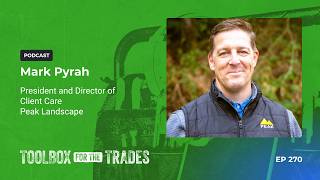
In this episode of Toolbox for the Trades, host Amanda Savateur interviews Mark Pyra, President and Director of Client Care at Peak Landscape. Mark shares his personal journey from a rural Idaho upbringing, mowing lawns with his family, to co‑founding a 20‑year‑old landscaping firm. He explains how lifelong anxiety became a catalyst for developing structured leadership practices, such as daily planning, SOP creation, and purpose‑first goal setting, drawing on the book The Four Disciplines of Execution. Mark discusses the financial turning point of focusing on free cash flow rather than top‑line revenue, detailing how he calculates it using profit‑and‑loss, cash‑flow, and balance‑sheet statements, and how this shift altered decision‑making. The conversation then moves to AI adoption: custom AI assistants for different roles, AI‑generated scopes of work, diagram creation, financial analysis tools, and an AI‑powered executive coach tailored to his personality. Throughout, Mark emphasizes learning, breaking tasks into digestible steps, sharing small wins, and advising his younger self to understand anxiety early and stay adaptable. The episode blends personal vulnerability with practical advice for business owners on leadership, finance, and technology adoption.
Chapters
Hello and welcome to Toolbox for the Trades. I'm Amanda Savateur, and today I speak with Mark Pyra, President and Director of Client Care at Peak Landscape. In this episode, we dive into a deeply personal and insightful conversation about how Mark's journey with anxiety has shaped his business philosophy and his evolution as a leader. If you've ever felt that familiar pit in your stomach over a never-ending to-do list, or if you find yourself dreading the financial side of your business, Mark offers some invaluable perspective on turning those challenges into insights. We also explore how to apply that same mindset when it comes to adopting new technology, specifically how to take the fear out of incorporating AI into your operations. I hope you enjoy this conversation as much as I did. Mark Pyra, you are the president and director of Client Care at Peak Landscape, and today we're going to be discussing how you transformed your anxiety into a leadership tool and the future of our traditional industry. Thank you so much for coming on Toolbox for the Trades.
My pleasure. I'm happy to be here.
I'm happy that you're here too. As you know, with Toolbox for the Trades, we always start off with a little icebreaker. What's a tourist trap? You actually think is 100% worth the hype?
One is the Grand Canyon. I used to think that that was just a, you know, it's a crack in the ground. It's not that big a deal. A lot of people make a big deal out of it, but I've visited it and just the size of it and standing in front of it and seeing it, that the pictures don't do it justice. You have to be there in person and feeling this awe of how grand it was. Grand Canyon. There you go. And then the other one being the redwoods, going to the redwoods and seeing— you see pictures of large trees, and in this industry we see large trees all the time, but being there among giants and not having just one tree that is massive, but having several hundred and being among them and feeling very small, that was, uh, well worth the trip that we made to do that.
I love that. Those are great choices and I agree. They're both worth the hype.
I need to get back. It's been several years since I've been, so.
Hey, you gotta check 'em out. Those redwoods have grown since, so you gotta get there. All right. So how did you find yourself in landscape?
I grew up in a really small rural town in southern Idaho called Carey, Idaho, just a farming community and not much to do there. My dad worked for Kraft and he was a cheesemaker. We didn't have a lot of money all the time or any of the time, really. We started mowing lawns as a family. There was a city park right there. And then in a town 7 miles away called Peekaboo, Idaho, we took care of a park there as well. And so I would help my dad and that's where I cut my teeth and learning. I loved being on a mower. I loved being, especially if it was a riding mower. That was the best. It gave me a time to just take a mental break and just focus on one specific task at a time. And I learned little bits and pieces about irrigation as well, cuz we fixed all of our own heads and, and did those kinds of things. So that's where I started. I didn't know what the landscape industry was at that time, but that's where I started in landscape.
So how did you start Peak Landscape and find yourself where you are today?
That's fast-forwarding several years for sure. I went to college and the Army aptitude test told me so that I was supposed to be a pharmacist. I went into pre-pharmacy in school and realized very quickly that I'm not that kind of smart guy when it comes to high-level calculus, high-level chemistry. Abandoned my plans after my first year in college and went and served a mission for my church for 2 years. I went back to school and the school I happened to be going to, which was BYU-Idaho, has a tremendous horticulture program. And I took a design class and just fell in love with the concept of design, the concept of creating something out of nothing. And so I just pursued it at that point, spent 2 more years getting my landscape horticulture degree, moved to California, to Los Angeles, to work for a company there for a year. Came to the Northwest in Oregon and started working for a company here. But then I met my business partner, Jason Ostley. He approached me and said, hey, we should start our own thing. So that's what we did. So that was 20, just over 20 years ago that we decided to take that leap. And I've always been kind of had an entrepreneur mind, but this is the longest job I've ever had.
What a great story. I don't think a lot of people think maybe design when they're mowing lawns when they're 12, that that's a possibility, or that's the thing that's really going to get them excited every day, right? But once you break open an industry, there's all of these other facets that you can discover for yourself that really fit your personality. When we originally spoke, you were generous enough and vulnerable enough to tell me about your struggle with anxiety and general anxiety. This is something that you have been dealing with since you were a little kid. How has that bit of a, of a worry or, or that nagging in the back of your head, how do you think it's shaped your approach to leadership and decision-making?
It's given me the opportunity to really organize myself. So if I allow myself to just focus on thoughts or things that make me anxious or think too far in the future or think about whatever problem it is. And if I don't sit down, plan, and try to strategize and work my way through the problem, then that anxiety can really take over and really be a problem. I've always wanted to be a leader in the sense that I always wanted to not necessarily be in front and be that guy that's like, follow me, I know everything, but I've always wanted to serve other people. I've always wanted to teach and to make others feel good. Part of that means that if I, if I'm anxious about something, then I will do what I need to do to set out whatever tasks, organization— now we call them SOPs. I've set out all those, those SOPs and things for different parts of my life, and so that I can move through them without getting too caught up in the big picture. Whenever you think too big, you put it out too long and you don't have concrete steps on how to get from where you're at to where that goal is or where that destination is, that's where anxiety can really take over. For me anyway, personally, that's where it is an issue. So every day is a sit down and plan and prioritize. That doesn't mean I don't have long-term goals. It doesn't mean I don't have a mountain that I'm trying to climb. It just means that I'm taking one step at a time each day towards that long-term goal.
As somebody who also suffers with anxiety, it really comes from a place of fear of not maybe understanding something. Being able to break down a big goal and find those digestible steps to get you there really is a way of calming yourself down. I'd love to know when things get too big, where do you want to focus first?
I will start breaking it down. Like if, if something is large, let's say for instance, in December, we're saying, hey, 2026 strategy, or I'm trying to set personal goals, 5-year personal goals. I have to start with purpose. And I go back to not sit writing down a bunch of tasks about what it is that I need to accomplish to reach that goal. But I start asking questions about what is the actual goal? Why am I trying to achieve that? Does it serve the purpose that I have for my self-identity? In a business sense, what is the SOP, or is the goal we're trying to reach, what is the end result of that? What is the consequence? Because sometimes we'll say, well, we want to reach X amount of revenue, or we want to reach certain net profit, or whatever that might be. But why? Why is that important? Why do we want to reach that goal? What does it— how does it benefit us? And if those aren't specific and you're not asking those questions, then you end up getting halfway down the road of planning this goal or whatever it might be, and you'll be like, I don't even know why we're planning anymore. I don't even know how half of these things that we've planned, are they really important or not? I read a book called The Four Disciplines of Execution, which is an amazing book. It helped me instead of just writing down a bunch of tasks, because I was a Mr. Taskmaster. I have lists upon lists, and I loved checking off tasks that— you talked about fear, and one of my fears is losing time, losing time to accomplish whatever I want to accomplish. I would write tasks, and that— I would check off those tasks, and that would make me feel— unfortunately, Toxically, I would base my value on the number of tasks that I completed, not based on the goals that I was trying to reach or the purpose for those goals. And so I, I call that clearing the deck when you're just trying to get rid of many, as many tasks as you can, but you're not really even accomplishing the most important tasks. And so that's what that book helped me kind of see is through the whirlwind, through the tornado of life, what is the most important? Thing that needs to be accomplished and then set a path to reach that specific thing. There's so much good that can be done in life that we don't have the time to do everything that's good. We have to prioritize and only do what's better or do what's best. There's a reason that I've kind of really focused on this and really made sure that I understand what is it that I fear, what is causing my anxiety, truly what's causing it. Because they're the other side of anxiety. If you get too much on your plate, the other side of the coin of anxiety is depression. I can remember at the age of about 32, somebody had to tell me that, hey, I think you're depressed. And I thought I was just anxious, right? But when you pile so much on your plate and you don't do anything to try to organize that or understand it, and you're just kind of— it becomes toxic, and then you become depressed and You become overwhelmed. You don't feel like there's a way out. There's not any hope. And that can be a dark place to go. The feeling that I would describe that you, you get when you're not properly working on it, you're allowing it to kind of take over, is you just become numb to everything and you really don't have high or low. You just are, you're just there. You're just experiencing, you're going through the motions. Uh, one thing that's super helpful for me is when you accomplish a task, when you— and I wouldn't even say a task, but you're, for instance, we're updating our SOPs right now for water management, because we're about ready to go into the season. When you find something fun and exciting and you've improved your SOP through organization and all these things, share it. Share those moments that are little victories to you, share them with your team, share them with your loved ones, whoever it might be, because that— those little things. And if you're able to teach that to somebody else, that's where the anxiety starts to just disappear, is you've affirmed it for yourself. And then if you help others along the way, those are the two things that I— that have kind of helped me kind of weather most of the anxiety storms I traditionally had.
I love this idea of helping others and finding that stillness through giving others an opportunity, helping them out, and giving of yourself in that way, I think is such a natural thing for people to want to do. I think we all want to help each other out, though we might not think that is the case, but it feels so good to help people. I can see why that would be one other way to manage this anxiety. Now, I know when you started, in this industry. Obviously you started off as a lawn guy, not a numbers guy, right? So why would you say understanding your finances when it came to the business, how did that help your anxiety?
There's two things that probably stress me out more than most, and I wouldn't say I'm unique for sure, and that is revenue and cash flow. So money in, money out. Those are the two things that probably stress me out the most. So I've tried to learn as much as I can on that side, but heavens to Betsy, I think the, the one thing that I wish I could go back and just tell myself 7 years ago, 10 years ago, 20 years ago is you need to buckle down and really understand what truly drives a business and what truly needs to be understood financially in a business to make sure you're successful long-term. Because there's a lot of moments in the past where you get frustrated because you're not making money or you're not profitable and you don't understand why. When you get to that spot, that can be pretty frustrating because we've worked incredibly hard and then you get to the end and there's nothing there. That's where most of the frustration can come from.
Now, you mentioned this before, but in your opinion, what really matters in business is knowing your free cash flow. What experience made you realize that was what you should be paying attention to, that this was the key to success?
Yeah, I wish it was, uh, I could say it was an epiphany or something like that, but it's most of my knowledge comes from, uh, pain or hard knocks. In a business, the way that businesses are looked from a tax perspective and the way that say private equity looks at a business is not the way that an owner or a the health of the business really should be looked at if you're trying to grow value long-term, right? So we, the terms of scale, private equity, growth, EBITDA, those are all things that we hear a lot about. But underneath EBITDA is after you factor in your capital costs, your capital acquisition costs and those things and distributions to shareholders, you have free cash flow that's left. And if that number is not a healthy number, it doesn't matter what's happening at net profit or EBITDA. It doesn't matter what's happening at gross margin or at revenue, top line revenue. If that number's not good, then none of that other stuff really matters.
So once you started focusing on free cash flow, what changed within the business?
Your decisions start to change for sure. You really focus heavily on not just revenue, but the right kind of revenue. That's always been part of our ideal customer profile strategy is finding the customers that are going to provide the right kind of revenue that is profitable. That's good for us, good for our team, good for the business that provides the free cash flow that we need, but then it's also determining when you start to make purchases, you're focusing on those items that don't hinder your overall progress and the building of this free cash flow. So you just— your, your mindset changes as to what you're trying to grow. But I think a lot of it also is you're not setting yourself up with a false premise that, hey, we just did X amount of revenue, top-line revenue, so we must be successful. It may not be the case. Like I said, in the past we've had months And where we've done what we thought we did really well, we'd build the most we've ever built, and then we look at the bottom and free cash flow because of capitalization or because of different costs that have come in, and you just don't, you don't have as much free cash flow as you thought you would.
For business owners who are really trying to get a sense of their financial operations within their business, and they want to start looking at free cash flow and kind of come at it from that angle. What would be your advice on how to set that up and how to find success?
Well, it's not too much different than what they're already tracking. So if they understand their profit and loss, there's really 3 main statements or reports that they need to track. One being your profit and loss or your income statement, your statement of cash flows, which is a report that can be run in most accounting software systems. And your balance sheet. And when you combine those together, you're trying to just pull information from those to get to the point where you can say, well, I'm gonna take my EBITDA and then I'm gonna minus out other capital costs that we had to make. I'm gonna minus out distributions to shareholders, current liabilities, short-term liabilities that need to be accounted for, that you're paying for on a monthly basis, but that are not accounted for potentially in your income statement. This would be like loans that you're making, that you're paying for, right? You're paying for them, but your depreciation number in your income statement might not be matching up to what you're paying. So I was just looking at, okay, what's my net profit or my EBITDA? And then factor in these other 2 or 3 items, and that gives you your free cash flow.
I can imagine owning a business and starting off, like we said before, as a lawn guy and not a numbers guy, that there is a lot of anxiety and almost pushback when it comes to understanding the numbers of your business. If someone is experiencing that type of anxiety and they have that fear of really kind of diving deep and understanding their finances, where do you think they should look and what should they maybe implement for themselves?
First rule of thumb is don't ignore it because that will cause more anxiety for sure. Learning is a, is one of my tools for getting rid of anxiety, is just diving in, constantly learning new things that you don't understand. So on the finance side, that's where it's been for me. In today's world, it used to be that you'd go and take a class. You'd go and take a class at college or Wharton Business School or, or whatever it might be. You would go in and take a class. But I would say my 90% of what I've learned in the last year has come from following people on YouTube, watching videos of people who are strategists, who are CFOs, who are in that space and really starting to understand, like they're using acronyms. What does that mean? Write it down. And then I will go and research what that means. But the web now is just full of information that's free that you don't have to— really, you can learn at your own pace. As much as you're willing to learn or want to learn, it will come to you. And then I would say just within the last 6 months, AI has been a tremendous teacher. Because when I go on Google and do a Google search, I have to search through multiple links to find the right information. But using AI has been tremendous in me just being able to have a conversation with it and look up concepts and learn concepts and figure out how, well, how does that apply to me? That's been a tremendous help.
AI is on top of everyone's mind right now. I'd love to kind of dive into AI a little deeper. You are taking the time to teach your team about AI. You're incorporating it into the business. How is a 20-year-old landscape company like Peak Landscape using AI today to become better professionals? And better people?
The answer is a lot. It's changing so quickly that things that I was using AI for maybe a year ago or even 6 months ago has completely changed or has upgraded to the point now where it's a lot easier for our team to understand and to use. We started with scope of work, so that's been a big one for us. We want our proposals to be the best. And to be the most clear. And when you're working with different account managers and Arbor consultants and all kinds of different people, they all have different personalities, writing styles. We use AI quite a bit for scope of work clarification and to make sure that our scopes of work are really good. So that's just a simple one. That's, that's child's play, I guess, as he would say. Just recently we've started creating custom AI assistants. And these AI assistants are by position. And so our account managers, or we call them asset managers, Arbor consultants, general managers, maintenance supervisors, we're all starting to build these custom AI assistants that are specific to their position, specific to Peak Landscape. And so the AI assistant is trained to answer questions based on their position description. Their job duties, Aspire, what they're supposed to be doing in Aspire, or information from Aspire, searches that they need to find. They can use that to just go ask questions about pricing, about estimating standards, all of that. So we even just, we're starting one now. I'm just wrapping up the details. It's for our water management technicians, but we'll have ones for our enhancement crew leaders, for anybody to have on their phone, like an app that they can ask questions about anything related to PEAK or, for instance, the irrigation design or troubleshooting, and it will respond to them and give them in their own language what it is that, uh, we've trained that AI system to give them.
I love this idea because now you're cutting out the middleman or waiting on finding out information Who do I need to ask?
Exactly.
Yeah. You don't need to worry if someone's off on vacation and they're the only person who knows, like that's really incredible.
Well, you know, part of the, part of the, what we're trying to accomplish is reducing the amount of decision volume that our leadership has to put on their plate. The idea here is we're trying to, AI is allowing us to create systems that allow my brain to be on. In the cloud, I guess, and all of our leadership's brains in the cloud so that if they have a question about, hey, I need a diagram on how to wire up a Rain Bird controller that's 2-wire and to a wireless rain sensor, but I don't know what that looks like. Can you give me a diagram? This AI assistant will give you the diagram. It will explain the steps on how to do it, any troubleshooting that might need to be done. That used to be a phone call, and now that's this, uh, technician in the field who's just communicating with an AI on his phone. But we're also using these for custom GPTs or Gemini Gems for financial analyzing. We use Weathermatic SmartLink, and so we're using it now to take those inspection reports and to summarize those into scopes of work for us to put into Aspire. Just all kinds of things like that to help summarize information and help us make decisions on lots of high-level information.
Is there anything else that you're implementing that you're really excited about?
I would say for myself, I'm creating an executive coach. It's not done, and people are going to cringe because I know there are executive coaches out there that are human. I get that. I understand that. The benefit of this and why I'm creating it is is to help me and my particular personality to be able to just ask questions. And it knows me. I've been talking to it for 2 years. It gives me the best information that I need at this point to help me make sure I'm on track with my goals, because I can instruct it however I want to instruct it. Like, I, I tell it to be direct with me, no sugarcoating. I tell it to be my enemy sometimes, to be rough, be hard on me, give it me to me straight, right? So that's what I'm excited about, what I'm creating. I just haven't finished it yet.
Mark, that is all incredible stuff, and I know that AI is so new for so many people in this industry, but you're really taking it to the next level and incorporating it throughout the organization in such a smart way. And I love that you're doing that. All of those initiatives sound incredible.
I think that's where it's a challenge with AI, because you can do an infinite amount of things with AI. But I think for us, our strategy is, and my own strategy is to use it that's going to enhance our capability, to enhance our capacity to do things. And it has to be something that we're already, that's going to enhance what we're already doing, not necessarily change paths for us. An example is I, I showed this kind of water management assistant to one of our technicians. And I said, hey, do you, or do you use AI? Do you know AI? And he's like, no. But the fun part about this is because it's on his phone, because it's an app, and he can talk to it in any language he wants, Spanish or English. Once he saw the capability and I was showing him what it could do, he got excited because it doesn't change what he's trying to do. It just enhances what he is trying to do and trains him at the same time. This reinforces SOPs. It reinforces our culture. It reinforces why we, you know, the trainings that we do every week, tailgates, spring rodeo trainings, whatever it might be. Now that's all on his phone all the time that he can reference anytime he wants.
Incredible, incredible work, Mark. Thank you so much. Before we go, I would love to know what advice what advice would you give to yourself when you were just starting to navigate this industry?
Yeah, that was a long time ago. I was 27 years old. That's weird. I would say that my advice would be is to take the time to learn. I've changed roles, I don't know how many times, and many of us have. As you grow, you have to adapt and you have to think bigger and you have to— your roles change constantly out of necessity. But I would, if I could go back, I'd say you need to really figure out why you feel the way you do. I can remember in that first 6 months, I can remember going down the road, driving, headed back to my office. I remember where I was. I remember the road I was on and this feeling almost like I couldn't catch my breath and my chest hurt. And it's because of anxiety. I was shallow breathing, right? And this was in our first 6 months. I was waiting for estimates to come through, for jobs to be won, and just anxious almost every day, all day long. And if I could go back, it would be to, hey, you need to figure out why you feel the way you feel and start doing the work then to overcome these challenges that you've had your whole life.
Mark, I want to thank you once again for coming on Toolbox for The Trades, a great and important conversation. Thank you so much.
Thanks for having me. I really appreciate it.
More from Bill



ServiceTitan Virtual Agents: Simplify Before You Scale | Podcast Ep. 110 | Mastering ServiceTitan



Life After Live Events: How to Turn Post-Conference Energy into Real Profits | Podcast Ep. 297




