Ismael Valdez’s Toolkit for Success | Podcast Ep. 158 | Toolbox for the Trades
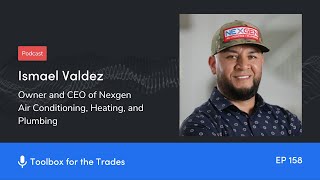
Podcast interview (recorded late 2023, airing Jan 2024) with Ishmael (Ishmael) Valdez, founder/CEO of NextGen Air Conditioning, Heating & Plumbing. Topics: how NextGen adapted to a softer contracting market (pricing, financing, technician training), core KPIs and daily operational fundamentals (BOOK, ASSIGN, SELL, INSTALL, COLLECT), dispatching and labor strategies across six Southern California locations, reasons for selling to The Wrench Group, and a preview of Nuve — a ServiceTitan-integrated predictive-maintenance thermostat launching Jan 2024. The tone is practical, mentorship-minded, and growth/people-focused.
Questions this video answers
74–80% (aim above 74%).
$21,980 (NextGen average install ticket).
Target above 55% closing on opportunity calls.
Six operational locations.
Approximately $115 million (projected/ended around $115M).
Hello, contractors, and welcome to Toolbox for the Trades. My name is Jackie Aubel, and today I have the pleasure of once again chatting with Ishmael Valdez, CEO and founder of NextGen. Ishmael is one of our most popular guests, and on today's show, he's answering your questions about KPI's profitability, the art of dispatching, and more. Plus, he's giving us a sneak preview into his new predictive maintenance solution, nuve. I hope you enjoy our chat as much as I did. Ishmael Valdez, you are the CEO and founder of NextGen Air Conditioning, Heating and Plumbing in Southern California, which was acquired by the Wrench Group in 2022. You are one of the more notable service entrepreneurs, having been featured on multiple platforms to share your story and offer insight and advice to fellow contractors. In fact, you still hold the title of of most popular guest on Toolbox for the Trades, and I am thrilled to welcome you back for another episode. I. It's. It's true, man. People have been trying to beat you and they just can't. So I'm so happy to welcome you back. What's new? What's going on?
Oh, what's new? There's so many new things going on. I thought I was going to retire after next gen, and it just got even worse and worse and worse, so. But I'm glad it's all good things. So I can't wait to talk to you guys about it, but you just made my day. I can't believe. I'm like, I like when the most popular one on our podcast. That is so dope.
Honestly, dude, it's. It's crazy. I think you know Amanda Triolo from Grasshopper.
Yes.
She was like, oh, I'm going to. She's amazing. She was like, I'm going to beat her. I'm going to beat him. I'm going to beat him. And I'm like, Amanda, it's, it's. It's a tough number to beat, but I think we should keep the competition strong. And the folks love you, so I really appreciate you coming back on, so let's jump right into it. So we are recording this at the end of 2023. This is going to air about January 2024. The contracting landscape has changed a ton this year, and I'd love to know what changes you're making at NextGen to adapt to the economic climate right now.
What changes are we making? We made a little bit more affordable systems for our customers. We. We. We went. We went back to our Our vendors, you know, our Amana vendors that do our next gen equipment. And we talked to our main people at Joker and we negotiated some really, really good deals so we can give our customers a better price on it. Because we know that you know, spending 20, 25, $30,000 on H vac system is, is brutal right now. Especially at, especially with all the, with all the noise happening in there. So we've, we, we've negotiated better equipment, better deals for, for our customers. We also been training our people better on, on, on repairing our equipment for our customers. Making sure that, you know, it's not always a replacement. Some people, you know, can't afford a brand new system and we just gotta get em through the winter, gotta get em through the summer, you know, maybe we could get a couple more years out of the, out of the system. So we've been training our technicians diligently every single week in and week out on making sure that they're, that they're doing what's right by the client, number one. But number two, always, always keeping in mind that at the end of the day we're a service based business and we always want to make sure that the, that the customer is always satisfied with our, with our options. It's not always, you know, trying to push numbers on them.
Yeah, totally. You know, I was talking to Jason Brady from Above and Beyond Service Company in Oklahoma I think he's at, and he was saying that he's actually using financing for a lot of repairs now. People are hurting out there.
Yeah, it is, it is. And we got to be, we got to be cautious about that. We got to be conscious about that like the consumer out there. You know, I think there was a statistic that there's. Most people don't have over $5,000 in their savings account or $1,000 over in their savings account. And the holidays are here. So we got to make sure that we're, we're cautious of that. So we always, always lead with financing. We always, whether it's a, you know, thousand dollars repair to a $20,000 system, whatever it is that we, that we're providing for our customers, we give them options on easy payments because we know that it's not, you know, it's not like they were saving up. Most people don't save up for their air conditioning to replace it. You know, they, they, they replace it when they need it or when, when it gives out on them.
Yeah, exactly. No one's exactly putting in a rainy day fund for like yeah, I'm gonna Get some. I mean, that being said, a new H VAC system, delightful. So enjoyable. But yeah, I mean, I'm totally hearing it too. Not just in, within my service titan world, within my personal world too. People are hurting, man. And this is such a stark contrast to where we were in like 2020, 2021 and that Covid boom and things are just slowing down. So I love that you're implementing these changes. What are you saying? Because you do a lot of mentorship. What are you saying to folks that are really feeling this, like contractors who are struggling right now, like what are some motivational things you're saying to them to keep them going through this tough period?
I'm telling them one of the things that Tom, that Tom Howard, which is one of my mentors, he's been my mentor for, for, for, for four or five years out of my journey already. Look, the operators and the people that are going to make it through these tough times are people that are going to be making the tough decisions. People that are going to be, you know, having a bad day, waking up the next day and doing it again. And even if they have two, three, four, a week, a month or a couple months that are bad financial months, like you gotta wake up and you gotta do it again and you gotta give it your all every single day. Because look, you know, in 2019, it was my worst year in history. I didn't know what gross profit it was. I didn't know what a P and L, how to even read a pnl. I didn't know, I didn't know a lot of the business side of it. But every day I woke up and I knew that my people were depending on me. My installers, my technicians, my sales guys, my in house personnel, my accounting team, everybody was depending on me, making sure that I woke up and I made the right decision for him. Which was one of this, One of the reasons why I decided to be sober since then is because I knew I had to show up for my people. And that's what the one thing that operators need to focus back on. Because the numbers are telling us one thing, guys. The numbers are telling us the economy's down, the people aren't buying systems, that the, the, the, the average ticket for systems is down. All of that, the numbers are telling us one thing. At the end of the day, we got to focus on our people. Because guess what? This, there's going to be a summer, there's going to be a winter. It's, it's just a matter of time before it Comes again. Right. And we got to make sure that we mentor our people and we keep them sharp to, to be prepared for those times. So I'm telling them, hang tight, put your head down. Go back to the fundamentals of what got you here, and make sure that no matter what you. Yes, the, you know, the numbers might not be telling the true story right now, because we're comparing it to an anomaly that happened in 2022. 2021. 2022. Right. And. And they're not telling you the true story. Go in there and love on your people and make sure that those. That. That your team is. Is. Is set for. For. For what's coming. And, And. And you'll be fine.
Yeah, I love that. So we're going to get into some questions that I pulled from Facebook groups from both the service and from the Toolbox for the tradesman. And our first question is from Christian Procic, who's actually on this app. His episode is going to air right before yours. So this is a nice little continuous loop. He specifically said, you know, you've mentioned your. Your relationship with Tom Howard. And Christian said, I think we all need a Tom Howard, but what were the specific things that Tom Howard taught you in 2019 that just turned the light bulb on in your head?
Look, and Tom Howard is, like I said, he's. I brought him on into most of my stories that, that I've done podcasts and presentations for. Now we have a crew called lsd, you know, that we came up with. It's seven of us. I keep talking about it on my group. I've mentioned it a little bit on Service Sign, but it's seven of us. We're all, you know, we're all young, ambitious hustlers that want to help each other get better. And that's, that's what I would. That's what I would advise people, like, find a little niche of group of people that are in the trades that are going to help you through these rough times, you know, because. Because there is a storm coming, whether people see it or not. And I'm not going to keep, you know, trying to be negative about it, but I'm, I'm realistic about it. There's a storm coming. We all got to hold tight together, and we all got to make sure that we make it, not. Not leave anybody behind. A couple of things that Tom, That Tom taught me was the financial and, like, knowing my numbers inside and out, knowing my numbers, knowing my average ticket, knowing my closing percentage, knowing my. My booking percentage, like knowing the main, the main KPIs that drive a business into being a profitable business and a successful business is what I would advise everybody to, to, to, to start learning. Like, like don't, but don't take your instinct off the, off the operation because the, the, the numbers are always going to tell you one thing. But us as operators, we're always going to have that 6 instinct of knowing. Like, hey, the numbers might be telling us that we're growing at 30% and our profits 18% and da, da. But you walk in there, nobody wants to work with each other and nobody wants to, you know, go outside the company and have a little lunch to get like, nobody even wants to have friendships in there that like that. That should tell you one thing too. Like, work also has to be, it's not always about numbers and profit and, and driving people to there. Like, you also got to be, be able to enjoy coming in here because if, if you're not going to enjoy it, guess what? It's gonna, it's gonna take a toll on you. Honestly. It's gonna take a toll on you and you're gonna, you're gonna look back and be like, man, you know, all that work for, for me to be unhappy, right? So the things that, that, that Tom taught me was the financial and definitely, definitely knowing the KPIs, guys, definitely knowing the. If you guys want to know the three major KPIs that I would, that I would focus on for, you know, every day is obviously, you know, you got to know your revenue, but, but I would know that your average ticket, right, Your average install ticket. I would know your booking percentage because if you're not booking properly, nothing else in the operation matters, right? The booking percentage will dictate how many, how many calls, the call volume, how many opportunities, all of that. So that would be my main, main point of focus. Go, go inside your CSR room and your dispatching room where the phones are coming in and make sure that you, that you work on that KPI first is, is, is a great company. Will always book above 74 to 80% booking inbound booking opportunity calls that are coming in. So 74% plus. Okay, that's one of the KPIs I would do. Second thing, I would know my average ticket on the install side because the average install ticket on the install side, right, 88% of our revenue comes in through the install department and our average ticket here at Nexion is 21,980. Like, I know that by keeping that high of a Ticket, we, we will be able to produce profit, right? So if you guys don't know your average ticket, don't know your booking percentage and most importantly your closing percentage, your closing percentage on opportunity calls is super, super oversaw by every operator. Okay? If there's a hundred calls that come into your call center and, and, and 80 of them were booked as an opportunity call, he need to have a percentage, right? We try to be above 55% of, of opportunity cost that we capitalize on to be able to, to be able to capitalize on. So like you gotta know those three major KPIs to be able to drive the business forward. If you don't know the, the, those three KPIs, you gotta get yourself a controller, an accountant, somebody high level that can, that can structure a P and L, A balance sheet, a cash flow statement that can help you make decisions in the business. Guys, you know, if you're running a business over a million dollars, Listen to me, because, because this is one of the things that, that most operators out in the industry don't, don't realize when they come up to me, the first thing I ask them is how many employees do you have? And they say 5, 10, 20, 30, whatever, right? How much revenue are you doing? Oh, Ishmael, I'm only doing. This is what they say, listen to me, I'm only doing a million dollars. I'm only doing $2 million. I'm not 100 million like you. I'm only doing. And I tell them, look man, you can't look at it that way. I, a million dollars is a lot of money. $2 million is a lot of money. Seven employees is a lot of employees. That's seven families that depend on you. 10 employees is a lot of employees. That's 10 families that depend on you. So don't think about it as a, hey, it's only 10 families. It's only 10 employees. It's only $1 million in revenue. Like you gotta, you gotta start, you gotta start like knowing those numbers and making sure to the million dollars, that's a full on operation. $5 million, that's a full on operation. And you got to know your numbers. You got to have an accounting team to be able to, to be able to make educated decisions. You can't just keep doing what you're doing because if you're stuck at three employees, if you're stuck at 10 employees, if you're stuck at one employee, it's because lack of decision making and lack of knowledge. The only reason why I got to $100 million is because. Because I educated myself and I kept making decisions throughout the journey. So whether they were good or bad, I was still making the decision. So those were, those were, those were some of the fundamentals I would tell people to learn.
Oh, my gosh, I love. And you actually already answered Kip Turner's question, which was the top three KPIs. And I actually, I need to know what is, what does LSD stand for?
Lsd? So we have a group messages. Tommy, Tommy Melo, Chad Peterman, Chris Hoffman, Tom Howard, Travis Ringy, Cristiano, and myself. And I think. I don't know if I said Chad, Peter. Yeah. So it's all of us in a group message, and it's a text message group that we're always holding each other accountable. We started working out together. We started, you know, making sure that we're holding accountable to workouts, to business plans, to. Hey, what. How much revenue are you guys doing for the day? Who's having trouble with what? So, like, I put on text message. We should call ourselves something because, you know, those guys are great, great leaders. Every single one of them. Aaron Gaynor's in there too. So every single one of them is a 50, 100, $150 million company in there. And, and, and the name LSD came about just because, you know, obviously I love coming up with dope, dope names for companies. And it stands for Lean because we, we all work out service because of the trades that we're in, and degenerates because we're dope. You know what I'm saying? We're not, we're not your traditional. We're not your traditional, like, contractors. You know, we're not 6, 40, 50, 60 year old contractors that have been doing this for a while. We're all young hustlers trying to figure things out. So it's not like, you know, we know every answer, but, but we definitely help and help each other hold each other accountable. So Lean service generates.
Oh, my God, I love it. Okay, so actually, speaking of Tommy, you spoke, I think, at his Garage Freedom event. And one of the questions that folks really wanted the answer to this was from David Dickerson. What is the simple day plan you talked about at the Freedom event? Can you tell us more about that?
I came up with. I came up with a basic plan on everyday operation, right? And it literally spells out basic, basic. The B stands for booking, right? The A stands for assigning the call. Right. The S stands for selling the call. The I stands for installing it. And the C stands for collecting it. So those are the five basic steps in the simple operation that you should focus on every day. You need to book the call, you need to assign the call properly. And this is one of the key factors that everybody misses. They know how to book the call because it's, hey, Mr. And Mrs. Smith, when could we go out there? But there's a, there's kind of like a gift and there's probably, there's, there's a there, there's. There's like an extra sense of where the cost should go and who it should go to. That's an art, okay? And people and people and, and a lot of the operators and contractors out there are, are misinterpreting or not paying enough attention to assigning the call properly. Assigning the call properly doesn't give you, doesn't mean I pay somebody 20, 25 bucks an hour to just give it to this technician. Or assigning the call properly is getting your whole team, your executives, your managers, your directors, your CSRs, your dispatchers to all work in one to make sure that that call gets capitalized on. So booking the call, assigning the call, selling the call, which is your sales department, right? Making sure we sell it, installing the call, which is a customer fulfillment, right? What happens when we sell it to the time we collect the payment? Right? And then collecting the call, which is your accounting group. Those are the five steps that I've been working on that I, that I've implemented at NextGen since day one. I came up with the system. It's called the basic system, right? Don't try to over complicate that, because I know people are like, well, what about this? And what about this? Or look, if you can't book a car, nothing happens. If you can't book a car and assign it properly, nothing happens. If you can't book it, assign it and sell it, nothing else would happen. So you guys got to learn those steps first before you start. Well, what about the average turnover? And what about my closing percentage on turnovers? And what about this? And what like, don't worry about that. Worry about. The basic fundamentals of an operation in contracting is these five things. You book the call, sign the car, sell the call, install the car, and collect the call. Those are the five fundamentals that you guys should be working on.
It's the foundation of the business. The business can't grow unless you've got those basics down.
Once you have that, then that's when you start fine tuning. Okay, what should be what should be my booking percentage on the booking? What. What should be our average turnover on technicians, what should be or average sale on sales department? Like, once you have the fund, the five fundamentals of the operation, then you start working on each department and putting a leader or a manager or an ex or a team leader, whatever you guys want to call them, to actually work on each section of the operation. But work on those five fundamentals and then start working on each fundamental by putting a team leader to work on it day in, day out.
I love that. All right, so speaking of assigning, you said assigning it is an art, the art of dispatching, right? So Johnny Mota wants to know, what does your dispatch board start looking like when you grow multiple locations? How do you filter and keep stuff organized? And how many locations do you have now, by the way?
So we have six operational locations in Southern California. They're all, you know, they all have equipment, personnel, technicians, installers and all that. So we, the way we do things here at Nexgen, we dispatch based on location and based on urgency, right? So number one, if there's a call coming in from SUNY Valley and we have a technician available and it's an urgent call, then we want to get there first, Right? Because whoever gets there first probably will win the ticket, right? So urgency is huge part of what it is. And then we want to make sure that we dispatch these technicians based on the locations that they live. So, like, that's why I opened up these multiple locations in Riverside, Palm Desert, Inland Empire, Orange County, Yusuf Valley, is because when I had an Orange county location, I had people driving from Los Angeles, from Riverside, from Palm Desert, all, all the way over here. And it was, it was wear and tear on my vehicles making. The technicians were getting in here, they were tired already for driving. They knew that they had to drive all the way back. So we would dispatch on location and urgency. And we also, also want to take consideration, guys, that where the technician lives, like, just because you have a technician that lives in Orange county and you're assigning them calls in Indian Empire, like, he still has to make that drive back to his house every single day. And then the next day he's going to wake up tired, he's going to wake up frustrated. Like, you guys got to take all that in consideration. The technician is the first point of contact inside the customer's house. And what's providing the value inside of the. Inside your operation. They're going to be with that customer two, three, four hours, okay? If they're in there tired. If they know that they have to drive 2, 3 hours for their next call, it messes with their mindset. And that's the one thing you guys got to protect on the technicians and the project managers is protecting the mindset. If you guys can protect the mindset and keep them at peace and know that, hey, my three calls are within 15, 20, 30 minutes of each other and I'm going to get home by 5, 6pm and I'm going to have dinner with my family and then I'm going to have a nice 7, 8, 9 hour sleep and I'm going to wake up tomorrow, have my meeting in the morning, have my coffee, go do my three calls. They're going to put 100, 20, 30, 50% more effort on those calls that then if you run them from one side of the city to the other to the other, and then they get home at 9, 10pm they didn't get to see their family. Like, you guys got to make sure three calls per technician, no more than three calls. When, when it's, when it's prime season, like in middle of summer, it's 100 degrees, we give them a fourth call, right? But in the shoulder season, two to three calls, have them maximize those two to three calls. Don't be giving them five, six, seven, eight calls. Because what happens is they start rushing through their calls. They know that they have four or five other calls. They know that they have four or five other calls. So protect the mindset of the technician. Dispatch on urgency, dispatch on location, and never forget that these guys are human. These guys are human. They want to spend time with their family, they want to, you know, rest up. They want to get home and not just shower and go to sleep. They want to get home and maybe watch a football game with their wife and kids and you know, have dinner with them and then they're recharged the next day. So take that in consideration.
Totally. And quick, quiet, quick follow up question there. Do you have one main call center for all locations?
Yes. Yes. So the dispatch center is here in our headquarters in Anaheim. And this is where all our service managers, executives and directors are all working. Dispatchers and CSRs are all here. So there's four or five different filters before a call gets dispatched to the technician. If there's a 20 year old call that came in, we assign it to the level of technician and I'll go through the levels. How we do it at next gen, you guys could do it differently, but the fundamentals are there. Level one technician is A tune up technician. So they get anything that we've installed. Right. So they're doing just tuna filter changes, you know, providing IQ solutions. Level two is, level two is a tune up repair technician. Right. So they're out there doing five, ten year old units, six year old units that are not working. Level three technician is a, is a full on tune up repair and selling technician and flipping technician. Right. So they're out there doing 20 plus year old units that are. These guys are probably the level threes and level fours are your, what you call a selling technician. They're, they're there, they could work on any single unit and they could provide the option of hey, these are your three options for repair or four options for repair and I could also give you a option for replacement. So level four technicians are 100% selling technicians. We put them as to mentor the level threes and level twos and level ones or they could sell themselves too. So if they go to a home and you know, it's a 20 year old unit and they provide the four or five different options and the customer wants a replacement option, they're also able to provide the equipment once. And then we also have project managers, Project managers are there to back up any technician. So if we have a project manager, they're assigned to three technicians. We call them project managers or channel managers. That channel manager will mentor these three guys or four guys and make sure that they go through every single call, they have a game plan for every single call. They're calling the customers direct, they're introducing each other with the customer. So they're always in, in communication. So they get high concentration of, of of training. Instead of having one service manager for 50 technicians or 60 or 100 technicians, we have channel managers that give those, mentor those two or three or four technicians so they could get the right training.
Amazing. I love that. Now I'm going to ask a follow up question from Chet Rogers because you mentioned already you're at a hundred million dollar company, right? Plus actually what, where are you at now if you don't mind me asking?
We should end around 115 this year.
Hell yeah. So Chet wanted to know how do you manage labor costs when you were in years one to two and I hear you saying, you know, keep your tech set, you know, two, three jobs a day max. And I could see a young startup guy being like how the hell am I going to make money if I'm only sending my tech on two, three jobs a day? So what do you think about that?
So for the, for this. Okay, listen, because I'm going to go through the service department, I mean the install department, then I'm going to go through the service department. Okay? So the install department, we pay them on 100% hourly and, and, and, and we, and we base them based on warranty costs, we bonus them on warranty costs, right? The late, the least the warranty cost, the more the bonus is. So we base them on, we give them efficiency hours for the installers. So an installer, you know, a project manager sells a three piece change out for $20,000. And we, and we're going to give them, you know, 14 hours to finish that between two guys or 16 hours to finish that three piece change out. If they finish that three piece change out in 12, 13, 14 hours, then they get the excess of the hours paid out as a bonus and they get in a bonus for minimizing warranties. That's for installers only. Okay? Because in the install department you want to, you want to, you want to incentivize the least amount of callbacks, but you also want to, you do also don't want to speed up the customer experience because you got to put yourself in these customers shoes. I just spent $20,000 on a brand new system and you did it in two hours. There's something wrong here. Okay? So we don't want to incentivize speed. We don't want to, we don't want to incentivize sloppiness and that workmanship. We tell our installers, take your time, make sure you're there to explain the customer's house. You're, you're, you're, you know, you're putting drop cloths on every single hallway, putting plastic on the TVs, on the furniture. Take your time doing all that because we want to make sure that the customer sees the value behind that. Okay? That's the install department and the technicians, we pay them on hourly or commission, okay? So they're always going to get paid 20 bucks an hour. They're always going to get paid 20 bucks an hour. So if they work a 40 hour, a 40 hour week times 20 bucks an hour, that's 800 bucks. Okay? But if their commission is $1600, they get paid the $800 plus an 800 bonus for their commissions. So that's what we incentivize, that's how we incentivize and we keep compliant in the city, in the state of California by always backing up with hourly. And we incentivize them. Look Guys, I'm going to be honest with you. The way you incentivize technicians and sales guys is by paying them properly. And, and most of the. Most of my contractors here in Southern California or across the United States, when I found out what they were paying the technicians, they were paying them two, two and a half percent, one and a half percent for turnovers, okay? I came in and I started paying the technicians 5%. And that's why we have a line from here to, you know, San Diego of people trying to work here, right? Because we're paying people properly. Right? We're overpaying, and we're making sure that. That a technician could come in here and have a good living. So, so you. The way. The way you fix your recruitment, your recruitment process, the way you incentivize people is by making sure you simplify the pay where they understand it, right? Some of these guys, the first thing I ask them is how many employees, how much revenue? And then I go into the operation by asking them, hey, how do you play your technicians? And they have to get a calculator out. And they're like, well, if they do this. And then. And I'm like, wait, you expect your technicians to learn that? So when they're in the call, they're thinking how much they're going to get made. They got to get a calculator. Like, you can't do that to these technicians and sales guys. You got to simplify your pay plan. So simple that when they're in the car, they finish the call, they go to their next call, they know within three seconds how much their commission was on the last call or how much they're going to get paid on the last call. You can't overcomplicate the pay structure. If you over complicate the pay structure, you slow down the growth and you de. Incentivize these, these project managers and technicians has to be simple. Look, 5, 5% on turnovers, up to 30% on IEQ and repairs, and they get bonus off based on revenue. Those three things. That's it. That's how we pay our technicians. Super simple.
Love it. And to cover that cost, I imagine, just to follow up on Chet's question, you have to make sure you're pricing yourself appropriately. You can't be the lowest. The lowest option out there, right?
No, no, no, no, no, no, no, no. Look, guys, you guys got to make sure, like whether you're a 1 million, 5 million, 50 million, 100 million, you have to have a strong accountant, a financial controller, you Know, for anybody, that's 1 to 5 million and every. Anybody about 5, 10, 15, 20 million, you got to have a high level CFO. There's no way around it. And these guys got to provide you the, the information to be able to make sure that you can, you can dial down or dial up based on the margin, right? So, yes, to answer Chet's question, you have to be priced out properly in order for you to pay people more. You can't pay people more and be the cheapest. You can't give people the best, the best incentives and the best insurances and all that. Being priced out low, there's no way to do it. You got to price yourself properly so you can hit your 15, 20% margin.
Hell yeah. Okay, so just want to say we've been recording for about 27 minutes and you just gave. This is free. I'm just here to remind the listeners this is a free podcast. I want to pivot a bit to you selling to the wrench group. Is that okay?
Of course, yeah.
So Jason Bowens wants to know, you know, your company was doing so well, so why did you sell?
The. The main reason that I tell people that I sell, and I mean this from the bottom of my heart, was I have four beautiful girls, okay? Andrea, Sofia, Camila, and Victoria. And, and they're young girls. And the last thing I wanted to do is pass up an opportunity that can set them financially for the rest of their lives, okay? Because I'm not selfish, number one. I want them. My number one goal in life is to make sure that those four girls grow up to be strong women leaders of their community and that they are financially stable so where they don't have to depend on nobody, right? And I did that by doing the transaction with the Ranch Group. The second reason I sold. Okay, okay. And, and this is one thing I haven't told a lot of people. Inside this operation, there's probably about 500 people, 550 people, okay? Some of these people been through, you know, wars with me, and some of these people, you know, seen the bad and the good of side of me. And, and it was, it was an opportunity for them to be financially stable. So out of nexion, there was 12 people that became millionaires with that transaction. And then now they have profit units. Now they, you know, then, now they're in here as business owners of Nexion. And I didn't want to pass up an opportunity on that. So I always looked at my, my beautiful girls first and then my team second. Like, I Wanted to make sure that they were both stable. You know, obviously God already blessed me with enough to be able to be happy for the rest of my life, and I just wanted to make sure that those girls were, were taken care of whether I was here or not.
That's a beautiful answer, and I'm so happy we did. Thank you for sharing. And to follow up on your experience with the Wrench Group, Drew Gay wants to know, what was it like partnering with Wrench and how has your work and personal life changed since the partnership?
Dude, best decision I made because I had a ton of offers. You guys got to understand, we were the fastest growing company in the nation. We were one of the biggest companies in the nation, and we had a ton of offers from private equity groups. Right. The reason why I made the decision to go with Wrench is because of their leaders. I found out who was in their portfolio and I started talking to them. You know, Kevin Comerford, Jonathan Bettencourt, Paul Kelly, Alan O', Neil, JD. Like, all those guys are $100 million plus, 50 million dollar plus companies. And, and I talked to them and I told them, hey, how is it? Nothing changed? The only thing that they came in here and did for us, they bulletproofed us. Our HR department is bulletproof. Our, you know, our compliance is bulletproof. Our fleet is bulletproof. Like, now there's so many systems in here that we have the freedom to make decisions of, keep driving the business forward. Right before. I'm not saying we were, we weren't complying. We weren't this. But guess what? There was gaps in, in the operation that I wasn't seeing. That Wrench came in here and covered every single gap. Now I have the peace of mind of operating the business every day instead of worrying, hey, am I going to get sued? Hey, is somebody going to crash it? Like, all those little things went away as soon as I partner up with Wrench. So it was the best decision with them. And I would honestly, if anybody's out there trying to, you know, look for a partner or they have a successful business, they want to talk about doing a transaction, for sure. I would, I would, I would tell them, hey, Branch Group is the best group out there.
So, yeah, I imagine that removed a lot of stress from your personal life. Getting rid of all of those, like, loose ends. Right?
I get to spend time with my girls now. I take them to school, I bring them back, I take them to dance, I take them recitals. You know, I still come in here every day. I'm still in Here, you know, at least two to three hours a day. I just had an executive meeting for an hour. So I'm in here every single day. I'm still grinding it. So it's not like I'm, you know, in a beach, you know, just relaxing. I. To me, my, My. My vacation is being at Nexion. My vacation, my peace, my. My sanity depends on being here on all my business, not just nex. I own. And I own and operate eight different businesses now. So it's not like, it's not like. So I. My sanity is. Is making sure that I'm involved in those businesses. That's, That's. That's what I thrive, and that's what, that's where my joy comes in.
Dude, I love it. And we're going to get to one of those businesses in just a second. But Josh Campbell asked a great question on the group. He said, if you were starting over with no cash, what's your first day on the job look like?
If I was starting with no cash, I would be calling credit cards companies. I would be talking to my vendors, right? I would be calling my vendors, you know, Ferguson, Lennox, all those guys, and I would tell them what my plan was, and I would sit down with them and have a conversation with them. And I would be calling, I would be opening up my credit cards, right? Because you can't do nothing without cash, right? So if I have no money in the bank account, I would open up a credit card and start it from there, right? And then I would go to the vendors and tell them, hey, I need a credit line for equipment and materials so I could be able to purchase my credit cards. I would grab them and put them in marketing, because without marketing and without making the phones ring, nothing happens. So the first thing I would do is open up a credit card, grab some marketing, start advertising my name and what I do and making the phones ring. As soon as the phones ring, you start the operation book, assign, sell, install, collect.
Love, love, love, love. All right, so let's get into one of your eight businesses, my friend. Talk to me about Nouve. What is new?
I'm so excited about new. I've been working on it. Well, me and my. Me and my best friend Travis been working on it for about two years now, and it's about to go live in January. We have over a hundred thousand units getting made. It's a. It's the first of its kind. It's new technology and, and the best part of it. Ready for this? It's only exclusive to service time users. Like we're not partnering up with anybody else yet. We're not partnering up with anybody. We're only offering it to service time users because it's going to connect the thermostat all the way to the CRM, all the way to CRM. So a bunch of it has five key features that, that I, that I, that I patent and that I came up with for, for the contractors. And remember nuva, the thermostat nouveau, we don't care if the consumer ever finds out it's a newer thermostat because on the thermostat the logo for the contractor will always be displayed. It's a digital logo that's always going to be displayed on the thermostat. So I don't know how many buildings, apartments, houses, offices I've walked into and there's a Nest, a Honeywell, an Echo B. And if you ever ask them like who installed this or who services it, nobody knows. And that to me, mind boggled me. For the last 50, 60 years of air conditioning, nobody ever thought of putting a name on that thermostat and a name that can't be white because there was companies that would imprint your, your company information on the thermostat. But then like after a month it would come off and you would be back on step one. So I made it a digital thermostat where your logo, you know, next gen service champions, Parker and Sons, whatever company you have, will be displayed on that, on that thermostat. And that thermostat goes connected back to your CRM, which is always going to be by you. So five years from now, somebody walks in and they, and they bought that house from somebody else, they're going to see that it's a next gen thermostat. They're going to Google it. Or they can just press on the button, they could press on the thermostat and dispatch a technician through the thermostat. So they click on the logo, it says dispatch technician, approve it on their, on their app. Done. Technician will show up.
Amazing. And this is all about predictive maintenance essentially, Right? Tell me a little bit about what kind of benefits this system gives to the person that chooses to use new based thermostats. Right.
So we're gonna, so we're also gonna be able to be able to send customized messaging to the thermostat. Like I know like emails are not, are not getting open for your customer base. Your direct mail's getting thrown in the trash, your ringless voicemails aren't getting heard, your text message campaigns aren't working. Like the open rate on emails is less than like 1 or 2%. Like nobody reads emails and if they read it, they'll probably spam it after a while. So the one thing that they, they can ignore is the app on their phone and the thermostat on the wall. Okay, so the, the one thing that I, I decided to do for the newer thermostat is be able to send customizing messaging on the app and on the thermostat. Hey, maintenance required, membership due, you know, AC tune up, do whatever you guys want to send to your, to your customers before the summer, before the, the winter hits, right? You're going to be able to send alerts on their app. When they open up their app, they download the app onto their phone, it's going to have a next gen logo. It's not going to have a nuve logo that like Nest does and Honeywell and Echoby. Every single time they want to turn on their thermostat, they want to turn off their thermostat. They want to, you know, schedule when they should turn all that. The app is going to open up and it's going to say your logo and your information in there. As soon as you open up that app, you could turn it on, turn off. Guess what? If it doesn't turn on or turn on, there's going to be a call button on that, on the app. They could click that call button, call you guys, and it directs them with a, with a, with a, with a specific number that's going to be able to attribute revenue back to your system CRM on that phone number. So now you're going to be able to click on that app, call all the way back and be like, hey, Mr. And Mrs. Smith, how can we help you? We notice that your thermostat's not turning on. So now it's no more. You know how many customers we've installed systems for or done repairs for or done maintenance on? And a month later they don't remember or they called another company because we couldn't get like thousands and thousands and thousands of clients are being lost every day for every contractor because nobody knows who installed that system. Nouve is going to be able to, nuve is going to be able to fix that for you guys because you guys are always going to have that thermostat and that thermostat is registered back to the original contractor. Which leads me to the second, the third feature Anytime somebody wants to get into the, the thermostat, on the settings menu, if there's another contractor in there, it's going to alert the original contractor. Hey, somebody's trying to get into your settings menu. Right click, call. Hey, just wanted to make sure your system's working properly. We noticed that somebody's trying to, oh, I have another contractor here. And, and I'm like, well, now you have an option to retain that client. Before you did it, guess what? Another contractor will show up, fix the problem, walk away. Now they took your client. Now you're going to be able to get alerts on your dashboard. On the nu dashboard of, hey, somebody's trying to work on your system, go call your client. You don't want to lose your client, right? So the messaging, I can't. It's insane, huh? Wait, wait, wait. I got one more.
Dude, go for one more. Yeah, go for one more.
The best one. The best one.
He's pulling up his sleeves. For anyone who's not watching, this is the one.
This is the one thing. Obviously the logo is dope, obviously. Dispatching the technician out of the thermostat or your app is dope. You know, attributing a phone number to the thermostat to be able to attribute revenue, that's dope, right, Mark? But custom messaging on the thermostat, that's dope. But the best one. Okay, what happens when it's 100 degrees? For the first time in, in every single operation in the whole nation, how many thermostats are being turned on the first 90 degree, the first 100 degree weather, thousands and thousands and thousands and thousands of thermostats. And what happens to the operation? All these warranty costs start coming in, hey, my system's not turning on. Hey, it's not cooling. So now you have half or more than half of your staff going to these customers that are non revenue calls. You, you have to go and fix the system, find out what's wrong with the system, all that. So guess what? I did. We are able to auto cycle these units from your app based on zip code, based on cities, based on whatever you want. So now in March, when you don't have any calls and you want to make sure that the system's running because April and May is going to be 100 degrees, you can auto start these units from your app, in your CSR department, in your office, wherever you're at, auto start them and it'll tell you, hey, these 10 units, turn on one of them is Offline or one of them is not hitting set point. Now you can call the customer, be like, hey, we noticed that your systems, we tested your system and we noticed that it's not meeting the set point. We need to send a technician. Now you're going to cover that warranty card in March and April, not in June and July when they're pissed off. Now you're going to make sure that the client has air conditioning and heating before the they turn on. Because you gotta, you guys gotta understand, the customers forget that they have an AC system or a heating system or, or water heater until they need it. They forget as soon as it's 90 degrees, they go to the thermostat, turn it on and if it doesn't work, now you got to send your warranty tech or your install crew or your technicians. And now they're pissed because they're running calls that aren't revenue providers, right? So we're going to be able to auto start these units based on zip code. Imagine you could start 10 units in Huntington beach, right, and two of them didn't turn on. Now you could send one technician to two calls within 15 minutes apart and fix those two calls before the summer gets here. You know what that's going to do to your efficiency, to your customer satisfaction? Like, that's insane.
Dude, that's incredible. When you turn on those units, does it, does it disturb the customer at all or is it just like totally behind the scenes? Just testing.
It'll say testing on their app or testing on the thermostat testing mode. And we'll give them an alert on their thermostat and on their app like, hey, we're going to test your system, make sure it's running efficiently. And we tell them that when we sell the system too.
Wow. So you've basically turned thermostats into a marketing channel.
Yes, we're not a thermostat. We are the highest retention. If you guys want to retain a client, there is no higher retention than nuve. I keep telling people, look, nuve is just, is going to be the lowest customer acquisition in the world. Because guess what? If you go to five, five different customers and they were all seven year old units, right? And you replaced an igniter, a circuit board, a motor or whatever you did in there, and you put a Nouve thermostat, hey, when it goes off, the chances of them calling you back if you didn't put a new thermostat is slim to none. They're gonna go on Google and Find somebody else and call them. Or they might call you and click on your Google and charge your marketing again. Or they could click on the thermostat and with for a free call you're gonna get the call and be like, hey, you guys were here a month ago and now it's not working. Cool, let's get back in there. Right? You guys were here two years ago. It says that you guys installed it. Can you guys come back out here? So now you have a fluent marketing channel with the literally the cheapest CPM ever.
Wow, that's incredible, dude. So if folks listening want to get started with Nuve, this will launch in January. So in theory it should be live and ready to go. Where should they go?
How do they get started new Nuvehome.com we're going to start taking, we're going to start taking applications. I'm telling you guys right now. And I'm, and I'm not trying to hype this up too much. Most of these thermostats are going to be pre sold already. Most of these thermostats are only sold to service time users. So I'm sorry for the other CRMs, they're not, they, they didn't have the technology or the API access for us to be able to program them properly. So you know, we're doing exclusive for service time users. Go on nuvehome.com fill in that blank, fill in that, that form and somebody will reach out to you and we'll start putting it. But they're going to get an app, they're going to get, you know, full customer support and most of all they're going to get the best marketing source they've ever had, period.
Dang, man, Congratulations. I can't wait to hear how the first few launches go and how things are moving along. You're going to have to come back and you're going to have to tell us.
Ish. You were always.
Oh my gosh, you love that data. I know you do.
I can't wait for the data to come back and be able to show them Jackie, like to be able to talk to them and be like, hey, look at what we were able to do with next gen. We were able to minimize warranties, we were able to minimize windshield time, we were able to increase efficiency in the like, I can't wait for that actual numbers to come back. We were able to increase profit by 5, 10, whatever it is. Like I can't wait for that to show to our customers so we can provide a different Avenue and we could like keep pushing the trades, right?
Hell yeah. Dude. You are always so gracious with your time. You're so kind in answering these questions. I'm just going to say, you know, Service Avengers, you're so active on there, you give back to contractors all the time. So I mean, I. Let me know if I can't say this, but I think contractors who admire you like what you've done. You're an open book, more or less, right? Especially on Facebook. If folks want to get in touch.
I am go on Service Avengers guy. It's a group of 6,000 contractors in there. They all have the same problems, they all have the same questions, they all have the same mindset in there. Like everybody's trying to help each other out. If you go in there, there's questions in there with 100, 200 comments of people trying to help each other out. So I would say, go on Service Avengers. That's the easiest way to get a hold of me. And dude, honestly, I do it because I know what it feels like to run a shitty business and I know what it feels like to run a non profitable business. And I'm telling you right now, it feels better to run a profitable business. So, hell yeah, we do it to help people out.
A couple more things someone, when I asked them for questions to ask you during this interview, one of them was like, yeah, is he going to write a book?
I am. I think I am. But. Well, first of all, I've never read a book, so somebody's gonna have to write it for me because that's my level of iq. That's my level of iq. But I eventually I do want to write a book on all my adventures in my life and everything. What I tell people is, look, I'm still living the book. I'm still in chapter two, I'm still in chapter three. Eventually I will sit down and write a book of, you know, what we did at Nexion and how we were able to improve the industry with all the tools we're giving between Data Cube and nuve and now, you know, the experience at Next Gen, all those, all those things that are coming about. I definitely want to write it to help more people.
I love it, man. And I can't wait to read that book when it comes out. I would love to end with a controversial icebreaker. I think it's. But I think it's a fun icebreaker that I may start doing in future episodes if you give me permission. So I got asked this and I laughed my Butt off. I would love to know, if you called your best friend and told them that you were in jail, what would they assume you got arrested for?
Laundry and money. That is the best answer I can give. You know why? Let me explain to you.
Sure.
Of course. For the last eight years of Next gen, everybody in Southern California, and I'm sure other places, they can't fathom how we went from zero employees to 500 employees, zero in revenue, to 115 million in eight years. So everybody thinks that I was laundering money for the Mexican mafia or something. So if I was to call my best friend and I would tell them, hey, I'm in jail, they, you know, I need you to help me. The first thought, oh, you're. You were laundering money this whole time. So I think it's funny. And for the record, I'm not. For the record, I'm not. You cannot do a successful transaction. You cannot do a successful transaction with a private equity group and be laundering money. They would catch your ass and put you in jail. So just.
Hell yes.
Ish.
Thank you so much as always. It's a pleasure. I can't wait to have you back on. And best of luck in 2024 with Nuve. Can't wait to hear how it goes.
Thank you, Jackie. Appreciate it.
More from Bill



ServiceTitan Virtual Agents: Simplify Before You Scale | Podcast Ep. 110 | Mastering ServiceTitan



Life After Live Events: How to Turn Post-Conference Energy into Real Profits | Podcast Ep. 297




