Onboarding ServiceTitan: What Exterior Contractors Need to Know|Podcast Ep 44|Mastering ServiceTitan
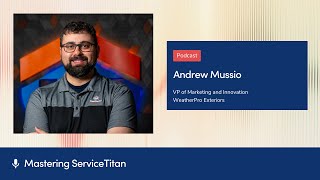
Podcast episode (Mastering ServiceTitan Ep.44) with host Josh Liu and guest Andrew Mucio (VP Marketing & Innovation, WeatherPro) about onboarding and using ServiceTitan for exterior contracting. Mucio recounts his garage-door background at A1 Garage Door, argues ServiceTitan enabled rapid scaling via integrated tech and data, and explains WeatherPro’s migration from AccuLink to ServiceTitan. The conversation highlights concrete features that delivered value (integrated phone recordings and marketing attribution, custom dashboards as role-specific homepages, Scheduling Pro for online bookings, Project Portfolios for production visibility, and spec-based estimates/price book for profitability). They discuss onboarding challenges (training, role/workflow mapping, extra data-entry steps), the launch of a new service & repair division enabled by ServiceTitan visibility, and the benefits of being an early adopter (access to new tools, influence on product development).
It really was the focus on technology. One of our sayings is we're a technology company. We're not a garage door company. Streamlining operations, which allowed us to scale, and being really focused on the tech side of things. Being data driven, really pushing all that stuff really helped us grow.
Welcome to Mastering Service Titan, where you get expert advice from power users. I'm your host, Josh Liu, and today I'm joined by Andrew Mucio, the VP of marketing and innovation at Weatherpro. We are diving into using Service Titan for exterior modeling and contracting. And, Andrew, welcome to the show.
Yeah, thanks for having me, Josh.
Of course. Super excited for our convo today. I'm curious, maybe we can start with how you got into the trades, how it led to where you are today.
Yeah, so I have a marketing background, and I first entered the trades within the garage door industry in 2017 with a one garage door service, and that was a fantastic experience. So I was with a. A1 garage from 2017 to 2022 in the marketing and technology space.
Gotcha. Wow. Six years at A1 garage door. And that, if I. If I remember correctly, that's a time where they really, like, grew very, very quickly. Can you talk a little bit about that growth that they experience and how Service Titan was involved?
Yeah, I think a lot of it actually was driven by Service Titan, and I see parallels with this in the roofing and exterior industry right now, which is really exciting. You know, there's a lot of. I don't want to trash the industry, but some unsophistication. A lot of smaller companies in the garage door space, especially, you know, Service Titan, gave us a platform to grow and to be more sophisticated, to improve the customer experience, to improve operations. And it really allowed us, you know, with a lot of pushing from Tommy, to really have the framework in the software to get where we wanted to go.
What do you think was unique or special about A one that had, like, helped you guys grow so much in an industry that was started off kind of not as sophisticated and then grew to where it is today?
Yeah, I think it really was the focus on technology. One of our sayings is we're a technology company. We're not a garage door company, which a lot of people at the time thought was ridiculous. You sure about that? But really streamlining operations, which allowed us to scale and being really focused on the tech side of things, being data driven, really pushing all that stuff really helped us grow, gave us just the platform to scale. So obviously Service Titan was a huge part of that.
And in Some sense, you all were guinea pigs in certain areas. Right. For service time entering the garage door space, are there some pieces of advice or wisdom from those years of testing things and whatnot that you're now taking to WeatherPro?
Definitely. I think one of the things is I'm able to see the other side, so I see the light of the tunnel with everything. So when we're onboarding, when we're going through training, a lot of people question, hey, why are we doing this? Or what? What does this mean? And you know, obviously seeing the other side I think is really helpful in the onboarding and training experience and communicating to the team members what the benefit is. So going through that experience being one of the first garage door companies on server site really helped a lot when being one of the handful of first refit companies on the platform.
Yeah, I imagine that helps a ton. And I'm also thinking back in the day at the garage door being one of the first, that must have been scary because there was no light at the end of the tunnel that you could look at.
True.
Yeah. So that's cool. Now you can have the conviction and kind of lead from the front there. So how has your experience been using service time for WeatherPro and now this.
New industry seeing other companies, service titan companies excel, really? And obviously my experience with Service Titan really helped us make the choice to switch. We were pretty persistent on wanting to get on the platform and we got on, which is great. So previously we were on Accu Links, which is a roofing and exterior modeling software. And there's a lot that we've kind of replicated. We tried to replicate the beginning with acculink. I tried to set up to emulate the servicetent experience, but it quite wasn't there.
Gotcha. And then how did you convince Everybody to join ServiceTen? It's a big change, you know.
Yeah, it is a big change. We're well networked in the servicetech community, you know, and we, we introduced our team to those people and really that helped guide them, you know, and really help their onboarding and allowed them to be comfortable with the platform as you.
Guys are learning service sign and onboarding. What do you think were some of the biggest features that made a huge difference for you guys at WeatherPro and especially for exteriors and contracting, there's a.
Lot of simple ones. So there's a lot of simple things that really helped us and a lot of things, like I mentioned, that we tried to emulate with the old CRM. So we. I tried to set up this wacky phone routing that attributed to marketing campaigns and recordings and it just, it did not work. This not work well. It was not very stable. It gave us some good data, but nothing like the, the seamlessness of service titan. So like there's a lot of simple ones. So phones, for example, like being able to listen to recordings, you know, that's a big deal. Previously we did not have that ability. So we'd have to dig into our third party software, listen to a recording, being able to like get away from the he said, she says, and if there's a problem, go right into that job file that customer profile, see what's going on, and then also the marketing attribution to that too. So being able to send out tracking numbers out there in our advertisements and know exactly, hey, they called in off this number. It's simple stuff, but it's huge. It's so huge. You know, phones is a big one. I think the other thing too is the sophistication of the reporting and service item. Our previous CRM did not have the ability to pull in all this data and just, you know, it's overwhelming at times because it's just like, wow, like the ceiling's high and you know, sometimes it's, it's a little overwhelming. But just knowing that eventually one day we'll be able to, you know, pull those reports and get that data is amazing.
That was the light at the end of the tunnel.
Yeah, I guess a little bit.
Yeah. The phones, it does sound like a simple part of this system. I'm curious where the value was. Was it just the fact that you had it integrated into one system or was it just the recordings that was valuable?
Yeah, I think it's just the seamlessness really helped. The recordings are very helpful too. It's just one of those simple things you don't really think about until you don't have it. And then when you don't have it, you really want it.
Yeah, because I'm wondering for people who are not on service tie and using third parties, are they just trying to like string together too many tools and stuff's getting lost in the mix or what's going on there?
Yeah, so we were using like a traditional phone provider. So we had programmed our handsets in the office. So each handset had like eight different numbers and the caller IDs were saved with marketing campaigns. So that person was looking at a handset, looking at the marketing campaign off the caller ID and then entering into our previous CRM. So that was how we were doing the marketing attribution part, which was a complete kind of workaround. And then the phone recordings too. Like those weren't consistently recording. We were using third party software. So by the time you dig into that, you spent half a day just trying to track down a couple of calls.
Gotcha. So because of the seamlessness, you can save a lot of that manual entry. Maybe some human error it sounds like. And then just overall efficiency, I guess absolutely too.
And like the thing that was new to us too is phone classification. Call classification. Like that's a simple one, you know, you don't really think about. But like knowing why our customers called is huge. We, that was a big gap. Invisibility we did not have as a black hole, you know, so being able to instantly have reports, send out and say, this is all our calls from today, this is the reasons why they call. Like that's the amazing thing about Service Titan is like if you have a problem or if you're looking to make an efficiency, like the data is there to track and be able to improve upon that. So like I kind of like think of it as like the day we got on Service Titan was like a sunrise and sun started like shining in every nook and cranny of the business and we were able to see, you know, exactly what was going on. And we're still finding stuff, you know, we're still it never. And that's the great thing. Like the ceiling is high so that it's amazing. Just, you know, that just those simple things to say like, hey, like we got 200 phone calls today. I wonder what those are about. Oh, 50% of them are about, you know, wanting project updates. They want a status on their project. Okay, let's work on an automation to send out some updates so we can, you know, reduce this call loop.
Wow, thank you for sharing that example. And that's such a beautiful analogy to the sunrise to find all the nicks and cranny of where data was missing. How was onboarding onto phones? I mean that's a big change, you know, for a lot of the front line. Was it hard for them to switch over to this new phone system?
It was a little bit of a learning curve. I think there's a lot of good training in the service tech academy that really helped. But honestly, nothing replaces just in person training. It was a little bit of a learning gym, but it was fine.
I know another feature you mentioned to me and last time we spoke was custom dashboards. Can you talk a little bit about maybe for those people who don't even know what custom dashboards are. Can you share what is it and how you guys use it?
One of the awesome things about Service Titan that we love, I love is the data sets, the reporting. It's just the combinations I can fit in. And a lot of those reports are available to put on a custom dashboard. So a custom dashboard, you have availability of all the reports and Service Titan, and you can put those on a dashboard, assign that to a user. So essentially it's their homepage when they log in, which is great. So custom dashboards allowed us to transition a little bit easier from our previous CRM because we were able to make those custom reports on those custom dashboards to follow the workflows a little bit closer to our previous experience. So the way I look at it is if I'm a csr, if I'm in sales, if I'm in accounting, whatever role it is, and I log in to service site, and, you know, with that custom dashboard, I'm able to see exactly what I need to do for the day. So I can put a task management, customer report on there. I can put different statuses of different projects, little buckets that I can see the progress of things all in one dashboard. And I think it really. It really helped us with the transition greatly.
So would you say, did you guys get custom dashboards set up before you went live, like some version of it and that was like one of the criteria you needed before going live?
Yeah, yeah, we definitely. I definitely spent some time. We spent some time setting those up, kind of mapping out what the roles we had, and then also, like, how we needed to set those up in the service Titan, you know, ecosystem. So we did have them set up before we went live.
Okay, gotcha. Actually, this is a perfect segue into some of the advice or something you would have done differently. If you can start over looking at those roles and responsibilities, can you share that advice of if you could redo your onboarding and start all over again, what you would do differently? When it comes to the employee roles and responsibilities, I would definitely spend some.
Time mapping out each role and their workflow, especially the workflows. I think that's really important. But there's certainly different things. You know, with all this power that service item has and all these reports, there's going to be sometimes a couple extra responsibilities. You know, you may have to click an extra button, you may have to put in, log some data here or there. And we communicated that to our team early on. It was like, hey, you know, we need to take a couple extra steps, you know, each day that will pay huge dividends to the entire team. And that's just a data entry thing. Like one of the things that I wish we would have did in the beginning, we're doing now would be setting up the price book. So price book is central to a lot of different things. And all companies in exterior modeling, we all have our own versions of a price book. You know, we had ours in Excel, but setting that up properly and servicing from the get go, I think I would definitely, if I had to do it over again, I would do that. We're going through that process right now and thankfully there's some awesome tools. Spec based estimates are amazing. It's like a superpower that we're setting up and we're so, so excited. We're just rolling it out for roofing and we got our other trades coming shortly. So definitely price book. If I had to go back, it would spend a little bit more time setting that up. Obviously right now there's a lot of resources from service titan, from others, from consultants that can help out with that. That's one of the big things I would do over again.
Gotcha. On one hand, it's, it's pretty inspiring, I guess, to see that you guys were still able to go live and be very successful even though you didn't ev the price book so much and are now getting to it. It seems like it can give people hope of like, hey, if your whole business is messy, like maybe you can still start with and then clean this up later and it could be a priority later, I guess, definitely.
So like, you know, and that's like I, you know, I've been around home service for a while. I've been in different industries, I've done consulting, I've been around different shops. We're not perfect. None of us are perfect. So there's always something. But yeah, it's definitely service titan. There's ways to get around that. But obviously doing it, you know, properly from the get go would be a huge benefit. We're not perfect, but we're getting there.
And it's hard to be perfect. It's almost impossible. So I feel like maybe people switching over, you do kind of have to prioritize certain aspects of the business. Sounds like phones is one that you all prioritized when you first moved over. Are there any parts of the business that you, you prioritized first and then. Yeah. Made sure to get right?
Yeah. I think one of the biggest things that we had to really work out was our production side of the business. So the installation side of the business, since that is one of the more lengthy workflows that we have. Sales was a pretty easy transition in production. We decided to think a little bit more, work through a couple more things. Thankfully when we launched Project Portfolios was live, which has been a fantastic thing to have. It's very visual, helps our production managers see the status of their projects, how things are going. There's a ton of filters on there and they really love it.
Did you guys have to change some of your workflows and best practices to fit into Service Titan for the production side?
On the production side, not as much. We actually had more workflow changes on the sales side of things. I think because there's been a lot of commercial clients on Service Titan, there's been a lot of different trades on Service Titan. I think from the installation standpoint things were pretty smooth and straightforward for us.
I was curious on the sales side. So you mentioned you guys had to shift a little bit in terms of your workflow for sales and that it was pretty smooth. It seemed what made it so smooth for you guys to switch over and what'd you guys change?
There's just a lot. Obviously service time has been around for a while, has taken best practices from all the industries service. So on the sales side, you know, things are pretty straightforward. It's like, you know, we get a call, we run an appointment, we leave an estimate, we sell an estimate. Obviously there's some stuff in between there. We mark, we log follow ups, lots of other things in there. We take pictures, we do forms. But you know, that part of the process, you know, it was pretty simple for us. I think there was a couple of changes we had to do just with the way we were doing things previously. But we're like super, super excited that we're going to get the full service tech experience with the spec based estimate templates, with the document templates and proposal builders. But yeah, it was a pretty smooth process.
Got it. So was the transition more of like, hey, we've been wanting to do things more professionally and use better tools but weren't able to and that's why it was so smooth. They're just like, oh, these new tools we can play with or what? What made it so smooth for those guys?
The only thing that we really struggled with on the sales side was like just the, the whole dispatching arriving, that whole process, that was something new. And I think those little things are huge because like previous to getting on service Time. We didn't know if our guys showed up to the appointments. We didn't know how long they were there. There was a lot of, like I said, like back to the. My analogy of the sunrise and the sun, you know, shining throughout the business is like, you know, that that was something new to them. I was like, okay, I have to, you know, use a tablet, I have to dispatch, I have to arrive, I have to complete my appointment, I have to take my pictures, do my forms. And it's really a benefit to them, but it's also a benefit to us as a business because we are able to in lifetime see, hey, they're at the appointment. And again, it's like the small things, like you don't realize until you don't have them how important they are. But like tons of things like customers call and say, hey, where's my sales rep? We know, you know, right there on the dispatch board. We know he's in route. You know, we can communicate with him and see that he's there. It just brings visibility to so many different things. And especially on the sales side, I think that was something that was new to them that they kind of like, hey, like, I don't know about this, but like, as like time progresses, that's also a sales training tool. It's like we're looking at, okay, how long were you in the customer's home? We have these forms set up that are putting tags to classify these appointments, saying, you know, did we do this, this and this? And we have all this data we just never had before.
Got it. Okay. So it sounds like they had to just get used to clicking a few buttons, letting the system know, hey, they arrived or they're on their way. But then the data that you get from seemingly something so small can actually make a big impact. We were talking about Scheduling Pro as well. What made you guys want to get on Scheduling Pro and what's that journey been like?
Yeah, so in our industry, a lot of our leads come in through form fills. So from the garage door industry, we are primarily phone call based. So people call in and then eventually we got on Scheduling Pro with a one garage door service and allowed people to do online bookings. But, you know, we get a lot of form fills and those are by far some of the hardest, you know, appointments to book because, you know, someone will be in the middle of the night in the pajamas, filling out a form and then, you know, you get all this great information. You get their contact info, you get what they're interested in. But Then you know it's on you to chase them down. And a lot of times you were like did you really submit that form? I mean we called you four times, we texted you, we did all this stuff but you know, setting up with scheduling for all we were able to book like hundreds of appointments and set up automations that when they submit the form, you know we send out that scheduling pro link right away and they're able to schedule at their convenience. See our live time capacity which is amazing. It's just a great convenience feature. Customers love it. And I said we've booked hundreds of appointments that we probably wouldn't have booked otherwise.
Wow. So previously before scheduling a pro they were just filling out a form and then you guys would get like an email or something and have to follow up with the customer to book the estimate.
Right. So we've always had some automation on that side. So forms filled out and we'll send them some automated with third party software, some you know, text messages, you know, redo our follow ups on the phone. We really have to chase the people down. It's amazing, you know it's such a convenient factor. Like not only do we have scheduling pro on our website and on different marketing pieces like we have cheaper QR codes on our print ads that people just scan, they can see like their schedule, they can appoint book the appointment right then and there. The places where we can't have that, where we are getting still form fills like we're able to have those automations to get back to them instantly while they're engaged to say here book it, it's on you. And you know we've definitely seen an amazing increase in booking, you know, appointments and just you know, it's great for the customer.
Wow, I'd love to dig into this a little bit more. So after the customer books an appointment do you guys still call to get some information from them or what's the balance there? Of like I know some people try to collect too much information on the booking screen and maybe customers don't fill it out versus you collect too little and maybe you book a lot but you don't have enough info. What, what's your process?
Yeah we do, we definitely try to be more conservative. We want to make it easy for the customer. Like it's all convenience. Like online booking is a convenience tool. So we don't want to make it too long. We try to keep it short and simple just so that we secure the appointment, they secure their spot. You know we have a busy schedule and we do do follow up calls, we just want to confirm the appointment details and we communicate that too. So when they book with the unscheduling pro, they get a little message say, hey, the next step is, you know, we'll be in touch shortly to confirm your appointment details and we also collect a little bit more data there. So like, we don't want to like make them abandon the form this Scheduling Pro widget by asking too much stuff. But we do that follow up call. That's where we get more details about, about the project.
That makes sense. So you're just asking for a little bit more commitment up front but making it easy to do so. So that way customer, hey, they're coming over Monday at 11 and then between that time you guys try to just collect more info to help set you guys up for success.
Yeah, we really just want to set up the appointment, secure the appointment for the customer for us and, and then we do a little bit of follow up just to confirm details, get more information if we need it.
Makes sense. Wow, I didn't realize 50% of the leads were coming in through form fills before. And so yeah, might as well just capture that interest and get the commitment up front. Were there any challenges with Scheduling Pro when you first started? That also seems like a big change for the team to get used to. Like, oh my gosh, customers are just going to book appointments on their own.
Yeah, there was definitely some questions about that, like how we're going to do this. Like the thing that was a little bit different is, you know, understanding capacity. So adjustable capacity. There's different ways to adjust capacity in Scheduling Pro. You know, there's simplified versions, there's using adjustable capacity planning. So yeah, I did get a lot of questions like, how is this going to work? How do we know that they're qualified? How do we know that they're real? You know, all these things. How is it going to like know our schedule? There's just a lot of tools baked in. Like you can, you know, block out certain points. You can have a, like, it's really customizable. So I think that allowed us like to get comfortable with it. And it's great because like we're booking more appointments. Customers are happier. They like the experience. They want that instant gratification of like, cool, I found you. I want to book my appointment. Like, I want my time slot. Like I want to move on and watch the rest of my Netflix show. And I think like in our industry, like that's a, that's a rare thing. Like I Look around at some of our competitors. It's like online booking really isn't a thing. And there's a lot of concerns with that is like, well, hey, you know, we want to qualify them. We want to make sure that we're, you know, booking a real person. We don't want to show up to a no show appointment. And that's, that's where the follow up call comes into play. And we have a pretty successful contact rate. After they've committed to that online appointment to get a hold of them on the phone and then, you know, confirm details, gather a little bit more information.
Yeah. Do you guys, as soon as you see the appointment booking come in, do you call them right away or how do you get that contact rate so high?
We try to contact them as soon as possible. And this goes back to custom dashboard. So on our custom dashboard, we have a tag every time an online booking is made that pops up on the custom dashboard to our CSRs and they're on that dashboard all day long and they know, hey, here's a new booking. Let me follow up. So they have visibility on that in live time just with simple use of tags. So when those online bookings are created, that tag prompts it to be picked up by the custom dashboard. And then they know, oh, okay, let's follow up. So they're, they're pretty good at that.
Do you guys have any protocols in place? If worst case scenario, like the customer is just like not picking up their phone, do you guys then like text them or email? How do you, how do you handle that?
Yeah, we'll send some texts, follow ups. Sometimes we, we can't get that follow up contact, but we'll show up anyways. We want to honor the appointment maybe once or twice. You know, it's been a no show, but we've had a pretty successful, like, show up. Right.
Okay. So, yeah, it still sounds like it's still very much worth it. Even if you have a few no shows, the gain you get in appointment bookings is still worth it.
Absolutely.
I did want to pivot a little bit and talk about how after you guys started with Service Titan, you guys made a pretty big change in your business of opening up a service and repair division. That sounds like a huge decision. Can you walk me through how that came about?
Yeah. So I think out of the convenience of the structure in Service Titan, like we've always struggled with this, a repair division, it's like, hey, we want to do retail replacements. Everyone wants to do retail replacements. No one wants you Know, want to be a handyman, essentially. But like, the existing structure in service site, and as we got on there, as we got comfortable, like, wow, like, all the tools are here. Like, it's pretty straightforward, like, to set up a service division. Like, why don't we give it a shot? You know, we're so thankful that we've been able to network with some of our larger peers in the service tech community who also, you know, told us, hey, like, it's a tremendous opportunity. Like, this is how we do it. Like, you guys should give it a shot. But that existing structure in service Titan really allowed us easily to, like, not only, like, set up this department, but also, like, have visibility on it. Because, like, one of the things we were always concerned about, there's always these questions and doubts is, like, these are going to be nightmare calls. We're going to have callbacks. All different types of doomsday scenarios if we start doing these repair, you know, appointments and these service calls. But, like, what service site allows us to do is, like, the tracking is there, the visibility is there. Like, if we do run into problems, we'll be able to see it right away, and we can, like, pivot and adjust from that. The biggest thing is, like, the visibility, so we can see, like, hey, you know, how much, you know, are we selling? And then also, like, the. The main thing for us was the point of the program is to take care of the customer and do the repair. But obviously, a lot of customers, you know, their first instinct is, I might just need a repair. I don't know if I need a full replacement. And prior, you know, to having the service department, we were, you know, referring people out to handyman services. We kind of joke that we kind of probably bought the handyman a lake cottage with all the. All the business we sent their way. And probably this year, you know, with this, the department, they're like, hey, what happened to our leads? What happened to our appointments, our customers?
What's going on?
It's because we're. We're taking care of our customers, and it's a better experience. So, you know, it felt bad to, you know, turn around, turn away people who needed little. A little bit of work. And that's the thing. They never quite know. We want to get out there, we want to do the inspection, and if it is a simple repair, we'll do it. And if it's not, like, we'll tell them the options on what they need for a full replacement. But the biggest thing that ServiceTech did for us is it Gave us visibility in that program, and it had the existing structure already built where it was simple for us to. To visualize that and set that up.
Yeah, I remember you saying that's kind of like service signs, bread and butter. Right. I mean, that's how we started with H VAC Plumbing Service and replace and repair. I'm curious, do you think I'm pretty ignorant to the space, the roofing and exteriors world. Do you think most businesses are. Do not doing service and repair?
It's a mix. You'll see a lot of the larger companies have those service division and repair divisions, and you'll see some of the smaller ones in the mid, in the middle. That's where you'll find people who are more chasing the full retail replacements and, you know, referring out that work to someone else.
Gotcha. And were you guys in that middle place of like, you didn't really. Okay.
In that middle place?
Yeah, got it. And how come do you think in the middle people don't really want to deal with the service and repair side?
I think it's a. It's just a little bit harder. It's a little bit more difficult. Like, you're going into an unknown. You know, you're not getting a customer calling and say, yes, I would like this, please. I would like a full roof replacement, please. You're coming into a situation that you're not guaranteed something you're not guaranteed.
You don't know.
So, you know, having a proper, like, you know, first workflow and also inspection process and visibility on how the program is doing is super important. But I think a lot of people just avoid that because of it's. It's a little bit harder. It's just a little.
It sounds intimidating if you don't really know what you're going into. It sounds like the chance of losing money on a job or it not being worth the time, it sounds like a big risk. How did you guys mitigate that risk?
It's all about tracking. So, like, the visibility that service tech gives us is amazing. And one of the things we want to track with this program is, like, how many of these repair calls are we converting to full replacements? And the amazing thing is we have visibility on that, and we've already been able to turn quite a few of them. And, like, our suspicions, we're right. Like, a lot of customers are saying, hey, you know, I just got a leak, and I got this and I got this and loose and this. And we show up and say, we can absolutely repair that. Absolutely. But you Know, honestly, that's not the right way to do it. And here are some options. And obviously with Service Titan, there's a ton of tools that gives us, you know, a lot of different options to present those.
And how long have you guys been doing service and repair now?
It's been a few months.
Been a few months. Okay, how's it going? Any, any tweaks you need to make?
It's always evolving. Like, you know, you mentioned like no one's perfect and it's, that's the great thing again about service. It'll be a broken record, is like the ceiling, but it's going great. So like we've already sold a few replacements. It's just like a matter of keeping track of it and seeing the profitability side of it, but also just having the proper workflow in place and set up and serve Service Titan to circle.
Back to the price book project that you guys are taking on right now is some of that price book project to help see the, the costing of some of these jobs and get better profitability numbers.
Definitely. So like, thankfully, you know, there's the, the project module in service item is really robust and we're able to get a really good idea and very close versus to our profitability. But one of the things. Yeah. That you're exactly right is because this new spec based estimate template system is so robust, we're going to have like just laser focused sharp numbers on our profitability which will make, help us make decisions. So that's like, that's the whole thing is like the more clarity we get on our data, the decisions are easy. And the hard part is getting that data and understanding that data to make those decisions.
Right, that makes sense. So Andrew, a lot of people are scared to try out software and be the first guinea pig or the first mover. Can you share a little bit about that experience for people? Like shed some light on what, what's it like sometimes to be the first people to use something?
Yeah, I, I look at it as like kind of the completely opposite. I think it's like not scary. It's actually incredibly exciting. We get a lot of attention, you know, being roofing exteriors. Like, you know, I mentioned Pantheon. Like we go to all these sessions and it was like roofing, roofing exteriors, exteriors. And you know, service tech is making a big push for us, which is awesome. We get to have, you know, the tools before everyone else and the amount of stuff that's coming down the pipeline is so exciting. Like there's a ton of Stuff from the sales side, from the production side, from the integrations with our existing third party softwares at every roofing contractor uses. It's like, you know, we're gonna have these tools before everyone else, which gives us an advantage. I think it's amazing to, to be on the platform right now and seeing the amount of investment from Service Titan and from other things going on in the space. It's like it, you know, it reminds me of that time, you know, Garage Doors, where it's just like, it's just so exciting to be, you know, in this community, in the servicetech community and in this trade right now.
Wow. Yeah. It reminds me of what you said at Tommy mellows at a 1. They say, hey, we're not a garage door company, we're a technology company. And back then maybe it sounded a little cheesy, but then you saw how it evolved and how it, you guys were really able to use it as a huge competitive advantage. And so I like that you reframed that Guinea Bay experience as more of like, hey, we have the tools that nobody else has. We get to use it first and grow with it.
So yeah, guinea pig. I, I feel like I'm pampered. You know, we have service titans attention and there's so much resources. You know, it's like every week there's someone else from Service Titan reaching out about a new product or our input on future development. And we, we're helping build the platform and it's not like there's not a lot today that's already extremely useful for us. It's just like we, we have a say in like how things are going and it's amazing. Like, it's so, so exciting and I, it just, I'm super excited about like what's coming down the pipeline.
Super cool. Andrew, we're grateful to have you especially this engaged and help us to shape the, the future of the, the features and technology that we build and. Yeah, excited to see you at Pantheon later this year.
Yeah, I'll see you there.
More from Bill



ServiceTitan Virtual Agents: Simplify Before You Scale | Podcast Ep. 110 | Mastering ServiceTitan



Life After Live Events: How to Turn Post-Conference Energy into Real Profits | Podcast Ep. 297




