Optimizing Technology to Scale Effectively in the Trades | Podcast Ep. 178 | Toolbox for the Trades
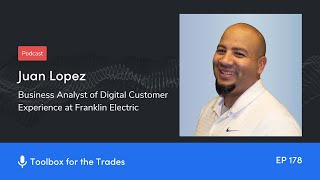
Podcast episode (Toolbox for the Trades Ep.178) featuring Jackie Aubel interviewing Juan Lopez (Business Analyst, Franklin Electric; ServiceTitan Certified Administrator). Juan recounts a varied career—Marine veteran, top inside salesperson at Helen Brand, brief sneaker-selling entrepreneurial episode—and explains how he leveraged acquisitions (Helen Brand → Aqua Systems → Franklin Electric) to grow into technology and operations roles. The conversation centers on optimizing sales and operational efficiency using ServiceTitan: standardized estimates/proposal templates, automated follow-up sequences, dashboards for managers, testing in practice/next environments, staged rollouts, and training (group sessions + one-on-one). Juan also discusses financing integrations (e.g., GoodLeap via ServiceTitan), membership-based rentals with auto-billing and recurring maintenance, and the value of empathy and follow-up in phone-based selling.
Questions this video answers
500 pairs of shoes.
$150.
Approximately 35 to 45 units per month.
About 20 units per month.
Around $5,000 for whole-home; up to $14,000 for major critical issues.
Hello contractors and welcome to Toolbox for the Trades. My name is Jackie Aubel and today I am chatting with Juan Lopez, business analyst at Franklin Electric. Juan is a service titan certified administrator who came on the show to talk about the magic of workflows and automation, the power of the follow up process, and thriving under multiple mergers and acquisitions. I hope you enjoy the show as much as I did. Juan Lopez, you are the business analyst of digital customer experience at Franklin Electric. You are also a service titan certified administrator. Today we're going to be talking about how technology can support sales and we're also just going to talk about best practices for technology success. Welcome to Toolbox for the Trades.
Thanks for having me. I really appreciate being on here and I'm excited to have this conversation.
So am I. So am I. One of my teammates, Ashley, recommended you so highly for the show and I have to say when we did our pre interview I was like, this man has a story and I'm so excited to share it.
So.
So normally I've got these icebreakers that are like kind of benign. They're kind of like, you know, what's your favorite song? Or like, you know, if you could get an extra hour in your day, what would you do? But in our discovery call, I found out this whole other side of you. So you were the top retail salesperson at Helen Brand, a water systems company for seven years. But outside of this you had a brief stint as a shoe entrepreneur. And as someone who's my brother in law is a bit of a sneakerhead, I kind of know about this culture. So I need to hear this story. So tell me me at all.
So I like to throw a disclaimer out that I'm gonna date myself on this story because this has to do with the early phases of ebay. And when ebay first hit the market, not a lot of people knew how to use it.
Right.
They didn't know how to source items. They got lost in the decisions and choices and pricing. They didn't trust the web.
Right.
The Internet, 20 years ago, people weren't trusting that. And I was always a forward thinker. I was a single dad, always looking for any opportunity to make money on the side. And I kind of fell into it with some of my friends finding them different, different shoes through ebay. I'd upcharge, obviously to make some money for myself. Next thing you know, I was doing this for a variety of people and I got connected with a local basketball site, the Spartans. It's about 500 kids in the Program. The guy running the program says, I heard you can get shoes for people. And I'm like, yeah, I can do that. He requested a specific shoe, however, it was from Adidas. And so I was like, okay, yeah, I can figure that out. I. I just never say no. Right. There's always an opportunity to do something. I just have to figure it out. I contacted Adidas direct, and Adidas was like, yeah, if you have a storefront, we'll give you a 40% discount on shoes. I said, okay, let me figure out how to get a storefront. So I then went back to the Internet. I paid $150 for a website that was basically an online store. I then had access to 500,000 plus items to sell, but I really only needed it to go back to Adidas with a storefront or like a. An online storefront presence. They've since changed. Change the rules, by the way. You can't do this anymore. So for those of you that are going to try to follow this model, it won't work anymore.
This is from the wild, wild west.
This is when everything was unregulated.
Sure.
And just sell whatever you can. So I contacted them, created an account with Adidas. So then the coach puts in the order. And I was living in an apartment at the time, so there wasn't a lot of thought process into the amount of product that I was going to get, how I was going to get it, how I was going to receive it, how I was going to deliver it. I was just kind of winging it, placed the order, had them prepay. Then when they contacted me and said, hey, where are we going to deliver these pallets? I said, I don't know. I live in an apartment. So then I had to go talk to the owner of helenbrand and say, hey, is it okay if I have a couple pallets delivered to the dock just this one time? He's like, sure, no problem. So then I have these pallets delivered, but then how am I going to get them from my office to the gym? I have a Lexus ES300. Now, I don't know if you know what type of car that is, but.
It'S pretty small, I imagine, from the way you described it.
So I had to bring in a couple friends, load up some vehicles, deliver these shoes, and it was a very successful transaction. I don't know how I made it happen. A lot of different resources, creative on all aspects, and I instantly retired after that transaction because I knew that this was not a sustainable line of income. But. But I was successfully able to deliver 500 pairs of shoes, turn a profit and opened up an account with Adidas.
There you go. And what I liked so much about this story when you first told it to me and why I think it was important to start the episode with this is that you came into this role, these, these roles throughout your career that have been so not what you're going for. You're very much a man who I think sees opportunity and goes for it, which is really rewarded in the trades industry, which is why I wanted you to share that story. I was going to ask how many shoes in a palette. 500 shoes. I mean, you think about it, that's a lot of dang shoes and A1. And when were you in a one bedroom apartment? You couldn't put them all in there.
I was definitely in over my head for sure.
Yeah. And you mentioned to me too that you were like a sales guy. You were top salesperson at Hella Brand for, I mean, about seven years. And so you always knew the sales end of this kind of retail experience, but this was your really first hands on experience to what goes on after the sale.
Exactly.
Yep.
Exactly.
Yep. Perfect. So you actually joined Helen Brand after a five year career with the Marines and at Helen Brand, as I said, you wore many hats, but you thrived in the sales position. So because we're really going to be talking about sales in this episode, I would love for you to share some of your best pieces of sales advice.
Sure.
One of the things I learned early in my career, I don't have any schooling background. I actually don't have any other employment background. HelenBrand is really my only job. So I've had one job as an adult. So I've had to kind of be creative, listen and just try to learn from the people that have kind of come through and put together a process that works for me. So one of the biggest things I take away from that is that my way isn't always the right way. Everybody has a different sales approach. You have to find what works for you. What works for me is listening to the customer, being compassionate and trying my best to help them out. Because I think every sale you're helping somebody out. If it's an old piece of equipment, you're helping them understand the benefits of getting into a new piece of equipment. If it's a cost thing, you're like a price thing where it's too much or too expensive. You're helping them understand their options to make it affordable for them to get it into Their home, whether that's the use of a finance plan or a purchase plan or rental. So just really listening was the biggest thing for me and relating to them. I grew up in a poorer neighborhood as a kid, so money's always been something that I really respect. And I feel like, you know, the people that I interact with, I'm very understanding to the financial obligations. I listen to what their situation is, and I provide the best scenario for their situation.
Yeah, so we've got education, options and empathy, essentially. That's. Those are your best pieces of advice. Now, for anyone who doesn't know, Helen Brand was later. Helen Brand was acquired by Aqua Systems, which was then acquired by Franklin Electric, which is, you know, where your job title comes in today. Can you tell us a little bit about what Franklin Electric does and where this industry is and how people can relate to your business?
Sure. Franklin Electric is a global company. They primarily are based around fueling. So, like, they provide all the equipment for gas stations. What they do is they move kind of laterally throughout the business. So, like, if there's a component or something that makes sense that they could purchase and acquire and produce that at a cheaper price or create more buying power in the industry, they'll do that. They found an interest in water treatment, ended up buying, not just us, but they bought a few different companies and built what's called global water treatment. And now we're a very large division in which we have a very high buying power to, you know, provide customers with a better price.
Got it. So anyone who's listening to this, and it's like, okay, this is Juan. He's a business operations guy. He's a master at sales. He's operating within the water treatment industry.
Correct.
All right, cool, cool. I have another question about you, because you were in the marines for five years, and you did mention, you know, this is the only job I've had as an adult. Veterans are really. I find they can really thrive in the trades industry. Do you find that to be true?
Absolutely. There's a lot of structure that's similar to how we operated in the military. And, you know, it's like A, B, C, and D in the water treatment industry. And that's very similar to the military. Those skills transfer over very well. I also think, you know, just veterans as a whole, they're used to following orders. We're. We're used to knowing where our place is and contributing to what our part is. Any business can use that skill set. You know, you can apply that to sales, manufacturing, even As a secretary.
Right.
They're in the military, they're very systematic. And that, like I said, that skill transfers over to everybody.
Yeah, I think so too. I think there is a really nice niche in the way that the businesses, water treatment businesses and other trade businesses operate. That really sits well with the military mind, the way you guys are trained and gals are trained. So we got into some of your biggest sales stuff. So you've got education, making sure the customer knows, you know, why. Like what? Like why they would want to update their system or get a better system. You want to make sure they know their options so they know, you know, there's financial financing options, plans, rental opportunities, and also empathy with families that may be struggling financially. And I really resonate with that as well because, you know, I didn't come from a ton of money either. And I think that's so important because sometimes you're dealing with units and purchases that are in the many thousands and actually I don't know that. Could you educate me on that? Like what would be maybe the biggest purchase someone would make within your division?
So on the residential side, if they're trying to do whole home problem, water, drinking water, it could be a $5,000 purchase. If they have a major issue that's critical, it could be a $14,000 purchase.
Right.
Just depends on what the issue is. And I want to make one more point on the sales recommendations. Everything that I talked about, what I do on the phone. So sales is two parts, right? You have what you do on the phone and what you do when you get off the phone. Sometimes what you do on the phone is more important. Sometimes what you do when you get off the phone is even more important. And that's where I would say follow up is key. You know, I was very, very resilient in my follow up. I would specifically say, hey, when do you want me to follow up with you? That way I made that connection with the customer and then I would make sure I did it. If you do what you say you're going to do, people will choose you over another company.
And this is actually interesting because you did all of your selling over the phone. You were never field sales.
Technically, there was a portion of my career where I was outside sales, but all my sales were purely over the phone. So I didn't have. I couldn't look somebody in the eye and get their cues. I had to listen for gaps in their conversations. If they hesitated, I had to listen to their questions. So it's a whole different skill set. When you're just sitting over the phone selling three $4,000 jobs.
Yeah. And actually I probably should have asked this at the beginning just so folks kind of get an idea, you know, you, top salesperson inside salesperson for seven years at hello Brand. What does that actually look like if you feel comfortable sharing your, your PRs.
So on average, I would say a normal salesperson that's been there, and this is just for my years of being there, would probably sell about 20 units a month. I averaged about 35 to 45 per month.
Dang.
So I almost doubled the normal, the normal output of a regular sales.
So you were basically two people for the most part. That's dope. All right. Well, as I said before, and normally what I, when I have people come on the show, I have them talk to me about their trades journey. But truly your trades journey just takes so many turns and like whines and it. You've touched every area of this business. You've done so much at Helen Brand. You've even at one point designed blueprints, helped the company revise the, the, the floor plan of the plant, which is insane to me. But your niche now is really in service titan, in adopting technology and making sure that you guys are using technology to the best of its ability, especially when it comes to sales. So I would love to talk specifically about some of the ways you've optimized technology today to best support your sales team.
Yeah, so what, what we've done is we've dug really deep into the sales process itself and we've made a really seamless process that we've put out for the whole company to follow. So we make sure everybody's following the same process. They're all entering estimates the same way, using the proposal templates, booking jobs from the estimates. So we're coding everything so it flows correctly through Servicetitan. By doing that, we can then back that up with automation that says if this lead hasn't been followed up on, it's been 48 hours, we're gonna send a note to that customer. If it's been a week and this lead hasn't been followed up on, we're gonna send an email to that customer. So we're backing up our tight, really good sales process workflow through Servicetitan with automated follow up. And like I had alluded to you earlier, the biggest thing is when you get off the phone, the follow up that we know that people get busy.
Right?
We know that. And we know when the phone's ringing, you know, they prioritize what's right in front of them instead of maybe what they need to get to, that's part of their side tasks. And follow ups are, it's always going to be a side task. It's always going to be something that if you got free time, make sure you're getting to your follow ups or if you got free time, make sure you're calling your maintenance customers. And for the worker today, you know, their day is pretty busy.
Right.
And I think that's where the power of Service Titan really comes in. And it says we're gonna remove the human flaw and follow up. And we're gonna say if you don't hit these markers, we're gonna cover you with Service Titan. And that's, that's a huge thing because if you lose connection with the customer, you don't do that follow up or you get it to it too late, you've lost that sale. So the automated follow up piece through Service Titan is huge. And then, you know, we link everything through dashboards. We have the managers looking at dashboards every day. They're looking at their numbers, you know, so that combination of automated follow up information at the push of a button is huge. And Service Titan makes it really easy then to manage sales. And then you can package in other things too with automated reporting if you want to look at something specific. But automation, that's, that's going to be the reoccurring thing. Automate, Automate, Automate.
I'm actually in the process right now of automating my workflows at, at Service Titan, not in Service Titan, but at Service Titan. And what I'm finding is that it, you know, with every automation I build, there's like another little thing. I'm like, oh yeah, and we should automate that too. So like, tell me a little bit about how you map that workflow out, like how you build out workflow and how you kind of test it.
Sure. So first and foremost, Service Titan offers a variety of different sites. So they have their live environment, they have their next, they have practice, and then they have integrations. So we're able to test these things out in these different environments before actually loading it into our production site. But the advice that I will give that anybody that's trying to automate, don't go above your pay grade. If you don't understand it, don't implement it right. Keep it simple, go as far as you're comfortable. Because once you start going too deep, then it can get lost in translation. I'll give you an example, they came out with direct mailers, right?
Sure.
Not too long ago for Service Titan, it was a new thing. They had emails, then they came out with direct mailers. And day one, I was like, ooh, we don't have to have a person send out our postcards anymore and do this process. I went right into it day one, but I hadn't really researched it or understood how deep you had to have it set. And so when I set it up, I didn't realize that there it was tied to some other scenarios, which is like reoccurring service events versus the equipment. And even though I had it set up as continuous, it was only a one time because you need the recurring service events to trigger the multiple dates. So if you don't understand that correlation and it doesn't make sense to you, then just do it. Do it at a one time. I want to Send out these 50 direct mailers. Send out your direct 50 mailers. The next month, push it again to do another 50 so you don't have to go as deep with the automation. You can still keep it really simple to where you understand it and it's easy to do.
Got it. I'm throwing so many questions at you that I didn't originally plan to ask, but you're giving me some great answers and giving me some great stuff to work with here. I would love to know how you train your team on automations. Like, do you. So also the workflows that you're working with, how many people are affected by those workflows? Like kind of, what is the. What does that process look like on the sales side?
First and foremost, I have a fantastic team that I work with. Our DCX team at Franklin Electric is really strong, a bunch of smart individuals, and I'm able to bounce ideas off of them. So before I start rolling stuff out, I have a really good group that I'm able to, you know, talk with the business leaders. They've put their time in to Service Titan so they understand it. The operations guy, he really knows what he's doing. I'm very fortunate that my boss also has dug really deep into Service Titan with me. So we have a group of people that can talk service Titan lingo and that's important. Find those people within your organization that want to learn and understand it, get them together, and then work it through on that end first and then everything will work out good. As far as what we impact right now, we have 22 different locations in Service Titanium. So our workflow process is going to Impact, you know, a few hundred employees depending on what aspect they're in each time. So, so we're rolling stuff out in mass. So, you know, that's why it's important to kind of test bounce it. See, you know, and it's, it's never perfect. You might, you might test something and it works out perfect here and then you roll it out and it blows up in your face. But you know what, don't be afraid to try stuff.
Yeah. Oh my goodness. So like, okay, so say I'm the salesperson who's like affected by this automation. How do I find out that Juan just developed this new thing and I'm gonna get an automated notification in two days to follow up with someone.
Every Tuesday we have what's called a direct to consumer meeting in the afternoon. That's where all of the reps hop in to a meeting. And I have a service Titan session at the end of that for about 30 minutes. Anything we're rolling out, we pass on in there. I screen share and then walk them through the change. Anything that's going to impact them. When we have updates to service Titan, I take and Service Tight does a great job outlining it, but I take and I make a newsletter out of it. So I kind of make it kind of fun to read. I'm a big Tom Cruise fan, so I put my little Tom Cruise pictures on there and Iron man and then I'll send out a newsletter kind of highlighting things that they should be looking for. And people read my newsletter because it's kind of funny. So I had some jokes in there and stuff like that. So I try to make it fun. I know it's.
Yeah.
Sometimes it's not, but.
Yeah, because that's a challenge. I mean, I. Yeah, you. I would have fun with it too, based on the way that you have it set up 100% because I think it's so interesting. It's like you have, I'm like putting my shoes. Like you were saying before, like we're busier than ever before. The everyday worker is busier than ever before. So I can imagine that when you have powerful technology like ServiceTitan at your fingertips and you can run these automations, you can run these workflows. You also have to be really mindful about how you roll that out to your team because they can only take in so much information at once.
Yeah, it's tough. You really have to know your group sometimes. We'll do it in steps. When we went to launch schedule assistant, you know, we broke it down into pieces. We said, okay, we're gonna do zones, you know, then we're gonna do skills, then we're gonna. And we rolled it out in small pieces and said, hey, here's what you got. So, you know, you gotta take that into consideration too. When we, when we rolled out the sales process, the first thing we did is we showed them the different proposal templates. We let everybody see that on a spreadsheet, get some feedback, we talked about it, I built it in the next environment. We hopped on with multiple training sessions. Then I got people into the practice environment and next environment, let them kind of mess around with it. And then I always offer myself up for one on one training as well. So if people are really stuck, I try to make myself available to them.
Wow. Yeah. So interesting. This is a whole other component I always have. I've said to people before, you know, service titan is such a behemoth of a software and it's so important to have folks like you that are bought in and fully trained in the tool to make it as successful as possible. Especially when you're working with hundreds of employees, probably thousands at this point, given the size of the company. So given your experience leveraging service titans, programs like Torch Network, Spark Sessions, and now you've become a service titan. Certified admin. What in your opinion are the most critical workflows to business success?
Well, we always start with people that answer the phones. So that's where I always look. What can I do to enhance the call booking screen? What can I do to automate the call booking screen to make it easier? We talked about automation on the sales side, but there's really a lot of automation on the call booking screen. You can tie automated features to the job type that trigger certain things. You can pre populate questions that the CSR should be asking based on the job type. Like there's a lot of ways you can help them. And if you feed your schedule assistant correct, I know that there's turnover, right? Like there's a lot of turnover in the dispatch positions for a lot of companies. If you do your schedule assistant right, instead of it taking two or three months to get a proficient schedule in there, I could have somebody up and running within three to four days, which is a big difference, right? So the more that you provide them, you know, I'll give you an example, please. Let's say we hire somebody new, right? And I say schedule a service call on a leaking softener. Their first question is going to be, what's a softener?
Right?
How much do we charge? What do I need to put in the notes? So. And who do I schedule that on? You know, the questions are going to be limitless. Like they're just going to continue to ask questions. Or I can say if somebody calls in to schedule a softener that's leaking, you do job type softener and it'll fill everything in for you in the summary box. It'll list five or six questions. Make sure you ask the customer that. Then you press schedule assistant and it'll tell you where to book it. So training somebody on those three parts versus everything that has to do with the softener, it just. It's a game changer. When I first started training dispatch, I'd have to set them in the back to manufacturing to work for a couple days so they knew what a softener was. Then I'd have to send them out on the road with a tech so they could see what the techs were doing. Then I'd have to send them up to accounting. Sit with accounting. It's just. And all that stuff is good. I want people to still learn the same way they did. I still want them to spend the first six months really understanding their job and digging in, but I also want them to start providing me some revenue within that first week.
Right.
I know we don't want to say that. Right. Well, we can only invest so long in people like you got to start giving back to us sooner.
Right.
And Service Titan provides a method to do that that's safe to where things are going to get scheduled appropriately. Notes are going to be filled out.
Right.
The invoice is going to populate correctly. All the things that as a business you want to make sure that's done. Those are there.
Yeah. That's so great. And you've mentioned, I should clarify. You know, we, we got a little deep into Service Titan on today's episode because you have such an experience. And I think hearing from someone like you who successfully developed workflows is really important for our audience Marketing Pro. So just want to make sure that folks know about that. We've talked now about, you know, answering the phone, scheduling the call. We've talked about the sales process on the tech side, building out those estimates, making sure. No, you know, I did actually want to get your take on financing. What we're hearing chatter about is, you know, people's pockets are tight right now. We're recording this in May of April of 2024. Folks are a little strapped for cash at the moment. Are you finding that financing is More popular these last year, this last year, these last couple months.
So I will tell you that the purchase plans financing has always been a thing. I think what is, what is helping financing is it being more is easier to get a hold of. Okay, so like for example, Service Titan is linked with Good Leap Financing. I can set it up in the background that every quote that set out has a link that the customer can choose and they can apply for financing. They can do it all right there notifies us before setting somebody up for financing was a harder process, you know, we had to like get documents scanned, signed, sent over, approved, and it just was a very disconnected process. Right now it's very seamless. So I think the seamless portion of it is what's going to cause an influx where it's going to be higher, more people are going to take advantage of financing because it's easier. But I think it's always been a thing. But anytime you make it easier, the more people are going to take advantage of that. I'm going to give you a side example of that. I'm also the president of East Madison Lulig. And this year we wanted to kind of revamp our scholarship program. And so I wanted to make it seamless for people to go on there as they were registering and be able to click the button and apply for the scholarships, you know, versus having to wait for responses and do this other stuff. And because of that, our scholarships did increase, which I knew it would because we made it easier, not because more people needed it. I think because we made it easier for people to access that they are using it. And I want people to use it. And financing is the same way. Your softener is never going to break down when it's convenient. It's always going to break down when it's inconvenient, especially around the holidays or you just got back from a vacation. So anytime that stuff breaks down, any household breaks down, it's never convenient. Financing is a great option whether you have money or not. Financing is a great option to turn an inconvenient situation into something that's manageable.
Yeah, that's a wonderful example. We chatting like, I don't know, I can't believe we've been chatting for like 35 minutes almost about workflows and automations. But I'm in this space myself and it's so great to hear from someone like you who has really mastered this. One thing I did want to make sure we talked about. So I mentioned earlier that you started off at Helen Brand, which then got acquired by Aqua Systems, which then got acquired by Franklin Electric. I would love to know, as someone who's not an owner operator, as someone who's. Who's working at these companies that are getting acquired, how did you keep a cool head during all of these changes?
Well, I'm gonna resort back to my shoe scenario. I'm always looking for opportunities. You know, I think there's. I think there's a way to look at things like this is in a negative view. I think you could say, oh, they're gonna fire us. They're gonna get rid of positions. They're gonna do certain things. Or you could say, this is an opportunity for show how value I am, how valuable I am.
Right.
To show what I can do. And now that we're a bigger company, there's got to be more opportunities. And that's literally how I went into each one. So for me, each acquisition came with a new role. So when Aquasystems purchased Helen Brand, I was the salesperson. And three weeks after they acquired Helen Brand, I became the general manager. And then within Aquasystems, they offered me a ton of opportunities. I got to work directly with Mike, and I got to show him what I could do. And then when Franklin acquired Aquasystems, I saw Service Titan as an opportunity to expand my career. So I dug very deep into it, and I was working with the IT department, and next thing you know, I was answering questions about workflow processing in our onboarding and our company. I'd never seen Service Titan before. And then that's when I got an opportunity and offered to join the IT department. And that's where I'm at today. So I used the acquisitions to grow my career. I felt like it was the best way to approach it. And on top of that, whether I didn't, even if I didn't get offered a new position or anything like that, I felt like I was showing my value by coming in, working hard, jumping in where they needed help, having a positive attitude, and then let the chips fall where they may.
Yeah, I think that's a really wonderful perspective. I have so many owner operators on here talking about the, you know, what can happen when you partner with private equity or when you sell these big life events. Sometimes I think that really intelligent brilliance, fundamental workers like yourself sometimes get looked over in that conversation, not by the owners, but just in the way we've talked about it on this show. So I'm really happy that you shared that perspective and that mindset. And I encourage anyone listening who may be going through this to do the same. Certainly I will too. So I appreciate you kind of diving deep into that for me, Juan. We've talked about workflow automation. We've talked about sneakers, we've talked about your best pieces of sales advice. We've talked about acquisitions and mergers, all that fun stuff. Is there anything that we should have talked about that we didn't get a chance to, that you would like to share with the broader toolbox for the trades community?
One of the points that I'd like to bring up is how we use memberships at Franklin. Traditionally, memberships are used as we're going to offer 10% discount or we're going to sell this membership to bring additional revenue. We actually use memberships for our rentals and then we build automation behind that. So I think we're slightly unique in that way. But yeah, we use, we use the memberships and then we can tie that automation to a part number. We can say if you use this kit, this service, and you add this to an invoice, it automatically creates the membership. It automatically creates the reoccurring maintenance, automatically sends them their direct mailer and email 30 days prior to their next visit. You can do all that with one part number. So the fact that we're using memberships for rentals really gives us a lot of flexibility. And on top of that, we actually then are able to tie our membership for rentals to a rule that does our auto invoicing and auto charging. So let's say we acquire a location and they want their invoices generated on the 1st and then the customers to be billed on the 25th, we put them in said membership and it automatically does that. We don't have to have somebody push a button once a month to generate the invoices or charge their cards. So it's like a touchless accounting for a good portion. And then once we start using estimates for repairs a little bit more, we're gonna auto apply refund credits and refunds. And we're really trying to take care, take the automation piece to the next level. So the more we can do that, the better. And that's what we've tired our rentals into. Memberships.
Wow. So are those rentals on commercial properties, essential properties, construction? Like, what does that look like?
Both.
Wow.
It's on both. So, you know, and then we. And then it depends on how their, their rental is and their maintenance is. So some of our maintenance will put on like a contract maintenance where we automatically go, some are on a call in, you can split it up however you want.
Wow, that's really interesting. So if I'm. So let's go back to water filtration for like home, right? So I'm a homeowner. I need water. I want like really clean tap water and filtration there. I come to Franklin Electric and I'm like, hey, you know, thank you so much for this estimate. This is a little too much for me. And you're like, oh, actually we offer this rental program which is going to cost you this much. And so now that's tied into a membership program. And so now I get an email from your company saying, Hey, 30 days, we have to come tune up the equipment. And then what do you just like refresh that rental for? Do the rentals go by like 6 month periods? 11 year periods, multi year? What does that look like? I've never heard this before, so I'm very. I'm nerdy now.
Yeah, so, so, so generally we do a monthly. It's per month we rent.
Right.
And when we automate that, the membership then creates a monthly rental rate and that's just on its own repeating pattern parallel to that. Because it's a drinking water system, that membership comes with a reoccurring service event.
Right.
So then you have your rentals that automatically run into that billing rule. Then you have your maintenance that automatically gets put into the automation to notify them. So it depends on the equipment. Some people need maintenance every six months, some people need it once a year. When they're setting up that account or reviewing it, they can change that or move it around.
Wow, that's really interesting. And what. And again, going back to like empathy for the consumer who may be in a different. Who be in a tight. And this is an option for them. Do you get a lot of rentals that roll over to ownership? Does that work like a lease?
Yeah, there's some people that actually want to buy it out. Absolutely. The benefit though, like for a drinking water system, let's say you own it, right. Every year we got to come out anyway. And you're paying, you know, 200 bucks to service it. If you rent it for, you know, 25 bucks a month, you pay slightly more for the cost of, you know, over the year. But if something breaks, we come out there and service that at no charge while you're renting it. So it almost becomes a wash. It almost makes more sense to rent it. So we have a lot of management accounts or landlord tenant scenarios that rent equipment. Peace of mind.
Very cool. All right. Wow. That was really great. Thank you for sharing that. I'm so happy I asked. That's why you always ask. What else should we talk about? Juan, you've been a phenomenal guest and someone who's shared a ton of knowledge with our audience. I know my mind is buzzing about workflows and automations. I hope everyone else's is as well. Thank you so much for being a guest on Toolbox for the Trades.
I appreciate you having me.
More from Bill



ServiceTitan Virtual Agents: Simplify Before You Scale | Podcast Ep. 110 | Mastering ServiceTitan



Life After Live Events: How to Turn Post-Conference Energy into Real Profits | Podcast Ep. 297




