Pantheon 2024: Efficiency in Your Business | Podcast Ep. 202 | Toolbox for the Trades
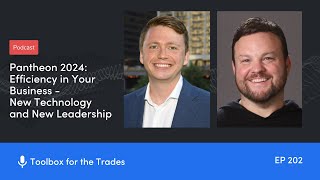
Transcript of a live Toolbox for the Trades podcast episode recorded at Pantheon 2024. Jackie interviews Isaac Zimmerman (CEO/owner, J. Blanton Plumbing) about buying and scaling a residential plumbing company (growth from $6M to $18M, recruitment, global staffing, training, culture) and Joe Papa (CEO/founder, Truversity) about AI adoption in the trades (training, ServiceTitan integrations, AI call centers, security/adoption guidance). The conversation covers change management, hiring strategies, training ROI, and practical AI implementation advice for home‑service businesses.
Foreign. Isaac Zimmerman, you are the CEO and owner of J. Blanton Plumbing. Thank you for joining me to record Toolbox of the Trades live here at Pantheon. Welcome.
Thank you, Jackie. Thanks for having me. It's really cool to be here again. I did the same interview a year ago. What I love is just coming back a year later and getting to see how our business has changed the industry. It's kind of like a good measuring stick for us.
Amazing. Amazing. Okay, so, Isaac, even though we are recording this at Pantheon, I do want to kind of do a classic little episode here with you. So I'm going to hit you with my classic question. How did you get into the trades?
Definitely a roundabout story. So I don't come from a plumbing background. I do come from a small business background. My parents were local entrepreneurs in Cleveland, Ohio. So I grew up knowing that I wanted to own and run a business one day. And so most of my background prior to the trades was in finance, private equity, buying, building companies, and was looking to do something new and had met some people that owned plumbing H vac businesses. Some people like John Wilson, you've had on the podcast before.
Yes.
And others. And I ended up coincidentally meeting them, shadowing their business, and just fell in love with the industry, the trades, and decided I wanted to buy a plumbing company. And now, three years later, here we are.
So three years later, you bought Jay Blanton Plumbing.
Yep. Yeah.
Okay. I'm very curious. As someone who is coming from out of the industry, what. What surprised you the most when you first got into it?
I think, honestly, how fun it is. I really have fallen in love with this industry. I think of myself as a nerd for home services and plumbing, even though I don't know that much about plumbing. I've now learned a lot about how the business of plumbing works. And I just. I love the people. I love the processes. I love coming to conferences like this. And the community is so surprising in this industry. It's very unique. You know, I have people who join my team from other industries, and they come. And there's so many companies doing the same thing as you that it can serve as a blueprint and people are so willing to share. I just think it's one of the most surprising and honestly, beautiful things about the industry.
The community is 100% one of the reasons why I love doing this show and why it's been such a joy, because I'm always so blown away by how much contractors want to help one another. I don't think you really can See that in any other industry.
I agree 100%.
So tell me a bit about what you've done to Jay Blanton since joining. Before we hit record, you were telling me that you guys have grown quite a bit. So why don't you tell us a little bit about that?
Yeah, so I, I bought the company two years ago. It has been around for over 10 years, but bought the business from the founder two years ago. Since then we've tripled in size. We were 6 million when I started. We're run rate 18 million now and our goal is actually be the largest residential plumbing company in the country on the next five to seven years. So we're very, very motivated, very growth oriented and it's just been having a growth mindset embedded in everything we do. We like to make decisions and pivots in hours, not days or weeks. We're just obsessed with our craft, getting better. I have an awesome team. Nine of them are here with me for this conference and you know, I think we're just very nerdy about what we do. We want to be the best, we want to employ the best and honor plumbing, bring honor to the trade and yeah, grow the business. So we've been investing a lot in sales, training, marketing, have really become masters of Google and yeah, just have embedded a growth philosophy in what we do.
That's amazing. So is there a specific, I mean, I know you just joined nexstar. Is there a particular blueprint that you've been following? Have you just been absorbing information from other mentors in the industry to figure out what you had to do to take it from. Remind me again, was that 6 million to 18 million now?
Yep.
Awesome. Way to go. So what was your blueprint?
I think kind of like what I said about community. I've met like minded owners and just being in group chats with them, talking about what they're doing, studying the competition, even seeing how they structure their Google pages, how many they have, what do they do for incentive compensation for, for technicians? How do they recruit? At the end of the day, it's kind of a simple business. You need more calls and you need more technicians. So we've just gotten good at generating more calls and probably one of the biggest needle movers has been hiring the best people. I would say that our talent level has skyrocketed.
Yeah.
And really especially our sales talent level has skyrocketed. And so just finding a way to get those A players. You know, I treat recruiting great technicians like NBA recruiting. So we want to go all out Whether that's compensation, wining and dining, vision, all of the above. Like, we treat it very, very seriously. We invest a lot of time to win the best and steal them from the competition.
All right, so you're actually seeking out seasoned technicians. I know a lot of folks are investing in folks that are very green to the industry, and they're kind of building them up from scratch. Doesn't sound like that's your strategy at the moment.
Yeah, unfortunately, we don't have the luxury of being big enough yet to do that. For us. Recruiting the best existing technicians is a way for us to grow. But our dream is to build our own school to do our own training. We just have to get to the point where we can afford to do that in a good way.
Yeah.
So for now, it's hiring the best, poaching the best, and then eventually it'll be building the best. But that's a tough journey to do it.
Well, and remind me, what part of the country are you in right now?
Chicago.
Chicago. Okay. Very interesting. So I know that before we hit record, you were telling me that you actually have quite a bit of a global team, so not just folks that are in the United States in Chicago. Tell me about how you've expanded globally.
Yeah. So we do think this is a big part of our secret sauce. A little bit, too. We do leverage a lot of global talent. So we have 71 U.S. employees and 40 overseas. And so most people think it's our call center, which it is a lot of our call center. We have software developers overseas, so we make a lot of our own custom dashboards and then custom scripts to automate business processes. We have a lot of digital marketing people overseas, business analysts, outbound salespeople. So we found, you know, a very eager global workforce, and we found that it helps us with specialization. So we take something that maybe we couldn't afford or couldn't find someone in the US who would want to just do that one task, even if it's very important. And so we'll find a global person. We'll have them just do that. And it's actually. It's worked tremendously well. I'll tell you a crazy one even. One of our main recruiters for Plumbers in Chicago is based in the Dominican Republic. So he spends all day setting up interviews. He's on. Indeed. And he sets up interviews for us in Chicago. Phone screens, the Plumbers from the Dominican Republic.
Oh, my God.
Sets up three to five interviews a day for us.
Wow. All right. All right.
Very successful.
I'M assuming you don't want to share the name of this person so no one else will find them. That's really incredible. So this person's main job in the doctor is just to be like, screening and finding local plumbers in your area and getting those interviews.
Just sits on. Indeed. Sorts through resumes, understands, you know, he's doing dozen of them a day. So he understands what to look for, what we want. He looks for the people that fit the bill. He does a phone screen, pitches us, and then sets up the interview for us. So that's a perfect example where we're able to take somebody globally, give them one mission that's critical to us, and then, you know, just rinse and repeat. So we get three to five interviews a day in person, doing that.
Three or five interviews a day. I know people's ears perked up at that. I'm very sure they did. So I'm curious here, too, because coming as the new owner of the business just a few years ago, coming from out of industry, did you have any pushback from the workforce that you were inheriting, essentially? And what was that like having to kind of win those folks over or ultimately decide, hey, it doesn't sound like we're on the same page and how do we end? I think it's time to part ways. I would love to hear more about that.
Yeah. Well, I think there's two things that kind of helped with that. The first, honestly, because we've tripled in size in the last two years, I basically hired 70% of the 80% of the people that work here now. So very quickly, if you're growing fast, they all become sort of my people. And then I think, secondly, like, I'm a very active owner operator, so, like, I am involved in everything. So it's not like I'm sitting somewhere else. No one sees me, or I just, like, have ideas and I'm not there. Like, I'm doing everything. I'm in sales training. I'm doing all the things that everyone does, and I'll continue to do so. So I think, like, A, like, we've grown a lot, so I've hired most of the people. And then B, like, they see that I'm on the ground, they see that I'm a part of everything. So I think that helps. But what's tangentially related to that, that's been different. And Tommy talked about this today in his. His breakout session is as we've grown, we've increased our expectations as a business. Like, we want to Be the best. We want to hire the best. We want to be the best place to work in plumbing. And to do that, we have to have high expectations of ourself. And as we've grown, our expectations of ourselves have grown. And what we expect out of our people now, our technicians, now our salespeople, is completely different than even a year ago. And so there's been that cultural movements to get people on board with this. How we approach every single service call, what we expect to offer the customer from the entire service system of how you go through a service call to what we expect in terms of pictures and videos and the after call reports. You know, Tommy said it in his breakout session as well. There's a lot to do as a technician. We expect a lot of our people. And that's just that bar is going up and up. And so I think for our people, it's finding the people who want to be a part of that winning team, want to adapt, have the high expectations of themselves, and then finding the people who that's not a good fit for. That's definitely not a fit for everyone. And so that's been a big, big change.
So this is kind of talking to change management, which I know is so important for owners, especially owners like yourself, who come in and grow the business and grow an existing asset and blow all of its records out of the water, essentially. How are you able to consistently change expectations you have for yourself? Or is that something that you just do automatically?
That's a good question. Honestly, what changes my expectations of myself is coming to stuff like this. Yeah, I hear, you know, some of the titans of the industry talking. You're in these breakout sessions, you're talking to people and you know, my expectations of myself change and that trickles down. I want more out of my life, I want more out of my business, I want more out of my people so that we can all win together and win bigger. I get energy from stuff like this, from meeting people, from seeing success. I love seeing success, studying success, and I think I have a lot of hungry winners on my team. So when we see someone else being successful, we want to know, how do we get to that table? How do we eventually get there? That's how we invent ourselves. Studying the best, seeing the best.
So two, three years now you've been at the helm of this company. Has there ever been a moment where you've been like, what the heck did I do? And I need to sell this business right now and like cut my losses and go, have you had A moment like that yet.
Honestly, no. I mean, there's crazy stuff that happens every day. Like, it is not a straight up business. Like, yes, we've grown a lot, but it's been blood, sweat and tears. Daily knife fight to do it, Ups and downs, forward progress, then going backwards. But there's never been a holistic moment where I felt that way. Because, number one, like, we're in one of the best industries you can be in, residential plumbing. Everyone needs us. You always want a shower and use the bathroom.
Yes.
And then number two, you know, I have a great team, a winning team, a team that cares about this and is passionate about this. So with those two facts, it's very hard for us sustainably beating the down and we know we want to win and we're doing everything we can. So I've never had that moment, really. I mean, obviously bad days, but I have more moments where I feel like, very blessed and shocked by, you know, I'll be in places like this and I'll just think to myself, like, I wouldn't have expected things to have gone this far in two years and I think how cool it'll be. God willing, knock on wood. Keep things going five years from now.
Yeah.
Where we could be.
Yeah. I. I love talking to owners, operators about their bad days, about those moments. And I love, by the way, how you're really celebrating your team, your team of winners, and you're accrediting your success to all of their hard work as well as your own. But I'd love to talk about those bad days because it's easy to come on a show like this and talk about all of the awesome wins you've had. But I think those bad days are better because I know for a fact there have been people that have tuned onto this show and they've just had like the worst day of their year or their career even. And it's so important to share those moments. So what would you say to someone who's like in the thick of it right now and is really struggling to. To see a path forward?
Yeah, I mean, we've gotten our teeth kicked in so many times. Maybe a year ago, year and a half ago. So I was like six months in. Our top sales guy quit without notice and he was 40% of our sales.
Wow.
So in 24 hour span, 40% of our sales walked out the door. So obviously that's a crazy moment. And so there are very rough days. What I was again, I just try to remember what I just said earlier, which is, we're in the right industry, we know that our intentions are right. And so if we can just make it through every single day, we know that brighter days will come and just not giving up. And I think as long as you're doing the right thing, your intentions are right and you are. You have a learning mindset. You will adapt. Like, I consider myself always to have a beginner's mindset. No matter what it is, we never think we're done. So if you have that mindset, the better days will come. I don't know. Ask people, ask friends who are in similar businesses, similar roles, like what they did in this scenario. This industry does have a lot of ups and downs too. So everyone's gone through weird, crazy stuff and they have. Everyone has. Has a story.
Yeah, I know. It would be so fun to do like a little side off podcast, like a few episodes. Like the worst day I ever had in the traits.
This is probably one of the craziest industries to do it in.
I think it would be really, really fascinating. So actually I would love it if you could indulge me. Walk me through. When you're the top sales guy who 40% of your revenue walks out the door, what was. How did you respond and what was your strategy to turn the ship around?
I took it as a challenge. So there wasn't really much notice to this either. So it was pretty surprising. But again, it comes back to the team. We had other people on the team who we believed in who could step up, so we gave them more opportunities. He was a very successful sewer salesman that left. So we gave other people on the team who had been waiting for an opportunity to run some of these most valuable calls that we had. We gave them an opportunity to step up and run them, and a lot of them found a lot of success. And honestly, that set us back months. Like, if you look at our revenue chart, we had, we didn't really go down that much. Maybe we lost 5%, sure. But we kind of hit a plateau for four, five, six months. We were just kind of trying to claw our way back up to a growing position. We're able to stem losses by, again, having people step up. They did an amazing job. We retooled, re regrouped. And I look back now and honestly, that was one of the best, most defining moments ever happened to us because it forced us to evolve, not be so reliant on one person, bring up other people, evolve our sales process, evolve our management process. And it made us 100 times stronger. And thank God that guy Left because he had, you know, no one's perfect. And so being reliant on that individual with his good things and bad things associated with that did not put us in a long term winning position. And had he not ripped the band aid off for us, we probably would have trudged along way longer than we should have in, honestly, a vulnerable position. So I also tell myself that a lot, whenever something bad happens, usually it's something that was meant to happen anyway. So I think about that. Thank God this happened.
Because xyz, you do have a very healthy mindset. Way to go. How did you even curate this healthy mind? Like the learning mindset, like the being able to change perception. We had a wonderful woman on yesterday who talked about head trash, and that's been jangling around in my head for the last, like 24 hours or so. So how do you cultivate that mindset?
I think just being obsessed with winning and not wanting to lose or and refusing to give up, like, we so badly want to be the best, want to grow. And so these are all just obstacles. And losing is not an option. Failing is not an option. And so if you have that mindset, I think that's a huge part of it. And then being genuinely curious, like, I really do love this industry. I love my company and I'm obsessed with, like, I listen to this podcast for fun. I listen to other podcasts, trades, podcasts for fun. I like talking to people in this industry for fun. Like, that is what I truly love doing. And so if you love what you're doing and you just obsess at winning and no matter success. Yeah. No matter what it is, like, you have to. And I make mistakes constantly, every day. We're super, super far from perfect. And I don't always have a positive mindset, but we do have a not giving up mindset. That's our number one mindset.
I think that is really important.
You.
I think you somewhat answered this next question, but I just want to clarify. It sounds like when you lost this salesperson, I love the way you're thinking about it. It was so good that it happened. You know, you ripped the band aid off for us. We were able to level up our sales training, our management training. So it sounds like in this instance, you learned this lesson of, all right, we can't rely on one person and we have to make sure that we have a roster ready to go when something like this happens. And so I'm sure you're now in a position where you've got multiple sales leaders in Your org that are and the more of those you have, the more revenue you're going to bring for sure.
That's, that's exactly right, Jackie. And that, that's true of all positions, you know, whether it's sales, install, warehouse, a key manager. That's the benefit of growing too. You can have more stability, more stability for the business and then therefore more stability for all team members. Healthy business shouldn't be reliant on one person. It should be a team that has redundancies built in. So we're constantly, you know, I'm constantly thinking about those vulnerabilities. Where do we have a department or role where we have reliance on one person and what would happen to us if they leave and how do we backsl for that?
Yeah, yeah, I know. It's a reality I've heard echoed on this show a couple times before. You have one key person leave or you know, suddenly pass in some situations and then the company's like in the red for months trying to scramble, trying to recover from that. So it sounds like you took a hard lesson and you turned it into something that's just helped your company skyrocket. So well done on you.
Thank you.
You mentioned that you listened to this podcast. Thank you very much. And other trades podcasts out there. So if this microphone right now is your megaphone to the industry, you're now on the podcast and you are able to share one piece of knowledge, one big nugget of information. What is it that you would like to share to the industry as a whole?
One thing that we've benefited a lot from recently is just the investment in training. And I think we joined nexstar a few weeks ago, which I think is a tremendous organization, and start doing their, their service system training. And I think with training it can seem, and training is really just investing in your people, but it can seem expensive or time consuming or whatever. And we've kind of just leaned into it the last few weeks and honestly we, we went to one training probably within two weeks had made a 10 times return on money on that training. Wow. Literally we sold two jobs that paid for the entire training for everybody that we wouldn't have sold without it. And the people who sold it said I would never have sold this had I not gone to that training a week ago, paid for the whole thing. And so what I say to myself now and say to everyone is invest in your people, invest in yourself. However much you think you're investing in yourself, you can do more. Even Tommy was saying in his Breakout session. You're doing two hours of role play a day. I thought to myself, we got to step it up. So I think, yeah, just let's invest in ourselves, let's invest in the trades, let's invest in our skills. And that's what I've been thinking a lot about.
Yeah, I 100% want to echo that because we've had folks come on and say it's so easy to just lose sight of training and it's so easy to just like let it go by the wayside. But it's like working out. It sounds like it's like exercise or like showering. Like you have to do it every day in order to be clean. And so I'm so happy that you brought that up. And thank you for sharing, kind of one of your more rough days on the job. Let's end this on a positive note. Can you tell me about one of the most memorable days you've had since becoming the leader at Jay Blanton?
Well, this was a year ago, but I think because we're here, you know, honestly, the first pantheon that I went to, which was last pantheon, was one of the most memorable moments I've had. It was my first really introduction to the community in a broader sense, how big it is. And I just remember being at this conference, being at, I think it was One Republic was the concert last year.
Yes, One Republic was the concert.
I just remember, like being at that concert and looking around, I was like, holy crap, this is crazy that I'm at this concert virtually like a front row seat and this is all for a bunch of plumbers and H Vac people. And so I thought, wow, this is really cool and kind of felt like we made it. So that's awesome feeling.
That's awesome. Well, I'm so happy that you stopped by Toolbox for the trades again. Thank you for listening. Thank you for sharing your story with our listeners. I'm sure you're going to get hit up once this goes live because people are going to want to hear all about your various processes. Isaac, I can't wait to see where you're going to be next year, honestly, because I'm sure you're going to be like, yep, we're at like 35 million now. No big deal.
Thank you so much, Jackie. It's amazing being here.
Joe Papa, you are the CEO and founder of Truversity. Welcome to Toolbox for the Trades live here at Pantheon.
Thank you, Jackie. It's great to be here.
I'm excited to chat with You. So for those who don't know, tell me what TrueVersity is.
Yeah. So TrueVersity, we are the largest AI training and consulting company for the trades.
That is quite a statement. So, second question. How did you get into the trades?
So my background is in engineering. I've been developing AI technology for the past 30 years. About 15 years ago, I had just exited local businesses and I met an individual named Mike Aguilera, who is the founder and one of the owners of Gold Medal. And Mike and I became friends, and so I've helped him through Gold Medal and CEO Warrior, and just really got to know the community and the industry, met some amazing people. And about two years ago, when ChatGPT came out, we had seen what was going on in the research and development space. I knew all this technology that was coming out, but when it was released to the wild, to everybody, I said, wow, I gotta help this industry, because there's gonna be a lot of confusion and a lot of people left behind if they don't do something about it.
All right, so first off, I didn't even know AI has. I mean, I guess it makes sense. 30 years.
Yeah, it actually goes back farther than that. It's probably in the 50s when it started to be developed. Yeah, the term AI is, you know, probably 50, 60.
So the Terminator is based on a true story is what you're telling me.
Cannot confirm or deny that.
Sure, sure.
All right.
I love that you're helping people with this topic. It is a very confusing topic. It's an exciting topic. I'm sure for some folks, it's a scary topic. When a trade company approaches you like, what are some of the common concerns that you're hearing?
Yeah, common concerns is just a lot of confusion about all the hype. And the biggest question I get is, how can AI help me in my business? And that's not a simple answer. So the first thing I tell people is you have to master the technology. And we're at a critical point in the world right now in human evolution because AI and technology has exceeded human intelligence at some level. And we're at a crossroads. People are either going to become zombies and just use these tools without thinking about it, or they're going to become leaders and master and control the technology and learn how to use it in their business.
Do you want to be a zombie or do you want to be a leader?
There you go.
All right, so obviously in the last, like 2ish years, last year at Pantheon, we spoke, we kind of were like, and now we're working with AI, right? Who are the big players in AI? Like, what are the tools that folks are most using in the service industry?
Yeah, so the biggest player by far is OpenAI.
ChatGPT.
ChatGPT, the creators of ChatGPT. And there's a bunch of other models that, you know, just beyond GPT that have come out, and that's where it starts. So what a lot of people don't know is the back end in technology is available for use. So you have tons of software that can leverage the technology in terms of models, which costs upwards of hundreds of millions to billions of dollars to train. So all of this technology is available to anybody to create softW. So there's been an explosion of new software features and new software applications that utilize this technology, like Service Titan. The number one thing I tell people is look at your current systems. Like, if you're using Service Titan, go through there and look at all the AI capabilities that you have available to you and start implementing that strategically.
Can you give me an example of that? So I know Dispatch Pro is one of our bigger AI tools. Tell me, can you tell me about a time a client leveraged ServiceTitan AI features to their benefit?
We have several clients that are looking at on the marketing side. So any kind of outreach, whether it's voice or whether it's text messaging, emails, AI could be used to craft those. The voice technology has accelerated in the past six months to a year. So, you know, we're attending a session today on the customer service side where you have voice assistants handling calls. We built our own AI call centers, AI roleplay trainers to where humans, in order to learn, could actually interface with AI. So there's a ton of features that are available in Service Day and as well as new stuff that's coming out that's really, really cool.
Awesome. All right, so talking about AI and call centers, call center training, the voice assistant, that kind of stuff, how does one avoid becoming a zombie and be a leader when it comes to that?
Yeah, so it's really all about people. And this is what companies really need to know right now, is that technology will only get you so far. It's investing in your people and leveling up your people that get you to new heights. So if you have an AI call center, there's always going to be a human element to it because AI can't handle complex issues or you just get customers that prefer to talk to somebody. So you want to be able to have that capability where not only do you have AI, but you also have people that are fully trained that can handle the calls extremely well. They're well skilled and well trained in Service Titan so that they can do what they need to do on the fly. And it's really about leveling up the people, not so much the technology.
Yeah. I'm going to give you a hot take. I know it's, I know it's 8 o' clock in the morning. I'm going to give you a hot take. I think computers are pretty dumb. Computers are really dumb. Like if you miss a colon somewhere, if you don't remember to close a parenthesis, your formula, the computer's like, I don't know, I can't do it. I can't do it. So that's what I'm thinking about. When I think about AI just as a layman, not even as a employee of Service Titan or somebody whose company is developing AI tools, I'm just like, I just don't see, you know, I just don't see how it could even be that good. I'm just like picturing I have this idea of sci fi robots and I'm like, no way is it going to be that smart.
Yeah.
Anyway, I just jumbled some words at you. You're trying to respond.
Let me put it in perspective for you, Jackie. OpenAI just came out with a new model a couple of weeks ago called 01. It has the capabilities to perform complex mathematics at the level of a rocket scientist. And I went through and I tested this. I went to the prompt and I said, solve the equation that Good Will Hunting writes on the blackboard. Right. So it responded. It first of all knew the equation that he wrote. Then it step by step figured out and solved the entire equation and explained it every part of the way. And I was just like blown away. Like, I was like, I didn't even know the equation. Like, you know, like, this is incredible.
So how about them apples?
Yeah, there you go.
Thank you for that explanation. This stuff is still so, like, how do you get people like me to not be intimidated by AI?
So start small. Like, that's what I tell people. And I hate to be like on a soapbox for ChatGPT and OpenAI, but really they're the leaders in the market. And there's other companies, Perplexity and Gemini and some of the Apple stuff that's coming out now. I mean, like where we are in time right now, Apple's leveraging a lot of the OpenAI technology. But as an individual, the first thing you should do is just get familiar with ChatGPT and use it every day. Download the mobile app on your phone and use voice mode. Okay. I have a 15 minute commute to the office in 8 minutes. The other day, just in a conversation with ChatGPT through voice mode on my phone, I redesigned entire website and redesigned the webpage, all the copy in eight minutes, forwarded it to my web designer and he went and implemented it all. That would have taken me probably two to three weeks working with a team.
So were you just speaking to ChatGPT and they were giving you solutions or were they like mocking up? Because that was one use case I learned about. For AI is just great use to like take meeting notes and all of that good stuff. Was that what you were doing?
So when I go into work, I look at my priorities for the day, what I need to create. So if it's like an email or a report or you're working on something, it says just start there with a key result that you want to achieve. And start and just tell, tell the tool, hey, I want to create this. And here's the information about it. Here's what I wanted to do. Here's what I wanted to say. It now has memory. So over time it will learn things about you and your company. And then the last thing I do in every conversation with ChatGPT is I ask it. What questions should I ask you?
That's going to be my last question for you. So I guess ChatGPT can soon take over this podcast.
It'll never replace you.
Jackie, thank you so much. Thank you so much, Joe. So you asked ChatGPT, what else should I have asked you? Yeah, and it spits out pretty solid information, I guess.
Yeah, it'll give me like 10 questions and like three of them will be gold. I'll be like, wow, I didn't even think of that.
Oh, boy. Wow. I mean, it's scary, but it's also exciting. And I can definitely see the time saving benefits from a personal management perspective. This podcast, this what we're doing today, this is a little bit different than my normal day to day. Normally I have a pre interview with someone. I curate six to eight questions to guide us. But I'd be lying if I told you I never went into ChatGPT and was like, what's a question I should ask a sales supervisor in H vac, you know, and sometimes it's really spot on.
Yeah, awesome. Yeah. And it can access the web too. So if you have a guest coming on the podcast, you can say, hey, access the web. See what you can find out about Joe Papa and give me some really good questions to ask him about how the trades of home service companies can succeed in AI.
Amazing. Do you have a story with one of your clients who's worked with Truversity? Do you have a success story or a memorable experience you'd like to share?
Yes, there's a few, but this one was interesting. So I was working with a client, and we did a ringless voicemail. So this technique works extremely well. So we generated a personalized voice, a message with AI that sounded extremely realistic, and it was personalized to the customer. So would say, hey, Mrs. Jones, thank you for trusting us in your home with your air conditioning repair. We have some questions for you. Can you please give us a call back and put the number in there? Right. So we. We send this out to hundreds of customers. And what's really nice is that the customers can call back when they're ready to talk. Right. So on the phone, it does a transcription. They can just click on the phone number and call back. So what was interesting was we were getting a lot of callbacks, and so we used the name of the person that was in the office, named Kristen. So we say, hey, this is Kristen calling on the ringless voicemail, but it wasn't her. We could have cloned her voice, but it wasn't her. So they call him back, and they're asking to talk to Kristen. And Kristen knew about it, so she would handle the call. But one day, somebody else answered the call, Dana. And this gentleman said, you know, we had called. We did this like three times. And he calls back and he yells, dana, would you please tell Kristen I'm sorry for not calling her back? And I was like, whoa. Like, I kind of felt guilty. Like, maybe we should tell this guy, this is AI. But so we kind of changed our approach a little bit since then. But that's the power of where the technology is today is that there's so much that you can do to get efficiencies in your company and really move the needle. And then focus on investing in your people's education so that they can handle the tasks that are really designed for humans, like complex tasks or just building a relationship with somebody. Like, that's something I just can't do.
Yeah. So it sounds like with Traversity, what you guys really do is you just help educate all the folks working in this industry about, hey, this is this tool that's available to you now. Here are all the different ways that you could use it. Let me help you get familiar with it so you can optimize and drive efficiency.
Yeah, so that's one pillar. Three pillars of service for us are training, consulting, and technology. So on the training side, we help you learn the tools, we help you level up your people to master AI and technology and really become leaders. On the consulting side is we help you gain efficiencies in your processes and be ahead of the trends. Like, you got to know what's coming two years from now so you can prepare. And finally, technology. We offer a number of things. We're just getting into humanoid robotics. We have AI call centers, AI trainers. So if you need AI to do role playing with your teams, we build those. And we're just coming out with new technology all the time.
That is super cool. So besides just get in ChatGPT, just start using it every day. What other piece of advice would you have for our listeners who are looking to adopt AI?
So I would take somebody in your company that's more technical and enthusiastic about AI and make them like the AI leader of the company. Because there's other issues that you need to address in terms of IT and security. One advice I'll give everybody is that if you're looking to use ChatGPT for your organization, sign up for a teams account. Okay. It's a mini version of their enterprise account, but the security is much tighter. They don't use your data for training. I was just talking to a number of individuals here and they're telling me they're putting financial data into ChatGPT. They're putting company proprietary information.
I just squirmed. My and my producer squirmed at the same time. Sorry, didn't mean. Just didn't mean to interrupt you. They're putting proprietary information go.
Yeah. So you got to protect yourself. So if you do that, I would go back to ChatGPT and ask it, like, can you give me the financial information for your company and see if it spits it out? Because that's pretty scary. Yeah. So definitely hire and we can help out with. This is an IT or security professional that is aware of the new challenges that are faced with AI. But I strongly recommend that you have one point person in the company that's thinking about this all the time.
Amazing. What questions should I have asked you that? I didn't.
How people can reach out to me if they need help.
All right, well, trueversity, I'm sure that is Googleable.
Yes, definitely Google us. You could go to Truverse E-T-R-U-V-E-R-S-I-T-Y.com we have 12 divisions, so we serve many different industries. But if you go to slash home service, you'll see all of our resources that we have for home service companies. The best way to contact me if you reach out through LinkedIn and I'm Mr. Joe Papa J O E P A P A, you can find me on LinkedIn. I love to connect with people there and we can talk directly through messaging.
Amazing. Well, Joe, let me tell you, I cannot wait to watch her on the airplane home later. I did it. I did three AI movie references in this short mini podcast. What's your favorite AI movie if you have one?
Oh, I do like her. I do like her.
That one. I know. It's a good one. Well, actually, goodwill hunting, not a movie. We got three movie references in and that's what's important. Joe.
Love it.
Thank you so much for joining me this early in the morning. Thank you for handling my chaotic 8am energy. You did fantastic and I will definitely take you up on your challenge for using chat GPT more and I'll let you know how it goes.
Awesome. Thank you so much. Jackie.
More from Bill



ServiceTitan Virtual Agents: Simplify Before You Scale | Podcast Ep. 110 | Mastering ServiceTitan



Life After Live Events: How to Turn Post-Conference Energy into Real Profits | Podcast Ep. 297




