Richard Kohberger: The Story Behind the Blue Collar Nerd | Podcast Ep. 21 | Mastering ServiceTitan
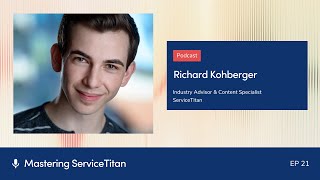
This is a YouTube podcast episode titled "Richard Kohberger: The Story Behind the Blue Collar Nerd | Podcast Ep. 21 | Mastering ServiceTitan" published in February 2025. The episode features a conversation between host Josh Liu and guest Richard Kohberger, known as the Blue Collar Nerd. They discuss Richard's personal journey from theater and film to working in the trades and eventually joining ServiceTitan. The discussion covers his experiences creating content about ServiceTitan, insights into underrated features of the software, and advice on asking better questions to get effective answers. The episode provides both a personal story and practical information about ServiceTitan's features and industry insights.
Welcome back to the Mastering Servicetein podcast. This is your host, Josh Lu, and today's episode is a special one. Our very own Richard Kohberger, or better known as the Blue Collar Nerd, shares his story about how he got into the trades and how he found his path here at Service nine. This is the first time he's shared this story in detail. He's a Service Time celebrity. Even before he joined our company. He's been covering release notes for, I don't know, six, seven, eight years or something like that. Hope you enjoy hearing his background. And then we jump into what he thinks are some of the most underrated features that everyone should use, as well as some exciting new updates on the roadmap. And then at the end, we close with his advice on how to ask better questions in order to get better answers. I love that closing note there at the end. It was quite profound and some cool analogies in there. And so hope you all enjoy this new episode. Welcome to Mastering Service Titan, where we get a expert advice from power users. I'm your host, Josh Liu, and today I'm joined by our very own Richard Coburger, the Blue Collar Nerd. If you've been living under a rock, that's the only way. You probably haven't heard of Richard Kohberger. I'm super excited to have him on the show. So, Richard, welcome to the show.
Pleasure to be here. Thank you so much for having me.
You're the most pro person probably on the show. You got your mic, you got lighting set up. Um, I'm sure people are familiar with seeing it. And I was mentioning before we started recording that every time we hop on a call, there's some major upgrades with your setup. So it's super cool to have you on. I wanted to ask you first, before we dive into any features and stuff like that, like we normally do, I just wanted to ask you about your story. Like, how did you end up here at Service Time? Let's go. Let's go way back.
So my dad owned an H vac company. He opened it the year I was born, 1992. You know, I was never really interested in it, to be honest. Like, I didn't care. When I got into high school. Like, I was a theater kid. I was very much not a contractor. I was an actor who liked to be on stage and wear funny outfits and goof around. Eventually, high school ended and college came up. At least that's kind of what it was. Just the thing that came after high school. I majored in film Because I liked the idea of, hey, I want to work kind of in the entertainment industry in some fashion, because I'm interested in theater. I really hoped to be involved in acting in some way because that was. That was really where I felt the most authentic. That was really where I felt like I fit in the most. But acting is not something where, like, okay, I've got an agent and now, like, great. The money's, like, rolling in. I'm booking roles left and right. Like, it just doesn't work like that. You're auditioning, and you're auditioning, and you're auditioning. And once in a blue moon, you might book a small role where you're kind of done in one day, you get paid one time, and then back to auditioning. So I still needed to, like, figure out what I'm gonna do. I started riding with a technician at my dad's company. The last couple of years I was in college, I started doing this. I don't really remember how this came to. I doubt it was my idea, but somehow I ended up doing this.
Yeah. How did he convince you to get in a truck? Do you remember how you felt? Was it more like a chore, like. Or was it, like, I might as well check it out.
I honestly, man, that. It's like I've deleted it from my brain. How it actually happened. Like I said, I doubt it was my idea. I'm guessing it was my parents kind of being like, you should maybe, like, have a backup plan here. I probably was just like, well, what else am I going to do? Like, it's over the summers anyways. And it actually doesn't sound like the worst idea to have some sort of fallback plan, so, sure, whatever. He just put me in with his top tech. His name, coincidentally. Also, Josh and I rode with Josh over the summers for a couple of years. Josh and I, like, bonded pretty deeply. Like, he was like a brother to me. Like, we were very close. At first it was very awkward because, like, you know, it's like, hey, the boss is just like, here's my son. Here's. You're my top tech. Take my. Take my son and, like, teach him the trick. Like, obviously, that's kind of an awkward situation, but I remember, like, the first moment where, like, we were under a house in a crawl space. We were down there trying to diagnose whatever the problem was. Like, we could hear, like, the customers, like, right above us because the floor was really thin. There was, like, a vent right there. We were squatting, and Josh just Like, accidentally lets one slip. Just like a fart echoes throughout the entire crawl space. We're both just, like, dead quiet. I kind of, like, look at him. He kind of looks at me, and we just like, burst out laughing. At that point, I was like, all right, we're. We're going to get. We're going to be fine. We're going to get along. So I'm riding with him. I'm an assistant service tech. And then by night, I'm like, I'm filming auditions. I'm attending acting classes. I remember, like, being up in a hot attic, like, dealing with a frustrating situation. It's 110 degrees or whatever it is. I'm sweating. And then, like, my phone would buzz, and it's like, it's an audition that's due tomorrow. I'm like, oh, God dang it. Like, it was. It was. It was a lot to do. That's, you know, while I was still in college. College ends now. What? So I moved back with my parents. I'm still riding with Josh. So I rode with Josh for a winter because I was doing it over the summers, right? And around that time, Josh was promoted to service manager. It was time for me to be a tech by myself. So I was a tech alone for, like, maybe one summer. It didn't last long. I think that everything that I enjoyed about the job, because I did enjoy the job riding with Josh, but once I was by myself, I think I quickly realized, like, oh, everything I liked about this was tied to that camaraderie. Once I was by myself, it was like, I don't like this. Just, like, distinctly remember working on a unit. It was. It was a ream unit, flat ones that should open up the panel from the top if, you know, you know, and just, like, nut driver in hand, just, like, hitting me and just, like, quietly starting to weep. I was just like. I felt so lost. Like, I didn't know what to do from there because I was like, I. I put a lot of time into this. I don't know where else to go, but I don't like this. So I asked my dad if I could move into the office. He was kind of reluctant because, like, in his mind, there was really nothing for me to do there. But in my mind, I was like, this place is kind of a mess. Like, I feel like there's kind of a lot I could do. He kind of, like, was like, I guess he. He let me in and I started. I started just, like, getting my little. My little hands on everything. So the first thing I did, I think was organized the warehouse. So I like bought a label maker, started like labeling where stuff goes. Went to, you know, the hardware store and bought a bunch of bins and tubs. So stuff wasn't just like on the floor. The B vent wasn't just like lying on the floor. That was kind of my first like endeavor to like, okay, I'm gonna like, I want more structure. I want to like get my hands on stuff. I started working with Josh Moore again because he was a manager now. We started kind of like mapping out changes for the company. So you know, everything from department KPIs, like HR stuff, hiring packets, marketing calendars, financial planning, ideas for cost reduction, new products we could sell. Like, like just so much stuff that we, we kind of started getting our hands on. Plus I was doing my, my nerd stuff. So I was like implementing automations and implementing slack and like zapier automations with service titan to you know, do some cool things with like webhooks and stuff like that. And of course I was involved with like all things service titan. So like that kind of became my, my domain. If it was a service titan thing you went to, you went to Richard about it. Eventually I, my, my rank became director of operations because I was kind of touching a little bit of everything. The plan, the idea that eventually Josh and I would, would run this company together. After my dad retired, my dad now, now that I'm like more involved and like might be running this company at some point by myself, my dad started bringing me along to events for like best practice groups, I guess you would say. It feels a little reductionist to call them that, but you know what I'm talking about like those, those kind of groups that get multiple contractors together and do coaching. And I felt very alien there and I felt very alien in the industry in general. There were not many people in these places that, that looked like me, that thought like me, that kind of I related to on any level.
Not a lot of theater kids.
Not a lot of theater kids. There were not a lot of theater kids showing up at the contracting events. But eventually he joined one called the Blue Collar Success Group. When we joined, it was run by Kenny Chapman and Justin Deese. But these guys, there was just a different vibe. They took a very inside out approach to coaching. Meaning like they, they talked a lot about what was happening in here. Like in, in inside of yourself. Start there to be the leader to affect the outside versus like trying to affect the outside to improve your company and make yourself happier. It really resonated with me and it's. I'm very fascinated by that sort of stuff. I've always been kind of fascinated by psychology and the workings of the mind and that sort of stuff. Just like, I just perked up a little bit. I was like, I kind of resonate with this. It was also the first place where I felt more seen, like I felt more recognized where like the fact that I thought differently and had different ideas and like that was seen as like a good thing. Like I was standing out, but I was standing out in a good way. They seemed to recognize something in me that made me felt special in a more positive way than just like, I'm an alien in this room. And I was inspired by them because they, they made content. They made like authentic content, just like kind of, you know, front facing camera on their phone or whatever. It kind of inspired me because I was like, man, contractors are interested in this. Like, contractors are watching their content. Contractors are joining their group. Maybe there are people that I could resonate with in this, in this industry. Kenny at Blue Collar Success Group and I, we talked about possibly doing something together. The stars never really aligned on that, but I still did feel inspired by them. I still did have that idea that like people might, you know, be interested in hearing my ideas and watch content that I make. It helped give me the motivation or the, the confidence, I guess, that I needed to start what was the Blue Collar Nerd YouTube channel. A YouTube channel where I was talking about technology and the trades, because that's where I felt like I had something unique to offer where not a lot of other people in this industry are talking about this. I have expertise in this area where other people might not. And so I'm going to offer my perspectives on it. Part of what I did was talk about Service Titan because Service Titan is technology. A lot of people use it in the trades. And those videos in particular took off. Like people started really resonating with those, finding them useful because I was, you know, doing a release notes videos. Like that was kind of from the very beginning I was doing release notes videos. I still do them today. I would print out the release notes that were on the serviceiton website, go over them, share my thoughts about what I thought this meant and stuff like that. I'd also made a couple of videos that got Service Titan's attention. So I made a video about PriceBook Pro. And at the time PriceBook Pro was a very different product. And one of the features of PriceBook Pro, it was like having A duplicate button to make new services that were duplicates of the previous. The mobile view to see what it would look like on the tablet. Those were PriceBook Pro exclusive features. And I thought that was absolute bullshit. Can I say bullshit?
Go for it.
I thought that was absolute bullshit. Like, I was. I was. I heard that and I was like, I'm so angry. I have to say something somehow. Like, I have to express this feeling. I have to put this out in the world. And so I. I made this video in a way that I hope was respectful. I think was respectful. I've always tried to, like, really keep in mind that even when something doesn't work or you disagree with something, or you think something's bullshit, there are still people behind it. There are still, like, humans made this product. Humans work on this product. I tried to keep that in mind from the very beginning, and I hope that came through. But that one did get service Titan's attention. I was told later, after I worked here by the PMs, that, like, you know, we got a call from Ara, this CEO, just so you know, when you release that video. So that one got some attention anyways, after all that. I'm not working with server side at this point, but they're in touch. But out of the blue, I got a LinkedIn message from a couple of guys by the names of Tyson Freeman and Tom Howard. They were starting some consulting company, a service titan consulting company called Blue Collar Profits. And they had seen one of my videos and they were interested in having me as part of the team. And I was like, very interesting. I happen to be kind of like, in a part of my life where I'm kind of looking for, where I'm going to go, what's my next thing going to be. You know how LinkedIn is, like, you get a lot of weird messages sometimes. So I was a little bit apprehensive. I was like, I don't know. But I did recognize Tom Howard's name because he spoke at the 2019 pantheon. He was on stage. And so that gave him some credibility. I was like, okay, well, this isn't just some, like, random guy. But I was still apprehensive because he wanted to fly me out to Fresno, Fresno, California, which is where he lived. The short version is I ended up staying at his house and watching his kids while his wife gave birth to his child.
Oh, my God. I was not excited.
Within, like, 10 hours of meeting the guy.
Oh, my gosh.
I worked with him doing consulting for a little while at Blue Collar Profits. We would fly out to different companies and kind of help them with Service Titan. And there was talks about being kind of like an official partner of ServiceTitan to help them with onboarding and stuff like that. Very shortly after I had joined the team, Tom got an offer to join the Service Titan team as VP of Customer Experience and he took it. Shortly after that, Tyson got an offer to be part of the ServiceTitan team as well. And he took it. So now the two guys that I had kind of like put my faith into were servicetitan. I talked to somebody at Service Site and somebody had, you know, kind of brought up the idea to me that maybe working at Service Site and was a possibility. And I was like, I think that's probably more the correct place for me than, than where I am. And the two people that I had kind of, you know, liked are over there now. And I kind of like to. I'm going to go. So I did. This was like 2020, like right at peak, like Pandemic was just like becoming a big thing. So they took me on as an independent contractor. Probably apprehension about the pandemic. Plus the fact that like at this point my content, yes, I taught about Service Titan, but I was also pretty critical of it. Like I didn't hold back about my opinions about it. And so I'm assuming they were a little bit like, you know, friend or foe. Like we have to kind of like feel this out a little bit. We did that for a little while as a contractor for a few months and then moved into a full time position. I care about this product. Like I've always kind of like just been drawn to this product when something I don't like about it. And I just feel this like uncontrollable urge like I have to tell the world. Like that's, that's unusual. There's stuff I don't like about other stuff where I don't really. It's just like, man, that kind of sucks. Like, I don't feel the need to like make a video about it. But I cared a lot about Service Titan for some reason. And so it was really nice to be part of the team and to be able to offer my feedback now internally to the people who can directly influence it and do something about it. It's been really nice and it's been a really nice place to utilize this unusual crossover of skill sets where I get to make videos and be on camera and talk about this software and advise and be that kind of a translator between these kind of two Worlds that now need to communicate with each other because the times demand it. A contractor isn't traditionally the person who's like super into tech, and a programmer isn't typically the kind of person who's super interested in learning the operations of a contracting company. But that now needs to happen. They need to understand each other. And I can kind of speak both languages, a little bit bilingual in that sense. I feel like my skill set is utilized in a way that like, I don't know where else I would get to do all of this.
As you're speaking, I'm just like, the theme here is alternative routes, you know, like you found your own path. I'm glad you went into like step by step, kind of just the whole journey because I think every human is really unique and it is quite difficult to find where your unique combination may fit in to a place where you enjoy the work and people value it and people are willing to pay for it. I didn't realize you started off doing release notes videos and that was like a big core of blue collar nerd and it's still something you do today.
I haven't missed a single one. I haven't missed a single one since my first release notes.
Dang, that's awesome. Kind of pivoting here to some of the, the Service Titan features and stuff like that. I'm curious. You've seen so many release notes. What do you think along the way are some of the underrated features where you talked about it and it was like, wait, why is this so quiet? I feel like people should take way more advantage of this.
I mean, one thing that like, I feel like a lot of people still don't know about, even though there was like outcry for it for so long, is the, the feature configurations that are within settings. If you've used Service Titan for more than like a month, you're probably aware about the concept of a feature gate or a configuration, a back end feature, all terms to refer to the same thing. There are features that are not accessible to you, the user in the user interface to like toggle yourself. It's a backend thing that somebody at service site needs to toggle for you. And there was outcry forever. Like it was so frustrating to have this sort of secret menu, so to speak. People did not like that there was no visibility into these things because they would learn about a feature and be like, well, gosh, that would have been really helpful. And I had no idea. I didn't know it existed. Like, how am I supposed to know what? I don't know. It was a difficult problem to solve because I don't know, Josh, if you've ever looked our internal view of the feature gates, but you can scroll for like 20 minutes, there's a ton of stuff in there. And we can't just like show it all because it's kind of a mess. And so somebody had to like go in and kind of curate and pick out. Okay, this is, this is old. We're not, we don't need that anymore. We're not going to put that in. This is the thing that turns on, you know, Marketing Pro. We can't just give them that because you have to pay for Marketing Pro, that kind of thing. So we had to go through all this giant list. It was a difficult problem to solve, but we did. So if you go into settings and search for feature configurations, you can now see a big list. It's still not everything, but it's a lot of those feature gates of those backend features that you can either toggle yourself in some cases or in the cases where you can't toggle it yourself, there's a button right there that says request and you can just put in the request right there to have that feature gate changed for you. That's really great. That's really useful. People have been calling for it forever. Every time I talk to somebody, they didn't know about it. Go, go use that. Go check it out. Go scroll through there and see what's available.
Yeah, I had no idea that existed. And wow, what a huge problem we solved for. Does everyone have access to this or. I would imagine you need certain permissions.
I'm honestly not sure. Permissions wise. I would imagine it's tied to certain roles.
Yeah.
So if you're an admin role, you should be fine. Other roles, if you're not seeing it, it's probably related to your role. But I don't, I don't believe it has an individual permission like show feature configurations. I could be wrong. I'm not 100% sure on that, but I don't believe it's got an individual permission like that.
Gotcha. And then why do you think some of them you can just turn on and some of them say request?
Some of them are just more sensitive, some of them are, I don't want to say more dangerous, but there's something to be like. There's some sort of like, hey, we need to make sure that you understand X and Y before we just go willy nilly toggling this on or some of them just have like, values that need to be input. Like, I think some of them let you alter the template of like an alert. So, like, when you get this alert, what information is included on the alert? It's not exactly just a toggle. You have to kind of specify what information you want. That was just, I guess, harder to build into the user interface. And so it's like something that you have to kind of do a small amount of back and forth for, but it's a lot less than having to go through support or having to, you know, not. At least you know about it. Right. At least you can find it and know that that feature exists. And that's the thing you can do.
Yeah, the secret menu is no longer secret. At least you can see it now. That's. That's awesome. Any other underrated features? I know pricebook has come a long way since you made that, that video, but are any other underrated features within PriceBook or elsewhere that, I mean, Price book.
Price book has. I've always got a soft spot in my heart for pricebook because it was like I spent a lot of time when I was at my dad's company working on the price book. And like you said, like, it has come a long way. Like, it used to be a real slog to work on the price book and now it's like the bulk editing, the dynamic pricing, like, it's, it's a very different product. So I mean, first of all, I don't. It's not, it's not exactly a deep cut, but dynamic pricing, if you're not using it, I think that's a mistake. Like, it's, it's such a useful feature to help you make sure that you're staying profitable with like, very little effort.
What is dynamic pricing? For those who haven't heard of it.
Dynamic pricing is a feature that allows you to one time go through a setup process to tell service titan how you would like prices calculated. You can have different calculations for different categories or different things. Different business units now and then you can even add modifiers. So things like if, if it's after hours, add on this percent or this flat amount. You can do levels, pricing levels. So like you can have a level 1, 2, 3. Like if this particular job is harder for some reason the unit's up on a roof or we. We have to rent a special piece of equipment that we normally wouldn't have to. You can use it as a level three to account for those extra expenses or that extra labor, that extra Difficulty. It's a really awesome way to build your prices out. So you go through that process one time and then your prices are calculated based on your changing material costs or if you change the amount of labor hours that you assign to a task that automatically updates the price. So if you're pricing on this capacitor went up by $10, you don't have to manually think about, oh, now I have to go rerun my formula manually and make sure that we update our price so that we're not losing money on this capacitor and the price is just going to update automatically when you change the price. The cost of that material in your price book, that's huge.
Especially with, you know, the material prices constantly changing and stuff like that. And then with every change, it can impact so many different tasks within price book. I imagine some people aren't using it because there is a little bit of setup because you have to have your sold hours and linked materials. Is that right?
You do. So there is, there is some, I guess you could say setup, but it's like setup that you should kind of do anyways because it's like setup that's necessary to have a good price book. And even with PriceBook Pro like your materials, you're going to have to over time personalize them to be the specific materials that you buy from your vendor versus kind of generic materials that are kind of carrying that cost and just helping you go ahead and get through the door and start selling. There is work to do, but you should do that anyway. I think it's necessary work that you need to do to actually make sure that you're using other features in Service Titan first of all, is like, if you're going to ever place purchase orders through Service Titan, having the materials tied to your services is going to be, if not necessary, extremely helpful because that's going to help automatically generate those purchase orders. You can use the truck replenishment that way so that you know what technicians have used. If you don't have the materials tied, you have to count on the technicians manually adding the stuff that they used. And technicians are terrible at that. It's not what's in the forefront of their mind. They're thinking about the unit, they're thinking about the problem at hand that needs to be solved. They're in the field that they're in because they like working with their hands. I don't want to make a blanket statement for everybody. Obviously there's exceptions, but in general, the little tinker y stuff, if you can automate it. If you can just do it on the back end, you're going to save yourself a lot of frustration.
Yeah. Because at the end of the day, the priority is fixing what's in front of them, Right? No, that comes first.
Definitely.
Yeah. Price Book also has a soft spot in my, my heart because when I first joined service time around, around late 2020, I worked on in product marketing for Price Book, Price Book Pro. So shout out to Wing, Al Lillet, that whole product team.
Yeah.
For your customers who know them, they're awesome. Yeah. Reach out to them. If you have feedback questions about pricebook, they're always willing to hear another Price Book related feature you mentioned that's underrated. When we.
Yeah, yeah. Configurable materials. So this is more recent and this kind of goes all the way back to that, that Price Book Pro video that I told you I made, you know, on the blue collar nerd channel when I was complaining about that duplicate button. So the reason I wanted that was because there was a lot of materials I needed to make that were like basically the same thing but slightly different. Like there was just a different size. Like capacitors, for example, they come in different sizes. So I would have to have material for a 35, a 45, a 55. Like it was just a pain in the butt to manually create all of these different materials. So I wanted the duplicate button. But with configurable materials, you don't even need to do that. You can assign all of it into one, into one service. So you sell it and then it will offer you, you tie in the multiple materials that you could theoretically use. Like, hey, I'm selling a capacitor. Okay, great, which one? And it will just come up with a menu of here's the different sizes, here's the different variations of this material. So it could also be useful for, you know, things that maybe are aesthetic. Like if you do garage doors, maybe you have a single model of garage door, but it comes in different colors, different finishes. So they're just variations of the same thing. You can say, okay, this is what I'm selling and service it will offer. Okay, which of these specific materials are you actually going to use? Pairs very nicely with dynamic pricing. Because if not all of those things are the same, like a bigger capacitor is typically more expensive. It's going to automatically adjust the price based on the material that I tell it I'm actually going to use.
Wow. What did you have to do before configuring materials? Was there just like you either can Assign one or there's like you have.
To rely on every. Every one was a service and a material. You still have to have separate materials, but you. In, in the old way, you had to have a separate service in order to individually tie so that the technician didn't have to do it. So which I didn't want the technician to have to do it. So I would have to have. Okay, here's capacitor 30 at 5. And then tie that material to that. Okay, next Service. Here's capacitor 45 at 5. Tie that material to that. Okay, Next Service. Here's capacitor 50 at 5. Tie that material to that. For everything that had variations, which is a lot of stuff, right.
So it's like you have one service like replace capacitor, but then you have to duplicate that so many times just to tie the material to each one. And now you have a really bloated price book. It sounds like versus.
Yeah, it also just creates mess, right? Like it's, it creates us, you know, cluttered price book, which is harder for your technicians to navigate, harder for you to, to deal with. It's, it's, you know, simpler is better when it comes to a price book, in my opinion. You, you know, a lot of people have stuff in there that like hasn't been used and the last three years. And that's probably a good sign that you don't really need it in there.
So those are a couple underrated feature. How about on the other hand, what's like the coolest new thing coming out that people should keep an eye out for?
It's on my list to make a video about. So very soon I will be. I'm excited about adaptive capacity planning. It's a new version of what adjustable capacity planning was, which is super helpful for dispatching to show you where your capacity is. You can strategically over or under book if, if you have stuff coming up and you're like, hey, I'm seeing in the weather, it's going to be like really hot. And I'm an H VAC company, so I know that's going to lead me a bunch of demands. Let me like keep people from booking a bunch of maintenance jobs that we can do anytime on that day. So you can, without having to like put any like fake thing on the calendar, you can just kind of remove capacity and so that things don't get booked there. So it allows you to dispatch and schedule much more strategically. We had that with adjustable capacity planning, but there were problems with it. I know one thing that made me kind of less interested in it was that if a technician worked in multiple business units, that was a big problem. And it's pretty common for technicians to work in more than one business unit. I know that adaptive capacity planning solves this problem. So just hearing that, I'm like, I'm very excited because the rest of what capacity planning offers always sounded really interesting to me. I've always really wanted it. I'm really excited to see what adaptive capacity planning brings to the table.
Yeah, I think that one is in beta right now or like a private preview situation with small group of customers. I think we're expanding it in late January and so sounds like we're moving forward with it. People are finding value and giving good feedback. So I'm excited for that one as well. When your video comes out, we'll link it in the description here. Last question. I know you want to, to talk about some advice for customers. I know it's related to masterminds and how we interact there. Can you share. Share that tidbit?
Yeah. So I think asking good questions is kind of a skill in and of itself. If you know how to ask a question in the right way, you, you'll, you'll get to where you're wanting to go a lot faster. You're going to make it really easy for somebody to understand your question and help you. So I, I have some advice there. This is certainly not to shame anybody for, like, oh, you, you're asking questions wrong. That's not my goal here. I just want you to be able to have some advice that's going to help you get to where you want to go. Because when you have a question, you just want to get the answer as quickly as possible. So here's some advice on how to get there. So what I see a lot is something that's called the X Y problem, which is where somebody's asking X we're trying to solve for X, when actually the problem is why, and we don't know about why. So an example of this might be somebody's asking, hey, what's a good way to stick two chairs together? Like, I need a really sturdy way to stick two chairs together. And people might come in and be like, well, you could, you could use tape, you could use glue, maybe, maybe some like, construction adhesive would be good. Maybe like some clamps. But nobody's asking, like, why do you want to do this actually? And then maybe if you asked, why do you want to do this? They'll say, well, my balloon is stuck on the ceiling. And you, you might say, well, a step ladder, a step ladder is what you're looking for. So all of this time that we spent trying to figure out what's the best way to stick two chairs together, that was kind of a waste of time because we didn't know what you were trying to do. If we knew what you were trying to do. Maybe you had never heard of a ladder, you didn't know ladders existed. Reasonable. You needed to let us know that what you were trying to do was get your balloon off of the ceiling. That's going to help us understand and think about what's going to be the best solution for you. So a more like practical service that an example might be, okay, you come in to Masterminds and you're like, hey, on the dashboard, how can I see the jobs that are making up the total sales number and the completed revenue number? A bunch of people might come in and be like, well you could, you could make a report, maybe this data set and pull this and pull that. The biggest question that somebody should ask is why? What are you trying to do? Ideally when you're asking a question, that's what you lead with, what are you trying to accomplish? Because in that situation maybe they'll say, well, I want to compare the two numbers of my total sales and my completed revenue to identify sold estimates that haven't been booked yet. So whatever, whatever the difference is that the jobs that are in the sold, but, but not in the completed revenue, I know that that's a sold estimate that I need to book. The follow ups page is where you do that. So I don't know to tell you that without knowing what you're trying to do.
Wow, that is beautiful. I had no idea where you were going when you said to stick, stick two chairs together, but that was the perfect analogy. And also I understand how people get to that because you mentioned they may not know what a ladder is. And in the software world there are a lot of different ladders.
A lot of ladders.
They're constantly being improved and then brand new ones are being added in all the time. And so yeah, it reminds me of a quote that where they say a well defined problem is half solved versus like what are all these like fancy solutions only I already know of. Let me take a step back and really define the problem I'm trying to solve and put that out there. Maybe as the question is that what you're saying that focus on what you're.
Trying to solve, focus on what you're trying to solve. And then if you want to go into some of your, like, leading theories on what you're thinking might be a good way to solve this, by all means do that, but always let people know what it is your, your end goal is. Because without knowing what the end goal is, we're going to run into that XY problem where we might solve for what you're asking, but we didn't actually efficiently solve your problem. And again, no shame, because Service Titan is a huge product. Nobody knows 100% of everything about all of Service Titan. Not, not me, not. Not Ara or like, nobody not. There's no single person on the earth that knows every little nook and cranny 100% because it's a big product that serves a lot of different types of companies, of types of verticals. And there's absolutely no shame in not knowing that something was out there that you're just now learning about. That's fine. Acknowledge that, like, there could be something out there that I don't even know about. So let me make sure that people know what my problem is, like, what I'm trying to do.
Perfect. Wow. What a beautiful way to end. Any last closing thoughts or what's next for Richard Kohberger or advice you want to share before we wrap up?
I'll just say that, like, I'm always working on stuff. I've got a big project in the works right now, not quite ready to unveil yet. But if you're interested in learning about Service Titan or learning about tech, you know, technology and the trades in general, or just kind of like the way that I think you can follow me, Facebook, Blue Collar Nerd, or subscribe to both YouTube channels. So anything that is under my employment at ServiceTitan, I will always upload to the Service Titan YouTube channel. That's where you're gonna find the release notes, videos and like, videos on. On new products that are coming out. And you can also subscribe to the Blue Collar Nerd channel. That's my independently owned one where I'll sometimes upload something a little bit different.
Perfect. Thank you so much for coming on today. It was cool to hear your story in its fullest. And then the Tom Howard story is so good, we'll have to, if we ever do a round two, one day.
Round two, we can dive into that.
And then also giving people, you know, some of the underrated features and some of the cool stuff coming out, a little sneak preview there. So appreciate you coming on and we will catch you all on the next episode.
Thanks for having me.
More from Bill



ServiceTitan Virtual Agents: Simplify Before You Scale | Podcast Ep. 110 | Mastering ServiceTitan



Life After Live Events: How to Turn Post-Conference Energy into Real Profits | Podcast Ep. 297




