SEO in the Age of AI: How to Stand Out in Search with Brand Trust | Podcast Ep. 278
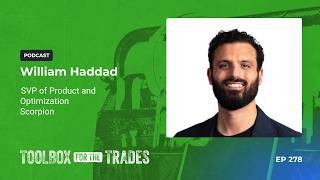
In this episode of Toolbox for the Trades, host Amanda Salvatore interviews William (Will) Haddad, SVP of Product and Optimization at Scorpion, about the seismic shift from traditional SEO to AI‑driven search. Will explains that AI‑generated overviews now dominate the top of Google results, pulling traffic away from organic listings and compressing the consumer research journey. To stay visible, businesses must broaden their digital footprint beyond their website, leveraging user‑generated content, reviews, social signals, and especially video on YouTube, which has the strongest correlation with AI brand visibility. Will outlines three core mechanics for AI visibility: (1) create content that directly answers user questions, (2) build authority and popularity signals such as brand mentions, PR, and citations, and (3) deliver strong user signals through UX, reviews, and engagement. He emphasizes local SEO tactics—community engagement, digital PR, citation management, and consistent video production—as ways to generate those signals. The conversation also covers Scorpion’s holistic service offering (website optimization, content creation, video, digital PR, AI attribution tracking) and the difficulty of measuring AI‑driven conversions. Will closes with practical, incremental advice: audit one local listing or produce one video each week, focusing on steady 1% daily improvements to avoid overwhelm.
Chapters
Hello and welcome to Toolbox for the Trades. I'm your host, Amanda Salvatore, and today I spoke with William Haddad, SVP of Product and Optimization at Scorpion. For years, contractors have been told that SEO is the key to the castle. You build the links, you write the keywords, and you wait for Google to serve you up to the customer. But with AI, everything has changed. Will walks us through how to navigate the digital noise and how to optimize the new AI marketing landscape. Turns out the answer is a little more human than you think. I hope you enjoy this conversation as much as I did. William Haddad, you are the SVP of Product and Optimization at Scorpion, and today we're going to be discussing AI search versus traditional SEO. What's actually different, how to optimize, and what consumer behavior is, how it, how it's shifting and how it's looking in practice. Welcome to Toolbox for the Trades.
Thank you very much. I'm excited to be here and this is a super fun topic for us to discuss today, so I'm looking forward to it. Thanks for having me.
Yeah, absolutely. I'm excited to talk about it too. From our previous conversation, I actually learned a lot, so I'm looking forward to having this conversation and kind of getting everyone on the same page when it comes to AI and their searchability. For their, uh, business. First and foremost, we always like to start with a little icebreaker here on Toolbox for the Trades. So what pizza topping absolutely ruins it for you?
As I'm thinking about this, I actually have two toppings that I, I cannot stand on pizza, and that is anchovies and artichoke.
And artichoke.
And artichoke. The only time I like artichoke on my pizza is there is a pizza restaurant in New York called Artichoke Pizza. And they do an incredible version of it. But other than that, it's just too sour for me.
I hear that. I was actually going to say, next time you're in New York, you gotta hit, uh, Artichoke Pizza. That has been a birthday meal for me quite often when I lived there.
So they're a pretty famous one. Yeah. No, I won't yuck somebody else's yum. Whatever, whatever, whatever you like. I support you.
I love it. I love it. Amazing. Can you introduce yourself and tell us a little bit about what you do at Scorpion?
I've been with Scorpion and digital marketing for around a decade. I head up at Scorpion our optimization and our SEO organic growth function for our clients. A lot of different areas internally. I mean, we have a pretty, you know, we've made a big investment back into our product development cycle and how we generate content and how we develop websites and how we optimize those websites and how we manage offsite signals for Google and for our clients. And so it kind of spans that whole area along with digital PR and social media, anything related to organic growth and brand growth for our clients kind of lives within my team at Scorpion. And I got to just call out, like, I work with a really incredible team of experts who've been in the digital marketing space for many, many years. Who've been focused on local search marketing. So I feel very blessed and grateful to work with such a great team for really a really incredible company.
I know today we're going to be talking about SEO versus AI. For a business owner who's been heads down running their company, how would you describe what's happening right now in the world of online marketing?
Yeah, this is a big shift. I think Maybe the easiest way to explain it is that we are coming from a world where Google used to rank websites and now AI is picking favorites and recommending brands. For the longest time in Google search and in the SEO space, it was around getting to the first page of Google because you knew if you got to the first page of Google, you would capture, you know, high intent, visibility, you could drive that visibility back to your website. And it was really around optimizing the website to gain conversion. And that whole model is evolving quite rapidly right now. And it's not even that far into the future. I mean, this has really been the theme over the last couple of years. And we're in a position right now where I'm sure many of y'all have experienced it is, you know, you go to Google, you run a search for nearly anything, it could be for a local service, for a product, for gathering information around something happening in your home. I mean, anything. And you'll see the AI overviews appear now at the top of the Google search engine page. Those are appearing more than 50% of the time. And so for those of you that run digital marketing and for those of you that, you know, are maybe engaging with, you know, with your marketing company or with an agency or you have somebody in-house or you're savvy yourself, you're going to see that website traffic has significantly declined across the board for everybody. And the big reason for that is because of the AI overviews at the top of the page, and it's really driving less visibility for the organic positions on Google. And so, you know, we're moving from a world where consumers had to do their own research in the past, and you'd have to go comb through many links on Google, and you'd have to click multiple websites to try to find the answers and run the validation yourself to make sure what you're researching or what you're going to the information you're going to rely on is actually accurate. And now AI is compressing that entire journey, handling it for you. And the mechanics of it are also quite different. You know, what happened historically with traditional search and kind of what's happening now with AI search. But it's fascinating. It's a big shift.
So when it comes to AI and what it's combing through, Yeah, it's going through as many sites as possible and really narrowing down what your intentions are for that service, what you're looking for. So what would be some of your advice for someone who is realizing that they have to have maybe a bigger presence so that they get noticed by AI?
It's time to start thinking about your entire— did you use the word presence, which is great. I like to think about it as your entire digital footprint. You know, what happens in the physical world now, the experiences that you create for your customers, it can all become known now through, you know, user-generated content and information about your brand. I would consider the fact that, you know, the website is one input now, And it's an input that you can control, but there are many inputs that AI can leverage that are perhaps more just influenced or completely out of your control. You know, you could influence your reviews online by asking for them. You can influence your reviews by asking customers maybe to reference something specific about their service. Hey, can you, when you leave a review, could you, could you talk a little bit about what the experience was like with, you know, hiring somebody from my team or having the service completed, you know, can you share something like that? There's influence, but you cannot control what somebody says about your brand. That information is really the kind of the goldmine for AI today because content generation has moved to be quite commoditized. AI can write content about anything. AI has been trained on data about everything. What AI is rewarding now for visibility is unique information about brands and about services that come from consumers. User-generated content is so important today, and it's, it's always been important, but now the context of it is being leveraged. Before, it was perhaps more— if we just take reviews as one of the examples of user-generated content, it used to be like, hey, you know, if you have the most reviews with the highest star rating, you know, that signal alone was perhaps enough, you know, so long as you had a great website and you had some good content. But now the sentiment of the reviews themselves, the language, it's not just about the star rating, it's about what are consumers actually saying about your brand and about your service that is being used to formulate answers about your, uh, about your brand and about your business online. And that highly influences conversion online. I would think about the entire footprint and how can you start to expand what you do online beyond the website, you know, beyond reviews. I would think about diversification more than ever as a function of SEO, as a function of GEO and AEO. And, you know, there's all the acronyms out there, but really it's it's all quite similar and it's all, it's all very consistent in terms of the tactics and what's important between all of these. And I would think about your brand.
I know that reviews are kind of king in, in—
Yeah.
When it comes to SEO, what other opportunities do companies have so they can expand that footprint? I can imagine that it must be overwhelming to have to think this way as a business owner that now on top of everything else that you also have to think about expanding this footprint. So what are some opportunities for business owners?
There's a lot of talk right now, like, oh, you know, SEO is dead, or there's a lot of companies that are emerging and technology that's emerging that's saying, well, I can get you number one in answer engines, and I can get you cited in AI, and I can deliver all these things, and almost pushing a different strategy when really I think you can boil it down to 3 very simple mechanics. And if you think about these 3 mechanics, it could guide everything that you do digitally online. And so for one, you've got to think, does your content answer the user's question? That's maybe like step 1. That could be, and it doesn't necessarily need to be questions, but like when, when there's a customer in your area looking for services that you provide, Is it obvious online that you are an option? Are you the answer when somebody is looking for that level of, for that service? Very simply, when someone's asking information about those services and wants to learn more and you want to be part of the research or the consideration phase of consumers when they're looking for that type of service, do you have answers to the types of common questions and issues and considerations and concerns that they might run into? That's kind of baseline on content generation. Search also is everywhere. You know, I mentioned the acronyms earlier, but what we like to think about, how we like to think about it internally at Scorpion is search everywhere optimization. The reason being is that search really does happen on all of these different experiences today. YouTube is like the second largest search engine. TikTok and various social channels have really emerged to be, you know, prominent areas. People spend hours of their day. Online shopping has picked up tremendously on these platforms. So I just, those experiences to reach customers and the touchpoints that, that users have throughout the buyer journey are everywhere and it's more fragmented than ever. And AI helps to consolidate all that fragmentation and give it to the user in one. That's why it's so helpful for us. That's why we love to, to use these tools. Does your content answer the question? That's step one. Number two, is popularity and authority signals. And this is going to really lean on your question around what are other areas that you can think about, like expanding the footprint. This is maybe one of those, one of those strategies that is just more impactful now than it ever has been before. And so if you think about it this way, let's say that I have a plumbing company. I put out content about my services for the areas that I serve, and it's really great content, and it's beautiful website and I'm fully optimized and it's all good. But, you know, Amanda on the call with me, she's got a website and she's got a plumbing business servicing the same area, equally great quality content and information about the services that she provides. But she was rated by Forbes as the best plumber of the year. And that best plumber of the year award that she got from Forbes ended up getting syndicated across a variety of different news networks and credible sources online. And so now everybody knows that Amanda is the best plumber of the year. Even if my content is better, AI is going to recommend Amanda's business because she has the credibility and the authority that is pointing back to her site and to her business and to her brand, mentioning her by name, saying, this is the best plumber of the year. And so I would think about that number 2, authority and your popularity signals. That's always been important for SEO. And we used to talk about that, like, in terms of domain authority and getting follow links and backlinks to the website. And, you know, there was a lot of benefits to that. But I'd say even more now, brand mentions from authoritative sources help AI to get your brand through the validation layer that happens when— after the query is determined. And we can talk about that, that there's all these other mechanics that happen with these prompts when it occurs. So step 1, does my, does my content answer the question? Step 2, authority and popularity signals. Step 3 would be user signals. Like when a customer visits the website, is it easy to access the information? Can I read it? Is the user experience good? Do I provide multiple opportunities for conversion? Are users talking about my brand? Am I getting the reviews? Are, do I have a social media channel? Is everything linked right? Right? Is the experience good? Do— when they visit the site, do— does— do traffic bounce off immediately? All that analytic data, that information can be used by, by Google to, to determine value and to determine relevancy for users. And don't ever forget that even with AI tools, the, the function of these tools is to keep the user engaged on the platform, to be the source of credible information so that they can acquire the user as part on their platform and they don't lose it. So now you take those 3 points and you look at your entire strategy and you go, well, how do I expand? Well, the easiest way to think about expansion is to get credible sources in your local area to talk about your brand and talk about your business. That is so critical right now. That could be done through various PR efforts. That could be done through really getting out into the community, you know, sponsorships, supporting other local businesses. Partnering, that could be done through social media, that could be done through video content, posting about your business, producing information, putting it online, talking about what you do in the areas that you serve and why it's so valuable for your customers. That strategy, that boots on ground strategy is really important today if you want to win online and you want to create a brand that will last. Through all the upcoming changes that will continue to occur as AI and agentic experiences get more inundated in our world?
To narrow it down, there's these 3 factors that we need to consider. We need to consider answering the questions that people are going to be asking. That way the AI is able to recognize and pull from that. So when people are asking questions, because that's how people are searching AI, right? They're asking, this is the problem I have, and they're giving as many details as possible. So if you have the details available, AI can comb through that and be able to pull that information and better serve the researcher. Then we have— what did you refer to them as?
Popularity. Popularity signals or authority signals.
Yeah, I love this because it's— I think it's something that a lot of people might not necessarily— might not necessarily consider consider. When you're really thinking about these popularity signals, people talking about the business, people interacting with the business, what are other ways that this might look to a business owner on how they can kind of expand that, uh, popular outreach?
You know, a lot of what I'm talking about right now is a local SEO strategy. Consumers that want to buy local or that are getting services for their household, you have to be within proximity, generally speaking. And so it's engaging with where consumers are. I think getting your name to be talked about online is really the key in the simplest sense. What would happen if every time you completed a job for a customer, not only did a review get posted, but somebody went on social media and said, hey, I just had XYZ out and they did this for me. And, you know, look how incredible my yard looks now. Or look at, look at, look at the, the, this level of service that I have. This was so great. I mean, that's just one very small example. I think it's just being connected and engaged with your community, connected with the consumers that would engage with your business and and just being a part of the story and working to get that story online.
Yeah, well said. I, I think that owners and operators like being in the community. I think there is something that is really incredibly rewarding about that. And to be able to not only have a rewarding experience, but finding something that you're passionate about, finding a cause that you're passionate about as a business owner, something that aligns with your company values, and then going out there and being a part of that is a great way to engage with the community. And very often, owners— it's, it's the best kind of work, honestly. So I think that's a great way and a positive way of engaging and gaining that popularity in search. I also wanted to talk a little bit about video. I think that that seems to be a bit of a factor here when it comes to this AI search. For trade business owners who have never made a video, where do you think they should begin? I feel like that can be really intimidating.
Yeah, just before I answer that, I love what you just said around aligning community engagement work, I guess you could say, with the, with the company's core values. When I heard you say that, in my mind I thought about it's to scale the idea and the philosophy of I exist, my business exists to be of service. I am passionate about being in service to the communities. If that really is your driving force, and for many owners, I've worked with so many local service businesses, that really is, you know, this industry wants to be in service. How incredible would it be to share that you are in service and have everybody know about it. You know, this is actually spawning one more thought for me before we get to video. Sorry. But like Chick-fil-A, for example, they do corporate social responsibility initiatives. Before Scorpion, I worked with the nonprofit space and I helped, you know, with fundraising and talked a lot about corporate social responsibility and et cetera, et cetera. But, but here what was, here's what was fascinating was they donate millions of dollars a year to charity, no one really knows about it. Don't really evangelize it. Like, it's not really like they don't necessarily lead with it or whatever. And so I just, I just think being in service and being able to take what you really are, what your business exists for, what really makes you unique, the story that you have of why you got into business in the first place. What is it about helping customers that gets your gears going and gets you and has you wake up every day and deal with the difficulties of running a service business, which is not easy. You know, you gotta evangelize that through your brand. Yeah.
I think that it, and it also makes it easier. It doesn't feel like a to-do. It doesn't feel like something you have to check a box off or anything like that. It's something to look forward to and to feel good about.
Right.
And when you're looking at AI as a whole, it can feel wildly overwhelming. But I think if we can find the human element and the human connection and how we can use that, I think it's going to make this transition with this technology a lot easier.
It's going to make it a lot easier, but that is what is performing. That is what will have you perform online today because content production, and I, when I say content, I don't just mean written content on the site and service pages and local pages and blog pages and whatever. I'm talking about social content, video content, which we could talk about. I'm talking about review content, user-generated content, all of it. Content creation. Y'all have experienced this. Can be generated with AI instantaneously, but it's only ever as good as what it's been trained on. And so if there's nothing new or there's nothing more human about it that doesn't already exist, then it doesn't help your brand cut through the noise. And eventually everybody will all have the same type of quality of content. You've got to really bring your humanness to it. That's your differentiator.
Yeah, I love that. Let's talk video content.
Let's talk video. Yeah, look, YouTube mentions have the highest correlation with AI brand visibility. There was a study done, forgetting the source, top of my mind, but they ran the— this measurement across 75,000 brands, and YouTube had the highest correlation with AI brand visibility. Gemini relies and pulls from YouTube more than many other sources they have access to. It's rich media, it's educational content, transcripts that are used in the video becomes really, you know, juicy, great content for SEO. And really, I, you know, we can't recommend it enough. Scorpion has made a big investment into helping our clients produce video content. And distribute it across various sources online. Creating a YouTube account today is so important because it's just such a prominent citation source. It is really one of the largest search engines that have the highest amount of consumer attention. I mean, people go to YouTube, they spend hours and hours and hours on YouTube. It's a great place to get in front of consumers. So what would I recommend? I would say like, don't, don't overthink it. Like, you know, in a production crew, if you got the resources to hire one, great. That could help to alleviate a lot of your concerns, and that content can be repurposed in many ways. And so it's a very, it's a great investment. But you don't need to do that. Just pull out your phone, film what you do every day. You know, a tech explaining what they have on the job. You guys are the experts. You are the expert in your craft and in your field and in your service. One philosophy when it comes to content creation, and this is so great for video content, is teach everything. If you just run with the foundation of, I'm going to teach everything that I know about what I do and the services that I provide, and I'm going to put it online in the form of video, or really any form of content, but in the form of video, I think that'll just make it easier to not try to, well, what do I have to make the video about? Just teach. And as you teach everything that you do, you're creating really valuable content to help evangelize your brand and improve your visibility online. You know, we help our clients, you know, we're consistently investing in like, how do we support video optimization? Because once you put the video on YouTube, there's all sorts of things you can do with titles and descriptions and tags and transcript usage and getting it on the website and including it in the HTML. I mean, there's a lot of different tactics that can be done to make it more machine-ready and machine-readable and, and optimized just as you would optimize a website. But it starts with having the content. Another way to think about content creation and to think about AI and to think about how these results get curated is you gotta remember that AI never hired your brand. AI never interacted with one of your technicians. AI never was in the house when the, hot water heater flooded and everybody's freaking out or it's in the middle of summer or whatever. AI never had those experiences. But if you go to AI and you ask about those experiences, it's pulling from users who had that experience, put it in form, and then it provides it. And so it's just, we humans, it was funny, I was at a really great conference a couple of weeks ago in New York, SEO Week, and brought big part of our team and we learned so much and it was just such a valuable experience. Somebody there, I don't remember, don't remember his name, but he said something and it was really funny, but it was like, oh, human beings are just the fleshy APIs to go gather data and give it to, give it to AI so that AI can provide these experiences, you know, but, but it's as funny as it is because AI has never actually experienced it yourself, you have to create it. And, and for those of you that are really passionate about your customer experience, and you invest so much into it and you believe that the experience you give customers is better than any of your competitors or better than anybody else, then you really got to think if that experience is not created in some form online, it doesn't exist to AI. And you're leaving it open for AI to tell whatever story about whatever customer experience exists about your brand online or for your customers to talk about it. And they may or may not articulate it in the way that, that, that is aligned with your values. Right. So, you know, as a form of GEO, it's really about like, hey, is my brand being articulated in the way that I want online? And if not, I need to produce content to get it to the place where it is, because that's what impacts conversion. And video content becomes a great medium to be able to go and deploy that information about your business.
When it comes to the video content, I love your suggestion of Teach. I think that it shows a customer first and foremost that you care. You're not gatekeeping something. And even if it's just these tips for keeping your lawn healthy during the summer season, or best, best practices for getting ready for the winter. Any of those kind of key takeaways that you can provide somebody with that they can learn from these bite-sized pieces of content that also show that you care and that you're, you know, you want people to have healthy lawns and beautiful spaces. AI is this mirror. And reflecting what we're putting into it and building upon that to make sure that the story you're telling is one that you're proud of.
Yeah, that's very well said. On the mirror. I love that.
For someone realizing that they might need help with all of this, what does working with Scorpion look like?
One point I want to make is that these models are evolving and changing so quickly. There's been more model updates, AI model updates, than there's been search engine algorithm updates over the last 12 months by far. And so I would be wary, first of all, of working with any businesses online that are maybe trying to sell the fact that they've got this silver bullet to get you visibility or pushing a narrative that, you know, SEO is traditional, SEO is dead and it's no longer necessary. The approach that we take at Scorpion is foundational and we really look at the entire ecosystem of your digital awareness and we look at it holistically. The website is still important and even if traffic is declining, the website becomes the foundational must-have brochure about your business to provide all the content and information and associations about your brand to create what we call entity clarity. And entity clarity is really just, can AI make sense of who my brand is online or what my business is and where I'm located and what I do? And who I service. I mean, that is really important. And so we have a very wide range of solutions and offerings and services to support our clients in their organic growth. And that is website and content generation and on-site optimization. That is also video and social content. I mentioned that we have a digital PR solution as well. We'll actually go and we'll engage with journalists and we'll look to get your brand mentioned by journalists that have a high level of authority. You know, different packages, levels. We can also produce press releases and then those press releases that we put out very often get syndicated across national or local networks that end up to really help support, you know, drive a higher level of credibility for your business. Something that I'm really— it's really top of mind for me personally as we're building a lot of these solutions is a couple of things. For one is AI visibility and attribution. It's the Wild West in attribution and tracking right now. And there are a lot of tools out there that, you know, could say that they could, you know, get you the attribution and the visibility that's necessary. But the reality is, if you really think about it, like we've built tracking to measure ChatGPT and Gemini and Claude and Perplexity, et cetera, conversions, lead conversions online. But those conversions must go back to the website in order to have any sense of lead tracking from these channels. And the experience in these channels is I, I go into the AI mode, I get the answers that I need, and I can convert right from the AI mode. Well, you can't control the tracking member that's using the AI mode. I would think for a minute about your own experiences using these search products and put yourself in the, in the, in the seat of the consumer for the moment is when was the last time you went to an AI search platform and then actually went back over to the website from this platform to do additional research? I would say that sometimes, yes, that does happen, or sometimes you learn about the brand in the discovery phase of AI, but then you go back to maybe Google search engine and you search the brand directly. And then you get the additional validation information you need before the point of conversion. That's a very common journey of the customer right now. But the influence and the attribution of what's driving success ends up getting broken there because you can't measure that. You can't measure it really when that happens. So I'm really passionate about like, how do we help to change the narrative around how we do— how do we actually track visibility? How do we track conversion from these tools? How do we track influence of these tools in the same way that we would track brand marketing and the impact of brand marketing through running radio or television or offline media or whatever, it's going to be a very similar association to look at the influence. So AI search reporting is something that's on our roadmap right now that we're looking to develop. I'm also— what's top of mind for me is how we can extract more information from the brands that we work with to help produce and distribute content for our brands because we can produce content everywhere. We can help expand the digital footprint across all the listing sources. I mean, that's something that's, that's also gotten much higher on our roadmap as of late is like the GBP is critical. We didn't really talk about that much today, but like GBP is an incredibly valuable source. So that's a focus for us. All your directories online, Yelp is becoming a very common citation source. So what we are looking to with expanding our services for AIO is, is just continuing to analyze what's actually happening. In the consumer journey, looking at the data, staying on top of it, measuring where the citation sources really are coming from, and making sure that we take a holistic approach to drive optimization across all these areas. Hence, search everywhere optimization. You know, I think brands that work with Scorpion, we work with businesses of all sizes, and, you know, we can really be the layer to help drive better consistency help improve authority and help with content distribution. And I just see that as a few, like the really key benefits that we can support our clients with. And, you know, we've got a lot of technology and platforms that I can talk for hours about, about how they help businesses. But we're also leaning heavily into AI for better intelligence to be able to serve our clients at a higher level and and, and give AI a larger context window to make more strategic decisions. I, I've seen some, some, some really great, you know, benefits from taking that approach.
Yeah, it's a really exciting time right now, and there's a lot to learn, and there's a lot to navigate. And I appreciate that Scorpion is keeping the door open to what this new technology can do and how they can navigate it with their customers.
That's right. That's right. We got to be adaptable right now. I think just, just in the same way that all of the businesses need to be adaptable. I mean, Scorpion's remaining, you know, nimble in our approach and measuring the data and also, you know, not jumping on a trend because someone publishes an article that this thing's going to work. It's just we are constantly experimenting and testing and finding what works. And we're looking at what can we provide for our clients to scale the impact that they can have in their local area. It's taking a holistic approach. It's just doing it right. You know, we used to talk about like white hat SEO all the time. It's just, it's just taking the approach that you do it above board and you build brand. Like that's really the big takeaway. Like that's what's, that's going to be the everlasting thing. And building brand today is so synonymous with search engine optimization strategy. And geo and AEO strategy today, it's all, it's all around brand building.
Will, before we go, what is one piece of advice that you would leave our listeners with today?
What's happening right now, it can be very overwhelming. I too fall in the category of like, man, this is like overwhelming to think about all the change that's happening right now. And so I guess maybe my advice would be just how do you get just 1% better every day? How do you just take one step each day? How do you look at maybe, maybe just do an audit of like all of your listings that are local, right? And just go, is there one that I haven't put too much attention on lately? I don't know, Thumbtack, Angie's List, Nextdoor, you know, whatever, something other than Google, Yelp. Like, have I gone to that profile lately? Have I looked at my reviews there? Have I built my profile there? you know, or maybe if it's around content generation, like, hey, what if just this week I produced one video? And if I have an agency, I gave it to my agency and I had, hey, can you help me, you know, deploy this or get this out? Or I put it on my social media channel as I'm doing things locally or in-house, right? Just could you do one thing? And so I wouldn't think about trying to boil the ocean as I thought, man, well, I got to do everything. I would just think about how do you start ingesting more of what we talked about today with the valuable content generation, And how do you just do that one additional thing? And you do it every day and it creates a compound effect. And you just get, you get better every day. You just, you take an action every week. Action will help alleviate maybe the potential overwhelm or, you know, anxieties or whatever around navigating change. You know, you just got to take that, take baby steps, take action.
Absolutely. Step by step, I think, is the best way to handle big, big change.
Well, thank you.
Thank you so much for coming on Toolbox for the Trades. This was a great conversation.
Awesome. Thank you so much for having me, Amanda. Appreciate the conversation and hope it was valuable for everybody. Thank you, guys.
More from Bill



ServiceTitan Virtual Agents: Simplify Before You Scale | Podcast Ep. 110 | Mastering ServiceTitan



Life After Live Events: How to Turn Post-Conference Energy into Real Profits | Podcast Ep. 297




