The Future of Memberships: Smart Strategies to Boost Loyalty with SmartAC Podcast Ep. 51
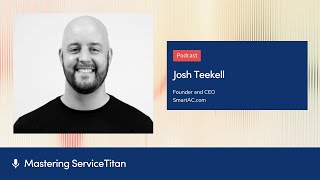
Podcast interview (Mastering Service Titan Ep. 51) featuring Josh Liu (host) and Josh Tekel (founder & CEO, SmartAC). Tekel explains SmartAC’s approach to modernizing decades-old HVAC membership programs by using low-cost sensors (supply, return, drain-pan) and software to move from fixed twice-yearly visits to data-driven monitoring and targeted service. Benefits discussed include higher retention, lower cost-of-goods, improved technician efficiency, tiered offerings (sensor-inclusive monitoring, monitoring-only, and software-only/Connect), and ServiceTitan integration. Key operational claims: rapid sensor installs, high-frequency telemetry, improved sign-up and retention KPIs, and case examples of larger-ticket sales enabled by monitoring.
Questions this video answers
Under 10 minutes per install.
Approximately 20-second telemetry granularity.
96.5% average retention across hundreds of customers.
At least 40% take rate (they've seen customers in the 50–60% range for some offerings).
A $10/month sensor-inclusive offering (and higher $20–$30/month membership tiers with one-visit-per-year).
What we have seen is by reducing the amount of times you're there, guaranteed annually, you're able to double the amount of homes that you can manage with your team and then use the data to be targeted on where you should be more than once a year.
Right.
You got to do everything right to sell, but at least you're not wasting your time in that home at that time.
Welcome to Mastering Service Titan, where you get expert advice from power users. I'm your host, Josh Liu, and today I'm joined by Josh Tekel, the founder and CEO of Smart ac. And so, Josh, welcome to the show.
Thanks, Josh. Appreciate you having me.
Of course. Yeah, I'd love to start off maybe with a quick intro of yourself and then Smart AC and the story behind it all.
My background was as a contractor, originally selling to homeowners at Smart ac, where we are helping contractors do a better job of selling to homeowners. And so. And so, yeah, everything I've done in my career has been around the buying psychology in the home. And fortunate enough to lead the team of almost 50 now@smartyc.com focused on. On customer loyalty.
Awesome. And actually, I wasn't planning to ask this, but you and I have something in common. We sold Cutco knives to homeowners for a few years right out of high school. Is there anything from that experience that led to, you know, homeowner psychology and understandings there?
Oh, no doubt. Well, I think that's a big reason why when I started my first company a couple years out of college, it was selling homeowners. I already found, felt really confident doing that. And Ms. Jones is. Ms. Jones is Ms. Jones. No matter what the business is. If you're, you know, so like working with our larger clients on strategy of exactly the. The psychology inside of each one of their membership offerings and everything is where I get the most fun out of my job today.
Amazing. Yeah, let's dive right into it. I know there's so many things a business owner can focus on, like marketing and operations and commissions and whatnot. But why is customer loyalty such a big passion of yours? And why is it so important for contractors?
It's the reason we started the company. It was studying the way that memberships had worked since the 70s and 80s. It was really the only way to acquire and retain an ongoing relationship. Yes, it makes sense to spend money to have a demand call for that day, but to get past day one to the future business, that was the only way. And so we saw very bad take rates, 20% plus and knew that there had to be a better way to be able to increase the customer lifetime value by making sure that you own that home. Moving forward, we focus on doing that with creating incredible experiences for the homeowner through the data that we get from the home. Really just making any of those situations where they have something they need, whether it's H Vac, plumbing, electrical, as close to a magic experience as possible, even though of course it's not fun to spend on those items.
Right. And I haven't been in this space very long, so actually I'm curious about a little history lesson here. Can you talk a little bit about how memberships have changed over the years and how contractors think about it, how homeowners think about it?
Yeah, so they really haven't changed much. That's what we're trying to do. But in the 70s and 80s, Jim Abrams and others, I'm leaving out a few, but came up with the concept of, hey, you know, you go out there, you sell something, a big ticket item and you know, it's kind of like planting a Christmas tree. That's actually what they compared it to back in the day. So you can't keep selling a new system to a customer every two or three years. You have to wait 10, 12, 15 years. So originally they would put them on a maintenance agreement when they sold them a new system. But now of course it's better to grab them later in that progression of the system aging. But it's just always been a couple of visits a year heating and cooling season to be able to go tune up the system and have some face time with a customer. Because without that there hasn't been really any way to have any interaction. And so two days a year of that interaction and the goal is just to make sure that you get that next demand call. So everything we do of course at SmartC is to try to accomplish that same objective, just doing it in a different way than had been done for 50 years.
And membership seems like something that's a no brainer. But I know there are some contractors out there who maybe still don't do it or just do a really bad job at it. Why do you think some people still don't offer memberships and what are some of the biggest mistakes people do when they start?
I think one of the main reasons people don't. Well, first of all, most people offer them. They've been kind of taught by best practice groups for decades, so very few people don't offer them. A lot of companies don't focus on Them very much generally because they were the only way of acquiring an ongoing relationship. People. It was a race to the bottom on the pricing. So it might be 15, 20 bucks a month. They're selling them at price points that don't even cover the labor of going to the house a few times a year. And so that's not a fun thing. It's really the only thing they would sell at a loss leader. And then in general, you know, attrition can be very high. And so people just get run down doing it the, you know, same old way and they don't see the benefit because, you know, again, it's the same way your grandfather was doing it. So I think that's, you know, the main reason I would say, are there.
Any quick like no nos that if someone's listening right now, like you could offer them like, hey, if you're doing this, definitely should stop.
You know, I think the probably the main one is offering a day one discount as the main reason for the homeowner to sign up for the plan. Often you'll get companies that have a pretty good like take rate where they sell a bunch of members, but they all turn off in the first year because the main reason the homeowner signed up was that 10% discount that they got on that service that day. Number one thing you want to do to stay away from is having the homeowner sign up. For some reason that isn't the ongoing value of the membership. So because it's, it's not sustainable if they got all the value day one, then there's that. You have to think what would be the reason why they stay with this plan 6, 12, 18, 24 months from now. And if that checks, you know, if that makes sense, then you have a better chance of keeping them around. But putting them on a membership just to have them turn off is, you know, accomplishes nothing.
And this gets into the fun topic of homeowner psychology here. Can you talk a little bit about why a homeowner would want a membership and how smart AC makes memberships way more valuable for them.
Main reasons homeowners have bought memberships over the years is really peace of mind and trying to stay away from that loss of comfort.
Right.
If you tune up the system twice a year, you clean them, you do that, there's not a whole lot to do on site, but if you do that things on site, the homeowners have been trained that they have less of a chance of breaking down right at the end of the day. That's really what we're trying to accomplish with the data that we have coming off these systems is many times those trips to the house become redundant because these systems don't really need to be tuned up every six months. But when it was the only way of getting a facetime with a customer, it made sense to kind of be pushing that. And so really the goal is to be adding value whenever you can to the homeowner. Now, H VAC specifically isn't something that homeowners want to think about very much, and they really don't until they need something. But offering them that peace of mind, some transparency into the process, knowing when the right time is to service the system, knowing that it's been done correctly afterwards, like all of those things are like a dashboard for your H Vac. And you know, you wouldn't drive around a car nowadays without a dashboard. And it's nice to have a third party kind of showing you a blinking red light, you know, and having some transparency in the process as well.
Yeah, it sounds like you all have been quite innovative when it comes to some of those best practices and the monitoring. Can you talk a little bit about how it's evolved with the technology these days?
Yeah, so our goal was to be very cost effective, very easy to deploy, and give the homeowner really focus on homeowner experience.
Right.
We want to give the homeowner a great experience so we can accomplish the key KPIs of acquisition and retention for the contractor. We try to help contractors have different membership offerings for different buying Personas. So homeowners for decades of, you know, 20% have signed up because only 20% of people are willing to prepay you to come out to the house a few times a year.
Right.
But by adding the technology and the, and the app relationship with a contractor, maybe we can get that to 30, 35. We've seen that.
Right.
But then some people aren't going to pay you 25 or $30 a month. They're just not going to do it. And so using the technology for a lower priced option like 8, 9, 10 bucks a month will capture a different buying Persona. And then, you know, what we're focused on now is how do we even go down market even more from there to be able to give every homeowner some option to engage with that contractor at whatever level they are willing to, all the way down to free, so that we can help contractors accomplish the main goal, which is just getting that next demand call at the house. That really was the only reason memberships were conceived of to start with. And really the only should be the only goal of any membership platform or any membership strategy moving, you know, today.
What are some of the offerings with Smart ac? What does the platform look like and some of the features and technology?
Yeah, so real simple sensors. One goes in the supply vent, one goes in the return air for the pressure and the delta T of heating and cooling. And then one sensor goes in the evaporator drain pan. And so the key, even though they're real simple, to deploy sensors under 10 minutes. But we were pulling that data like 20 second granularity. And so we create a model for every single house and then we do like, you know, looking over time, the regression analysis to understand how well the system is operating. So it's really obvious when you're running both old school kind of algorithms on H VAC technology and then you're running a machine learning AI approach as well, when they both say something's wrong, that's when we, you know, serve it up a monetizable opportunity to the contractor. And we allow them, we actually don't send it to the homeowner, we send it to the contractor first, allow them to be the hero, calling them up, calling their attention to the problem. Everything we're trying to do is to empower the contractor to kind of be that hero to the homeowner by giving them the experience they promised when they signed up for the membership with that technology.
How does pitching and structuring the membership work with the homeowner now?
Yeah, so. Good question. So most of our clients are going from, we Talked about A2 to visit a year plan. They're going down to a one visit plan, at least for H vac. And then they're telling the homeowner, hey, we used to come out twice a year to do all the physical things, but a lot of that was just to see how your system was operating because we were blind. But now we're actually putting these sensors in your house. We're going to monitor it all year long and we're still going to come out to take a look at the physical, do the physical things we need to do, blow out drain lines, things like that. But if it says you're 95% efficient in the dashboard, we see that and you see that in your app. We're not going to make you take out part of a day of work to meet with us. And so what that does is allows the contractor to save half of the cost of goods going out there, which allows them to free roll everything we charge for our platform monthly and then also allows them. Really one of the other problems that we see is very high pressure sales tactics multiple times a year. We all want to sell something to the homeowner, we get that, but they're batting those things away twice a year. That can lead to attrition. And so what we have seen is by reducing the amount of times you're there, guaranteed annually, you're able to double the amount of homes that you can manage with your team. And then you use the data to be targeted on where you should be more than once a year.
Right.
So there's still going to be other opportunities, but you just have the data enabling you to know, you know what, since I'm out here in Montana, what rock to cast the fly behind?
Right.
If we tell you there's no fish behind the rock, don't spend your time there. And if there is a fish behind the rock, you still got to present the fly. Right. You got to do everything right to sell, but at least you're not wasting your time in that home at that time.
Do you have any tips for if people are interested in taking on some of the sensor technology and shifting their memberships to this new model, what do they have to implement in terms of like a change management or business model to implement something like this?
So we have different offerings that we have. We have our detect offering which is powered by the sensors, and then now we have our new Connect offering which is a software only offering. So there's different ways to go to market. You can start with one, then onboard the other you can go different paths and the different paths have different change management requirements.
Yes.
If you're going to put sensors in the house and teach your techs how to do that 10 minute install and you're going to reconstruct your plan totally around it, which many people, most people do. That does take a little bit of, you know, game planning. You know, four, three, four, five weeks, we work with you to get to launch. But if, you know, if you want to start taking advantage of some of the software only offerings we have, people live with that in a matter of days and that doesn't require the sensor. So the end of the day you really just need to decide, is this the right time to be thinking about this for your business? What do your metrics look like? Right. If you have really bad acquisition and really bad retention, then you have a huge leak in the bucket and you can't grow your customer base. So most of the time we try to work with our clients with building a model of their current numbers and then showing them a five year pro forma of what it'll look like with the average numbers of our customers. Having a 95 plus percent retention rate means that you stack a lot of customers over time. And so it's really just a numbers game and we try to run the numbers with people so they can make an educated decision.
And how does the software only model work? I'm not as familiar, so forgive me for my ignorance here, but what's it look like?
Yeah, so it's kind of brand, it's kind of brand new for us and that's that so much of the relationship was fostered by the software.
Right.
So the homeowners can video chat with the, with the contractor and show them what's going on at the house. They can buy filters that blow Amazon pricing.
Right.
You don't obviously have the data from the sensors, but we have some thermostat integrations where you can get some of that data in that way. But at the end of the day and really the one of the biggest features of our platform is the loyalty rewards, the kind of airline miles, if you will.
Right.
And so if a homeowner won't sign up for a third hour plan and if they don't want monitoring only they don't want sensors in the house, which is probably going to be 50% of all homeowners have something to be able to check the box in their mind that that's my company and I'm going to use them in the future when I have a problem. And so that's what the connect offering is for people that are already deploying the sensors. It's a great dropdown offering to be able to capture more homes. For the people that haven't yet done that, they can start day one with having their own white labeled branded app for the homeowner engagement piece so that they can try to win that next demand call and give the homeowner as good of an experience as they can have.
So shifting from the twice a year to once a year. I know a lot of contractors like to try to put in all their membership visits during like the shoulder seasons in the spring and fall. Does this change any of the timing around that? And some of the scheduling it can.
Especially way up north. There's, you know, there's some situations. We actually worked with some of the biggest technical minds in the space, Jake Berman being one of them at Measure Quick to kind of put together a plan for what that looks like in different temperatures. Most climates you can still do once a year. And then of course, with having the data like you're going to see, you know, when it pops on the first time and see how it's running too. So it's not quite the same as flying blind, but. But yeah, there's, there was a few, you know, if you're south of the Mason Dixon line, you're good to go. But yeah, if you're up north, you might have a little bit more considerations as far as, you know, how often you go out depending on what you're offering.
That makes sense. It's a very dynamic landscape. How about the smart AC and service side integration? How does that work exactly?
Yeah, so our goal was to build our platform with the integration with Service Titan so that the data would just flow straight through. Of course.
Right.
But we don't want them to have to log in. Of course, they don't have to look through the data to find opportunities. Those flow to the top in our dashboard. But we wanted those opportunities to flow directly into their daily workflow.
Right.
And so that's really what the integration does. When there's an opportunity at a home where something is trending down very badly, it goes directly through the Service Titan. So the csrs can see the high level data and reach out to the homeowner. And then of course, for demand calls and for non demand calls, for annual maintenance agreements, visits, the bookings through the app flow directly to Service Titan as well. And the real time availability API that you guys have now makes that really beautiful where the homeowner doesn't even have to like verify anything. There's no verification. It, it's purely software and no human touch, which can really help with CSR bandwidth as well.
That's awesome. Since you've seen this from day one till now, are there any favorite moments working with your clients or with customers or any customer stories that you can share to highlight some of the use cases here?
The main thing we're trying to accomplish is getting the next demand call on a big ticket item.
Right.
And so it's fun seeing clients that have success stories of just, hey, I put this on a, on a nine year old system and it broke down and I sold a $15,000 ticket at 50% margin.
Right.
So that's, that's really great. I mean, seeing people more excited about memberships because like we talked about, they've been around a long time, but technicians are bored with all of that. So it really is like revitalizing their kind of entire strategy. Around customer loyalty and then in the integration, of course, you know, it's, it's great to, to have that feedback loop as well. Over time our algorithms are getting better and better because we know not only hey, we sent a lead here, here was the data trend that went to that and then here's what they sold, here's what it, here's how much margin it was. Right. And so integration of course been around for a couple years, but as we build more and more data it allows us to be even better about how we're predicting when things are going to be needed and predicting how much revenue there is at the end of that, at that call.
In terms of an H Vac company like their size, their offerings, are there certain H Vac companies that are like perfect fits? Like this is if someone's listening, it's just like low hanging fruit. You should definitely add this to your business. And then are there others that are may not, that may not be as good of a fit like if they do like all commercial or like construction or I don't know, something like that?
Yeah, we focus on residential. So I would say for smartyc.com you know, need to be majority resi. Of course we work with, with companies that do commercial as well. But if, but it's. While the technology is applicable, we have been really focused on the use cases and the software around the homeowner experience. And then size wise, I mean we have customers all the way down to two trucks. So especially with the new Connect offering, like it's an ideal offering for a smaller shop to be able to really have level up their overall experience with their homeowner by having their own branded app overnight. I mean it's a really cool offering. So we haven't been on the airwaves with it yet very much. It's brand new for us, but excited about scaling that a lot in back half of the year.
I just really like that approach of like the different user or buyer Personas of like hey, if they don't want that traditional membership, what are some, what are other ways that we can create this connection, this ongoing relationship with the customer and capture that customer loyalty?
Yeah. The goal is to sell every homeowner a 20 or $30 a month membership.
Right.
But a lot of people won't sign up for that and we just need to have something else to offer the people that, that won't because otherwise you're going to lose them back, you know, to the ether and have to spend on Google for them next time.
Right?
Yeah. And just to clarify, you guys now, instead of offering that one and done now you guys have three kind of tiers.
So we have two offerings, the $10 a month inclusive of the sensors. And then we have a software only offering as well. And so those two offerings power a 20 or 30 membership with one visit, a monitoring only, where you don't go out to the house annually at a much lower price point, and then a software only offering if the homeowner just isn't going to pay you anything monthly. And that's actually meant to be subsidized just as a way to be able to grab the home but still give the homeowner some of that value through the software to try to be in front of them next time.
Very cool. Wow, it's so crazy how much memberships have not changed in all these years.
They haven't at all, like literally for 50 years at all. That's why we start with the numbers, right? Like look at your numbers and then compare those numbers to what we see. But it's all a numbers game and we try to let the numbers do the do the talking because otherwise they're like, well, no, my grandfather did this way. It's always worked for him. And true, but like your grandfather didn't have this tech, right? We're trying to slowly reframe the industry, but some of the bigger players are having a lot of success and that's.
Helpful of course, actually to highlight some of those numbers. Which key KPIs should a business owner be thinking about when it comes to integrating something like this?
I would say there's three main ones. Number one, what's your signup rate? We like to see 40 plus at least. But then you have to couple that with a high retention rate. And so if you can be over 40 and then over 90, I think that's great. We've had customers when they lean into the monitoring only as an offering be up in the 50s and 60s. We think with Connect now maybe we get to 80, 90. My goal is to get to 85, 90 as far as take rate. But then retention, you know, our average customer is 96.5% across hundreds of customers. It's unbelievable. And that's just a function of giving the homeowner value they can see all year long instead of twice a year. So yeah, I mean if you can be, you know, over 40% and over 90%, that's a home run.
Another piece of value is going from that two visit to one visit. Seems like contractors save a lot of overhead Costs on sending out a technician to a job that you don't get any money from, and then the opportunity cost of taking a way more valuable job in its place.
Yeah, no doubt. Now, sometimes these are on shoulder seasons, but in general, where there's not as many demand calls, of course, but in general, we help people double the amount of homes they have under management and over. Over time, over a few years. But then do it with the same team.
Right.
Because we've decoupled, needing more trucks and more people to. To own more homes.
Right.
With monitoring only, you literally don't even have to go until there's revenue. So you could just be stacking those up and then just going out for big ticket items.
Right.
For demand calls. But yeah, the CFOs love the fact that they can directly affect the cost of goods of all of these agreements, get them more close to break even instead of a loss leader, and dramatically grow the base of them.
That's incredible. I will provide a link in the description here of the. The integration so you can learn more and reach out to Smart ac. What's next for you guys? What are you working on behind the scenes that you're allowed to talk about?
Well, the Connect offering was what we've been working on for a long time, so that's just. Just coming. Most people won't have heard about it yet. It'll be hitting the airwaves in a big way here in the next couple of months. Our goal is to really be able to give contractors a way to own the home for H vac, plumbing, electrical, garage. We're really focused on H vac, of course, and plumbing, but we have some really cool hardware integrations that we're working on so that if a homeowner wants to have everything covered with IoT, they can. And when we need to make those ourselves, we will. But when we can partner with someone else that's a little bit more efficient. The goal is just to give, you know, give contractors more tools to be able to attain loyalty with customers.
Beautiful. And I know I did want to call you guys out and shout out that you guys will be at Pantheon this year, which is super exciting. It's always an awesome event. Can you share a little bit more about what you're bringing to Pantheon?
And yeah, our biggest presence so far, people and booth size. And yes, agreed, it's. It's always our best show of the year. There's some good shows, but it is the best. So we are really excited about it this year, as we were last year. And excited to see you there as well.
Sounds good. Yeah, I'll be there. And are you speaking at Pantheon, or do we have any workshops?
Yeah, Andy and I are speaking at one of the breakouts. Yep. So I don't have the details yet, but it will be about customer loyalty for sure.
Perfect. So, yeah, be on the lookout for that, and we'll see you at your session. Thank you so much, Josh, for joining us today.
Yep. Thanks, Josh.
More from Bill



ServiceTitan Virtual Agents: Simplify Before You Scale | Podcast Ep. 110 | Mastering ServiceTitan



Life After Live Events: How to Turn Post-Conference Energy into Real Profits | Podcast Ep. 297




