The Golden Carrot & Working w/ Your Sisters | Podcast Ep. 89 | Toolbox for the Trades
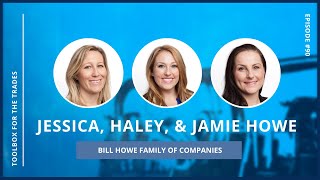
A podcast interview with sisters Jessica, Jamie, and Haley Howe who run the Bill Howe family of companies (plumbing, heating & air, restoration). The sisters describe company origins (originally AM PM Plumbing), their individual career paths (Jamie: plumbing operations manager, started 2008; Jessica: CFO, started 2012; Haley: restoration GM, started 2009), current scale (about $35M annual revenue, ~217 employees), leadership transition during COVID, and practical advice on finance, dispatch, training, family communication, and growth plans (remodel/electrical divisions, marketing/TikTok).
Questions this video answers
$35 million
217 employees
Jamie: 2008; Jessica: 2012; Haley: 2009 (Haley started Nov 1, 2009)
AM PM Plumbing
$7 million
Jessica Howe, you are the cfo. Jamie, you are the plumbing operations manager. And Haley, you are in charge of the restoration and flood services division at Bill Howe Plumbing, Bill Howe Heating and Air, and obviously Bill Howe Restoration and Flood Services. That's a whole lot of things I just said. But you three are sisters, and you run three corporate entities which net about $35 million in revenue in a year, which is absolutely insane. You are my very first trio that I'm interviewing on this podcast, so I'm a little nervous, but I am so excited to hear your story. Why don't you say hello to our audience and introduce yourselves? Jamie, you can go first.
Hi, I'm Jamie. I'm the plumbing operations manager, and I got to start my venture here at BILHOW back in 2008. So I've been here quite a long time. Started as just a call taker doing collections, so started at the bottom and now I've worked my way through becoming the operations manager on the plumbing side. So very happy to be here. Thank you for having us.
Oh, no problem. Jessica, why don't you go next?
Hi, I'm Jessica. I am the CFO here at the Doha family of companies, as we like to call them. And I, similar to Jamie. Well, I started here in 2012 right after college and was a call taker too. Worked my way up family business. Have quit once, returned once, but been here ever since. And yeah, love it, love it every day.
Hi, I am.
Oh, sorry.
It's all good. And last but not least, Haley.
Hi, I am Haley Howe. I started here at the company in 2009 in the restoration and flood division when my dad decided up to open that division. And I am the. I started as a call taker in that division and then worked my way up to the GC and general manager of the division. And I also love working here.
That is amazing. Thank you so much for those introductions, Jessica. Thank you for the Bilhow family of companies. That is how I will refer to you from now on, for sure. So, normally I start this podcast with the same question throughout the board. This is going to be the very first time I do not ask this question because I know how the three of you got in the trades. You were born in it, and I appreciate the transparency, especially with you, Jessica. As I left and then I came back and we'll get into that a little bit. But before we even do that, I would love to just learn how Bill House started. So, Jamie, why don't you take that question, tell us a little bit about where the company began and where it's at today. Awesome.
I would be happy to. The company started originally as AM PM Plumbing. Back when the yellow pages were around. AMPM Plumbing was right at the top. So my dad thought, what a great name. I'll be first in line to get those calls. And he was. So with that, he began his venture in Pacific beach in San Diego on his bicycle with a drain machine in the basket, going up and down the boardwalk, just snaking drains for I think $25, $35 back then back and forth and then started in his apartment in Pacific beach, outgrew his apartment and rented somebody else's garage so he could have a mini warehouse. And then he needed a call taker. And lo and behold, our mom was in the same apartment building and she needed a job. So she was first a, like a housekeeper at a hotel in Pacific beach at night. So she started answering phones during the day with him and then kind of the rest is history. We continue to grow, outgrew the apartment complex, went and rented a building in the Marina Boulevard area and then continue to grow from there.
Can I just say real quick that your dad riding a bicycle on the boardwalk is the most San Diego way to start a business?
Yes.
It's one of his like most famous stories. On July 4th because it was party central and they all, all the restaurants were clogged back to the hive.
He would just like go and be like, you clogged, you clogged, you clogged.
Yeah.
At the end of the day I love that. I also love how your mom first was his employee and then became his wife. Can you tell a little bit about how that happened?
Yeah. So she, he had his apartment and she lived upstairs with her boyfriend at the time. She came over from England on a one way ticket out of England when she was 20 and with her boyfriend at the time came to San Diego because she had a friend here and said, hey, come to San Diego, it's great. So she came over, like I said, one way ticket, no way home and decided to because she loved it and then needed a job. So housekeeping and cleaning rooms at a hotel was her first, her first job here. And then the phone started happening and she needed, my dad needed a call taker and so she lived in the complex. And then yesterday the boyfriend went back home. She stayed working at then a few years later, Bilhow Plumbing.
I know that the story goes as well that at some point in their relationship after they started dating, she came to him and was Like, Bill, I'm going to be deported. Because for years working for him, she had given him fake Social Security numbers because back then it was all paper based. And he was like, well, I guess. I guess we should get married. And they did. And I forget, maybe 15 years later, she went and actually got her citizenship and now she's a US Citizen.
That's amazing. I also just love the strategy of I need employees, I better marry someone, and then that person better have a series of children so I can one day employ them as well, which I want to get to in a bit. But before I do, I already mentioned $35 million in revenue across the three entities right now, which is incredible. Congratulations. How many employees do you guys have right now?
The official headcount as of yesterday was 217.
Holy cow. And just to you guys all came around around the late 2010s, 2008, 2009. Where was the company when you first joined Hayley? Do you remember?
Oh, my gosh.
Probably in the 80s, maybe 80 people.
Around that time, you didn't have anything. Yeah, Restoration wasn't born yet. Or heating and air.
Yeah, just got started.
Just got started.
80 people.
So it's safe to say that once the three of you really came in, the company really was able to grow substantially. That's the takeaway I'm going to create anyways, so spoiler alert to anyone listening. Before I invited these three wonderful women on, I spoke with Jessica first to get a little bit of background because there's obviously so much to cover here. And one thing she said was that throughout your lives, as you guys were growing up and figuring out your careers, your parents always dangled this, like, golden carrot of, hey, come work for us and we'll give you a career. But they never actually pushed it on you. You were never expected to go into the family business. And I would really like to learn a bit about what made you decide to commit to it as a career. And Jessica, maybe you can start with this one first, because like you said, you did it for a bit, you left and then you came back.
Yeah. So I had graduated College in around 2012, and I had gone to work for another company out of college and importer of, like, Japanese and Chinese organic food. Started as a little call taker there, and I got really bored. I wasn't motivated to work. I wasn't excited about going to work, and I couldn't figure out why. I was like, what's going on? Like, I'm. I'm a really hard worker. My Parents, you know, they brought me up to do really well, to motivate myself. I want to do well in what I do. But I was unhappy with where I was working and, you know, so my parents were like, well, you know, come work for us. Come figure it out. You know, we'll help you. You'll get, you know, great pay, good benefits, you'll work with us and like, okay, why don't you. I don't have any other plans right now and I don't know what I want to do, so I'll go try it out. And so I moved. I moved over and I started as a call taker. And then, well, I started filing because back then we had legal side paper, carbon copy invoices. And then I became a call taker, a dispatcher, worked on our billing side as well. And that's kind of where it happened, where I started to understand some of the stuff that I like to do when I work and some of the stuff I didn't. And I realized I am not a call center dispatcher whiz by any means. But I really enjoyed following the money, so I really enjoyed calling people for money and collecting on it. And I ended up quitting the job because there wasn't a position for me necessarily at that point. And I wanted to go explore other options. And so I went and went to night school for accounting and I went to go work for a CPA firm as well, and I ended up getting my CPA license and I went back to my parents at that point and I was like, hey, I work in accounting now. I think you have a need for this. I think you have a need for strong financial leadership, strong accounting skills, and I think I can bring that to the table. And so I came back on and I worked just accounts payable. I was still, you know, bottom of the barrel in the accounting world, and I worked my way up and the companies have been able to provide me with a career path and they've given me leadership skills and they've given me an opportunity to grow my passion, which is, you know, accounting and finance. So, you know, the golden carrot for me was this ability to find my passion and pursue it.
That is awesome. I really love. And that's such a rare path that I hear on this podcast. I do hear a lot about people who inherit leadership positions from their parents who start the business, but they start at a really young age and they're kind of nurtured for that leadership role. I really like that it was really open ended for you and you were able to come back once you had gotten those skills and just be like, I can offer this for you. How do you feel about me coming on? I think that's. That's really cool. Jamie, what was your experience like after college?
I went to work for a food manufacturing company, actually, and I did dispatching there and some pr, and I was living in Newport beach and just having fun after college and did not really have a career path in mind at all. And. And Newport beach wasn't working out as well as I thought it would. So they're like, come back home. Come figure it out, similar to Jessica's story. And so I'm like, okay, I'll come back home, but I'm not living at home. And in hindsight, I probably should to save a lot of money. So I moved to Encinitas, and then I commuted down, but started at the bottom. Didn't know what I was gonna do. But I really love working with our teams. I really love working with our guys and my dispatch team and our csrs. It's fun to see that growth. It's fun to figure things out and find the best job for the best guys in the right area so that they're happy every day when they get to go to work and fix things for people in San Diego. It's been a pleasure to work with them. And it's fun. I do. I enjoy myself. I have a good time. And Jessica didn't like working with me either, which is why she quit. I'm sure we'll get back. We'll get into that in the podcast later on. Just this whole sister dynamic.
It's going to be great. She's the oldest sister.
We're definitely getting into your opinions of one another, and I cannot wait. Haley, I would love to learn also for you, what was the moment where you were like, okay, I'm going to start working at Bill Howe full time and of kind commit to it.
Yeah. I also had just left college and I was working as a project manager in San Diego, and I didn't. I wasn't doing very well financially. It was very hard. And my dad. I was constantly talking to my dad about it, just calling him, like, what do I do? I don't know what's going on. There's this, this. And he's finally just said, come work for. For Bill Howe. I'm opening up a restoration and flood division, and we need your expertise to help it. Just come here because I don't have anybody else.
So.
Yeah, in 2009, I got my WRT certification and started on November 1st in that division and we were just growing. We had, I think three employees at the time. I did call taking and dispatching and then from there, because I went to school for architecture and I did some project managing, I was able to get my contractor's license to then have the license for that division and just work my way up from dispatching to project managing to estimating kind of all the different positions in the industry and then now up to the gm. That's.
Awesome. Congratulations, all three of you. You have really impressive career trajectories within Bill Howe. And I know that wasn't easy at times, but really inspirational for sure. Now we are going to get into the sister dynamic, I promise. But all three of you have really unique skill sets and really different, really different strengths within the business. So I would love to talk to you a little bit about your big tip and your big aha moment. So, Jessica, as cfo, how should contractors think about their financials? Especially if they're aspiring to be as big as Bill Howe one day, they.
Should understand their financials. First off, don't be afraid of accounting. Don't be afraid of a profit and loss statement. Don't be afraid of a balance sheet. You know, you have to understand that in order to be successful. You know, you can job cost 2 Tibac 2, but when you put everything together in a big picture, you know, that's when you'll truly understand how well you're doing as a business owner. One of the things to, you know, a contractor should really focus on too, especially as they grow that in growth, you have to look at everything. You have to look at all your expenses. You have to look at every transaction that comes through because if you don't know, things will fall through the cracks and next thing you know, you're going to be spending $4,000 on a dumpster in the back that you don't need, you know, so it's really important that you look at everything that you have your head wrapped around, what's happening in your organization from financial standpoint. And you know, there are people out there, there are consultants, there's, you know, best practices and service titan that can help you do that. And just the biggest thing is don't be afraid of it. Never be afraid of it. If you've gotten this far in life with your business, you are obviously unbelievably smart enough to do it. And yeah, no fear.
I take it that the $4,000 dumpster example is a real one. Is a real one.
Yes, yes, yes. There's a date.
And that was really when you kind of came on, was during like basically the company has since 2x since you, the three of you have joined more or less. And so I'm sure you've been able to see that kind of stuff. And when you grow so quickly, when you open up new divisions, it's like, I'm sure so hard to keep track of everything if you don't, if you're not actually doing it on a consistent basis.
Yeah, yeah. And with growth, one of the skill sets that I feel that I brought to was the accounting understanding that a family business, organically grown, didn't necessarily have to structure their books because at a certain point when you get to 20 million, it's so important that your books are not only there and you can understand them, but that they're accurate and correct.
Jessica's background has helped both of us understand the financial's so much better also, just because we trust her being our sister and we can come with her with our dumb questions and not feel dumb.
Jamie, I know we already kind of alluded to the fact that you were definitely in with dispatching, in with the pit. You're now the plumbing operations manager. But I love talking dispatching. So looking at what you've learned in your time dispatching, taking calls, what kind of tips would you like to give our audience of contractors who are trying to assuming aspire to Bill Howe stature?
But you know what I was saying? Of course.
Thank you.
I think one of the biggest things that I learned from the get go when I was first starting in dispatch is really understanding my zip codes, where everybody is really understanding what your technician skill sets are. Because if you have a ccr, CSR call in and they have a priority one call, which would be like a flood or no water or sewage everywhere, no facilities. You have to understand already without looking at the board, because you're in it, where your guys are at, what the zip codes are and what their skill set is, because dispatch is so dynamic that it's unpredictable. And you want to make sure that you're capturing all those leads because that's revenue that's going to be on your board today and hopefully a customer for life because you're able to provide that emergency service in real time. So I think for me that was just one of the biggest things. So that you can also train your ccrs or your call takers on those priority ones and they can have a lifeline to dispatch to say, yes, we can Take that call. I have this guy in this area. The customer's on the phone for that long and you guys are already building that and placing that need to get servicing asap.
That's awesome. And I like the idea of having that lifeline to dispatch in order to prioritize those high level calls. I had a question and they're gonna. And it's losing me. Okay. Do you have any type of tips that you use to kind of memorize that stuff or is that something that you find you just learn by doing and just really ingratiating yourself in the practice?
Yeah, Service Titan is a great help as well. They can color code and then also with the skill sets with your plumbers, but I think it just comes with practice on the job training because it's going to take a lot of memorization. We have 60 technicians and I unfortunately know 80% of their phone numbers by heart. But it's because it's a now thing you want it because they're there to make the most of their day as well. And they want to increase their price per ticket as well. So I think when you return that back to them, when they're ready to take that late call for you, you're backing them. And that's really important as you grow your teams because as much as we want to service that customer, we want to make sure that we're filling our board too and maximizing those dollars for our guys that they're best at. So I think it's just repetition, understanding zip codes, understanding skill sets, and really building that team so that you guys can work hand in hand.
I barely know my own phone number, so I'm impressed by that. It's really something. Haley, architecture background. Holy cow. I know that is so difficult, but also is opening up a whole new division. So how should contractors approach doing something similar? And for reference, a lot of folks on Service Titan, for example, maybe they start with H Vac, they open up a plumbing division, vice versa. So I would just love to hear from you now that you've lived it. You know, what would be your best tips for that?
Well, it kind of just developed. So being in the restoration and flood division, a lot of our customers are going through insurance to put their homes back together after a flood.
And.
And since their home is torn apart, we have the discussion of, well, why don't you do a cabinet upgrade or a kitchen upgrade or a bathroom upgrade tile. And so it kind of just developed in that manner. We're still navigating the just kitchen and bath remodel section of the division. In terms of how do we estimate this? What are our margins? Can our subcontractors handle this? What about our in house technicians? And so it's still developing, It's a few months in, but just I think when I was talking to my operations manager, it's more of just planning and preparing and doing research and talking to other contractors on what they do and what, what works for them.
Got it. I mean, it makes sense too. If you're going to have technicians in your home clean up after a flood or cleaning up after some sort of disaster. It's like, well, while you're there, why don't you just, you know, put some new tile on? Because I can't stand looking at it.
Yes, exactly.
And also restoration was pretty new when you joined as well, and now it's grown be, I think $7 million you said to me, right, Jessica?
Yes.
So how does that feel being there from the beginning, Hailey?
A lot of ups and downs trying to navigate it, working with insurance companies and figuring out how to get paid from them, but it's actually pretty cool. It's super interesting. I think it finally took off with the help of my sisters and all of us helping to navigate it better. They have both helped me implement different systems to help bring in money faster, work with insurance companies, the financial specifically. So like I said, it's pretty cool to see it grow from the ground up.
That's awesome. And definitely seeing this throughout, all your answers, all the support that you give one another, which I just absolutely love. So we just went over your own strengths and your specialties in the business. But I'm curious what your other two sisters have to say about what your strengths and specialties are. So Jessica and Jamie, what would you say is Hayley's biggest strength?
It's a kind of a funny question too because, you know, I handle some, we all kind of handle some of the marketing. I'm like the direct point of contact because we outsource it. But recently, you know, Haley's come and said, you know, I really want to be involved. And I was like, great, okay. And we just have a new social media venture where we're, we've hired somebody to run and create like TikToks and Instagram Reels. And I being my analytical number self was like, oh, I can't do this. And Hailey has jumped right in and her biggest strength is that ability to bring a smile to our employees face and calm up and say, hey, you want to be famous? And to rah Rah them. And to just bring.
Convincing them.
Yeah, yeah. Bring energy, like, so much energy to what she's doing. Right. And she's got that. That. I don't know, that. That brightness, I guess, you know, she went around all Tuesday, ran around to five different jobs. Rah, rahed the employees, you know, was.
Talk to the customer.
Talked to the customer. And so, you know, it took a lot of hard work, but she did it with such pizzazz. So.
Thanks.
You're welcome. So, yes, her biggest strength, I think is, you know, that smile that she puts on everyone's faces and whatever she does.
She's like our class clown in here.
That's awesome. That's awesome. And kudos to you for doing TikTok plumbers. I love TikTok, but as someone thinking about doing, I don't know if I want to do it, but there are some service companies that are doing some really cool stuff on there. I actually did an episode this season with Sarah Gerardo, who works in our marketing pro department, and we geeked out on TikTok in the trades for a bit. So I think you're with some cool company and really on the forefront of a really cool platform. So way to go. That's awesome. So, Haley and Jessica, what would you say Jamie's biggest strengths are?
Jamie. When she wants to get something done, she gets it done, and nothing stands in her way.
So.
So that's a big.
Yeah, she's what we call a driver.
A driver.
Yes.
And I didn't say bulldozer.
Well, her nickname in the office is. Well, her maiden name is Hal, but her married name is Stolas, so she is Solution Stolas. So her biggest strength is just driving the people. Driving change.
Making it happen.
Making it happen. So, yeah.
Thanks, guys.
I'm actually loving this. I feel like this is almost like the Newlywed game, but, like, complimentary. And it's with sisters, so I love it. So last but not least, Jamie and Haley, what would you say Jessica's biggest strengths are?
Jamie? Well, besides numbers, she really. When I come with a crazy idea, I'm like, we gotta do this.
It's gonna be awesome.
Jessica just reels it back a little bit. She goes, let's see what the risk fact are. What are the numbers? Where's the data? Where's the. The sheet that's going to tell us this? And I don't know. I didn't think about.
Let's just do it.
Yeah, I don't care. It's going to be great.
She puts us in Our place in terms of like, analytical data that makes sense. Like, okay, I didn't think about that.
Yeah. So she really puts. She backs up the idea with critical thinking analysis so that it can be successful, so that we're not just going to fumble on our buts at the end of trying something new so that we are successful in the get go. Because one of the things we do here at Bilhow is we just go and we don't really think what all the other factors are. And so it's been great to, for me in how I operate to really think of other driving factors or what I. What I should do, shouldn't do and put that into our forefront so that we can make it a dream come true.
Because we're the dream team. Three sisters.
I mean, not. I thought of a metaphor while you were finishing up. It's like, Jamie, you're the gas pedal. Jessica, you're like the mirror. I was gonna say brakes, but I'm gonna say actually more the mirrors of the car so we get all sides. And then Hailey, you're just like waving off the passenger seat, like with balloons and like sparklers, giving people excitement. I really love that. And I can definitely, totally see how you guys complement one another. And we'll talk a little bit about how you lead now that your parents have stepped away from the business. But before I do, I would love to hear if you have any advice for folks out there who are also running a business with their sibling or siblings.
I think one of the one things that we all said to collectively was communication and transparency.
Definitely. I. One of the things I mentioned was if you're mad at them, if there was a disagreement or if there was an issue or you didn't like how a conversation went amongst employees, you walk into their office right after and you deal with that issue or that miscommunication or whatever is happening in the relationship, because it will fester or it will come back later somehow. So it's that communication is key, like Haley said.
Yeah. Full transparency is important because you'll build a wall and then the wall gets thicker and thicker and thicker and then nothing really gets done. And then when you see each other outside of the office, then it's even worse because you can't actually spend quality family time together because you're harboring whatever what the disagreement was inside the office. So we want to love each other as much as we do outside the office, in the office and in the office outside the office. So. Yeah, easier said than done.
Yeah.
Yeah, easier said than done. It's still a working process.
You totally don't want to build. Build that wall of resentment. Right. Like, that's exactly what it is. And I love the strategy of just getting it out there right at the beginning when it happens instead of festering it. Obviously, like, for some people listening, you may need to take time to collect yourself, but I love addressing it as soon as possible. So from what Jessica told me, when Covid hit, it really impacted the way you guys ran the business and your parents took a pretty big step back, allowing you all to take bigger roles in the day to day operations. So I would love to hear what was the hardest thing about that transition for you.
I think just relying on each other more and relying on our teams more. Being our mom and our dad were the decision makers mostly, but as they were home watching our children, we were, you know, we had to take almost a different role, but making decisions kind of on the fly with the PPE and the virtual estimates. And how are we going to do this? And let's try this remote working. Remote working. And how are we going to. How are we going to hold them accountable and what are we going to do? And it was kind of almost like a seat of our pants. Ish. Because things were flying off and decisions were going everywhere. But honestly, with the three of us, we were able to.
It kind of like forced us together. Yeah, it forced us because before we were kind of like in our own separate like areas. And then Covid hit and we were forced to just figure it out and start working together like full on. So that's.
Yeah. When they took a step back, we were forced into bigger shoes. Right. When it came to decision making. And we formed, you know, an exec team, basically. Exec team of sisters in our upper management. In our upper management. And we had to learn not just to run our divisions or the people that we've managed, but also the companies all of a sudden, because our parents weren't there to make the final decision or be. The buck stops here. You know, it became this team of people. So that was. That was hard, but good because now we're here, made it.
I know Covid puts so much pressure on so many individuals, so many businesses. I'm happy to hear that you guys were able to make it through. You know, you've mentioned your executive team a couple times and I've talked to some of them before, but I would love to hear a little bit about who else is on that executive team and how you rely on them.
We have our General manager, who is Bill Hawes. And he's been with us for 35 years. So he's a huge support to us as well because he's been in the business for so long. He's seen every avenue Covid differently, but he's helped navigate a lot of different waters with us. Rhett Wheeler, who's our risk manager, he's been instrumental as well with our fleet and with the PPE and some of the other risk factors that we deal with. Sometimes liability wise, he's a great support somebody that we can lean on as well. And then among that, you know, our service managers and our dispatch team, our csrs and H vac, we've collaborated, collaborated, and it's been great to work with them because it's a team that makes it happen. It's. It's not just us three. We're only as good as our team. So it's been. It's been amazing to work side by side and continue to grow and hopefully double our size in five, ten years from now, which would be a huge success to everybody's hard work.
Well, you jumped the gun on my next question. Now that the three of you are on the helm, like, what's next? And it sounds like, you know, sky's the limit, more or less.
Yeah, I think right now we really want to develop more SOPs. I'm speaking for myself on the plumbing division, really looking at what we can do in training. Some of the coaching things that we've been through is, you know, training is kind of where it's at. You know, you need to train your team. So we're really developing our training so that our guys are more successful and they have the tools to help what they can do when they hit each service call. So that's what we're working on to collectively on the plumbing side, but in other ways, in other divisions growing as well.
Yeah, I know for me, obviously, process efficiencies and then revenue growth, I'm hyper focused on what's the next step. Opening the remodel division, supporting that from a marketing perspective, rolling out new radio campaigns and also preparing for eventual turbulent times with everything going on too, and preparing the businesses to pivot if we need to. So stuff like that that I'm focused on and what's next for accounting and finance that they'll have.
And I'm focused on having more fun with TikToks.
She can be the TikTok star.
Well, yeah, like looking forward to working in marketing more, doing more marketing campaigns and things like that. And then we've been talking about opening up an electrical division and different other divisions as well. So I think we have a lot of, lot of goals for this year and the next years to come.
I love that and I love how you're able to just separate it by having the support amongst the three of you and with the executive team, too. TikTok's definitely a life, definitely something to strive towards. And, Jessica, one thing you said that just really caught my attention was how you are really doing your best in finance and accounting to future proof the business in case pivots have to happen. And I don't think a lot of folks have that luxury. And it sounds like because of all the support you guys have at the leadership level, you're able to focus on that, which I think makes you pretty awesome as a business. And not a lot of people get to focus on that. So that's great.
Yeah, no, it's great to have my sisters and the managers that I have in my division, too, to have the ability to provide what if scenarios and projections. So the businesses, if we continue to grow, if the times change, to be able to sit down and figure out, how are we going to get through this, we're lucky in the industry is that we have services that people need in hard times that is so crucial to, you know, I think it's why we like what we do, because we can always, you know, feed the people that work here and provide for their families. So. But again, yeah, like Jamie said, it takes a team. So.
So I have some final questions, but before that, I just. We. We scratched the surface. You guys have been working at the company now for over a decade. You've really done some tremendous things in your respective specialties. Is there anything that we should have talked about that we didn't?
How awesome Jamie is, how awesome Hayley is, how awesome Jessica is.
I think something that we also. As you're. If you are in a family business and as you grow, having a family coach is also instrumental in communication because sometimes you do hit those blocks and you guys aren't getting along. To have an outsource, kind of like a family therapist, but a family coach has been great, has been great for us because we can lean on him or her. And then they will open that conversation for us. They'll open the door. They'll understand both sides so that we. Even though we may not be able to explain our feelings or what's in our head, they're there to help guide you through that. So we've been Working with somebody for three years now and it's been great. I think that's why part of the reason why we get along for the most part on a daily basis and outside. So it's been great. So if you don't have that, it's recommended.
Absolutely. I think especially as a family member wants to grow in the business and grow the business and be a part of the business, like on the board of directors or shareholders, it's crucial that that family communication, you know, is ironed out. And a family business consultant can be really awesome for a team of family members. So. And yes, his name is Joe for us. What would Joe do? I love that.
I love that 100%. You're echoing a lot of things that I've heard here before, but I can only imagine how much more needed that is when you're dealing with such a big family. Because your parents are still somewhat involved in the day to day of. Not in the day to day, but they're still involved in the business somewhat. Right? Yeah, totally makes sense. I'm glad to hear that you guys are having success too. So let's move on to some of the more fun questions. So if you could give yourself one piece of advice from early on in your career, what would it be? Haley, you can go first.
Probably ask more questions. Ask more questions and communicate. And I like, for me, I like to ask why, because you don't know why someone's saying what they're saying. And a lot of the reasons, like a lot of the reasons why Jessica and I might not communicate well is I don't understand her why and she doesn't understand my why. And if we did like, oh, that's why you want to do that? That makes sense. Because I don't want to do it that way. So that would be my advice.
What about you, Jessica?
So as a accountant, right, I'm very risk averse. I would always encourage, you know, sometimes I wish I was more like Jamie and Haley in being a driver and taking more chances. And if you think an idea is good and you have the data to back it up, you know, the sky's the limit, go do it. Don't be afraid to go do it. So, yeah, have no fear.
Jamie, because I just go, go, go, go. I think for me, part of my tip would be accountability. To hold your teams accountable right from the start and to learn that accountability on how you communicate, accountability, your leadership role and accountability. So as you're growing, if you're young, in a management role, I think training in that area in that arena is super crucial for your growth and developing respect among your teams and that leadership role. It's crucial so that you can have success, so that your teams can grow and have the processes behind it. So I think accountability is something I wish I learned a lot longer ago, so. So that I was better at it now, but still growing, still learning.
Awesome. All right, so the favorite question that I gave you guys, if you had to choose a song to be the soundtrack of your life, what would it be? And I think you guys have one song for the three of you, but if you have three songs, please give it.
I think we came up with one song for us, and it was the new song from Encanto, the Disney movie the Family Madhubigal, with all of our different personalities and being able to communicate through that. We're all stars as well, and sometimes we burn, but we'll work through that. You know, you just gotta remember, you know, we each have our own problems, too, and if we're working through issues that day and we should all talk about it. And, you know, we do have an abuela. She's our mother. You know, we. You know, we each have our strengths and weaknesses, so we just need to remember that and acknowledge that we are a family first, too.
And then we have Rocky in the background when I have the tiger pushing us along. So you struggle. You just got to make it up those stairs.
I love that. I love that so much. Jessica, Jamie, Haley, it was a delight to talk with both, with all three of you. Thank you so much for being guests on Toolbox for the Train.
Thank you very much.
More from Bill



ServiceTitan Virtual Agents: Simplify Before You Scale | Podcast Ep. 110 | Mastering ServiceTitan



Life After Live Events: How to Turn Post-Conference Energy into Real Profits | Podcast Ep. 297




