The Messy Side of Accounting in the Trades | Podcast Ep. 54 | Toolbox for the Trades
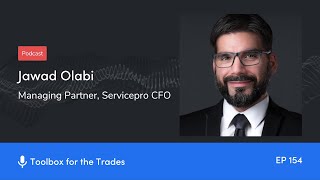
Podcast interview (Dec 2023) with Jawad Olabi, managing partner at Service Pro CFO, about accounting challenges in trade firms, his transition from corporate finance to servicing the trades, the role of private equity in the trades since COVID, and financial/operational strategies contractors should adopt going into 2024. The conversation includes practical advice on Excel, ServiceTitan-focused bookkeeping, pricing/service models versus PE competitors, and cautionary 'war stories' about accounting measures and incentives.
Jawad Olabi, you are the managing partner at Service Pro cfo. I am so excited to have you on the podcast today. You are going to share some war stories from two decades in finance. We're going to talk a bit about private equity, and you're going to share some projections you have for contractors in 2024. Welcome to the show.
Thank you for having me, Jackie. It's a pleasure to be here.
I'm so psyched to have you. We, you and I actually partnered on a webinar a few weeks ago as of this recording that I know our audience absolutely loved. We're going to link it in the show notes. But for today's conversation, we're going to kick it off the way I have been kicking off episodes recently, which is with an icebreaker. I would love to know, if you had to teach a class on one thing, what would you teach?
Okay, so I have an interesting answer for you on this one. It's a little bit nerdy, but I'm going to answer it with a little bit of a story. So about 10 years back, I was in auditing compliance and we were traveling to South America for a site assessment and I asked them, hey, what business system are you guys running your facility on? And they're like, oh, we have this thing called xat. And I'm like, I've never heard of this before. Can you send me a link, please? And they sent me a link to Microsoft Excel. And so it wasn't Excel that was just the accident. It was actually they were running their business on Excel. And for me, it was really, really nice because honestly, if I were to go and what I do actually at my kids school, I teach a class on how to use Microsoft Excel. I love it. I'm a straight nerd. I manage my fantasy basketball team using Excel. I manage all my party lists on Excel. It's why I'm an accountant. Right? But what's amazing for me is about five years ago, I was meeting some product owners with an engineering organization and I was asking them if they were to go back to college and they were to pick courses that would help optimize their career, what would they pick? And they said, obviously, I will go back and learn how to use Excel. Because almost every engineering workflow, whether you're defining your refinery, hardware requirements, economic modeling, reservoir simulation, whatever industry you're in, you always ultimately manage your business through that system. It's kind of there's a joke in the finance industry that the entire finance industry is built on itself and it's amazing. It's also amazing for me to kind of convey to children that, you know, it's not just a calculator. You can build whatever you want in it. I've seen people do art in Excel, so probably a little bit longer of an answer than you were expecting. But I think it's an amazing tool and to link it back to the trades, you know, when I'm talking to owners or when I'm kind of looking at the service sign Facebook group, one of the most common questions that comes up is like, how do I build a report to do this? And honestly, in many cases it's like two or three different data sets that need to be blended together. And having that kind of like Excel competence where you can kind of commingle things to see really interesting views I think is really powerful. Powerful.
So I remember the first time I learned how to do a vlookup, which by the way for the listeners was not that long ago. And I felt like a God. I felt like a superhero almost. I was like, I have all the power in the world so I 100% endorse this. And I love that you're already teaching a class with at your kids school. That's so awesome. So perfect icebreaker for you. So now as we get started, I would love for you to tell us a bit about Service Pro cfo. What is it and who do you serve?
Okay, so in a nutshell, we do turnkey accounting and finance for trade firms on using Service Titan. So we only service service Sign clients. We started about three years back. We were kind of doing more generic accounting services. But what we really noticed is that there was this very specific need in the industry that required not only kind of a defiant process but also service time expertise. And we realized that there was a gap in the market and that could focus on it and really be of value to customers. So because of that expertise, we kind of have this nuanced understanding of how membership accounting works. Deferred revenue with IT Accounts Receivable. This is getting a little bit nerdy. I don't want to bore people, but that's kind of like, that's the part that the value of using us is. You don't have to worry about all this kind of like industry jargon. It just gets taken care of.
Nice. That's awesome. And you're actually part of the Service Titan Professional Service Partners program, is that correct?
That's right. We got certified as a way to kind of establish our competence within this realm. And it's Been a great journey so far.
Awesome. Okay, well, before you even thought about serving service titan customers and before you even thought about working in the trades, you spent two decades in corporate finance, which probably was wild and crazy. What prompted you to turn your attention to the trades? What was it about this industry that called to you?
I wish I could say it was like a direct linear path. It's kind of been a journey that's eventually ended here, but I'll give a little bit of context. So to your point, two decades in corporate, that's across the gambit to finance, accounting, compliance, tax treasury and data and analytics and it was great. I worked on almost every single continent in the world, multi billion dollar projects. But what really happened or really kind of caused me to take a pause and reconsider things was that during COVID and I have to be a little bit sensitive about what I say because I don't want to disparage my former employer or anything, but you know, everybody was doing significant headcount reductions. I was in the energy industry at that point and in our case it was, you know, you know, let's see here, 7, 7 digit headcount reduction, so quite sizable reduction of the workforce. And I, my primary role in this was actually centrally managing that reduction across about 80 different countries. And you know, horrible, sorry, let me.
Say horrible, but what a bummer of a task to be assigned during a global pandemic. I'm sorry, I just had to say that.
No, it was tough. It was super, super tough. You know, we were working 16, 18 hour days trying to figure out the legal requirements and all these different geographies. I had the list of all my friends who were going to be laid off and didn't know yet. And honestly that was, it was pretty tough for me to realize that kind of after all this thing at the end we are still just a couple of numbers and I wanted to take a little bit more ownership of like and kind of own my destiny. That was kind of the realization from that. Not to say that I would have changed anything. I still loved my experience but it was just kind of the dawning. And so I did naturally what any guy with a finance background did. As I said, you know, I'm going to look at M and A and advisory services or merger and acquisition advisory services. And you know, during COVID coincidentally there was this big private equity boom, interest in H Vac firms. And so you know, I was helping on buy side and sell side kind of advisory on some of these deals. But what was clear was that the accounting for these firms, despite being, you know, 40, 50 million, was still a mess. And you know, despite the fact that they were in and because of the fact that they were in such bad state, it really put them in a bad negotiating position. They couldn't really substantiate add backs. They had issues establishing customer concentration, customer reoccurrence, and you know, it allowed them to be out negotiated, especially when you're kind of in the end of due diligence. And that was the realization that, hey, you know what, there is actually an underserviced market here, which also happens to be a market that's performing quite well. Is there any way that I could leverage my expertise to help? And that's how I end up ultimately arriving at the trades.
That's great. I mean, you said at the top of that explanation, there wasn't some aha moment like you didn't have a plumber in your house that just did a fantastic job and was like, if only I could figure out Excel. And you were like, I will help you, sir. But I think honestly your story is pretty profound and something that I think a lot of entrepreneurs align with, which is, you know, it's so tough. What I've noticed in the two years doing this podcast, the pro of being an entrepreneur is you have a little bit more control. You are able to be more in the driver's seat when it comes to planning and hopefully not having to make tough decisions like what you had to do back in Covid while in the energy industry. But then the cons is that now you have shouldered all this responsibility. So I think it's quite, I think it's quite telling that you had this personal realization of like, okay, where can I make more of a difference? Where can I put myself in a situation where I may. I probably don't have to do that again because that must have been just so painful. Sorry you had to go through that.
Yeah, it was tough. It was just part of the journey. And I'm very happy for all of. Not necessarily happy, but very thankful for the reality that's occurred. You know, I would say kind of from your perspective, my wife, when I wanted to make this transition, she's like, you're going from a place where you have tenure, you have a pension and, and, and, and, and well compensated to want to take a chance on something new. Why would you want to do this? From her perspective, it was like, you know, my time is no longer well defined within a workday. Now it's completely unvariable. And my earning is completely variable. But so it was hard to kind of articulate this idea that like I want to own my destiny. And the other thing which I didn't touch on here was that finance in corporate environment. And I don't want to kind of bore people with some of the finance and accounting, but I'll talk about it in context that everybody can understand, I believe is that finance is a support function, accounting is a support function, supply chain is a support function. They're not at the end a business, they're not the business enabler. And after all of that duration of playing that support role, which is fine, there became this kind of, well, I would like to actually solve problem, client facing problems and not simply be optimizing an internal process. And that's one of the nice things about running a firm is like, you know, it's impactful. You know, if you're a supply chain person and your inventory arrives on time, you did, you did your job and if it doesn't arrive on time, then you screwed up. So it's like one of the things where like, you can only do a bad job, you can't really do. You either did the job or you did it. But when you got to get to be the business owner, you actually get to see the impact in your community, your clients. And that for me is really, really interesting and exciting. It's something that is a new kind of experience for me.
Very, very cool. So you mentioned the PE boom during COVID so let's actually stick with that because that's one of the things I wanted to talk to you about. So in Covid, we saw this giant boom with private equity in the trades. They were like, oh my goodness, these businesses are recession proof. We need to invest in them. We personally here at Service Titan had tons of webinars and podcasts with different M and A advisors with different, I don't know what's the word to call them, but the companies that are basically like, you know, pe? Yeah, that kind of stuff. And I would love to know what were your observations of PE in that time and you know, now thinking at us, we're recording this in 2023, it'll go live right before we start 2024. How should folks think about an exit who are in the trades given this history with PE and maybe looking forward into 2020 beyond.
Okay, so I'm not going to hold any punches. I'm going to give the good, bad and the ugly. Right?
Please. That's what we're here for.
So I Think it's interesting starting point to this discussion is like really the advent of PE. It's not that old business model. PE really started around the 1960s. There was an. And the, the business. The idea behind private equity originally. And so I'll start with there's venture capital. And venture capital is take a significant amount of risk on unproven ideas. This is what happens in the tech industry where they'll take nascent companies with no revenue, but they think there's a technology that can automarket. That's kind of the private equity world, sorry, the venture capital private equity world is like hey, I want proven revenue streams with proven profitability that I can come in and 2 to 3x and then I can use leverage. This is the key component of the private equity model that I need to apply a high degree of leverage. So I put a little bit of capital and get an outsized return. And the way that private equity looks at deals is they're looking on a cash, on cash basis. Yeah, you know, if it's $100 million acquisition, but I could put 75 million of debt, I'm only putting in 25 million of my own funds. And then if I can take the value from 100 to 150 and I'm exiting with 50 million, I only invested 25, I got a 2x return, it's not a 50% return. And so their business model is like how do I optimize for how do I take on as much debt? And we have to keep in mind that really for the last 10 and this is something that we talked about in the webinar, for the last 10, 15 years, interest rate environment has been all zero. Right. So with debt as cheap as it was, it became really attractive for private equity to be, to be a prevalent model. And so to your point you made earlier, private equity likes industries where reoccurring, revenue resistant, proof, all of those type of things. The most obvious implementation of this is going to be industries that have very little service service delivery risk. So a rental property, you don't need specialized skills to deliver rental property. You just need to have the property and a property manager. Which is why if you look at real estate, it's why that the market is expensive as it is. It's because it's a really attractive passive. I use that word passive loosely because there is no such thing as passive income. But it's as passive as you get now.
Oh my gosh. So that's all the TikTok influence influencers out there who are encouraging Me to get my, my second stream of passive income. I'm like.
You know, tik tok, I'm going on a little bit of a tangent here. Talk. Yeah, the whole, like, tax scene, right, where they're giving all these kind of. I don't want to use any profanities, but really, BS tax advice about like, oh, yeah, you can, you can do this and you can write this off. And, you know, my, my feeling is when I investigate this stuff, that it's like 25%. It's like a little bit of truth that's been commingled with a bunch of BS. And I don't rely on anything that's coming off TikTok. You know, if you look at part supply houses, this has been a business model where PD has been very active because they realize that it's effectively distributed business. There's not a lot of proprietary skill. They own a market because they have that volume of sales. And it's really hard in a localized market to build an alternative competitor. So they see that as a business, it's easy to deliver. And then you get the second or third elements that are important for private equity. It's like, is there pricing power and can I get price concessions on my cost or reduce my cost basis? So again, they're going to be like, okay, well, I own the market. If I buy up all the distributors within an area, I can get a 20% price concession from my vendors, I can increase prices by 5%, and at the end of the day, you get a sizable uplift on the bottom line. So this is kind of like the very stereotypical Harvard MBA, P.E. kind of cookbook of how you would implement. Um, now these opportunities were getting fewer and fewer. Uh, there's. I mean, if anybody's interested in reading, there's a great podcast about Transdigm. I think it's called the 50X podcast. They have 50X the company over the last 20 or 30 years. It's a great private equity story. And it's just about acquiring companies that are adjacent, that have kind of a good customer base that they can sell into, where they can increase pricing on day one. Um, so effectively, that's kind of the stereotypical cookbook. Now, what happened during COVID that's interesting for the trades is they said, hey, you know what? Yeah, like, okay, trades is not a manufacturing business. There's a bigger service delivery risk here. But when businesses get above a certain size, you can really kind of industrialize that onboarding process of tax. And the owner is not going out delivering work anymore. So it's kind of like it's automated, the workload. So there's kind of point one. And then they said, plus, hey, it looks recession resistant. And there's a lot of pricing power. Because when somebody needs H VAC or plumbing services, they will shop around to some extent. But they can't just defer this indefinitely. Like, I live in Houston. It's a. It was 100 degrees for most of the summer. If you don't have air conditioning, it's literally unlivable. Right?
Yeah.
And so they, they realize that, you know what this is, this is actually a really impressive sector that we could invest in, especially in states that have very loose licensing environments, like Florida as an example. Right. So that's what got things interested. And then, you know, you'll see. So you saw multiples, and when I say multiples, I'm talking about the sales price relative to the earnings. And so if it's a five multiple, that means that they paid five times last year's earnings for the business in terms of the sales price. You saw earnings multiples going up because it became very competitive. And it was because private equity said, hey, you know what? We can come in on day one. We can increase call booking rates, we can increase revenue per job, we can introduce financing, like all these levers of like, what, what I would call from the energy industry, like behind pipe potential things that are there that you just need to slightly work a little bit harder to extract. So for them, it's like, you know, there's this effectively operating model of like, what you can do when you come into these. And then you, you, you start at 5, you get at the 10 or 15, and then you can, you know, sell it. And there are other industries that you're seeing this in. You're seeing something very similar in the medical industry. And there's a lot of, like, parallels about what's happening there that can be.
Applicable to H. So I love what you're saying. I recently had Chris Hunter and Angie Snow on the podcast, and they shared the state of the trade today and projections for 2024 as we at Service Titan see it. And what we're noticing is a lot of contractors are seeing that the COVID boom is over and folks are tightening up their budgets as a result. So I'm curious, how do you think 2024 will play out for contractors nationwide?
So I think the saying the COVID boom is over is definitely true. It links back to this idea of recession resistance that was kind of developed during COVID that was not a real recession. We had so much economic stimulus to the government. You could see it on almost every financial backdrop metric was that savings rates were incredibly elevated, interest rates are incredibly low. And all of that kind of had a knock on effect that people have this extra liquidity to invest in services. And if you go to ask contractors now, what are they feeling? People cannot get secured for financing. People are sensitive about doing new installs. They'd like to see how they can prolong their existing systems a little bit longer. And then if we look at 2023 going into 2024, 2023, savings rates are beneath annual trend line. We had a big peak in Covid because of all that government stimulus. It's all gone, right? Interest rates are significantly higher, the highest, the fastest tightening cycle we've ever had on record. And that makes financing much more difficult. And we're already starting to see small uplifts in the unemployment rate within the US So obviously if I could, if I had a crystal ball and I could see the future, I would be on Wall Street, I wouldn't be here. So. So take this. Worth a grain of salt, right? But if you just kind of look at the backdrop with what seems to be the reality is that inflation expectations are tapering or reducing. Inflation is already down. That does not mean we're going to go back to cost from a previous perspective. It just means that inflation is not increasing like in the rate that it used to. We will not go back to our, our prior cost basis anytime soon. It's unfortunately the stick, the cost of stick stick sticky costs exist everywhere. If you see in the freight industry for ocean freight a cost for a shipping per Shipping container was 5k for a very long time during COVID it was 20 25k. It's not going to go back to 5k anytime soon. That's just the reality of it. Costs don't go down at the same rate, they go up. Having said that, inflation seems to be less sticky. It's trending downwards, close to zero in terms of a growth rate. It's not declining. What I would expect for 2024 is that costs will probably be under control, would probably have some negative pressure. Unemployment will likely be higher next year than it is right now. And that's why the Fed is not actually increasing rates anymore, but stabilizing. And in the longer term, what I expect by sometime in 2024 is you're going to see that the Fed has the Federal Reserve. When I say the Fed has to react to the reality that people don't. People are not spending as much, people are more sensitive and unemployment is increasing. We will likely see a reduction in rates. And what I think happens as a result of that is that financing becomes more accessible and open and hopefully we get what everybody's been praying for, which is kind of this soft landing scenario. Not take complete recession. We get some stability on pricing, we get maybe some fitful tailwinds on financing and then hopefully by 2025 we're in a much better place. This is what I see from the data. Anything that can, you know, this is where the black swan or the unpredictable events can materialize. I mean we could have a war we already seeing or in multiple geographies in the world. So those can have knock on effects on energy prices, those have knock on effects on materials, international logistics. So praying that's not the case. I'm optimistic that 2024 is at par or slightly better than we are right now and that hopefully we see more of a robust recovery by 2025.
Well, thankfully you ended on a optimistic note.
I always, the silver lining is always the last point. I don't want people to be walking away upstairs, but it's not great people. So.
Yeah, well, well let's, let's talk about this like, so let's talk about, you know, 2024 is not, no one's expecting any crazy things happening unless you know, at some point insane global event that none of us can predict happens again. Which I really hope it doesn't because honestly, I don't think I can take it. I don't think anyone else can take it. So let's hope that does not happen. Now, going back to your work with service, taking customers who are buttoning up their finances, buttoning up their accounting. What are some things that you are instructing or suggesting that your clients do with all of this global trend, with all of these global trends in mind.
So this is a key point. I'm glad you brought it up. So one thing is that many clients and I'm going to link this to the PE group PE discussion indirectly. But many of the clients I talked to, they're saying, hey, you know what, I am in a market that has several PE players and they're significantly cutting costs versus cutting pricing as a way to outcompete me. And so I have a couple points that I want to address here. One is that a lot of these private equity players are in a tough spot. They have their debt, unlike most other debt that we're used to is not fixed. It's variable debt and it's repricing on these higher rates and the liquidity sources where they could sell or kind of get an exit from this are drying up in many cases, not always the case. There's still M and A activity. Right. So what what you're seeing now is a lot of players are saying we need to take a market share at any cost. So let's just cut pricing, let's try to take market share, will try to recover our overhead by servicing a much, a much wider audience base. It's kind of a very stereotypical strategy that you would see in kind of the software world. Sure. And so when customers come to me, they're like, I can compete on this price. And so I don't have any silver bullets on how to manage this. But what we can talk about it from, is from a business model perspective where your competitive advantages that you can leverage. And the first question that comes to mind is that so look, private equity, their biggest metric of value is going to be or one up is going to be average ticket size. As a result of that, their business model is almost always going to be exclusively focused on new install and not service work. And if you look at over the last three to five years, I know many, many people who have went from nothing to three to $5 million firms doing 100% new install. That business model is going to struggle in this environment. Not only are you competing with private equity who has a much better cost basis or discounts they can get on that equipment, but they can also take less per unit because they can distribute their overhead across a much wider base of sales. And at the same time, the amount of people who want to do new install or who can afford to do new install with limited financing is shrinking. So what people need to focus on is kind of going back to the old tried and true service model of, you know, trying to repair and not replace as a mechanism to engage. And this goes kind of to this idea of what's gross profit dollar, what's gross profit percentage? And I don't want to get too tactical, but this is stuff we start talking to clients about is that how do you price in a way where you're taking away money without over optimizing on kind of these industry stereotypes or tropes around what's the minimum percentage you need to price at? It doesn't matter. You're right now, especially in shoulder months, it's like how do you survive? How do you get activity? How do you cover your overhead? How do you survive how do you fight another day? Right? Or live long enough to find another day? And so those are kind of the other thing here is that from private equity perspective, they do not have infinite cash to be able to slash their pricing in order to win market share, especially if interest rates stay elevated as they are. So if I were an operator today of a firm and I saw private equity playing like this, the first point would be, okay, how do we make sure we optimize our pricing strategies to make sure that we're as competitive as possible? And that may mean breathing some percentage away and optimizing for dollars. One. Right. Two is how do you make sure that service is a big part of your business and you can price service profitably, which is tough. It's where honestly using service lines functionality around dynamic pricing.
I actually love what you were just saying because I'm putting myself in the shoes of the contractor. Right. And Jawad, I have to be honest with you, I am a communications marketing people person. The way you talk about finance, there was a way for me to inject what, you know, from your brain into my brain. Oh my God, I would be so happy. But alas, we all have our different strengths and that is fine. But putting myself in the shoes of an owner operator who maybe is surrounded by competitors that are in this PE space that are cutting their costs to adjust to this new market, I would, you know, not to be crass, I would be, you know what, my pants. I would be so scared about this. But to what we actually talked about with Angie and Chris in the last podcast, and I know you haven't listened to it, but I want to just bring it back. You know, it goes back to the service model, the service, the repair and replacement, working those membership programs and using tools like Dynamic Pricing and Service Titan to make sure that you are pricing your services accordingly. So it sounds like to me, you're not saying to folks who are in this position, yeah, compete with your PE people. You're like, it's almost I'm feeling from you and let me know if I'm right or wrong that PE is this whole other beast and you're completely different. So maybe lean on the fact that you're locally owned, that you are, you know, a part of the community, can up your community involvement. These are again, things that Chris and Angie shared. That kind of sounds like that's the way for contractors to go in 2024.
Absolutely cannot be seen as some soulless kind of. I like this to think about the same way I think about a Doctor. I will not go to a doctor's office if their name is not on the door. I do not want private equity to be the one controlling my medical results. Not that I don't think they're going to do anything wrong, it's just that they're, they're optimizing for money. And so when I'm picking a doctor or I'm picking an H vac service, I'm always going to be optimizing for something that looks to be more resonant, close, closely related to me in my local community. So clearly I love that. I also love thinking about this from a business model perspective and to say that, look, you don't have the debt that private equity does, you don't have the large overhead structure that private equity does and you don't have this obsession with you're only able to service new install work. So take those flexibilities and say how do I turn these into advantages? And if those advantages enable you to survive and thrive in an environment where their financing costs are continuing to increase, you know, at the end this is not the first time we've had a private equity boom in this industry. And you know what happened last time was that private equity, these roll ups, there's element of like entropy from a science perspective that like nothing likes consolidation. Things like, so get consolidation and then you'll get disconsolidation. It's just a natural kind of the pen, how the pendulum swings, right? And you know, when we had last time we had aggregation, they couldn't service step, they start spitting off assets. And so smart operators who had cash saved up now can buy stuff for pennies on the dollar. Am I saying that's going to happen again? I don't know. At some point, yes. When, who knows. But being in a position where you're prepared to take advantage because you don't have that debt that's repricing and you can make those strategic decisions. Something that is an amazing advantage to smaller players in the space.
I promised war stories at the beginning of this podcast and I really want to get to it, but I honestly, I have to ask, is the dream of private equity in the trades, is that still valuable in 2024 and moving forward, what are your thoughts?
So if you were to look at activity private equity transactions, you're definitely already seeing it slowing down and as a result and with it, you know, a tempering of what valuations people are willing to pay. So I still think it is going to be there, especially if you consider that I Suspect next year interest rates are actually going to be coming down again. I think that this may kind of revitalize a second or third wave of this. But when people ask me about my thoughts on selling to private equity, my first question is, well, what do you want to do at the end? Yeah, you know, you're going to get an exit, you're going to have some money, but do you really want to sit at home with your spouse all day? You know, like these people have been working for like their entire life. They're not. And so when I see people happen is like they get home and they, they, they like, I don't know what to do with myself. They start getting into like high risk sports or like professional gambling because they just need the adrenaline. Yeah, I'm being serious. This is, you know.
No, I believe you.
Yeah. And so then, so the question is, what exactly are you going to do? Like, you're going to have money, you're not, you're going to have your time back, but are you prepared? And in many cases this shapes the way they make their decision because it's like, well, maybe you want to join a private equity firm where you're going to stay on in a managing partner level or some sort of, you know, like active management role. And so you're not actually just trying to get a full exit. You want to retain a percentage interest in your firm. You just want to have some type of liquidity event where you can do something. Right. Or you may say, no, I don't want anything to do with it. Right. I don't even, you know, I want to go spend time with my grandchildren. And you know, that's an alternative and a good option. But people need to start with what do they want out of it.
Yeah, that's actually advice that's been, that's been echoed quite a bit on this show when it comes to PE and picking the right PE partner and making sure that at the end of the day you are invest, you are. The partnership is something you want and what you want, you see your life being, which I know can be kind of scary for some people. But this context especially applied for 2023, 2024 has been so helpful. Jawad, thank you so much. I got to ask about war stories. You know, you mentioned you have some. The first time we spoke a couple of weeks ago when we started planning these content, these content pieces together. So care to share any and some best practices that maybe come from some of these stories?
So I'm going to try to thread a narrative here around some of these war stories. And I'm going to start with something, a question that I get quite a bit from the industry, which is like, oh, how do I know how I compare? How do I benchmark out of gross margin, net income margin or cost of goods sold perspective? And my knee jerk reaction always is that benchmarking in many cases doesn't make a lot of sense because there is no standard way of doing accounting. What you consider gross margin and what they consider gross margin are not going to be aligned. For example, like where do you put your burning cost? Where do you put your bonuses? Is that above the line or below the line? So if you start with the baseline that everybody's stuff is inconsistent and comparable, even if you were to go look at like the Fortune 100 companies, their P. Ls are not in any way relatable to each other. And then you say, okay, so forget benchmarking. How do I know if I'm making progress? And that's where it's like, okay, let's look at the trend. Let's make sure you have a consistent approach to your accounting that really is aligned with how you'd like to see the results. And then the question is, are you improving or dis improving? Not are you better or worse than somebody else? And this kind of goes to the false, this kind of idea that accounting is true, accounting is useful, but accounting can also be very, very corrupt and misleading. And so there's an example that I'll take from my, my corporate experience that I use to convey this. So one of the businesses I was running, we were delivering fluid systems. Again, this is an oil energy example, right? So you can imagine you have hundreds of barrels full of mud slurry, effectively. And then they would use this when they're drilling. And then we would take it back with us. And when we would take it back, we'd end up with more barrels than we started with because it's diluted with rocks. Like we're taking all this debris from the well with us when we come back. So effectively it's out of spec. And you know, let's say I started with 100 barrels, I brought back 105. Now from an accounting perspective, I have to make a decision. This stuff is not usable right now. It's out of spec. Do I want to purify this? We would use a centrifuge, but effectively try to remove the debris. And when I do that, I'm going to have to spend time to remove the debris. But more importantly I'm going to get losses because some of that rock will have absorbed some of my mud, right? So at the end, you can imagine that I'm going to have yield issues. I'm going to go from 100 barrels to 95 barrels. I'm going to write off five barrels. So I'm going to take a loss, right? That's from the accounting perspective. Option two, I can say, you know what, no, I don't want to take any losses. I'd rather just go buy some chemicals, add them into my tanks and go and dilute them back to spec. So now instead of going from 105 tanks, I'm going up to 110 barrels. And you know, you would say, any reasonable person would say, I'm not going to spend dollars, buy chemicals to increase my inventory if I don't need it now, just clean the stuff up and reuse it. Right? That's what a normal person would say. That's not what an accountant would say. Right, because an accountant would say, well, you know what, if I centrifuge it and take losses, that's a piano hit, right? It's going to hit my profit and loss statement. I lost five barrel. Five, five units, right? But if I were to buy chemicals and dilute it, that's just hitting my inventory in the balance sheet. That doesn't hit the P and L. Because even though, and this, I'm going to elaborate on what I mean here, but just because you spent cash doesn't mean it hit the accounting books. I spent cash. I bought inventory, I put it on the balance sheet. My P and L doesn't show anything. And so like smart ops managers are going to say, you know what, My KPI has all my net income. I'll spend cash that I don't need to dilute this inventory to build stock I don't need because I'm trying to optimize for my kpo, which is a net income. And that's where it's like, accounting is an interesting tool, but it's just a tool. There's no such thing as silver bullets. There's no such thing as one thing that's going to answer all your questions. And so I know it's kind of like a nuanced, a little bit of nerdy accounting analogy here, right? But the big takeaway is that there is no necessary right answer. There's actually this idea in science, or this idea, it's called Goodhart's Law. And it's like when a measure becomes a target, it ceases to be a good measure. And for me, this is amazing. This is exactly what's happening here. When you're just focusing on net income, you're going to do stuff that's, you know, you're going to impact your cash flow.
If I was, I just need to stop. If I was a morning dj, like shock jock dj, I would have a sound bite right now that was like, hot take. And I would be pressing that button like three times during this. This your answer here. So it's just, it's blowing my mind. If a measure becomes a target, then it's now an effective measure. Holy measure.
Yeah, cow. And this is here from science. Right? So but it, it applies, you know, like I had an example in my career where one of my managers had a target on selling or on invoicing a certain number of product. And that invoicing was to an internal part of the company, it wasn't to an external company. So it was just like moving inventory from one side of the company to the other. And that was his kpo. That was his paid to keep performance objective. That's what he was going to get paid his bonus on. Now the company, we realized that our customer didn't want the products anymore because they didn't have demand for it. And so a reasonable business owner would have said, you know what, I'm not going to spend money building inventory to take it from one pocket, move it to the other just for the sake of hitting somebody's kpo. We don't need it. But we built it and we sold it because everybody's bonus was tied to it. And so again, it's like this idea that bonuses are fine, but bonuses can't just be one dimensional. It's like, how do you make sure that you're optimizing for cash and you're optimizing for net income and you're optimizing for the long term, for your customer and the long term viability of the business. And that's where. And so this is where it's like, everybody's always like, get to the chase, get to the bottom line. What's the right thing to do? What is these silver bullets? And it's like, unfortunately, the world runs on nuance, right? There is no silver bullet. Your KPOs will change every single year. And that's a good thing, that's not a bad thing. Right? And, but you know, that might make people feel uncomfortable, but I mean, that's just the reality of it.
Well, let me just say this. It's a good thing. You pivoted your career to finance for the trades and not to politics because you not not have done well in politics.
I would be a horrible politician. I would flip flop because I would enhance my view and people would say it's a derogatory thing and I would say, no, it's a good thing. Right? I'm enhancing. Right?
So that's incredible. Juwan, I have learned a ton from this conversation. Thank you. Thank you so much. If folks listening want to get in touch with you, how can they do that?
A couple of ways. You can hit us up on our Website Service Pro CFO.com I'm also pretty active on the Service Titan Mastermind Facebook group, so feel free to find me there. And beyond that, we host occasional webinars and content many times in Service Titan, so you may be able to. We also have an email list actually, so feel free to subscribe to that. That's something you'd like. We send out two emails a week. We do a lot of financial trends. And if that's something that's of interest for you, feel free to reach out.
Awesome. Well, Jawad, thank you so much for being a guest on Toolbox for the trades. I cannot wait to hear reception on this episode.
Truly, it's been, it's been fun. Thank you.
More from Bill



ServiceTitan Virtual Agents: Simplify Before You Scale | Podcast Ep. 110 | Mastering ServiceTitan



Life After Live Events: How to Turn Post-Conference Energy into Real Profits | Podcast Ep. 297




