The ServiceTitan Certified Technician: Faster Onboarding and Real-World Mastery | | Podcast Ep. 104
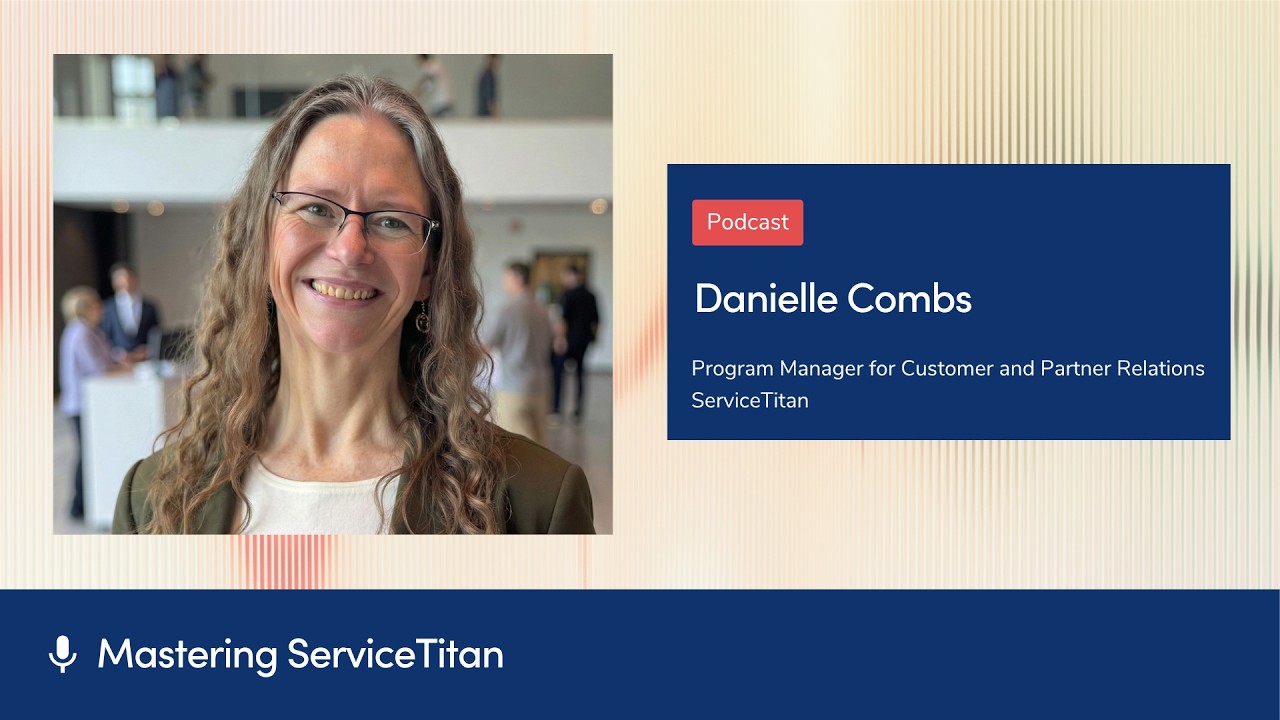
In this episode of Mastering ServiceTitan, host Josh Liu interviews Danielle Combs, Program Manager of Customer and Partner Relations at ServiceTitan, to introduce the new ServiceTitan Certified Technician certification. The conversation explains why the certification was created – to ease recruiting, shorten time‑to‑revenue, and give trade‑school students a technology‑savvy credential that makes them more attractive to shops. It outlines the certification’s target audiences (current ServiceTitan users, trade‑school students, and trade schools), the role‑based curriculum (administrator, CSR, dispatcher, accountant, inventory manager, technician) and the ten curriculum sections (job lifecycle, estimates & proposals, price book, invoicing & payments, findings & equipment, forms, financing, memberships, opportunities & follow‑ups, procurement & inventory). The program is delivered as a self‑paced, video‑and‑text based Academy with interactive click‑through exercises that adapt to the technician’s trade. Three progressive levels – Explorer (basic), Navigator (intermediate), Commander (advanced) – must be completed in order. Danielle shares implementation tips: start with field managers, champion the weakest‑tech‑user, embed training into one‑on‑ones and team meetings, and allocate roughly 5‑6 hours total (optional for experienced techs). The certification is free for trade schools and includes a verifiable online certificate that can be linked to resumes and social profiles, helping shops attract talent and improve hiring efficiency. The episode also mentions upcoming expansion of the click‑through format to other role‑based certifications and provides links for end‑users, non‑users, and trade schools.
Chapters
If we have a certification available for a trade school student, they're going to be more apt to lean towards continuing to use that tool. If we introduce ServiceTitan, you know, before they even come to your door, then it actually, you know, puts our customers at the top of that list for shops that they'll apply for and potentially go work for in the future.
Welcome to Mastering ServiceTitan, where you get expert advice from power users, I'm your host, Josh Liu, and today I'm joined by Danielle Combs, Program Manager of Customer and Partner Relations here at ServiceTitan. And Danielle has been on the show before, and we've worked together for many years now. So welcome back to the show.
Thank you so much, Josh. I'm so excited to be here with you.
I'm excited to dive into the ServiceTitan Certified Technician certification. But before we get into the specifics of that, Danielle, can you maybe remind people of what the user certifications are like here at ServiceTitan?
Yeah, thank you so much. So we do have our ServiceTitan Certified User program, and it's a great tool to do 2 things. Either get your new teammates up to speed on the best practices and how to use ServiceTitan in their new role that you may have just hired them for, and make sure that they can take self-paced training and take a lot of that load off of you and your employees to teach, train the trainer type situation. We want to take off some of that, but also those, you know, tenured employees that you have, it's a great opportunity to help career path them and give them exposure to other roles that they might want to grow into. So maybe they're a CSR today, but they want to be a CSR manager tomorrow, or maybe even an admin, you know, an operations manager or something even greater someday in the shop. And we want to help you do that.
And I know we're going to dive into the technician one, and I'm kind of putting you on the spot here, but How many different paths do we have now? Like, what are all the roles that people can go down for this certification?
Oh my goodness. Yeah. So there's a few different. So the roles we have is administrator, CSR dispatcher, we have accountant, the inventory manager, and now we have technician. But also we have different areas as well because not everybody runs the same type of shop. So We have commercial and residential versions of these available. So then that way they make the most sense for your business model and your workflows because not all businesses run the same. So especially like accounting in residential and commercial, night and day difference. So we do have those separated as well as we do add an add-on option for a construction administrator as well for those shops that also dabble in some construction work.
So, let's dive into the new one. Why did we create the Certified Technician certification?
So, one of the things that, like, coming from the trades, you know, one of the things that just took a lot was getting our new technicians, you know, number one, in the door. Recruiting, getting, you know, the talent is a really hard thing to do sometimes, especially when you have all of these other shops competing against you. And the other one is then once you do finally get them, the time to get them to be a revenue-producing technician, even as just a basic maintenance tech, can be quite a while because you're not only training them on the company policies and how you want them to run the calls, but also the systems that you use. So like ServiceTitan. So the reason why we created this is a couple of reasons is that number one, we wanted to help alleviate some of that pain. First and foremost, that funnel. As we know, the industry is lacking in new blood, fresh technicians coming into the trades. And so we want to help any way we can with that. And we want to empower these technicians that are coming into this field to really be able to use technology in their day-to-day and get used to it upfront. And what that does for our customers is that it also makes it so then that way, if we have a certification available for a trade school student, not just somebody you already employ, it actually helps because You know, if a technician learns to use a tool, they're going to be more apt to lean towards continuing to use that tool. So if I have my favorite, you know, DeWalt or Milwaukee or whatever tool I have, you know, and I, I will go towards something that I can use that. And so that's one of the great things about doing it this way is that if we introduce ServiceTitan, you know, before they even come to your door, then it actually, you know, puts our customers at the top of that list for those shops that they'll apply for and potentially go work for in the future. So helping with that funnel is a huge piece. And then when they do get hired, it's a lot less time of training those individuals because you can truly focus on what's important, which is your business practices and what you want them to do in the customer's home to make your customers feel at ease versus learning the software. So it's really a great way to alleviate that, you know, time to revenue. And also it makes it a great experience, you know, for the rest of your teams. to bring on somebody who has a little bit of that under their belt. And the nice thing is that they're learning best practices directly from the source versus learning some bad habits maybe that they may have learned at another shop that they may have used the same software, but maybe used it the wrong way.
And I imagine when people are interviewing and hiring for all kinds of roles, if they already have ServiceNow experience, that makes that hire way more attractive because they can come in and probably just, it'll be way easier to onboard them 'cause the ServiceNow software, there's quite a lot to it.
Exactly.
Is this the first certification where You don't have to be a ServiceTime user yet to complete.
That's right. This is the first time ever we have offered any type of training within our academy or certification to a non-user. And so that's the great thing with this is because we want to not only help our contractors that have their technicians already on our platform get even better and more efficient, but we also want to be thinking Even more advanced, and like I said, you know, trying to get to them before they even get to you, so that we can make sure that you look even more appealing to to apply to your shop. So we're trying to help with that. So yes, absolutely. This is the first time that we're opening those doors, you know, and testing that out. And I do want to give a huge shout out to our internal learning content team. Our digital content team has been amazing. This was not a small feat. You may all you know every customer may want to curse me for this from last year, but. The reason why we changed Academy platforms and changed the style was actually because of this, because our previous platform we used didn't allow us to open those doors to allow non-users into it. And so we did have to make that big leap, which was a giant leap, to this new platform so that we could allow this to happen and future things that we want to expand on to help our users and future users.
So before we started recording, you mentioned trade schools. So this is a huge opportunity for trade schools to allow their technicians to get certified for ServiceTitan. And then when they enter the workforce, they already are super comfortable with ServiceTitan and can go find shops on ServiceTitan. And that's another thing they can have on their resume, I guess.
Absolutely. And the great thing is that just like all of our other certified user programs, the technicians get an online validable certificate that's linkable to all of their social. They can put it on their resume and, you know, that's That's a huge win because it makes it easier for, you know, our customers to vet those new technicians. You know, because like you said, I wanna hire somebody who I don't have to train as much if I can. And so it makes it great for that. And also it's something that, again, it can be linked on social media and things. So look at those LinkedIn profiles, search for ServiceTitan certified, you know, technician, you know, on LinkedIn and you'll get, you know, some things popping up. But yeah, the trade schools, it's a great opportunity. We're offering this completely free, just like all of our other certifications. So there's no cost to the school. It's just a benefit to the future of the trades. And that's what we're really looking to do is, you know, how do we empower the future? How do we help bridge that skilled trades labor gap that, you know, has been growing, unfortunately? You know, so we want to help bring this, you know, as a tool that they can put in their tool belt and have ready, as well as help our existing users, you know, be able to recruit and, you know, get time for hire to revenue producing just that much quicker.
Do you think this is, this certification, like those listening are likely ServiceTime users and have technicians on ServiceTime. Do you think this is for every technician? Like every technician at every shop who's on ServiceTime should go through the certification? Or are there maybe like power users that should start first at your shop? Like how do you recommend owners think about that?
I love that. So absolutely every single person that uses the field app should absolutely take this. Number one, old dogs can learn new tricks. My husband has been on ServiceTitan just as long as I have. We both were users working for the same shop. Then I started working for ServiceTitan, but he's still in the field every day. And I actually had him take it and he learned a few things as well. So if he can learn something, I think everybody can. But the really key thing is that never expect your employees to do something you're not willing to do. And from a technician's perspective, it's great to have somebody, especially my leadership, know what I'm expected to do every day and have an understanding. And if they need help, having somebody that can help them and understand it. So, I absolutely think that you should start, number one, with your, you know, service managers, your field management team, you know, have them do it. And then, I'm gonna flip the script a little bit. I think somebody's gonna think, hey, start with my, you know, my power users, my technicians that are the best. I say do it the opposite because the best way to get buy-in from your team is if you have your technician that struggles the most with technology master it, then there is no reason why everybody can't do it. So what I did with my technicians was I actually made my champion my technician that actually had the hardest time using technology to the point where he couldn't operate a flip phone by himself, to be honest. Like smartphones were not his thing. So, you know, introducing ServiceTitan, you know, was a huge leap for us. And he was my champion and he actually ended up being our trainer for all of our new technicians going forward because he had that confidence because we built it into him and that the team, you know, could rally around him to do that. So. Definitely, you know, think about who your strong and weak technicians are in your team. And I, you know, challenge you to, you know, to flip things around and maybe try it the other way.
Let's dive in a little bit to the certification details. Maybe we can walk through some of the sections of it just to give people kind of a roadmap or an idea of the areas that we cover. It looks pretty comprehensive. There's about 10 sections and yeah, maybe We can kick off with the first one, job lifecycle and navigation.
Yeah. So first and foremost, I want to call out that this certification specifically is focused around our new field mobile app. So it is the newest version. So it's not something that's going to be quickly outdated when you're switching to the newest version. So keep that in mind that if you're not currently on it, this is also a great way to introduce it to your technicians so then that way they can start using that new tool. and become even more ready to use it. But yeah, so we start out with job and lifecycle navigation. So really, to break that down, what does that look like? What does that mean? How do I view my schedule? How do I dispatch myself to a job? Just the simple things. How do I arrive to the job? And maybe if I'm in commercial or construction, I need to add a work performed log. And then also, how do I pause or hold an appointment? You know, and just, you know, general things like, you know, generating a work summary in the system and utilizing new tools that we might have available like Titan Intelligence and Atlas that can help them do their job more efficiently in the field in the new app. So we really focus on the basics underneath that, you know, job and lifecycle management of just how do you get there? How do you even find the information?
So we got the backbone of a job. You know, technicians are going through that. Looks like the next section is on estimates and proposals. Can you give us a brief idea about what's covered there?
Yeah, of course. And please remember that we do have a residential and commercial version of this, so it does differ based on that because my commercial guys aren't going to be doing estimates in the field. So please know that we know that. And so it is not something that we necessarily cover. They might have the option to show them how to tweak it, but not create it. So overall, we do focus on how to create an estimate. Marking an estimate as, you know, the top recommendation. So you, if you have them do good, better, best, you know, making sure that they flag which one is the most important to that homeowner. And then, you know, entering presentation mode, how to present it to the customer, you know, they're in the home and make sure that it's a good experience so they're not fumbling around and not feeling confident in what they're doing. Selling an estimate so that they can actually perform the work. That's a huge step. And just again, all through that lifecycle, including converting templates from something that the office has put together to maybe updating it and adding and removing items, swapping materials out. That's something that we have there for those estimates.
Now, next, getting a little bit more advanced, we got price book and item management.
The price book is the heartbeat of your company. It's where all of your services live. And so we want to make sure that we show them how to efficiently be able to add items, configure a service, Because we now have configurable services and materials and things. We want them to be able to be confident in how to use those if you guys use those features. And then also utilizing item groups with subitems. So that way, if you don't show itemized pricing, they have a way to make sure that it just shows that main item and everything's nested below that for you, as well as being able to We have items for recommendations and upsells. Again, replacing those items, utilizing materials, really the basics there. And the one thing that I will say is that a lot of people might be like, well, we don't use some of these features. You know what? Knowledge is power. It is better for them to know about it and know how to navigate than to not know it and come up against things. So knowledge is power. Keep that in mind. The biggest thing to know is that We're not training your technicians for your shop. That's on you. This is about how to use the system efficiently, how to, you know, run calls in it, you know, in using technology in the field. Your policies are your policies, and they're going to be different drastically from shop to shop.
It's such a good point. As you were mentioning, like configurable services, it could be a great discovery way. Like maybe you have your service manager go through this first and they're like, oh my gosh, We should definitely use this for something at our shop. And so along the way of getting certified, I, I imagine people are adopting new features and just like upleveling their, their technology use.
Exactly. It makes it, um, nice because, you know, my husband, he learned how to use ServiceTitan, you know, 12 years ago and not as a technician. And so, uh, he had no idea that some of these things existed and that like, what do you mean a technician can pull a PO? I was like, well, if you give them permission, you can. So they're great things that they can add to their belt if and when your company is ready.
Now, domain number 4, section 4, we've got invoicing and payments.
Yeah, because I mean, you can run jobs all day, but if you can't invoice and collect for it, then your company is not really doing anything and is not going to be able to keep the lights on. So we really focus on reviewing the invoice items after the estimate sale, making sure that it's right, making sure that it's still consistent and then also verifying things like tax zones, making sure that the taxes are looking correct before they present something to a customer and then generating the invoice summaries. We all have those technicians that struggle with being appropriate sometimes in their summaries or maybe their writing skills aren't the greatest. So showing them how to use tools to their advantage to help with that, presenting that invoice and emailing the invoice to the customer. taking payments, you know, something as simple as taking credit card payment and maybe storing it on file because you sold a membership. You know, having ACH payments or check payments, how to process those. And then, you know, one of the most important things is maybe they're not there and they can't, you know, the customer doesn't want you to process their card on your tablet. Maybe they feel more comfortable with you sending them a payment link. So how to do that. And then also, Financing, you know, going over the basics of financing. So it's not as scary because, you know, me, I might be able to afford, you know, as a customer to pay for that $15,000 placement or major repair, you know, plumbing repair or something. But if I can keep that money in my, you know, high-yield savings account and make money on it, well, I don't have to pay you interest. I'd rather do that and then pay you at the end, you know, in 6 months or, you know, 18 months, however long it might be. So even though I can afford it, I'd still like to use that. So making sure that the technicians know how to use all of those payment options.
Perfect. Yeah, it's quite comprehensive and financing is huge and this would be such a great way just to get even just a quick view of how it all works before you dive in.
Exactly.
For section 5, we got findings and equipment.
Yeah. So how do we, you know, keep things going? How do we keep this engagement and customer lifecycle going with this customer? We need to know what's going on in their home. We have to have an insight so then that way we can make sure that we're connecting with that customer. And so how we do that and, you know, keep that future pipeline going and make sure that we keep their home healthy is that we need to know about it. So we want to make sure that the technicians know best practices and how to do things like, you know, attaching findings to an estimate. So, you know, instead of just presenting an estimate, showing the customer this is why I'm presenting this estimate. It's because I found this leak. And being able to show that documentation not only to the customer, but also making sure that it's in the system for the future for other technicians to see, as well as maybe your follow-up salesperson. Because if the technician doesn't sell it in the field, maybe we want that person in the office that's following up to have that insight. So it's extremely important. Documenting equipment. Oh my gosh, that is incredibly critical. If you find equipment, if you install equipment, it needs to be documented so that you know the true age of the equipment. You're not going by something that was a note on a file, and you have no idea, you know, how old that equipment is today. Putting the equipment in there properly, make sure that the system's tracking it to the date how old that equipment actually is. So showing them how to do that, and also being efficient at it. So, you know, duplicating findings on multiple units, not every house is the same. Sometimes you have those large houses or buildings that have tons of systems in it and being efficient in adding them and documenting findings for them is huge. So being able to show them how to duplicate those as well.
This section reminds me of like just planting seeds, investing in the future, putting all the notes down so that way you can maximize revenue later on or come back to it or revisit. Because there's probably so many times where someone goes back to a place, if there's no notes at all, it's like, oh my gosh, we're going to waste a lot of time here. redoing everything and finding out.
Exactly.
So I like that section. That might be my favorite section so far. Number 6, we have forms and documentation.
Yeah, so it's just as simple as that. Forms are a huge thing to utilize, you know, in your processes because it creates consistency in the processes that the technician follows. It creates documentation for that CYA so that you, you know, when a customer says, well, you didn't check this, you can be like, well, I did. And it provides that documentation that you can give to the customer of the health of their systems, their plumbing, their electrical, their HVAC, whatever it may be. So forms are very critical. So being able to complete arrival checklist, something that you want them to do, or maybe if it's commercial, there's certain things that they need to complete when they first get onto a job site as part of your requirements for that company that you're servicing. So those are really important to be able to know as well as Again, that equipment, being able to link those findings if it's specific to a piece of equipment. So if there's a serialized piece of equipment like an HVAC unit, or maybe even a water filtration system that they've just diagnosed problems with, it's really important that that form that proves it is actually attached to the equipment. So showing how to do that as well.
It seems like— do you think this is kind of like a side tangent? But do you think forms is the best way to have a— to operationalize like a standard Like an SOP, I guess, for technicians.
It is because it allows them to have a step-by-step. You're walking them through. And the great thing is that with forms, we have smart fields and things that they can use. So then that way it can fill in key information for them so they're not wasting time doing it. And the really cool thing is that with conditional logic, if it doesn't apply to them, like we can have those if-thens built in so that it skips some things. And so if it's not pertinent to that call, they're not having to scroll through this giant form. So I highly recommend forms.
Next we have financing or revenue. Seems like maybe a little bit more of a deep dive into financing versus earlier the basic intro.
Yeah. So really the previous section about payments is really how to process it. This one goes more into selecting that financing partner because sometimes our customers offer multiple of our integrated partners. And so seeing that, especially when you're looking at first look versus second look, the waterfall options, things along those lines. And then being able to add those financing plans to the estimate so that when they present the estimate, that those are what they're seeing so that they're not being shocked with a giant sticker, you know, price, but seeing a bite-sized monthly payment instead. So they're more apt to buy from you. And it also makes it easier on the tech, the technician, if we can show them how to use the system to present that with them versus having to have an awkward conversation with the customer. And then, you know, submitting the financing application, we call it again, things like turns, you know, being that second look financing option, letting them know that like, hey, it's not another credit app. It's something that you've already filled out. We can just easily process it, taking away some of that fear that sometimes technicians might have if they don't understand what first and second look means, you know, so trying to help alleviate some of that.
And the next section is memberships and agreements. Oh my gosh, I keep every section that comes up, I'm like, well, this one's probably the most important. Now I look at membership, I'm like, wow, this one's probably pretty important. So yeah, let's dive into that one.
Yeah, it gets better and better every time, like as we build. And that's the great thing about these is that they're level-based. So then that way they start off with the easiest things and build up to the more complex. And so we wanna make sure that it's a simple process to learn and execute. But yeah, memberships. Um, is a big one. That's how we keep a steady revenue stream, especially in those, uh, slower months. Uh, so if we want to keep them busy and not have to have layoffs, uh, they definitely need to know about memberships. And so we go over, you know, selling a membership on an estimate. So how do you add that to the membership or to the estimate? Sorry. And then, you know, marking, uh, recurring services completed. One of the headaches that one of my, um, you know, core office people had was They manage our memberships and technicians not marking properly in the field that we actually completed the service. And then we have our CSRs calling a customer saying, hey, we need to schedule your service. And the customer's upset because they're like, you've already been here. Obviously you're not paying attention. So then the customer's upset and then our membership person's like, this isn't being done right. So teaching the technicians, because it does have a major impact on the rest of your team and the customer experience. So marking that appropriately. Again, attaching equipment to the membership, showing that on an invoice that it's been serviced through that membership, selling a renewal. Maybe you offer memberships that, you know, are for a set time. Being able to, you know, get them to renew with you if it's not an ongoing membership is huge. And then also being able to sell what we call membership add-ons. Not something that's used a lot, but it is something that especially if you offer a lot of maybe multi-system options or specialty items like, you know, ductless mini splits and/or salt delivery, things like that. Those can be done as add-ons onto your existing memberships and showing them how to do that.
Awesome. We got 2 more. The 9th section, opportunities and follow-ups. This one looks a little bit shorter.
Yeah.
It's more straightforward.
Much more straightforward. Basically think of it as, you know, allowing your technicians to know that they have the power to follow up too. So if you have selling technicians, if you have comfort advisors, project managers that are in the field, they actually have their own opportunity section in the field mobile app. So the Follow-ups tab is in the office side. We have follow-ups in the mobile side as well for technicians. They can set reminders to go back to that customer and contact them, call them, be able to represent those options. So we want to make sure that we cover that as well because it's extremely important that they know that resource is there. Again, might not be your company's process today, but maybe it's something that you want to add in the future and start with certain technicians.
Perfect. And then this last one is— this one seems a little more advanced to me. Well, anytime I hear inventory, I get a little intimidated. But we've got procurement and inventory as section 10.
Yes. So we kept it as its own section because, again, not everybody will do it, but we want them to at least know about it and know best practices if they are going to do it. And so we just go over the basics of how do you create a purchase order from a job? So maybe I need to run to a parts house and pick something up. How do I actually document that so that I lessen the amount that my office has to do for me? Adding items to that purchase order, sending the purchase order to the vendor, maybe to make sure that I'm not sitting there wasting time at the desk at the vendor. I want to send that over to the vendor ahead of time while I'm driving over there. So then that way it's ready for me to pick up and bounce back to the job and get it done. And then also sometimes the vendors don't give us everything we asked for. Real-world scenarios come up. So we do show them how to adjust what they received on the purchase order. So maybe they received 2 of an item when they were supposed to get 3. And then also we do have auto receive options for purchase orders, just kind of touching on that again. So then that way they have a knowledge. So it's not scary when they do get confronted with having to do it. It's better to have somebody prepared for something Um, and, you know, not need to use it than need it and not know what the heck they're doing and then make more mistakes that cost your company more time and more money and frustration of your other employees.
Wow. Uh, 10 sections. It's super comprehensive. I can see why, like, people get these certifications and it's something you should really be proud of when you get the certification, cuz you truly know ServiceTitan. Can you talk a little bit about the, the levels, like the Explorer, the Commander, Yeah, absolutely.
So in true ServiceTitan theme, we wanted to go with the rocket ship theme because as you all are very aware, we have the Titan Advisor. And so that's why we have our levels of Explorer, which is your beginner. It's where you're just learning like, what is this? What— where do I need to, you know, look at? And then your next level, once you've completed that, is Navigator. That's that intermediate. So, okay, I now know where the buttons are. Now I need to figure out what they actually do and And how they might work together. And then once the user has completed that navigator, that intermediate level, they get the commander level. And so that's the advanced level. That's the— you've mastered all of these things. That's where we get more into those more intricate topics like the financing, the purchase orders, doing some more tricky things. Like maybe think of it this way. For a documentation standpoint, you want your technicians to take pictures, right?
Yeah.
What's even better than just taking a picture but having them mark on it where the problem is. And so that's something that we do in the commander level because then they've learned, this is how I take a picture, this is how I attach it to something. Now at the commander level, this is how I actually go one step further and can annotate and put documentation on that graphic image for not only the customer to see but also the office for future use.
So people can take the certification, like the technician certification, and just do the Explorer first, like the basics, then they come back to it, go to the next level, and then finally get to that commander level, level 3 for the technician certification. Is that right?
Yeah. So every one of our certifications, the role-based certifications, is level-based. You can't skip ahead. You can't just go jump straight to commander and pass and say that you're good. We only allow you to do it in order. So then that way you learn things and absorb it in the right way because we don't want to give you something that you haven't learned about yet. So we want to make sure that we do it in a meaningful way. So that's why it's stair-stepped in that. And so as soon soon as you complete that Explore level, the system will automatically assign you the next, next level. You don't have to worry about contacting your CSM or filling out another form, anything like that. And I know that one of the big questions here is going to be like, that's a lot of content. You guys just went over 10 sections and there's 3 levels. That's 30 things. Um, you know, how long is this going to take my technicians? Because they don't have that much time. Their time is incredibly valuable. So what's that look Well, I have to say that we did just launch this in July, so it is very new. So we don't have all the averages just yet. But what I've done is I've made sure that all of the learning content and the testing as a whole, you know, if you were to go through it end to end, takes, you know, right around, you know, 5 to 6 hours if you literally go through everything. Because I, you know, time is so valuable of your technicians. They're your most expensive and dearest asset on your team. You know, trust me, I know that from experience. And so, I wanted to make sure that we use their time very wisely and make sure that it's there. And the other thing is that if they're already a seasoned, you know, technician that's been on ServiceTitan, the training is optional. They don't have to take it. So, they can jump straight to those tests, but they still have to do those levels in order.
What can they expect in terms of the training? Is it a mix of reading, videos, exercises? If someone were to jump in today, what would they expect to see?
Yeah, so it's all self-paced training that is based in our Academy. So the Training Academy videos that you've seen and heard, they've been refreshed. Our team's been doing an amazing job getting them up to date and more proficient. So in those trainings, they'll be able to have a video that walks them through what it looks like, as well as they'll have some text-based information. So in that way, applies to all learners because of course anything that's in our academy is also in our knowledge base. So if you have somebody who's that bookworm instead of the video guy or gal, they do have that option. But we do present the technician specifically with the video options first, so then that way they can complete those. And the really cool thing that sets this certification apart from all of our other role-based certifications that we've offered in the past is we've actually updated it. So instead of being a bunch of text questions that you have to read and answer, this is the first one that's actually click-through. So we present you a question and we ask you to actually do it in the system on the screen. So it's really great for technicians who are already, you know, very hands-on people. And the other thing with it is that it also gives us the opportunity to customize what those screens look like. Based on the trade and the type of work you do. So when the technician gets into this, it will present them first with what trade is your primary trade? Is it HVAC? Is it pool and spa? Is it a different trade that we're looking at? And the great thing is then the system will actually change those screenshots and the wording of the questions to be customized to that trade. Because I might say in HVAC, a comfort advisor, where I wouldn't use that same terminology if I'm talking about my plumbing salesperson. So it's something that we want to be very aware of and present it in the right way to them. And we're actually going to be expanding that to all of the other role-based certifications by the end of the year. So if you're looking to do any of the other role-based certifications, that's something that we'll be updating throughout the coming months as well.
That's so thoughtful, especially to start off the technicians with this one because, yeah, they're so hands-on getting To click through instead of read will be such a huge upgrade. So that's great to hear. Maybe we can wrap up with advice. So let's say we're super bought in, we love this technician certification, we want to get everybody certified on it. How would you recommend them break it up? And is it like maybe an hour a day or like 15 minutes here or there, like all at once? Any best practices that you've seen so far for people who've been really successful with this?
You know, honestly, um, a lot of our existing users that have taken it You know, they jumped right through it pretty darn quick. They're like, this is the easiest one yet. And I was like, well, yeah, because the office, you're used to the office side, which is a lot more complex. You have a lot more workflows than a technician does. If you're presenting this to your technicians, you know, remember, utilize the time that you have with them. Engage with them during their one-on-ones, whether that be weekly, biweekly. Have their manager working on this with them. Make that part of that conversation. And then also, you usually have team meetings. We had a once-a-week all-tech meeting that we would do. And, you know, having them, you know, talk about it, you know, provide time to do this. This is just as important as having them do, you know, role-playing and going through a scenario, you know, that you would want them to know how to go through with a customer. Utilizing the system is just as important because utilizing, you know, their technology in the field is going to make them more efficient, and they're going to look a lot more polished in front of those customers and make it a better customer experience. as well as a technician experience.
Thank you so much for coming on to share and to deep dive into the whole curriculum, the thought process behind it, and what's new coming to not only this one, but all the certifications. I feel like we could do this for the CSR. Like, we could do 10 other episodes for like every other role. So this is amazing. Thank you so much, Danielle, for coming on the show.
You're very welcome. And just to call out, remember that you don't have to be a user. You can be a technician that is in trade school, or if you're a trade school that wants to participate or you have a trade school that you work with, we have a form for that. So just let us know.
Good call. I almost missed this. So for the different categories of folks, like maybe they are a service end user, maybe they're not, maybe they're a trade school listening, there's links for all 3 of those options, right? For where to go find this.
So right now I have them as 3 separate links. We will soon be finalizing and launching the landing page where this will live. So then that way it'll be all in one place. But absolutely.
And I'll give those to you, Josh, so we can share them So those will be linked in the description for you to learn more. And, uh, with that, we will catch you on the next episode.
Amazing. Thank you.
More from Bill



ServiceTitan Virtual Agents: Simplify Before You Scale | Podcast Ep. 110 | Mastering ServiceTitan



Life After Live Events: How to Turn Post-Conference Energy into Real Profits | Podcast Ep. 297




