Turn Summer Service Calls into Lifelong Customers | Podcast Ep. 98 | Mastering ServiceTitan
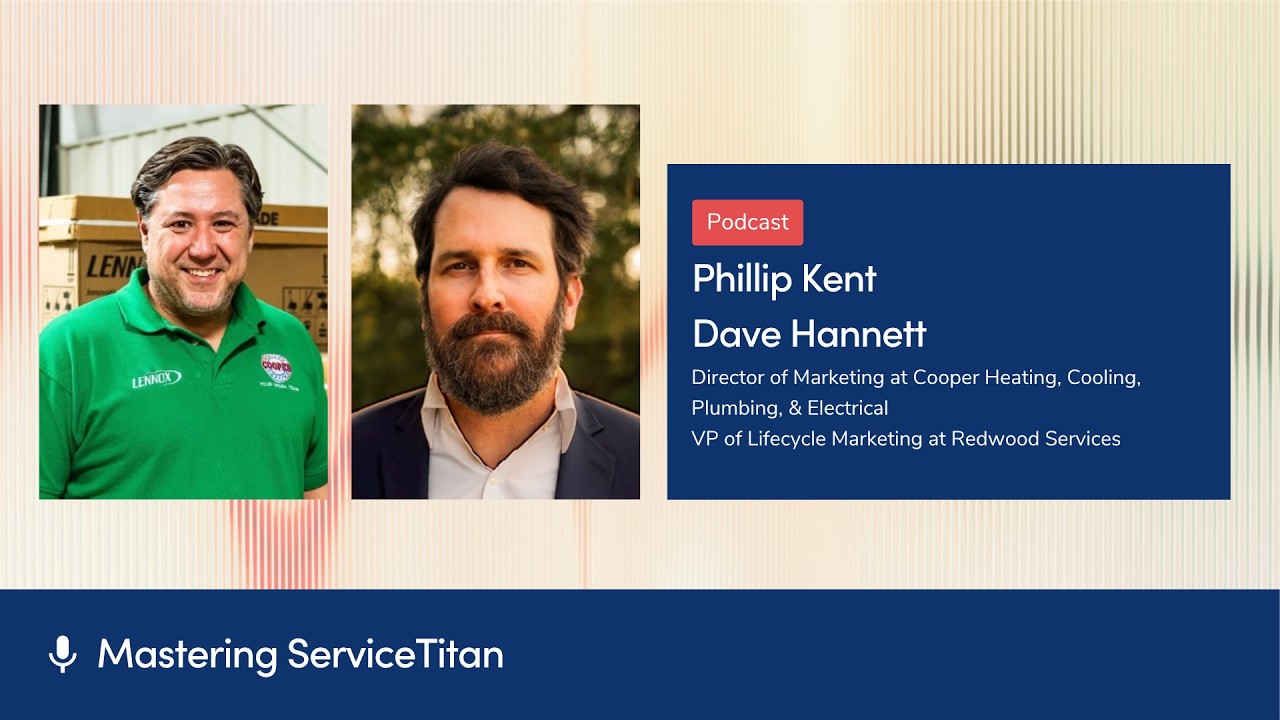
In this Mastering ServiceTitan podcast episode, host Josh Lew shares a recorded webinar featuring Paul Balesis, Philip "PK" Kent (Director of Marketing at Cooper Heating & Cooling) and Dave Hannett (VP of Lifecycle Marketing at Redwood Services). The conversation focuses on turning hot‑weather service calls into long‑term, high‑value customers. Key themes include building a membership program (members generate ~5× the lifetime value of non‑members and are 3× more likely to use multiple trades), using ServiceTitan’s Marketing Pro to automate highly personalized pre‑arrival and post‑job communications (email, SMS, tags, autopilot campaigns, online estimate links), leveraging autopay and annual system‑check reminders to boost retention (2× retention with ongoing autopay, 4× with yearly checks), empowering technicians as marketers with bios, leave‑behind materials and spiff programs, and orchestrating a channel mix that blends Google search/PMax, Google Business Profile, Reddit and seasonal/opportunistic messaging (e.g., heat‑wave tips, wildfire alerts). The episode also shares concrete data points (e.g., 20‑25% of follow‑up estimates convert via the online estimate link) and practical playbooks for building automated journeys, segmenting members vs. non‑members, and staying relevant through rapid environmental changes. Listeners are encouraged to start with a few high‑impact touchpoints—pre‑job email, membership onboarding, and timely seasonal alerts—to begin capturing the 5× revenue upside.
Chapters
What we found, and we dove down in the data, is that members have 5 times the lifetime value of a non-member. They're 3 times as likely to use multiple trades if you have them, because membership is, it's really just the rocket fuel for that cross-selling.
Welcome to Mastering ServiceTitan, where you get expert advice from power users. I'm your host, Josh Lew, and today's episode is a little different. You guys might not know this, but I actually work a lot on ServiceTitan's webinars, and recently we had a webinar that I thought was really worth sharing on this podcast platform as well. A few episodes back, we had Paul Balesis on the show, and for this webinar, he really took the reins and had a great time talking to Philip Kent, or PK as he's known. He's the director of marketing at Cooper Heating and Cooling, as well as Dave Hannett, the VP of lifecycle marketing at Redwood Services. So we're going to bring you that conversation that Paul had with them, and they cover the topic of How to Turn Summer Service Calls into Lifelong Customers. They go over things like memberships, referrals, and a bunch of growth strategies, especially for the summertime. So I hope you enjoy this conversation, and by all means, please let me know, uh, if this kind of content is interesting to you, if you like this kind of content, or really any feedback at all. You can always email me at jolu@service-sign.com. And with that, we'll see you with more new episodes soon.
Wonderful. Thank you, Josh, and welcome everybody that's here today. We got a rockstar lineup. I've been talking with PK, Philip, but we call him PK, and Dave for over a year now and gotten to really know them and their businesses. And they are two people that I can say are on like top tier of what they're doing in marketing for whether it's one brand, multiple brands across a lot of different things, experimenting, doing automations. So you're going to get a really good crew today to learn a lot. So today we're just going to take you through essentially how to get customers that you're taking in right now to be lifelong customers. And we know that you're experiencing, if you're on the East Coast especially, you're experiencing quite the heat wave right now. And I'm sure the phones are ringing. People are looking for ACs to be replaced. And yes, you want to take care of that job right now, but how are you going to translate that into lifelong customers down the road? So I'm going to start with you, PK. Before the technician arrives, it's really hot, customer's calling in, they book a job. Where does the job actually start for Cooper and for you?
With the marketing beforehand. Basically, it's that top of the funnel branding, letting them know what we are, the services, different options. We also have a pretty robust campaign going on with, for our membership program. You begin there, once the customer enters the The journey, the funnel, phone, picks up the phone basically. We start to empower our techs to take that message out to them so they're not just, hey, we're gonna do a tune-up or we're gonna fix their whatever it is. They start learning about everything that Cooper can offer, we're getting included in the merchant.
Awesome. And Dave, same similar question for you. You're doing this, remind me, how many brands do you have across the country?
Every time we talk it's gone up. So I think we're sitting at 23, 23 now. And there are 23 partners, 23 partners.
23 partners. And that's got to be probably like 1,000 technicians at this point, or you're getting close to it.
Oh, almost 3 times. Yeah, almost 3 times.
Nice. Impressive. So when the customer comes into you for the job, where do you consider the job starting between them getting, booking the job and the technician arriving?
Similar to what PK said, you know, it depends if it, It starts when you start marketing, right? Decide who your customer is and then start developing strategies for both. And then you split it by like new and existing, right? But I think what you're talking about colloquially, job, you mean like the service experience. So really that starts, you know, once they've responded to your ad and they've made contact one way or another, whether that's your website or calling you. So from a like a lifecycle standpoint, like my discipline and my team's discipline, That's where we really believe that it starts.
And if you can take us through this a little bit more, because I know this seems like your playbook that you have for Redwood and for all the different partners that you're working with. What's your thought process behind a strategy like this and all the different touchpoints that you're using?
Yeah. So first, I should clarify at Redwood, you know, my role and the role of my teammates here in this building in the Partner Support Center is to be a center of excellence for our partners. Provide recommendations and support where needed. But our partners, our partners run the business. Our partners are the ones out there, they're executing, and then we help where, where needed. But we've got 23 great partners that are amazing and driving the business. So, you know, you're in the job, you call, you book, you know, you're going to start getting these service site notifications right now. A lot of people don't necessarily take advantage of the full, the full benefit of using those. Because you never, if you look at like open rates and eyeballs and stuff like that, you never have more of the customer's attention span than you do right here when they're experiencing your product. So you would do booking confirmations, your appointment reminder, and all those other ones there. Customize these, you know, make sure you're talking about your brand, having the name in there, having, if you've got a full name that has multiple trades in there, but, you know, put that in there. The emails in particular, you can be promotional in those or do all sorts of other stuff in those that will still that won't be, that won't run afoul of TCPA. So you've got a lot of liberty there. You know, they're not like a full marketing pro email, but like I said, you never have more, more of the customer's eyeballs and mindshare than during this window between booking and job complete. The other side of that, so the personalization, depending on who the customer is, like, are they HVAC or plumbing? Do they have aged equipment or non-aged equipment? Are they a member or a non-member? Like, that's the degree at which we're getting granular and sending out a new marketing pro email. We call it a pre-arrival. So let's say if you have an HVAC system that's 10 years old, you're going to get something that helps you, helps the customer and ultimately the technician in terms of— we call it your home comfort guide. You'll get information on depending on the age of your system, whether maintenance, repair, or, or replacement is right for you. If you have a water heater, Same sort of thing, but with, with, you know, with plumbing there. And then if you're not in aged equipment, we'll parse it out and say, all right, well, are you a member? Then we'll give you like a related items or services thing. You know, like when you're on e-com, when you're on Amazon or a website, you'll say customers like you also bought, or you may also like. So we'll do something like that. If they're not a member, then we want to message the membership program because we know that that is, you know, one of the biggest levers in the trades to keep a customer.
We're going to get into memberships like right after this. You were talking about a lot of levels of personalization. How do you get to that level of personalization within ServiceTitan? Are you using tags? How are you doing all the different emails? Can you explain that a little bit more?
Yeah, well, so first it's with Julia Gundell, who is a gangster and incredible at the building, building out anything in Marketing Pro. So shout out, shout out to her. But in terms of personalization and tagging, it depends. The tags are manual, so they can be less reliable. And you've got multiple tags. Sometimes you've got an age tag, opportunity tag in the customer tag, which is probably the wrong place to be because the customer can move, right? So having it in the location is generally the ideal place, but that's probably where there's the least amount of compliance in putting it. And then you've also got it in a job, which we find is the, the probably the most prolific and used and accurate place because it's the technician or the CSR doing it when they call in at the time. It doesn't need to be updated, it's current. So yeah, but we'll, we'll use tags and also just dimensions like are they a new and existing customer? Are they a member or a non-member? When was their last job? You know, what have they done with us in the last 18 months, 6 months? When was the last time we called them? I mean, you name it, depending on the campaign, there's, there's a lot of different stuff that we'll do.
And PK, you follow a very similar formula here for before the technician arrives, sending out automated communications.
One of the things you could also do is just to piggyback on that, you can add PDFs to these communications. So if you want to include promotions or anything like that, that's what I do, what we do here. You know, obviously it's, it's Format it to the type of customer. So if it's an HVAC service maintenance, plumbing, electrical, um, but we'll let them know about the promotions that we have, um, and give them a little bit of information about the, the Cooper Green Club. It's our membership program. And the referral program, we have a really successful referral program right now. So you can add those to those automations, little customizations that Tim was speaking about. Give it that extra personal touch.
And then question for both of you, you're sending out these types of reminders. Is there anything that you've gotten feedback from the customer that they really appreciate and that they really like to get?
Sure. Like in the, in some of the early notifications, like say, like say booking confirmation, you know, everyone, like no one's ever happy to see us, right? They're neutral to see us at best. And so there's a lot of stress that they've gone, that they're going through. Like they've just had something fail. It might be 100 degrees inside their house. You know, maybe mother-in-law's visiting and that's not helping with stress level in the house. But we try to, with that first one especially, set expectations. You know, tell them basically, hey, we got you. You demonstrate your expertise and tell them what to, what to expect. And if you need anything from them, like someone over 18 has to be there, the owner of the home has to be there. You know, if you have a dog, put them away. Hey, you know, here's what your technician will walk through. This, this, this, this, and this. Explain the process to them so you can make a stressful situation for them less stressful, make them feel more in control. And the more you cultivate that relationship with them starting from the beginning, the better set up they're going to be and the better set up the technician's going to be when they do reach them.
TK, any additional thoughts there?
We hear the feedback in our reviews. So we give them an opt here review. We have multiple ways they can leave a review. We also have it so if something's not right, an email is automated to our president, owner, CEO, or all those titles where he will reach out to whatever manager and say, hey, what happened here? What, you know, why did we slip on this particular customer? And then he'll reach out and say, hey, we're going to, we'd like the opportunity to make it right. And so whatever it is, So it's, you know, I guess to the crux of the, the whole point of this webinar is like that continuing to give them good service. And so it's, I think for us is that follow-up from the highest levels of our management, I think is a really good touchpoint for them.
Yeah, agreed. And for any of the owners on here, or really anybody, general managers, marketing managers, it's a really good way to keep your finger on the pulse of what's going on with your business just by seeing those reviews and just getting a gut check on them. I know if we have like Marketing Pro with reputation, you're able to see that at a glance, but you just go on your Google Business Profile and just start filtering by what happened most recently and by different review scores. It's a really easy way to be able to see that and see what's going on with your business. I recently, I used to live in Pennsylvania. I got a water heater installed by a company that actually used ServiceTitan, and they sent me a tech bio, which I thought was pretty cool. And it was like, Penn State fan, has a dog that's 5 years old. Wife and 2 children. And it was just a really nice, I thought, introductory way because you're inviting someone into probably your most private quarters, your home, and you never met this person. And it just gives you a little bit of insight into who they are. So I think every one of these touchpoints has a really good initiative, letting— whether it's letting the booking confirmation all the way down to the technicians en route, who the technician is, they all set the stage. I think that's what PK and Dave were starting to say. This all sets the stage for what's about to follow. So your technician essentially leaves the home, but that's really where this marketing efforts start. So hopping into the next, I think Dave pulled a lot of these numbers and I, I'd love him to explain this a little bit more because he's given this talk a little bit more. If you ever come to our Toolbox Lives, you've probably seen Dave talk, you've probably seen BK talk. They're legends at Toolbox Live. Dave, can you take us through some of these numbers because you've done the math here and why customer lifetime value and memberships really matter?
Thanks to ServiceTitan and the visibility we have into our entire business across the continuum, you know, we have access to this data. Like, you don't— don't get me wrong, like, it's great. We have amazing analytics people here as well. But just anyone can pull this with just in ServiceTitan using basic ServiceTitan reports. So this is specifically about the importance of memberships. Again, it's one of the biggest levers we have in the trades. And what we found, you know, we dove down in the data is that members have 5 times the lifetime value of a non-member. They're 3 times as likely to use multiple trades if you have them. Because membership is, it's really just the rocket fuel for that cross-selling, right? Like a lot of folks don't even know you have other trades. And if you've got that membership with benefits in each of those trades, you're much more likely to get them to engage there. Also, they're more likely to purchase an install from you. You know, about 2.5 times more likely to purchase an install from you. So whether water heater or HVAC install. And then from a retention standpoint here, again, it's not just like first job value, it's that lifetime value. So membership is one, but there are a couple underlying elements you have to do in the membership itself to make sure that you realize the full value here. And that's number one, you know, put them on autopay. If you sell one-time pay memberships, Stop doing it right now. Just stop doing it right now. You have 2x the, uh, 2x the annual retention if you put them on autopay. Uh, and also don't get trapped by setting— into setting up a fixed autopay. It's ongoing autopay when setting up a membership. Membership's like one of the most complex things, uh, in service Titan, but that's a great nugget. One, all on ongoing autopay. And number two, make sure no matter how old the water heater is, no matter how old the system is, make sure you run at least one system check for them. Every year, just about, you know, 4x the leverage, 4x the leverage there, retention there. If you actually deliver on what you promised them there.
To Dave's point, if you don't have a membership program, that's definitely something you need to start investing in. Yeah, VK, I'm going to switch it over to you because you guys just recently, as Dave said, memberships are very complex. Also within ServiceTitan, you guys took a different approach where you're— you try to simplify the membership program. And I remember at Haller we had The amount of membership and the different systems and the different things you could add on. I mean, I couldn't even keep track of it. So would love to hear from you a little bit how you went through that process because you've been on a membership journey right now to really 2 and 3x how many members you have.
Yeah, it's many x's. We've increased, but yeah, we had different memberships for different levels, different services, and we scaled it all back. So we essentially have one membership with three levels. So there's 1A, 1B, 1C. So it depends on how much people want to go out to their homes. The reason we didn't go with one is because here in Colorado, I mean, it's probably the same everywhere, but there are people, it's just different size homes, different HVAC systems. So sometimes people want multiple services done or multiple checks on their, they have 3 systems in their home or whatever it is. So it's still, so they'll pay for it. The next level, but it's, it's essentially the same still membership. Just you get more home visits. You know, it's really empowering your techs to become marketers. So when you go out there, we really value the opportunity to go into somebody's home. It's one of the, I don't know, like Dave sort of alluded to this at the beginning. It's like people aren't happy we're there, but like the amount of trust that people have to throw at, I think we as marketers in the HVAC industry and especially techs and owners, like we did at a town hall meeting and I asked the question about who was the last time somebody bought an HVAC system. Nobody. We have a pretty big staff, like 550 people, and nobody has an HVAC system in the last 5 years. And so it's like, you know, to put ourselves in the shoes of the customer, you know, hey, we're going to invite these strangers, pay them money to come into our home and make us comfortable again. And so anyway, it's empowering them to be able to make, create options. They're fully, you know, giving them all the promotions we're running, rebate programs that are available to them. So that's part of what we do with that membership. And so when it comes time to like, would you like to become a member? I mean, before our membership was all over the place, I couldn't tell you what the number was. People were dropping out left and right. But as soon as we made it a rolling membership, like Dave mentioned, and, you know, started having customers feel the type of person that's going to come into their home, it's just, it's an easy sale after that. And then, you know, like, I don't know if we went over that number, but the amount of lifetime revenue from a member is just insane.
Yeah, I think it's a 5x customer value and that's fairly significant. I mean, I think if they come in as, let's say they have a 7-year-old system, HVAC system, and you get them on the membership program, even if it's for a discount, couple of years from now, you're setting yourself up for a very nice $15,000, $20,000 install. So you're going to see— you're going to reap the benefits there. PK, how are you? So you go to the service managers meetings. Are you doing anything else with the technicians? Any spiffs, any competitions, anything like that to help drive memberships?
Yeah. I mean, one is it's, it's, it's just communication there. You know, like one of the things I did when I got here was tear down the barriers between marketing and everybody else. It's very transparent what we're doing. And so, and then helping them, like, so we started handing out, like, creating these different type of leave-behinds, but not just like, you know, like, then here it is. It's also like having them understand what it is. So everything that we do, they can just talk about so that there are options for the customer before they leave. Like, hey, you know, like, have you, you know, did you have any questions about the indoor air quality pamphlet that I gave you? Do you have any questions about the referral program or the membership program? Would you like to sign up for the membership program? Also, you know, just having them understand that to provide options like, hey, we were cleaning out your condenser, you know, like there's lots of fires happening in Colorado. Have you ever thought about, you know, like an air purification system? We do that here. Just having them understand that, you know, like they become cross-marketers. And that's a big way of like, you know, just offering those, having them to be able to offer those customers, have the printed materials. I mean, I do a lot of digital marketing. I've been to a lot of digital marketing company, but print, print still has power in people's hands. You know, those are the kinds of things that we do to give those extra personal touches. Because I can't remember where in the slide, but personalized, everything has to be personalized. I mean, everything is so automated, AI. Personal touches will not fall behind any of those. Get, you know, somebody being comfortable and feeling they trust you, you know, they end up trusting your whole company. They will call you back first.
I think that's a good point. The more personalized you can get, obviously the better. And then someone had a question. Let me go back to it. I think Dave, you were talking about autopay. Jeremy has a question. How do you let customers know that they'll be billed via autopay?
Yeah, if they're on monthly autopay, you probably don't need to unless you're charging like $1,000 a month for your membership. If they're on annual autopay, you can send them, you know, send them a letter, you know, send them an email. That's going to be a bigger amount, you know, that helps soften that a little bit if it's on annual autopay. And I think there's some— I think there are some Autopilot campaigns also for like membership about to expire, just expired, things like that, as well as credit card failures and credit card expirations.
Yeah, it's a good point. If they don't have the time to build out their campaign, I know everyone's really busy right now. You can just go to Marketing Pro and the Autopilot tab in the top right corner, and you can activate some of those campaigns with your custom branding automatically and already pulling that whole targeted list. It honestly takes like 3 clicks and seconds of your time to do.
Don't forget to do it because if anybody questions about it, like Kay, we notice, we send an email to anybody. Within. So they have an annual membership. We create an automated campaign and say, hey, just to let you know, this is going to renew. Because with us, if they do annual, they get extra Cooper Bucks, which are like a credit towards a future service. And so we'll let them know like, hey, you're going to get these extra bucks, plus we're going to renew your campaign for a year. You know, sometimes people miss those emails. They'll call back like, hey, we sent you an email. They're like, you Most times it calms them down right away, like, oh, I missed that, but thank you. So yes, don't forget to do those emails.
Overcommunicate. Well, maybe not overcommunication, but making sure you're communicating the proper information so that way the customer knows when they're going to get billed. No one likes that surprise bill. That's always a good thing to do. Best practice. Let's jump into some of the journey that the new customers have. So we just talked about you got the customer, you did the job. We understand how much value comes from making this customer a member or a lifetime customer through the membership program. Dave, do you want to take us through this a little bit about some of the campaigns that you guys are running and the impact that they're having?
So everything here is triggered based on, with the exception of missed call, based on when the job date is or when the job complete was. So it's all automated and then we sort of clear space around this automated journey. So that if we've got promos or newsletters running in this time frame, you know, they don't, they don't get those. So we're not confusing, confusing or overwhelming them here. So it starts first with abandoned call or missed call. You know, you get to trigger that SMS, drop a booking link in there, and also set up your ServiceTitan alert if you don't have that set already for abandoned calls. So you can burn that candle at both ends. Each one of those best practices, one of those tactics will increase your booking rate by like a third. There. I think we talked about the pre-arrival just a little bit earlier. You know, it's once they're in that, in that sweet spot where you've got their mindshare. That's what I was describing with regard to that. If you've got aged equipment, you get this before the appointment, etc. If you get into the home and they don't convert, we trigger unsold estimate campaigns, both email and SMS, and run those for about 60 days. You'd be surprised at two things. One, how many of your unsold estimates convert the very next day after you were in the home. So these are all people who have said no to you in the home. And, you know, about a quarter of them are changing their mind when you ask them again. So you just got to— you got to keep asking. And then this is also a long tail that we see estimate follow-up conversions out beyond 100 days and sometimes even like 150, 150 days. So that's, that's why having that automation is really, is really key. Once the job completes, they do convert, then we put them in the next stage. There you get a welcome and thank you. You get a cross-sell offer. If you came in via plumbing, you're going to get an HVAC coupon. If you came in the HVAC, get a plumbing coupon and so forth. If they selected a membership throughout the process, then we are going to give them a membership onboarding email that again explains what they just bought to get them to understand all the benefits that come with it. If they understand them, then they're going to use them. And when they use them, that's when they retain and you get the full realization of that 5x lifetime value. And if they're not a member, they're getting information on how to be, how to be a member and what's included and all that stuff. And then your fast follow is, you know, to try to get them to use one of the recurring services. And remember, that's, you get, that's where you get the 4x customer retention when you do that. And then after that, you know, you put them in a monthly, a monthly cadence. There's usually an offer and a newsletter. And those are both— the newsletter especially is really great at being your lifeline to, to the customer. You'd be surprised at how many folks who are in the middle of a job experience or are months removed from their last job will actually read the newsletter. Those are always some of the best performing, performing pieces, both in terms of email and click rate. And then you can also work in, you know, some content marketing that has an offer. You know, we do a great— Julia did a great piece on the importance of maintaining your HVAC system. She did a great piece on electrical hazards in your home and some stats, some stats around that. I know there's call to actions of like, hey, electrical system check and HVAC system check, things like that. Also, I wouldn't encourage you to do too many offers in a month. If you do put them in that one offer email, say, hey, here's the, here's the July specials. The more you sort of put indiscriminate blasts out there and the more of them you do in a, in a discrete timeframe, the more you're just gonna, you're gonna divide the customer's attention. In our industry, you know, the average HVAC system is gonna fail, you know, once every other year. You know, this is not a, not a Chipotle, right? You can give someone a coupon and give someone a coupon again next week and it's relevant to them. So if you divide their, if you put multiple offers out there in multiple emails or vehicles, you're gonna, you're gonna dilute the effectiveness of those. So I'd encourage you to figure out how to do like one specials email and then one newsletter each month once they're out of this, you know, this, this automated cycle.
Do you separate out like your newsletters and the types of emails they get from members to non-members?
Yep. We try to set it up so that there's a not basically a member and non-member version of all, all the emails. Okay.
And what would be like the main difference? Is it the offers? Is it the type of personalization? Is it cross-selling opportunities versus the non-members?
All of those. Yeah, it's all of those. But also to, to, again, one of the biggest benefits is just reinforcing the value of them or say, hey, we see you, you know, we see you, Paul, you know, thank you for being a member. Here's your, this is your newsletter. So it's recognizing you and then con— you know, conveying, again, reinforcing the benefits. And some, and sometimes there's something a little different in there for them. And sometimes it's subtle, but there's always something a little different.
I really like what you said, that you're communicating not just offers and such, but you're also communicating best practices and tips. And I think it's important to remember that most of the customers— well, I grew up with a dad as an HVAC tech, so he knew, but like anybody normally does not know what to do with their HVAC system. They don't know when to change out their filter. They don't know when to— maybe they need to get their water softener refill. They don't know when to get their water heater flushed. They don't know when to change their smoke detector batteries, or they might forget. So there's a whole bunch of things that you can have different touchpoints, and it sounds like you're automating most of them seasonally that you can send out. It's 100-something degrees on the East Coast. It's best practices to make sure you're not overworking your HVAC unit because then it's going to break down. Good for all of us here, but not good for your customer. So I think there's like definitely things that you can have for best practices. I want to circle back what you said with the unsold estimate campaigns, because I think this is a really important one. So right now it's it seems like it's— everything's moving quickly. If a customer's HVAC system breaks right now, they want it replaced probably sooner than if it breaks in mid-September or October. They might wait a little bit longer. Do you fluctuate timelines of when you send those communications at all based on seasonality?
No, we're in there pretty early and often with the, with the follow-ups. You know, within the first week they'll get, you know, 3. They'll get one on the very next day., then they'll get 3, 3 in the first week. And then depending on whether or not, like, if it is, you know, a potential, you know, no-cool or system replacement situation, they'll also get multiple outbound calls from our inside sales reps that are working, working those, working those jobs.
Okay. So yeah, multiple touchpoints there. And is it just email that you're using or using different other different channels outside of calling?
Primarily email and SMS. I, you know, I coach our inside sales reps on letting, letting, let the technology front run your, your manual effort. You know, the, the, your, the people in your chain are the most valuable and the most scarce resource. So let the campaigns go and then follow up on the heels of those after they've had a chance to soak for a little bit. You know, ServiceTitan has some great tools that separate it from other providers that you may do, you might do estimate follow-up with. And first of all, it's that online estimate link, right? So you'd be, might be surprised to know First of all, you embed that online estimate link in both your SMS and your emails. And you might be surprised to know that anywhere from 20 to 25% of the sales that you convert on follow-up. So after you leave the home, you know, day 1 plus, 20 to 25% of those are people hitting the accept button in the online estimate link that you sent them. You know, and that's something that, that online estimate link can't be used in any other platform, can't be used on a third-party platform if you use that's true for any of those folks that they're at a disadvantage there because you've got that functionality for the customer to say yes and advance that order. Likewise, they can apply for financing directly through that link. You're giving them the opportunity to self-serve. And likewise, you also can trigger and you can set up an alert in ServiceTitan so that as soon as Paul looks at his estimate, PK gets an alert. And lets him know that Paul's looking at it. And that's an incredibly powerful signal of intent. Now you don't have to try to figure out of the 100 estimates you created yesterday who's still considering it and at what level. You know now that PK is still considering it and now is the time he set aside to consider it. So that's when you have your ISR, is jump on that, you know, jump on the phone, give them a call or reply, reply in the text to try to get them served or get their questions answered.
Makes sense. And I'm sure we have like a ton of marketers here for today's session. So if you're not— and they're on Marketing Pro. So if you're not checking that out and using that, I think that's a really powerful tool. Um, yes, that tool is only available in Marketing Pro, but it would be very powerful for your sales team to have that warm lead and immediately do the follow-up. I think we've all been to websites before where maybe you filled out a form and then immediately you get the follow-up. The speed to lead, it's very critical. And if you don't have salespeople that can follow up right away, we also do have outbound AI agents that are now able to follow up with that customer automatically. So maybe you're not bogging down some of your sales team if they're very, very busy. PK, outside of these campaigns, like, well, with these campaigns, what channels are you seeing drive the most impact for your customers?
Google, um, all the different various Googles, PMAX, we have we run a really robust Google campaign through it. And so it's with search, with PMax, I would say search for us. I know PMax, I always hear people doing really well with PMax. Our Google business page drives a lot of traffic and revenue. We keep that really up to date. It's crazy, I'm actually kind of glancing at numbers, a report that somebody sent me. Our social and Reddit, Reddit is a really good, like we, we, we were finding ways to get into subreddits. There's a lot of fires happening. We started running these campaigns in Reddit with indoor air quality. And it's pretty awesome how much traffic it drives to the website and people are actually booking IQ stuff with us through Reddit. I would say that's very good. But I mean, again, you know, like Reddit is, is a really good place that you can actually enter conversations. There's that personalized touch. We have a really successful, the open estimate campaigns. We allow our techs to follow up, even, you know, the maintenance techs. We give them business cards so they can be followed up with. And then once the automation enters that, like after 3 or 4 days in the summer, it's hard for them to follow up. But our open estimate campaigns are game busters. We've always had a really good open estimate campaign following up. And I, I'm a big fan of Reddit.
All these different types of campaigns are available within Marketing Pro. Um, did you see Dave in the chat? The alerts is in the financing integration, so make sure you check that out for those alerts and then incorporate that within Marketing Pro for your alerts. There is one that you can do within Core right now though. So if you're not on Marketing Pro, those recurring services, that is available on the Core platform. So that is a no-brainer. Just set that up and make sure your customers are getting their texts or your members are getting text messages to schedule their recurring services. So we were kind of talking about this a little bit more, a little bit earlier, and it's kind of cyclical. So I think, Dave, you were chatting about this a little bit and all the different touchpoints that you have with the customers. When you create campaigns like that, how do you think through seasonality with what the customer should be getting with also what objectives you're trying to drive for the business?
With the automation, it's evergreen.
It's—
we deliberately construct it so that everything in the automation works no no matter what, what time of year it is. We'll layer in seasonal stuff within the monthly cadence. So between the offers and the newsletter, that's where we'll work in some seasonality. And then also if you've got extreme heat, extreme cold, hurricane or whatever it is coming in, well, we have a sort of a third class of emails, if you will, between, you know, automated, scheduled and what I call it opportunistic. So, you know, that there's a cold snap coming, get a cold weather email out there, talk about, you know, pipes freezing and your HVAC system having to work harder, things like that. So we'll do those opportunistic ones seasonally as well.
And PK, it sounds like you're doing something similar, especially with the wildfires. You're not just using MarketingPro and sending automated emails. You're even going next level and being like, where are customers looking for help on this information? Where can we show up? And that's where you're thinking about the Reddit. Correct.
Correct.
But you know, the emails too, it's like sometimes don't be so tied to the automatic automations. I mean, they're great, but you know, like events happen quickly. You know, here we went from, you know, a few hundred acres of wildfires to like tens of thousands of acres, I think. We're at now. We had the worst air quality in the world 2 days ago. And so that happened really quick. So there's not an automation for that. And so it's like they were saying stay indoors, all this and that. And I'm like, you know, is your indoor air quality as good as it should be? Right now it's the worst air quality. And so, you know, we're only in— it was in, you know, early July, but about August, you know, we're going to have a— it's going to be a brutal summer here. It's very dry. So it's like being open to having those emails. So sometimes you have to like pivot on your automations because it's like Dave said, you don't want to just keep blasting people with emails. So I actually stopped a campaign, came, you know, restarted it, we customized it to what was actually happening. Like our summer savings campaign, summer newsletter campaign, it all started all over because I mean, I don't know that we all knew here in Colorado that summer would be bad, but not as bad as it has been, as quickly as it's become. It just, it made us pivot. So the thing I would add to this is don't get stuck in your automations. When you're delivering newsletters and promotions. But they all gotta be relevant. I mean, one of the things that I think too, just kind of the max and high-level, SageTrack companies, we're problem solvers. People aren't calling us 'cause they're like, oh, what's the newest, latest, you know, communicating system? It's like, my stuff is broke. Like, I'm hot, I can't breathe, whatever it is. So we're always solving problems and the problems, they do change.
Yep. Always stay relevant. This was from a couple weeks back, but it had two points. One, it was relevant because it was Memorial Day, and two, you're trying to drive memberships. So can you take us through your thought process on making sure you stay relevant and how you come up with some of these promotions as well? Because this one was really cool, I thought.
I mean, it was a really aggressive promotion for a full 4-day period. We did it in a way that it benefits our, you members. So if you're not a member, you could not take advantage of this. We highlight how great our membership is, um, how great our techs are that will take care of you. Really a service-first kind of mindset, even when you're doing AOR or installs. That's just one of the shifts that we've done this year is like promotions are tied to memberships. You know, somebody who's a member to take advantage of that, we're actually giving them extra Cooper dollars to thank as a thank you for already being a member. So you get a good deal if you're not a member and become one. If you don't become a member, then it's not for you. Because this is right when we started ramping up for summer. So we were not like, we were looking for a higher quality lead rather than like just throwing out a net. And so like, hey, here's a great deal if you become a member. Oh, you're already a member? We're going to say thank you by giving you these extra dollars. That's our line of thinking here is that we're a service-first company. We take— get those people into the cycle and then we take care of those people who are in the cycle even more so.
Makes sense. And I think it really resonates that you are a service company. You're trying to provide them a good service, but also trying to provide them with a ton of value at the same time. And then, Dave, I know you're making all these in MarketingPro. Maybe just take us quickly through just the components of a really good email, what you've seen historically work.
Sure. So first, this is all one email. They're just sort of stacked here. So it's easy to digest them. Yeah. This is the newsletter format in MarketingPro. When you select the templates or newsletter template in MarketingPro, this one specifically is for the automated onboarding sequence. If you opted for the membership, as you know, during this, during this job. So we like to say, first of all, generally speaking, number one rule of like whether it's email design or mobile design or whatever is try to have everything that's relevant above the fold, like without having to, without having to scroll down if possible, you know, like, just by looking at the first panel, they should know who it's from, what it's about, and if you're asking them to do anything. So in this first panel here, we're welcoming them to the club, we're giving them, we're restating the benefits here, because remember, if they understand the benefits, they're going to use them and then retain. So we call this like the no-brainer panel, right? Hey, you save all this money, for just this little monthly cost. And we want to explain here in this case, anything that's unique about the plan. In this case, they get an app and they get thermostat and things like that. And then we'll pull out in the social proof there. One of my favorite— as great as Google is with a lot of different things, one of my favorite features is just the ability to search the reviews by text. So anytime you're cranking out a marketing piece, just say, all right, give me a Google review on X and you can clip that, put it in here. So this is an actual review about this membership from from another one of their, their customers here. And then we go into some of the, you know, hey, well, you got Better Business Bureau, you won this award, blah, blah, blah. We always sort of have the opt-in in there too. We think of that last panel as like a mega footer, right? It's like, just, you know, you get by having it out there, you're going to grab a couple opt-ins, you're going to grab, you know, XYZ. And then we have the brand story. You know, it's important to try to, you know, connect on an emotional level with your customers. You know, so this is a, this is a great well-run business by Raymond and Ben Nolte down in Jackson, Mississippi. So we talk about, you know, the history of this, the history of the 3 generations and the commitment to, to, their customers, things like that. So this is sort of, sort of the prototype, I guess you'd say. We do, we think that we'll do some more abridged versions if just as a quick, you know, a quick offer or what have you. This is more of a content piece. Yeah. But this is, this is a good example of, Generally speaking, how we structure.
Go ahead, TK.
I was going to say too, like, giving campaigns, or we give a lot. And so they're not just for social media posts. These are places where you can add these into the emails. If your company is doing something that's giving back to the community, mention that. Those are great, great things. We give 1% back from all of our profits to Various programs. I encourage everybody to do that.
And then just to wrap us up here, so we talked about a lot today. We talked about going from not even the technician arriving at the job, before the technicians arrive, the marketing beforehand, booking the job, all those communications before the technician arrives. Technician in the home, they're equipped, they understand, they've had the service meetings about the membership program. They have the information that they need, like PK was saying, the actual physical copies of information. And then they got the quick follow-ups like Dave and PK were saying about join our membership program, explaining the benefits, being thought leadership. If weather events happen, fires, wildfires happen, you're intentional about the communications that you're sending and the value that all those little touchpoints have in accumulating 5x customer revenue over a long period of time. So it's just something to make sure you think about and just to maybe start taking baby steps, maybe start taking one step of each of those journeys. Like a pre-job arrival email, a follow-up email with your membership program, and then think about some weather events that are happening. And speaking about weather events that are happening, here's one you could start with right away. So heat wave best practices, make sure you're preparing for it as a marketer, as an owner, you're thinking about ways you can capture every call. Your phones are going to be inundated. Make scheduling very easy for your customers. Dispatch the best technician to every job. Throttle your spend. I think some people can forget about this when they can just leave your Google Ads thrown up because you're trying to capture all those jobs. It might make sense to throttle that back down a little bit because you might be wasting it if your board's already full. And speaking of your board, adjust it to capture those high value jobs. And then kind of like what Dave was saying, use it using some playbooks and have those in your back pocket to activate. You can do all those with Marketing Pro.
Awesome.
Thank you, Paul.
And thank you all so much for joining us today. We will catch you on the next webinar. Do serviceaim.com/webinars. We've got a bunch lined up for you all as well. So thanks, everyone.
More from Bill



ServiceTitan Virtual Agents: Simplify Before You Scale | Podcast Ep. 110 | Mastering ServiceTitan



Life After Live Events: How to Turn Post-Conference Energy into Real Profits | Podcast Ep. 297




