What, Why, and How: Mapping Leadership Roles for Maximum Scalability | Podcast Ep. 275
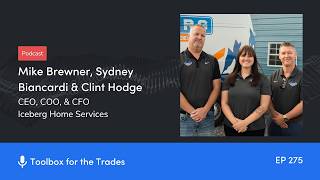
In this Toolbox for the Trades podcast, host Jackie Aubel interviews the leadership trio of Iceberg Home Services—CEO Mike Bruner, CFO Clint Hodge, and COO Sydney Biancardi. The conversation covers the founders’ personal backgrounds, the company’s evolution from a small 12‑by‑12 office in 2015 to a multi‑market HVAC, plumbing and electrical service provider across Central Florida, and the strategic framework that enables rapid scaling. The trio explains how they mapped their roles to the classic "what (visionary), why (strategic), how (execution)" model, heavily influenced by Gino Wickman’s Rocket Fuel and reinforced by data from ServiceTitan. They discuss hiring philosophy (industry veteran, non‑industry finance/gaming talent, and fresh‑grad CSR), core values (serve people, have fun, win big), decision‑making dynamics—including frequent disagreements, data‑driven tiebreakers, and Mike’s final call—and how those dynamics fuel growth. The episode also explores how COVID accelerated data‑driven processes, the importance of mentorship, and the company’s 5‑year and 10‑year visions (expanding to seven Florida markets, $50 M revenue in five years, $100 M in ten, and building a top‑graded team). Throughout, the leaders share personal anecdotes (dance dad, drumming, early motherhood) that humanize the business and illustrate the culture of fun and community service that underpins Iceberg’s scalability.
Chapters
Hello contractors and welcome to Toolbox for the Trades. My name is Jackie Aubel, and today I'm speaking with Mike Bruner, Clint Hodge, and Sydney Biancardi. They are the CEO, CFO, and COO of Iceberg Home Services. I spoke with them about how their leadership trio works together to grow their Florida-based business. I hope you guys enjoyed this conversation as much as I did. Mike Bruner, Clint Hodge, and Sydney Biancardi. You are the CEO, CFO, and COO of Iceberg Home Services in Winter Haven, Florida. Today, the four of us are gonna be talking about the what, the why, and the how, how you three leaders with nothing in common built a trifecta that runs like a machine. I'm so excited to have you guys on the podcast. Welcome, welcome. So everyone can differentiate who is who, I'd like you to say hello after I say your name. Mike Bruner, you are the CEO. Please say hello.
Hello, how are you?
Clint Hodge, you are the CFO. Please say hey.
How we doing?
And Sydney Biancardi, you are the COO. Please say hello. Hello. I am so excited to chat with you guys. This is a full house, but given what I know about your background, I'm really excited to have all three of you here today. We're going to kick things off with an icebreaker, and I wanted to start somewhere personal before we got into business. I'll go around to all three of you. I would like to know what's something you're into outside of work that people on this call might not know about you? Mike, why don't you go first?
So I'm, I'm big on my family. I got two little girls, a 4 and a 7-year-old, and, uh, I have become a huge dance dad. Uh, they're both into travel dance and dance competitions. So, uh, when we're in season, it's, uh, I, my life just about revolves around that every, every, every other weekend or a couple times a month or whatever. And I, I love it. I, I didn't know I would love it as much as I do. That's for sure. All right.
Well, that's what we're talking about on this show. That is incredible.
What is it?
L.A. tap, hip-hop? What's the style you do?
It's a mixture of all of it. They got different numbers. I think my, my girls tend to— they have a little spark to them, so I think they like some more of the hip-hop, faster movement stuff, but they do a little bit of all of it. So.
Oh, it's so, so cool. I love that. I love that specific. Okay, Clint, what about you? What is something outside of work that people on this call might not know about you?
Yeah, so, um, uh, drumming. I used to play, teach, and write, uh, music's kind of one of my first careers before ending up in, um, finance and what I'm doing here today. So quite a bit of a drummer.
What kind of drumming?
Rock mostly, and some jazz stuff. Anything that's pretty quick and kind of, uh, kind of layered in there. Like if it's something like really slow, I mean, pretty much anyone can do that, but fast feet, fast hands. Very much, very much a style I like.
Amazing. One other question. Do you have a drummer that you particularly admire? I'm a bit of a music head, that's why I'm asking.
Dave Matthews drummer's pretty good. Carter Buford. Carter Buford. I think I'm getting that name right. And, uh, but he, he's really good. He just knows when to kind of pick his spots. It's really, really hard to do. So.
Very, very cool. I know Dave Matthews kind of goes into that jam band territory a bit, so that is very cool. Yeah. All right.
Awesome.
And last but not least, Sydney, what's something about you that, uh, outside of work that people would be surprised to learn about?
I am very work motivated. So when I get home, I work. But I also have a 2-year-old that takes up— she'll be 2 actually in a couple of days, but takes up pretty much every other waking moment that I have. So we go to Disney a lot, we go to parks a lot, but basically it's work and her are my main focuses and main interests for sure.
I have a nephew who's about to be 2, and that was one of the people that I visited when I was on vacation right before this week. So very, very cool. Oh, I love to— I I love hearing about the people behind the business. So for listeners who don't know Iceberg, I would love it if you guys could give us the overview. What do you guys do? Where are you? And what does the company look like today? Mike, why don't you take this?
We're, uh, mainly HVAC and plumbing right now, home services here, uh, in Central Florida. We basically cover the Orlando market, but we go, uh, across Central Florida and into Tampa area. We've scaled really well the last several years. We have a great team here and, and we just continue to work on taking market share, but also serve our communities. We're really big on community first and do a lot of events and all that kind of stuff that goes with it. And just have fun doing business.
And Mike, you have been at Iceberg since the beginning, so why don't you walk us through where it started? And then Clint and Sydney, I'd love you guys to pop in when you guys entered the business.
We started, we're going on like 12, 13 years now. Feels like it was just yesterday some days. But I had a partner at the time that we went, he was, his background was more like the big stuff, commercial kind of industrial stuff. My background is in HVAC in the residential side. Before we kind of started, before I came to start Iceberg, we, I was 10 years into HVAC sales and throughout the Florida market and kind of did, you know, that kind of thing and learned what not to do, what to do in business. And got to where eventually I knew I wanted to kind of get involved with doing my own thing and doing our own business. Just had that opportunity. We ran our first call January 5th, 2015, uh, first residential call. And, uh, again, just kind of started grassroots, didn't know anything. We were in a small, we were actually in a small building that was on somebody's property that we kind of rented and, and just put a little, I mean, building that's smaller than my office now. It's probably like a 12 by 12 building. That was kind of our office to start with. And we just started from there and just put all the hard work in behind it and put everything back into the business to get it to grow in scale as fast as we were able to.
And Mike, I'm curious, was there any specific thing or a person that inspired you to go off on your own after doing HVAC sales and installs prior to starting Iceberg?
No, I would say when I was in college, I actually dropped out of business school in college like 3 3 years into getting my business degree because I had an older brother that was in HVAC and he was doing really well and making pretty good money in HVAC sales. And I was young at the time. I was like, let me, let me try and take the risk and I'll, I'll go try and make some money. And I did that and, uh, just kind of hit the ground running and kind of never looked back. So he got me, he got me into the trades and then to the business. Uh, and then I quickly from there, like learned again, I still had the entrepreneurial business mindset from there that I wanted to. Build something and get into management. So I worked my way through different, uh, you know, HVAC businesses, plumbing businesses, electrical businesses, into management and kind of did the whole sales managers and general managers kind of route. That just kind of led me to where we, when we ever start Iceberg, um, again, I had taken so many things that I learned right or wrong, uh, from there that when, when I had the chance to be able to start my own thing or, or you know, build something. I knew I had a pretty good playbook there, uh, for us to, to kind of hit the ground running. So I've had so many mentors and, and people I look to along the way. Uh, but the last 5 years is really when I've expanded a lot of, uh, as we, as we've grown and scaled and, and the territories that we've taken over. Uh, I look to a lot of mentors now that I would say compounded my interest in business more than anything. And so I have a lot of those that I still regularly listen to and, and talk to and, you know, I continue to wanna grow and wanna listen to, uh, now. So I got a list of those guys.
Awesome. That's so cool. So Clint and Sydney, which one of you guys came first?
Technically me, I guess. So Iceberg, uh, actually was my first job out of high school and, um, it was a summer job. I came in, worked 20 hours a week part-time, uh, as a CSR, helped do some dispatching, uh, really just helped float around the office, ran a couple of events with their event coordinator and I went off to college and, you know, was gone for 4 or 5 years and graduated in COVID and came back and I got a business degree, but the landscape was completely different than what I was anticipating in the job market. And so I reached out basically to pretty much everyone I knew. And, um, when I came back from college, Mike basically said, hey, I have a CSR job open and it's yours if you want it. So came back, um, I guess that was 2021 is when I was back. And started as a CSR and really learned a lot of the roles in that timeframe and really just climbed the ranks from there, being able to learn every spot in the company of ordering parts and offloading shipments sometimes or learning the marketing side. And it was really a great time to get into Iceberg back because it was in such a pivotal time because it was in a time of growth and expansion and defining what we wanted for the future. Mike was really, really redefining his vision at that point too. And so it was nice to be able to be back in that time to see kind of where he saw me in that vision as well.
Were you kind of, Mike, did you kind of like ride the wave of COVID uh, like the initial COVID boom, everybody was home. Did that like provide, did that infuse your business with new life? Is that kind of what prompted the pivoting or did this, was this just happening naturally and then just it happened to coincide with COVID Yeah.
I think it was a combination of a lot of things, but COVID really, we didn't see a huge boom in COVID because we were kind of, we went through a 3 or 4 year period where we were getting a lot of the right people. I think that was the biggest key was getting the right people in the right spots to be able to accelerate growth. So that happened at the same time. So I don't attribute a lot of it to COVID. Now that, that helped just our business in general, just, just home services in general. Uh, but we, at that time we were doing so much of, retooling, getting data and testing. And I think learning a lot during that time that we, if we had a couple COVID years now, we would be so much further along. But we used that to help us, educate us and get us the data-driven decisions that we're able to have a lot faster now. That now we could, where it helped us be able to scale a lot faster now because of that.
Interesting. Very cool. Okay, Clint, now when did you come along? When did you join the party?
It was in 2021. And, um, I was actually in the process. So, um, I was in a different industry, in the gaming industry, actually.
Um, you're like me. You've had so many different lives.
Yeah.
Weren't you also in finance too, or was it finance in gaming?
No, it was gaming was out. So I was in, I was studying finance, but studying gaming kind of at the same time, but I wasn't employed, but I was creating income for myself. That would really help me like very much in business because there's a lot of, you know, entrepreneurs that are having those conversations while they're kind of socializing and kind of doing what that, you know, what that world is. But I was in banking and finance and financial planning and things in Cincinnati. Grew up in Florida, but then went to Cincinnati for about 10 years. That's where I went to school. And I came back to Florida to take care of my parents and then COVID happened. And I'm like, you know, kind of looked at the world a little bit different.
I think we all did.
I was going to move back to Cincinnati. And when I first initially came back to Florida, Mike, I think he wanted me to be a comfort advisor for him. But I had spent so much time in sales and insurance and retail and all that stuff in the financial sector. I was like, I don't really want to do the sales thing. I just want to be the kind of behind the scenes part. And so when I first came to Iceberg, I was actually a business consultant, right? So it was like, um, it was, the word was efficiency. It was like, you know, we just want to get efficient at everything, top to bottom. And for me, I didn't even know what that meant, but I think that was really good because we kind of got to define what efficiency meant. As Cindy mentioned, Mike was retooling, rebranding, putting in the people and putting in all these things. So I was a part, I was able to be a part of that time when we were defining both what we're looking for and how to get that, but also like what was that measurable outcome. ServiceTitan came in really at that time too. It was, partially kind of onboarded, but we, we kind of threw that playbook out and just started all really kind of totally over, uh, with that again. So, so I'm going on my 5th year serving now as like the CFO, but I really took myself a little bit through everything because I think as the accounting piece is at the end of it, it started out, I was like, yep, I'll work with you for a couple of weeks. And then like 3 days in, it was like, all right, I'll, I'll be here maybe a couple of months. And I remember Mike asked, he's like, what's it going to take to stay? And I really looked at what he was doing. And I said, okay, you got me for like 3 years. And we just, we put this whole thing together, you know, double-double. Here we are 5 years later surpassing all of those, all of those visions that existed then. And, you know, following Mike with wherever it is he's going to take us next, quite honestly.
I want to get into how the 3 of you work together. But before I do, Mike, you mentioned you had a ton of different mentors. Was it with talking and working with these mentors, listening to them, is that how you got the ideas to transform Iceberg, or was there another tool you were using to kind of figure out, hey, what does efficiency look like for us? How do we want the business to look?
Yeah, I think it was a combination again of all that, um, just the constant learning and education piece. But mentors like, like Tommy Mello and Ken Goodrich and some of those like heavyweights of our industry, I just, I'm one to never care about, I just ask questions and I just go try to do the work or figure out the answer. And, you know, I know, I think in business, a lot of people are just either hesitant or scared to ask. And then I've just kind of been an open book and I want to go to where whoever's getting to where I want to go or where we want to go with the business. I want to go visit them or I want to go see them or I want to go see it in real life because that's how I learned the most. Uh, but there's also a book that I think when we, when I read it and we read it, um, it kind of changed the whole, um, dynamic of, of just us three on this call, but, um, how we looked at a lot of things in business. And that was Rocket Fuel, uh, by Gino Wickman. We read that 4 or 5, 6 years ago, whatever it was. And I remember just, you know, I said, hey, I need you guys to read this. Gave it to Clint and Sidney and they read it like a weekend. And it was, it's really just identifying Um, the roles, you know, the visionary and integrator role. And I'd say that when we really figured that out, I think we kind of knew it, but when we knew exactly like, this is our lane, this is where we're going to lean into, this is where we're going to get the most bang for the buck or the most success for the business. We were able to, I, I'm kind of, I lean really heavily in that visionary role and, uh, my two integrators on here, Sydney and Clint, like those, they are the ones that can help. Bring that vision to life. And that's when I realized that, and they are so heavy on the integrator side and they realize that in their own rights. Everything that we've looked at since then has, has kind of came from that mentality of to have the most success and the most success in business within our business. Every person, every title, everybody that works on a day-to-day level in Iceberg, how do they fit in that role and that visionary to integrator role? And the most successful are the ones that can work together. Put a visionary with an integrator. And we realized a lot of times we had two visionaries working together or two integrators and it just didn't mesh well on certain decision makings. So I think when we figured that out, we, we, again, that was through a book of reading that and applying it. That really kind of changed the trajectory of, of all the decisions from then. Um, and, and also with ServiceTitan at the time, like Clint said, that we, we're able to back all this stuff up with data. you know, we weren't just throwing stuff and, and opening stuff on the wall. We were able to back every decision up with data at that point. And that's where the real scalability for the business really started to happen.
And I just wanna take a moment to clarify. I just kind of realized this while the three of us are talking. Mike, you are an industry vet, essentially. You came from the trades. You didn't come from it, but you started it earlier in your career. Clint, you are a non-industry hire. And Sydney, you were basically a, fresh grad hire. And this is really interesting because it's showing how resilient and how much opportunity is in the home services.
Oh yeah.
And how it's really attracting people from all different areas. Uh, I just wanted to call that out 'cause I was like, oh wow, I didn't realize I have all three of you on the call now.
So, well, I think, I think, I think that has a lot to do with what, again, just the scalability of our business is we started looking at, as people that come in, again, when I say we had, we found, we had to get the right people on board and in the right spot. We didn't need to look within the industry for a lot of those roles. Some of them were, some of them weren't, but it was, we just wanted good people. We could teach the rest and we could teach the service side and we could teach the home services side of it. We just want good people that's gonna have fun and just get, you know, get to work and let's all work together and we're all gonna be successful together.
And I think what's funny to mention there is so while I was going to college and going that non-trade route and racking up debt, and not making a lot of money and then graduating with debt and then not making a lot of money. Mike the whole time was building a business and staying within the trades and not doing that to himself. Circle back, I work for him, he doesn't work for me. So when people ask me about, you know, that college route, I've actually become a little bit more torn. I think there's benefits on both sides. I'm not mechanically driven. I didn't have the chance. You know, I'm not a technician. I'm not, you do not want me working on your AC. But cut me loose on your budget. That's kind of the right fit. And, you know, that's kind of back in that Rocket Fuel kind of piece. It's like if, you know, when you identify that lane that you're strong in, just get out of that person's way and support them and give them those tools. But the trades have opened up opportunities and knowledge and things like that that I think some of those more traditional, you know, if you want to call it white collar, there's too much bureaucracy that goes into that stuff. You got to play a bunch of politics. In the trades, you just get in there, everyone will help you, they'll give you their playbooks, they'll give you the information. And that's a pretty rare thing in other, like really in like other industries. And I think that's a really cool kind of uncelebrated part outside of it. So it makes you part of something way bigger, you know, from the East Coast to the West Coast and even internationally, the trades are for the trades. And I think that's a real cool thing.
Yeah, and I use my story for anyone really that's in the position that I was in. You know, when I was graduating high school and thinking through career or career paths and, you know, degrees for college, I never imagined working in HVAC or plumbing. And so even I was looking in medical, I was looking at education or, you know, everything that's typical of these like larger scale careers. And I think this, my path and this job and this company has opened up my mind and allowing me to open up other people's minds that they don't even really know what's out there. Like I said, thinking of being 18 and picking up a major in college and not anticipating even what an HVAC or plumbing company is to now actually just pass our license test and I'm our license holder even without knowing the industry. And so like that's something that I always use as an example to say you don't have to know everything you need, you know, about an industry, about a company, whatever that may be. You just have to have the grit and have the, find the right path for you regardless of what that is.
Yeah. And to what Clint was saying about like the opportunity here, Sydney, you said you graduated college in 2021 and we're recording this in 2026 and your title is COO, right? Not many people get to do that. That's a pretty, that's pretty impressive.
Thank you.
So I want to talk a little bit about how you guys work and how your roles are defined. So you have a pretty specific structure. When you guys first spoke to me, you described it as Mike is the what, Clint is the why, and Sydney is the how. How did you figure out that's actually what you were? Did it, did that kind of fall in place immediately or was that through trial and error of you guys trying these different visionary versus integrator roles?
It definitely was more trial and error than anything. I think that's just about where we've came to a lot of decisions and a lot of places in the business was through trial and error. But we've also had, always had the mentality that we're gonna, we're gonna continue to move and move fast. Well, we're going to fail even faster. So we're not afraid of failure. It's getting through the failure and learning that we're not going to make that mistake again. Uh, so in the early days, a lot of it was just figuring ourselves out, figuring out how we work together. Like I said, going back to the, even that book of the Rocket Fuel, figuring that our roles out and how we think differently, uh, was key. But a lot of that was through those trial and errors on just on a day-to-day, uh, level within the business.
My answer is going to be, and I know Sidney's laughing, so I'm probably the one that loses sleep, if you will, of these what, why, how things. And it's like, did you know that we were doing? So I'm always looking to define the things that we're already doing. And I think a lot of times it's like, oh, did you know that we're doing this? Like, yeah, of course. Sometimes you stumble upon that, I think. And so some of this has been stumbled upon, but once we found it, we're like, we need to kind of do more of that. But in my capacity, which is I'm inherently designed to, and I should always be asking questions.
Well, why?
We want to get more trucks, we want to take over market.
Well, why?
Why is that important? What does that mean for the vision? Who is that going to impact, right? So just question marks all the way around that. So I think inherently I'm always asking why anyways. If I could do anything else other than what I'm doing, I'd love to be a philosopher. Like, why is that important? What's the whole big greater meaning in this? In this whole big thing. And Farron, like, and there's some aspects of probably Mike that he can really, he's not really, he's not focused on that. He's getting things done. And I'm kind of like pie in the sky. Sydney's probably a little bit closer with that stuff too. She's like, Clint, just go to sleep, please. You know? And it's like, it's really important and it really matters. And everyone's correct, right? There's moments for all of these different things. So I think that's why I think I'm a big part of what that was. And then I'll let Cindy speak for herself, but the how is, she's just so much more intelligent anyway, so she knows how we get things done.
I would definitely say the what versus the why versus the how is Clint's brainchild. He, I don't know how long he spent on that, but probably a long time. But I do think it describes us all so perfectly, not only in our skill sets, but also in our interests. I think that's what's so crucial about all three of us is we don't really want to step on each other's toes because in all reality, I don't really care about the why. Or really the what, I mean, I do to an extent, but I want Mike to tell me the what and I'm going to go and I'm going to make it happen. And then Clint can figure out why later. And I think vice versa for everyone else, you know, on this call. Clint doesn't care about necessarily the what as much or the how. He's just going to know why is it important and can it get done. And then same thing for Mike. He wants to kind of drop the what on us and then go on to the next what. And so that's kind of been the dynamic between the three of us is we're all kind of these, you know, high-level thinkers and, and going towards these big things, but we don't really cross each other's lines in a kind of interesting way because of our interest cross or skill set.
Yeah, as I'm listening to you guys talk, it just, it sounds like a really interesting checks and balances system, and I'm, I'm kind of jealous of it because I'm, I align with you, Mike. I'm very much about what, I love like the new shiny thing, I'm very visionary focused, um, but sometimes it's helpful to have the why person and the how person because you get really excited about these ideas and you don't really stop to think how much are they gonna cost and can we actually do well?
It's, it's definitely helpful and it's, it's crucial and it's needed in the business. I just don't care about it. I just move on to the next thing and we're gonna continue to do it.
Right. Jenny, but no, I think it's so important and I really love that I have the three of you on here too. Mike, um, I just wanna like take us off script a little bit here. Uh, you're, I think, the first entrepreneur I've talked to. I've had multiple people on before, but I don't, I can't remember the last time I had someone on the show who had their core operators on here with them. And, uh, I can imagine as the CEO and as the person who started this business, it must be a relief to have this kind of support, especially as the business grows and you're creating more opportunities, more jobs, but then you're also getting more pressure to continue to succeed and to grow.
Oh, definitely. And the vision here for Iceberg is, it's simple. Like we just, I wouldn't be here obviously without just the blue collar industry. All the people that's in the industry has been great to me and just give back to that. But also the people obviously that are on this call like Sydney and Clint, but there's a, we have a great management team, middle management team, everybody down, even, you know, in every department. We just, again, it goes back to we want good people. We wanna do everything together. And my vision needs to be, My, my vision needs to be big enough that everybody's else, everybody else's goals and dreams can fit in it. So I gotta be out there and I gotta think and I gotta look into the future so much. I just can't, you know, do that without the people that are on this call, but that, that are underneath us. And my job is just to serve them every day and we can all just win together.
So I wanna know what it sounds, what happens when you guys actually disagree. So, uh, you told me that there's this three-way dynamic. because you have this 3-way dynamic, you have this built-in tiebreaker. How does that actually play out?
Well, we disagree a lot, uh, first of all, so it, but it's for—
can I just pause you real quick?
Yeah.
I just wanna say to anybody who's not, uh, watching the YouTube, but who's listening, everyone's smiling. So how nice when you bring up that we all just, we disagree all the time and just everyone's having a nice little smile on their face.
Yeah, we did. Yeah, we disagree, but we're very competitive and at the end of the day, we all want the same result. We just get there a totally different way a lot of times, especially in the way that we think through it. Again, going back to just how we, how we're programmed to get through, uh, uh, what I think is a simple decision, or I, I can't keep thinking about it, is going to drive Clinton insane. He's thinking so much about it that he thinks too much about it. And Sidney's kind of in the middle of just, I, I need to think about it, but just to get to the next step. It gets us to the same result most of the time. But a lot of times it definitely doesn't start that way. And the good thing about the data now that we were able to see the data, that is usually becomes the tiebreaker. Although I've been the tiebreaker on certain things because Clinton, Sydney are usually on the opposite spectrums. And that's a healthy thing for business. And that's what you want in a lot of the decisions. I don't want a lot of yes people around me. I want people that's going to say, and challenge certain things and question certain things. And that's the thing. Let's go find the result and let's see what the data tells us to move forward, you know, faster and be able to scale even faster.
I think we go into a lot of problems kind of anticipating, especially Clinton and I, like Mike said, we're probably, we go into every situation or problem pretty much knowing that disagreement's gonna be there. And so I think that's where we're kind of looking at the same exact thing at, we're literally arguing about saying the exact same thing. Just from completely different lenses. And usually, you know, the way we go into it is, I know we're going to disagree on this, but I'll hear your side and you hear my side and we'll see kind of who converts the other one first. And if it needs to be done and we're kind of at a stalemate, Mike comes in and just kind of drops the hammer and decides what's what. So that's usually my default, our default.
Clint has a lot to say, I'm sure.
I'm waiting, I'm being patient.
I'm working on my feedback. Mike mentioned the word competition, and I think that's probably the— out of all the differences that we have, that's probably the most common thing that we have. And so we know that if we have a very passionate— so I think we have complementing passions. We know we're going to be passionate about our disposition, and we know that it's going to come from an opposing view, also an opposing passion in that. And so I think that's really good because you've already gone through— you have to already make your point before you go to make your point. You got to— I got to know that Sydney's going to say whatever, how she's going to be looking at things. She knows that I'm going to come at it from, from what my experiences and kind of perspective are and that stuff. But 5 dysfunctions of a team, the first thing is conflict. So it's a very healthy, natural, almost a required thing to come in. And I think that's what's really good about the dynamic is if everyone is coming in looking at it from the same perspective, you got a bunch of yes people around you. Yeah, I think this and yeah, I think that. You need a no. Or a different version of a yes. Maybe you need a capital yes. Maybe you need a lowercase yes. Maybe like, maybe it's depending upon the validity of the viewpoint. And then that's just to me, that's really submitted, right? It's Mike's business. It's Mike, like that's what makes him the CEO. He's a great decision maker. He can take a lot of emotions out of things. He can take a lot of IQ out of stuff and bring the best out of both of those things. And I mean, that's really his probably superpower in being able to do that. And he's really patient in that process. He'll throw something out there. I think he goes back in his office and probably chuckles at himself and laughs because he knows Cindy and I are going to fight over it for the next 18 hours. Then we'll come back and he's like, what do you got for me? And then we're anticipating his decision kind of in that process to see who won a little bit. Sometimes that's probably a little bit of a hidden benefit behind the scenes.
But, uh, Awesome. Awesome. All right. Well, if you guys are open to it, I would love to hear a specific example of when you had to change a decision that one of you guys made alone, or when you had a, a disagreement that you had to resolve. I think it'd be helpful for the listeners to kind of hear this in action.
There's a lot on a day-to-day level. I would say anything that pertains to speed is usually where I lean to. So a lot of times it's obviously when Clinton's involved and Sidney's involved, it's it's on spend or what we're doing. And I want to get to the scalability of something so much faster. So I would say majority of the, or a lot of the times it's like a marketing decision. Just take for instance, what percentage we need to be at the cost of marketing for a month. I think Clinton, you know, looks so much into the percentage of where we need to be at. I just want to get there as fast as possible and take over market share a lot of times. So I'd say like a lot of decisions when we come to it is Like, just go spin, let's go get these leads, let's take over this, move into a new area. So a lot of it has been around that because that's just what I want to do with the business is to continue to scale and move into new regions. I'm just thinking that's probably one regularly that's happened. I don't know if Sydney's got anything.
I was going to say, I think in that specific example, we all kind of bring our what versus why versus how mentality to the argument. So the what, for example, is Mike says, hey, we need to go into a new market. We need to increase our market share. We gotta spend a lot more money in marketing. Instantly Clint and I are stressed. And so I'm saying, okay, well, if we do that, here's how it's going to play out, or what we actually need to do. Here's the logistics. Here's what it looks like. Clint is coming at it and saying, well, why do we need to spend this much? What's the data say? Is it actually gonna bring us what we're looking for at the end? And so when we're saying we disagree or we arguing, we're taking the what and dissecting it into a how versus why versus is that the correct what? And that kind of is where each of our strengths and interests play together to say, once we make a decision as a group and once that disagreement's kind of over, we all feel very, very strongly about the decision because we've all kind of looked at it in our different ways, in different lenses to come through one conclusion that really we all feel good about.
Got it. That's awesome. Clint, anything to add there?
Like Sydney mentioned, like, I look at the end, and there's, for me, there's a couple of different ends. There's an end of quarter, end of year, and probably end of 3 to 5 year vision stuff. So I start with my why is, is this decision or this initiative, where does that fit into the things, all these things we've already talked about? How do I start? Because I got to, for me, I got to compartmentalize it. But then I'll compartmentalize it so much and try to make it so perfect that I actually kind of do too much. And like, that's where Sydney, as the logistical talent, she'll get in and she'll start to figure that out stuff and kind of free me of having to worry about all that. And I can just focus on, I just gotta go get capital. I gotta go put a number to it. I've gotta figure out like a couple of things and back that into a bigger picture that at the end of the day, in some regards, she's not that worried about. She gets to start at the start and I get to start at the end. And so Mike's bringing that, he's bringing that from the negative to that zero starting point for us. And what happens is I think we just come together, we meet somewhere kind of in that middle and keep bringing it into the, to the next one. And Mike just keeps stacking ideas onto that. And so it just evolves more and more and more as I demonstrate graphically over the—
go to YouTube.
Yeah.
So you guys have 3 values at Iceberg: have fun, oh, serve people, have fun, and win big. How do these values map to each of your individual roles?
I think within the business, like we wanted to make it real simple. That's why our core values are real simple. And I think my job has become really fun that because we have so many good people and good talent at Iceberg that now on a day-to-day level, I just get to be the biggest cheerleader in every department. Like go support, be there. It starts with serving the people. Like we have to serve our community. You have to serve our customer. That then allows us to get to the end goal for what we have here at Iceberg. Again, that's for everybody to win big. Along the way, we just get to have fun doing it. So that's kind of the journey of the core values we have. If the SERV people have fun, win big. But my role is just to continue to serve our people, you know, employees at the most level. And that's add as much value as possible and continue for me to get better and continue to have more ideas and listen to people and and put those in front of the team that we can go execute, have fun doing it. I'm probably one of the biggest kids here around Iceberg. Like, I love scaring people or doing this, you know, just to make people have fun. So we're not looking at this as a job. You show up to Iceberg, it's such a fun atmosphere that I don't feel like I'm working a lot of the majority of the time. I think a lot of the team is like that here. Again, the end goal for all of us is for all of us to win big. And I think that's one thing, you know, those 3 core values that we all take to heart. We've seen really good success, not just in the business. I mean, with obviously here at Iceberg, but I want everybody to be the best father or mother or whatever they are in their personal lives to match everything that we're doing here at Iceberg and the way we function Iceberg. I want everybody to be able to enjoy their lives and have fun throughout life. And we were able to do that. And I think it's just the beginning. I think, again, we have a great team here that we're just going to scale and find the top talent that's coming in. That's just key for us to continue to see all that and see everybody win big at the end of the day.
I think we all kind of have different versions of these 3 core values, you know, kind of like how Mike said the serve people, he's kind of looking internally and thinking how can we serve our internal customer, our employees and How can we get them to win big? How can we have fun, you know, at work? He does scare the crap out of people literally all the time. But, you know, my version from a different perspective is, you know, let's serve people, let's serve our customers, let's, uh, make sure our processes are tight to be able to serve these people and not miss anything. And, um, you know, while we're having fun, we want our customers to have fun while we're at their homes. You know, we want them to enjoy our marketing videos and winning big is us as a company. And so kind of different view. And then obviously Clint has different perspectives as well. But I think that's why I like these core values is it can mean anything, you know, to what your perspective is of who are we serving, who is having the fun and kind of who's winning big, how are we winning big? And that's what I really like about our core values is just the specificity that can be applied to different situations and internally. And you know, each person has their own different view.
We're all going to have our different perspectives on the exact same thing. So the simplification of the core values is like really, really powerful. Something I'm, someone like me is probably not going to do very extremely well. Like I actually look at them different. For me, it's a reminder. So I think by default, I'm that Linbig assumption, right? So in all of our titles, the F and the E and the O, Mike's the have fun. For me, I'm trying to get everything to equal zero.
Right?
There's a 3-thing thing and there's 3 people on this call. We've got to pair those things up. And you don't, but I'm going to, because that's my brain. So Mike is the have fun. Mike's going to make people want to come here and achieve great things that they never knew was possible. And that's, again, that's a special skill set. I think the surf people, I actually view that as kind of operation, right? Surf people, who does that mean? Is that our internal, external customer? But that's a logistical interpretation from my end. And then I win big, that's a measurement. What does winning big mean? Does it mean losing less? Does it mean scoring kind of? Does it mean scoring really high? Does that mean going to market? Does that mean break even? Does that mean like, does that mean going to a new territory? So I'm measuring that and that's, that's how I interpret winning big. But even for myself, with whatever I'm doing, that also inherently keeps me balanced too. No matter what I'm doing, if I'm getting too serious about winning big, don't forget that you need to have fun. Don't be so many, so much into your numbers and so much of that, that you're no longer serving people and treating people like they're a number. That would be my version of, of, but the core values, they fortunately, they capture, they capture, they capture that whether or not they're trying to or not. I think that's some of the genius to Mike is he's like, yeah, it doesn't work for everybody and everything. And, and it does. It's, it's highly applicable. It's awesome.
I would love to know besides Mike developing his own in-house prank show, uh, where does Iceberg go from here? Uh, what are you guys hoping the company will look like 10 years from now and what your roles will be?
I think the, uh, the mindset's still gonna be the same until we get there. I don't know if we haven't really put an end in mind goal because we're having so much fun doing what we're doing, building the business. So continue to scale, be profitable, and then take more market share is, is the goal. We plan to move into eventually 7 markets in Florida. basically from like Northeast all the way down to Southwest. So we have all these put in place and that's the goal. But in 5 years, you know, we have a 5-year vision that we got to be at $50 million and with the 20% net, I think that's key. Like there's just KPIs that we're putting behind this, you know, in getting to that $100 million, uh, dollar goal and revenue is, is more closer to that 10-year. The key is just continue to build what, on what we've been able to build. And become that home services company and just in Florida in general that is, that the community looks to like, this is our, this is, I want people in the community to say, oh, I have a guy for HVAC or plumbing or electric or what that looks like for us that we feel like we're so closely connected to the community. Like that's gonna be our heartbeat as we continue to scale and grow like we've been doing. And that's gonna be the, a goal for the foreseeable future. We have everything tracked to a number. So, you know, we know exactly how many employees we're gonna need and vehicles and this and that. But that's the end-all goal is for all of us to, again, win big, continue to develop our bench and continue to develop the people that are coming in and continue to top-grade. And again, that means top-grading with just good people. We train, we train every single day. We'll teach the HVAC and we'll teach the plumbing and we'll teach electrical side of things. We just want good people that's gonna be a great part of the team and that we can continue to win.
The team is my focus for the next 5, 10 years. I think we have, like Mike said, we spent years kind of putting the right people in the right place and I think we all feel very, very confident about that. I love to see, kind of map out their next 5 years of their personal growth, their professional growth and, and adding to that team unit further as well with, like Mike said, just topgrading and continuing to fill that bus with everyone that's in, on, that needs to be on the bus, but also in the right spot. So really just dedicating all of these next years to just our team and our growth and them really.
These last 5 years, we've been very fortunate to get resources and invest into resources like ServiceTitan and some other platforms and some other mentors along the way. I think kind of the immediate time is to do the things that we've learned. We've already done them, but to really, really do them a lot more our way. Like, we know what it is that we're doing. It's our responsibility to do the next thing. And I think probably in that later 10 years, I think that's going to be— they'll be looking at this 10 years from now and saying, oh, I heard your story when you just started 5 years ago. Now you're sitting up there talking about that 20x exit, you know, and some things there. So I've got to cast that far out as big as it can absolutely get. I don't think there's anything holding us back. There's certainly some, I think we're gonna get lucky along the way, but I think it'll take us all the way to the stage, take us all the way to some international conversations, certainly. But we gotta start with where we're at to get to where we're going.
I appreciate you guys coming on, sharing your story. This is a really cool dynamic, and I'm excited to see where Iceberg's gonna be in a couple of years. And I'm thrilled that ServiceTitan's gonna be along on the journey with you guys. Thank you so much for joining Toolbox to the Trades.
More from Bill



ServiceTitan Virtual Agents: Simplify Before You Scale | Podcast Ep. 110 | Mastering ServiceTitan



Life After Live Events: How to Turn Post-Conference Energy into Real Profits | Podcast Ep. 297




