Why Career Sponsorship is the Key to Advancing Talent | Podcast Ep. 274 | Toolbox for the Trades
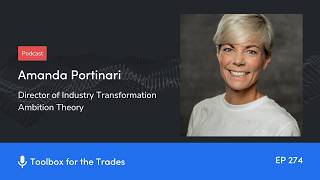
In this episode of Toolbox for the Trades, host Jackie Aubel interviews Amanda Portinari, Director of Industry Transformation at Ambition Theory. The conversation explores why the construction industry must shift from traditional mentorship to active sponsorship to retain and advance women (and all talent) in leadership roles. Amanda shares her unconventional career path, explains Ambition Theory’s focus on leadership development for construction, architecture, and engineering firms, and contrasts transformational versus transactional leadership. She details how transformational leadership—vision‑setting, empowerment, and collaborative decision‑making—drives higher engagement and retention, especially for Gen Z and women, while transactional leadership remains necessary for safety, budgets, and schedules. The discussion then moves to mentorship versus sponsorship: mentorship provides advice and preparation; sponsorship delivers exposure, opportunities, and advocacy, with sponsors having “skin in the game.” Research cited (in partnership with NCCER) shows women are mentored twice as often as they are sponsored, leading to talent loss and slower career progression. Amanda offers practical advice for individuals seeking sponsors and for leaders looking to become sponsors, emphasizing mindset shifts, intentional introductions, and integrating protégés into real work. The episode closes with a call to leaders to confront uncomfortable truths about poor leadership and to adopt sponsorship‑focused cultures to build a pipeline of diverse leaders.
Chapters
Hello contractors and welcome to Toolbox for the Trades. My name is Jackie Aubel, and today I had the pleasure of speaking with Amanda Portinari, the Director of Industry Transformation at Ambition Theory. We spoke all about how folks in the construction industry need to stop mentoring and start sponsoring to get more women in leadership positions. This was a fascinating conversation and I hope you enjoy it as much as I did. Amanda Portinari, you are the Director of Industry Transformation at Ambition Theory. We are gonna be talking about how folks can stop mentoring and start sponsoring, the leadership shift that retains women and grows whole teams. Thank you so much for joining me on Toolbox for the Trades. Welcome to the show.
Thank you for having me. I'm so excited.
I am so excited too. This is such a unique topic. But before we kick things off and get into what you do at Ambition Theory and what your mission is, I wanna start us off with an icebreaker like we always do. So you are a Canadian who spends a ton of time in El Sal. El Salvador entirely because of surfing, which I think is like the coolest thing ever. So I would love to hear what's your most memorable surfing experience?
So surfing is very interesting. I think that part of what makes it so addictive, because it's definitely addictive, is that your memorable moment, your most memorable moment, just keeps getting more memorable. It's replaced on this like very frequent basis. So you never know if a random Monday morning is going to be the surf session of your life. And I think in the grand scheme of surfing, I'm still pretty early in my career, so maybe this changes, but I don't think it does because I have listened to interviews with like big wave surfers and the kind of emotions and feelings and fears and challenges that they, they describe. I feel the same, like I can totally identify with them, but the difference is that they're having those experiences. In relation to a 60-foot wave maybe, and I'm having them in relation to a 6-foot wave or even a 6-inch wave sometimes, you know? So sure, it just keeps going and it just keeps getting better. And just when you think you've kind of, I don't know, it couldn't get any better, you unlock this new level and the hook is still there.
That is so cool. When did you start surfing?
I tried a long time ago. I lived in Australia and then Um, when I first started spending time in El Salvador, which is about, I think, 6 years ago now, is when I actually, I would say, finally progressed from beginner to being a competent surfer, which I think I'm a competent surfer now, which is pretty cool to say.
That is so cool. I, I've tried it before. I'm more of a paddleboarder myself. I do paddleboard on the ocean when I can. I absolutely love it. It is so calming and just so cool being out on the waves and just not having any devices on you and just being able to move with the water. It is so relaxing.
It's a really cool way of life, honestly. I see the sunrise most mornings. I watch the sunset almost every day. You really kind of shift your rhythms to, to follow the ocean, as cheesy as that sounds.
I know, very cheesy, but honestly, it kind of aligned with what we're talking about here. Yeah. So you actually met my colleague Josh Liu at South by Southwest a few weeks ago, Josh Lew, for folks who have not, who are, this is the first episode of Two Blocks for the Trades you've ever listened to. Josh Lew hosts our companion podcast called Mastering Service Titan, and you guys really clicked. And when he got back from Southwest, he was like, Jackie, you've got to have Amanda on the podcast because she has this whole cool thing about women in construction and how leadership style, like how to lead them. And you and I did a little talk and I was like, yep, immediately, let's have you on. But my guess is a lot of folks listening do not know what Ambition Theory is. So can you tell me a bit about it, uh, what you guys do and who you work with?
Ambition Theory is a leadership development company, and we work exclusively with the construction, architecture, and engineering sectors. And we're especially focused, like you said, on advancing women and also helping companies build workplaces where women and really everyone can thrive. We've actually, started with women, and now we do training for both men and women. And I am the Director of Industry Transformation. And so I really look at how does the work that we do with individual women and companies, how can we expand that and see shifts across the industry? How, how can that have a ripple effect? To make this an industry where, again, it's not just women, it's really those younger generations. We know the industry has a labor shortage. It's not a secret. And so how do we make this a place where people can come, grow, thrive, and stay for their whole careers?
That's awesome. And we're gonna get into it a little bit more, but while you, the work you do at Ambition Theory focused mainly on women, what you're finding is a lot of these tactics or methods of developing women in construction is applicable across all genders and has really impressive effects in cultures that implement them. Before we get into like the meat and potatoes here, I'm so fascinated about how the heck you ended up doing this work because the intersection of leadership development and construction, that's a very specific place to land. And I would love to just hear your background and how you ended up here.
The Full honest answer is it's totally by chance, but it's one of those things where now that I'm here, it totally makes sense, if that makes sense. So I've had this very winding career path. I worked in the finance department at an ophthalmology company. I was the general manager of a baking school and cake shop. I worked in advertising for several years, so I was in an agency doing content production, whatnot. Ended up burnt out, and I ended up at an organization that was doing mindfulness training for companies. Um, so for employees, it was an employee program, and I started to really think a lot about, uh, workplace culture, organizational change. And obviously, you know, what came out of that was like, it's actually really about leadership. And so whenever I met Andrea, which was just by chance— my brother, her and my brother connected I don't know how they decided they would not work together or had nothing to do. And he said, "I think you should meet my sister." And we met and we talked and I just was super intrigued with what she was doing. And I got really excited very early on because I hadn't considered what the construction industry really means and how vast it is in terms of roles and how much space there is for so many different skill sets to kind of come and thrive. So yeah, that's kind of how I got into it. And I think, you know, 4, 4 and a half years in, I think for me what keeps me is really women. You know, there's, we say this a lot, you know, it's interesting because in the construction industry, women are often the only one, you know, they're the only one on their job site, they're the only one there on their team, maybe the only one at their company. And, I have a very different experience. I am surrounded by incredible women in the industry all the time, and just to put it super simply, it's really inspiring. So, so I'm still here. Same.
And for folks who aren't aware, and you mentioned Andrea, she is the founder of Ambition Theory, correct?
Exactly.
Yeah.
So Andrea Jansen, she's the founder and CEO of the, of Ambition Theory, and she's, um, executive leadership coach and keynote speaker, etc.
Very, very cool. And you already mentioned the point that obviously I was going to mention, which is labor shortage. Since I joined ServiceTitan— oh my gosh, going— getting very close to 10 years ago, which is insane— we've been talking about this. We've been talking about this labor shortage. When I started Toolbox for the Trades in 2020, it was harder for me to find women leaders in the trades to interview. Now I have the privilege of having many different women on this show. And so it's been so cool to see a shift in real time. But that being said, there's still area for growth. So the Ambition Theory teaches transformational leadership, and you'd said that's fundamentally different with how construction companies lead today. So tell me, what's the actual difference?
Transformational leadership and transactional leadership. First of all, I think it's important to note that in the construction industry, we do need both. So transactional leadership is more of that traditional leadership style that we're most accustomed to, top-down leadership. So the leader's job is to set a direction for the team from the top down, delegate to others, supervise progress. And it really shows up in how leaders assign work, and, you know, it kind of relies on like checking in and oversight in order to kind of keep things rolling along. Whereas transformational leadership is all about inspiring others to take action. So it's about collaboration, setting a vision, getting buy-in from others on that vision, and really kind of inspiring others to contribute like at their best. And so it shows up in how leaders give people real ownership over just assigning a task, for example. It really kind of creates a sense of trust and alignment on a team, which then means that the teams can make decisions usually easier without having to escalate. And it really invests in, in the team members, and you end up with this capacity that's exponentially greater than if it's only in the leader's hands. So you have everybody's best strengths and abilities brought to the table to solve problems. And I think Actually, today, if you look at the construction companies that are thriving, they're probably the ones that have already really started to embrace these two leadership styles. But even those companies might not have started to formalize that distinction and to start recognize it and reward it. So, we don't see those skills on a performance review, for example, like inspiring others necessarily. And Sometimes people think of it as kind of like fluffy type things, but we see it play out in very concrete ways where clients give a company the next project without putting it out to bid, and their only request is that the original project manager is the lead again on the project. Like when you bring that kind of style, and it's not just internal, it's how you do business with others, it really makes a difference.
So I want to explain how I'm understanding it based on our chat to make sure that my listeners are also on board here. So transactional leadership, which is this standard style of leadership, is very much about delegation. It's about top-down. I'm the person in charge, right? It's kind of hierarchical, and this is how everyone's gonna do the job versus transformational leadership is inspirational and it empowers the folks, um, lower down in a more traditional ladder, right, to take action and to make changes without necessarily having to escalate every blip or, uh, obstacle.
Yeah, and I think, you know, we can see where those two leadership styles come into play. Like, there are budgets that need to be maintained, there are timelines that need to be adhered to, there are safety protocols that actually just need to be followed to the letter. Like, it's very important. So that's where transactional leadership is very effective. Where transformational leadership can really make a difference is when, especially when we're seeing maybe problems that we haven't faced before, um, where innovation is really crucial or relationship building is going to be fundamental. Um, where we see it play out a lot of times where a client relationship has sort of broken down. And the transactional approach would be like just about bottom line, maybe dollars, where the transformational approach is coming at things with more of a curious lens and asking questions and really seeking solutions. And what's that win-win solution? And it tends to have this outcome that you, you wouldn't have figured out if you were just like, oh, this is the way to do it, this is how we've always done it.
Yeah, I know that in other research that has been done, they connect leadership style directly to retention, which kind of makes sense to me. Like, if you are in a role, um, and instead of being told what to do constantly, you're being encouraged to come up with your own solutions, obviously you're going to be more engaged in a role and you're going to be more invested in a role versus if you're just executing based on what someone's telling you. I would love it if you could expand on that a little bit and maybe even tell some stories that you've heard from women in construction about how this leadership style can really make a difference.
You know, it's not probably not the first time you've heard, like, people leave bosses, not jobs. And I think that extends to culture as well. People don't necessarily leave the job. Maybe it's the environment around them that isn't quite supporting, supporting them. And one thing that we, we've seen and that we think about a lot these days is that next generation, right? So transformational leadership, women tend to veer more towards the transformational leadership style, and men tend to veer more towards transactional. It's not hard and fast. Obviously, there are men who are transformational leaders, women who are transactional leaders, but kind of as a general rule, that, you know, tends to be what happens. So Since this industry has been so heavily dominated by men for so long, the leadership style that's mostly rewarded is that transactional piece. And we actually see a lot of women who come through our training don't even recognize themselves as leaders before they take the training because they don't see that skillset that they're bringing to the table as leadership because they haven't seen it before. When people find out that, oh, this is actually leadership and it helps me influence decisions and influence others, which is very helpful internally and externally, it's helpful when a problem arises, they can harness those and start to advocate for themselves and speak up a little bit. And we say this, I say it's silly but true, but if you want more women in leadership, you need more women in leadership. There's also research to show that when you have more women at the top, you have more women coming through and you have more women staying. There's research to show that actually one of the most effective ways to retain that, the next generation of workers, is through transformational leadership, because we know that Gen Z on down, uh, really value transparency. They value meaning. They care about where they work, they care about what the companies they work for stand for. It doesn't mean that they all have to be saving the world. It's just they wanna see the big picture. They wanna be brought into the vision. Something that came to mind when you were talking just around how do people feel in that moment, I think that the thing is when you're inviting people to take ownership and bring in their own thoughts and hone their skills and bring their strengths to the table, what you're actually doing is developing your own company's leadership pipeline. So, long before someone is holding a leadership title, they're exhibiting leadership actions and skills, and they're able to influence those decisions. And I think that that's a big shift, and that's where you start to see this kind of ripple effect of transformational leadership.
Very, very cool. You make a distinction that I think a lot of people in the trades um, haven't fully stopped to consider. I never stopped to consider this until you brought it to my attention. It's this idea of sponsorship versus mentorship. Talk to me about the difference.
One of the things to note is actually we talk about these two things and we call them both mentorship, but there is a distinction, and it's quite important because one of them leads to career advancement much faster and more consistently than the other one. So the simplest distinction I think is to think about mentorship as advice and preparation, and sponsorship is exposure and opportunities. And what we see is that women are typically mentored and men are typically sponsored. And how this plays out in real life, you get a mentor and you meet with your mentor and they offer some advice on how they learned a specific skill set. Maybe they suggest some books to read. Maybe they say you should try to meet with these people, whatnot. Versus sponsorship would be, oh, you know, if you really want to get to the next level of leadership here, you need to know more about business development. I'm meeting with our director of business development next week. Why don't you join me for that meeting? And then the person joins the meeting, and they meet the director of business development, and they say, you know, this is what I'm doing. I'm trying to advance my career. And the director of business development says, hey, you know, we have a client presentation next week. Why don't you come and present a few slides? I'll be there, so if anything goes wrong, I can jump in, but I think it would be great experience. And you can see right away, you know, that expo—
those—
that exposure and those opportunities just inevitably lead to faster advancement. It's just versus having to kind of take away what you were told and figure out, how do I now turn this into something? The idea is to prepare. We want to prepare women. We want them to be able to knock it out of the park when the opportunity does come knocking. And I remember there's an executive that I spoke to. We were prepping him for, um, we were doing a panel, an internal panel showcasing this really great success story of a sponsorship. He had a woman working under him. She was great. He didn't have any criticisms. She was doing her job. And then he listened, I think, to one of our podcast episodes, and he was like, oh my gosh, you know, if a man was in this role, I would've taken a really different approach. I probably would've taken more of a sink or swim approach. Not without assistance, but just sort of throwing someone in. And he's like, you know, and then I realized I hadn't even asked this woman if she liked water. And he started showing up differently. And quite simply, actually, he just invited her to things to start. And she said yes. And then as that relationship developed, more trust was built. And then he started presenting her with opportunities Do you want to take the lead on this? Would you like to do this? And she just kept saying yes. And in very many cases, he said, honestly, she was much better at certain things, networking or relationship building, than he had been. What ended up happening is actually they both advanced because he was able to spend more time on sort of higher-level tasks and focused on, you know, bigger picture things. and she was taking other things off of his plate and continuing to, you know, get more exposure, more opportunities, build those relationships. So yeah, it really shifted things for them. And we've done two research studies with the mouthful, National Center for Construction Education and Research, NCCER. And one, you know, I really, it was anecdotally, so the qualitative responses. So we asked women what kind of support they wanted to advance their careers, and they would say things like, "I want to do bigger work," and, you know, "Sometimes as a woman, I feel like I'm put on the smaller tasks or I'm not given the chance to work with heavier materials or on bigger jobs." They would say, "I want to attend the same meetings as my male colleagues. I want to be introduced to the right people and supported in building those relationships. And they're identifying sponsorship behavior. They might not have called it that, but that's what that is. I want exposure and opportunities. I want the chance to show what I've got. I want the chance to expand what I can already do. And to be able to do that, I need the introductions. I need to be on bigger projects. I need to have those opportunities.
I totally feel that. The thing I want to say, uh, is that I wonder if subconsciously folks tend to shelter women a little bit more just based on like standard gender stereotypes. You're nodding for anyone who's just listening and not watching on YouTube. But, uh, that is my guess as to why that— it sounds like it's really an unconscious bias.
Yeah, I, I think definitely that's the case. And even just anecdotally, like with the men that we speak to It's so often they actually want to support the women on their team, and then they learn this information and they're like, oh my gosh, I actually think that unintentionally, in a way that I thought I was supporting, I may have been holding this person back, right?
So, yeah, I can totally relate that to my, to moments in my own career where I've wanted to get put in, in bigger rooms or be exposed to folks who are making bigger decisions. and a well-intending manager is like, well, no, I know you're really busy, so I'm gonna keep you away from that. It's like, yeah, but you're kind of impacting my ability to grow, um, which is one of the reasons why I, I, because I have personal experience here and the stuff that you're talking about, and which is why I was so happy to have you come on and, and talk about this. So your research found that women are sponsored half as often as they're mentored. I'm pretty sure I know the answer to this, but I, well, let's just, let's make it really clear. What's the real consequence of that gap?
There is a lot of research aside from ours that shows that sponsorship definitely is more effective at advancing women's careers. So we're losing talent. We're, we're seeing people, um, walk out the door. What I think it really does— so, you know, before we did that research and found out that women truly were being sponsored much less than they were mentored, because we we knew that, but we didn't know-know it, and now we know-know it. I think it really uncovers the next phase of the work that we need to do in this industry. So it's not to say that, oh, we're going to stop workforce development or that we can't— we can stop recruiting. We obviously need to continue full throttle with all of that stuff. But I do think that we need to start talking about what happens after we bring people into the industry. That's women and anyone, frankly. And so Our research shows that women want to lead. So I think like 87% of women say that they want to be in a leadership role at some point in their career. We even asked the question a second time in the follow-up report saying, do you want to advance your career, just in case leadership role didn't land? Maybe they thought CEO. 86% want to advance their careers. And the number one factor for women who have more than one year of work experience when selecting a job is a clear path to career advancement. So women want to be leaders, and they want to know that they're working somewhere where the path to leadership exists, where they can see it. So the real consequence is losing great people, um, either before they ever enter the industry or your company, if they don't see women leaders or they don't see an organization and a culture where there's a possibility, the path exists, or soon after they join because they're just not seeing the opportunities come their way that they know they need if they want to advance.
It's really, really interesting stuff. So when we first spoke, you said something that really stuck with me, which is that sponsors have skin in the game. And I think that example you gave a few minutes ago is really impactful here. Walk me through what that means in practice and why it changes the equation when it comes to leadership.
This is sort of a key difference and something that's sort of nuanced and, and often missed. So when we think about mentorship relationships, especially because there's a lot of formal mentorship programs that exist out there, the relationship may have been set up through a program, right? But even when it doesn't happen that way, the mentor is giving advice, and then it's really on the mentee to take it away and go figure out what to do with it. And the mentor has really nothing to gain, and the mentee is really left sort of really trying to figure things out on their own. But like you said, in that example, when you have a sponsor and the junior person is called a protégé in that relationship, Um, so the sponsor and the protégé both have skin in the game. So when that executive started inviting this woman to attend certain meetings, uh, lead different projects, own other relationships, he really was putting his kind of neck on the line, right? If she doesn't succeed, he also looks bad. Um, but If she does, they both have this opportunity to advance, and that's really the difference. And it also, this is a small thing, but I think when you're thinking about it on an organizational level, people are really busy and having to find another time to sit and meet and talk with a mentee. I don't wanna say it's not important. I think mentorship is important for a sense of belonging and, um, to feel that you have someone you could go to if you have a question, like that kind of confidant type thing, but it's an additional thing you have to do, whereas sponsorship can just happen a little bit more naturally and in the moment.
You integrate them into your existing workflow, so they're coming into meetings, they're seeing, they're observing, and they're retaining. And it may not be in that structured 1-hour mentorship meeting, but they're being integrated into your day-to-day, and so they're kind of learning more. It's learning through osmosis. It feels like.
Yeah. And then, and it's also just around a bit around advocacy as well, right? So, you start inviting someone to those meetings and, or to participate in a different task on the job site with bigger equipment, I don't know, material. The other people around see that you have faith in this person. And they start to shift how they respond. So there's a story in our first Building Better report, and it was around networking. And so the senior man, Hal, invites his— he learns, you know, oh shoot, I'm doing this wrong. And so he invites a junior woman on his team who he had been really trying to kind of help and support her, and he invited her to a networking event, and he was like, oh my gosh, she was amazing, really quick to build relationships. So he actually started to rely on her. Sometimes he couldn't go and he would just send her in his place. And so that was amazing in and of itself. He now can spend more time doing other things. She's getting this exposure, exposure. She's honing this skill. But the thing that he was really impressed by, and maybe I think more surprised by, was actually he saw how the rest of the people on the job site were treating her. When once he had sort of— he's advocating for her, and then when she's not in the room, I think that's the other thing. It's like, who's speaking for you when you're not there? When a promotion is being tossed around, who's saying, what about this person? What about this person? And that sponsorship.
All right, I want to pivot a little bit from what we originally planned because I want to talk to people who are in leadership roles right now who are hearing this and want to take action. And then I want to talk about women who are hearing this and are saying, oh crap, yeah, that's what I want. So let's start with the women, or anyone really, because again, we're— this was coming from an area of how we can develop more women leaders, but we're also seeing that it has effects across genders. Like, this is beneficial for everyone. So if someone's listening to this show right now and they're like 'Oh my God, everything Amanda's saying is resonating with me. I want this type of sponsorship. I want to be given opportunities that are transformational.' What would you recommend they do?
This is something that we actually help women with, is like to identify who a sponsor is, because sometimes people aren't even clear. And then you probe a little bit and they're like, 'Oh well, you know, this person always asks me about this.' And, and it can start that small, you know, who is Who do you have the relationship with, and how can you start to expand that relationship? Because sponsorship is typically less formal than mentorship. It's not— you're not going to ask somebody necessarily to be your sponsor. So it's how can you build that relationship? I was interviewing some women who were going to be some guest speakers for our training program, and they were saying— one woman says, you know, I have my, I have my top 3 things that I on cue can chat about with a senior person if I happen to pass them on the job site, in the elevator, that type of thing. So starting to build those relationships and then asking. So that's a tough one, but identifying what it is you want and starting to voice that, you know, these types of opportunities, if this is coming up, please think of me, that type of thing. The other thing is to start, to start actually modeling transformational behaviors yourself. So what tends to happen is there's a ripple effect with transformational leadership. So in a transactional environment, people are always going to default to that. But as soon as you start to show up a bit differently, so that's asking more questions, bigger picture thinking, you'll see that people start to respond differently. So actually modeling the behavior that you want to see above you, start doing it yourself, actually.
So what would you say to someone who's listening now, who's in a leadership position and is like that example you gave and is like, ah, okay, noted. How do I get started? What would be some actions that they could take, like say today or this week, if they wanted to start thinking about doing this? What resources or advice would you give them?
I think it's really simple, actually. There's— it's a mindset shift. And, you know, we've said it already today in this conversation, but how can you shift from thinking about trying to prepare somebody and offer— offering them advice, and what opportunity could you give them today? What opportunity either exists already or could you create for them to start expanding their skill set, to start meeting other people, to start getting that exposure that's really required to grow. So, it's just a mindset shift. And I think that that's an, you know, one thing that's really helpful, even on an organizational level, if you have a mentorship program already, just actually explaining the difference between mentorship and sponsorship could change the trajectory of many of those relationships right away. You know, people going into their next scheduled mentorship, um, meeting, and instead of thinking about what advice they're going to give, they're like, who can I introduce you to? Who, you know, what, what are you— what, where can I bring you? What, what project do you want? You know, would you love to work on, and how could I make that happen? That can shift things pretty quickly.
I think that's awesome. All right, my final question for you, Amanda. I'm just like, my, my wheels are turning from this conversation. So I'm loving it. I hope our listeners are too. So 68% of women in one of your studies says poor leadership is what's pushing them out. What do you say to a company owner who hears that and thinks, no, that's not me?
Oof. Okay, so at Ambition Theory, we, we talk about, um, the elephant in the room. It's kind of getting comfortable with being uncomfortable. First of all, get outside the comfort zone. Know that you might find out something that you don't want to know or that you think isn't true. So there's prob— there might be those elephants that are sitting there that we haven't addressed. Recognize that it's not necessarily intentional. We operate in this world where the barriers that hold women back are systemic. You know, that doesn't mean that we don't— we all individually can't do things to Remove them. It's not, there's no pointing fingers, it's just getting curious and asking questions. You know, I think about, this is a long time ago, but a man came to a webinar that we hosted and he actually sent an email afterwards because he was so floored. He said, okay, I was, I was in sitting in this webinar. We talked about a lot of the things that we talked about here today. One of the things we talked about was the double bind, so that women are told that to get ahead they need to be more confident, and then as soon as they start acting more confident, they get feedback that they're being bossy, aggressive, or worse. So he was like, you know what, you had me until you showed me this. And I think the statistic was like 78% of women have told they need to be more confident, and 76% have told that they're too been told they're too bossy. He was like, I don't believe it. And he actually went and he asked all of the women that he worked with, have you ever been told this? And he was like, every single one of them, whether it was at their company or sometime in their career. He then was able to show up differently, you know what I mean? So I think it's, it's being open to the fact that even if you've invested a lot of time, energy, and resources already to moving things forward, there may still be other areas of opportunity. And being okay with possibly finding out something uncomfortable could be actually the thing that helps you make the shift that really changes things for not just the women in your company, but your company overall.
Let me tell you, my gears are turning. I think this is such an important conversation. And again, while I think this really impacts women, I think the lessons that you're talking about here are going to be impactful to everyone in every company ever. So, I just want to thank you for taking time out of your busy schedule, out of your surfing schedule as well, to sit down with me and talk a little bit about this. So, again, you are with Ambition Theory, so we will link some resources in our show notes and the webpage of this episode. But thank you so much for joining me on Toolbox for the Trade.
Thank you so much. It's been an Absolute pleasure.
More from Bill



ServiceTitan Virtual Agents: Simplify Before You Scale | Podcast Ep. 110 | Mastering ServiceTitan



Life After Live Events: How to Turn Post-Conference Energy into Real Profits | Podcast Ep. 297




